


 Скачать презентацию John Fowles 1926 — 2005 One of
'The Magus' made by Kat.pptx
- Количество слайдов: 15
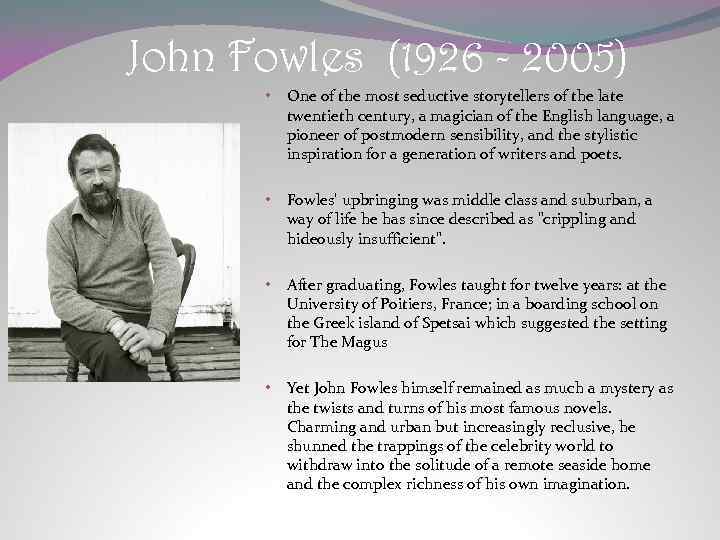 John Fowles (1926 - 2005) • One of the most seductive storytellers of the late twentieth century, a magician of the English language, a pioneer of postmodern sensibility, and the stylistic inspiration for a generation of writers and poets. • Fowles' upbringing was middle class and suburban, a way of life he has since described as "crippling and hideously insufficient". • After graduating, Fowles taught for twelve years: at the University of Poitiers, France; in a boarding school on the Greek island of Spetsai which suggested the setting for The Magus • Yet John Fowles himself remained as much a mystery as the twists and turns of his most famous novels. Charming and urban but increasingly reclusive, he shunned the trappings of the celebrity world to withdraw into the solitude of a remote seaside home and the complex richness of his own imagination.
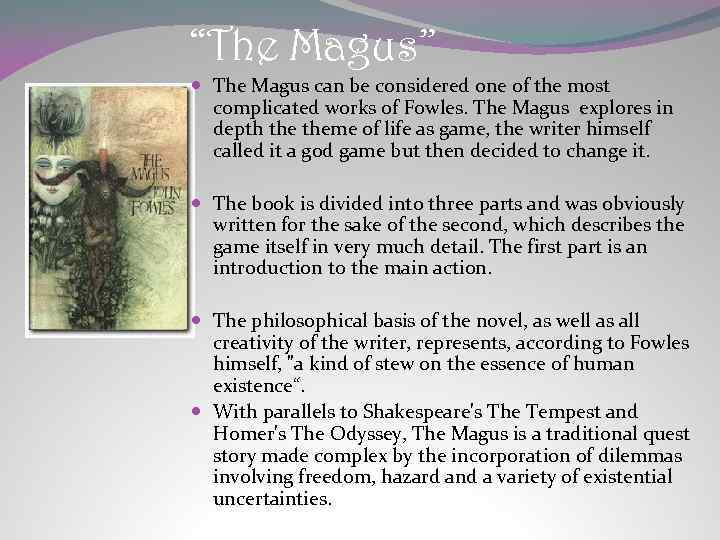 “The Magus” The Magus can be considered one of the most complicated works of Fowles. The Magus explores in depth theme of life as game, the writer himself called it a god game but then decided to change it. The book is divided into three parts and was obviously written for the sake of the second, which describes the game itself in very much detail. The first part is an introduction to the main action. The philosophical basis of the novel, as well as all creativity of the writer, represents, according to Fowles himself, "a kind of stew on the essence of human existence“. With parallels to Shakespeare's The Tempest and Homer's The Odyssey, The Magus is a traditional quest story made complex by the incorporation of dilemmas involving freedom, hazard and a variety of existential uncertainties.
 Main characters: Nicholas Urfe – The main protagonist, 25 -year-old English man who goes to Greece to teach English and one day stumbles upon the waiting room. Alison Kelly – Nicholas's girlfriend whom he abandons to go to Greece. Maurice Conchis – Wealthy intellectual who is a main player in the masques. Lily de Seitas – Young woman who is involved in the masques and with whom Nicholas falls in love. Rose de Seitas – Lily's identical twin sister round three protagonists (nicolas urfe – Maurice conchis – lily de seitas ) are developed the basic events on island. other: Joe – young black man, involved in the masques. Maria – Conchis's maid. Demetriades – Fellow teacher at the school. Lily de Seitas (older) – Lily's mother. Benji de Seitas – the older Lily de Seitas's young son. Kemp – Unmarried woman who rents Nicholas a room in London. Jojo – Young girl whom Nicholas pays to accompany him.
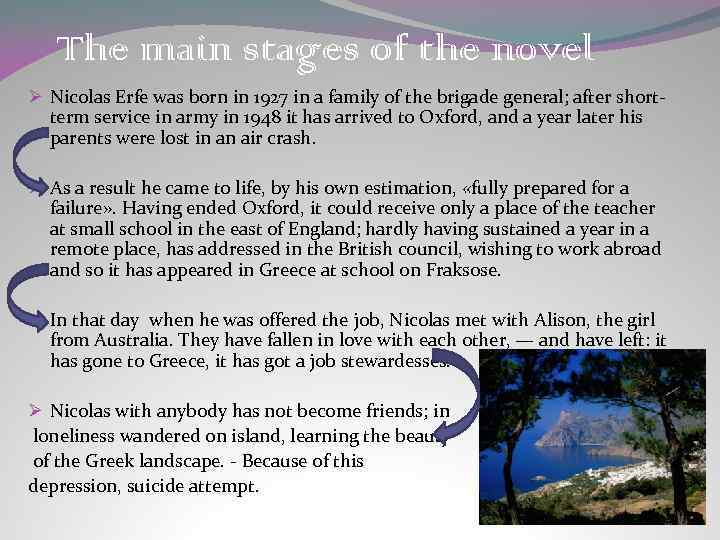 The main stages of the novel Ø Nicolas Erfe was born in 1927 in a family of the brigade general; after shortterm service in army in 1948 it has arrived to Oxford, and a year later his parents were lost in an air crash. Ø As a result he came to life, by his own estimation, «fully prepared for a failure» . Having ended Oxford, it could receive only a place of the teacher at small school in the east of England; hardly having sustained a year in a remote place, has addressed in the British council, wishing to work abroad and so it has appeared in Greece at school on Fraksose. Ø In that day when he was offered the job, Nicolas met with Alison, the girl from Australia. They have fallen in love with each other, — and have left: it has gone to Greece, it has got a job stewardesses. Ø Nicolas with anybody has not become friends; in loneliness wandered on island, learning the beauty of the Greek landscape. - Because of this depression, suicide attempt.
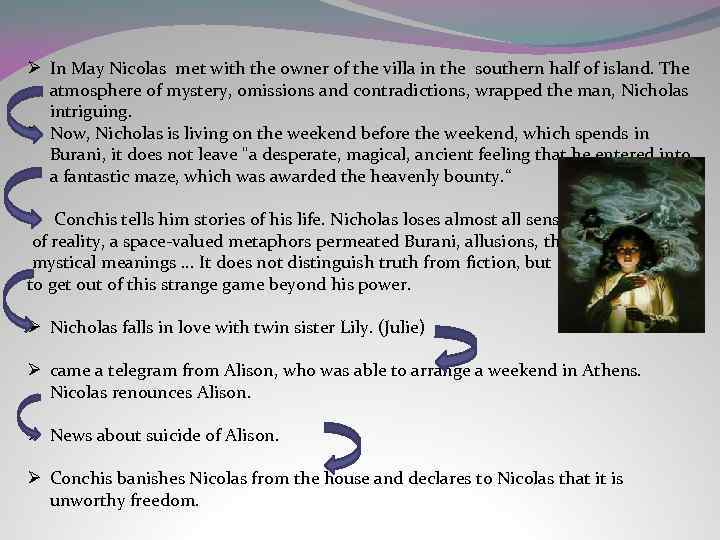 Ø In May Nicolas met with the owner of the villa in the southern half of island. The atmosphere of mystery, omissions and contradictions, wrapped the man, Nicholas intriguing. Ø Now, Nicholas is living on the weekend before the weekend, which spends in Burani, it does not leave "a desperate, magical, ancient feeling that he entered into a fantastic maze, which was awarded the heavenly bounty. “ Ø Conchis tells him stories of his life. Nicholas loses almost all sense of reality, a space-valued metaphors permeated Burani, allusions, the mystical meanings. . . It does not distinguish truth from fiction, but to get out of this strange game beyond his power. Ø Nicholas falls in love with twin sister Lily. (Julie) Ø came a telegram from Alison, who was able to arrange a weekend in Athens. Nicolas renounces Alison. Ø News about suicide of Alison. Ø Conchis banishes Nicolas from the house and declares to Nicolas that it is unworthy freedom.
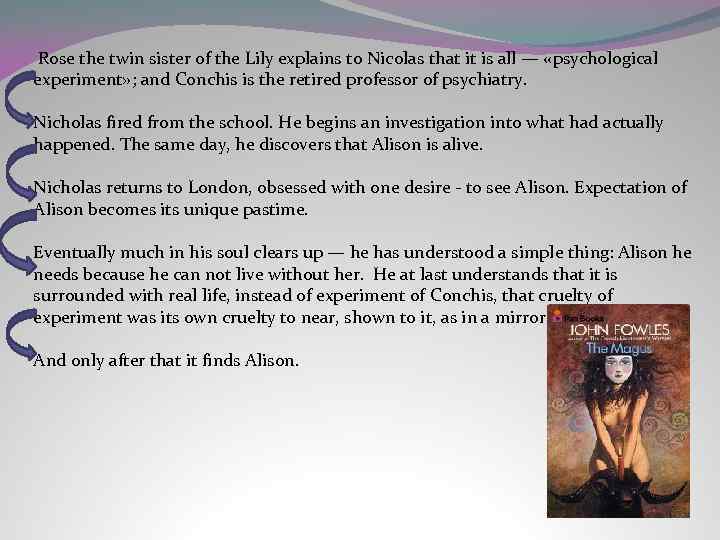 Rose the twin sister of the Lily explains to Nicolas that it is all — «psychological experiment» ; and Conchis is the retired professor of psychiatry. Nicholas fired from the school. He begins an investigation into what had actually happened. The same day, he discovers that Alison is alive. Nicholas returns to London, obsessed with one desire - to see Alison. Expectation of Alison becomes its unique pastime. Eventually much in his soul clears up — he has understood a simple thing: Alison he needs because he can not live without her. He at last understands that it is surrounded with real life, instead of experiment of Conchis, that cruelty of experiment was its own cruelty to near, shown to it, as in a mirror … And only after that it finds Alison.
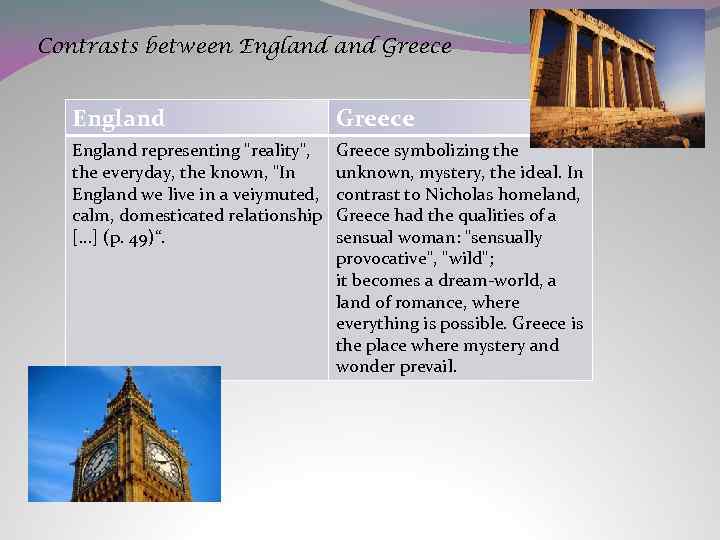 Contrasts between England Greece England representing "reality", the everyday, the known, "In England we live in a veiymuted, calm, domesticated relationship [. . . ] (p. 49)“. Greece symbolizing the unknown, mystery, the ideal. In contrast to Nicholas homeland, Greece had the qualities of a sensual woman: "sensually provocative", "wild"; it becomes a dream-world, a land of romance, where everything is possible. Greece is the place where mystery and wonder prevail.
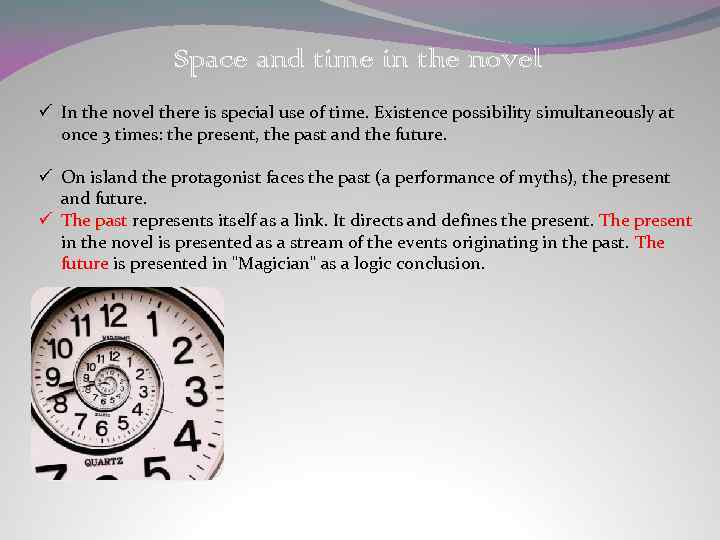 Space and time in the novel ü In the novel there is special use of time. Existence possibility simultaneously at once 3 times: the present, the past and the future. ü On island the protagonist faces the past (a performance of myths), the present and future. ü The past represents itself as a link. It directs and defines the present. The present in the novel is presented as a stream of the events originating in the past. The future is presented in "Magician" as a logic conclusion.
 Nicholas Urfe As it is usual for Fowles the main character Nicholas Urfe as “a typical Englishman” with a college education, actually he is a graduate from Oxford where he played into social elite clubs, existentialism, etc. Fowles painted a very good portrait of a selfish and conceited man who cannot see beyond his nose but thinks he is very smart. Naturally he is not satisfied with life, the work of a teacher does not please him and he decides to go to Greece to be a teacher there (as though the change of the scenery will change his inner landscape).
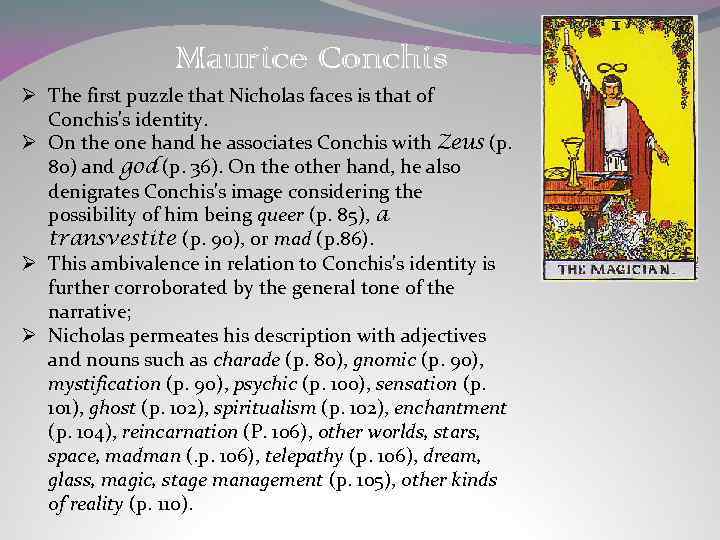 Maurice Conchis Ø The first puzzle that Nicholas faces is that of Conchis's identity. Ø On the one hand he associates Conchis with Zeus (p. 80) and god (p. 36). On the other hand, he also denigrates Conchis's image considering the possibility of him being queer (p. 85), a transvestite (p. 90), or mad (p. 86). Ø This ambivalence in relation to Conchis's identity is further corroborated by the general tone of the narrative; Ø Nicholas permeates his description with adjectives and nouns such as charade (p. 80), gnomic (p. 90), mystification (p. 90), psychic (p. 100), sensation (p. 101), ghost (p. 102), spiritualism (p. 102), enchantment (p. 104), reincarnation (P. 106), other worlds, stars, space, madman (. p. 106), telepathy (p. 106), dream, glass, magic, stage management (p. 105), other kinds of reality (p. 110).
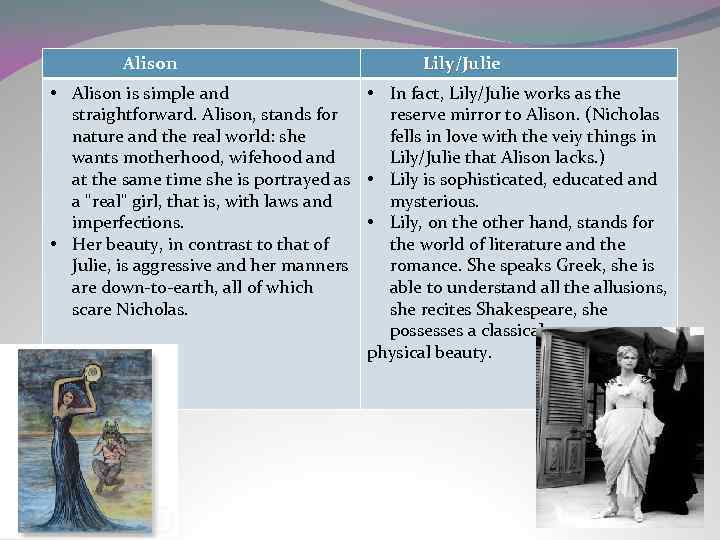 Alison Lily/Julie • Alison is simple and • In fact, Lily/Julie works as the straightforward. Alison, stands for reserve mirror to Alison. (Nicholas nature and the real world: she fells in love with the veiy things in wants motherhood, wifehood and Lily/Julie that Alison lacks. ) at the same time she is portrayed as • Lily is sophisticated, educated and a "real" girl, that is, with laws and mysterious. imperfections. • Lily, on the other hand, stands for • Her beauty, in contrast to that of the world of literature and the Julie, is aggressive and her manners romance. She speaks Greek, she is are down-to-earth, all of which able to understand all the allusions, scare Nicholas. she recites Shakespeare, she possesses a classical physical beauty.
 Themes Freedom and Choice: This is the novel's core theme, both evoked and specifically defined at three principal points. These are the climax of Conchis' story of his experiences during the Nazi occupation of World War II, the climax of Nicholas' trial when he is presented with the opportunity to punish Lily, and in the book's final moments, in which he forces Alison into a position similar to the one he experienced on the previous two occasions. In all three of these instances, the choices made by the characters are portrayed as embodying an ideal, and, therefore, also embody the book's main thematic point - that ultimate freedom lies in the ability to choose, and the ultimate choice is freedom. Forced choice is not freedom, and where there is no freedom there can be no choice. Themes of Love and Loss: Nicholas had met a beautiful, intelligent, and witty woman at the novel's first party, only to leave her for Greece on a whim we are at first unable to understand. Fowles describes the scene just after they settle down for the first month: "The bedroom air seemed full of unspoken words, unformulated guilts, a vicious silence, like the moments before a bridge collapses. We lay side by side, untouching, effigies on a bed turned tomb; sickeningly afraid to say what we really thought. "
 Sense of human life - The basic aspect of the novel is search of answers to "eternal" questions on the purpose and sense of human life. In the novel Moris Konchis becomes this selector. It, having found a certain law in decoding of secret codes of life, now checks it in practice and various people. Experimental there is also Nicolas Erfe. Thanking Konchisu Nicolas comes nearer to knowledge of, to learn to be oneself, instead of to play a certain social role. Having passed numerous tests, it safely faces the truth; Nicolas is ready for real life.
 THE ISSUE OF ILLUSION AND REALITY • Nicholas, in Bourani experiences the inversion of reality, that is, the "real" becomes "unreal" and the "unreal" becomes "real". • First, he meets a man who wears many different masks: he can be a teacher, a magician, a therapist, a tyrant. Then, he falls in love with Lily, alias Julie, an actress who plays diverse roles: she is a nineteenth century Victorian girl, a prude twentieth century Cambridge graduate. In fact, Lily/Julie works as the reserve mirror to Alison, Nicholas's Australian girlfriend. • Nicholas, has thus a certain awareness that he is a character manipulated by his "author", Conchis, who cunningly manages to make him play the roles he stipulates. • Therefore, the reader is all the time invited to make associations between the fictional world and the real world of writing.
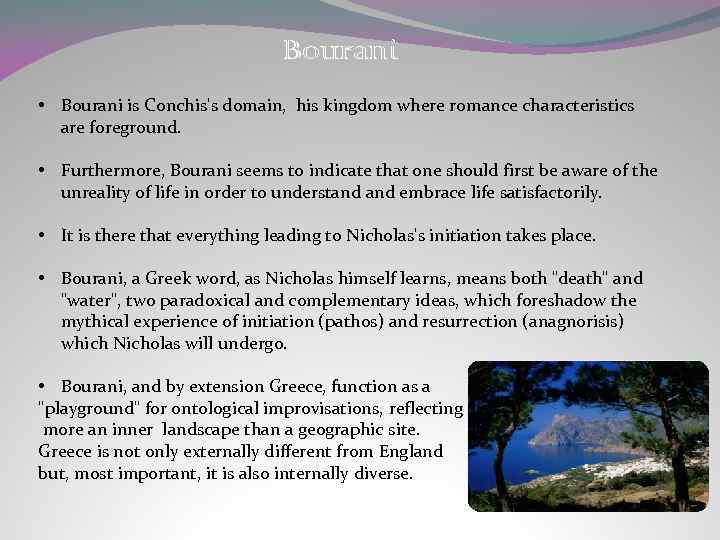 Bourani • Bourani is Conchis's domain, his kingdom where romance characteristics are foreground. • Furthermore, Bourani seems to indicate that one should first be aware of the unreality of life in order to understand embrace life satisfactorily. • It is there that everything leading to Nicholas's initiation takes place. • Bourani, a Greek word, as Nicholas himself learns, means both "death" and "water", two paradoxical and complementary ideas, which foreshadow the mythical experience of initiation (pathos) and resurrection (anagnorisis) which Nicholas will undergo. • Bourani, and by extension Greece, function as a "playground" for ontological improvisations, reflecting more an inner landscape than a geographic site. Greece is not only externally different from England but, most important, it is also internally diverse.