


 Скачать презентацию Jewish history of Romania Among the most popular
ba431fc8380b81c380c412e46271c7cf.ppt
- Количество слайдов: 19
 Jewish history of Romania Among the most popular Yiddish hits in America was one which reminisced about life in the old country: "Romania, Romania!" Written by Aaron Lebedeff, a star of the Yiddish stage, "Romania" remains a beloved hit. Throughout the Diaspora, despite the bitter hardships to which Jews were subject, they could still be sentimental about their old homes. "Once there was a beautiful land. Romania! Life was so good! No cares, just wine, mamaligeh (Romanian porridge), beautiful girls, and merriment!"
 Jewish history of Romania • Romania is a country with a rich Jewish Heritage. The first Jews are believed to have arrived along with the Roman legions who invaded Dacia (today's Romania) in 101 AD. During the Middle Ages, Jewish immigrants began settling in Wallachia and Moldova. By the early 16 th Century, their numbers once again swelled by the arrival of immigrants (Ashkenazim Jews) fleeing persecution in Poland Ukraine. During the next two centuries the Romanian Jewish Community evolved into a prosperous middle class in charge of much of the country's trade. The modern history of Romania's Jews mirrors the experience of other European Jewish communities; a dynamic cultural and spiritual life in the face of recurrent periods of anti-Semitism. After 1948 emigration to Israel and other countries significantly reduced the number of Jews living in Romania.
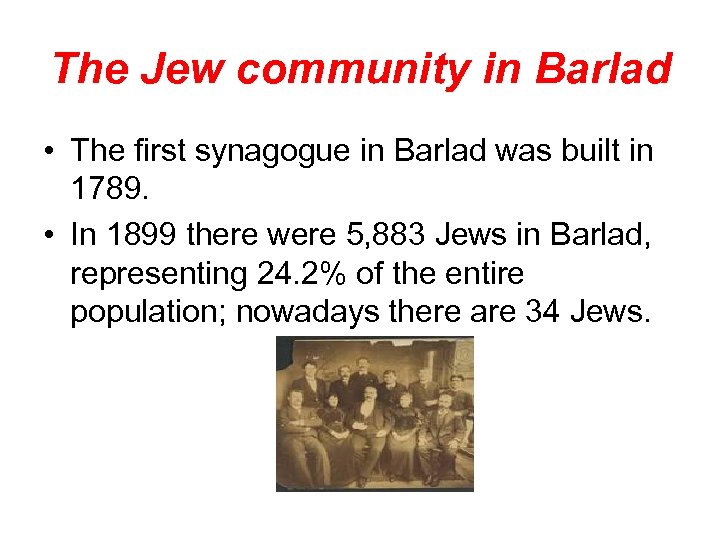 The Jew community in Barlad • The first synagogue in Barlad was built in 1789. • In 1899 there were 5, 883 Jews in Barlad, representing 24. 2% of the entire population; nowadays there are 34 Jews.
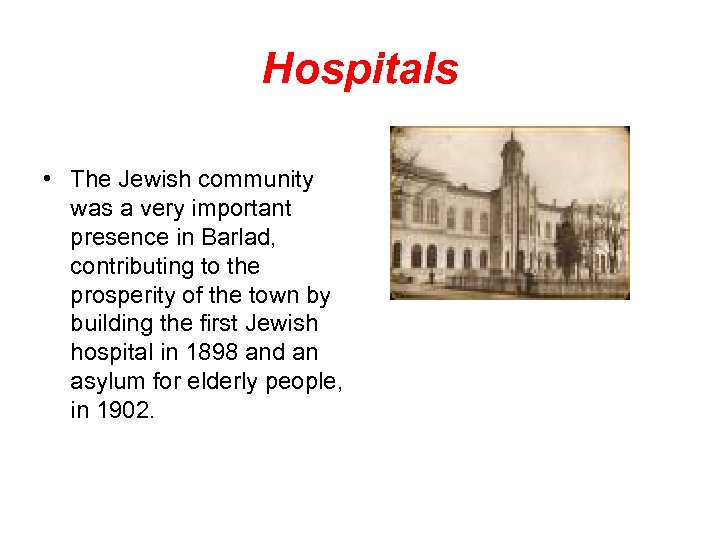 Hospitals • The Jewish community was a very important presence in Barlad, contributing to the prosperity of the town by building the first Jewish hospital in 1898 and an asylum for elderly people, in 1902.
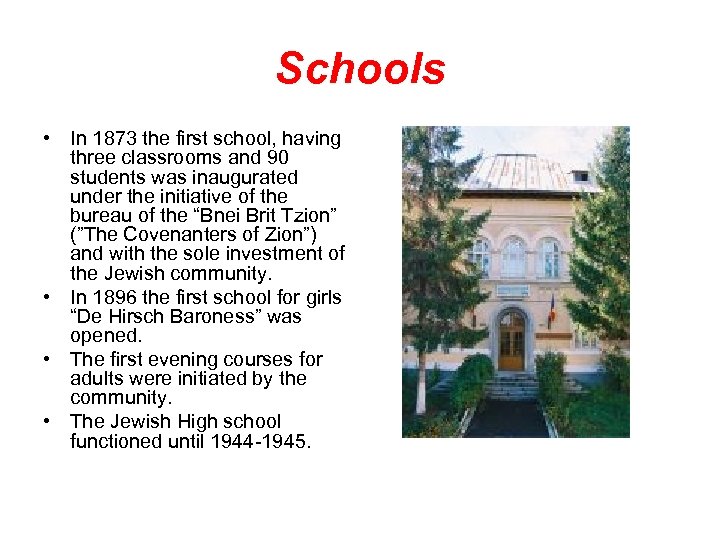 Schools • In 1873 the first school, having three classrooms and 90 students was inaugurated under the initiative of the bureau of the “Bnei Brit Tzion” (”The Covenanters of Zion”) and with the sole investment of the Jewish community. • In 1896 the first school for girls “De Hirsch Baroness” was opened. • The first evening courses for adults were initiated by the community. • The Jewish High school functioned until 1944 -1945.
 Personalities • Some of the most reputed teachers of the town were of Jewish origin, for example Ioan Barbalat, teacher of mathematics with studies at Sorbonne. • Virgil Duda (Leibovici Rubin ) is a well known writer who says in memories about his hometown: " For me it (Barlad) has remained the center of the Universe”.
 Personalities • Radu Nichita Rapaport is known for having translated Shakespeare. • A. Axelrad, poet, began his literary activities under the influence of “The Emigration on Foot” • Marcel Saragea is considered the father of physiopathology in Romanian medical schools. • David Solomonovici-painter • Shimon Rubinstein-historian
 Members of the Romanian Academy • Martin Bercovici- Energetic engineering • Barbu Zaharescu (Bercu Zukerman)-Social sciences • Marcel Saragea-honorary member of the Academy for Medical Sciences • Professor Dr. Miron Segall-Medical Sciences • Professor Dr. Paul Pruteanu (Pincu Solomonovici)-Researcher in the past of the Moldavian medicine
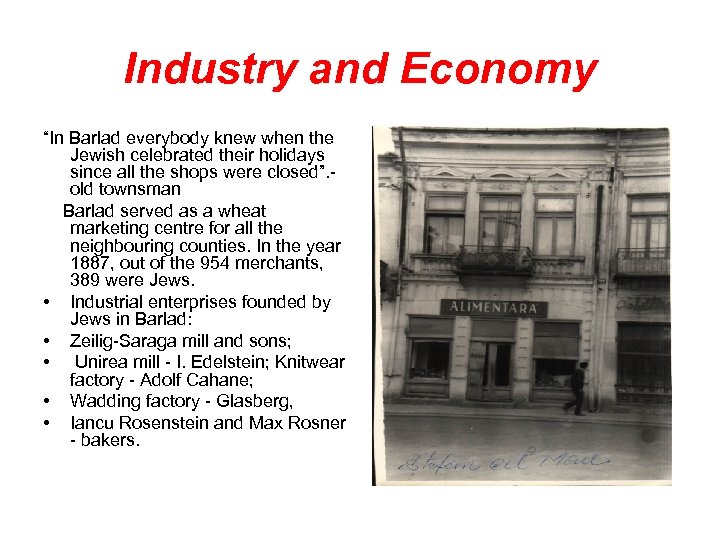 Industry and Economy “In Barlad everybody knew when the Jewish celebrated their holidays since all the shops were closed”. old townsman Barlad served as a wheat marketing centre for all the neighbouring counties. In the year 1887, out of the 954 merchants, 389 were Jews. • Industrial enterprises founded by Jews in Barlad: • Zeilig-Saraga mill and sons; • Unirea mill - I. Edelstein; Knitwear factory - Adolf Cahane; • Wadding factory - Glasberg, • Iancu Rosenstein and Max Rosner - bakers.
 Mass media • • 1899 - "Aurora Tionista", weekly, there were edited only 16 editions. The founder was Sigismund Gross. The Barlad newspaper tends "to elevate the prestige of the Jewish people towards itself and towards the people with whom it lives" (S. Podoleanu, "Istoria presei evreiesti in Romania"). Here made his debut A. Axelrad with a poem titled "In sant" (1917), an appeal to the naturalization of the Jews. In the pages of this magazine was promoted the idea of returning to Eretz Israel even "by foot immigration". 1913 -1915, 1919 - "Bar Kochba" magazine ("Fiul Stelei"), "Revista nationalevreiasca", monthly, 16 pages, director Achile M. Finkelstein. In its opening speech, it is reaffirmed the fact that the orientation of the magazine is "in the sense of the modern Zionist ideas". July 16, 1900 - the feminist magazine "Bas Ami" (editor Dr. Herscu Fridman), just one edition, published by the women immigrants; May 18, 1900 - "Jidovul ratacitor", four pages, published by "pedestrian Jewish immigrants"; 1900 - "Drumetii", Gross Typography; May 18 -20, 1900 "Emigrantii", "Lacrimi de despartire". "Traiasca Romania", publication of the immigrants from Barlad.
 Mass media • • • I. SCHECHTER Editor for "Viata noastra" and editor-in-chief for "Izvoare", first editor at "Ultima ora". He was laureate of the Zion Price for literature. He was member of the Association of the Israeli Writers of Romanian Language. "The satire doesn't correct the customs, but it denounces them and makes fun of them… the villains are incurable". … Here are their "Ten Commandments"… Ten Commandments I. Do not kill continuously. II. Do not steal in all foolishness. III. Do not endorse. IV. Be watchful in your sleep. V. Do not regret the crimes before committing them. VI. Do not be afraid to compromise yourself. VII. Be what you seem. VIII. Do otherwise. IX. Honor the ones who pay for it. X. Kiss yourself.
 Persecution: • In the year 1867 the Christians brought a libel against the Jews in Barlad accusing them of killing a monk. The rabble fell upon Jewish homes. The government ordered an investigation into the matter, and the Minister of the Interior announced in parliament that the Jews were at fault in this incident. • In 1868 another riot occurred because of the feud between a Greek and a Jew. In the year 1870 the French consul protested against the persecution of the Jews in Barlad and demanded intervention by the responsible world powers. • In the year 1886 a new wave of persecution occurred which brought about the beginnings of Jewish emigration out of the city.
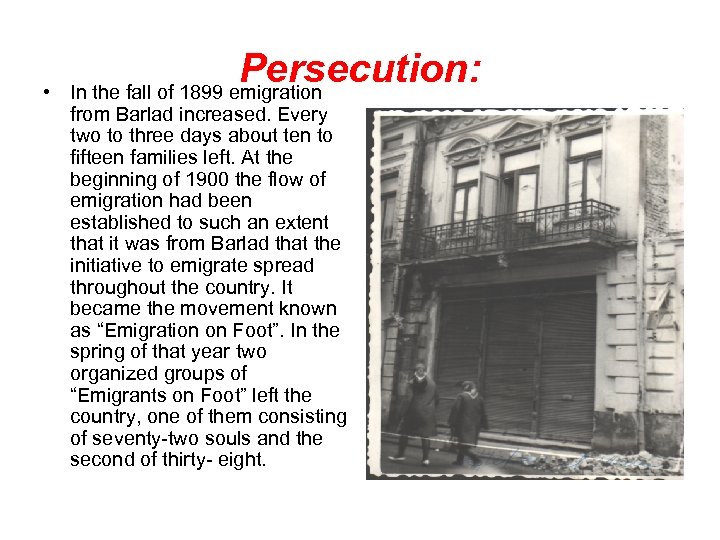 • Persecution: In the fall of 1899 emigration from Barlad increased. Every two to three days about ten to fifteen families left. At the beginning of 1900 the flow of emigration had been established to such an extent that it was from Barlad that the initiative to emigrate spread throughout the country. It became the movement known as “Emigration on Foot”. In the spring of that year two organized groups of “Emigrants on Foot” left the country, one of them consisting of seventy-two souls and the second of thirty- eight.
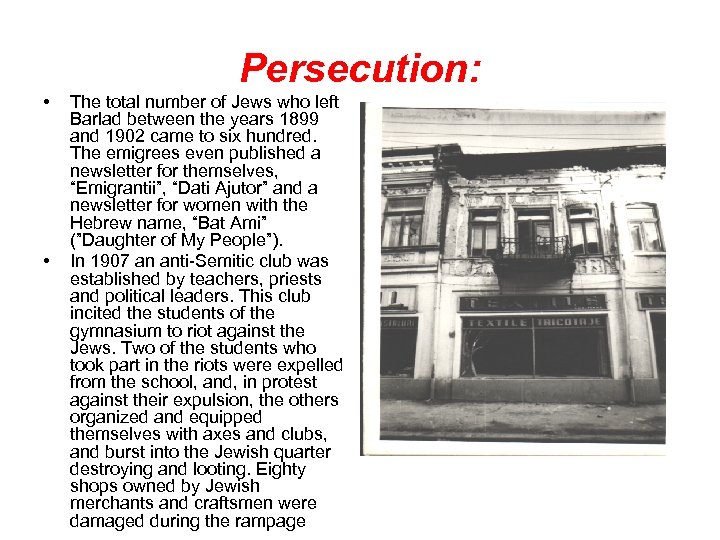 Persecution: • • The total number of Jews who left Barlad between the years 1899 and 1902 came to six hundred. The emigrees even published a newsletter for themselves, “Emigrantii”, “Dati Ajutor” and a newsletter for women with the Hebrew name, “Bat Ami” (”Daughter of My People”). In 1907 an anti-Semitic club was established by teachers, priests and political leaders. This club incited the students of the gymnasium to riot against the Jews. Two of the students who took part in the riots were expelled from the school, and, in protest against their expulsion, the others organized and equipped themselves with axes and clubs, and burst into the Jewish quarter destroying and looting. Eighty shops owned by Jewish merchants and craftsmen were damaged during the rampage
 Persecution • In the period between the two world wars Barlad was a center of pogroms. The Christian teachers in the government gymnasium, headed by the school principal Cezar Ursu, , used to regularly incite the students against the Jews. Their pogroms increased when the students in the Romanian universities began to demand a “numerus clausus” against Jews. Whenever the Jewish youth had any kind of cultural event, they used to organize anti-Semitic demonstrations.
 During the Holocaust • The sufferings of the local Jews increased during the days of the terror of the “Iron Guard”. In November 1940, Jewish males were taken forced labor. After a short time the academics among them were let go. This was the result of protests from the Romanian academic community, who threatened that they too would come to work together with their Jewish colleagues. Four Jewish students were arrested and convicted of promulgating Communist opinions. They were tortured in order to extract their confessions. At the trial, which took place on November 19 th, 1940, they were acquitted. • With the outbreak of war between Romania and the Soviet Union in June of 1941, all the Jews from the villages of the county were deported into Barlad. In the spring of 1943 the hospital, the old folk's home and the bath-house were confiscated by the “National Centre for Romanization”.
 During the Holocaust • With their retreat from the advancing Red Army, the Al German forces under the command of General Woehler came into Barlad. The general suggested exterminating all the Jews of the place under the pretext that the Jews were trying to trade with his soldiers. Only the developments on the front, which were to the disadvantage of the Germans, spoiled this plan. Four Jews of Barlad, who were suspected of being Communists, were exiled to the camp at Vapniarca. They returned some time later. • After the war, life returned to normality, and the community continued its regular activities. • The chief of police in the time of the Holocaust, Ion Hagiu, who persecuted the Jews during his tenure, was sentenced in 1949 to three years in prison.
 The Jewish community nowadays • Nowadays only a few Jewish families live in Barlad (34, most of which old people). • The old synagogue was destroyed in the communist era. There is now a prayer house where the small community gathers every Sunday. • The Jewish cemetery, built in 1845 can still be visited. • The museum in Barlad houses the impressive collection of furniture belonging to Dr. Wainfeld. • The president of the community is Mr. Bernat User, born in 1927.
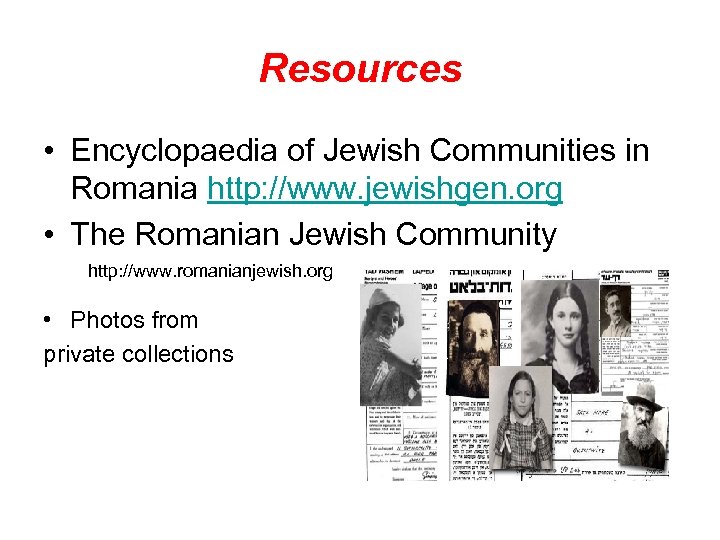 Resources • Encyclopaedia of Jewish Communities in Romania http: //www. jewishgen. org • The Romanian Jewish Community http: //www. romanianjewish. org • Photos from private collections