


 Скачать презентацию JEREMIAH Jeremiah was primarily a
214f1acf0ff033f65754cc76657c3eb1.ppt
- Количество слайдов: 73
 JEREMIAH
 • Jeremiah was primarily a prophet to the Southern Kingdom (Judah) and his prophetic ministry lasted from about 627 -585 B. C (ref Jer. 25: 3). • Thus, Jeremiah prophesied for 40+ years, ministering from the reign of the last good king of Judah, Josiah, to the final destruction of the city of Jerusalem. • Interestingly, God did not allow Jeremiah to take a wife or have children (16: 1 -4).
 • The first chapter tells us he came from the priestly class, and was the son of Hilkiah. • We do not know if this is the same Hilkiah recorded in 2 Kings 22 and 2 Chron 35, who during Josiah’s reign, found the book of the Law, and oversaw the reinstatement of the Passover. • His hometown, Anathoth, was a Levitical town (Joshua 21: 18), given to the sons of Aaron. • Jeremiah lived about a century after Isaiah and began prophesying almost immediately after the ministry of Zephaniah • Isaiah's ministry saw Jerusalem's deliverance from the Assyrians (Isaiah 37: 36 -37), while Jeremiah's saw its destruction by the Babylonians (Jeremiah 39: 1 -10) • Why a shift in regional power? ?
 • Politically, the region in the interval between the preaching of Isaiah and Jeremiah went through tremendous changes as the Assyrian Empire waned and Egypt, Babylon, the Medes, and Persia, all tried to grab the remains of the Assyrian Empire. • The Assyrian empire begin to crumble when Ashurbanipal died in 633 BC. The sons of Ashurbanipal battled for the throne, causing the empire to be thrown into internal turmoil. The empire was split in two as a result, with one son ruling in Nineveh and another in Harran.
 • Babylon used this Assyrian civil war as a chance to conquer the Assyrian empire. Nebopollaser of Chaldea seized power in Babylon and after allying himself with Persia, he conquered Nineveh in 612 BC and Harran in 610 BC. • Egypt saw the balance of power shifting from Assyria to Babylon and launched a campaign to stop the Babylonians. King Josiah foolishly tried to engage the Egyptians under Pharaoh Neco as they passed through Judah, but was killed in battle. • Then, in a dramatic battle that set the course of history for centuries to come, Nebopollaser’s son, Nebuchadnezzar, defeated the Egyptians in the battle of Carchemish in 605 BC.
 • After the battle of Carchemish, which ended Egypt’s domination over Judah, Nebuchadnezzar entered Jerusalem, made Jehoiakim a vassal, and took many of the Jewish nobles (including Daniel and his three friends) to Babylon. • Jehoiakim reigned a total of 11 years (2 Chron 36: 5 -7) but rebelled against Babylon and was deposed by Nebuchadnezzer. His son, Jehoiachin reigned for 3 months before Nebuchadnezzar retook Jerusalem, deporting young Jehoiachin and placing Zedekiah on the throne as his vassal. (2 Kings 24: 8 -16) • Zedekiah reigned for 11 years, until he too rebelled against Babylon, looking to Egypt for help. Egypt never came to help, and this time Nebuchadnezzer destroyed Jerusalem, including the temple and hauling off the rest of the Jews to Babylon (586 BC).
 Theme and purpose • The Book of Jeremiah is primarily a message of judgment on Judah for rampant idolatry and iniquity (Jeremiah 7: 3034; 16: 10 -13; 22: 9; 32: 29; 44: 2 -3). After the death of King Josiah, the last righteous king, the nation of Judah had almost completely abandoned God and His commandments. Jeremiah compares Judah to a prostitute (Jeremiah 2: 20; 3: 1 -3). God had promised that He would judge idolatry most severely (Leviticus 26: 31 -33; Deuteronomy 28: 49 -68). Jeremiah was warning Judah that God’s judgment was at hand. God had delivered Judah from destruction on countless occasions, but His mercy was at its end. • Jeremiah records King Nebuchadnezzar conquering Judah and making it subject to him (Jeremiah 24: 1). After further rebellion, God brought Nebuchadnezzar and the Babylonian armies back to destroy and desolate Judah and Jerusalem (Jeremiah chapter 52). Yet, even in this most severe judgment, God promises restoration of Judah back into the land God has given them (Jeremiah 29: 10).
 Christ as seen in Jeremiah: • Many pictures of Christ are seen in Jeremiah: He is portrayed as the fountain of living waters (2: 13; cf. John 4: 14), the Good Shepherd (23: 4), a Righteous Branch (23: 5), and the Lord our Righteousness (23: 6). He is seen as the one who will bring in the New Covenant (31: 31 -34).
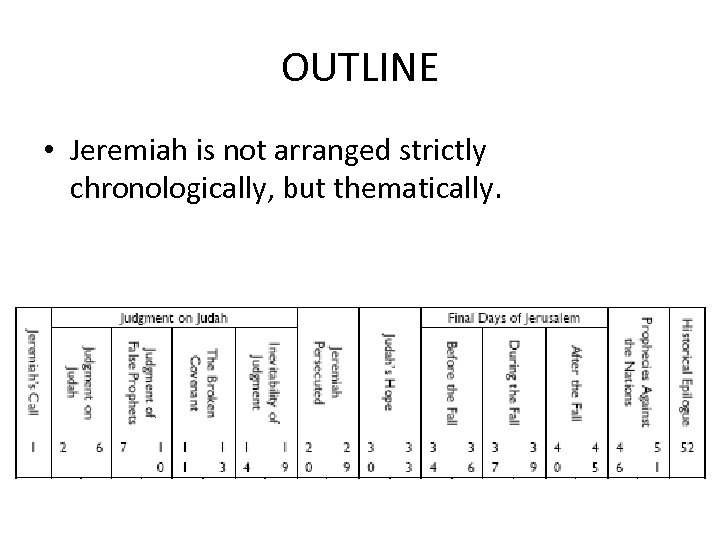 OUTLINE • Jeremiah is not arranged strictly chronologically, but thematically.
 • “The words of Jeremiah the son of Hilkiah, of the priests that were in Anathoth in the land of Benjamin: To whom the word of the LORD came in the days of Josiah the son of Amon king of Judah, in the thirteenth year of his reign. ” (1: 1 -2) • The LORD calls Jeremiah to proclaim his message to Judah. • However, after hearing God’s call, Jeremiah tells Him, “Ah, Lord GOD! behold, I cannot speak: for I am a child. ” (1: 6) • Like Moses, Jonah, and Amos, God’s ambassadors often are hesitant at first to take on the task of proclaiming God’s word. However, just as in these cases, God takes away the excuses one by one. • God then gave Jeremiah two visions that confirmed his divine calling (1: 11 -16)
 • “Moreover the word of the LORD came to me, saying, Go and cry in the ears of Jerusalem, saying, Thus saith the LORD; I remember thee, the kindness of thy youth, the love of thine espousals, when thou wentest after me in the wilderness, in a land that was not sown. Israel was holiness unto the LORD, and the firstfruits of his increase: all that devour him shall offend; evil shall come upon them, saith the LORD. ” (2: 1 -3) • Chapter 2 contains a prophetic oracle indicting Judah for her evil • The Lord had broken the yoke of Egypt off His people at the Exodus and had set them free, but being ungrateful they refused to yield themselves to Him in covenant faithfulness. Thus, throughout this oracle, Jeremiah presented Israel's covenant unfaithfulness to God from two perspectives: religious and political. • Religiously, Yahweh's people had abandoned exclusive faith in their covenant God and had committed spiritual adultery by prostituting themselves to the gods of Canaan, worshipping idols at their hilltop and grove shrines. • Politically, they had ceased to recognize Yahweh's sovereignty over them and had turned to Egypt and Assyria for security, “for they have turned their back unto me, and not their face: but in the time of their trouble they will say, Arise, and save us. ” (2: 27)
 • “They say, If a man put away his wife, and she go from him, and become another man's, shall he return unto her again? shall not that land be greatly polluted? but thou hast played the harlot with many lovers; yet return again to me, saith the LORD. Lift up thine eyes unto the high places, and see where thou hast not been lien with. In the ways hast thou sat for them, as the Arabian in the wilderness; and thou hast polluted the land with thy whoredoms and with thy wickedness. ” (3: 1 -2) • The second prophetic oracle (3: 1— 4: 4) is the call for the people to repent. • Yahweh instructed His prophet that though both the Northern and Southern Kingdoms had committed spiritual harlotry, Judah's sin was worse than Israel's. Here the Lord personified Judah as "Treachery" and Israel as "Apostasy" (cf. 3: 6, 12) • Thus, genuine repentance would have to include acknowledging that what they had done was iniquity, transgression of covenant commands, apostasy and spiritual adultery, and disobedience to Yahweh's Word (3: 13 -14)
 • “Declare ye in Judah, and publish in Jerusalem; and say, Blow ye the trumpet in the land: cry, gather together, and say, Assemble yourselves, and let us go into the defenced cities. Set up the standard toward Zion: retire, stay not: for I will bring evil from the north, and a great destruction. ” (4: 5 -6) • 4: 5— 6: 30 is Yahweh's declaration of divine judgment in the form of a military invasion • This section also includes the first of Jeremiah's "confessions“ (4: 19 -22). Jeremiah was very distraught because he understood that this announcement meant sudden and severe devastation for Judah, “My bowels, my bowels! I am pained at my very heart; my heart maketh a noise in me; I cannot hold my peace, because thou hast heard, O my soul, the sound of the trumpet, the alarm of war. ” (4: 19)
 • “Run ye to and fro through the streets of Jerusalem, and see now, and know, and seek in the broad places thereof, if ye can find a man, if there be any that executeth judgment, that seeketh the truth; and I will pardon it. And though they say, The LORD liveth; surely they swear falsely. O LORD, are not thine eyes upon the truth? thou hast stricken them, but they have not grieved; thou hast consumed them, but they have refused to receive correction: they have made their faces harder than a rock; they have refused to return. ” (5: 13) • Jeremiah is told that Jerusalem will be spared if there is a single righteous man (cf. Gen. 18: 23 -32). • Jeremiah reiterates that both the Northern and Southern Kingdoms had behaved treacherously toward the Lord. They denied God and His warnings about judgment (cf. Gen. 3: 4). They were blind due to complacency (5: 11 -12).
 • “Lo, I will bring a nation upon you from far, O house of Israel, saith the LORD: it is a mighty nation, it is an ancient nation, a nation whose language thou knowest not, neither understandest what they say. Their quiver is as an open sepulchre, they are all mighty men. And they shall eat up thine harvest, and thy bread, which thy sons and thy daughters should eat: they shall eat up thy flocks and thine herds: they shall eat up thy vines and thy fig trees: they shall impoverish thy fenced cities, wherein thou trustedst, with the sword. ” (5: 15 -17) • The nation which is destined to come up against Judah is Babylon. Over the next few years, the armies of Babylon would conquer the kingdom of Judah, taking its people away into captivity. • Yet, the Lord promised, not to wipe out His people completely (5: 10). He would be faithful to His covenant promises even though His people were unfaithful to their covenant responsibilities (cf. 2 Tim. 2: 13).
 • “O ye children of Benjamin, gather yourselves to flee out of the midst of Jerusalem, and blow the trumpet in Tekoa, and set up a sign of fire in Bethhaccerem: for evil appeareth out of the north, and great destruction. ” (6: 1) • The Lord called the Benjamites, Jeremiah's tribal kinsmen, to flee for safety from the coming invader from the north (cf. 4: 5 -6). Jerusalem stood on the southern border of Benjamin. • Further, God promised that the coming enemy would remove the people of Judah from their land as a grape harvester removed the grapes from his vines (6: 9; Isa. 5: 16). The harvest would be so thorough that even the small number of Israelites left in the land would be taken captive. • Jeremiah also made it clear that it would be the Lord Himself, acting in power, who would be responsible for this judgment on Judah, because the Judahites were stubborn, rebellious, and deceitful. Everyone was guilty and worthy of judgment, from all levels of society including the false prophets and the unfaithful priests (6: 12 -13, 28)
 • “The word that came to Jeremiah from the LORD, saying, Stand in the gate of the LORD's house, and proclaim there this word, and say, Hear the word of the LORD, all ye of Judah, that enter in at these gates to worship the LORD. Thus saith the LORD of hosts, the God of Israel, Amend your ways and your doings, and I will cause you to dwell in this place. ” (7: 1 -3) • Chapter 7 includes Jeremiah's “Temple Sermon. ” Jeremiah was told to go to the gate of the temple in Jerusalem and deliver a prophecy in Yahweh's name to the Judahites who entered to worship. • He was to announce that sovereign Yahweh, the God of Israel, promised that if His people would repent (change their thinking, actions, and way of life), He would allow them to continue to dwell in their land. • Unfortunately, many of the Judahites believed that the existence of the temple guaranteed Jerusalem's inviolability. Thus, Jeremiah, warned the people that they were not to assume that just because they had the temple the Lord would keep them safe.
 • “Will ye steal, murder, and commit adultery, and swear falsely, and burn incense unto Baal, and walk after other gods whom ye know not; And come and stand before me in this house, which is called by my name, and say, We are delivered to do all these abominations? Is this house, which is called by my name, become a den of robbers in your eyes? Behold, even I have seen it, saith the LORD. ” (7: 9 -11) • The Judahites would commit these sins and then come to the temple, stand before Yahweh, and conclude that He had forgiven them. They would go through this ritual only so they could go out and sin again. • By treating the temple this way the people had turned it into a den of robbers, a gathering place for those who stole from others and God, and violated God's word with impunity (cf. Matt. 21: 13; Mark 11: 17; Luke 19: 46). • God was so angry with His people that He even told Jeremiah, “Therefore pray not thou for this people, neither lift up cry nor prayer for them, neither make intercession to me: for I will not hear thee. ” (7: 16)
 • “Moreover thou shalt say unto them, Thus saith the LORD; Shall they fall, and not arise? shall he turn away, and not return? Why then is this people of Jerusalem slidden back by a perpetual backsliding? they hold fast deceit, they refuse to return. I hearkened and heard, but they spake not aright: no man repented him of his wickedness, saying, What have I done? every one turned to his course, as the horse rusheth into the battle. ” (8: 4 -6) • Despite Jeremiah’s prophetic concerning Judah’s inevitable destruction, the people remained rebellious and incorrigible. • In fact, the religious leaders of Judah were minimizing God’s condemnation by saying that peace was imminent. They were unwilling to admit that God was punishing the nation (8: 8 -9, 11).
 • “Oh that my head were waters, and mine eyes a fountain of tears, that I might weep day and night for the slain of the daughter of my people! Oh that I had in the wilderness a lodging place of wayfaring men; that I might leave my people, and go from them! for they be all adulterers, an assembly of treacherous men. ” (9: 1 -2) • Jeremiah loved his people so much that he wished he had more tears to shed. (cf. 2 Sam. 18: 33; Matt. 23: 37; Luke 19: 41 -44; Rom. 9: 1 -5; 10: 1). • His empathy with his people's sufferings earned him the nickname "the weeping prophet. “ • Furthermore, Jeremiah longed for a place of retreat in the wilderness where he could go to get away from his fellow countrymen. Their spiritual adultery and treachery repulsed him. • Sadly, Jeremiah relates in 9: 5 that not only did the people of Judah intentionally deceive their neighbors, but they cultivated the skill of lying and practicing iniquity.
 • “Thus saith the LORD, Let not the wise man glory in his wisdom, neither let the mighty man glory in his might, let not the rich man glory in his riches: But let him that glorieth glory in this, that he understandeth and knoweth me, that I am the LORD which exercise lovingkindness, judgment, and righteousness, in the earth: for in these things I delight, saith the LORD. ” (9: 23 -24) • Truly knowing the Lord implies participating with Him in valuing and practicing the essential covenant virtues of loving kindness (loyalty, steadfast love, unfailing devotion, merciful love, Heb. hesed), justice (Heb. mishpat), and righteousness (integrity, Heb. sedaqa) on the earth. The standard is not social custom or community consensus but the character and will of Yahweh (cf. 1 Cor. 1: 31; 2 Cor. 10: 17; James 1: 9).
 • “Hear ye the word which the LORD speaketh unto you, O house of Israel: Thus saith the LORD, Learn not the way of the heathen, and be not dismayed at the signs of heaven; for the heathen are dismayed at them. ” (10: 1 -2) • He warned His people that the worship of the Gentiles was an empty delusion and not to be disciples of their religions. • He specifically admonished them not to let the celestial phenomena that the other nations looked to for guidance frighten them. The surrounding nations regarded abnormalities in the heavens as divine signs and held them in awe, particularly unusual phenomena such as comets, meteors, and eclipses. Jeremiah reminded Judah that it was Yahweh who controlled these things (cf. Gen. 1: 14; Hab. 3: 4, 11).
 • “And say thou unto them, Thus saith the LORD God of Israel; Cursed be the man that obeyeth not the words of this covenant, Which I commanded your fathers in the day that I brought them forth out of the land of Egypt, from the iron furnace, saying, Obey my voice, and do them, according to all which I command you: so shall ye be my people, and I will be your God: That I may perform the oath which I have sworn unto your fathers, to give them a land flowing with milk and honey, as it is this day. Then answered I, and said, So be it, O LORD. ” (11: 3 -5) • Yahweh, Israel's God, announced a curse on any of His people who did not obey the covenant that He gave their forefathers when He liberated them from their Egyptian hardships (cf. Deut. 4: 20; 11: 28; 27: 26; 28: 15 -19; 29: 20 -21; 1 Kings 8: 51; Isa. 48: 10). At that time the Lord had commanded the Israelites to listen to His voice and to be completely obedient (cf. Exod. 19: 5 -6). By promising to do so they entered into covenant relationship with Yahweh; they became His special people and He became their national God (cf. 7: 23; 24: 7; 32: 38). • Nevertheless the Israelites had failed to listen and obey. Consequently the Lord had brought all the curses warned of in the covenant on them. The root of the problem was Israel's stubborn and evil heart.
 • “And the LORD hath given me knowledge of it, and I know it: then thou shewedst me their doings. But I was like a lamb or an ox that is brought to the slaughter; and I knew not that they had devised devices against me, saying, Let us destroy the tree with the fruit thereof, and let us cut him off from the land of the living, that his name may be no more remembered. But, O LORD of hosts, that judgest righteously, that triest the reins and the heart, let me see thy vengeance on them: for unto thee have I revealed my cause. ” (11: 18 -20) • Men from Jeremiah's hometown had warned him to stop prophesying in Yahweh's name or they would kill him (11: 21). However, unknown to Jeremiah, there had been at least one other conspiracy to kill him, which he was as unaware of their intention as a lamb going to its slaughter • Righteously, Jeremiah would not take vengeance himself, but he trusted the Lord to take vengeance for him.
 • “Righteous art thou, O LORD, when I plead with thee: yet let me talk with thee of thy judgments: Wherefore doth the way of the wicked prosper? wherefore all they happy that deal very treacherously? Thou hast planted them, yea, they have taken root: they grow, yea, they bring forth fruit: thou art near in their mouth, and far from their reins. ” (12: 1 -2) • Jeremiah wanted to know why God allowed the wicked to prosper and the treacherous to live in ease (cf. Job 21: 7; Ps. 37; 73: 3 -5, 12; 94: 3; Hab. 1: 12 -17). • It appeared to the prophet that the Lord, as well as Israel, had broken covenant (cf. Ps. 1: 3 -4).
 • “Thus saith the LORD unto me, Go and get thee a linen girdle, and put it upon thy loins, and put it not in water. So I got a girdle according to the word of the LORD, and put it on my loins. ” (13: 1 -2) • This is the first of several symbolic object lessons that Jeremiah performed to communicate divine messages (cf. 16: 1 -4; 18: 1 -12; 19: 1 -2, 10 -11; 27: 1— 28: 17; 32: 1 -15; 43: 813; 51: 59 -64). • God tells Jeremiah to buy a linen belt and wear it. Then he is told to bury it in the rocks at the Euphrates River. The belt lay there for many days until God tells him to go dig it up. • Now the belt had rotted and was no longer any good. God explains: “Thus saith the LORD, After this manner will I mar the pride of Judah, and the great pride of Jerusalem. This evil people, which refuse to hear my words, which walk in the imagination of their heart, and walk after other gods, to serve them, and to worship them, shall even be as this girdle, which is good for nothing. ” (13: 9 -10)
 • “The word of the LORD that came to Jeremiah concerning the dearth (drought). ” (14: 1) • A message came to Jeremiah from God concerning some droughts (Heb. plural) that overtook Judah. Droughts were a punishment for covenant violation in Israel (cf. Lev. 26: 18 -19; Deut. 28: 23 -24). • Judah had so persistently continued in her rebellion and idolatry that God declared, “Thus saith the LORD unto this people, Thus have they loved to wander, they have not refrained their feet, therefore the LORD doth not accept them; he will now remember their iniquity, and visit their sins. Then said the LORD unto me, Pray not for this people for their good. When they fast, I will not hear their cry; and when they offer burnt offering and an oblation, I will not accept them: but I will consume them by the sword, and by the famine, and by the pestilence. ” (14: 10 -12)
 • “Then said the LORD unto me, Though Moses and Samuel stood before me, yet my mind could not be toward this people: cast them out of my sight, and let them go forth. And it shall come to pass, if they say unto thee, Whither shall we go forth? then thou shalt tell them, Thus saith the LORD; Such as are for death, to death; and such as are for the sword, to the sword; and such as are for the famine, to the famine; and such as are for the captivity, to the captivity. ” (15: 1 -2) • The Lord assured Jeremiah that even if two of Israel's most effective intercessors stood before Him and pleaded for the people now, they would not change His mind about bringing judgment. Moses had been effective in getting God to change His plans when Israel had been unfaithful (Exod. 32: 11 -14, 30 -32; Num. 14: 13 -20; Deut. 9: 13 -29). Samuel had also obtained God's mercy for Israel when she had sinned greatly (1 Sam. 7: 8 -9; 12: 19 -25).
 • “And it shall come to pass, when thou shalt shew this people all these words, and they shall say unto thee, Wherefore hath the LORD pronounced all this great evil against us? or what is our iniquity? or what is our sin that we have committed against the LORD our God? ” (16: 10) • The Lord prepared Jeremiah for questions that the people would ask him. They would wonder what they had done to deserve the great calamity that the prophet predicted. They had become blind to the sinfulness of their ways (cf. Mal. 1: 6 -7; 2: 17; 3: 7 -8, 13). • The Lord provided Jeremiah with direct answers, “Then shalt thou say unto them…”
 • “Then shalt thou say unto them, Because your fathers have forsaken me, saith the LORD, and have walked after other gods, and have served them, and have worshipped them, and have forsaken me, and have not kept my law; And ye have done worse than your fathers; for, behold, ye walk every one after the imagination of his evil heart, that they may not hearken unto me: ” (16: 11 -12) • Jeremiah was to give a direct, undiplomatic answer: the coming judgment was due to the accumulated sins of their forefathers in forsaking the Lord and His covenant and in practicing idolatry. • The punishment was also for their own sins, which were worse than those of their forefathers. They had been stubborn in their hearts and had not responded to the Lord's Word. • In fact the Judahites loved to practice idolatry so much that God was going to give them all they could handle, “Therefore will I cast you out of this land into a land that ye know not, neither ye nor your fathers; and there shall ye serve other gods day and night; where I will not shew you favor. ” (16: 13)
 • “The sin of Judah is written with a pen of iron, and with the point of a diamond: it is graven upon the table of their heart, and upon the horns of your altars; Whilst their children remember their altars and their groves by the green trees upon the high hills. ” (17: 1 -2) • Sins engraved on the heart pictured the unashamed sin of idolatry and rebellious iniquity that marked the inner life of the people. • The brazen altar was a place of sacrifice where their sins could be removed, but the horns of their altars had become places of sacrilege where their sins stood recorded. • Why did the people continue to revel in their sin? ? ?
 • “The heart is deceitful above all things, and desperately wicked: who can know it? I the LORD search the heart, I try the reins, even to give every man according to his ways, and according to the fruit of his doings. ” (17: 9 -10) • The Old Testament frequently uses "heart" to identify the source of a person's thinking and acting. It describes the root of unconscious as well as conscious motivation. • The heart is deceptive and depraved and only God can fix the problem
 • “The word which came to Jeremiah from the LORD, saying, Arise, and go down to the potter's house, and there I will cause thee to hear my words. Then I went down to the potter's house, and, behold, he wrought a work on the wheels. ” (18: 1 -3) • God tells Jeremiah to go visit a potter. The potter was working the clay and as he was making a vessel on the pottery wheel, the vessel became ruined. So the potter remade the clay into another vessel. • Emphasizing this object lesson, God spoke to Israel through Jeremiah, “O house of Israel, cannot I do with you as this potter? saith the LORD. Behold, as the clay is in the potter's hand, so are ye in mine hand, O house of Israel. ” (18: 6) • Thus, God explains to Jeremiah that by His sovereign grace He is able to take the marred vessel (Israel) and remake it a vessel of usefulness, if Israel will repent and be obedient.
 • “Thus saith the LORD, Go and get a potter's earthen bottle, and take of the ancients of the people, and of the ancients of the priests; And go forth unto the valley of the son of Hinnom, which is by the entry of the east gate, and proclaim there the words that I shall tell thee” (19: 1 -2) • God tells Jeremiah to buy an earthenware jar. After announcing judgment on the people, Jeremiah was to break the jar before his audience, announcing that in the same way God would break his people. • The calamity would come because the people had forsaken Yahweh and had turned the valley of Hinnom, and all Jerusalem (cf. 2 Kings 21: 12), into a place of heathen worship, including openly practicing child sacrifice (19: 5; cf. 7: 31). They would not be able to recover from this catastrophe any more than one could repair a shattered earthenware jar.
 • “Now Pashur the son of Immer the priest, who was also chief governor in the house of the LORD, heard that Jeremiah prophesied these things. Then Pashur smote Jeremiah the prophet, and put him in the stocks that were in the high gate of Benjamin, which was by the house of the LORD. ” (20: 1 -2) • After preaching judgment in the Temple courtyard (19: 1415), Pashhur, who was the leading priest responsible for the oversight of the temple, heard Jeremiah's words and ordered him beaten and imprisoned in stocks • Jeremiah's confinement only lasted one day. Following his release, the prophet prophesized that the Lord promised to deliver all Judah over to the Babylonian king, who would take many of the people captive to Babylon and slay them with the sword. • This is the first explicit reference to the place of exile in the book (cf. 1: 13; 15: 14).
 • “The word which came unto Jeremiah from the LORD, when king Zedekiah sent unto him Pashur the son of Melchiah, and Zephaniah the son of Maaseiah the priest, saying, Enquire, I pray thee, of the LORD for us; for Nebuchadrezzar king of Babylon maketh war against us; if so be that the LORD will deal with us according to all his wondrous works, that he may go up from us. ” (21: 1 -2) • Chapter 21 contains the message that Yahweh gave Jeremiah after King Zedekiah sent messengers to him to inquire of the Lord whether He would give Judah deliverance from Nebuchadnezzar as He had delivered His people in the past. • Jeremiah told them that the Chaldean soldiers who were then besieging the city's walls would penetrate it and enter the center of Jerusalem. Furthermore, the Babylonian king would show no mercy or compassion and would also slay King Zedekiah, his servants, and the people who survived the seige.
 • “Thus saith the LORD; Go down to the house of the king of Judah, and speak there this word, And say, Hear the word of the LORD, O king of Judah, that sittest upon the throne of David, thou, and thy servants, and thy people that enter in by these gates: Thus saith the LORD; Execute ye judgment and righteousness, and deliver the spoiled out of the hand of the oppressor: and do no wrong, do no violence to the stranger, the fatherless, nor the widow, neither shed innocent blood in this place. ” (22: 1 -3) • The Lord told Jeremiah to go to the king's palace and deliver a prophetic message to him. • Jeremiah called the king and his administrators to practice justice in their decisions regarding civil matters. They should protect the weak and vulnerable and should not shed innocent blood. • If they obeyed, God would perpetuate the reign of David's descendants on Judah's throne with glory and power. However, if they disobeyed, God swore by Himself to destroy the palace.
 • “Shalt thou reign, because thou closest thyself in cedar? did not thy father eat and drink, and do judgment and justice, and then it was well with him? He judged the cause of the poor and needy; then it was well with him: was not this to know me? saith the LORD…Therefore thus saith the LORD concerning Jehoiakim the son of Josiah king of Judah; They shall not lament for him, saying, Ah my brother! or, Ah sister! they shall not lament for him, saying, Ah lord! or, Ah his glory!. ” (22: 15 -16, 18) • By God’s standards, the measure of a king's greatness is not the beauty and cost of his palace but his righteousness and justice. Jehoiakim's father, Josiah, had been a great king, and God had blessed him because he practiced these virtues • Jehoiakim, on the other hand, had only been interested in acquiring things for himself, even dishonestly. He resorted to oppression, extortion, and even murder to get what he wanted (26: 20 -23; 2 Kings 24: 3 -4). Thus, Jehoiakim was condemned by Jeremiah more severely than any other king.
 • “Behold, the days come, saith the LORD, that I will raise unto David a righteous Branch, and a King shall reign and prosper, and shall execute judgment and justice in the earth. In his days Judah shall be saved, and Israel shall dwell safely: and this is his name whereby he shall be called, THE LORD OUR RIGHTEOUSNESS. ” (23: 5 -6) • Yahweh promised to raise up another Davidic king in the future (cf. Ps. 2; 44; 72; 89— 110). He would be as a branch or sprout (Heb. semah) that springs up from an apparently dead stump, namely, the Davidic line of kings (cf. 2 Sam. 23: 5; Ps. 132: 17; Isa. 4: 2; 11: 1; Zech. 3: 8; 6: 12). His characteristic marks would be wisdom, justice, and righteousness, traits notably absent from the last of Judah's kings (cf. 22: 3) • He would rule as a true king, not as a puppet like the last four kings of Judah. During His reign Judah and Israel would experience salvation and security. People would refer to Him as "Yahweh our righteousness. " This strongly suggests that the king would be Yahweh Himself ruling in righteousness and this is one of four direct messianic references in Jeremiah (cf. 3: 15 -18; 31: 31 -34; 33: 15 -16).
 • “The LORD shewed me, and, behold, two baskets of figs were set before the temple of the LORD, after that Nebuchadrezzar king of Babylon had carried away captive Jeconiah the son of Jehoiakim king of Judah, and the princes of Judah, with the carpenters and smiths, from Jerusalem, and had brought them to Babylon. One basket had very good figs, even like the figs that are first ripe: and the other basket had very naughty figs, which could not be eaten, they were so bad. ” (24: 1 -2) • Jeremiah saw two baskets of figs in the temple courtyard. In one basket there were very good figs and the other contained extremely bad figs. This was designed as another object lesson for Jeremiah. • The Lord explained that He would regard the people that had gone into exile with Jehoiachin as good, like the good figs. He would watch over them, prosper them, and return them to the Promised Land. • The bad figs corresponded to King Zedekiah, his administrators, the people who remained in Jerusalem and Judah, and the Judahites who had already fled to Egypt for safety.
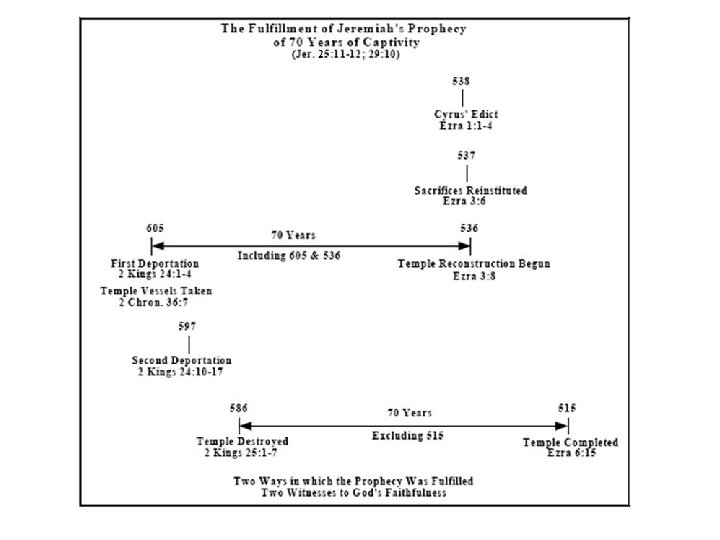
 • “Behold, I will send and take all the families of the north, saith the LORD, and Nebuchadrezzar the king of Babylon, my servant, and will bring them against this land, and against the inhabitants thereof, and against all these nations round about, and will utterly destroy them, and make them an astonishment, and an hissing, and perpetual desolations… And this whole land shall be a desolation, and an astonishment; and these nations shall serve the king of Babylon seventy years. And it shall come to pass, when seventy years are accomplished, that I will punish the king of Babylon, and that nation, saith the LORD, for their iniquity, and the land of the Chaldeans, and will make it perpetual desolations. ” (25: 9, 11 -12) • The Lord announced that because they had not obeyed Him He would bring Nebuchadnezzar down from the north and destroy them and their neighbor nations with a terrible devastation. • The whole land would remain in desolation for 70 years during which Israel and Judah would be absent from the Promised Land. This is the first prophecy of the length of the Babylonian captivity. The Israelites had not observed 70 sabbatical years, so the seventy-year exile restored rest to the land (2 Chron. 36: 20 -21). • After 70 years, the Lord promised to punish the king of Babylon and his nation for their sins and make their land a desolation forever (cf. Hab. 1— 2). Babylon fell in 539 B. C. when Cyrus the Persian captured and overthrew it. It did not become a complete desolation, however, which has led literal interpreters to conclude that a future destruction of Babylon will fulfill this prophecy (Rev. 16: 19; 17: 1— 19: 10).
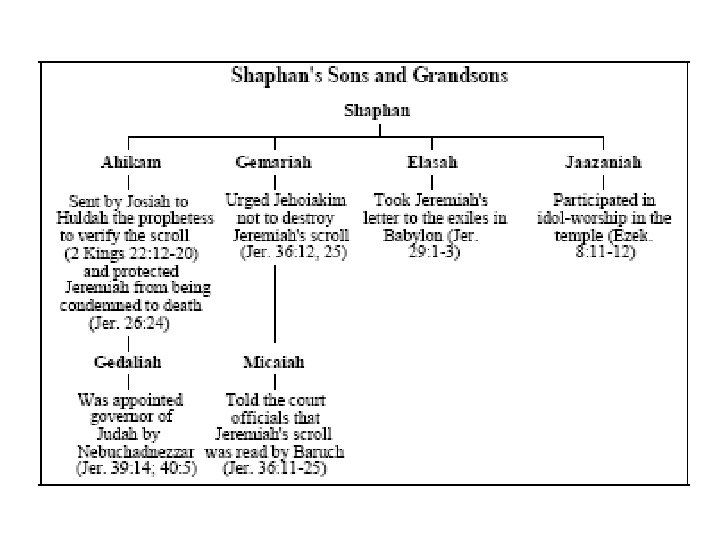
 • “Now it came to pass, when Jeremiah had made an end of speaking all that the LORD had commanded him to speak unto all the people, that the priests and the prophets and all the people took him, saying, Thou shalt surely die. Why hast thou prophesied in the name of the LORD, saying, This house shall be like Shiloh, and this city shall be desolate without an inhabitant? And all the people were gathered against Jeremiah in the house of the LORD. ” (26: 8 -9) • Jeremiah's message was that if the people continued to refuse to listen to the Lord through His prophets and to disobey the Mosaic Covenant, He would destroy the temple and Jerusalem. The temple would suffer complete destruction as the town of Shiloh had (ref 1 Sam. 4), and Jerusalem would an object of ridicule and an example of horrible suffering • When the priests, prophets, and people heard this message, they arrested Jeremiah and threatened to put him to death. However, along with other officials, a man named Ahikam exercised his influence and Jeremiah escaped death. Ahikam and his family came to Jeremiah's aid more than once (cf. 36: 10, 25; 39: 14; 40: 5 -16; 2 Kings 22: 3 -14; 25: 22).
 • “Thus saith the LORD to me; Make thee bonds and yokes, and put them upon thy neck, And send them to the king of Edom, and to the king of Moab, and to the king of the Ammonites, and to the king of Tyrus, and to the king of Zidon, by the hand of the messengers which come to Jerusalem unto Zedekiah king of Judah; ” (27: 2 -3) • Jeremiah received a message from the Lord toward the beginning of King Zedekiah's reign. The prophet was to make animal yokes and to put one set of them on his neck. The animal yoke represented submission, servitude, and captivity (cf. 1 Kings 22: 11; Ezek. 7: 23). • Jeremiah then sent the message of “And now have I given all these lands into the hand of Nebuchadnezzar the king of Babylon, my servant; and the beasts of the field have I given him also to serve him. And all nations shall serve him, and his son's son, until the very time of his land come” (27: 6 -7) to the kings of Edom, Moab, Ammon, Tyre, and Sidon through the envoys that had come from those places to visit King Zedekiah (cf. 25: 21 -22) and gave them one of the yokes to take back to their leader.
 • “And it came to pass the same year, in the beginning of the reign of Zedekiah king of Judah, in the fourth year, and in the fifth month, that Hananiah the son of Azur the prophet, which was of Gibeon, spake unto me in the house of the LORD, in the presence of the priests and of all the people, saying, Thus speaketh the LORD of hosts, the God of Israel, saying, I have broken the yoke of the king of Babylon. ” (28: 1 -2) • Another prophet named Hananiah delivered an oracle of peace and prophesied that Yahweh had broken Babylon's authority over Judah. In fact, within two years the Lord would return to the temple the vessels that Nebuchadnezzar had already taken to Babylon (remember, Jeremiah had prophesied that the captivity would last 70 years). • Hananiah proceeded to deliver a symbolic act of his own by breaking the yoke that Jeremiah had been wearing on his neck. • Jeremiah then told Hananiah, “Hear now, Hananiah; The LORD hath not sent thee; but thou makest this people to trust in a lie. Therefore thus saith the LORD; Behold, I will cast thee from off the face of the earth: this year thou shalt die, because thou hast taught rebellion against the LORD. ” (28: 15 -16) • Guess what happened? . . . “So Hananiah the prophet died the same year in the seventh month. ” (28: 17)
 • “Now these are the words of the letter that Jeremiah the prophet sent from Jerusalem unto the residue of the elders which were carried away captives, and to the priests, and to the prophets, and to all the people whom Nebuchadnezzar had carried away captive from Jerusalem to Babylon; (After that Jeconiah the king, and the queen, and the eunuchs, the princes of Judah and Jerusalem, and the carpenters, and the smiths, were departed from Jerusalem; )” (29: 1 -2) • There are references to and citations from several letters that went back and forth between Jerusalem and Babylon in this narrative • Jeremiah wrote a letter to the exiles (vv. 1 -23). He then wrote a letter to the false prophet Shemaiah in Babylon (vv. 24 -28) in which he referred to a previous letter that Shemaiah had written to the priest Zephaniah, who lived in Jerusalem (vv. 26 -28). Finally, Jeremiah wrote a third letter, this time to the exiles again (vv. 31 -32).
 • The basic message of the first letter told the exiles to settle down in Babylon and prosper because Jeremiah again reminded them, “For thus saith the LORD, That after seventy years be accomplished at Babylon I will visit you, and perform my good word toward you, in causing you to return to this place. ” (29: 10) • The Jews throughout all their dispersions have generally followed this same pattern of instruction from Jeremiah: They have identified themselves with the country of their residence, while at the same time looking toward eventual restoration to their native land. This anticipation was due to the belief in God’s promise, “For I know the thoughts that I think toward you, saith the LORD, thoughts of peace, and not of evil, to give you an expected end… And I will be found of you, saith the LORD: and I will turn away your captivity, and I will gather you from all the nations, and from all the places whither I have driven you, saith the LORD; and I will bring you again into the place whence I caused you to be carried away captive. ” (29: 11, 14)
 • “Thus speaketh the LORD God of Israel, saying, Write thee all the words that I have spoken unto thee in a book. For, lo, the days come, saith the LORD, that I will bring again the captivity of my people Israel and Judah, saith the LORD: and I will cause them to return to the land that I gave to their fathers, and they shall possess it. ” (30: 2 -3) • Chapters 30 -33 are known as the Book of Consolation because it is a collection of prophecies that focus on the hope of a glorious future for the Israelites. • Yet, Jeremiah also prophecies about a time called “Jacob’s trouble/distress” (30: 7). This anticipates the Tribulation in which Israelites will suffer more greatly than they ever have or ever will (cf. 46: 10; Isa. 2: 12 - 21; 13: 6; 34: 1 -8; Ezek. 30: 3; Dan. 9: 27; 12: 1; Joel 1: 15; 2: 1 -2, 11; Amos 5: 18 -20; Mic. 1: 2 -5; Zeph. 1: 2— 3: 8; Zech. 14: 1 -8, 12 -15; Matt. 24— 25; Rev. 6— 18). However, the Israelites would not perish in this distress because the Lord promised them deliverance, both physical and spiritual (cf. Zech. 12: 10— 13: 1).
 • “Behold, the days come, saith the LORD, that I will make a new covenant with the house of Israel, and with the house of Judah: Not according to the covenant that I made with their fathers in the day that I took them by the hand to bring them out of the land of Egypt; which my covenant they brake, although I was an husband unto them, saith the LORD: But this shall be the covenant that I will make with the house of Israel; After those days, saith the LORD, I will put my law in their inward parts, and write it in their hearts; and will be their God, and they shall be my people. ” (31: 3133) • In the future the Lord would make a new covenant with all the Israelites (This is the only place in the Old Testament where the term "new covenant" appears, though there are references to it elsewhere). This New Covenant would be different from the Mosaic Covenant in that instead of God's law being external to them, the Lord would write it on their heart; in other words, it will be instinctive.
 • “And Jeremiah said, The word of the LORD came unto me, saying, Behold, Hanameel the son of Shallum thine uncle shall come unto thee saying, Buy thee my field that is in Anathoth: for the right of redemption is thine to buy it. So Hanameel mine uncle's son came to me in the court of the prison according to the word of the LORD, and said unto me, Buy my field, I pray thee, that is in Anathoth, which is in the country of Benjamin: for the right of inheritance is thine, and the redemption is thine; buy it for thyself. Then I knew that this was the word of the LORD. ” (32: 6 -8) • To confirm that the restoration promised in the previous chapter will take place, Jeremiah gives another object lesson. His relative offers to sell him land. However, the Babylonians had now laid siege to Jerusalem and King Zedekiah had imprisoned Jeremiah for preaching that Yahweh was about to turn Jerusalem over to Nebuchadnezzar and fighting against the Chaldeans would be fruitless, which sounded like treason. Thus, obviously, buying real estate at this point would not be the smartest investment. • Yet, God tells Jeremiah to go ahead and buy the land. For some day, God will restore Judah and the people will again buy and sell land, conduct commerce, and dwell back in the Promised Land (32: 15). • So while it is true, God will hand Judah into the hands of the Babylonians (32: 26 -29), God will some day bring them back to the Promise land (32: 37). God will make a new covenant which will not be broken (32: 40) and once again fields will be bought and sold (32: 43 -44).
 • “Behold, the days come, saith the LORD, that I will perform that good thing which I have promised unto the house of Israel and to the house of Judah. In those days, and at that time, will I cause the Branch of righteousness to grow up unto David; and he shall execute judgment and righteousness in the land. In those days shall Judah be saved, and Jerusalem shall dwell safely: and this is the name wherewith she shall be called, The LORD our righteousness. For thus saith the LORD; David shall never want a man to sit upon the throne of the house of Israel; ” (33: 14 -17) • An integral part to the restoration of Israel is a restoration of the throne of David. With the deposition of Zedekiah by Babylon, the reign of the Davidic kings comes to an end. But in the future a king in the lineage of David would rise up. This king will be just and righteous and under His reign Jerusalem will live in peace and safety. From then on, there would always be a Davidic king ruling over the nation of Israel (cf. 1 Kings 2: 4; 8: 25; 9: 5). • Interestingly, Jeremiah also prophesies that the Levitical priests would resume their functions and to stand “before me to offer burnt offerings, and to kindle meat offerings, and to do sacrifice continually. ” (33: 18)
 • “Thus saith the LORD, the God of Israel; Go and speak to Zedekiah king of Judah, and tell him, Thus saith the LORD; Behold, I will give this city into the hand of the king of Babylon, and he shall burn it with fire: And thou shalt not escape out of his hand, but shalt surely be taken, and delivered into his hand; and thine eyes shall behold the eyes of the king of Babylon, and he shall speak with thee mouth to mouth, and thou shalt go to Babylon. ” (34: 2 -3) • Zedekiah had rebelled against Babylon and was counting on Egypt for help. Babylon soon plundered Judah and attacked Jerusalem. However, during this period, there was a break in the siege because the Babylonians received a report that the Pharaoh was leading an army into Palestine from Egypt (37: 5). The Babylonian army went to engage the Egyptian army, but the Egyptians returned home without a fight. • The Babylonians then again resumed their siege on Jerusalem and Jeremiah tells Zedekiah that Babylon will destroy the city and he will be captured and delivered into the King of Babylon’s hand.
 • “The word which came unto Jeremiah from the LORD in the days of Jehoiakim the son of Josiah king of Judah, saying, Go unto the house of the Rechabites, and speak unto them, and bring them into the house of the LORD, into one of the chambers, and give them wine to drink. ” (35: 1 -2) • The Rechabites were a branch of the Kenite clan that descended from Jethro, Moses' father-in-law (cf. Judg. 1: 16; 1 Chron. 2: 55). They had previously settled in northern Israel (Judg. 4: 17; 5: 24) and in southern Judah (1 Sam. 15: 6). • In another object lesson for Judah, Jeremiah offered wine to the Rechabites, who refused because their ancestor, Jonadab ben Rechab, had commanded his descendants never to drink wine. Thus, for over 200 years they had been faithful and obedient (cf. 2 Kings 10: 15 -23). • Jeremiah then used the faithfulness and obedience of the Rechabites as a denouncing contrast against the continual faithlessness and disobedience of Judah • Additionally, the Lord openly praised the Rechabites for their tenacity in clinging to what they believed to be right and promised them, “Therefore thus saith the LORD of hosts, the God of Israel; Jonadab the son of Rechab shall not want a man to stand before me for ever. ” (35: 19)
 • “And it came to pass in the fourth year of Jehoiakim the son of Josiah king of Judah, that this word came unto Jeremiah from the LORD, saying, Take thee a roll of a book, and write therein all the words that I have spoken unto thee against Israel, and against Judah, and against all the nations, from the day I spake unto thee, from the days of Josiah, even unto this day. ” (36: 1 -2) • Jeremiah was to write on a scroll all the prophecies that he had delivered concerning Israel, Judah, and the other nations since he began prophesying in the reign of Josiah • Jeremiah then instructed Baruch to take it and read the prophecies to the people in the temple courtyard in the hope that, “It may be that the house of Judah will hear all the evil which I purpose to do unto them; that they may return every man from his evil way; that I may forgive their iniquity and their sin. ” (36: 3) • Unfortunately, when the scroll was later read to the king and his court, Jeremiah's prophecies did not frighten them nor did they express any grief over what Jeremiah had predicted—which was in direct contrast to what the king’s father, Josiah had done. Josiah tore his clothes in remorse when he heard the law scroll read to him (2 Kings 22: 11 -20). • Even more defiantly, after several columns were read, Jehoiakim would reached over and cut off that portion of the scroll and toss it into the fire. The king did this until the whole scroll was consumed. • Jeremiah was then instructed by the Lord, “Take thee again another roll, and write in it all the former words that were in the first roll, which Jehoiakim the king of Judah hath burned. ” (36: 28)
 • “Thus saith the LORD, the God of Israel; Thus shall ye say to the king of Judah, that sent you unto me to enquire of me; Behold, Pharaoh's army, which is come forth to help you, shall return to Egypt into their own land. And the Chaldeans shall come again, and fight against this city, and take it, and burn it with fire. Thus saith the LORD; Deceive not yourselves, saying, The Chaldeans shall surely depart from us: for they shall not depart. For though ye had smitten the whole army of the Chaldeans that fight against you, and there remained but wounded men among them, yet should they rise up every man in his tent, and burn this city with fire. ” (37: 7 -10) • Zedekiah sent two messengers to Jeremiah requesting the prophet's prayers on the nation's behalf. • Yet, while the siege was temporarily suspended, Zedekiah should not deceive himself by thinking that the Chaldeans had departed from Jerusalem permanently. In fact, Jerusalem's destruction was so certain that even if the Judeans defeated the entire Babylonian army the Lord would use the wounded Chaldean soldiers to rise up and destroy the city. In other words, deliverance was out of the question.
 • With advent of the renewed siege on Jerusalem, King Zedekiah secretly went to Jeremiah for advice. • Jeremiah told him, “Thus saith the LORD, the God of hosts, the God of Israel; If thou wilt assuredly go forth unto the king of Babylon's princes, then thy soul shall live, and this city shall not be burned with fire; and thou shalt live, and thine house: But if thou wilt not go forth to the king of Babylon's princes, then shall this city be given into the hand of the Chaldeans, and they shall burn it with fire, and thou shalt not escape out of their hand. ” (38: 17 -18) • Unfortunately, the real tragedy is that Zedekiah sought advice from God, and then rejected it • As for Jeremiah, he “abode in the court of the prison until the day that Jerusalem was taken: and he was there when Jerusalem was taken. ” (38: 28)
 • “In the ninth year of Zedekiah king of Judah, in the tenth month, came Nebuchadrezzar king of Babylon and all his army against Jerusalem, and they besieged it. And in the eleventh year of Zedekiah, in the fourth month, the ninth day of the month, the city was broken up. ” (39: 1 -2) • What Jeremiah had predicted for so long finally became a reality for Judah. • Nebuchadnezzar and the Babylonian army captured Jerusalem and began its siege in 588 B. C. It took the Babylonians about eighteen months to breach the walls of the city, which they did in 586 B. C. (cf. 52: 4 -6). • There are four chapters in the Bible that record the fall of Jerusalem reflecting the importance of this event (39; 52; 2 Kings 25; 2 Chron. 36).
 • When Zedekiah saw the invaders within the city, he and many of the Judean soldiers tried to escape Jerusalem by night through a gate in the king's garden. • The Chaldean soldiers spotted Zedekiah fleeing and finally caught up with him in the plains near Jericho. They captured him and took him to Nebuchadnezzar, who was at Riblah. • Nebuchadnezzar punished Zedekiah: “Then the king of Babylon slew the sons of Zedekiah in Riblah before his eyes: also the king of Babylon slew all the nobles of Judah. Moreover he put out Zedekiah's eyes, and bound him with chains, to carry him to Babylon. ” (39: 6 -7) • Furthermore, Babylon then carried out God’s judgment of Jerusalem, “And the Chaldeans burned the king's house, and the houses of the people, with fire, and brake down the walls of Jerusalem. Then Nebuzaradan the captain of the guard carried away captive into Babylon the remnant of the people that remained in the city, and those that fell away, that fell to him, with the rest of the people that remained. ” (39: 8 -9)
 • In contrast to Zedekiah's horrible fate, Jeremiah enjoyed the attentive care of the Babylonians. • In fact, “Now Nebuchadrezzar king of Babylon gave charge concerning Jeremiah to Nebuzaradan the captain of the guard, saying, Take him, and look well to him, and do him no harm; but do unto him even as he shall say unto thee. ” (39: 11 -12) • They released Jeremiah from his confinement in the court of the guardhouse (cf. 38: 28) and entrusted him to Gedaliah, the appointed governor, who took him into his home. Jeremiah stayed among the poor people who remained in Jerusalem for some time.
 • Nebuchadnezzar appointed Gedaliah governor over the cities of Judah, and the other remaining Judahites. He was a part of the noble family of Shaphan. • Gedaliah was warned, “Dost thou certainly know that Baalis the king of the Ammonites hath sent Ishmael the son of Nethaniah to slay thee? ” (40: 14) • However, Gedaliah did not believe that any such plot existed. • Johanan offered to assassinate Ishmael secretly so Gedaliah would not die and harm would not come to the remnant community. Gedaliah refused to permit Johanan to carry out his plan because he thought he was misjudging Ishmael (40: 15 -16)
 • “Now it came to pass in the seventh month, that Ishmael the son of Nethaniah the son of Elishama, of the seed royal, and the princes of the king, even ten men with him, came unto Gedaliah the son of Ahikam to Mizpah; and there they did eat bread together in Mizpah. Then arose Ishmael the son of Nethaniah, and the ten men that were with him, and smote Gedaliah the son of Ahikam the son of Shaphan with the sword, and slew him, whom the king of Babylon had made governor over the land” (41: 1 -2). • Not long after the fall of Jerusalem, Ishmael and 10 other men came to Mizpah and ate a meal with Gedaliah. During the meal they rose up and killed him with the sword. The assassins also murdered the other Jews and the Chaldean soldiers who were there. • Adding to the tragedy, Ishmael and his men slaughtered another 70 religious pilgrims who were grieving over the effects of the Babylonian invasion
 • Then Ishmael took captive all the people of Mizpah that Nebuzaradan had placed under Gedaliah's charge including King Zedekiah's daughters (or perhaps women with royal blood). He began to transport all these people to the nation of Ammon. • Johanan and his allies pursued Ishmael and caught up with him by the large pool in Gibeon about three miles southwest of Mizpah. Ishmael, however, escaped to Ammon with eight accomplices. • Johanan and his group intended to proceed to Egypt “Because of the Chaldeans: for they were afraid of them, because Ishmael the son of Nethaniah had slain Gedaliah the son of Ahikam, whom the king of Babylon made governor in the land” (41: 18).
 • “Then all the captains of the forces, and Johanan the son of Kareah, and Jezaniah the son of Hoshaiah, and all the people from the least even unto the greatest, came near, And said unto Jeremiah the prophet, Let, we beseech thee, our supplication be accepted before thee, and pray for us unto the LORD thy God, even for all this remnant; (for we are left but a few of many, as thine eyes do behold us: ) That the LORD thy God may shew us the way wherein we may walk, and the thing that we may do. ” (42: 1 -3) • The refugees asked Jeremiah to pray for them that the Lord would tell them what to do. They promised, “Whether it be good, or whether it be evil, we will obey the voice of the LORD our God, to whom we send thee; that it may be well with us, when we obey the voice of the LORD our God. ” (42: 6) • After 10 days God told them that He would bless them if they stayed in the land. However if the people decided to leave the land not listen to the Lord's voice, if they chose to go to Egypt where they thought they would be safe and have plenty of food, they would surely die by the sword, famine, and disease there.
 • As soon as Jeremiah had finished telling the remnant what God's will was, Azariah, Johanan, and other arrogant men among them accused Jeremiah of lying to them. • Sadly, then, “Johanan the son of Kareah, and all the captains of the forces, and all the people, obeyed not the voice of the LORD, to dwell in the land of Judah. But Johanan the son of Kareah, and all the captains of the forces, took all the remnant of Judah, that were returned from all nations, whither they had been driven, to dwell in the land of Judah; Even men, and women, and children, and the king's daughters, and every person that Nebuzaradan the captain of the guard had left with Gedaliah the son of Ahikam the son of Shaphan, and Jeremiah the prophet, and Baruch the son of Neriah. ” (43: 4 -6) • They stopped at Tahpanhes, an Egyptian frontier town in the northeastern Nile Delta region on the road from Canaan. However the chapter continues to emphasize the people's disobedience.
 • “The word that came to Jeremiah concerning all the Jews which dwell in the land of Egypt, which dwell at Migdol, and at Tahpanhes, and at Noph, and in the country of Pathros, saying…” (44: 1) • This chapter is believed to contain Jeremiah’s last known words • Jeremiah announced Yahweh's judgment on the idolatrous Jews in Egypt (vv. 1 -14): “For I will punish them that dwell in the land of Egypt, as I have punished Jerusalem, by the sword, by the famine, and by the pestilence: So that none of the remnant of Judah, which are gone into the land of Egypt to sojourn there, shall escape or remain, that they should return into the land of Judah, to the which they have a desire to return to dwell there: for none shall return but such as shall escape. ” (44: 13 -14) • Unfortunately, many of the people unashamedly proclaimed, “As for the word that thou hast spoken unto us in the name of the LORD, we will not hearken unto thee, ” (44: 16) and that they intended to continue to worship the Queen of Heaven, a Near Eastern fertility goddess, as they had done in Judah (cf. 7: 18; 2 Kings 17: 16). • Thus God responded, “Behold, I will watch over them for evil, and not for good: and all the men of Judah that are in the land of Egypt shall be consumed by the sword and by the famine, until there be an end of them. ” (44: 27)
 • “The word that Jeremiah the prophet spake unto Baruch the son of Neriah, when he had written these words in a book at the mouth of Jeremiah, in the fourth year of Jehoiakim the son of Josiah king of Judah, saying, Thus saith the LORD, the God of Israel, unto thee, O Baruch: … And seekest thou great things for thyself? seek them not: for, behold, I will bring evil upon all flesh, saith the LORD: but thy life will I give unto thee for a prey in all places whither thou goest. ” (45: 1 -2, 6) • This is the last chapter in the book in which Jeremiah is part of the narrative. • The Lord promised to bless Baruch by preserving his life wherever he went because of his faithful service to Jeremiah.
 • “The word of the LORD which came to Jeremiah the prophet against the Gentiles; Against Egypt, against the army of Pharaoh Necho king of Egypt, which was by the river Euphrates in Carchemish, which Nebuchadrezzar king of Babylon smote in the fourth year of Jehoiakim the son of Josiah king of Judah. ” (46: 1 -2) • The final seven chapters of the book are judgments to the various nations around Judah. Oracles against foreign nations appear in every prophetical book except Hosea, which emphasizes Yahweh's sovereignty over the whole world. • This chapter on Egypt contains three separate prophecies that Jeremiah delivered about the fate of that nation. Their purpose seems to have been to discourage King Jehoiakim (609 -598 B. C. ) and the pro-Egyptian party in Judah from forming an alliance with Egypt. • The first prophecy announced Egypt's defeat at Carchemish (vv. 112). • The second prophecy predicted Nebuchadnezzar's conquest of Egypt (vv. 13 -24). • The third prophecy against Egypt promised the humiliation of Egypt and the deliverance of Israel (vv. 25 -28).
 • “The word of the LORD that came to Jeremiah the prophet against the Philistines, before that Pharaoh smote Gaza. ” (47: 1) • An invader from the north would sweep in like a flood and overwhelm the land Gaza. • Gaza and Ashkelon, in the southern part of Philistia, would suffer ruin. • Nebuchadnezzar may have fulfilled this prophecy in 604 B. C. when he destroyed Ashkelon
 • “Against Moab thus saith the LORD of hosts, the God of Israel; Woe unto Nebo! for it is spoiled: Kiriathaim is confounded and taken: Misgab is confounded and dismayed. There shall be no more praise of Moab: in Heshbon they have devised evil against it; come, and let us cut it off from being a nation. Also thou shalt be cut down, O Madmen; the sword shall pursue thee. ” (48: 1 -2) • This oracle is similar to the one in Isaiah 15 and 16. Other oracles against Moab appear in Ezekiel 25: 8 -11, Amos 2: 13, and Zephaniah 2: 9, but this is the longest one. • The oracle begins with a general prediction of Moab's destruction (vv. 1 -10). • Yet at the end, God promised to restore the fortunes of Moab in the distant future (48: 47; cf. 46: 26; 49: 6, 39). • Chapter 49 contains oracle against several nations: Ammon, Edom, Aram, and Elam
 • “The word that the LORD spake against Babylon and against the land of the Chaldeans by Jeremiah the prophet. Declare ye among the nations, and publish, and set up a standard; publish, and conceal not: say, Babylon is taken, Bel is confounded, Merodach is broken in pieces; her idols are confounded, her images are broken in pieces. ” (50: 1 -2) • Jeremiah wrote almost as much (Chapters 50 -51; 110 verses!) about Babylon's future as he did about the futures of all the other nations in his other oracles combined. • There are two main themes: the judgment coming on Babylon, and the restoration of Israel and Judah to their homeland. • Jeremiah 51: 64 ends by saying, “thus far are the words of Jeremiah. , ” but doesn’t tell us anything of Jeremiah’s death.
 • “This is the people whom Nebuchadrezzar carried away captive: in the seventh year three thousand Jews and three and twenty: In the eighteenth year of Nebuchadrezzar he carried away captive from Jerusalem eight hundred thirty and two persons: In the three and twentieth year of Nebuchadrezzar Nebuzaradan the captain of the guard carried away captive of the Jews seven hundred forty and five persons: all the persons were four thousand six hundred. ” (52: 28 -30) • The book ends with an historical epilogue describing Jerusalem’s fall, the number of exiles carried into Babylon, and the release of King Jehoiachin. • This chapter has many similarities to 2 Kings 24: 18— 25: 30.
 Just so we don’t miss the main point… • The book of Jeremiah is a constant reminder of God’s faithfulness to His covenantal promises. Thus, the main message deals with the certainty of God’s judgment due to unrepentant sin, while at the same time emphasizing the timelessness of God’s boundless love. • Jeremiah stressed the fact that immorality always accompanies idolatry. Israel's present problems were the result of her past and present apostasy.