


 Скачать презентацию Jeopardy Hydrology Closed Conduit Hyd Open Channel Hyd
2f3c827311b4a43174c6b0d13793da88.ppt
- Количество слайдов: 27
 Jeopardy Hydrology Closed Conduit Hyd. Open Channel Hyd. EPANET Other $100 $100 $200 $200 $300 $300 $400 $400 $500 $500 Final Jeopardy
 1 - $100 What is a hydrograph? n What does the area under the hydrograph give you? n Graph of flow at the outlet vs. time n Volume of runoff n
 1 - $200 n What is the frequency of a 4% exceedance probability? n 25 -Year
 1 - $300 n Name a hydrologic method how an engineer would decide which method to use for design? n Based on the county’s recommended methods or drainage area size as a limitation!
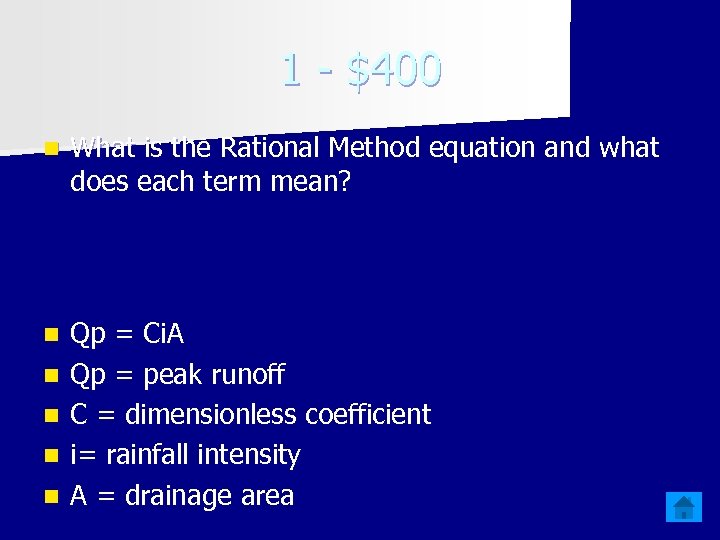 1 - $400 n What is the Rational Method equation and what does each term mean? n Qp = Ci. A Qp = peak runoff C = dimensionless coefficient i= rainfall intensity A = drainage area n n
 1 - $500 n What is a hyetograph? Why is it useful? n Graphical representation of depth or intensity vs time.
 2 - $100 n What is the difference between hydrology and hydraulics? Hydrology is the study of the water cycle (gives you a volume) n Hydraulics is the study of the mechanics of flow (velocity, flow, depth, etc. ) n
 2 - $200 n If flow rate is constant in a closed conduit, what happens to the velocity and pressure when the area gets smaller? Q=v. A if area gets smaller, velocity increases. n P/g + v 2/2 g + z pressure is inversely proportional to velocity. n
 2 - $300 n Water is almost always a _-dimensional flow but is analyzed in _-D flow. 3 -dimensional n 1 D n
 2 - $400 n In fluid dynamics, what is head defined as? n Energy per unit weight of water.
 2 - $500 n What are the roughness coefficients for the Darcy, Manning and Hazen-Williams headloss equations? Darcy – f n Manning – n n Hazen-Williams – C n
 3 - $100 n Why is open channel hydraulics important for engineers? WSE n Discharge-depth n Channel design n
 3 - $200 n What is the difference between steady and uniform flow? Steady flow – temporal – depth and velocity remain constant over time. n Uniform flow – spatial – no change in velocity within the channel. n
 3 - $300 n What/where is the HGL in an open channel vs. the HGL in a closed conduit? HGL is the water surface in the open channel n Closed conduit, it’s where the water would be if a piezometer was placed there n
 3 - $400 n What is critical depth and why is it important? Depth of flow where specific energy is at a min. n To determine if flow in channel is subcriticial or supercritical n
 3 - $500 n What is gradually varied flow (GVF) and what do GVF profiles tell you? Steady non-uniform flow with gradual changes in WSE n Profiles permits a classification of liquid surface as a function of Fr, So, and Sf. n
 4 - $100 n What is EPANET and what is it used for? Pressurized pipe modeling software n Used to simulate water distribution networks n
 4 - $200 n Which headloss equations does EPANET support? Darcy, Hazen, Mannings n All of them!
 4 - $300 n What could a “negative pressure” warning mean? n System is unable to meet the demand
 4 - $400 n When you enter in elevations at a node, what is the reference point? Usually mean sea level. n (should have entered in elevations of pipe not the land elevation) n
 4 - $500 n What is the difference between a Looped and Branched network system? Branch has no circulation, looped does n During failure, looped is advantageous to branch n
 5 - $100 n Difference between positive and non-positive displacement pumps? Positive has a fixed volume of fluid n Non-positive volumes are dependent on static head or pressure n
 5 - $200 n Name a valve and its function. n Valves are used to control flow
 5 - $300 n What is the net positive suction head required? n Minimum pressure required at the suction part of the pump to prevent cavitation
 5 - $400 n What are the use of inlets? n To collect water off the streets and into a storm sewer system
 5 - $500 n Describe how bonds work. Company issues bonds n People buy bonds = lend money to company n Company agrees to pay money back with interest n
 Final Jeopardy n TBA n ?