


 Скачать презентацию JC Decaux Key Issues 1 Strong competition
58d6fda85ac2bfe8fc624a8b60e4b146.ppt
- Количество слайдов: 27
 JC Decaux
 Key Issues 1. Strong competition 2. Key contracts are coming to term 3. Strategy for worldwide development 1 -2
 Strong Competition The company’s two main competitors in its three main activities: advertising on billboards (Billboard), advertising on and in public transportation vehicles and stations (Transport) and advertising on street furniture (Street Furniture) in all the countries where JCDecaux is, are Clear Channel and Viacom. Both Clear Channel and Viacom are world leading media companies. Both companies have higher turnovers (in 2002) than JCDecaux. Clear Channel, apart from outdoor advertising, is involved in radio broadcasting (1200 stations), television and entertainment (live event production). Viacom is involved in cable television and radio. 1 -3
 Key contracts are coming to term Many current contracts will expire in the next 2 years. From 2003 to 2005 13. 3% of their street furniture contracts will expire and 35. 1% of their transport advertising concessions. JCDecaux intends to bid for renewal of the existing contracts but competition will be tougher. For a long time JCDecaux was alone on the street furniture market but now media companies are competing against it. JCDecaux faces legal problems concerning its contracts with local governments, more particularly in France (in which the contracts are reviewed by local state representatives in accordance with French administrative law) Authorities are also allowed to terminate current contracts for public interest reasons. 1 -4
 Strategy for worldwide development JCDecaux is now trying to win contracts in markets where street furniture is a relatively new concept such as the Asia-Pacific region and Latin America: Street furniture tenders have been put out to tender in major cities such as Sydney, Seoul, Bangkok, Montevideo and Salvador de Bahia. 1 -5
 SWOT analysis - Strengths • Present in 43 countries around the world and in major European cities, as well as worldwide big airports • N° 1 in Europe for Billboards • N° 1 worldwide for airport advertising • 60% of its sales outside of France • Audience measurement techniques provided by leading companies in Europe Street furniture • N° 1 worldwide • Quality control inspections, installation and repairs are carried out by their own specially trained service technicians. • Long term contracts with a high percentage of renewal • “Premium quality advertising medium” image Billboards • Pioneer in major innovations • Broad range of products in billboard offer • Strong relationships with media buyers and advertising agencies • The company can post a nation-wide campaign in France within 24 hours • Flexible pricing system • Possibility of time sharing Transport • They reach 30% of worldwide airport traffic • Maintenance is much lower than open-air street furniture contracts • First airport advertising company to develop a transport audience measurement system 1 -6
 SWOT analysis - Weaknesses • They are too specialised in outdoor advertising compared to their competitors (big communication companies such as Viacom) – JCDecaux is attacked on their core business, which is at the same time the only one the firm operates in. • The name JCDecaux sounds very “French” and could not be easily exportable and not easy to be pronounced in various languages. Nowadays, big groups and holdings change their name for one that is short and easy to say by everybody • Many executives from the group have problems with the justice and face trials. Street furniture • They never offer any discounts, only volume discounts in street furniture Transport • Airports ask for high advertising revenues 1 -7
 SWOT analysis – Opportunities • Street furniture is a young and fast growing sector • Annual growth rate in outdoor advertising is higher than the one for the overall advertising industry • High growth of audience in outdoor advertising • Street furniture is becoming an increasingly popular advertising medium in the U. S • New expansion in shopping malls all over the world • Changes lesser quality panels for modern, high-quality displays • Audience in airports particularly sought after by advertisers 1 -8
 SWOT analysis – Threats • The strength of the Euro against the Dollar has an impact on the profits • Highly competitive market with major international companies and local niche players • Drop of the occupancy rate for the street furniture • • Large proportion of their billboard business comes from short term contracts Air passenger traffic growth lessened by 9/11’s terrorist’s attacks • Many contracts come to term and might not be renewed • Possible depreciation of the image of the company because of law procedures undertaken • • Anti trust laws could slow down JCDecaux’s external growth strategies Companies cut their advertising budget because of the bad economic conditions 1 -9
 Three alternatives to build a new strategy • Do not change anything • Intensive market penetration • Diversification 1 -10
 Do not change anything Continue to apply the same strategy: bid to renew the existing contracts, and try to acquire new markets (in USA and Asia especially). 1 -11
 Intensive market penetration • Two main advantages of JCDecaux: - An image of leader in the outdoor advertising industry, due to its first mover advantage in the street furniture market; - A great presence in Europe, which could be the starting point of a global strategy • Recommendations to JCDecaux: - Review its existing contracts through competitive bids in Europe - Compete (and win) for new contracts all around the world with a focus on the Asian market As it is difficult to enter and expand in a new market, it would be better to have partnerships with Asian firms. 1 -12
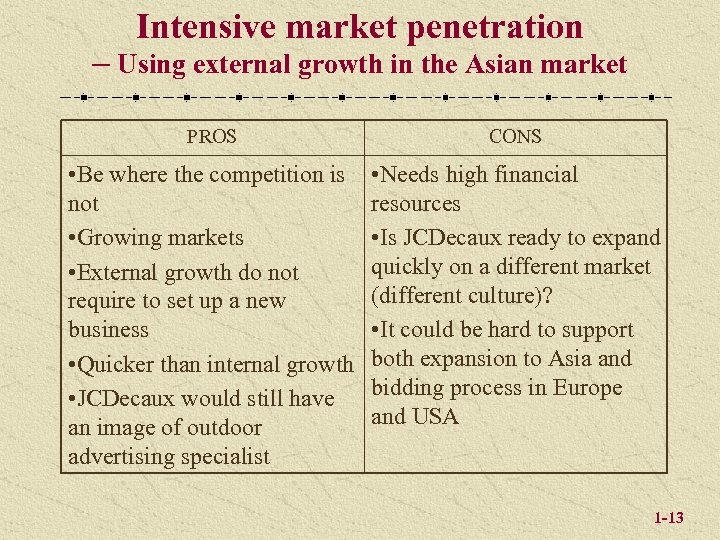 Intensive market penetration – Using external growth in the Asian market PROS CONS • Be where the competition is not • Growing markets • External growth do not require to set up a new business • Quicker than internal growth • JCDecaux would still have an image of outdoor advertising specialist • Needs high financial resources • Is JCDecaux ready to expand quickly on a different market (different culture)? • It could be hard to support both expansion to Asia and bidding process in Europe and USA 1 -13
 Diversification • JCDecaux could become a generalist in the media industry. This implies a diversification strategy; it means that JCDecaux would have to develop new kinds of businesses, like: • • Radio, Broadcast and cable television, Ad agency, Etc. • Setting up new businesses or by applying an external growth method (buying existing radio, Ad agency, etc…). Thus, JCDecaux could compete against Clear Channel and Viacom by using the same tools. • But there is no real competitive advantage brought by a diversification strategy for the outdoor advertising business of JCDecaux, moreover the firm would lose its image of specialist. • We think that this alternative is not good enough for JCDecaux, regarding the current key issues that the firm is currently facing. 1 -14
 Solution In order to compete against the strong competition, we advise JCDecaux to use an Intensive Market penetration strategy and to use external growth to be competitive on the Asian market (more competitive than its current competitors). Thus JCDecaux would take advantage of the knowledge of the market of the Asian firms. 1 -15
 Li & Fung Limited
 Key Issues Some of the concepts surrounding SCM Growth through acquisitions Use Internet to capture business from SME 1 -17
 Discussion Questions 1. Why would a company want to use the supply chain management services of Li & Fung rather than simply organizing an in-house department or appointing a senior manager to handle these activities? 1 -18
 Answers to the discussion questions • As discussed in the case, customers are willing to pay these fees to Li & Fung in return for its services because the reduction in production cycle time and lower costs resulting from outsourcing enable Li & Fung’s customers to enjoy substantial savings both in terms of cost of goods and administrative expenses. And the uncertainty involved in the transfer of raw materials and work-in-process between supply chain members at different production stages is also reduced. • Therefore, through outsourcing their supply chain management functions, Li & Fung’s customers can enjoy cost savings, reduced risks, and higher efficiency because it is generally easier to deal with one party at one relatively convenient location compared to dealing with multiple parties potentially located in several countries situated on different continents. 1 -19
 Answers to the discussion questions • • Companies themselves may not have the expertise and the resources to do their own supply chain management. They often cannot afford the time, cost, and risk to develop advanced supply chain and information technology (IT) capabilities. This leads them to consider outsourcing possibilities in a “make or buy” decision framework. In essence, they may lack the core competencies to fully vertically integrate backwards towards their suppliers or forwards towards their customers, these moves being among the most difficult growth options to execute successfully. This provides an incentive for companies facing these constraints to outsource their supply chain management function, a role Li & Fung is well equipped to fill. On another level, customers can capitalize on the competitive advantages of Li & Fung’s sourcing network, their knowledge, social capital, experience, and goodwill. Competitive advantage based on these sorts of factors is usually referred to as “sustainable” competitive advantage because it is very difficult for a potential competitor to duplicate them successfully at a competitive cost level in the short-run. 1 -20
 Discussion Questions 2. Much of Li & Fung’s growth is through acquisitions. Why would it spend the money to buy other companies’ networks rather than just creating their own? 1 -21
 Answers to the discussion questions • • • Li & Fung quickly realized that it needed to be close to both potential clients seeking a supply chain manager and its network of suppliers. It found that it could rapidly expanded its global sourcing network through acquisitions since developing networks from the ground up tends to take a long time and to be relatively very expensive. Li & Fung acquired Inchcape Buying Services in 1995, which doubled the size of the company and expanded the company’s customer base in Europe. To strengthen its position in the U. S. and European markets, Li & Fung acquired Swire & Maclaine Ltd. and Camberley Enterprises Ltd. in 1999. In 2000, Li & Fung acquired Colby Group Holdings Ltd. , a buying agent for the sourcing of consumer goods with a 35 -office network. In just the three-year period beginning in 1999, these acquisitions increased the size of Li & Fung’s sourcing network from 48 offices in 32 countries in 1999 to 68 offices in 40 countries in 2001. 1 -22
 Answers to the discussion questions The majority of the business at Li & Fung is generated from the soft goods market with only 28% of the business derived from the hard goods market. To avoid something of an overdependence on the soft goods market, Li & Fung increased its stake in the hard goods market through the acquisition of Colby Group Holdings Ltd. and Swire & Maclaine Ltd. (which provides another reason for their acquisition in addition to those above). This move, in addition to further expanding Li & Fung’s global network, increased the contribution of hard goods from 22% of total turnover in 2000 to 28% in 2001. In 2002, Li & Fung acquired Janco Overseas Ltd. to further develop its hard goods market. Li & Fung ended 2002 with 32% of its turnover in hard goods, but senior management would still like to decrease their reliance on the soft goods business even more. 1 -23
 Discussion Questions 3. How will Li & Fung use the Internet to capture additional business? What will they need to do in order to make this additional business profitable? 1 -24
 Answers to the discussion questions First Question: The use of Internet • Li & Fung usually only wants customers with annual sales of at least US$100 million. • However, Li & Fung senior management noticed that there an even larger number of small to medium sized businesses that would benefit from the services they could provide. This market segment is characterized by small order size and shorter delivery time requirements since these smaller businesses cannot afford to tie up large sums of money in inventory. The problem was how to service their needs profitably. • The Internet suggested itself as a solution. An on-line business outlet could allow Li & Fung to consolidate small orders for mass production by the existing supplier network. 1 -25
 Answers to the discussion questions Second Question: How to make internet business more profitable • • • Li & Fung’s approach would, in essence, allow these smaller businesses to have their own private label. There would be different styles with limited customization. While sizes and styles would be fixed, choices available on-line would allow a product to have the small business’ own distinctive label attached, with choices of embroidery, colors, and packaging. Li & Fung would still be able to obtain the benefits of mass production, but with perhaps enough limited customization to meet the needs of the smaller business. 1 -26
 Outcome of dot. com adventure • • Some observers wonder if this Internet business model can produce the economies of scale necessary for Studio. Direct to earn a profit”. The answer is that it could not and, since it could not meet the high profit expectations set for it, Li & Fung quickly moved on to other things. Studio. Direct was born and died in the same year. 1 -27