


 Скачать презентацию Java Security David A Wheeler dwheeler dwheeler com 703
0698893dea0b6021bacaeaa5f5192812.ppt
- Количество слайдов: 61
 Java Security David A. Wheeler dwheeler@dwheeler. com (703) 845 -6662 April 24, 2000 (C) 1999 -2000 David A. Wheeler
 Outline • Java Basics – What’s Java, Modes of Use, major components, implications, implementations, politics • Security-related capabilities (JDK 1. 0, 1. 1, “ 1. 2”) • Selected upcoming developments • Miscellaneous – Past breaches, malicious applets, advantages & disadvantages, key points (C) 1999 -2000 David A. Wheeler 2
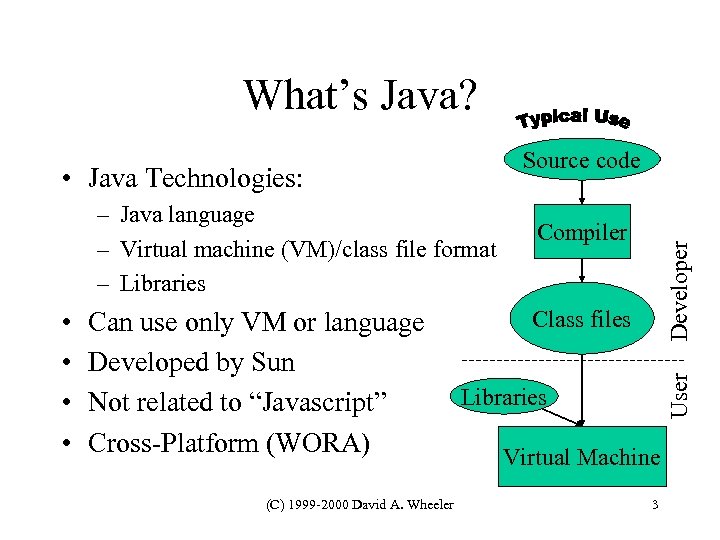 What’s Java? Source code – Java language – Virtual machine (VM)/class file format – Libraries Can use only VM or language Developed by Sun Not related to “Javascript” Cross-Platform (WORA) (C) 1999 -2000 David A. Wheeler Class files User • • Compiler Developer • Java Technologies: Libraries Virtual Machine 3
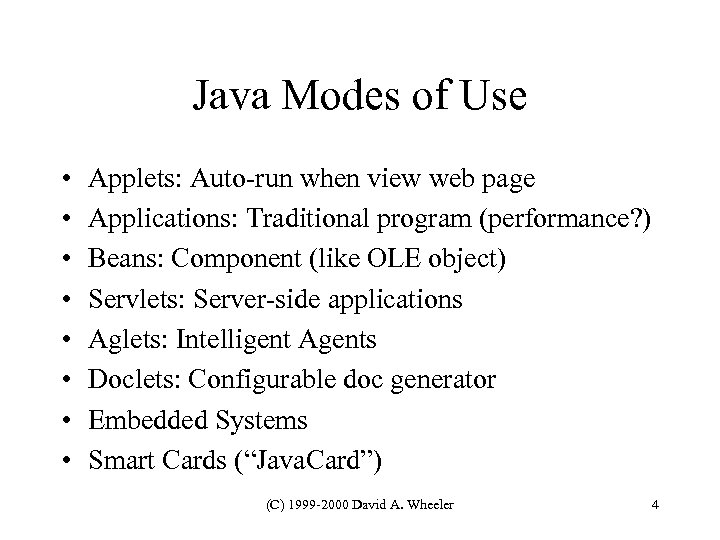 Java Modes of Use • • Applets: Auto-run when view web page Applications: Traditional program (performance? ) Beans: Component (like OLE object) Servlets: Server-side applications Aglets: Intelligent Agents Doclets: Configurable doc generator Embedded Systems Smart Cards (“Java. Card”) (C) 1999 -2000 David A. Wheeler 4
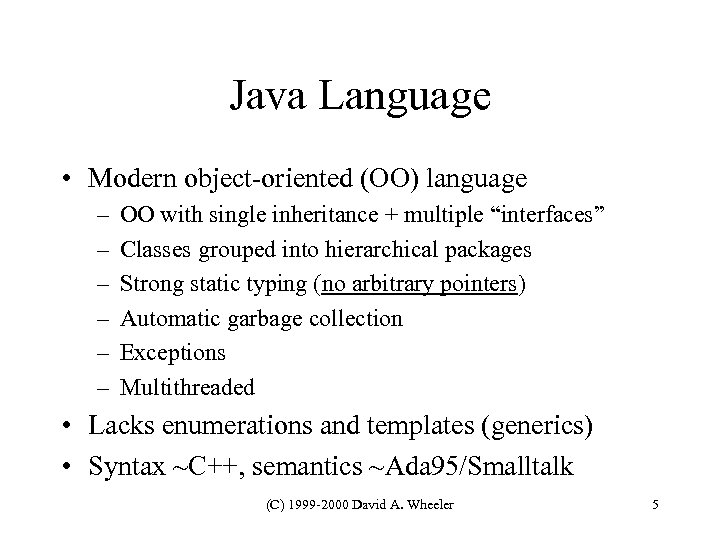 Java Language • Modern object-oriented (OO) language – – – OO with single inheritance + multiple “interfaces” Classes grouped into hierarchical packages Strong static typing (no arbitrary pointers) Automatic garbage collection Exceptions Multithreaded • Lacks enumerations and templates (generics) • Syntax ~C++, semantics ~Ada 95/Smalltalk (C) 1999 -2000 David A. Wheeler 5
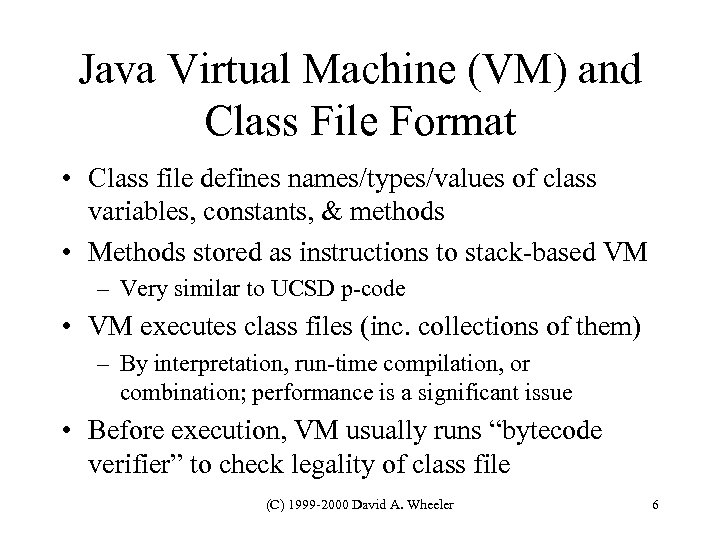 Java Virtual Machine (VM) and Class File Format • Class file defines names/types/values of class variables, constants, & methods • Methods stored as instructions to stack-based VM – Very similar to UCSD p-code • VM executes class files (inc. collections of them) – By interpretation, run-time compilation, or combination; performance is a significant issue • Before execution, VM usually runs “bytecode verifier” to check legality of class file (C) 1999 -2000 David A. Wheeler 6
 Java Libraries • Set of built-in APIs, including: – GUIs – Networking – Computation • Growth area • Several classes are security-related – This presentation will skim ordinary crypto functions such as ones for encryption/decryption, certificate management, etc. , since they are not essentially unique (C) 1999 -2000 David A. Wheeler 7
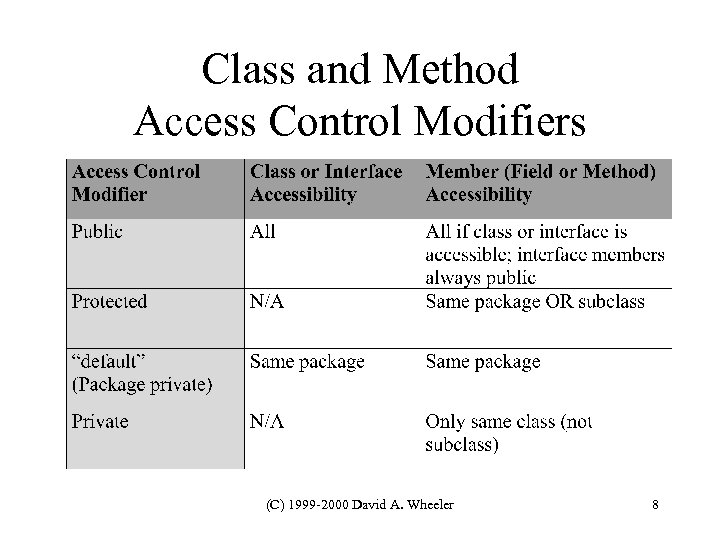 Class and Method Access Control Modifiers (C) 1999 -2000 David A. Wheeler 8
 Implications of Java Basics • No arbitrary pointers: references ~ capabilities – Only creator & createe have reference for new object – If objectset doesn’t pass a reference, you can’t manipulate that object • Can only manipulate objects in limited ways – If data private, can only manipulate via methods – Methods can be used to protect data – Constructor method can limit who can create an object • Software-enforced protection (small slips break it) (C) 1999 -2000 David A. Wheeler 9
 Notes on Java Implementations • “Java” is the general technology • Multiple Java Implementations – Sun, Microsoft (derived), Kaffe, … – This presentation emphasizes Sun’s implementations – Sun essentially controls the interface and reference implementation (C) 1999 -2000 David A. Wheeler 10
 Java: Caught in Political Cross-fire • Microsoft – Intentionally “polluted” with incompatible unmarked extensions to fool developers into unportable code – Sun sued & won court injunction partly forbidding this • Sun – – – Promised to support standardization (they have before) Customers trusted Sun & committed major resources Sun flirted with ISO & ECMA, then halted cooperation Greatly angered users: “Sun lied” Linux port taken without warning or acknowledgement Suddenly charged royalties on enterprise edition, even to those who had partially funded its development (C) 1999 -2000 David A. Wheeler 11
 Java: Current Political Situation • Sun controls spec & primary implementation – “Community” license means “Sun controls everything” – Java is essentially Sun proprietary language/technology • Disincentive for other organizations – IBM, etc. , don’t want to depend on a competitor – Sole-source dangerous: surprise fees, nasty changes • User best interests not in Sun/Microsoft interests • To avoid total dependence on a capricious vendor: – Consider open source, Linux, standardized languages (C) 1999 -2000 David A. Wheeler 12
 Security-Related Capabilities (1 of 2) • JDK 1. 0 (Fall 1995) – Policy: “Sandbox” for applets; others unlimited – Mechanisms: Security. Manager, Bytecode verifier, Classloader • JDK 1. 1 (Spring 1997) – Policy: can also grant total trust to signed applets – Mechanisms: Java Archive (JAR), crypto-related APIs • Inflexible: Too little or too much privilege (C) 1999 -2000 David A. Wheeler 13
 Security-Related Capabilities (2 of 2) • Netscape & Microsoft Extensions – Enabled more flexible approaches – Incompatible with each other and with Sun • J 2 SE (Java 2 Platform Standard Edition) (Fall 1998) – Includes SDK 1. 2 and runtime – Policy: can also grant fine-grained privileges to specific applets/classes based on source and/or signatures – Mechanisms: Access. Controller, Protection. Domain, Code. Source, Permission, Guarded. Object, … – “Java Plug-in” supports both Microsoft & Netscape (C) 1999 -2000 David A. Wheeler 14
 Java 1. 0 Security Policy • Sandbox Policy (for applets) – – – Cannot access local filesystem or devices Network connections only to applet load source Cannot invoke any local program or library “Untrusted” indicator on top-level windows Cannot manipulate basic classes or another Thread. Group – Appletviewer CL can be initialized to vary these • Applications unlimited in 1. 0; can code a policy (C) 1999 -2000 David A. Wheeler 15
 Security. Manager • Class defines check methods called by system – E. G. “check. Read(String filename)” – Method throws exception if invalid • To create a security policy from scratch: – Create a subclass (code) & instantiate – Install using System. set. Security. Manager; this cannot be revoked or replaced – This is used to create the Sandbox – If no Security. Manager installed, all privileges granted (C) 1999 -2000 David A. Wheeler 16
 Bytecode Verifier • Checks a classfile for validity: – – – Code only has valid instructions & register use Code does not overflow/underflow stack Does not convert data types illegally or forge pointers Accesses objects as correct type Method calls use correct number & types of arguments References to other classes use legal names • Goal is to prevent access to underlying machine – via forged pointers, crashes, undefined states (C) 1999 -2000 David A. Wheeler 17
 Class. Loader • Responsible for loading classes – given classname, locates/generates its definition – always looks at “standard” classes first – every class has a reference to the classloader instance that defined it – keeps namespaces of different applets separate (different Class. Loader instances) – each Class. Loader instance ~ OS process – “CLASSPATH” classes trusted in JDK 1. 0 -1. 1, system classes trusted, otherwise invokes bytecode verifier (C) 1999 -2000 David A. Wheeler 18
 Java Archive (JAR) Format (1. 1) • Format for collecting & optionally signing sets of files – ZIP format + manifest + optional signatures • Manifest – In file META-INF/MANIFEST. MF – Lists (some) JAR filenames, digest algorithm(s) (MD 5, SHA) • Signatures – Separate manifest-like file, separate signature (C) 1999 -2000 David A. Wheeler 19
 Java Cryptography Architecture (Added in 1. 1) • Java cryptography architecture (JCA) – Framework (API) for access to services implemented by pluggable “providers” – digital signature algorithms (DSA), message digest algorithms (MD 5 & SHA-1), key-generation algorithms, simple certificate management (1. 1 had no API for specific formats) – Simple key management tool (simple “database”) (C) 1999 -2000 David A. Wheeler 20
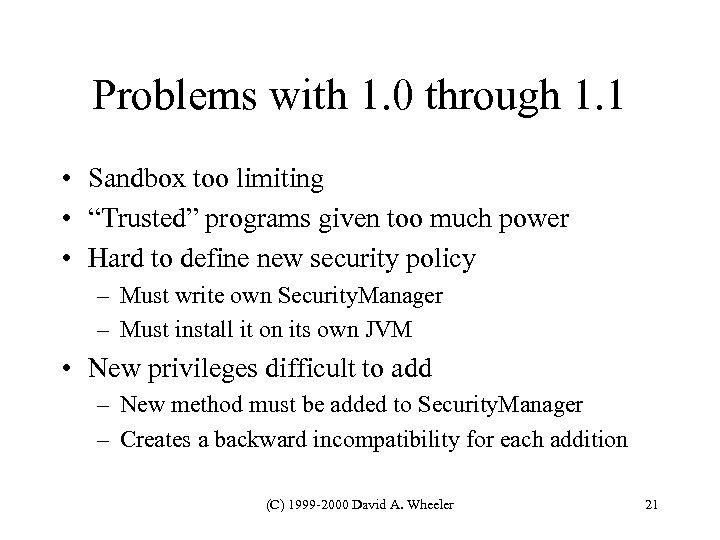 Problems with 1. 0 through 1. 1 • Sandbox too limiting • “Trusted” programs given too much power • Hard to define new security policy – Must write own Security. Manager – Must install it on its own JVM • New privileges difficult to add – New method must be added to Security. Manager – Creates a backward incompatibility for each addition (C) 1999 -2000 David A. Wheeler 21
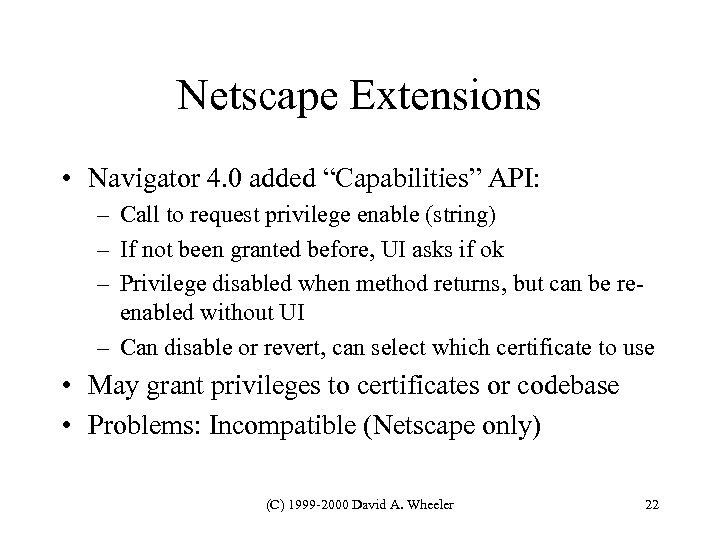 Netscape Extensions • Navigator 4. 0 added “Capabilities” API: – Call to request privilege enable (string) – If not been granted before, UI asks if ok – Privilege disabled when method returns, but can be reenabled without UI – Can disable or revert, can select which certificate to use • May grant privileges to certificates or codebase • Problems: Incompatible (Netscape only) (C) 1999 -2000 David A. Wheeler 22
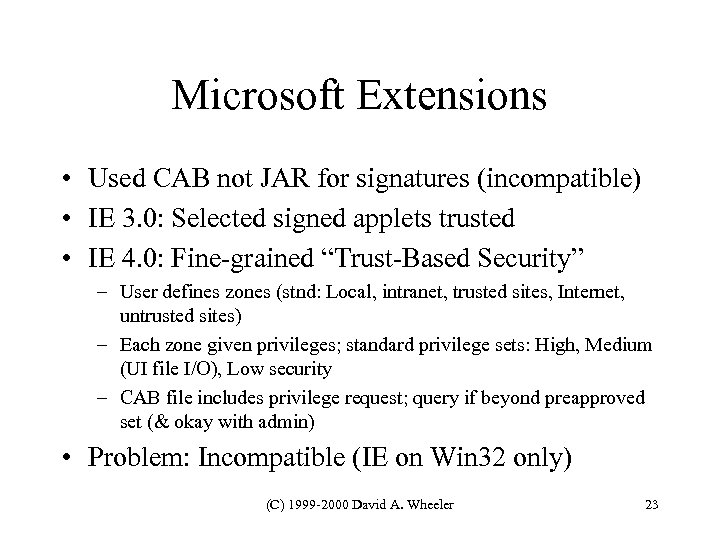 Microsoft Extensions • Used CAB not JAR for signatures (incompatible) • IE 3. 0: Selected signed applets trusted • IE 4. 0: Fine-grained “Trust-Based Security” – User defines zones (stnd: Local, intranet, trusted sites, Internet, untrusted sites) – Each zone given privileges; standard privilege sets: High, Medium (UI file I/O), Low security – CAB file includes privilege request; query if beyond preapproved set (& okay with admin) • Problem: Incompatible (IE on Win 32 only) (C) 1999 -2000 David A. Wheeler 23
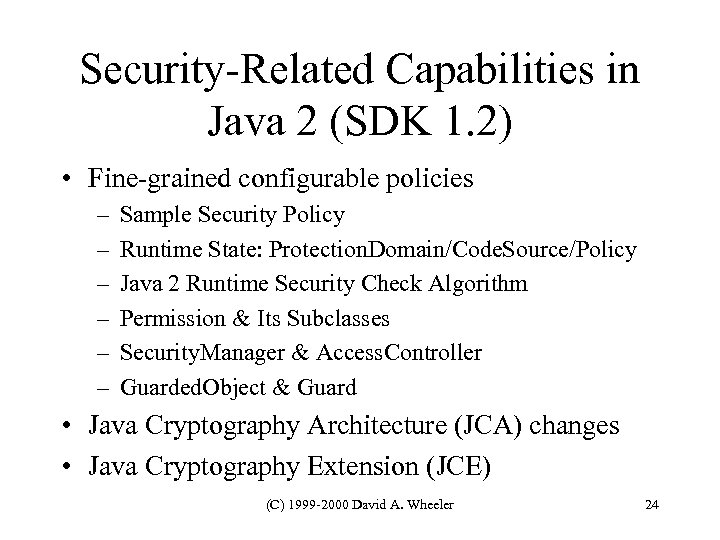 Security-Related Capabilities in Java 2 (SDK 1. 2) • Fine-grained configurable policies – – – Sample Security Policy Runtime State: Protection. Domain/Code. Source/Policy Java 2 Runtime Security Check Algorithm Permission & Its Subclasses Security. Manager & Access. Controller Guarded. Object & Guard • Java Cryptography Architecture (JCA) changes • Java Cryptography Extension (JCE) (C) 1999 -2000 David A. Wheeler 24
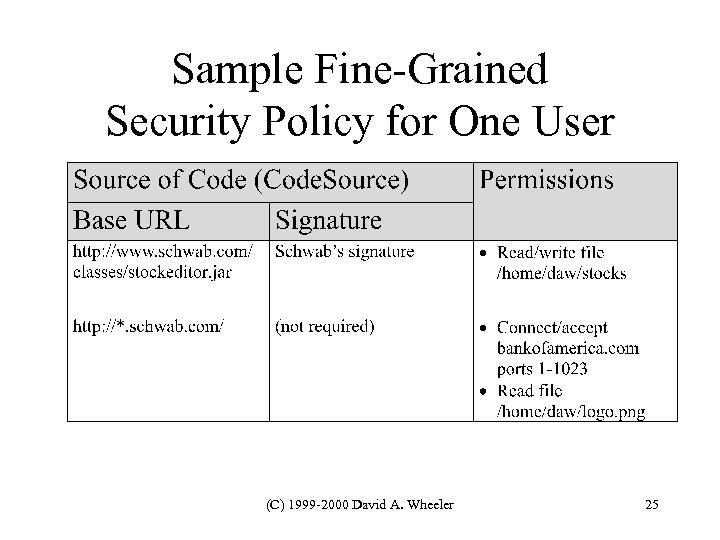 Sample Fine-Grained Security Policy for One User (C) 1999 -2000 David A. Wheeler 25
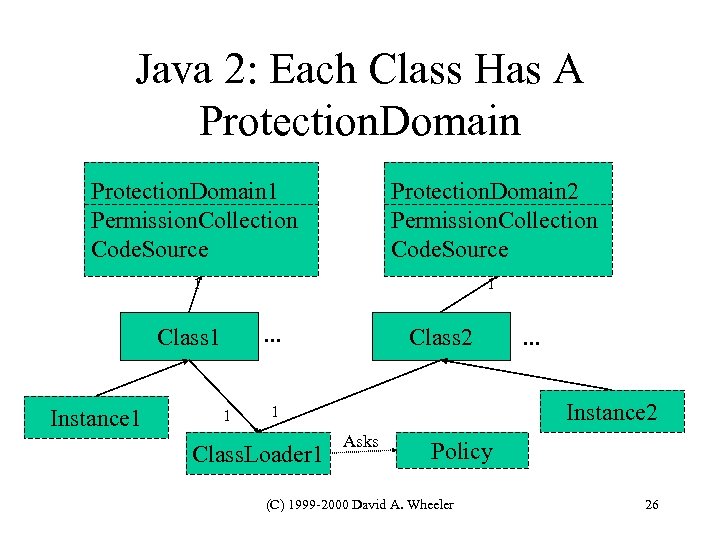 Java 2: Each Class Has A Protection. Domain 1 Permission. Collection Code. Source Protection. Domain 2 Permission. Collection Code. Source 1 1 . . . Class 1 Instance 1 1 Class 2 Instance 2 1 Class. Loader 1 . . . Asks Policy (C) 1999 -2000 David A. Wheeler 26
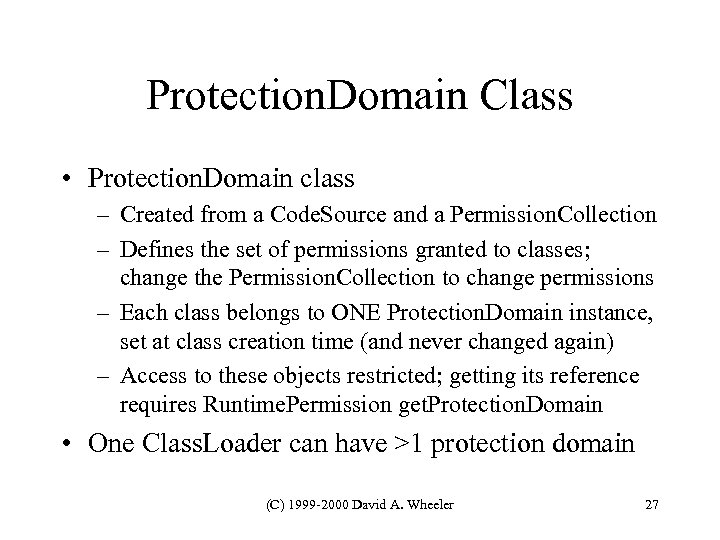 Protection. Domain Class • Protection. Domain class – Created from a Code. Source and a Permission. Collection – Defines the set of permissions granted to classes; change the Permission. Collection to change permissions – Each class belongs to ONE Protection. Domain instance, set at class creation time (and never changed again) – Access to these objects restricted; getting its reference requires Runtime. Permission get. Protection. Domain • One Class. Loader can have >1 protection domain (C) 1999 -2000 David A. Wheeler 27
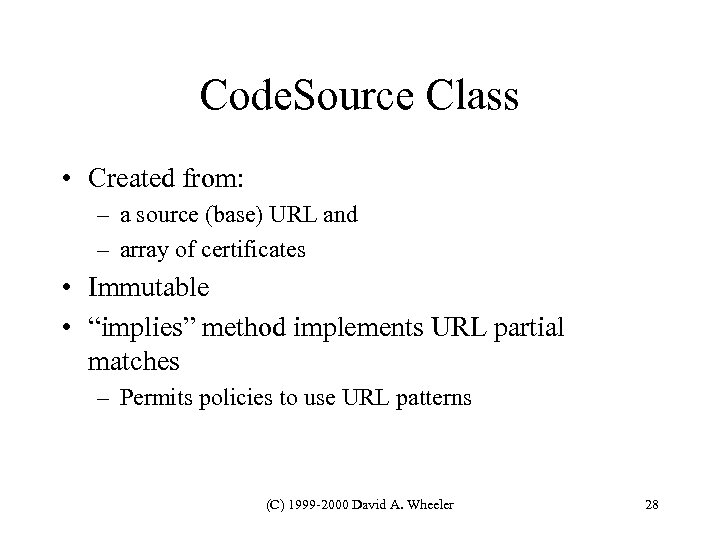 Code. Source Class • Created from: – a source (base) URL and – array of certificates • Immutable • “implies” method implements URL partial matches – Permits policies to use URL patterns (C) 1999 -2000 David A. Wheeler 28
 Policy Class • Provides interface to user policy – Given a Code. Source, returns a Permission. Collection – Used during setup of Protection. Domain to set a class’ permissions (C) 1999 -2000 David A. Wheeler 29
 How a Class and Protection. Domain Are Loaded 1. Loaded class C 1 requests an unloaded class C 2 2. C 1’s Class. Loader called, loads C 2’s class file, calls bytecode verifier 3. C 2’s Code. Source determined 4. Policy object given Code. Source, returns Permissions 5. If an existing Protection. Domain has same Code. Source & Permissions, reused, else new Protection. Domain created; C 2 assigned to it (C) 1999 -2000 David A. Wheeler 30
 Java 2 Runtime Security Check Algorithm • If method M requires permission P – M’s implementation calls current Security. Manager’s check. Permission(P) • By default this calls new “Access. Controller” class – – For each call stack entry, unwind from caller: if caller’s Protection. Domain lacks P, exception (fail) if caller called “do. Privileged” without context, return if caller called “do. Privileged” with context, check it: return if context permits P else exception (fail). (C) 1999 -2000 David A. Wheeler 31
 Examples of Algorithm At Work • Multiple Protection. Domains: – Instance 1 M 1 calls Instance 2 M 2 calls System 1 M 3 – System 1 M 3 (in System’s Protection. Domain) asks for a permission check – Permissions checked against the Protection. Domains for System 1, then Class 2, then Class 1 • do. Privileged call (without context): – Same example, but first System 1 M 3 calls do. Privileged – When permission check requested, Protection. Domain for System 1 checked and no others checked (C) 1999 -2000 David A. Wheeler 32
 Context • get. Context() takes a snapshot of current execution context (“stack trace”) – snapshot includes ancestor threads – stored in type Access. Control. Context – results can be stored & can used later to limit privileges (instead of enabling “all” privileges) • Purpose: support actions “on behalf of another” – one thread posts event to another – delayed actions (“cron” job) (C) 1999 -2000 David A. Wheeler 33
 Algorithm Implications • Default privileges are the intersection (minimum) of all class’ permissions in call tree – Without do. Privilege, permissions only decrease • “do. Privilege” enables “all” class’ privileges – Like Unix “setuid”; enables trusted classes to use their full set of privileges but only when requested – Without context enables all privileges – With context enables only those privileges also in given context; safe because resulting privileges always less than without context (C) 1999 -2000 David A. Wheeler 34
 Warning: Don’t Mix Protected Variables and Permission Checks • If a method M 1 is not overridden, the Protection. Domain of its defining superclass used • Methods running (even indirectly) with privilege shouldn’t depend on protected variables – Attacker creates subclass with new method M 2 – M 2 modifies protected variable used by M 1 – Cause M 1 to be invoked; M 1 influenced by M 2! • Identified by David A. Wheeler Oct 1999 – Have not seen this in the literature (C) 1999 -2000 David A. Wheeler 35
 Permission Class • Permission class – Encapsulates a permission granted or requested – Can be set “readonly” (from then on immutable) – Can be grouped using classes Permission. Collection and Permissions • This briefing’s terminology: – permissions granted to a Protection. Domain also called “privileges” – no separate “Privilege” class (C) 1999 -2000 David A. Wheeler 36
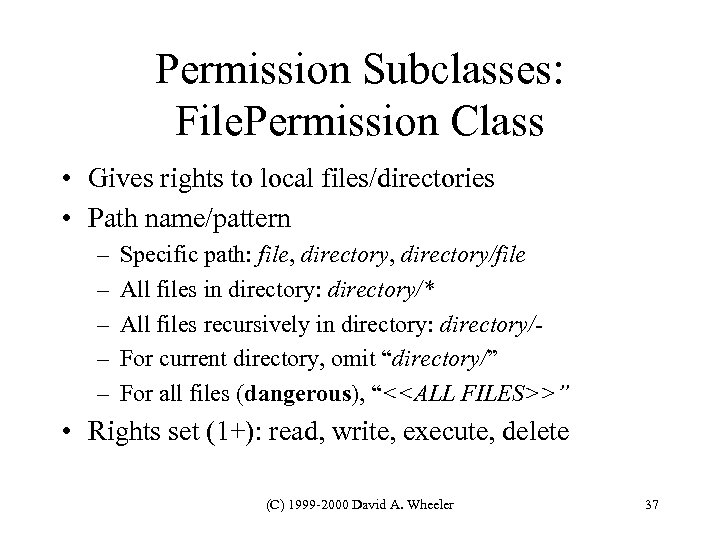 Permission Subclasses: File. Permission Class • Gives rights to local files/directories • Path name/pattern – – – Specific path: file, directory/file All files in directory: directory/* All files recursively in directory: directory/For current directory, omit “directory/” For all files (dangerous), “<
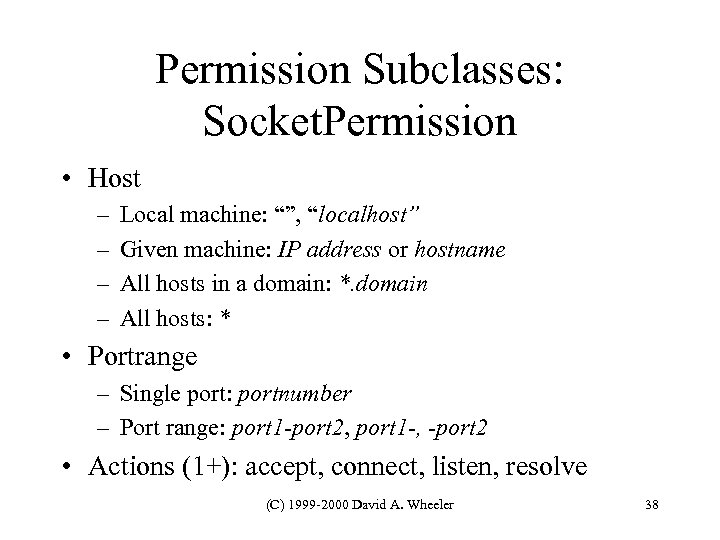 Permission Subclasses: Socket. Permission • Host – – Local machine: “”, “localhost” Given machine: IP address or hostname All hosts in a domain: *. domain All hosts: * • Portrange – Single port: portnumber – Port range: port 1 -port 2, port 1 -, -port 2 • Actions (1+): accept, connect, listen, resolve (C) 1999 -2000 David A. Wheeler 38
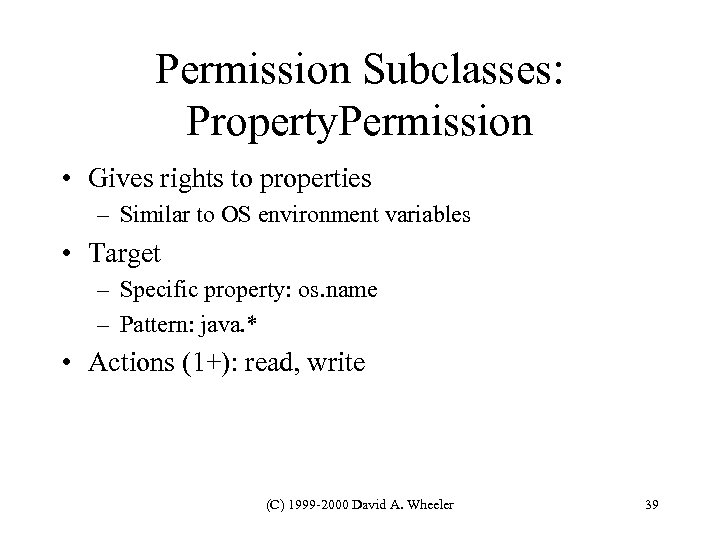 Permission Subclasses: Property. Permission • Gives rights to properties – Similar to OS environment variables • Target – Specific property: os. name – Pattern: java. * • Actions (1+): read, write (C) 1999 -2000 David A. Wheeler 39
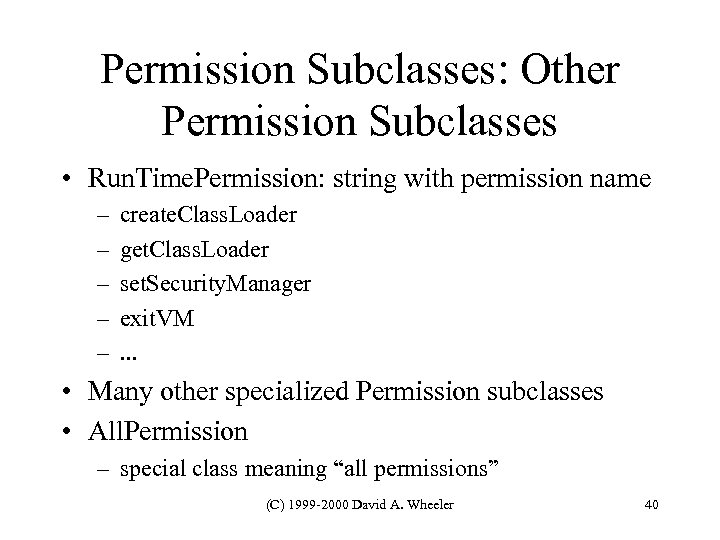 Permission Subclasses: Other Permission Subclasses • Run. Time. Permission: string with permission name – – – create. Class. Loader get. Class. Loader set. Security. Manager exit. VM. . . • Many other specialized Permission subclasses • All. Permission – special class meaning “all permissions” (C) 1999 -2000 David A. Wheeler 40
 Security. Manager Changes • New method check. Permission(P) – Throws exception if permission P not held, else returns – All previous “check” methods rewritten in terms of check. Permission – Permits creation of new Permissions without changing Security. Manager • By default, calls on Access. Controller class – Access. Controller implements the new algorithm (C) 1999 -2000 David A. Wheeler 41
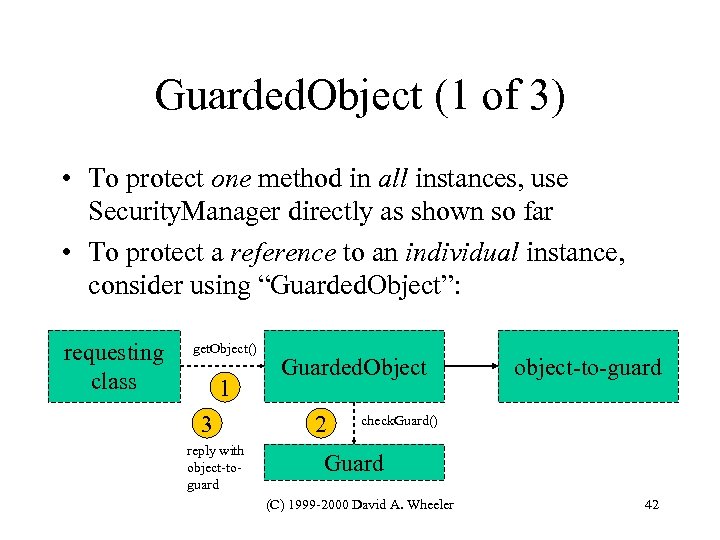 Guarded. Object (1 of 3) • To protect one method in all instances, use Security. Manager directly as shown so far • To protect a reference to an individual instance, consider using “Guarded. Object”: requesting class get. Object() 1 3 reply with object-toguard Guarded. Object 2 object-to-guard check. Guard() Guard (C) 1999 -2000 David A. Wheeler 42
 Guarded. Object (2 of 3) • Guarded. Object class encapsulates object-to-guard – asks “Guard” interface to determine if access ok – Permission implements Guard by calling Security. Manager. check. Permission(self) – Permission. Collection doesn’t implement (I’ve reported) • Provider of object-to-guard does the following: – Instantiates new Guard (e. g. , a Permission) – Instantiates Guarded. Object, using object-to-guard and the guard – Gives Guarded. Object’s reference to requestors (C) 1999 -2000 David A. Wheeler 43
 Guarded. Object (3 of 3) • Clients who wish to use object-to-guard call Guarded. Object’s get. Object() – Guarded. Object instance calls its Guard’s check. Guard() – if ok, object-to-guard’s reference returned – if not ok, security exception thrown (C) 1999 -2000 David A. Wheeler 44
 Java Cryptography Architecture (JCA) Changes in 1. 2 • Adds more APIs that providers can support – – – Keystore creation and management Algorithm parameter generation Conversions between different key representations Certificate factory support to generate certificates and certificate revocation lists (CRLs) from their encodings (Sun implements X. 509’s) – Random-number generation (RNG) algorithm (C) 1999 -2000 David A. Wheeler 45
 Java Cryptography Extension (JCE) • Adds encryption, key exchange, key generation, message authentication code (MAC) – Multiple “providers” supported – Keys & certificates in “keystore” database • Separate due to export control (C) 1999 -2000 David A. Wheeler 46
 Other Areas In Development: JSSE and JAAS • Java Secure Socket Extension – Implements SSL • Java Authentication and Authorization Service – Based on PAM: pluggable authenticators for passwords, smart cards, biometric devices, etc. – Authenticators may be required, requisite (stop on failure), sufficient (but not required), or optional – Adds user-centric (vs. code-centric) control: permissions granted to Principal (not just Code. Source), implemented through a modified Security. Manager (C) 1999 -2000 David A. Wheeler 47
 Past Java Security Breaches (1 of 2) • 8 Serious Breaches listed in Java Security (1997) – “Jumping the Firewall” (DNS interaction) – “Slash and Burn” (slash starts classname) – “Applets running wild” (evil class loader installed and creates type confusion) – “Casting Caution” (failed to test if method private, type casting) – “Tag-Team Applets” (create type confusion) (C) 1999 -2000 David A. Wheeler 48
 Past Java Security Breaches (2 of 2) – “You’re not my type” (flaw in array implementation type confusion) – “Casting Caution #2” (as before, but in a loop test wasn’t repeated) – “Big Attacks Come in Small Packages” (untrusted code could be loaded into sensitive packages, e. g. com. ms, and gain their privileges) • Others have been announced since – See http: //java. sun. com/sfaq/chronology. html – Many are problems in bytecode verifier or classloader (C) 1999 -2000 David A. Wheeler 49
 Malicious Applets (Staying Within the Sandbox) • Denial of Service – Deny platform use (busy threads, loop, exhaust GUI resources) – Kill other threads • • Invasion of Privacy Annoyance: constant sound Flashing display (causes seizures in some users) Steal CPU cycles (e. g. crack encryption) (C) 1999 -2000 David A. Wheeler 50
 Java Advantages • Permits controlled execution of less trusted code (vs. Active. X) • Permits fine-grained permission control • Attention paid to security • Portability • “Instant installation” • Sun’s source reviewable (not open source) (C) 1999 -2000 David A. Wheeler 51
 Java Security Disadvantages (1 of 3) • Hard to prove correct – complex from security point-of-view – rapidly expanding/changing – VM+libraries lacks formal security model • Many internal interdependencies (vs. reference monitors); often breaks “all the way” • Complex dependencies on other systems – OS, browsers, network (DNS), PKI (C) 1999 -2000 David A. Wheeler 52
 Java Security Disadvantages (2 of 3) • Applets evade many security measures (e. g. most firewalls) • Breaches demonstrated • Many areas immature • No standardized auditing (MS extension) • Simplifies reverse engineering of code (problem? ) • Poor performance may encourage securityweakening “shortcuts” (C) 1999 -2000 David A. Wheeler 53
 Java Security Disadvantages (3 of 3) • Weak against denial-of-service & nuisances • Insecure implementation defaults (e. g. null Class. Loader or Security. Manager) • Security policy management too complex for endusers and weak administrative support • Flexible policies accepted by users may permit hidden breaching interactions (C) 1999 -2000 David A. Wheeler 54
 Key Points • Progression of Access Control Flexibility – JDK 1. 0: Sandbox + total trust of local applications – JDK 1. 1: Above + optional total trust with signature – SDK 1. 2: Above + Fine-grained access control • Java 2 Protection. Domains – Checks call tree, by default intersection of permissions – do. Privilege permits permissions to be re-enabled • Guarded. Object to protect specific objects (C) 1999 -2000 David A. Wheeler 55
 Useful References • Li Gong, Inside Java 2 Platform Security, 1999, Palo Alto, CA: Addison-Wesley. • G. Mc. Graw & E. Felten, Java Security: Hostile Applets, Holes, and Antidotes, 1997, NY: John Wiley & Sons. • G. Mc. Graw & E. Felten, Securing Java: Getting Down to Business with Mobile Code, 1999, NY: John Wiley & Sons, http: //www. securingjava. com (C) 1999 -2000 David A. Wheeler 56
 Useful Websites • Sun’s Java website: http: //java. sun. com • Existing Java programs/info available at: – http: //www. gamelan. com – http: //www. jars. com (Java Applet Rating Service) • RST’s Java Security Hotlist – http: //www. rstcorp. com/javasecurity/links. html (C) 1999 -2000 David A. Wheeler 57
 About this Briefing • This briefing is at: http: //www. dwheeler. com • This entire briefing is GPL’ed: – (C) 1999 -2000 David A. Wheeler. – This information is free information; you can redistribute it and/or modify it under the terms of the GNU General Public License (GPL) as published by the Free Software Foundation; either version 2 of the license, or (at your option) any later version. This information is distributed in the hope that it will be useful, but WITHOUT ANY WARRANTY; without even the implied warranty of MERCHANTABILITY or FITNESS FOR A PARTICULAR PURPOSE. See the GNU GPL for more details. You should have received a copy of the GNU GPL along with this information; if not, see http: //www. fsf. org/copyleft/gpl. txt or write to the Free Software Foundation, Inc. , 59 Temple Place, Suite 330, Boston, MA 02111 -1307 (C) 1999 -2000 David A. Wheeler 58
 Backup Slides (C) 1999 -2000 David A. Wheeler 59
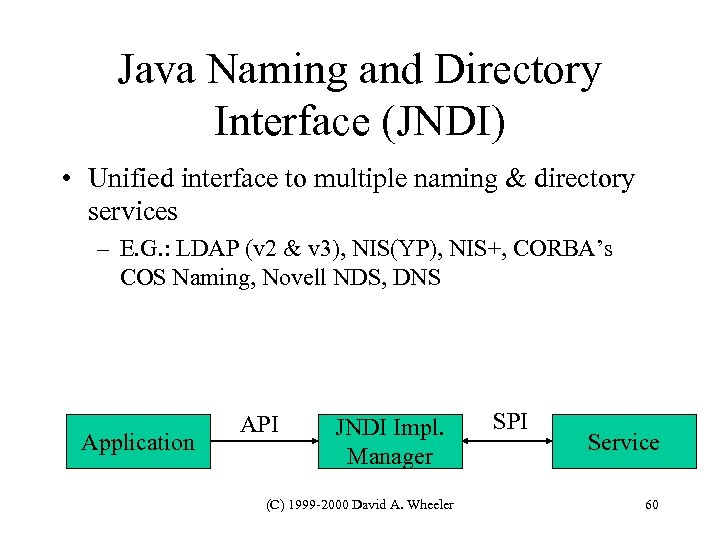 Java Naming and Directory Interface (JNDI) • Unified interface to multiple naming & directory services – E. G. : LDAP (v 2 & v 3), NIS(YP), NIS+, CORBA’s COS Naming, Novell NDS, DNS Application API JNDI Impl. Manager (C) 1999 -2000 David A. Wheeler SPI Service 60
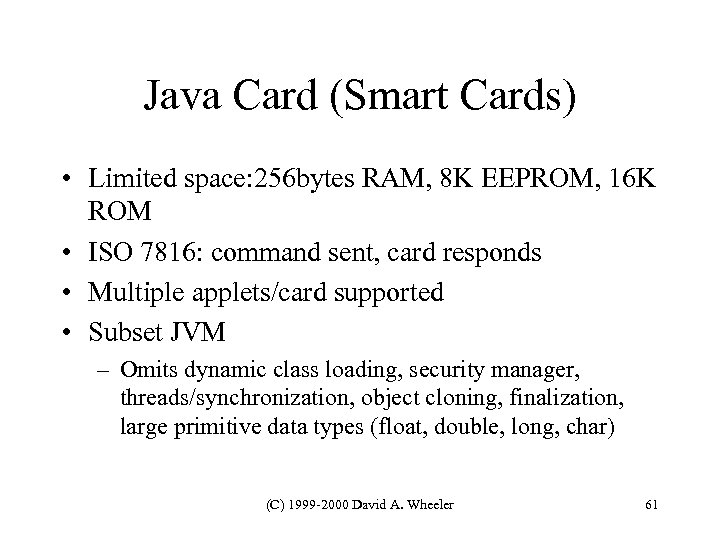 Java Card (Smart Cards) • Limited space: 256 bytes RAM, 8 K EEPROM, 16 K ROM • ISO 7816: command sent, card responds • Multiple applets/card supported • Subset JVM – Omits dynamic class loading, security manager, threads/synchronization, object cloning, finalization, large primitive data types (float, double, long, char) (C) 1999 -2000 David A. Wheeler 61