


 Скачать презентацию JASPA 2010 Summer Institute Making the committment Case
1857443981bb38b0f05391e65df09d0e.ppt
- Количество слайдов: 29
 JASPA 2010 Summer Institute Making the committment: Case studies highlighting the need for partnerships and collaboration in order to effectively accommodate students with disabilities Neal E. Lipsitz, Ph. D. Associate Dean for Student Development College of the Holy Cross July 22, 2010
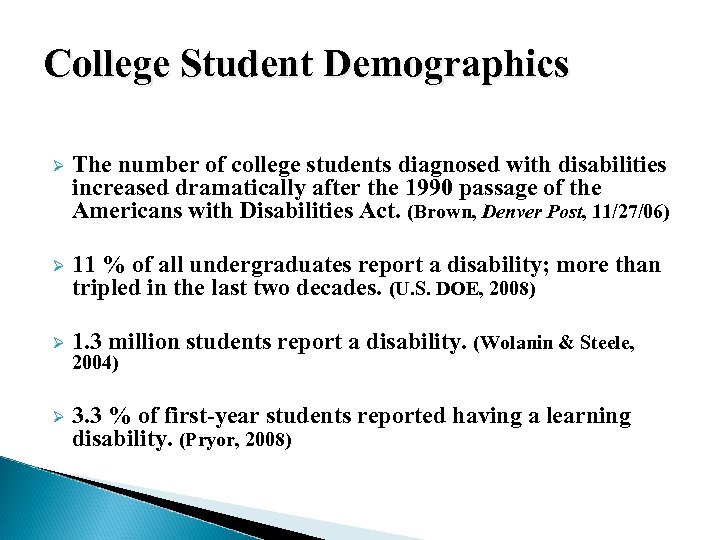 College Student Demographics Ø The number of college students diagnosed with disabilities increased dramatically after the 1990 passage of the Americans with Disabilities Act. (Brown, Denver Post, 11/27/06) Ø 11 % of all undergraduates report a disability; more than tripled in the last two decades. (U. S. DOE, 2008) Ø 1. 3 million students report a disability. (Wolanin & Steele, Ø 3. 3 % of first-year students reported having a learning disability. (Pryor, 2008) 2004)
![College Student Demographics Ø 24% percent reported mental illness/depression [up from 17% in 2000].](https://present5.com/presentation/1857443981bb38b0f05391e65df09d0e/image-3.jpg "College Student Demographics Ø 24% percent reported mental illness/depression [up from 17% in 2000].") College Student Demographics Ø 24% percent reported mental illness/depression [up from 17% in 2000]. (U. S. DOE, 2008) Ø Significant increases were also reported for attention deficit disorder (19% vs. 6%) with a smaller increase in learning disabilities (9% vs. 5%). (U. S. DOE, 2008) Ø In the past 15 years, depression has doubled and suicide tripled. (ADAA, 2008) Ø Six out of 10 students report having felt so stressed they couldn’t get their work done on one or more occasions. (ADAA, 2008)
College Student Demographics Ø 24% percent reported mental illness/depression [up from 17% in 2000]. (U. S. DOE, 2008) Ø Significant increases were also reported for attention deficit disorder (19% vs. 6%) with a smaller increase in learning disabilities (9% vs. 5%). (U. S. DOE, 2008) Ø In the past 15 years, depression has doubled and suicide tripled. (ADAA, 2008) Ø Six out of 10 students report having felt so stressed they couldn’t get their work done on one or more occasions. (ADAA, 2008)
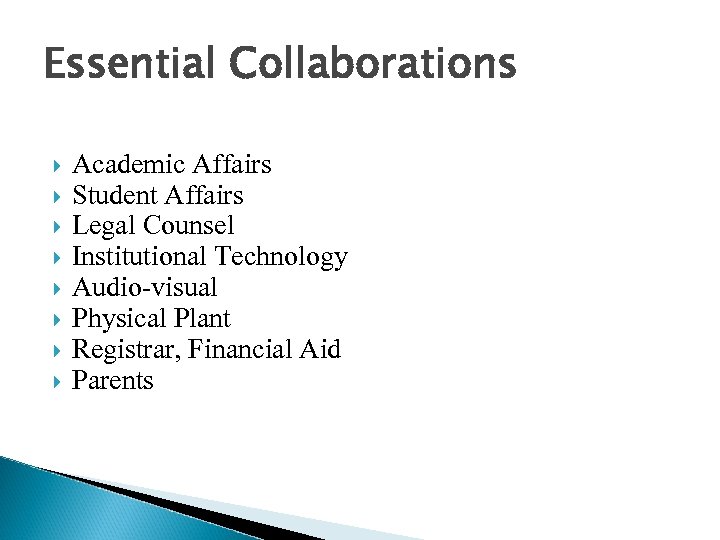 Essential Collaborations Academic Affairs Student Affairs Legal Counsel Institutional Technology Audio-visual Physical Plant Registrar, Financial Aid Parents
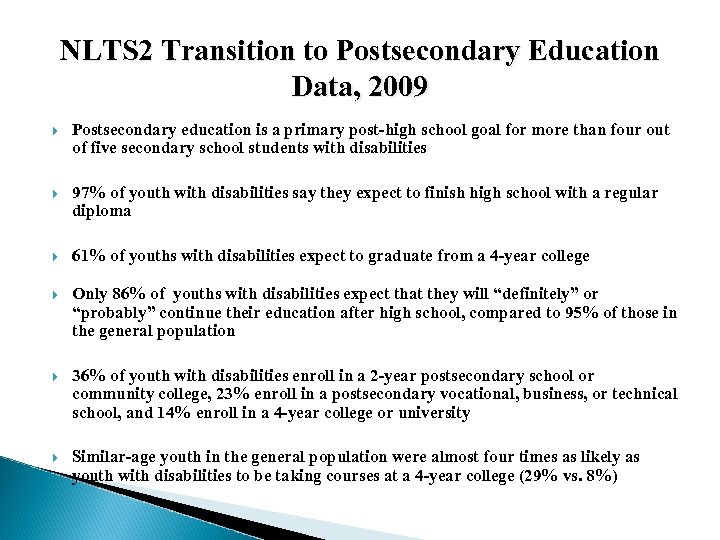 NLTS 2 Transition to Postsecondary Education Data, 2009 Postsecondary education is a primary post-high school goal for more than four out of five secondary school students with disabilities 97% of youth with disabilities say they expect to finish high school with a regular diploma 61% of youths with disabilities expect to graduate from a 4 -year college Only 86% of youths with disabilities expect that they will “definitely” or “probably” continue their education after high school, compared to 95% of those in the general population 36% of youth with disabilities enroll in a 2 -year postsecondary school or community college, 23% enroll in a postsecondary vocational, business, or technical school, and 14% enroll in a 4 -year college or university Similar-age youth in the general population were almost four times as likely as youth with disabilities to be taking courses at a 4 -year college (29% vs. 8%)
 Americans with Disabilities Act (ADA) Emerged from Civil Rights Act of 1964 in conjunction with laws protecting the rights of women and older Americans The ADA is a civil rights act and not an entitlement program like the Individual with Disabilities Education Act (IDEA; 1975. PL 101 -476) It is a statute of the Department of Justice
 ADA Title III – Public Accommodations “…no individual shall be discriminated against on the basis of disability in the full and equal enjoyment of the goods, services, facilities, privileges, advantages, or accommodations of any place of public accommodation by any person who owns, leases (or leases to), or operates a place of public accommodation. ”
 Definition of a Disability A physical or mental impairment that substantially limits one or more major life activities, a record of such impairment, or being regarded as having such an impairment. The impairment must “substantially limit” the student’s ability to participate in and/or benefit from the educational programs and services of the college. Substantial limitation is determined by the nature of the impairment, the impact on major life activities, and the student’s current abilities and limitations.
 Major Life Activities The Amendments expands Section 504’s original non-inclusive list of major life activities so that it clearly includes major bodily functions such as normal cell growth, digestive, bowel, bladder, neurological, brain, respiratory, circulatory, endocrine, immune system; and reproductive functions. Additionally it expands the more familiar list of activities (caring for oneself, performing manual tasks, seeing, hearing, eating, sleeping, walking, standing, lifting, bending, speaking, breathing, learning, reading, communicating, and working) by adding concentrating and thinking.
 Conditions that Cannot be Legal Disabilities Common personality traits such as poor judgment or quick temper that are not the result of a medically diagnosed mental or physiological disorder Environmental, cultural, or economic disadvantage Advanced age or other personal attributes such as having red hair or being left-handed Compulsive gambling Kleptomania Pyromania Psychoactive substance abuse disorders caused by current, illegal use of drugs Most sexual behavior disorders not resulting from a physical impairment, including transvestitism, pedophilia, exhibitionism, and voyeurism Current drug abuse
 ADA guarantees that individuals with disabilities who would otherwise be qualified will not be denied access to work and educational opportunities It is an outcome-neutral law that ensures access but not necessarily success There is an emphasis on equal opportunity rather than optimizing academic performance or guaranteeing success
 Essential Academic Requirements Students must meet the essential academic requirements of the College If a student’s disability limits their ability to meet essential requirements, the College will not be considered discriminatory in insisting s/he fulfill these requirements This highlights the need formal and documented accommodations to ensure that a student is qualified to meet essential requirements
 Modifications to Curriculum and Teaching Faculty are not required to fundamentally alter the nature and content of their courses Faculty are not required to make accommodations that will have an adverse impact on the academic integrity of courses However, modifications that provide equal access must be and should be made (e. g. , extended time, substitutions, course adaptations)
 The Role of Disability Services To ensure that the College is providing access to students with disabilities To assist the College in applying standards set by The Americans with Disabilities Act and Section 504 legislation To review documentation that supports a student’s claim of disability status To support students with disabilities To make recommendations with respect to necessary and reasonable accommodations to faculty and staff
 Court Cases Sutton vs. United Airlines Toyota Mfg. vs. Williams
 ADA Amendments 1/1/09 “This bill better defines who Congress intends to meet the definition of disabled. It clarifies that mitigating measures, such as medication, may not be taken into account. It provides guidance as to what is a major life activity. And, most critically, it lowers the threshold for how limiting a condition must be, and insists that courts interpret the ADA broadly. For all these reasons, this bill returns the focus of the ADA to where it was meant to be – on whether a person with a disability is being discriminated against. ” http: //harkin. senate. gov/blog/? i=f 0 b 8 bd 21 -242 b-4058 bf 5 a-3 dd 134 ad 0045 Harkin Statement On House Passage Of The ADA Amendments Act And, I would add – to assure that individuals with disabilities are receiving reasonable accommodations.
 Physical Impairments Physical disabilities include any physiological disorder or condition, cosmetic disfigurement or anatomical loss affecting one or more body systems, including: neurological, musculoskeletal, special sense organs, respiratory (including speech organs), cardiovascular, reproductive, digestive, genitourinary, hemic and lymphatic, skin or endocrine Physical impairments also include medical conditions such as dietary limitations, allergies, or asthma
 Mental Impairments Any mental or psychological disorder such as mental retardation, organic brain syndrome, emotional or mental illness, and specific cognitive or learning disabilities Learning disabilities cause individuals to experience difficulties in learning, remembering, and communicating information. Common types of learning disabilities include; dyslexia and speech impairments
 Invisible Impairment Disabilities that are not immediately apparent to others 10% of people in the United States have a medical condition that is considered to be an invisible disability Examples: Extreme fatigue, weakness, pain, dizziness
 The Accommodation Process Students must first notify the College that they have a disability Students must provide formal and specific documentation as to the nature of the disability and the functional limitations The determination of a disability that qualifies a student for accommodations is a legal one, and not a medical one, and is based on a number of factors
 Symptoms of Asperger Syndrome Social problems: eye contact, conversations, interpersonal distance, social awareness Behavioral problems: preoccupation with objects or ideas, mannerisms, clumsiness Language problems: background noise, pragmatics (tone, volume, pitch, prosody), emotional/interpersonal Sensory overload Can coincide with other psychiatric diagnoses
 Accommodations Extra time on tests Occasional extension of due dates Note taker Use of computer during class, for exams Referral to Academic Services and Learning Resources for organizational skill building and time management Additional time to respond orally or another option (see professor after class or write contributions down and submit) E-texts
 Necessary Collaborations Admissions Parents Academic Affairs (Class Dean, Individual Faculty, Department Chairs, Academic Advisor) Academic Services and Learning Resources Student Affairs (Housing, Counseling, Health, Public Safety, Orientation) Registrar, Financial Aid Legal Counsel Physical Plant
 Right to Accommodations Students do not have the right to accommodations just because they ask for them The College has the right to insist that students follow the published procedures for requesting accommodations Faculty can compromise the process by giving informal accommodations that have not been recommended by the Office of Disability Services
 Confidentiality at the College Students have a right to confidentiality in the handling of their medical information Disability Services informs the class dean that a student has met the eligibility criteria for a documented disability that warrants accommodations and outlines the specific accommodations The class dean then informs faculty members of the recommended accommodations Students are asked to follow up with professors
 Roles and Responsibilities of Faculty Members Be sure that accommodations are recommended and approved by the Office of Disability Services Be supportive of students with disabilities and be protective of their right to confidentiality Contact the Office with any questions or concerns regarding a student’s disability status or accommodations
 References Blanco, C. , et. al. (2008). Mental health of college students and their non-collegeattending peers. Arch Gen Psychiatry. 65(12): 1429 -1437. Brown, Jennifer. "More Colleges Helping with Disabilities. " The Denver Post, 27 Nov. 2006. Gordon, M. & Keiser, S. (2000). Accommodations in higher education under the Americans with Disabilities Act. NY: Guilford Press. Heyward, S. M. (2002). Faculty disability services handbook. Heyward, Lawton & Associates, Sagamore Beach, MA. Kadison, R. and Di. Geronimo, T. F. (2005). College of the overwhelmed: The campus Mental health crisis and what to do about it. San Francisco: Jossey-Bass. Leadership 21 Committee. (2008). Campus mental health know your rights: A guide for students who want to seek help for mental illness or emotional distress. Judge David L. Bazelon Center for Mental Health Law: Washington, DC. Pryor, J. H. , et. al. (2008). The American Freshman: National Norms Fall 2008. Higher Education Research Institute: Los Angeles.
 References Tartakovsky, Margarita. "Depression and Anxiety Among College Students" Psych Central - http: //psychcentral. com/lib/2008/depression-and-anxiety-among-collegestudents/. The Post-High School Outcomes of Youth with Disabilities up to 4 Years After High School. A Report from the National Longitudinal Transition Study-2 (NLTS 2) (NCSER 2009 -3017), by L. Newman, M. Wagner, R. Cameto, and A. -M. Knokey. (Menlo Park, CA: SRI International). Developed for Current Status of Transition of Students with Disabilities to Postsecondary Education, by S. F. Shaw. Wallace, J. E. & Hackett, R. E. (2004). Students with disabilities. Bowditch & Dewey, Worcester, MA. Wei, C. C. , Berkner, L. , He, S. , Cominde, M. , and Siegel, P. (2009). 2007 -08 National Postsecondary Student Aid Study (NPSAS: 08): Student Financial Aid Estimates for 2007 -2008: First Look (NCES 2009 -166). National Center for Education Statistics, Institute of Education Sciences, U. S. Department of Education. Washington, D. C. Wolanin, T. R. and Steele, P. E. (2004). Higher education opportunities for students with disabilities: A primer for policymakers. The Institute for Higher Education Policy Washington, DC.
 References www. adaa. orgfinding-help/helping-others/college-students/facts ww. ahead. org www. holycross. edu/disability_services/