


 Скачать презентацию Japanese Reanalysis JRA-25 and JRA-55 H Kamahori 1
108870b82a02f11c96d12bedd6d0f60c.ppt
- Количество слайдов: 36
 Japanese Reanalysis JRA-25 and JRA-55 H. Kamahori 1, A. Ebita 2, S. Kobayashi 2, Y. Ota 2, M. Moriya 2, R. Kumabe 2, K. Onogi 2, Y. Harada 2, S. Yasui 2, K. Miyaoka 2, K. Takahashi 2, C. Kobayashi 1, H. Endo 1, M. Soma 2, Y. Oikawa 2, T. Ishimizu 2 1 MRI, 2 JMA
 Overview of JRA-25 Japanese 25 -years Reanalysis • Long range reanalysis based on JMA's operational global assimilation system • Joint Project by JMA and CRIEPI • Target Period : 1979 -2004 • Completed in 2005 • Continued as operational JCDAS after 2005
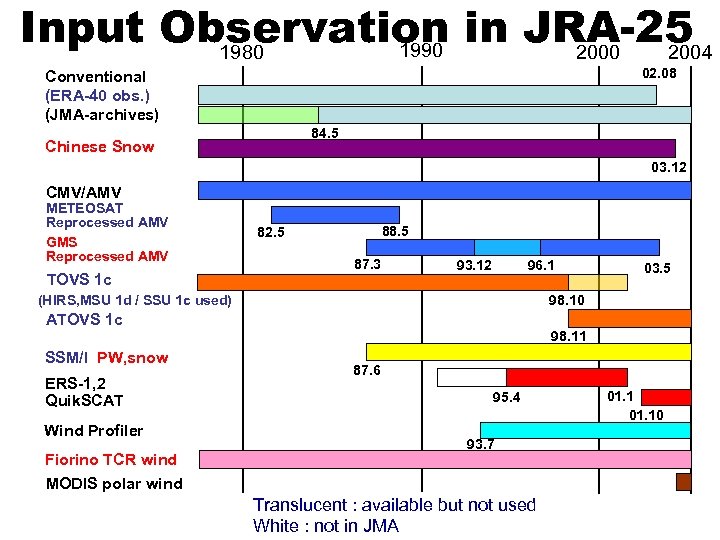 Input Observation in JRA-25 1990 1980 2004 02. 08 Conventional (ERA-40 obs. ) (JMA-archives) 84. 5 Chinese Snow 03. 12 CMV/AMV METEOSAT Reprocessed AMV GMS Reprocessed AMV TOVS 1 c 88. 5 82. 5 87. 3 96. 1 93. 12 (HIRS, MSU 1 d / SSU 1 c used) 98. 10 ATOVS 1 c SSM/I PW, snow ERS-1, 2 Quik. SCAT Wind Profiler Fiorino TCR wind 03. 5 98. 11 87. 6 95. 4 93. 7 MODIS polar wind Translucent : available but not used White : not in JMA 01. 10
 Performance of JRA-25 • • Tropical Cyclones Global Temperature Forecast Score as initial state of JRA-25 Global Precipitation
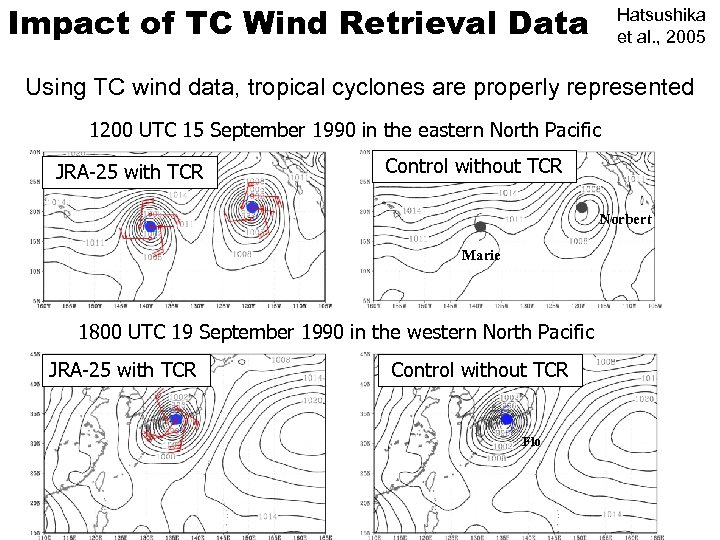 Impact of TC Wind Retrieval Data Hatsushika et al. , 2005 Using TC wind data, tropical cyclones are properly represented 1200 UTC 15 September 1990 in the eastern North Pacific JRA-25 with TCR Control without TCR Norbert Marie 1800 UTC 19 September 1990 in the western North Pacific JRA-25 with TCR Control without TCR Flo
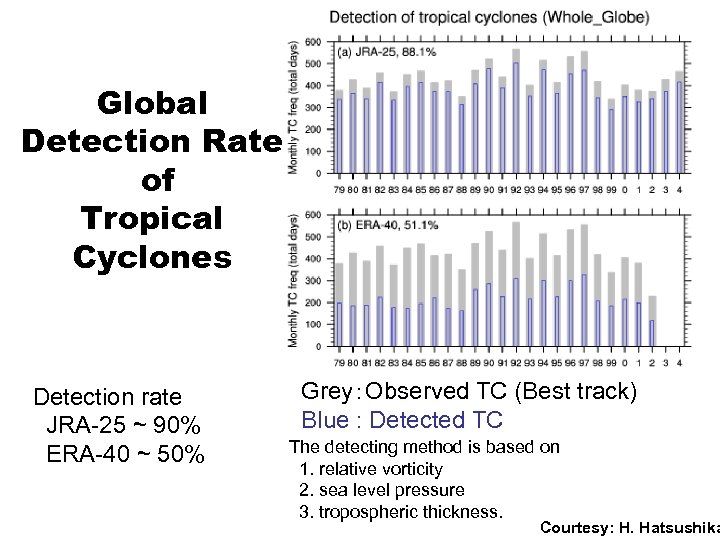 Global Detection Rate of Tropical Cyclones Detection rate JRA-25 ~ 90% ERA-40 ~ 50% Grey:Observed TC (Best track) Blue : Detected TC The detecting method is based on 1. relative vorticity 2. sea level pressure 3. tropospheric thickness. Courtesy: H. Hatsushika
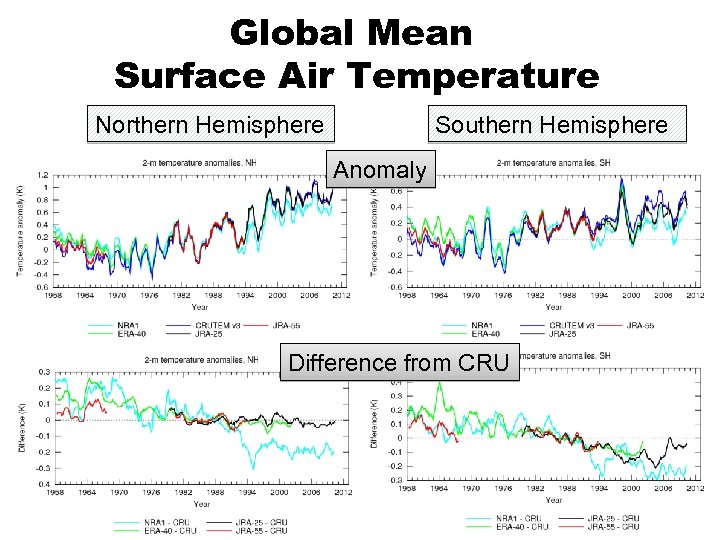
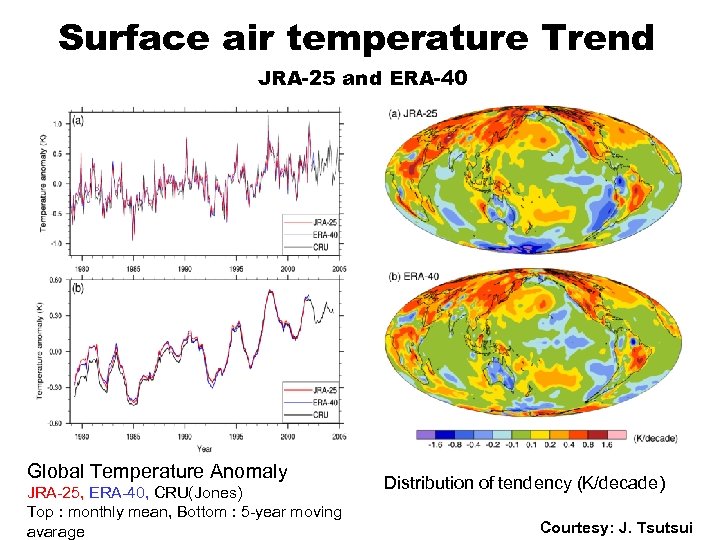 Surface air temperature Trend JRA-25 and ERA-40 Global Temperature Anomaly JRA-25, ERA-40, CRU(Jones) Top : monthly mean, Bottom : 5 -year moving avarage Distribution of tendency (K/decade) Courtesy: J. Tsutsui
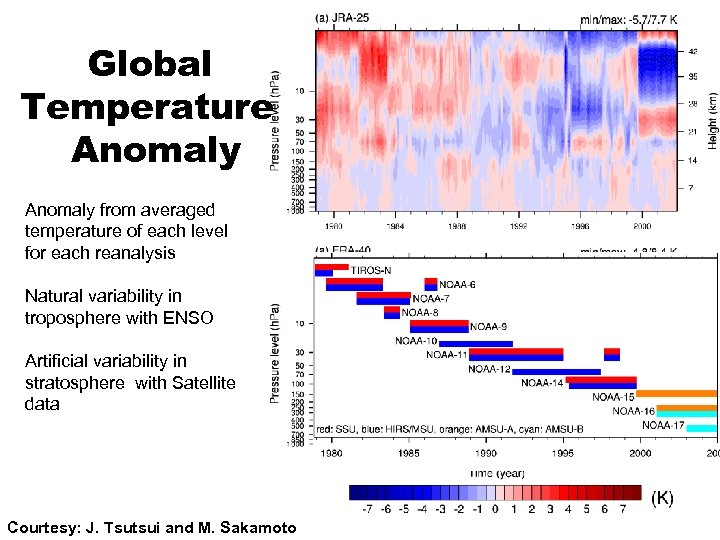 Global Temperature Anomaly from averaged temperature of each level for each reanalysis Natural variability in troposphere with ENSO Artificial variability in stratosphere with Satellite data 8 Courtesy: J. Tsutsui and M. Sakamoto
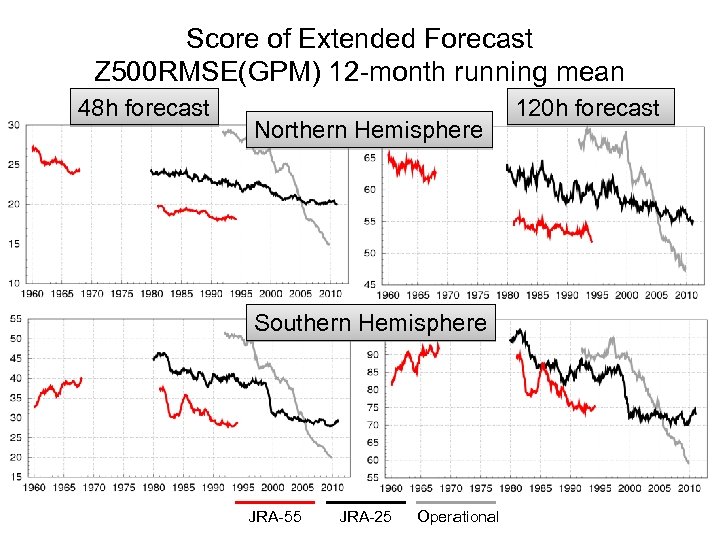
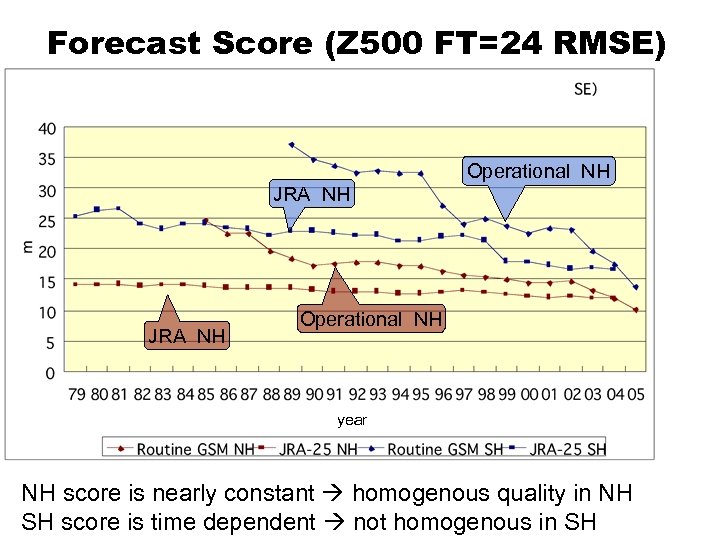 Forecast Score (Z 500 FT=24 RMSE) Operational NH JRA NH Operational NH year NH score is nearly constant homogenous quality in NH SH score is time dependent not homogenous in SH
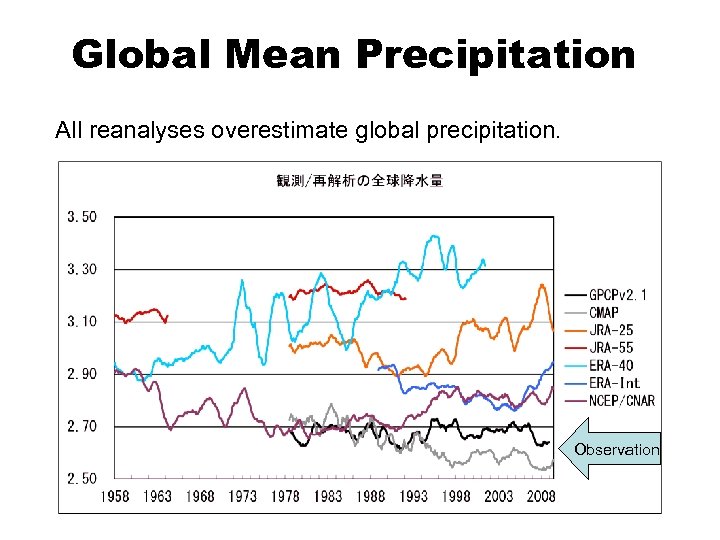
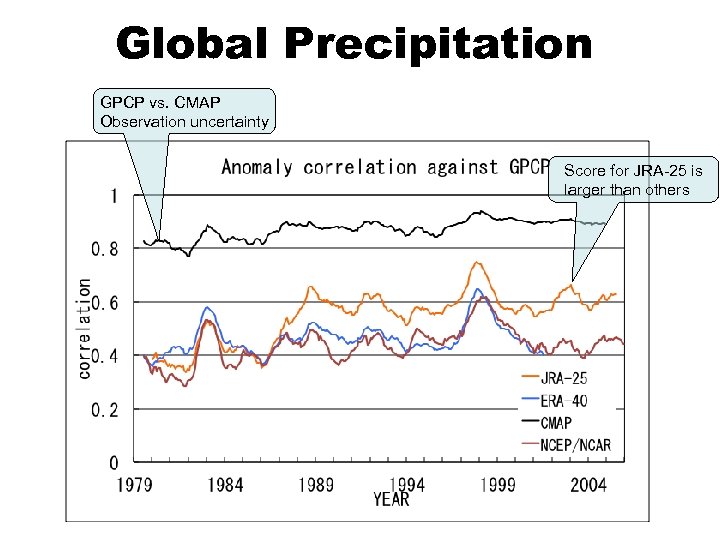 Global Precipitation GPCP vs. CMAP Observation uncertainty Score for JRA-25 is larger than others
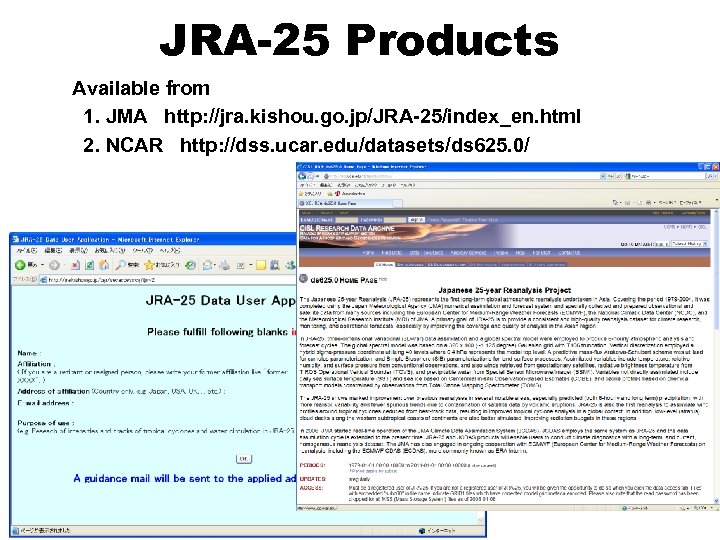 JRA-25 Products Available from 1. JMA http: //jra. kishou. go. jp/JRA-25/index_en. html 2. NCAR http: //dss. ucar. edu/datasets/ds 625. 0/
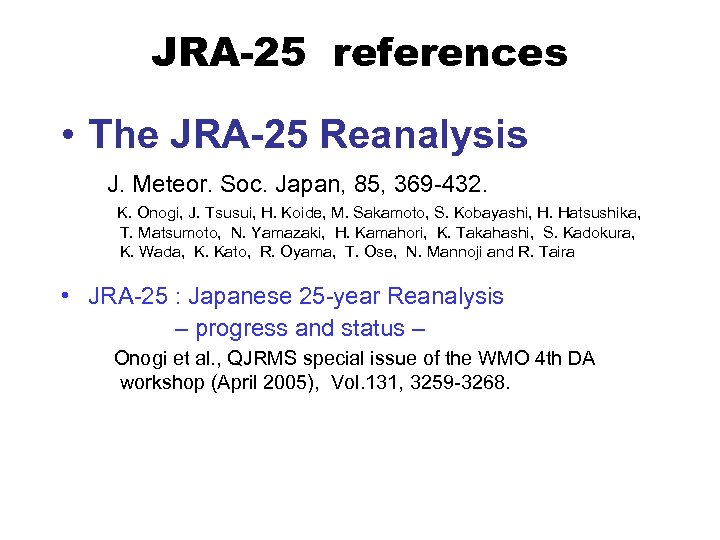 JRA-25 references • The JRA-25 Reanalysis J. Meteor. Soc. Japan, 85, 369 -432. K. Onogi, J. Tsusui, H. Koide, M. Sakamoto, S. Kobayashi, H. Hatsushika, T. Matsumoto, N. Yamazaki, H. Kamahori, K. Takahashi, S. Kadokura, K. Wada, K. Kato, R. Oyama, T. Ose, N. Mannoji and R. Taira • JRA-25 : Japanese 25 -year Reanalysis – progress and status – Onogi et al. , QJRMS special issue of the WMO 4 th DA workshop (April 2005), Vol. 131, 3259 -3268.
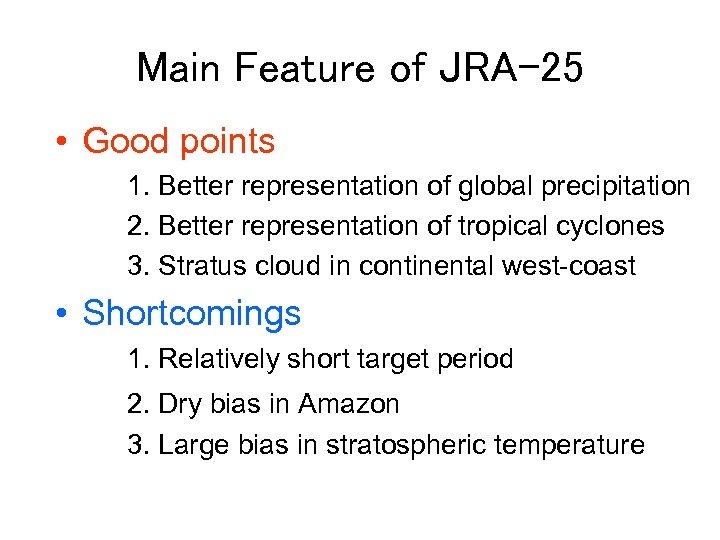 Main Feature of JRA-25 • Good points 1. Better representation of global precipitation 2. Better representation of tropical cyclones 3. Stratus cloud in continental west-coast • Shortcomings 1. Relatively short target period 2. Dry bias in Amazon 3. Large bias in stratospheric temperature
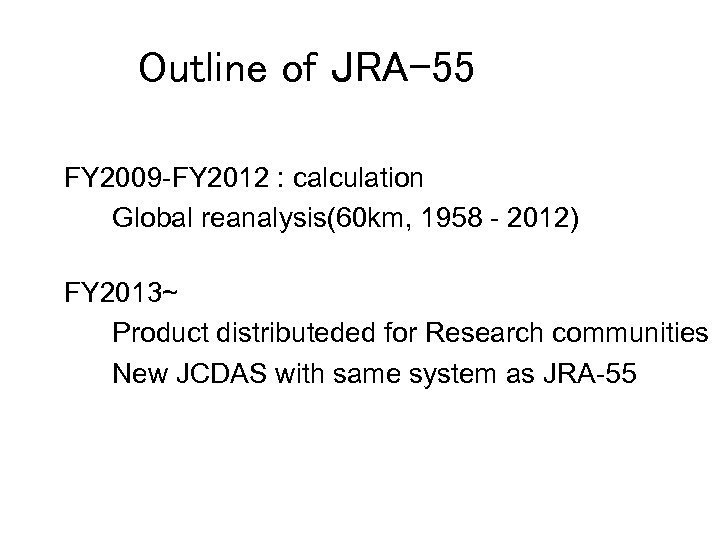 Outline of JRA-55 FY 2009 -FY 2012 : calculation Global reanalysis(60 km, 1958 - 2012) FY 2013~ Product distributeded for Research communities New JCDAS with same system as JRA-55
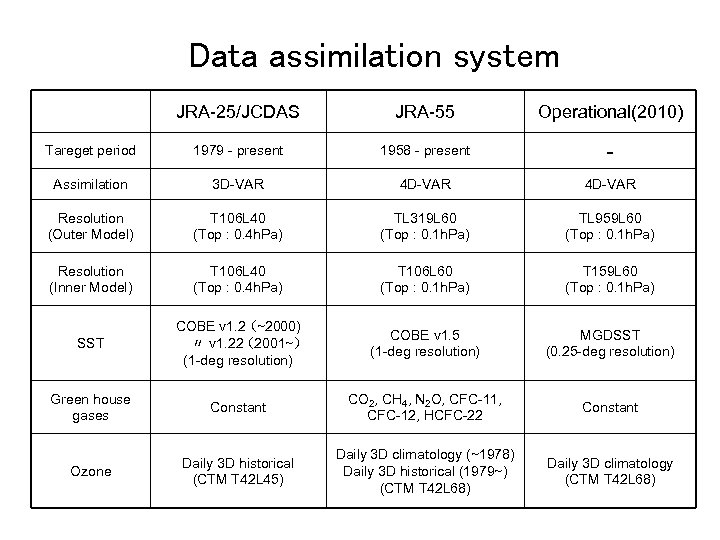 Data assimilation system JRA-25/JCDAS JRA-55 Operational(2010) Tareget period 1979 - present 1958 - present - Assimilation 3 D-VAR 4 D-VAR Resolution (Outer Model) T 106 L 40 (Top : 0. 4 h. Pa) TL 319 L 60 (Top : 0. 1 h. Pa) TL 959 L 60 (Top : 0. 1 h. Pa) Resolution (Inner Model) T 106 L 40 (Top : 0. 4 h. Pa) T 106 L 60 (Top : 0. 1 h. Pa) T 159 L 60 (Top : 0. 1 h. Pa) SST COBE v 1. 2 (~2000) 〃 v 1. 22 (2001~) (1 -deg resolution) COBE v 1. 5 (1 -deg resolution) MGDSST (0. 25 -deg resolution) Green house gases Constant CO 2, CH 4, N 2 O, CFC-11, CFC-12, HCFC-22 Constant Ozone Daily 3 D historical (CTM T 42 L 45) Daily 3 D climatology (~1978) Daily 3 D historical (1979~) (CTM T 42 L 68) Daily 3 D climatology (CTM T 42 L 68)
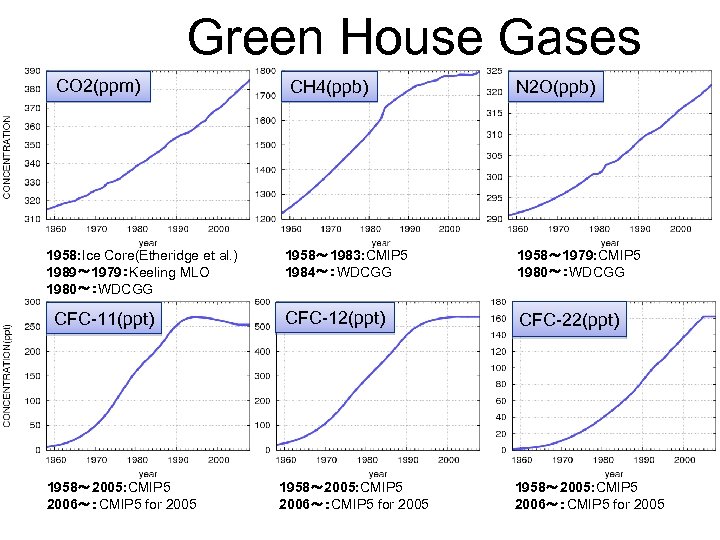 Green House Gases CO 2(ppm) 1958: Ice Core(Etheridge et al. ) 1989~ 1979:Keeling MLO 1980~:WDCGG CFC-11(ppt) 1958~ 2005: CMIP 5 2006~:CMIP 5 for 2005 CH 4(ppb) N 2 O(ppb) 1958~ 1983: CMIP 5 1984~:WDCGG 1958~ 1979: CMIP 5 1980~:WDCGG CFC-12(ppt) CFC-22(ppt) 1958~ 2005: CMIP 5 2006~:CMIP 5 for 2005
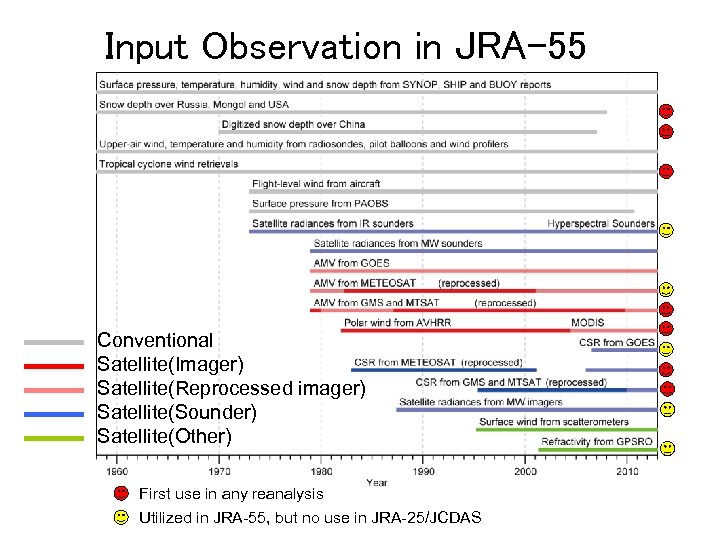 Input Observation in JRA-55 Conventional Satellite(Imager) Satellite(Reprocessed imager) Satellite(Sounder) Satellite(Other) First use in any reanalysis Utilized in JRA-55, but no use in JRA-25/JCDAS
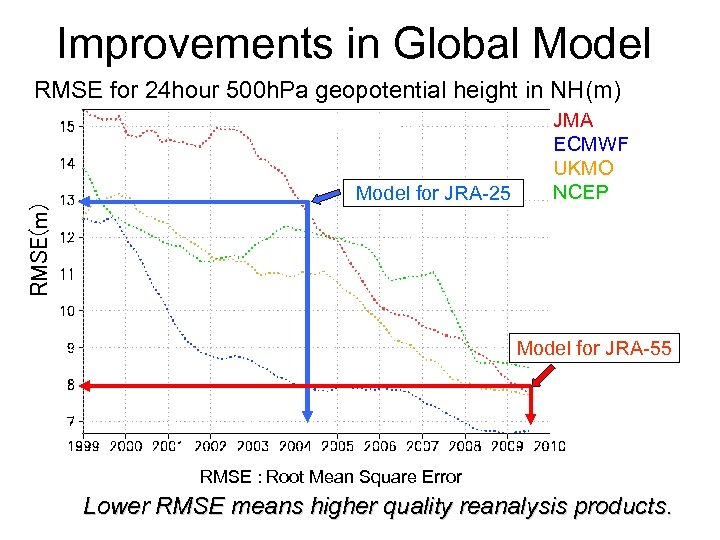 Improvements in Global Model RMSE(m) RMSE for 24 hour 500 h. Pa geopotential height in NH(m) Model for JRA-25 JMA ECMWF UKMO NCEP Model for JRA-55 RMSE : Root Mean Square Error Lower RMSE means higher quality reanalysis products.
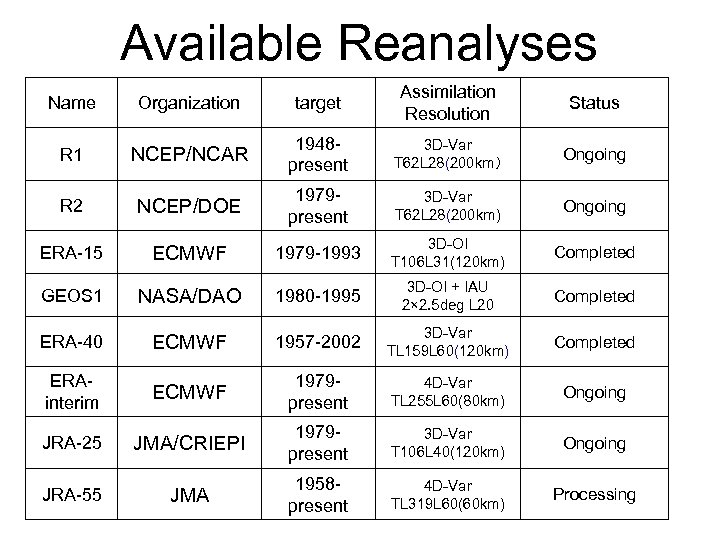 Available Reanalyses Name Organization target Assimilation Resolution Status R 1 NCEP/NCAR 1948 present 3 D-Var T 62 L 28(200 km) Ongoing R 2 NCEP/DOE 1979 present 3 D-Var T 62 L 28(200 km) Ongoing ERA-15 ECMWF 1979 -1993 3 D-OI T 106 L 31(120 km) Completed GEOS 1 NASA/DAO 1980 -1995 3 D-OI + IAU 2× 2. 5 deg L 20 Completed ERA-40 ECMWF 1957 -2002 3 D-Var TL 159 L 60(120 km) Completed ERAinterim ECMWF 1979 present 4 D-Var TL 255 L 60(80 km) Ongoing JRA-25 JMA/CRIEPI 1979 present 3 D-Var T 106 L 40(120 km) Ongoing JRA-55 JMA 1958 present 4 D-Var TL 319 L 60(60 km) Processing
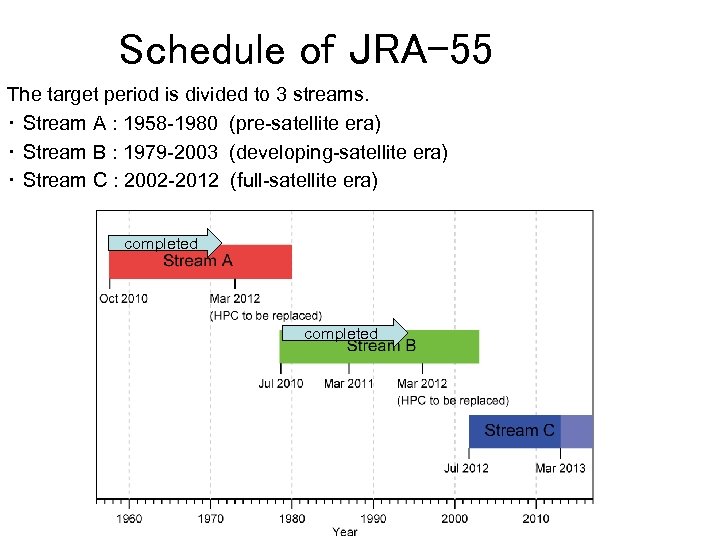 Schedule of JRA-55 The target period is divided to 3 streams. ・ Stream A : 1958 -1980 (pre-satellite era) ・ Stream B : 1979 -2003 (developing-satellite era) ・ Stream C : 2002 -2012 (full-satellite era) completed
 Preliminary Results of JRA-55 • Forecast Score • Global Temperature • Global Precipitation • Radiation
 Score of Extended Forecast Z 500 RMSE(GPM) 12 -month running mean 48 h forecast Northern Hemisphere Southern Hemisphere JRA-55 JRA-25 Operational 120 h forecast
 Global Mean Surface Air Temperature Northern Hemisphere Southern Hemisphere Anomaly Difference from CRU
 Global Mean Precipitation All reanalyses overestimate global precipitation. Observation
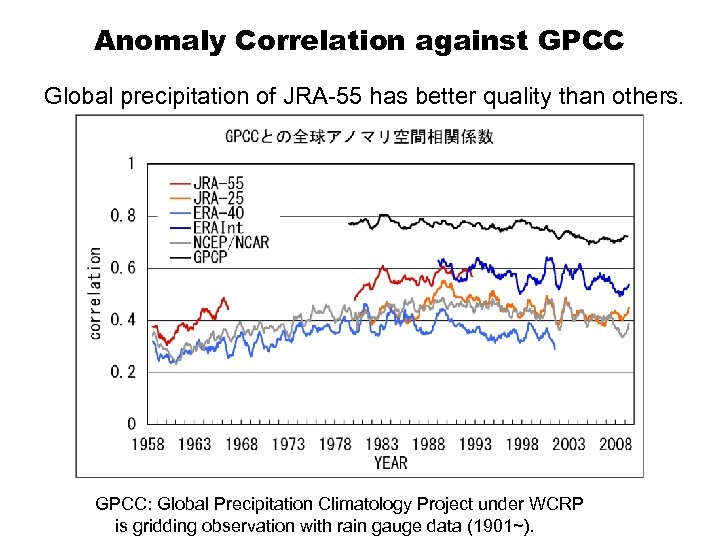 Anomaly Correlation against GPCC Global precipitation of JRA-55 has better quality than others. GPCC: Global Precipitation Climatology Project under WCRP is gridding observation with rain gauge data (1901~).
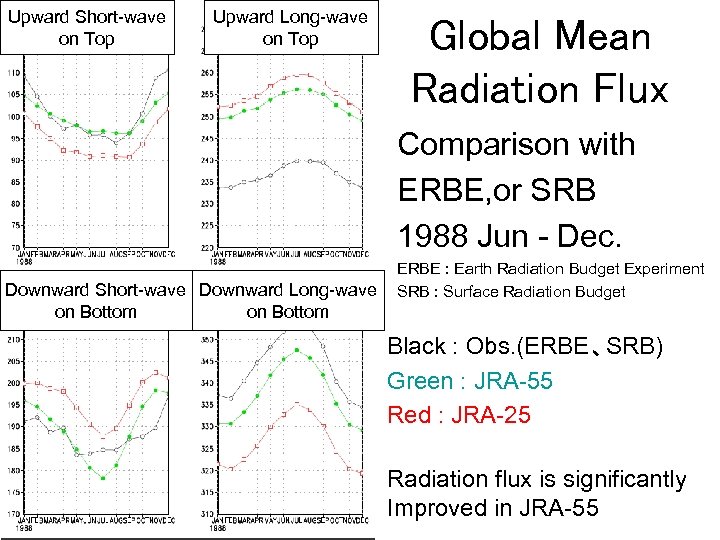 Upward Short-wave on Top Upward Long-wave on Top Global Mean Radiation Flux Comparison with ERBE, or SRB 1988 Jun - Dec. Downward Short-wave Downward Long-wave on Bottom ERBE : Earth Radiation Budget Experiment SRB : Surface Radiation Budget Black : Obs. (ERBE、SRB) Green : JRA-55 Red : JRA-25 Radiation flux is significantly Improved in JRA-55
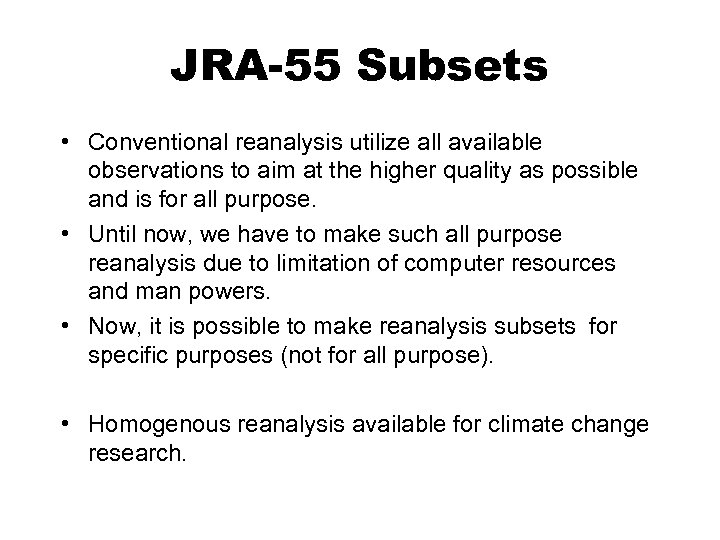 JRA-55 Subsets • Conventional reanalysis utilize all available observations to aim at the higher quality as possible and is for all purpose. • Until now, we have to make such all purpose reanalysis due to limitation of computer resources and man powers. • Now, it is possible to make reanalysis subsets for specific purposes (not for all purpose). • Homogenous reanalysis available for climate change research.
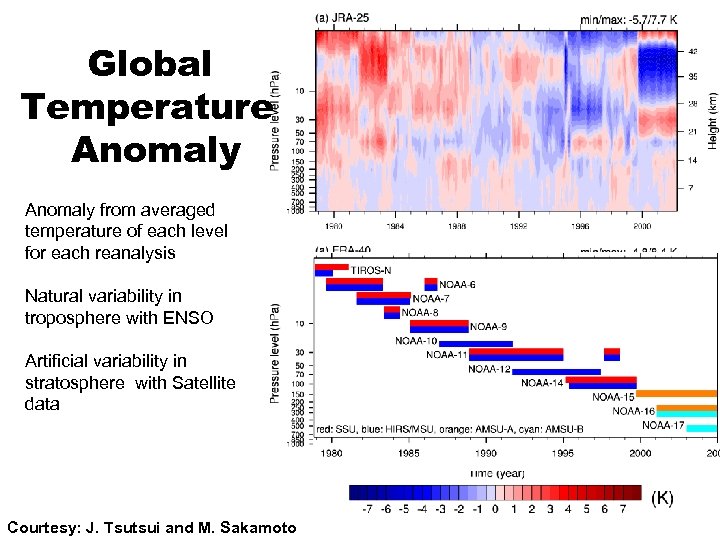 Global Temperature Anomaly from averaged temperature of each level for each reanalysis Natural variability in troposphere with ENSO Artificial variability in stratosphere with Satellite data 28 Courtesy: J. Tsutsui and M. Sakamoto
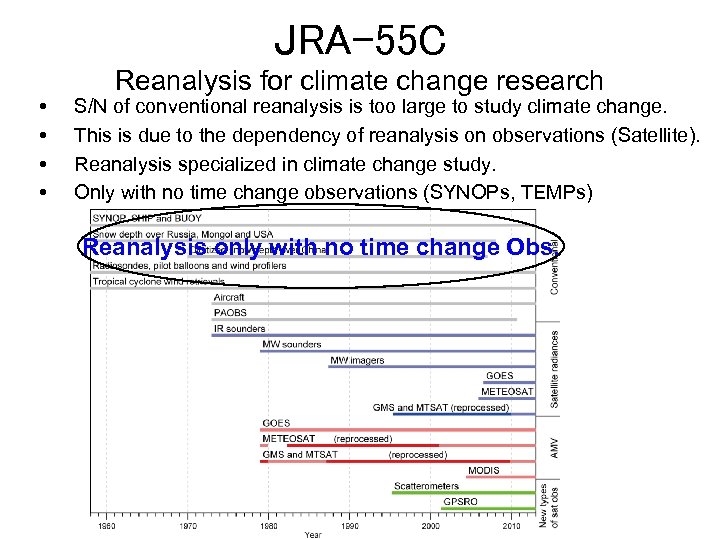 JRA-55 C Reanalysis for climate change research S/N of conventional reanalysis is too large to study climate change. This is due to the dependency of reanalysis on observations (Satellite). Reanalysis specialized in climate change study. Only with no time change observations (SYNOPs, TEMPs) Reanalysis only with no time change Obs.
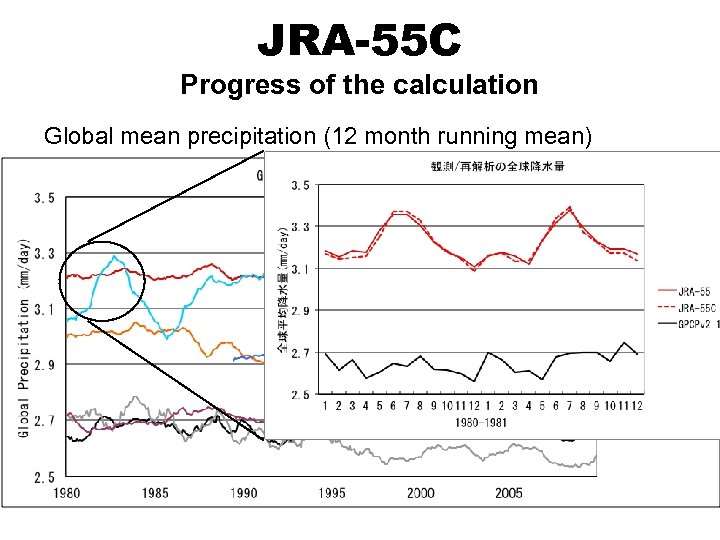 JRA-55 C Progress of the calculation Global mean precipitation (12 month running mean)
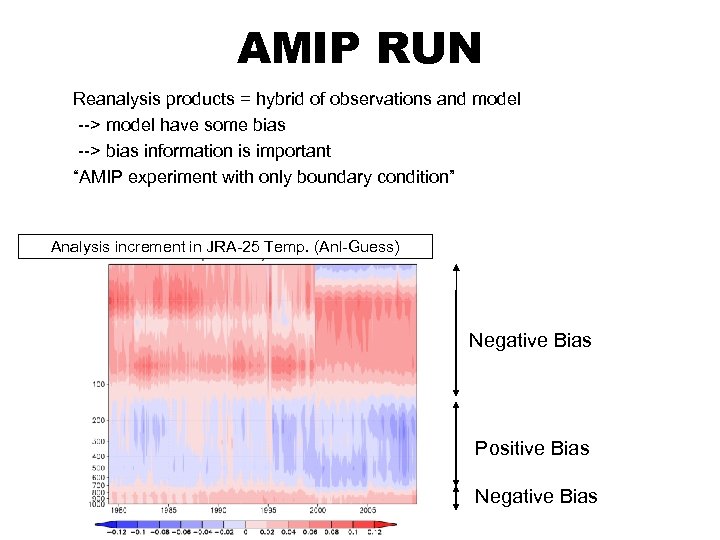 AMIP RUN Reanalysis products = hybrid of observations and model --> model have some bias --> bias information is important “AMIP experiment with only boundary condition” Analysis increment in JRA-25 Temp. (Anl-Guess) Negative Bias Positive Bias Negative Bias
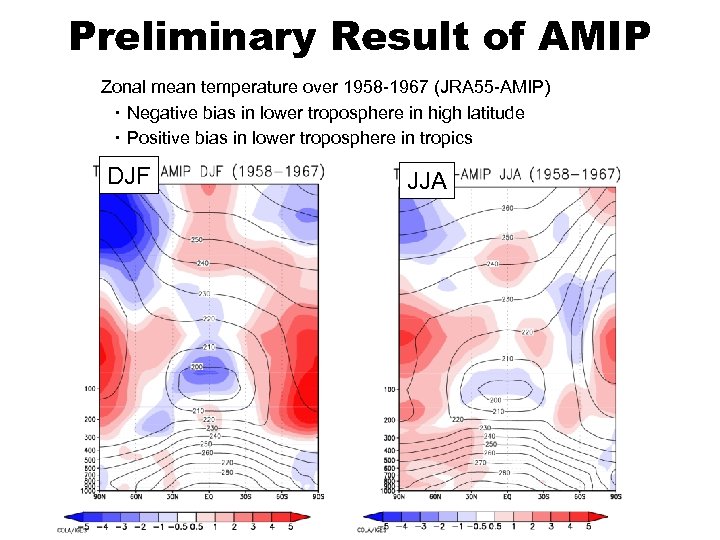 Preliminary Result of AMIP Zonal mean temperature over 1958 -1967 (JRA 55 -AMIP) ・ Negative bias in lower troposphere in high latitude ・ Positive bias in lower troposphere in tropics DJF JJA 東西風
 Summary • JRA-55 improves many shortcomings in JRA-25. • Improved in JRA-55, precipitation, radiation fluxes, , , • JRA-55 is now processing, and a half of the period has been completed. • JRA-55 will be completed in 2013 spring, and be started distribution for research uses. • MRI has also been processing JRA-55 subset for climate studies. JRA-55 C JRA-55 AMIP
 Thank you very much

 JRA-25 and JCDAS JRA-25 (1979 -2004) Joint project by JMA and CRIPIE JCDAS (2005 -) JMA’s operational assimilation with same assimilation system as JRA-25 copyright by JMA and CRIPIE JCDAS copyright by JMA But, both are a series of things, and end users do not need to distinguish it.