 Скачать презентацию Japanese Radio and TV Foreign Journalism Berdak Bayimbetov
12.Japanese Radio and TV.pptx
- Количество слайдов: 17



Japanese Radio and TV Foreign Journalism Berdak Bayimbetov
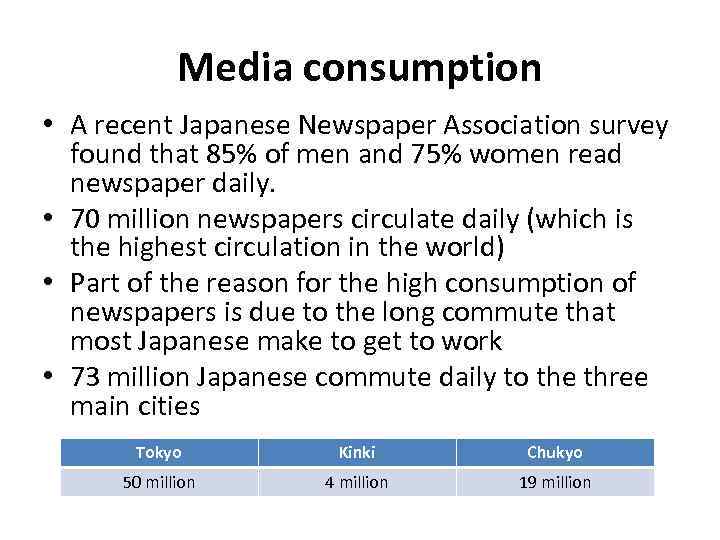
Media consumption • A recent Japanese Newspaper Association survey found that 85% of men and 75% women read newspaper daily. • 70 million newspapers circulate daily (which is the highest circulation in the world) • Part of the reason for the high consumption of newspapers is due to the long commute that most Japanese make to get to work • 73 million Japanese commute daily to the three main cities Tokyo Kinki Chukyo 50 million 4 million 19 million
Radio in Japan • Radio in Japan so NOT very popular as in the UK, USA and France • Number of Radio Stations: 305 • Because of governmental regulation, Japan has a relatively small number of radio stations. • The stations with "TV" signs also broadcast television. • Sample radio: Radio Loyalty
Radio in Japan • Radio broadcasts in Japan date from 1926, but until the end of World War II they were monopolized by the government-affiliated Nippon Hoso Kyokai (NHK: Japan Broadcasting Corporation). • A new broadcasting law that came into effect in 1950 resulted in NHK being reorganized as a special corporation that is neither state-operated nor private. • NHK radio and television do not broadcast commercial advertising. • About 98 % of operating revenues are obtained from monthly viewer fees. NHK television made its debut in Tokyo in February 1953.
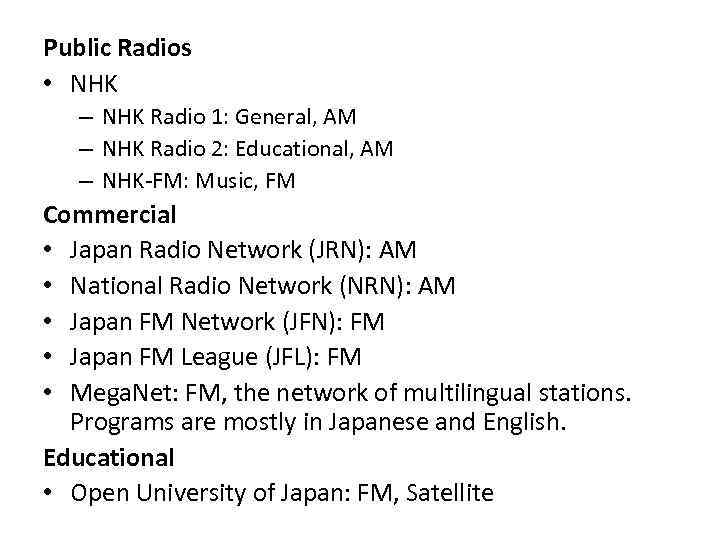
Public Radios • NHK – NHK Radio 1: General, AM – NHK Radio 2: Educational, AM – NHK-FM: Music, FM Commercial • Japan Radio Network (JRN): AM • National Radio Network (NRN): AM • Japan FM Network (JFN): FM • Japan FM League (JFL): FM • Mega. Net: FM, the network of multilingual stations. Programs are mostly in Japanese and English. Educational • Open University of Japan: FM, Satellite
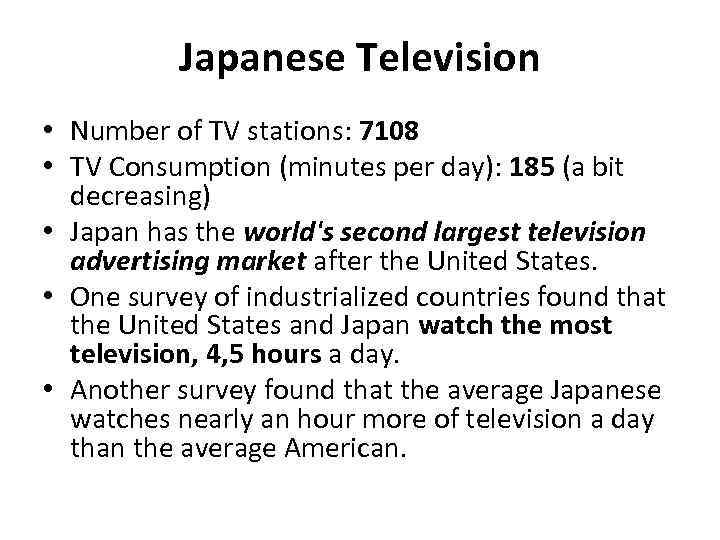
Japanese Television • Number of TV stations: 7108 • TV Consumption (minutes per day): 185 (a bit decreasing) • Japan has the world's second largest television advertising market after the United States. • One survey of industrialized countries found that the United States and Japan watch the most television, 4, 5 hours a day. • Another survey found that the average Japanese watches nearly an hour more of television a day than the average American.
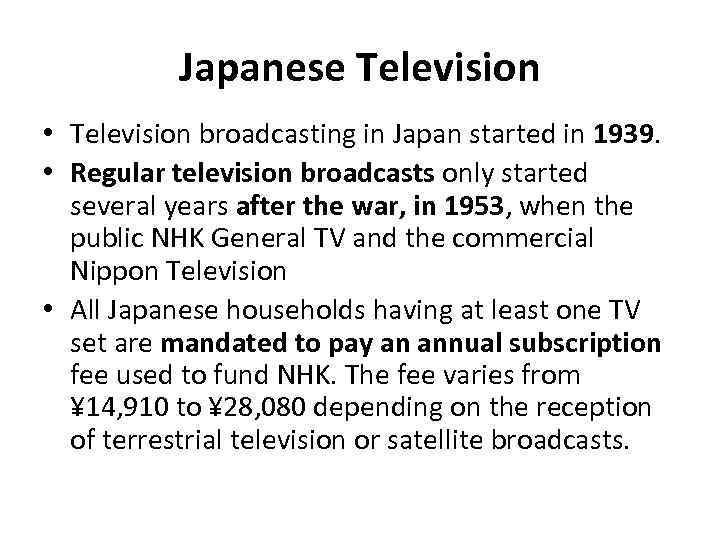
Japanese Television • Television broadcasting in Japan started in 1939. • Regular television broadcasts only started several years after the war, in 1953, when the public NHK General TV and the commercial Nippon Television • All Japanese households having at least one TV set are mandated to pay an annual subscription fee used to fund NHK. The fee varies from ¥ 14, 910 to ¥ 28, 080 depending on the reception of terrestrial television or satellite broadcasts.
• NHK (Nippon Hoso Kyokai) is the public broadcasting system of the country. • TV users pay reception fees which produce 98% of NHK's revenues. • In 1926, NHK was founded as the sole radio broadcaster, and remained so until 1945. • The foundation was modelled on the BBC of the United Kingdom. • The Broadcasting Law of 1950 allowed commercial competition, which began in the following year on radio and in 1953 on TV.
• So, it began as a radio station, then expanded into terrestrial and then satellite TV. • It runs two channels on regular television (NHK, and NHK Educational) and two channels (BS 1 and BS 2) on its satellite network. • These channels have no commercials and have a mix of dramas, news, sports and features. • Some broadcast are done simultaneously in Japanese and English (with a device on your television you can watch either language or both at the same time).
NHK World TV is received by 72 million households in 180 countries via satellite and cable hook ups. As of 2006, 70 percent of the programming was available in English. The plan is to increase the figure to 100 percent by 2010. NHK World Premium service provides programs for a fee to satellite and cable television broadcasters.
Japanese Television • There are five major private broadcasters: NTV, TBS, Fuji, TV Asahi and KTV. • Fuji TV is known for its “not ashamed” entertainment programmes that affect on public mood. • Tokyo Broadcasting is one of Japan’s largest television companies. • WOWOW is a movie channel.
• Fuji Television is one of Japan’s largest television and film producers. • It fills many of its time slots with quiz shows with ditty celebrities that seem funny by the dumbest questions and ridiculous answers.
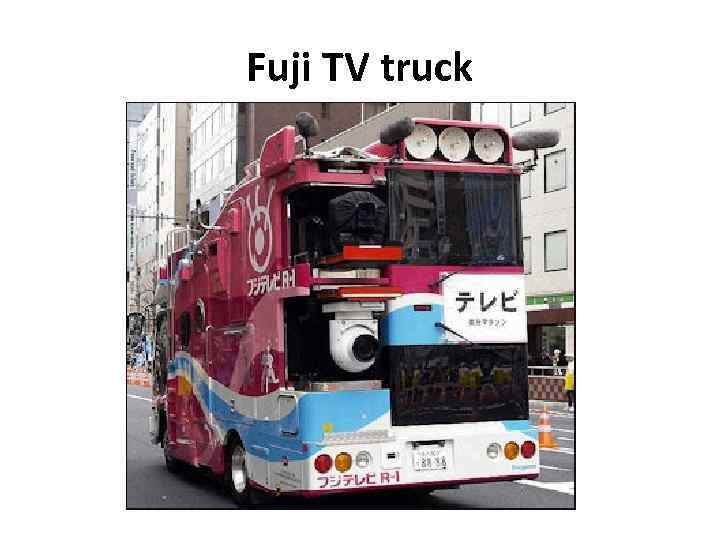
Fuji TV truck
TV Technology in Japan • Television remotes in Japan have a button that allows viewers to choose between English, Japanese, or both languages at the same time. • With the news, for example, viewers can choose between the original Japanese transmission or English dubbing; • With a Hollywood film, they can choose between the English soundtrack or Japanese dubbing.

Pioneer company has developed a jacket with a television in its sleeve. The screen is made of an paper-thin electro-luminescent material
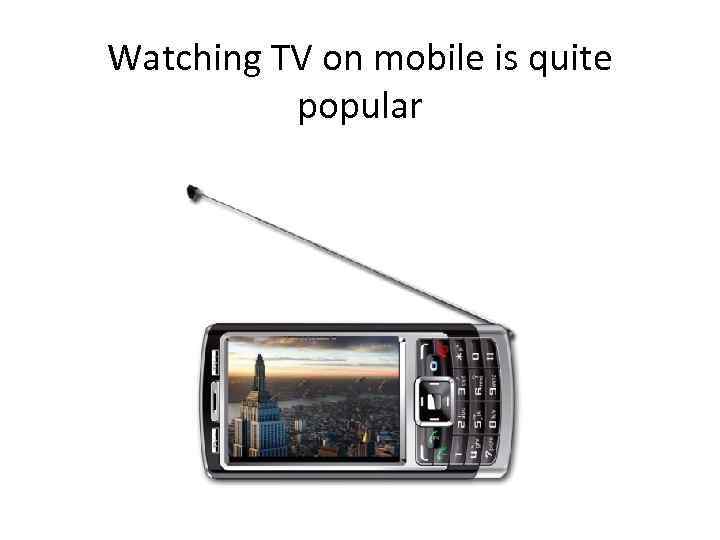
Watching TV on mobile is quite popular
TV surveys Television ratings in Japan are determined with little boxes that are placed on the televisions of some viewers. The boxes record which shows the viewer watches.
Скачать презентацию Japanese Radio and TV Foreign Journalism Berdak Bayimbetov
12.Japanese Radio and TV.pptx