 Скачать презентацию Japanese lessons global macro and market outlook Prepared
2b0e98f481a3e06fa8ab98d290c859fd.ppt
- Количество слайдов: 40




Japanese lessons: global macro and market outlook Prepared by: Philip Poole For professional clients only Date: October 2012

Tripping up in Tokyo – will others fall? INTERNAL (amend as appropriate)
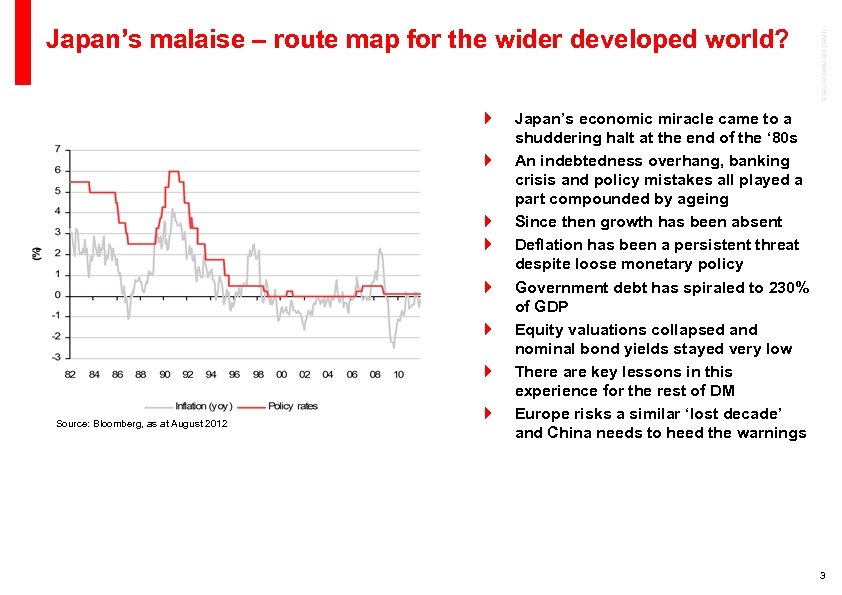
} } } } Source: Bloomberg, as at August 2012 } Insert job number here Japan’s malaise – route map for the wider developed world? Japan’s economic miracle came to a shuddering halt at the end of the ‘ 80 s An indebtedness overhang, banking crisis and policy mistakes all played a part compounded by ageing Since then growth has been absent Deflation has been a persistent threat despite loose monetary policy Government debt has spiraled to 230% of GDP Equity valuations collapsed and nominal bond yields stayed very low There are key lessons in this experience for the rest of DM Europe risks a similar ‘lost decade’ and China needs to heed the warnings 3
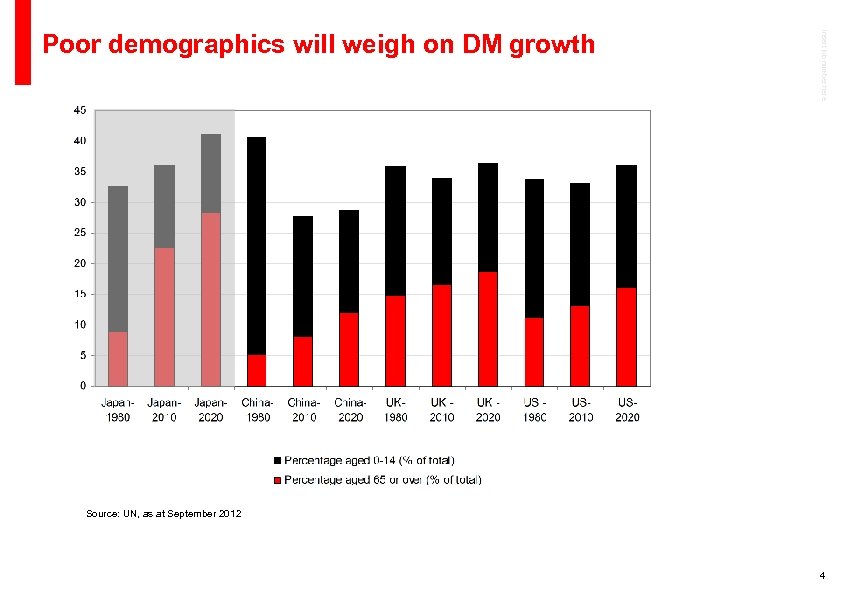
Insert job number here Poor demographics will weigh on DM growth Source: UN, as at September 2012 4
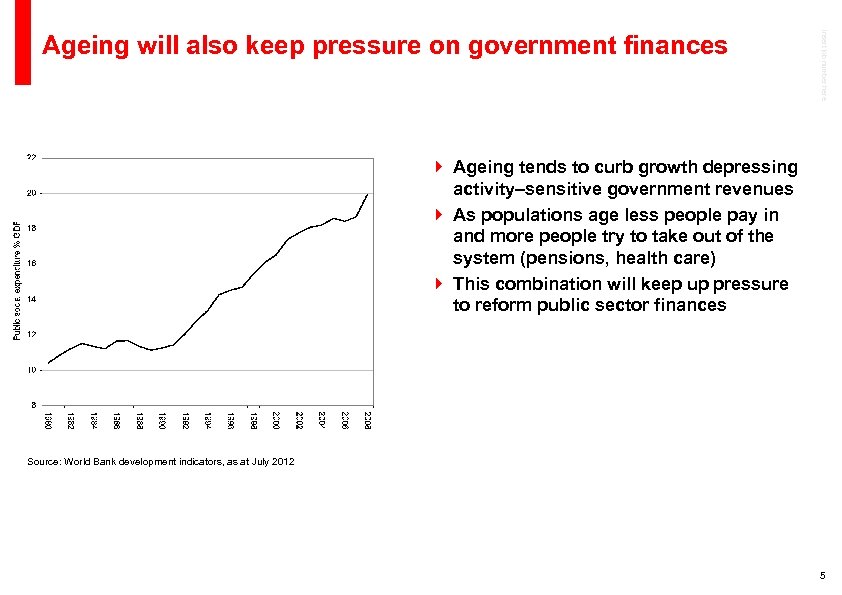
Insert job number here Ageing will also keep pressure on government finances } Ageing tends to curb growth depressing activity–sensitive government revenues } As populations age less people pay in and more people try to take out of the system (pensions, health care) } This combination will keep up pressure to reform public sector finances Source: World Bank development indicators, as at July 2012 5
Insert job number here Lessons from Japan } } } Growth is likely to be in short supply in the developed world Developed world inflation likely to remain low with a deflationary overhang Compensating for low growth by stimulating investment can backfire badly Flooding the world with liquidity does not guarantee recovery Monetary policy should not be tightened prematurely but largely loses its potency to stimulate where there is a balance sheet overhang } Fix ‘zombie’ banks as quickly as possible or recovery will be further delayed } Ageing necessitates pro-active reform of public sector finances or it will add to fiscal problems } Japan also needs to heed Europe’s mistakes - or else investors could lose confidence and bond yields move sharply higher 6
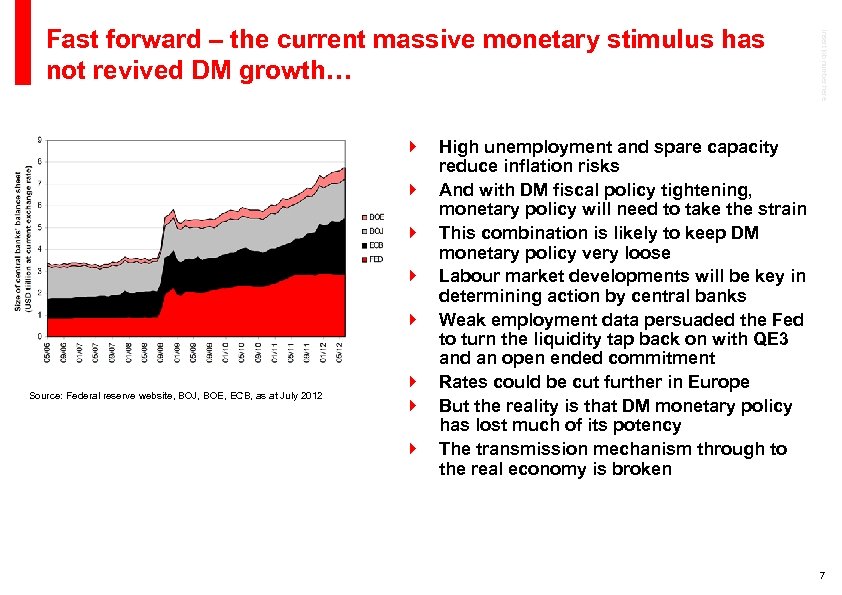
} } } Source: Federal reserve website, BOJ, BOE, ECB, as at July 2012 } } } Insert job number here Fast forward – the current massive monetary stimulus has not revived DM growth… High unemployment and spare capacity reduce inflation risks And with DM fiscal policy tightening, monetary policy will need to take the strain This combination is likely to keep DM monetary policy very loose Labour market developments will be key in determining action by central banks Weak employment data persuaded the Fed to turn the liquidity tap back on with QE 3 and an open ended commitment Rates could be cut further in Europe But the reality is that DM monetary policy has lost much of its potency The transmission mechanism through to the real economy is broken 7
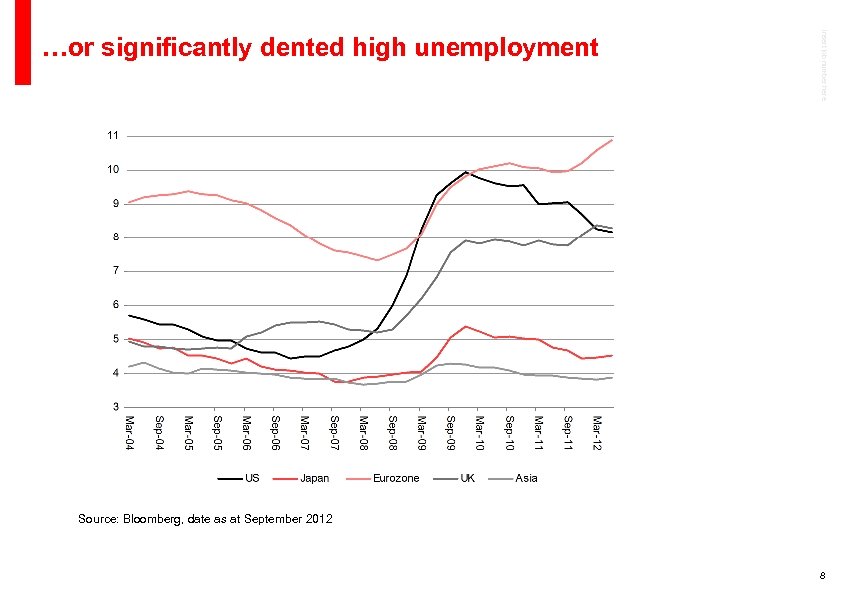
Insert job number here …or significantly dented high unemployment Source: Bloomberg, date as at September 2012 8
Insert job number here The eurozone crisis is not over } Solving the eurozone’s problems will require a multi-year work out, whether or not it holds together } There are two key requirements: to clean up the existing mess and to convince markets that it won’t happen again } The debt swap for Greece was an important step forward } As are efforts to recapitalise Spanish banks – the first time enough cash has been put on the table to do the job } Yields have to be brought down to sustainable levels for Italy and Spain if the crisis is to abate } The ECB’s new OMT programme should help to cap yields in the short-term. . . } …but can only buy time not fix the problem } A solution will necessitate implementation of credible fiscal adjustment plans } To be successful it will also require macro stabilisation and concrete moves towards fiscal union 9
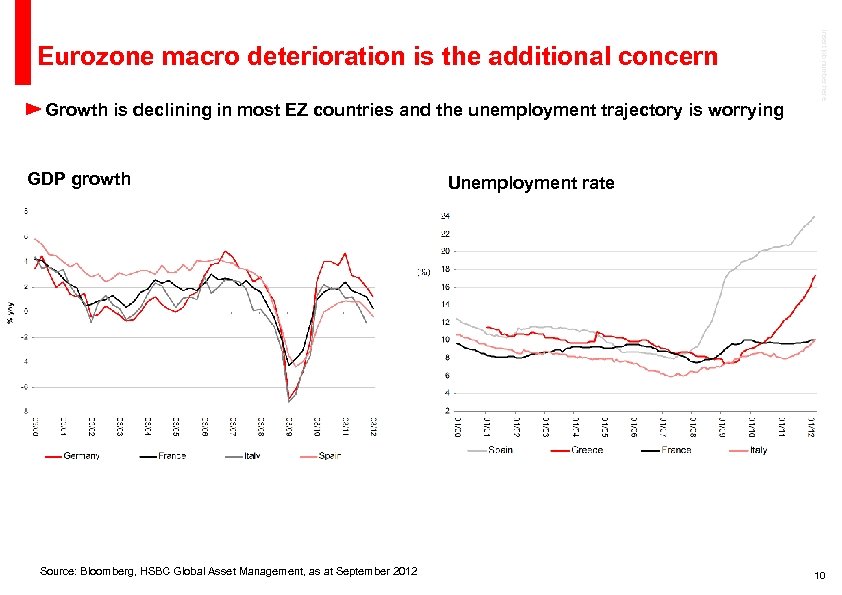
Growth is declining in most EZ countries and the unemployment trajectory is worrying GDP growth Source: Bloomberg, HSBC Global Asset Management, as at September 2012 Insert job number here Eurozone macro deterioration is the additional concern Unemployment rate 10
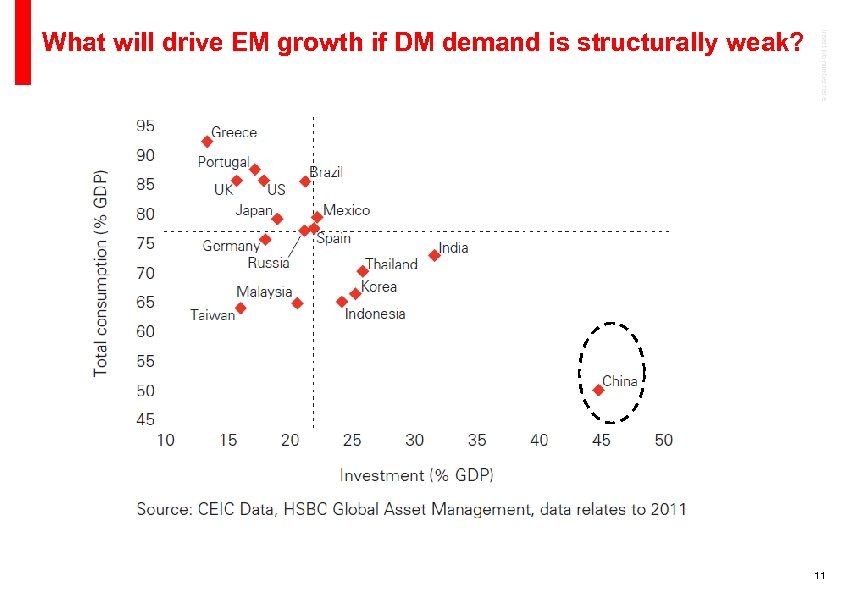
Insert job number here What will drive EM growth if DM demand is structurally weak? 11
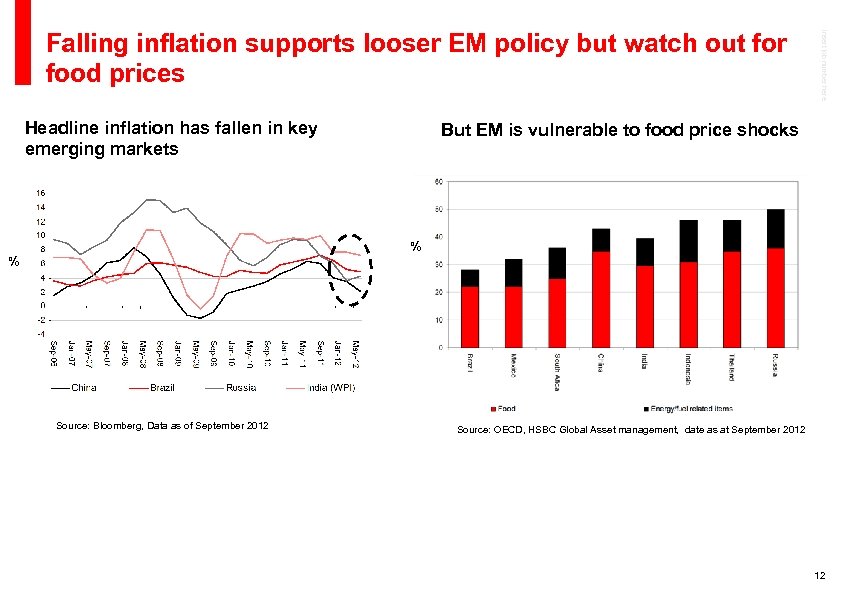
Headline inflation has fallen in key emerging markets Insert job number here Falling inflation supports looser EM policy but watch out for food prices But EM is vulnerable to food price shocks % % Source: Bloomberg, Data as of September 2012 Source: OECD, HSBC Global Asset management, date as at September 2012 12

Global recovery. All over bar the shouting? INTERNAL (amend as appropriate)
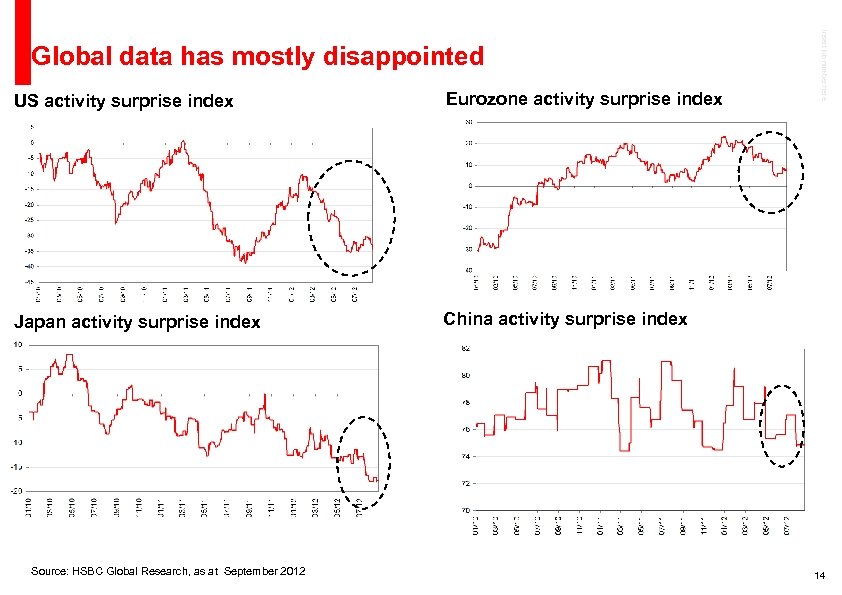
US activity surprise index Eurozone activity surprise index Japan activity surprise index Insert job number here Global data has mostly disappointed China activity surprise index Source: HSBC Global Research, as at September 2012 14
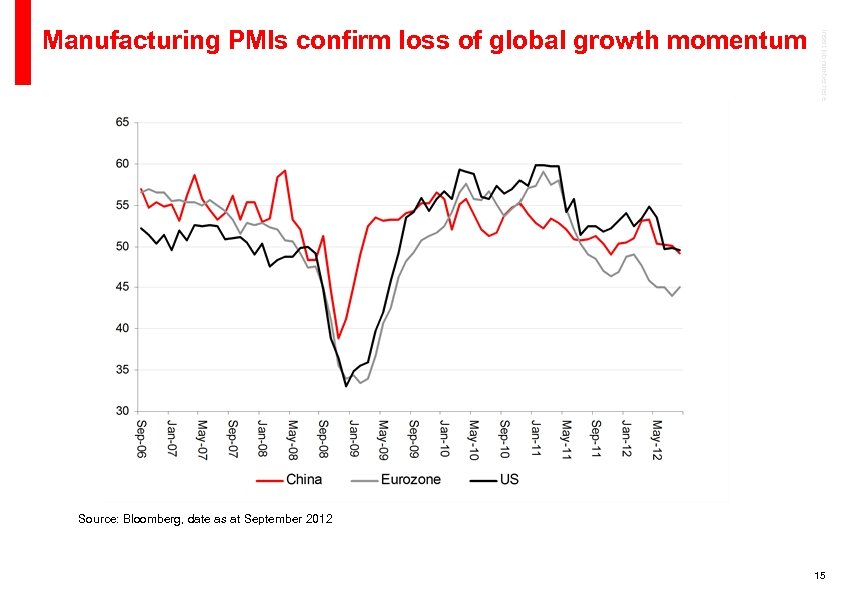
Insert job number here Manufacturing PMIs confirm loss of global growth momentum Source: Bloomberg, date as at September 2012 15
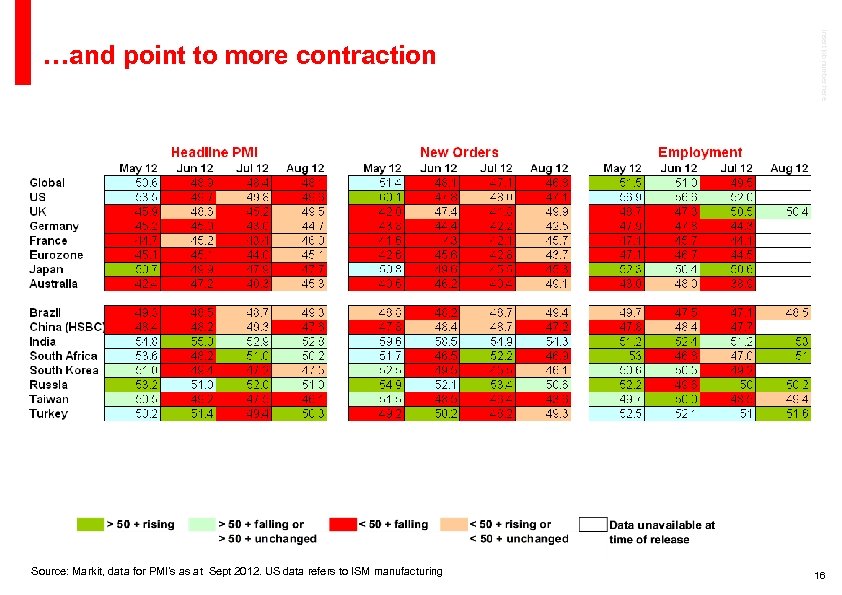
Source: Markit, data for PMI’s as at Sept 2012. US data refers to ISM manufacturing Insert job number here …and point to more contraction 16
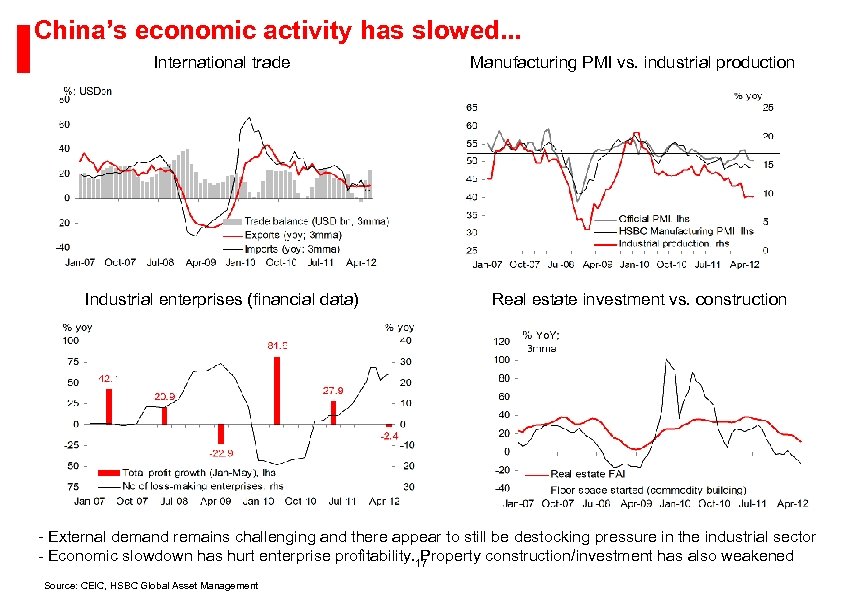
China’s economic activity has slowed. . . International trade Industrial enterprises (financial data) Manufacturing PMI vs. industrial production Real estate investment vs. construction - External demand remains challenging and there appear to still be destocking pressure in the industrial sector - Economic slowdown has hurt enterprise profitability. Property construction/investment has also weakened 17 Source: CEIC, HSBC Global Asset Management
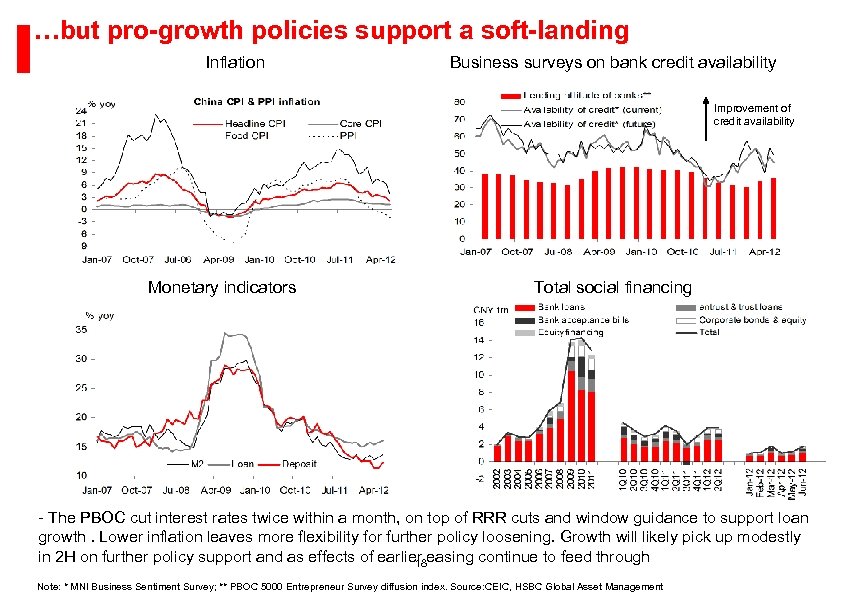
…but pro-growth policies support a soft-landing Inflation Business surveys on bank credit availability Improvement of credit availability Monetary indicators Total social financing - The PBOC cut interest rates twice within a month, on top of RRR cuts and window guidance to support loan growth. Lower inflation leaves more flexibility for further policy loosening. Growth will likely pick up modestly in 2 H on further policy support and as effects of earlier easing continue to feed through 18 Note: * MNI Business Sentiment Survey; ** PBOC 5000 Entrepreneur Survey diffusion index. Source: EIC, HSBC Global Asset Management C
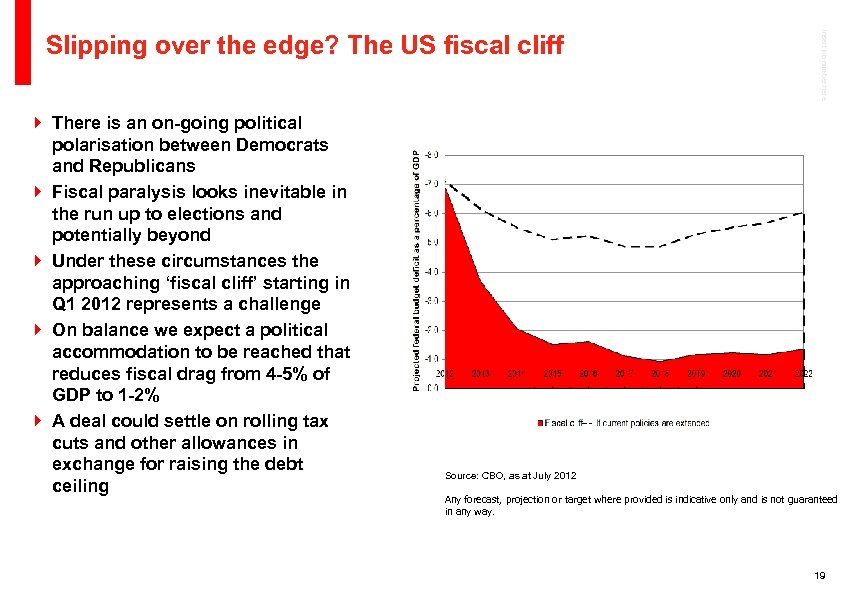
} There is an on-going political polarisation between Democrats and Republicans } Fiscal paralysis looks inevitable in the run up to elections and potentially beyond } Under these circumstances the approaching ‘fiscal cliff’ starting in Q 1 2012 represents a challenge } On balance we expect a political accommodation to be reached that reduces fiscal drag from 4 -5% of GDP to 1 -2% } A deal could settle on rolling tax cuts and other allowances in exchange for raising the debt ceiling Insert job number here Slipping over the edge? The US fiscal cliff Source: CBO, as at July 2012 Any forecast, projection or target where provided is indicative only and is not guaranteed in any way. 19
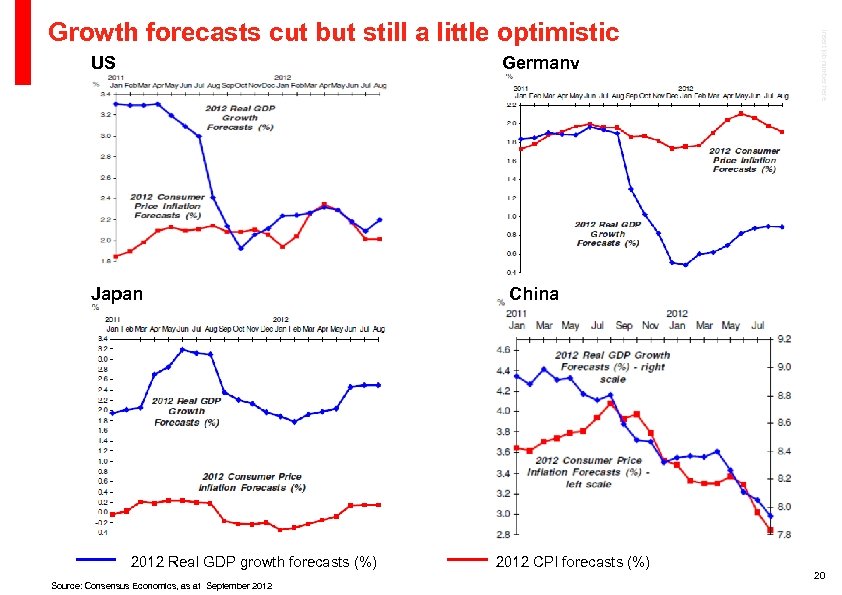
US Germany Japan 2012 Real GDP growth forecasts (%) Source: Consensus Economics, as at September 2012 Insert job number here Growth forecasts cut but still a little optimistic China 2012 CPI forecasts (%) 20

Investment themes INTERNAL (amend as appropriate)
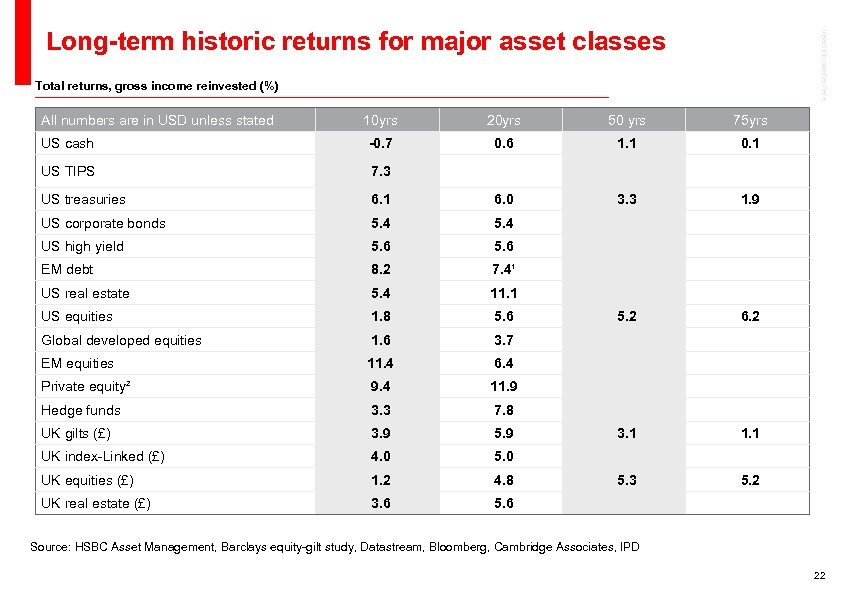
Insert job number here Long-term historic returns for major asset classes Total returns, gross income reinvested (%) All numbers are in USD unless stated 10 yrs 20 yrs 50 yrs 75 yrs US cash -0. 7 0. 6 1. 1 0. 1 US TIPS 7. 3 US treasuries 6. 1 6. 0 3. 3 1. 9 US corporate bonds 5. 4 US high yield 5. 6 EM debt 8. 2 7. 4¹ US real estate 5. 4 11. 1 US equities 1. 8 5. 6 Global developed equities 1. 6 3. 7 EM equities 11. 4 6. 4 Private equity² 9. 4 11. 9 Hedge funds 3. 3 7. 8 UK gilts (£) 3. 9 5. 9 3. 1 UK index-Linked (£) 4. 0 5. 0 UK equities (£) 1. 2 4. 8 5. 3 5. 2 UK real estate (£) 3. 6 5. 6 5. 2 6. 2 1. 1 Source: HSBC Asset Management, Barclays equity-gilt study, Datastream, Bloomberg, Cambridge Associates, IPD 22
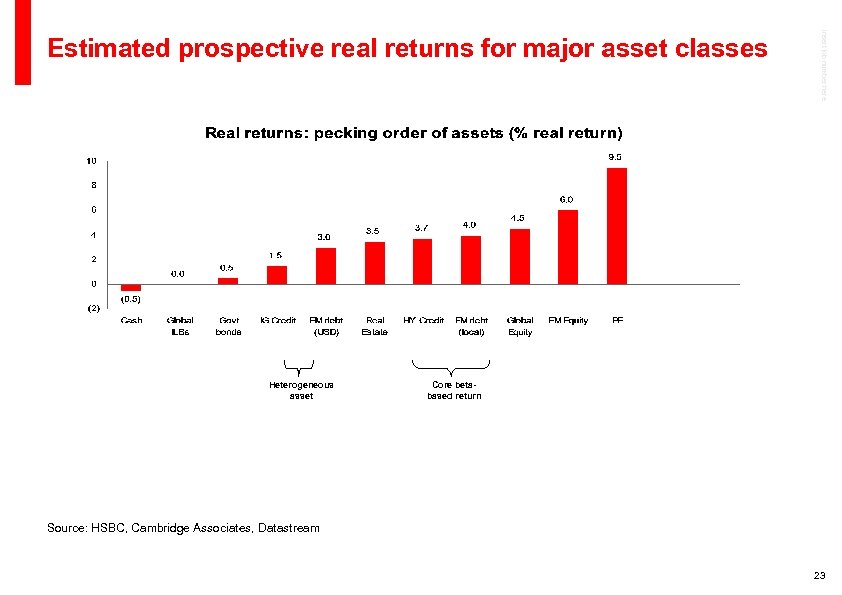
Heterogeneous asset Insert job number here Estimated prospective real returns for major asset classes Core betabased return Source: HSBC, Cambridge Associates, Datastream 23
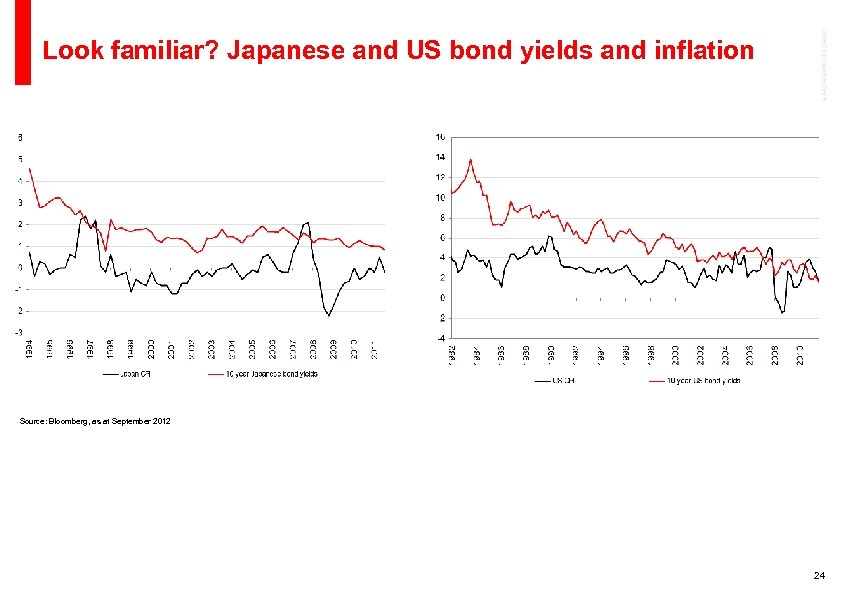
Insert job number here Look familiar? Japanese and US bond yields and inflation Source: Bloomberg, as at September 2012 24
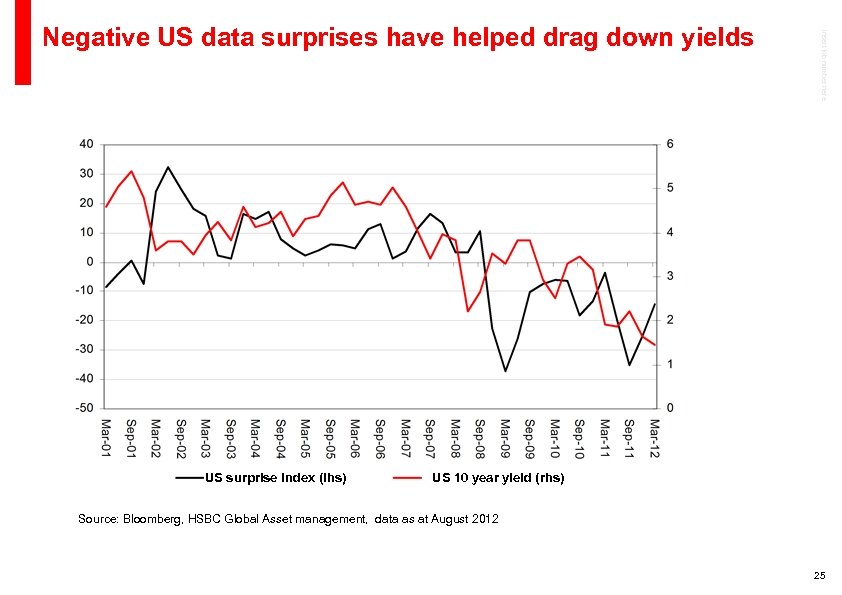
US surprise index (lhs) Insert job number here Negative US data surprises have helped drag down yields US 10 year yield (rhs) Source: Bloomberg, HSBC Global Asset management, data as at August 2012 25
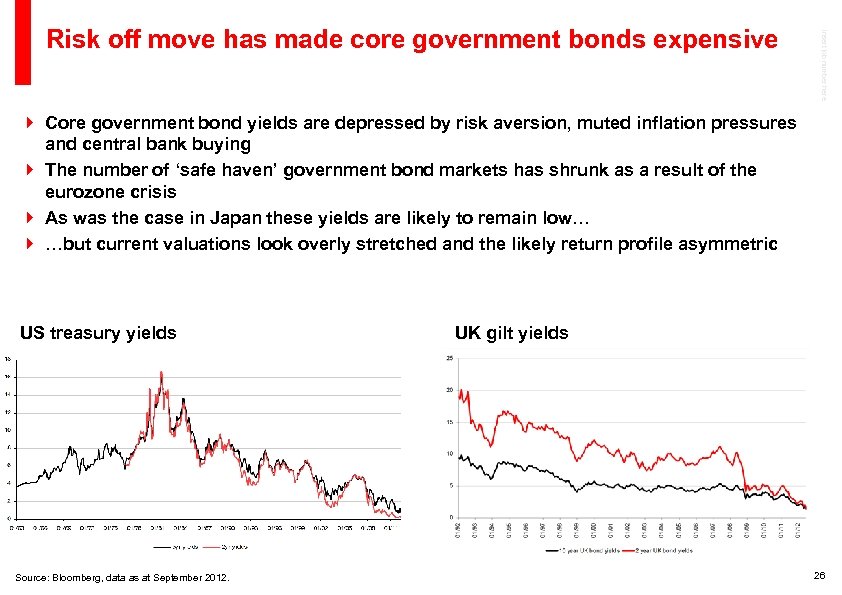
Insert job number here Risk off move has made core government bonds expensive } Core government bond yields are depressed by risk aversion, muted inflation pressures and central bank buying } The number of ‘safe haven’ government bond markets has shrunk as a result of the eurozone crisis } As was the case in Japan these yields are likely to remain low… } …but current valuations look overly stretched and the likely return profile asymmetric US treasury yields Source: Bloomberg, data as at September 2012. UK gilt yields 26
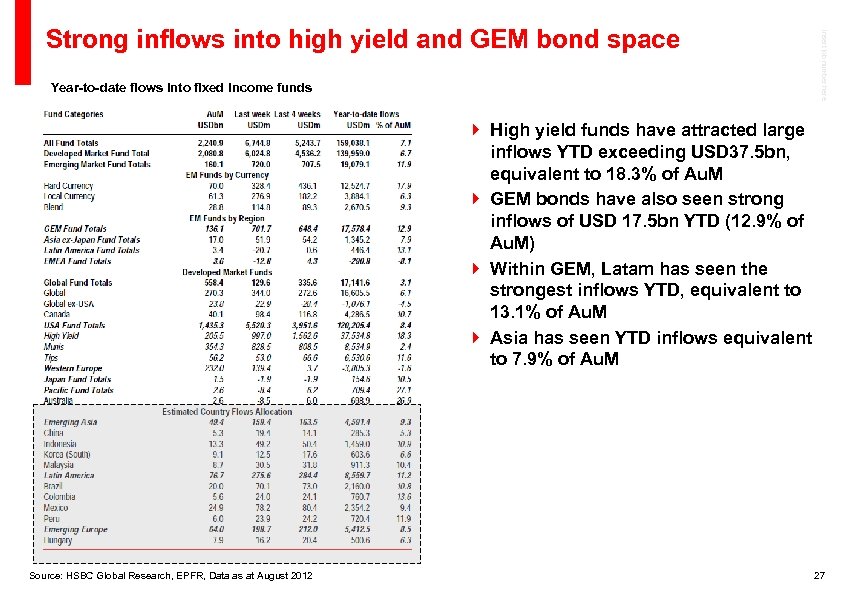
Insert job number here Strong inflows into high yield and GEM bond space Year-to-date flows into fixed income funds } High yield funds have attracted large inflows YTD exceeding USD 37. 5 bn, equivalent to 18. 3% of Au. M } GEM bonds have also seen strong inflows of USD 17. 5 bn YTD (12. 9% of Au. M) } Within GEM, Latam has seen the strongest inflows YTD, equivalent to 13. 1% of Au. M } Asia has seen YTD inflows equivalent to 7. 9% of Au. M Source: HSBC Global Research, EPFR, Data as at August 2012 27
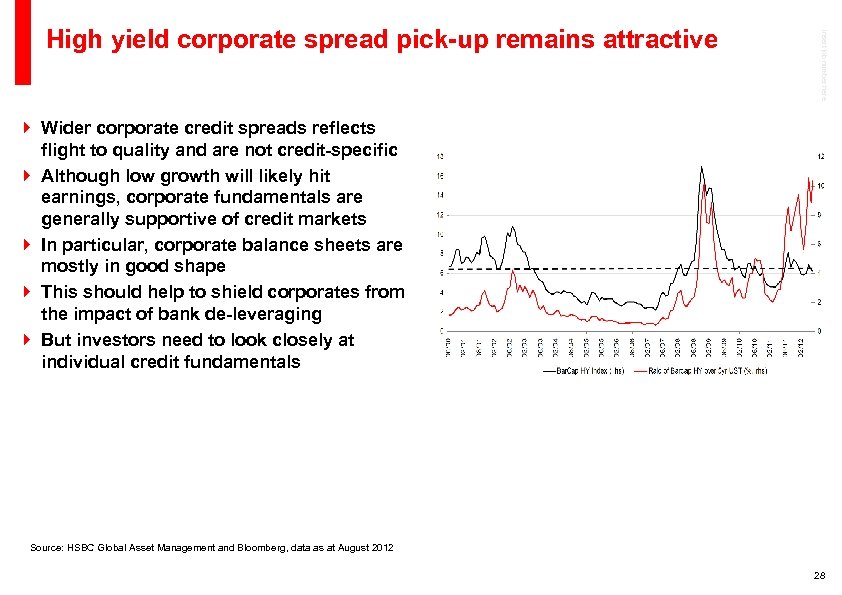
Insert job number here High yield corporate spread pick-up remains attractive } Wider corporate credit spreads reflects flight to quality and are not credit-specific } Although low growth will likely hit earnings, corporate fundamentals are generally supportive of credit markets } In particular, corporate balance sheets are mostly in good shape } This should help to shield corporates from the impact of bank de-leveraging } But investors need to look closely at individual credit fundamentals Source: HSBC Global Asset Management and Bloomberg, data as at August 2012 28
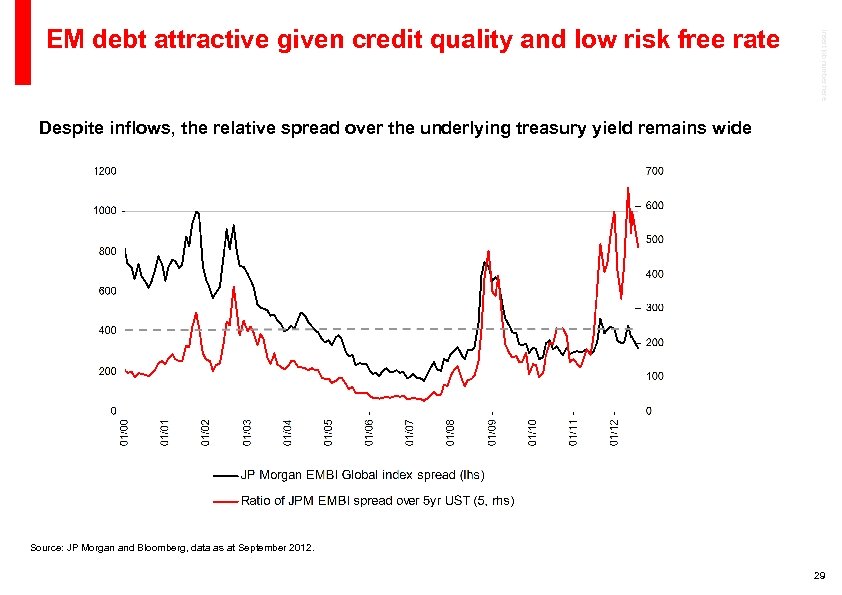
Insert job number here EM debt attractive given credit quality and low risk free rate Despite inflows, the relative spread over the underlying treasury yield remains wide Source: JP Morgan and Bloomberg, data as at September 2012. 29
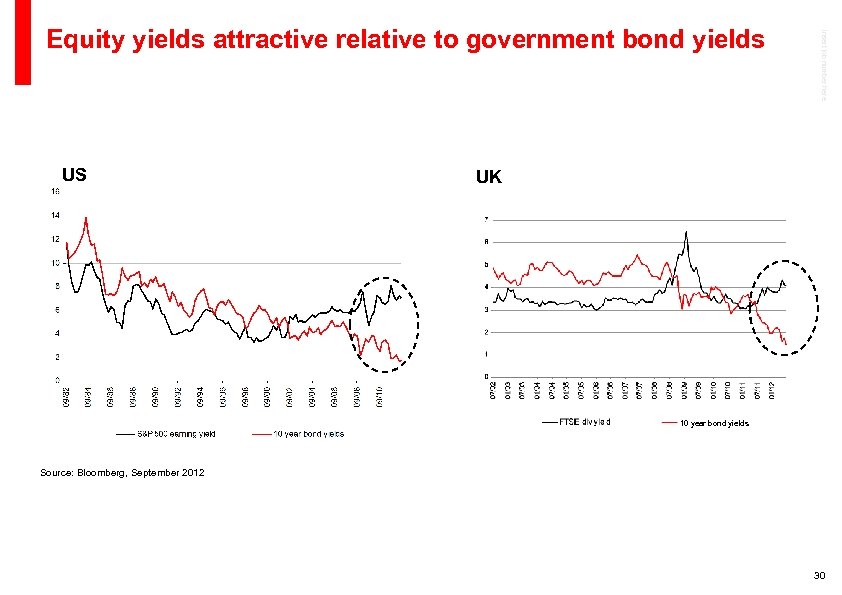
US Insert job number here Equity yields attractive relative to government bond yields UK 10 year bond yields Source: Bloomberg, September 2012 30
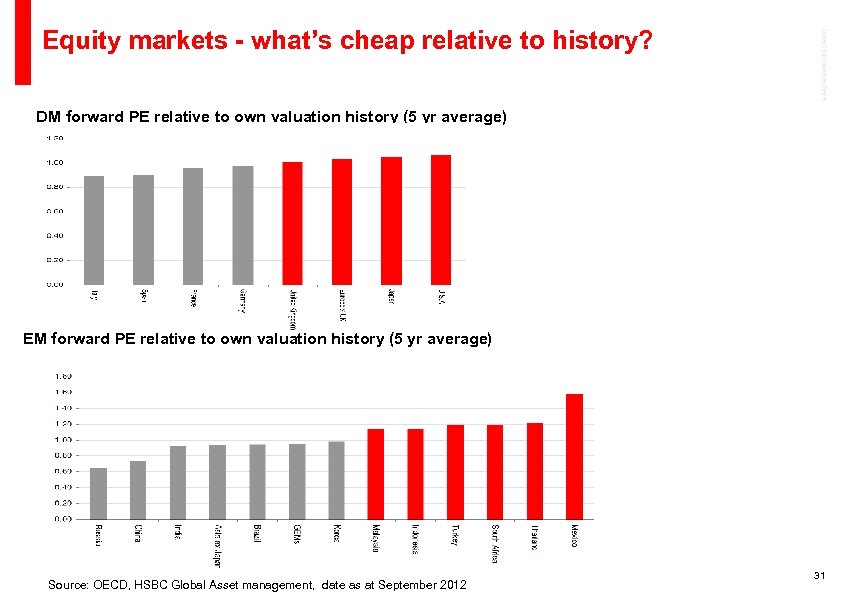
Insert job number here Equity markets - what’s cheap relative to history? DM forward PE relative to own valuation history (5 yr average) EM forward PE relative to own valuation history (5 yr average) Source: OECD, HSBC Global Asset management, date as at September 2012 31
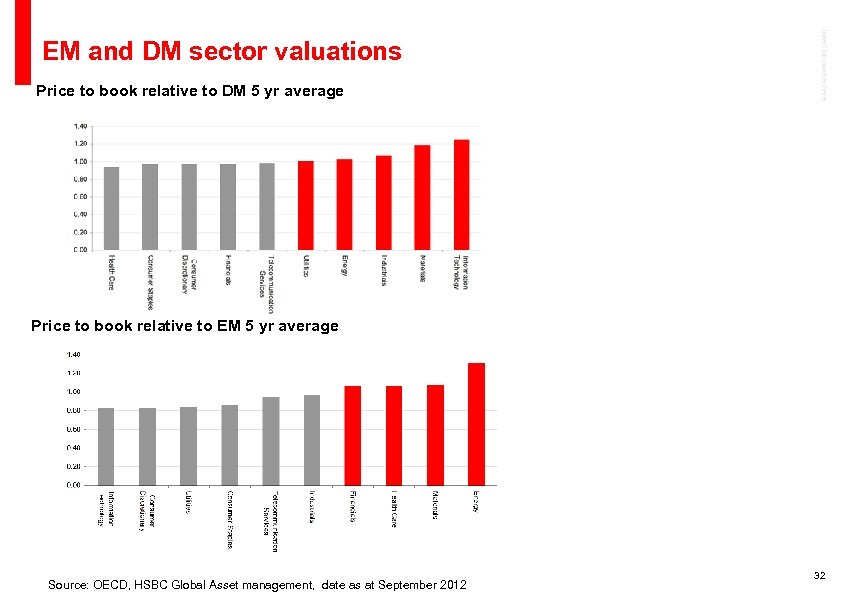
Insert job number here EM and DM sector valuations Price to book relative to DM 5 yr average Price to book relative to EM 5 yr average Source: OECD, HSBC Global Asset management, date as at September 2012 32
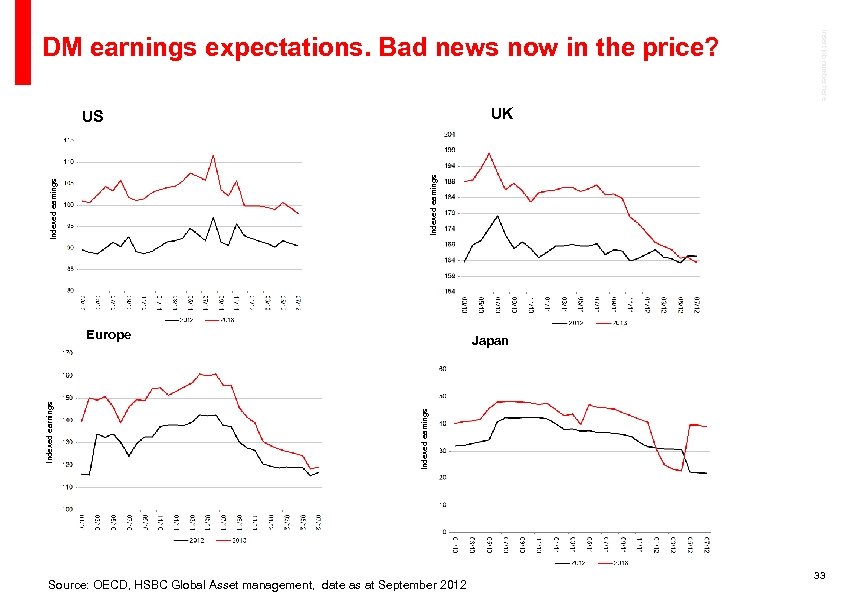
UK Indexed earnings US Europe Japan Indexed earnings Insert job number here DM earnings expectations. Bad news now in the price? Source: OECD, HSBC Global Asset management, date as at September 2012 33
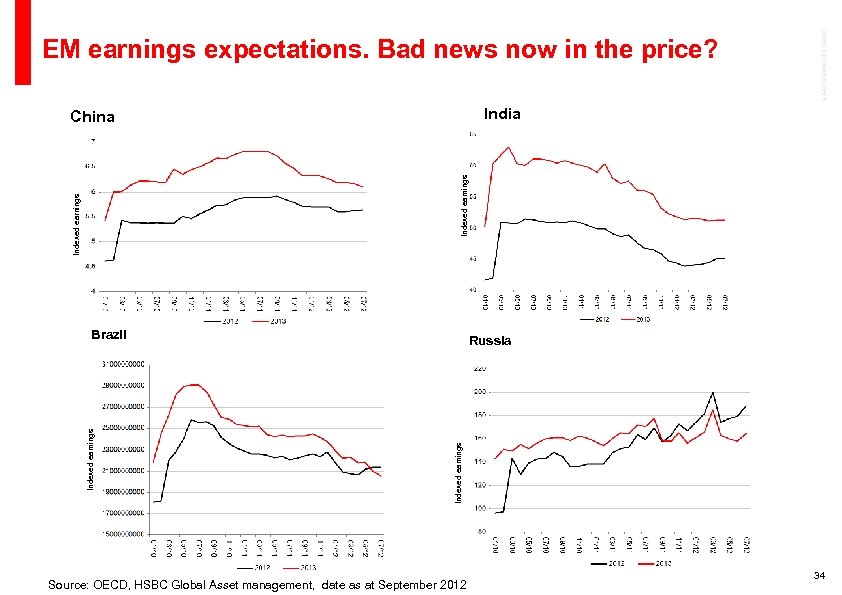
Insert job number here EM earnings expectations. Bad news now in the price? India China Indexed earnings Russia Indexed earnings Brazil Source: OECD, HSBC Global Asset management, date as at September 2012 34
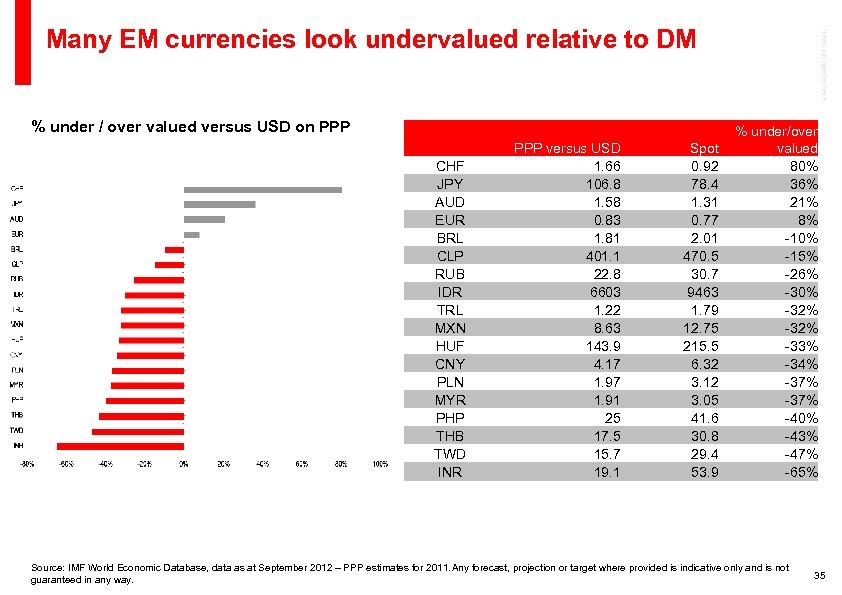
% under / over valued versus USD on PPP CHF JPY AUD EUR BRL CLP RUB IDR TRL MXN HUF CNY PLN MYR PHP THB TWD INR PPP versus USD 1. 66 106. 8 1. 58 0. 83 1. 81 401. 1 22. 8 6603 1. 22 8. 63 143. 9 4. 17 1. 91 25 17. 5 15. 7 19. 1 Spot 0. 92 78. 4 1. 31 0. 77 2. 01 470. 5 30. 7 9463 1. 79 12. 75 215. 5 6. 32 3. 12 3. 05 41. 6 30. 8 29. 4 53. 9 Insert job number here Many EM currencies look undervalued relative to DM % under/over valued 80% 36% 21% 8% -10% -15% -26% -30% -32% -33% -34% -37% -40% -43% -47% -65% Source: IMF World Economic Database, data as at September 2012 – PPP estimates for 2011. ny forecast, projection or target where provided is indicative only and is not A guaranteed in any way. 35
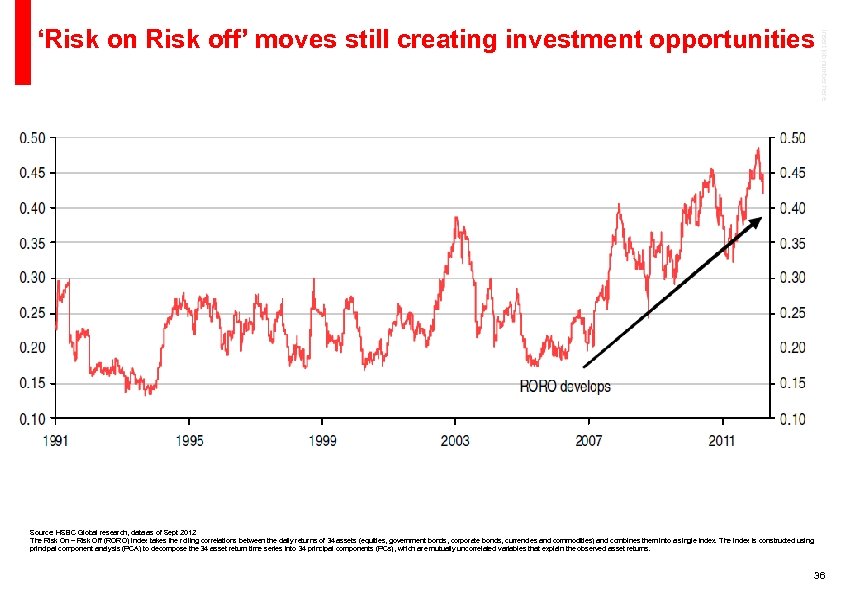
Insert job number here ‘Risk on Risk off’ moves still creating investment opportunities Source: HSBC Global research, data as of Sept 2012 The Risk On – Risk Off (RORO) index takes the rolling correlations between the daily returns of 34 assets (equities, government bonds, corporate bonds, currencies and commodities) and combines them into a single index. The index is constructed using principal component analysis (PCA) to decompose the 34 asset return time series into 34 principal components (PCs), which are mutually uncorrelated variables that explain the observed asset returns. 36
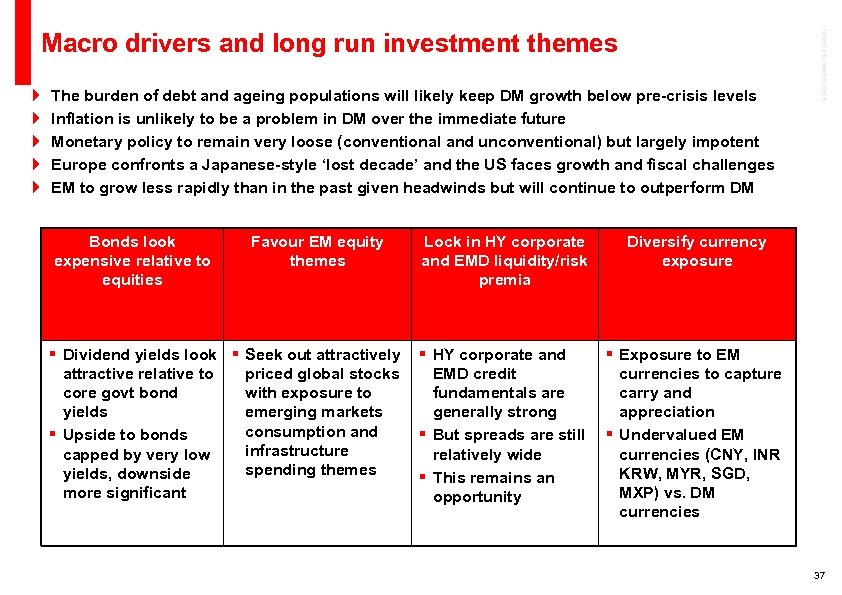
} } } The burden of debt and ageing populations will likely keep DM growth below pre-crisis levels Inflation is unlikely to be a problem in DM over the immediate future Monetary policy to remain very loose (conventional and unconventional) but largely impotent Europe confronts a Japanese-style ‘lost decade’ and the US faces growth and fiscal challenges EM to grow less rapidly than in the past given headwinds but will continue to outperform DM Bonds look expensive relative to equities Favour EM equity themes Lock in HY corporate and EMD liquidity/risk premia Insert job number here Macro drivers and long run investment themes Diversify currency exposure § Dividend yields look § Seek out attractively § HY corporate and § Exposure to EM attractive relative to priced global stocks EMD credit currencies to capture core govt bond with exposure to fundamentals are carry and yields emerging markets generally strong appreciation consumption and § Upside to bonds § But spreads are still § Undervalued EM infrastructure capped by very low relatively wide currencies (CNY, INR spending themes yields, downside KRW, MYR, SGD, § This remains an more significant MXP) vs. DM opportunity currencies 37
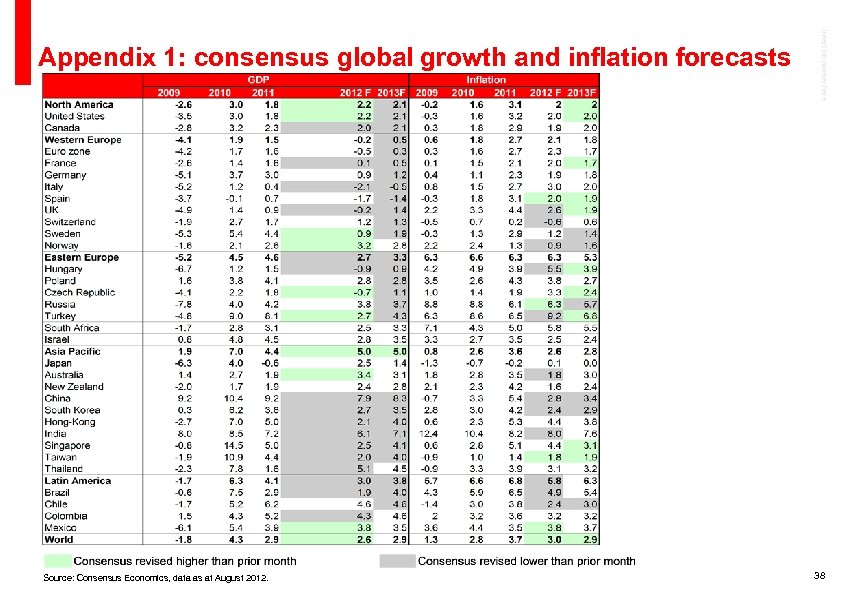
Source: Consensus Economics, data as at August 2012. Insert job number here Appendix 1: consensus global growth and inflation forecasts 38
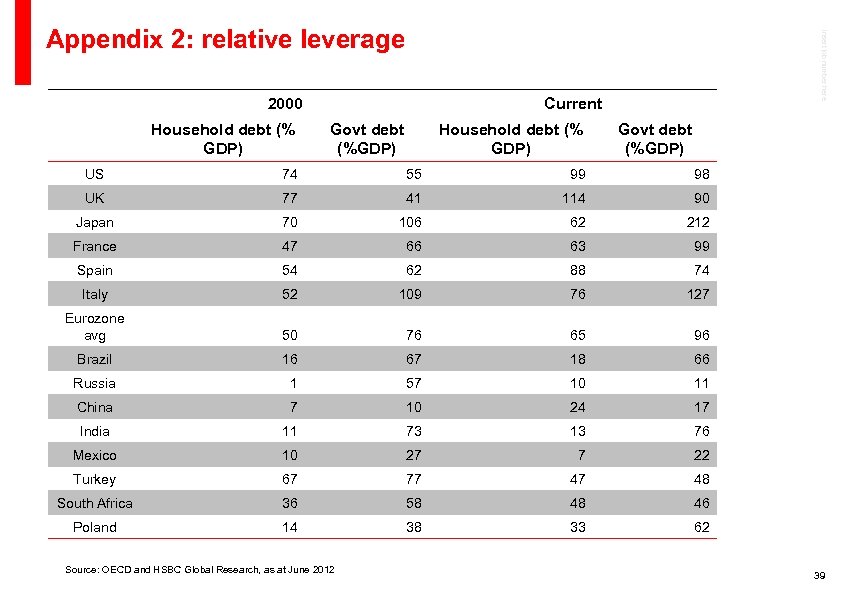
2000 Household debt (% GDP) Insert job number here Appendix 2: relative leverage Current Govt debt (%GDP) Household debt (% GDP) Govt debt (%GDP) US 74 55 99 98 UK 77 41 114 90 Japan 70 106 62 212 France 47 66 63 99 Spain 54 62 88 74 Italy 52 109 76 127 Eurozone avg 50 76 65 96 Brazil 16 67 18 66 Russia 1 57 10 11 China 7 10 24 17 India 11 73 13 76 Mexico 10 27 7 22 Turkey 67 77 47 48 South Africa 36 58 48 46 Poland 14 38 33 62 Source: OECD and HSBC Global Research, as at June 2012 39
Insert job number here Important information This presentation is intended for Professional Clients only and should not be distributed to or relied upon by Retail Clients. The contents of this presentation are confidential and may not be reproduced or further distributed to any person or entity, whether in whole or in part, for any purpose. The material contained herein is for information only and does not constitute investment advice or a recommendation to any reader of this material to buy or sell investments. This document is not intended for distribution to or use by any person or entity in any jurisdiction or country where such distribution or use would be contrary to law or regulation. This document is not and should not be construed as an offer to sell or the solicitation of an offer to purchase or subscribe to any investment. HSBC Global Asset Management (UK) Limited has based this presentation on information obtained from sources it believes to be reliable but which it has not independently verified. HSBC Global Asset Management (UK) Limited and HSBC Group accept no responsibility as to its accuracy or completeness. This presentation is intended for discussion only and shall not be capable of creating any contractual or other legal obligations on the part of HSBC Global Asset Management (UK) Limited or any other HSBC Group company. Care has been taken to ensure the accuracy of this presentation but HSBC Global Asset Management (UK) Limited accepts no responsibility for any errors or omissions contained therein. This presentation and any issues or disputes arising out of or in connection with it (whether such disputes are contractual or non-contractual in nature, such as claims in tort, for breach of statute or regulation or otherwise) shall be governed by and construed in accordance with English law. The views expressed above were held at the time of preparation and are subject to change without notice. Any forecast, projection or target where provided is indicative only and is not guaranteed in any way. HSBC Global Asset Management (UK) Limited accepts no liability for any failure to meet such forecast, projection or target. The value of investments and any income from them can go down as well as up and investors may not get back the amount originally invested. Where overseas investments are held the rate of currency exchange may also cause the value of such investments to fluctuate. Investments in emerging markets are by their nature higher risk and potentially more volatile than those inherent in established markets. Stockmarket investments should be viewed as a medium to long term investment and should be held for at least five years. The level of yield is not guaranteed and may rise or fall in the future. Any performance information shown refers to the past and should not be seen as an indication of future returns. HSBC Global Asset Management (UK) Limited provides information to Institutions, Professional Advisers and their clients on the investment products and services of the HSBC Group. This presentation is approved for issue in the UK by HSBC Global Asset Management (UK) Limited, who are authorised and regulated by the Financial Services Authority. www. assetmanagement. hsbc. com/uk Copyright © HSBC Global Asset Management (UK) Limited 2012 All rights reserved. FP 12 -1237 40
Скачать презентацию Japanese lessons global macro and market outlook Prepared
2b0e98f481a3e06fa8ab98d290c859fd.ppt