



 JAPAN
JAPAN
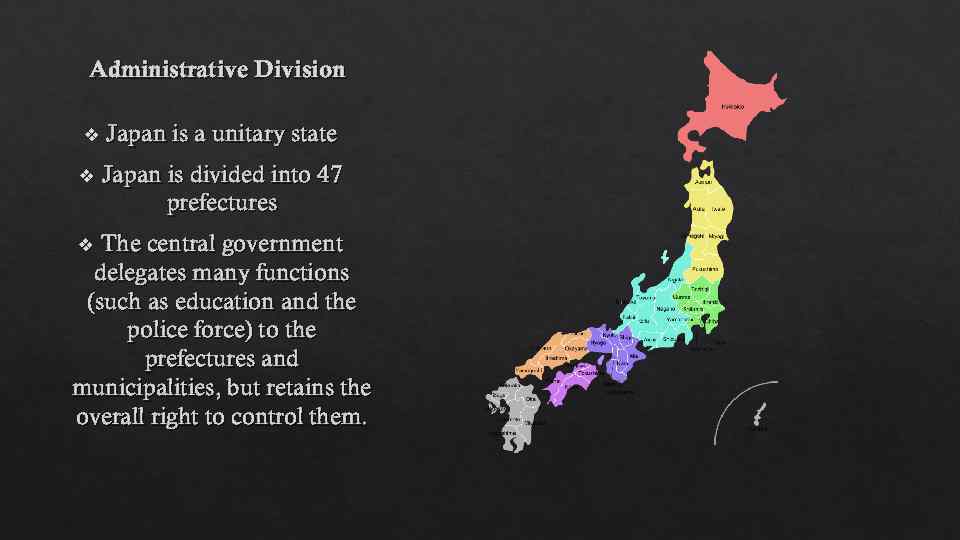 Administrative Division v Japan is a unitary state v Japan is divided into 47 prefectures The central government delegates many functions (such as education and the police force) to the prefectures and municipalities, but retains the overall right to control them. v
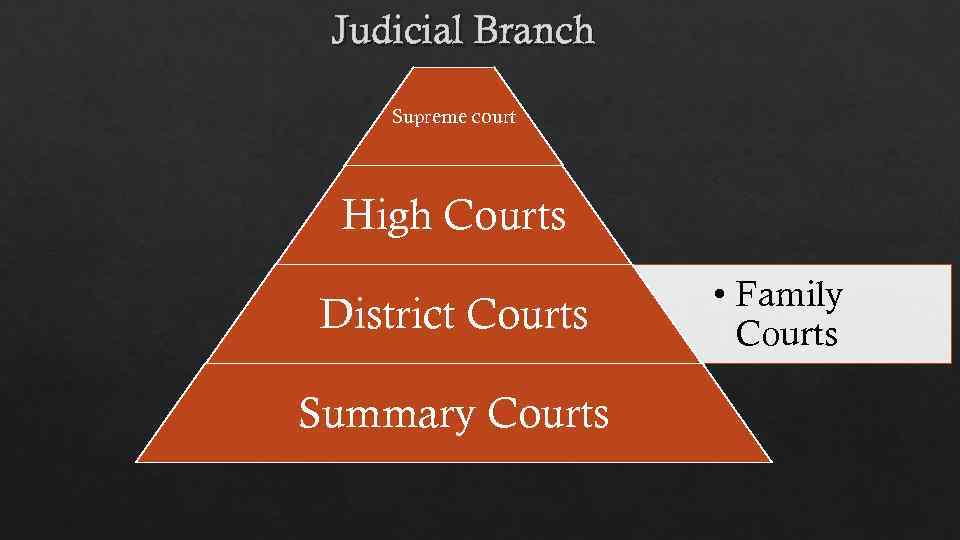 Judicial Branch Supreme court High Courts District Courts Summary Courts • Family Courts
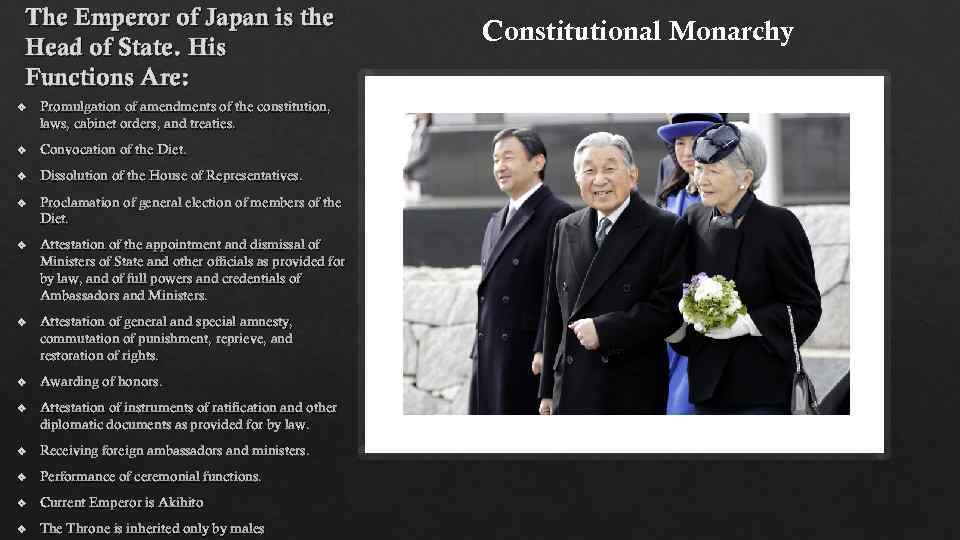 The Emperor of Japan is the Head of State. His Functions Are: v Promulgation of amendments of the constitution, laws, cabinet orders, and treaties. v Convocation of the Diet. v Dissolution of the House of Representatives. v Proclamation of general election of members of the Diet. v Attestation of the appointment and dismissal of Ministers of State and other officials as provided for by law, and of full powers and credentials of Ambassadors and Ministers. v Attestation of general and special amnesty, commutation of punishment, reprieve, and restoration of rights. v Awarding of honors. v Attestation of instruments of ratification and other diplomatic documents as provided for by law. v Receiving foreign ambassadors and ministers. v Performance of ceremonial functions. v Current Emperor is Akihito v The Throne is inherited only by males Constitutional Monarchy
 The Cabinet Functions: ). v Execution of the law. v Conduct of foreign affairs. v Conclusion of treaties (with the consent of the Diet). v Administration of the civil service. v Drafting of the budget (which must be adopted by the Diet). v Adoption of cabinet orders. v Granting of general amnesty, special amnesty, commutation of punishment, reprieve, and restoration of rights. v Signing of laws or cabinet orders by the relevant Minister of State and countersigned by the Prime Minister. v Appointment of the associate justices of the Supreme Court of Japan (except for the Chief Justice, who is designated by the Prime Minister and formally appointed by the Emperor). v Appointment of vice-ministers (who are nominated by their respective Minister to whom they will report).
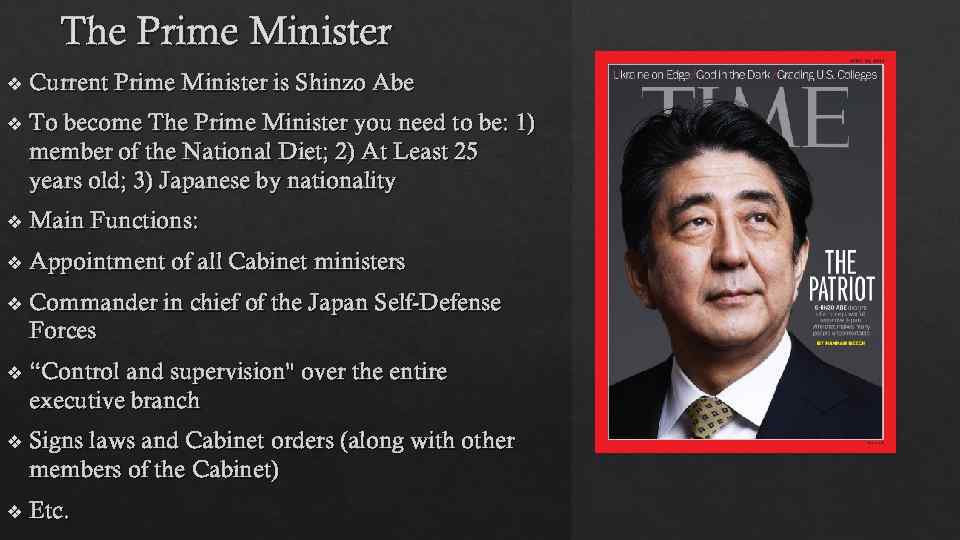 The Prime Minister v Current Prime Minister is Shinzo Abe v To become The Prime Minister you need to be: 1) member of the National Diet; 2) At Least 25 years old; 3) Japanese by nationality v Main Functions: v Appointment of all Cabinet ministers v Commander in chief of the Japan Self-Defense Forces v “Control and supervision" over the entire executive branch v Signs laws and Cabinet orders (along with other members of the Cabinet) v Etc.
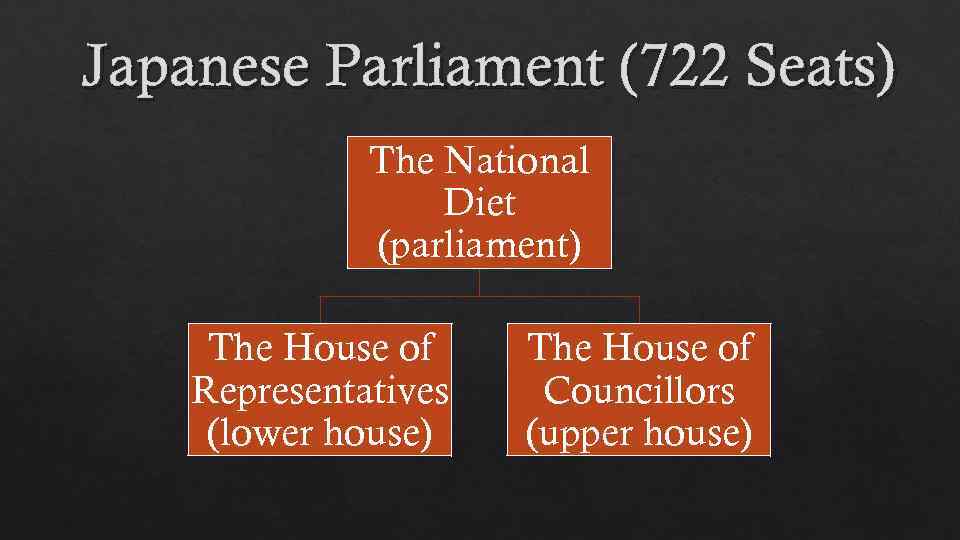 Japanese Parliament (722 Seats) The National Diet (parliament) The House of Representatives (lower house) The House of Councillors (upper house)
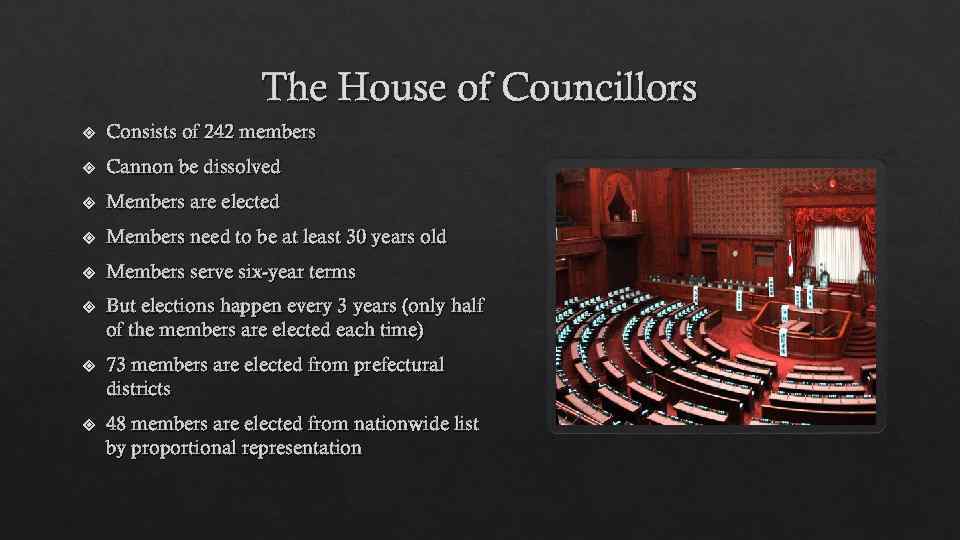 The House of Councillors Consists of 242 members Cannon be dissolved Members are elected Members need to be at least 30 years old Members serve six-year terms But elections happen every 3 years (only half of the members are elected each time) 73 members are elected from prefectural districts 48 members are elected from nationwide list by proportional representation
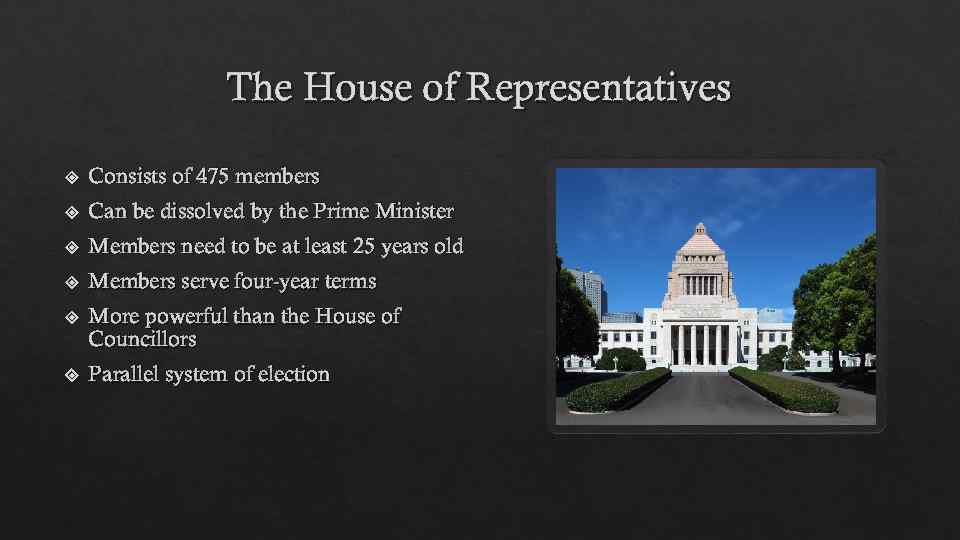 The House of Representatives Consists of 475 members Can be dissolved by the Prime Minister Members need to be at least 25 years old Members serve four-year terms More powerful than the House of Councillors Parallel system of election
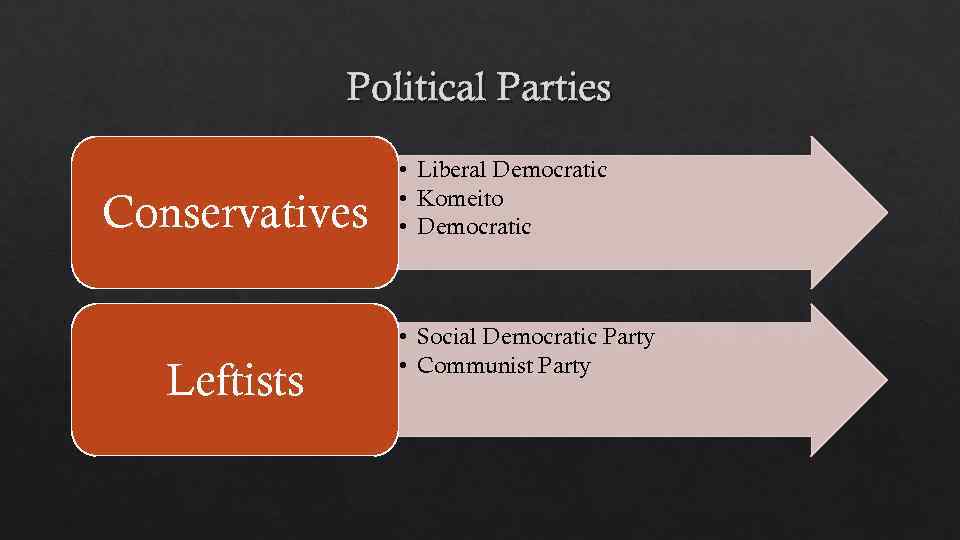 Political Parties Conservatives Leftists • Liberal Democratic • Komeito • Democratic • Social Democratic Party • Communist Party
 “…it has become all but impossible to distinguish the basic policy lines followed by the two parties. Differences between the LDP and DPJ have been blurred by Abe and Noda. ” Takamitsu Sawa© president of Shiga University (2013)
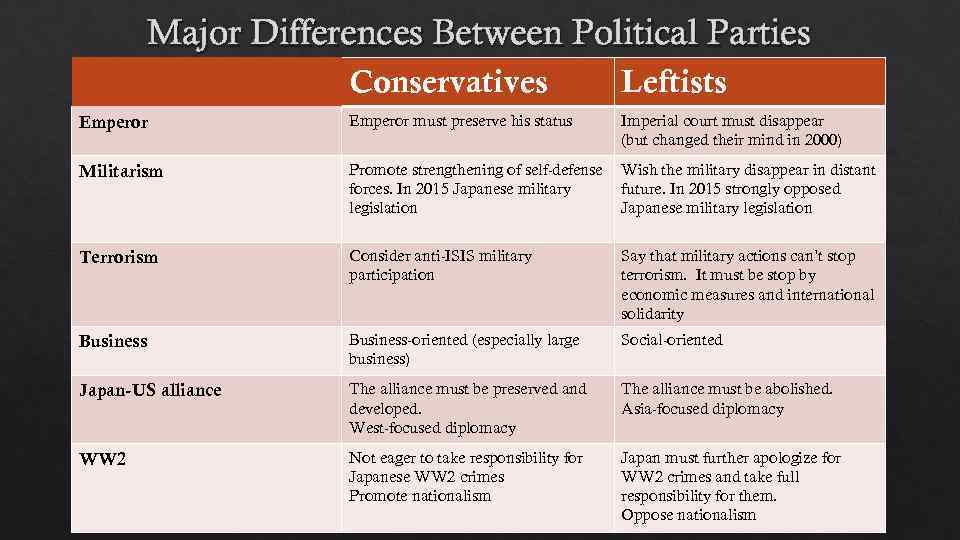 Major Differences Between Political Parties Conservatives Leftists Emperor must preserve his status Imperial court must disappear (but changed their mind in 2000) Militarism Promote strengthening of self-defense forces. In 2015 Japanese military legislation Wish the military disappear in distant future. In 2015 strongly opposed Japanese military legislation Terrorism Consider anti-ISIS military participation Say that military actions can’t stop terrorism. It must be stop by economic measures and international solidarity Business-oriented (especially large business) Social-oriented Japan-US alliance The alliance must be preserved and developed. West-focused diplomacy The alliance must be abolished. Asia-focused diplomacy WW 2 Not eager to take responsibility for Japanese WW 2 crimes Promote nationalism Japan must further apologize for WW 2 crimes and take full responsibility for them. Oppose nationalism
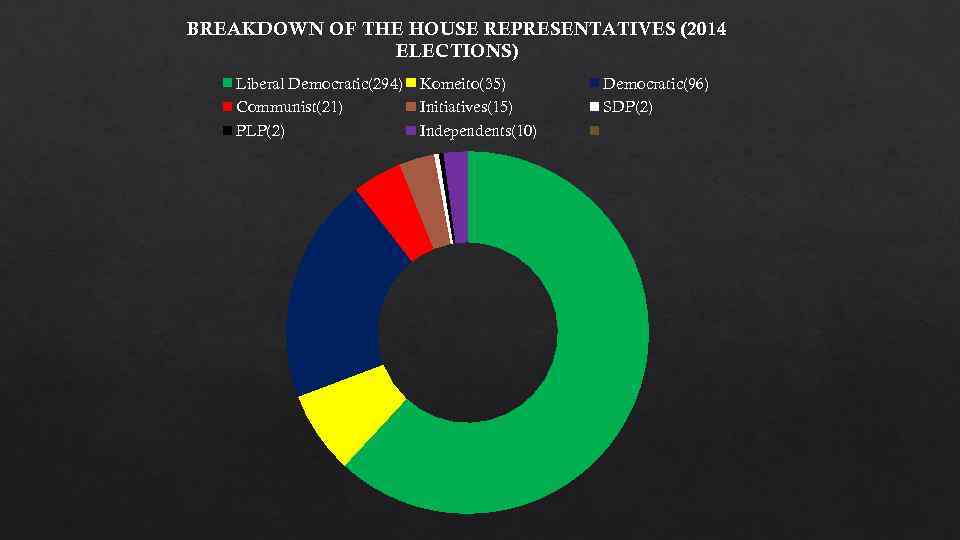 BREAKDOWN OF THE HOUSE REPRESENTATIVES (2014 ELECTIONS) Liberal Democratic(294) Communist(21) PLP(2) Komeito(35) Initiatives(15) Independents(10) Democratic(96) SDP(2)
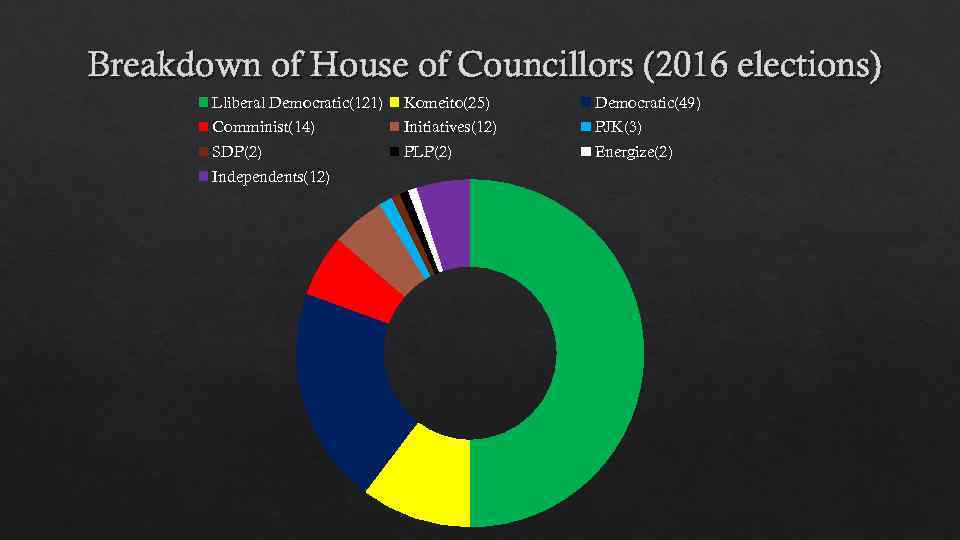 Breakdown of House of Councillors (2016 elections) Lliberal Democratic(121) Komeito(25) Democratic(49) Comminist(14) Initiatives(12) PJK(3) SDP(2) PLP(2) Energize(2) Independents(12)
 Japanese Self-Defense Forces According to the Article 9 of the Constitution of Japan the country has no army but “self-defense forces”, but….
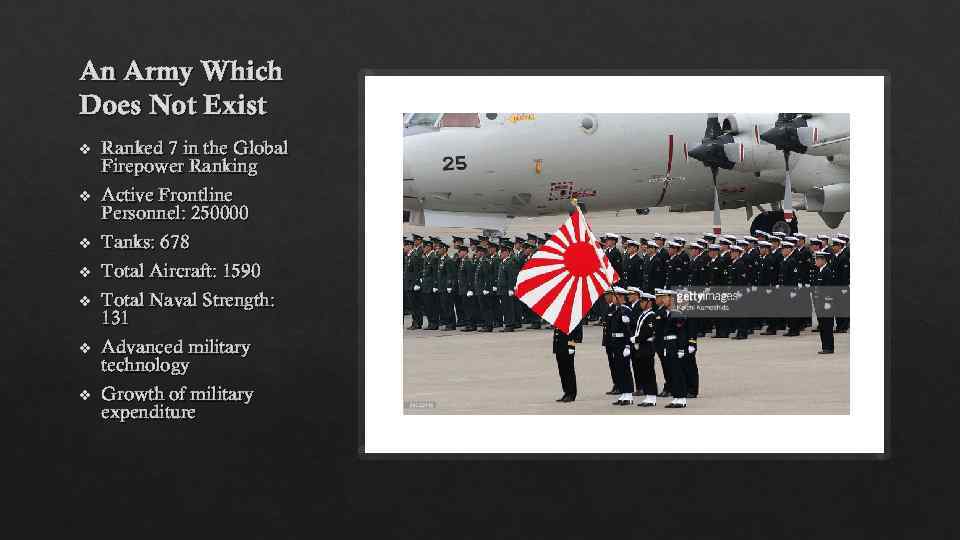 An Army Which Does Not Exist v v v v Ranked 7 in the Global Firepower Ranking Active Frontline Personnel: 250000 Tanks: 678 Total Aircraft: 1590 Total Naval Strength: 131 Advanced military technology Growth of military expenditure
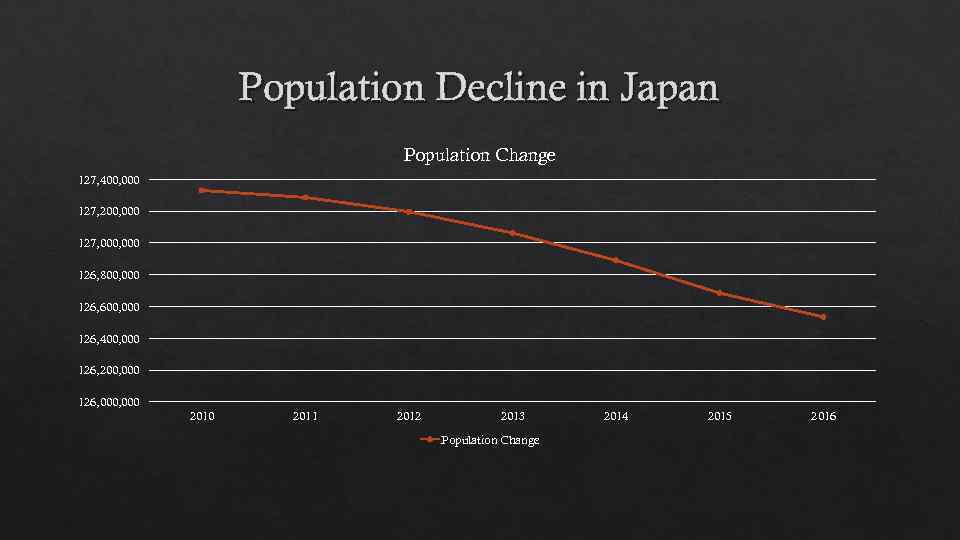 Population Decline in Japan Population Change 127, 400, 000 127, 200, 000 127, 000 126, 800, 000 126, 600, 000 126, 400, 000 126, 200, 000 126, 000 2010 2011 2012 2013 Population Change 2014 2015 2016
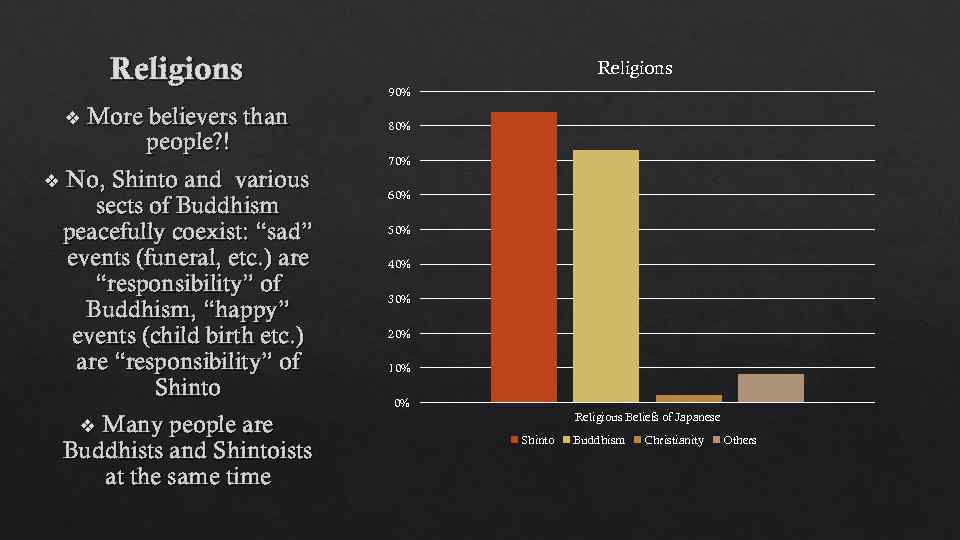 Religions v v More believers than people? ! No, Shinto and various sects of Buddhism peacefully coexist: “sad” events (funeral, etc. ) are “responsibility” of Buddhism, “happy” events (child birth etc. ) are “responsibility” of Shinto Many people are Buddhists and Shintoists at the same time v Religions 90% 80% 70% 60% 50% 40% 30% 20% 10% 0% Religious Beliefs of Japanese Shinto Buddhism Christianity Others
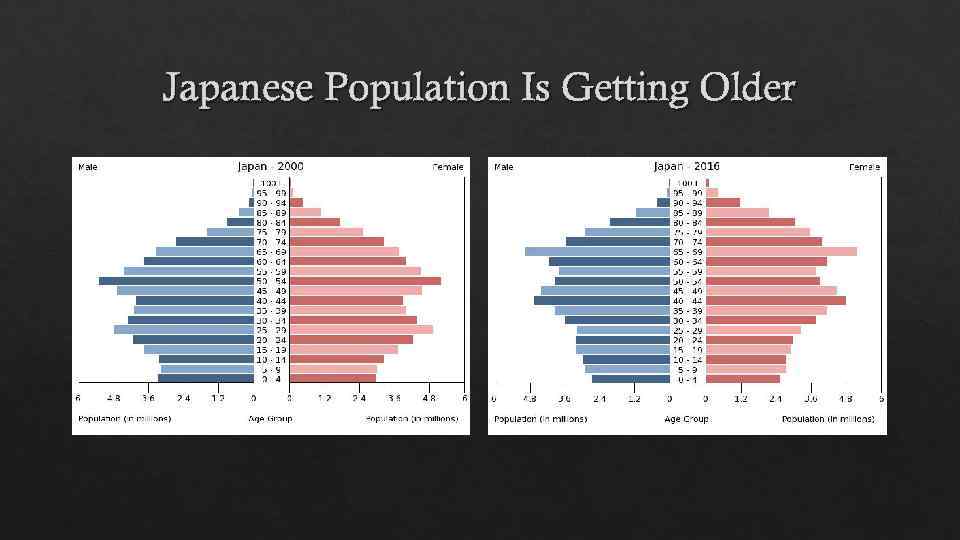 Japanese Population Is Getting Older
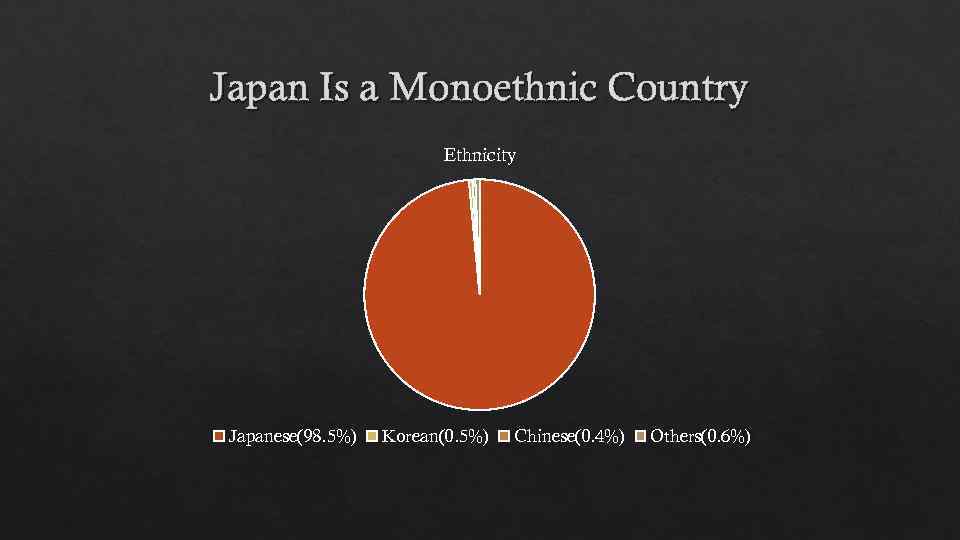 Japan Is a Monoethnic Country Ethnicity Japanese(98. 5%) Korean(0. 5%) Chinese(0. 4%) Others(0. 6%)
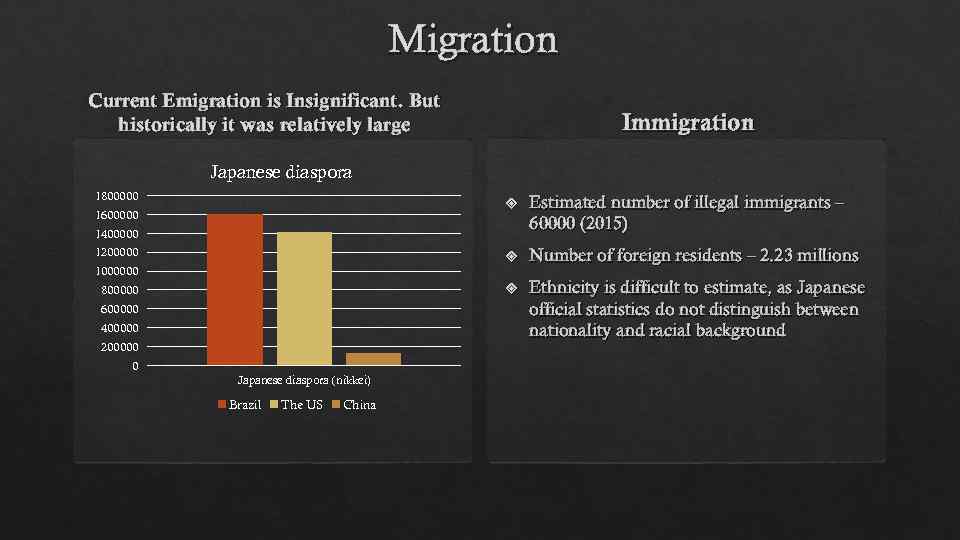 Migration Current Emigration is Insignificant. But historically it was relatively large Immigration Japanese diaspora 1800000 Estimated number of illegal immigrants – 60000 (2015) Number of foreign residents – 2. 23 millions 1600000 Ethnicity is difficult to estimate, as Japanese official statistics do not distinguish between nationality and racial background 1400000 1200000 1000000 800000 600000 400000 200000 0 Japanese diaspora (nikkei) Brazil The US China
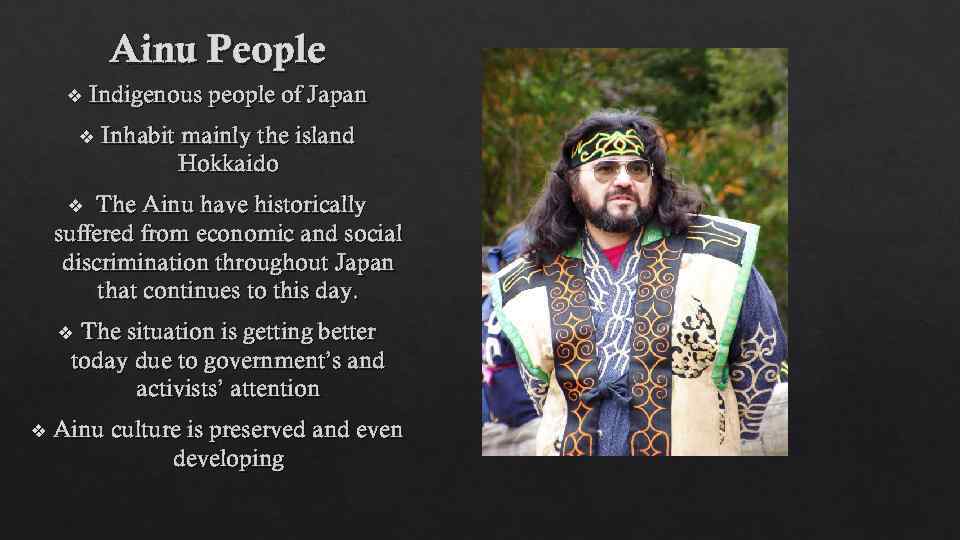 Ainu People v Indigenous people of Japan v Inhabit mainly the island Hokkaido The Ainu have historically suffered from economic and social discrimination throughout Japan that continues to this day. v The situation is getting better today due to government’s and activists’ attention v v Ainu culture is preserved and even developing
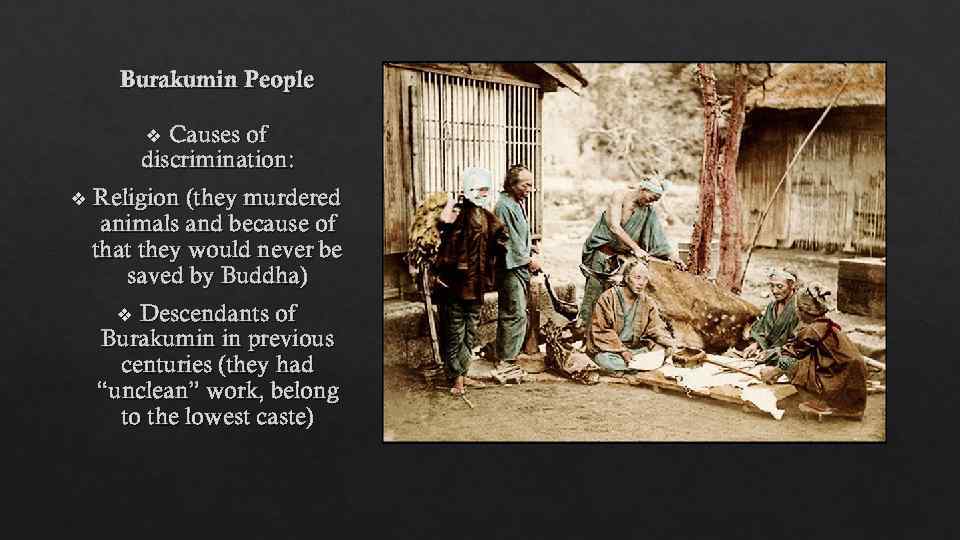 Burakumin People Causes of discrimination: v v Religion (they murdered animals and because of that they would never be saved by Buddha) Descendants of Burakumin in previous centuries (they had “unclean” work, belong to the lowest caste) v
 Foreign Policy Priorities v Strengthening Japan-US alliance v Enhancing relations with neighboring countries v Solvation of territorial issues v Strengthening economic diplomacy
 Economic Diplomacy Economic diplomacy is when the government uses full spectrum of economic tools to promote its agenda on international stage
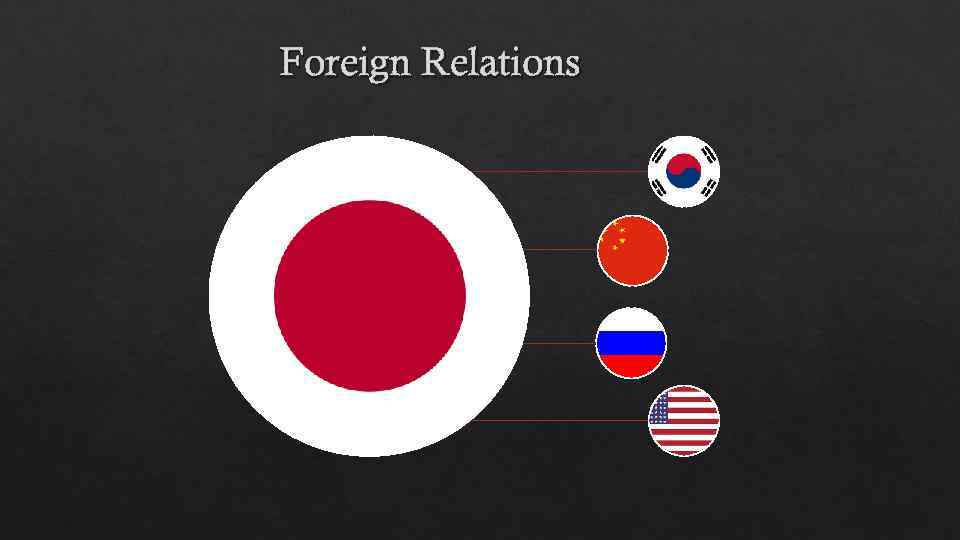 Foreign Relations
 Japan-US Relations Despite Japan's defeat and subsequent occupation by Americans, relations with the United States have been friendly and close except for intermittent bouts of trade friction beginning in the 1970 s. The United States sponsored Japan's membership in various international organizations.
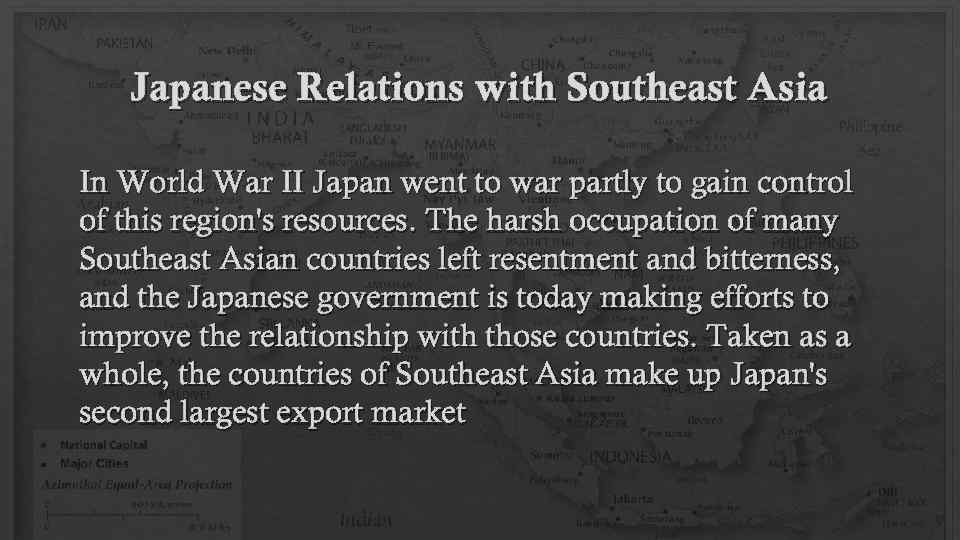 Japanese Relations with Southeast Asia In World War II Japan went to war partly to gain control of this region's resources. The harsh occupation of many Southeast Asian countries left resentment and bitterness, and the Japanese government is today making efforts to improve the relationship with those countries. Taken as a whole, the countries of Southeast Asia make up Japan's second largest export market
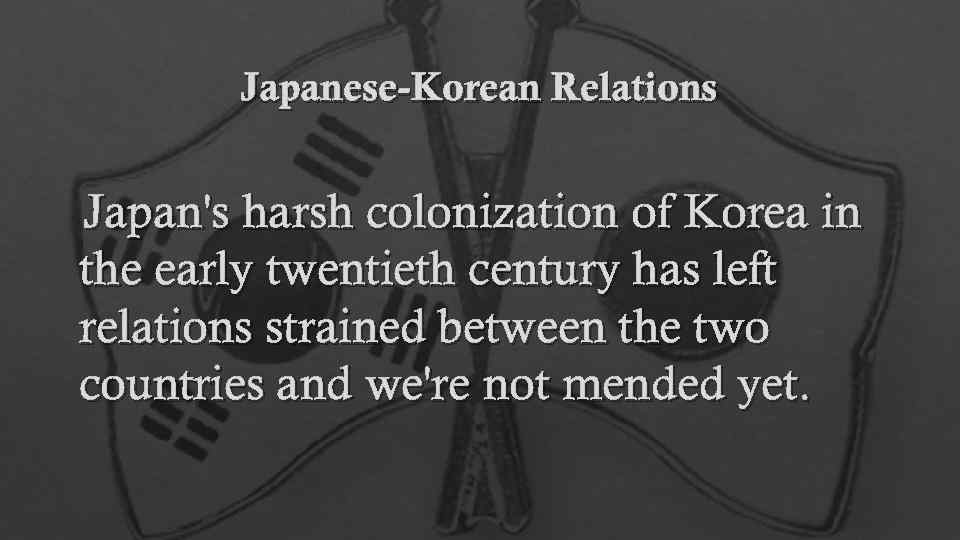 Japanese-Korean Relations Japan's harsh colonization of Korea in the early twentieth century has left relations strained between the two countries and we're not mended yet.
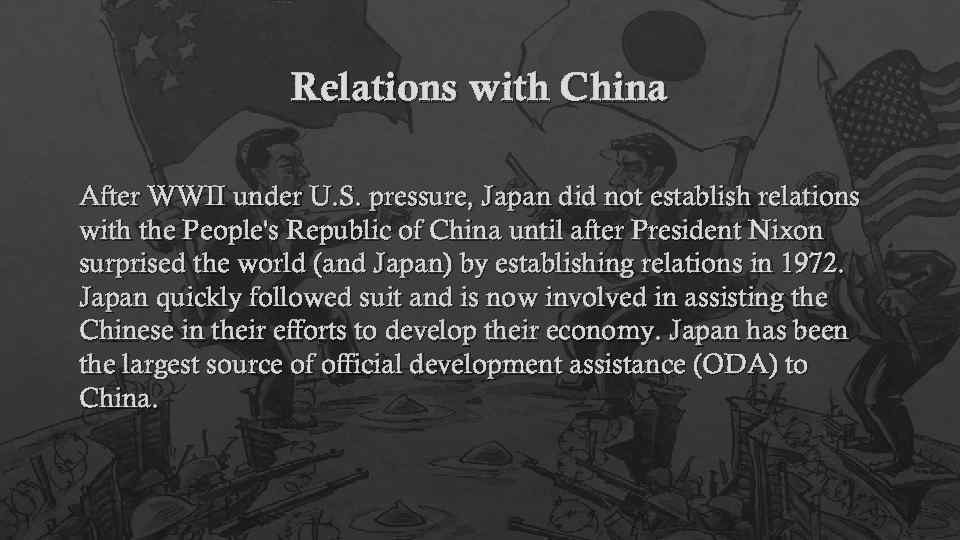 Relations with China After WWII under U. S. pressure, Japan did not establish relations with the People's Republic of China until after President Nixon surprised the world (and Japan) by establishing relations in 1972. Japan quickly followed suit and is now involved in assisting the Chinese in their efforts to develop their economy. Japan has been the largest source of official development assistance (ODA) to China.
 Relations with Russia. Japan's relations with Russia have been strained throughout the postwar period. In the last days of World War II, the Soviets occupied South Sakhalin Islands and the Kurile islands, including a few islands close to Hokkaidô that the Japanese claim as part of their native land. The issue of these islands is under negotiation between the two countries. They have set a goal to resolve the conflict and sign a peace treaty by the year 2000. Trade has gradually developed between the two countries and Japanese business has participated modestly in certain development projects.
 Major Export Partners v. China v. The v. South (131 billion $) US (128 billion $) Korea (52 billion $)
 Membership in International Organizations UN v IMF v World Bank v WTO v ADB (Asian Development Bank) v G 20 v IOC v
 References: http: //www. japantimes. co. jp/opinion/2013/01/21/commentary/japan-commentary/anagging-japanese-riddle-whos-left-and-whos-right/#. WEm 8 IOa. LRPY http: //www. mofa. go. jp/fp/pp/page 24 e_000157. html http: //www. hurights. or. jp/archives/focus/section 2/200 http: //countrymeters. info/ru/Japan