


 Скачать презентацию January 28 2004 Outline of Presentation Overview of
2935dd057bc4d23e29b6520b0dafa292.ppt
- Количество слайдов: 59
 January 28, 2004 Outline of Presentation Overview of vitals and then Discussion of analytic data files Births Fetal deaths Linked births and infant deaths Deaths
 National Vital Statistics System An Overview • 57 reporting areas • Decentralized • US historical development-self-governing States • Nothing on registration in US Constitution • Responsibility based in state law • Responsibility with provider of services
 Federal Role Defined by the Public Health Service Act – Sec 306 (h) (1) • Annual collection of data from the records of births, deaths, marriages, and divorces • Satisfactory data in necessary detail and form • Encourage States to collect detailed data on ethnic and racial populations • Each State or registration area shall be paid by the Secretary the Federal share of its reasonable (? !) costs
 National Vital Statistics System Individual Record Data: • Births • Deaths • Fetal Deaths • Linked Infant Birth and Death Counts: • Marriages • Divorces
 Vital Statistics • Core of our health data system • Base for public health, social science, economic planning and program development • Monitor key indicators of health world-wide and at the local, state and national level • Track progress to goals • Identify disparities • Alert to emerging problems
 NCHS Roles: Promoting Consistency and Uniformity • Model State Vital Statistics Act and Regulations • Standard Certificates and Reports – standardized worksheets • Training materials – handbooks, videos, instruction manuals • Technical assistance – ICD 10 • Software – ACME, MICAR, etc…
 Data Release: Provisional Data • Most timely data release of counts and rates • Short “fact sheet” released monthly on the Internet in the NVSR series • Includes counts only of births, deaths, infant deaths, marriages & divorces • Estimates based on counts of certificates received during a one-month period, regardless of month of occurrence
 Data Release: Preliminary Data • Detail for basic variables and preview of data in final report; data track well with final report • Based on substantial sample of records – 99% of all births for 2003; 97% of demographicdeaths and 92% of medical-deaths for 2002 • Sample of all records received and processed by cut-off date – 3 -4 months after end of data year 2003 for births, 7 months for deaths • Births published 6 -11 months after end of year; 14 -15 months for deaths
 Data Release: Final Data • Annual reports – based on all US births and deaths in a given year • Final public use files available with release of final data reports • Births released 12 months after end of data year , deaths about 21 months after end of data year • Integration of data from 1989 and 2003 certificate revisions delayed 2003 release by 3 -4 months
 Development of the Revised Birth and Death Certificates 12 th Revision • 12 revisions during the 20 th century: 11 th revision is still in use in many jurisdictions • In 1998, NCHS assembled an expert panel to evaluate the current certificate and recommend changes. • Panel consisted of State vital registration and statistics executives representing 11 jurisdictions (NAPHSIS) as well as • Researchers and representatives of data providers and user organizations - (e. g. , AAP, ACNM, ACOG, AHA, AHIMA, AMA, and ASTHO).
 Why revise? -Research Implications- Provide improved data for each of more than 4 million births, 2. 4 million deaths, and about 25, 000 fetal deaths annually. For Example: Research on the etiology of premature birth will be substantially improved through the collection of data on important pregnancy risk factors…. .
 Why Re-engineer Vital Registration Systems? • Automation of records at the source • Flexibility to revise rapidly, address new data needs • Speed the flow of data • Implemented by states along with new standard certificates • Potential for linking with other health data systems • Protocols and standards for Intelligence Reform Act
 Intelligence Reform Act • Legislation just signed by the President contains authorization for grant programs to strengthen state registration and certification for identity purposes • If appropriations follow … we could have a rejuvenated vital statistics system for states and the nation through boot strapping statistical needs with registration needs
 Recent analytic additions quality added to quality= the best
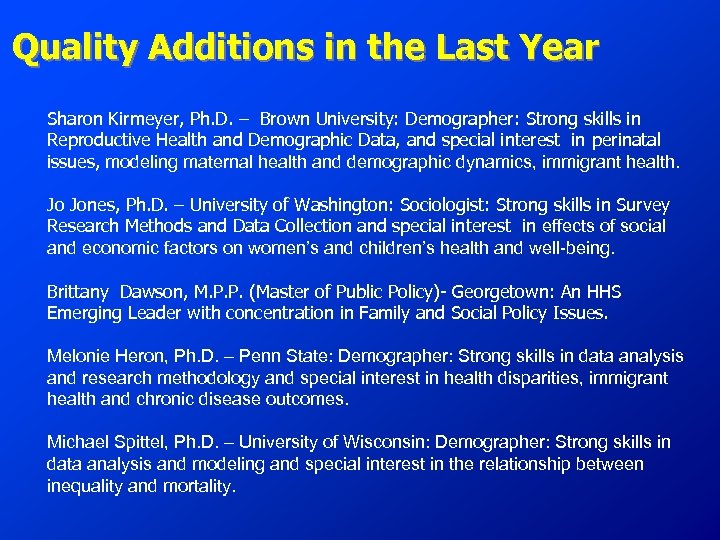 Quality Additions in the Last Year Sharon Kirmeyer, Ph. D. – Brown University: Demographer: Strong skills in Reproductive Health and Demographic Data, and special interest in perinatal issues, modeling maternal health and demographic dynamics, immigrant health. Jo Jones, Ph. D. – University of Washington: Sociologist: Strong skills in Survey Research Methods and Data Collection and special interest in effects of social and economic factors on women’s and children’s health and well-being. Brittany Dawson, M. P. P. (Master of Public Policy)- Georgetown: An HHS Emerging Leader with concentration in Family and Social Policy Issues. Melonie Heron, Ph. D. – Penn State: Demographer: Strong skills in data analysis and research methodology and special interest in health disparities, immigrant health and chronic disease outcomes. Michael Spittel, Ph. D. – University of Wisconsin: Demographer: Strong skills in data analysis and modeling and special interest in the relationship between inequality and mortality.
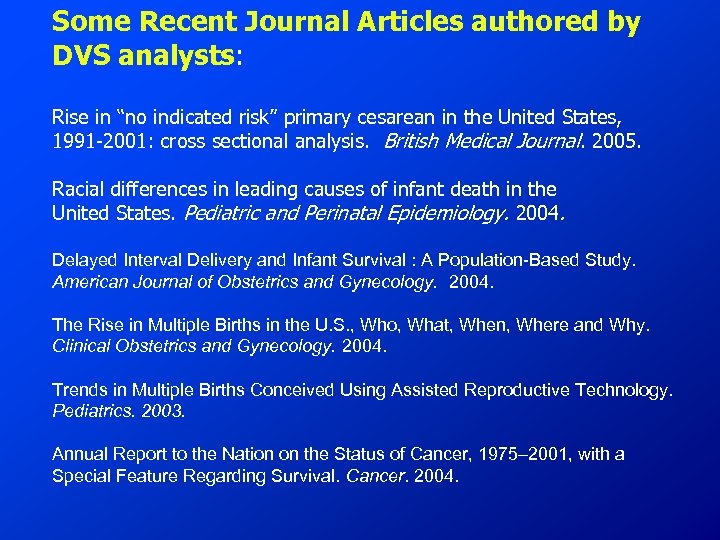 Some Recent Journal Articles authored by DVS analysts: Rise in “no indicated risk” primary cesarean in the United States, 1991 -2001: cross sectional analysis. British Medical Journal. 2005. Racial differences in leading causes of infant death in the United States. Pediatric and Perinatal Epidemiology. 2004. Delayed Interval Delivery and Infant Survival : A Population-Based Study. American Journal of Obstetrics and Gynecology. 2004. The Rise in Multiple Births in the U. S. , Who, What, When, Where and Why. Clinical Obstetrics and Gynecology. 2004. Trends in Multiple Births Conceived Using Assisted Reproductive Technology. Pediatrics. 2003. Annual Report to the Nation on the Status of Cancer, 1975– 2001, with a Special Feature Regarding Survival. Cancer. 2004.
 Some Recent Journal Articles authored by DVS analysts: Paradox Lost: Explaining the Hispanic Adult Mortality Advantage. Demography. 2004. Mortality associated with birth defects: Influence of successive disease classification revisions. Birth Defects Research. 2003. Disease Classification: Measuring the Effect of the Tenth Revision of the International Classification of Diseases on Cause of Death Data in the United States. Statistics in Medicine. 2003. Long Term Trends in Cancer Mortality in the United States, 1930 -1998. Cancer. 2003. Increase in HIV Deaths Due to Changes in Rules for Selecting Underlying Cause of Death. Journal of Acquired Immune Deficiency Syndromes. 2003. Classification of deaths resulting from terrorism. Homicide Studies. 2003. Influence of Rules from the Tenth Revision of the International Classification of Diseases on U. S. Cancer Mortality Trends. Journal of the National Cancer Institute. 2003.
 -Birth filewith the 2003 revision there will be an almost completely new analytic file
 Leading indicators from birth certificate data: Birth Rates by Age Teenage Pregnancy and Childbearing Timing and Adequacy of Prenatal Care Cesarean Delivery and VBAC Preterm Birth and Low Birthweight Multiple Births
 Leading indicators from birth certificate data Fertility and Maternal/Infant Health Differences by Race/Hispanic Origin and Educational Attainment Geographic Differences (State, county-level data) Neural Tube Defects Maternal Medical Risk Factors (Diabetes, Hypertension) Smoking During Pregnancy
 The New Birth Certificate: Additional New and Improved Items Maternal Demographic and Social Factors • Age and parity • Marital status • Educational attainment (captures highest degree) • Race and Hispanic ethnicity (captures multiple race) • Use of WIC food during this pregnancy • Principal source of payment for the delivery • Breastfeeding
 The New Birth Certificate: Modified Items • Cigarette smoking before and during pregnancy, captures levels of smoking • Pre-pregnancy weight, weight at delivery and height, used to calculate Body Mass Index and weight gain
 Detailed Specifications for Electronic Systems Because states have automated systems in hospitals -detailed specifications for birth certificate were been developed. The specifications include: • Suggested electronic screens • Response categories • Drop-down menus • Edits • Help screens • Ability to edit and query at data entry; resolution of data issues at the source
 Birth reporting is automated in hospitals however systems are inflexible and antiquated and can’t make these needed changes
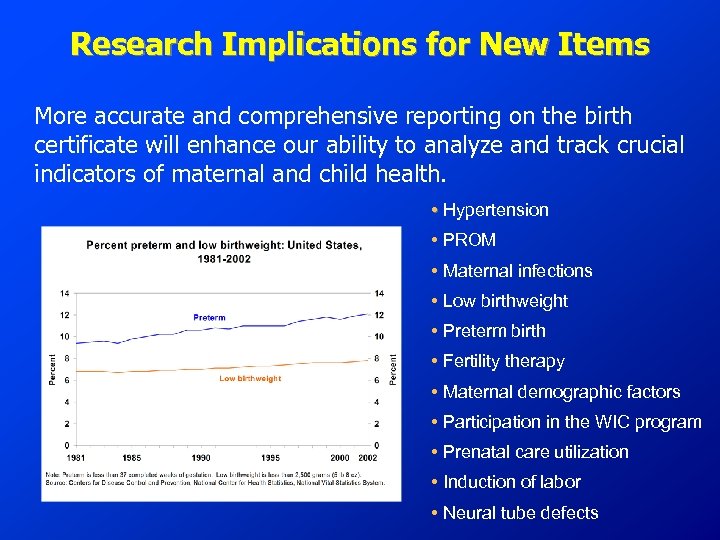 Research Implications for New Items More accurate and comprehensive reporting on the birth certificate will enhance our ability to analyze and track crucial indicators of maternal and child health. • Hypertension • PROM • Maternal infections • Low birthweight • Preterm birth • Fertility therapy • Maternal demographic factors • Participation in the WIC program • Prenatal care utilization • Induction of labor • Neural tube defects
 But it is not just Vitals: Two recent reports focusing on teens for birth and infant health and pregnancy rates using vital stats for births, CDC and AGI for abortions, and NSFG for fetal losses
 Major Users of Birth and Infant Health Data Federal Agencies and Other Governmental: CDC’s Division of Reproductive Health, NCCDPHP CDC’s National Center for Birth Defects and Developmental Disabilities Surgeon General National Institute for Child Health and Human Development HHS Assistant Secretary for Planning and Evaluation HHS Administration for Children and Families HHS Office of Population Affairs U. S. Census Bureau Social Security Administration Indian Health Service Department of Homeland Security Canadian Institute for Health Information Maternal and Child Health Bureau, HRSA Georgia Campaign for Adolescent Pregnancy Prevention The Kentucky Cancer Registry United Nations
 Advocacy Groups, Think Tanks, Professional Groups Using Birth and Infant Health Data March of Dimes The Urban Institute National Campaign to Prevent Teen Pregnancy Child Trends Annie E. Casey Foundation (Kids Count reports) Population Reference Bureau SIDS Alliance Child Health USA American College of Obstetricians and Gynecologists American College of Nurse-Midwives National Partnership to Help Pregnant Smokers Quit International Cesarean Section Awareness Network Planned Parenthood National Organization on Fetal Alcohol Syndrome Negative Population Growth Maternal and Child Health Policy Research Center Association of Maternal and Child Health Programs Marvelous Multiples
 Commercial Organizations Using Birth and Infant Health Data Nestles Westat Hasbro Fisher-Price Pfizer Toys R Us Novartis Porter-Novelli Land’s End Honeywell
 Methodological Challenges: Births • Testing the quality of new data • “Integration” of different data items from states operating under different revisions • Use of expanded race/ethnicity data and bridging back to old categories • How best to utilize new data from selected states? • Future: How to provide and publish data on a current flow basis?
 Fetal Death File
 The U. S. Standard Report of Fetal Death: Modified Items The U. S. Standard Report of Fetal Death was also revised with changes similar to the birth certificate. Modified items include: • Maternal morbidity • Smoking • Method of delivery • Congenital anomalies • Cause of death
 Leading indicators – using fetal death data: Pregnancy Health Pregnancy Rates Perinatal Mortality Rates Tracking Causes of Pregnancy Loss Differences in Pregnancy Outcomes by Race/Ethnicity Tracking outcomes for multiple deliveries
 Major Agency/Foundation Users of Fetal Mortality Data CDC’s Division of Reproductive Health, NCCDPHP National Institute for Child Health and Human Development HHS Assistant Secretary for Planning and Evaluation Maternal and Child Health Bureau, HRSA March of Dimes International Cesarean Section Awareness Network American College of Nurse-Midwives American College of Obstetricians and Gynecologists Association of Maternal and Child Health Programs National Organization on Fetal Alcohol Syndrome
 Methodological and Analytic Challenges for Fetal Death Reporting • reporting issues impact infant mortality reporting • • not receiving early fetal loss quality of cause of death
 Linked Birth and Infant Death File
 Leading Indicators Linked Birth/Infant Death Data: Differences in Pregnancy Outcomes by: Race/Ethnicity Marital Status Educational Attainment Maternal Medical Risk Status Smoking Status During Pregnancy Gestation and Birthweight-Specific Infant Mortality Rates by Plurality Geographic Variation in Infant Mortality Leading Causes of Infant Death
 Why is the linked file important for examining changes in IMR? Is the change in IMR the result of changes in risk BEFORE birth? • Maternal characteristics • Infant characteristics • Characteristics of labor and delivery • OR
 Why use the linked file for IMR? If not before - Is the change in IMR primarily the result of an increase in the risk of death AFTER birth: • changes in birthweight/gestationspecific mortality? • changes in obstetric and neonatal care?
 Example of improved analysis of infant mortality reporting through the use of the linked Birth and Infant Death File
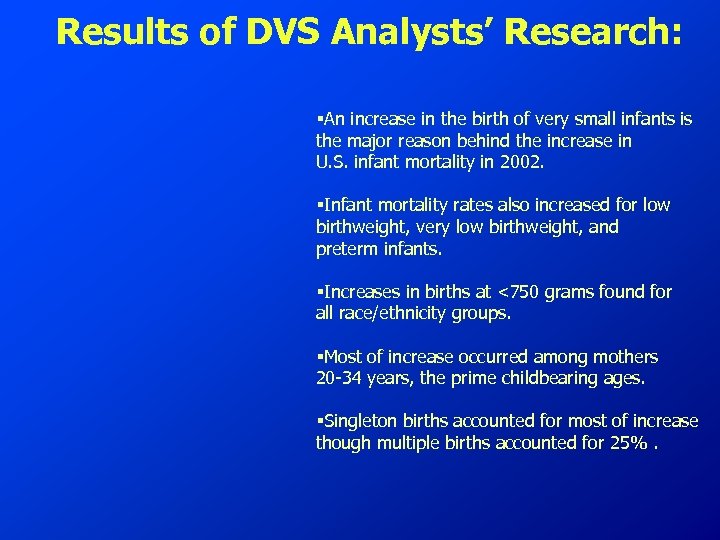 Results of DVS Analysts’ Research: §An increase in the birth of very small infants is the major reason behind the increase in U. S. infant mortality in 2002. §Infant mortality rates also increased for low birthweight, very low birthweight, and preterm infants. §Increases in births at <750 grams found for all race/ethnicity groups. §Most of increase occurred among mothers 20 -34 years, the prime childbearing ages. §Singleton births accounted for most of increase though multiple births accounted for 25%.
 Major Agency/Foundation Users of Linked Birth/Infant Death Data CDC’s Division of Reproductive Health, NCCDPHP National Institute for Child Health and Human Development HHS Assistant Secretary for Planning and Evaluation Maternal and Child Health Bureau, HRSA March of Dimes SIDS Alliance National SIDS and Infant Death Resource Center Association of Maternal and Child Health Programs International Cesarean Section Awareness Network American College of Nurse-Midwives American College of Obstetricians and Gynecologists Association of Maternal and Child Health Programs National Organization on Fetal Alcohol Syndrome
 Mortality File
 Data Items on the Mortality File • Demographic and other characteristics • Age, race, Hispanic origin, sex, marital status, education • Geographic • State, MSA, county – of occurrence and residence, State of birth
 Data Items on the Mortality File • Medical • Underlying cause of death • Other diseases/injuries reported (max 20) • Manner of death, place of injury, injury at work
 Death Registration Process: Two Responsible Parties and an Old Story • Hospital (or ME/coroner) initiates paper certificate and gives to funeral director • Funeral director obtains personal facts about decedent, completes certificate, and obtains cause of death from attending physician as needed • FD files certificate with local office or State office, per State law; obtains burial permit • Local office may hold records for fixed period (e. g. 2 months) to provide copies to family members • State office receives certificate and codes/keys demographic and medical information • State office transmits demographic and medical data electronically to NCHS for editing and possible additional coding of medical data.
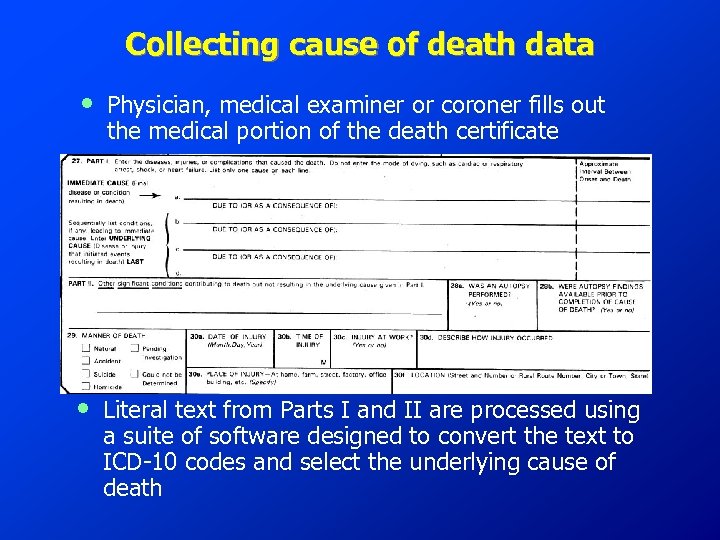 Collecting cause of death data • Physician, medical examiner or coroner fills out the medical portion of the death certificate • Literal text from Parts I and II are processed using a suite of software designed to convert the text to ICD-10 codes and select the underlying cause of death
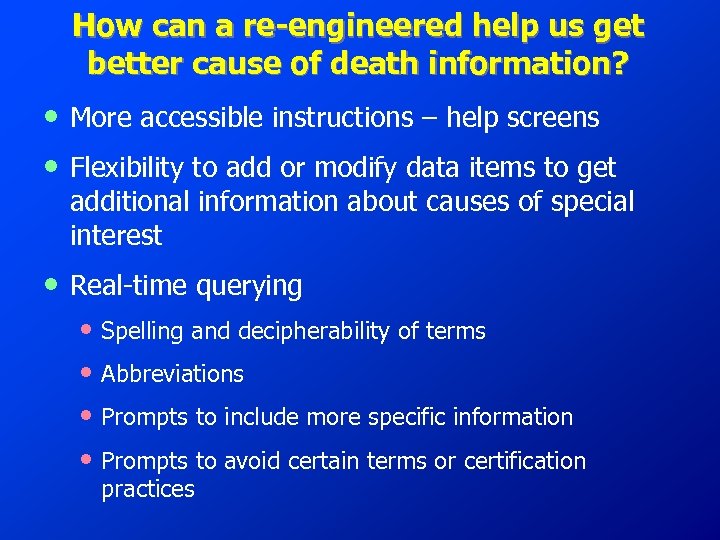
 There is hope for Electronic Systems at the Source Eventually, deaths are expected to be registered electronically. Therefore, detailed specifications for each data item on the electronic death certificate have been developed. The specifications include: • • • Suggested electronic screens Response categories Drop-down menus Edits Help screens Ability to edit and query at data entry; resolution of data issues at the source
 New Death Certificate: Modified Items • Decedent’s race, captures multiple race identification • Decedent’s education, captures highest degree attained • Decedent’s marital status distinguishes “Married” from “Married, but separated” • Place of death includes hospice facility
 New Death Certificate: Important New Items • If female, pregnancy status at time of death that will help identify maternal and pregnancyrelated deaths • If transportation injury, decedent’s role with respect to vehicles • Did tobacco use contribute to death? • Separate instructions for funeral director and person completing medical portion
 Major Users of Death Data Federal Agencies: Office of the Surgeon General HHS Assistant Secretary for Planning and Evaluation Government Accountability Office CDC’s Nat’l Center for Chronic Disease Prevention and Health Promotion CDC’s National Center for Injury Prevention and Control CDC’s National Center for Infectious Diseases CDC’s National Institute of Occupational Safety and Health CDC’s National Center for HIV, STD and TB Prevention U. S. Census Bureau Social Security Administration Food and Drug Administration Indian Health Service National Cancer Institute National Heart, Lung and Blood Institute National Institute on Aging National Institute on Drug Abuse National Highway Traffic Safety Administration Agency for Healthcare Research and Quality Substance Abuse and Mental Health Services Administration
 Other Users of Death Data United Nations World Health Organization Pan American Health Organization American Cancer Society American Heart Association American Lung Association American Diabetes Association American College of Surgeons National Association of Medical Examiners National Bureau of Economic Research Max Planck Institute for Demographic Research North American Association of Central Cancer Registries Population Reference Bureau Various State and Local Departments of Health Various Marketing, Investment, Insurance, Pharmaceutical, Healthcare and Law Firms Various Colleges and Universities
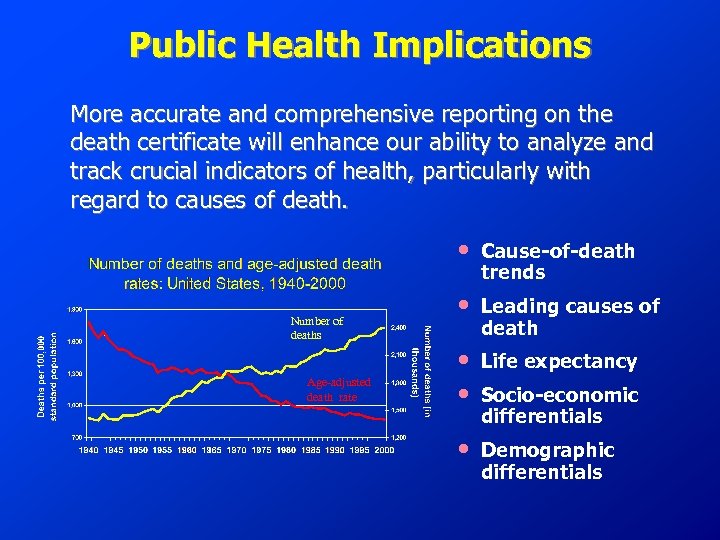
 Methodological and Systems Challenges • Integrating 2 separate providers of data – Funeral Director and Physician • Collecting cause of death information and automated medical coding • Quality of cause of death information • Proxy reporting of demographic information – e. g. , age, race, Hispanic origin
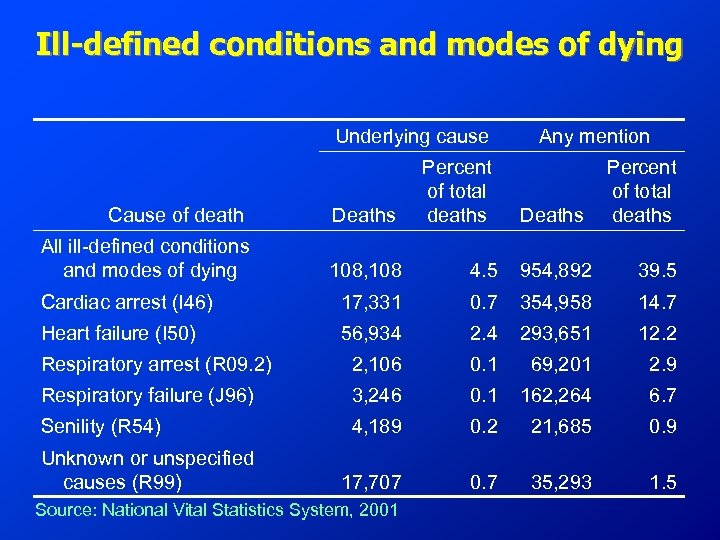
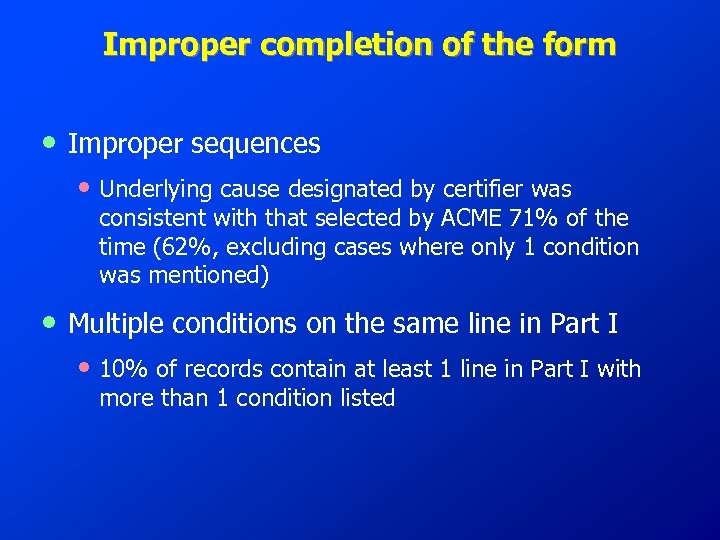
 Problems in the Reporting of Cause of Death • Overall the consistency and quality of the coding is very good – but, of course, output is only as good as the input provided • Problems with the input • Ill-defined conditions and modes of dying • Lack of specificity • Improper completion of the form • Misdiagnosis
 Ill-defined conditions and modes of dying Underlying cause Percent of total deaths Any mention Cause of death Deaths All ill-defined conditions and modes of dying 108, 108 4. 5 954, 892 39. 5 Cardiac arrest (I 46) 17, 331 0. 7 354, 958 14. 7 Heart failure (I 50) 56, 934 2. 4 293, 651 12. 2 Respiratory arrest (R 09. 2) 2, 106 0. 1 69, 201 2. 9 Respiratory failure (J 96) 3, 246 0. 1 162, 264 6. 7 Senility (R 54) 4, 189 0. 2 21, 685 0. 9 17, 707 0. 7 35, 293 1. 5 Unknown or unspecified causes (R 99) Source: National Vital Statistics System, 2001 Deaths Percent of total deaths
 Improper completion of the form • Improper sequences • Underlying cause designated by certifier was consistent with that selected by ACME 71% of the time (62%, excluding cases where only 1 condition was mentioned) • Multiple conditions on the same line in Part I • 10% of records contain at least 1 line in Part I with more than 1 condition listed
 How can a re-engineered help us get better cause of death information? • • More accessible instructions – help screens • Real-time querying Flexibility to add or modify data items to get additional information about causes of special interest • Spelling and decipherability of terms • Abbreviations • Prompts to include more specific information • Prompts to avoid certain terms or certification practices
 Public Health Implications More accurate and comprehensive reporting on the death certificate will enhance our ability to analyze and track crucial indicators of health, particularly with regard to causes of death. • Number of deaths Age-adjusted death rate Cause-of-death trends • Leading causes of death • • Life expectancy • Demographic differentials Socio-economic differentials
 This is the beginning of a new era for vital registration and statistics Measuring “what is” not just “what was”