


 Скачать презентацию January 2007 doc IEEE 802 15 -07
b20855dce1439ea9d2a6b36c24be692e.ppt
- Количество слайдов: 111
 January 2007 doc. : IEEE 802. 15 -07 -0576 -00 -0 ban Project: IEEE P 802. 15 Working Group for Wireless Personal Area Networks (WPANs) Submission Title: [Wi. BEEM (Wireless Beacon-enabled Energy Efficient Mesh network) technology for BAN and U-City Core Services] Date Submitted: [January 17, 2007] Source: [Ho-In Jeon (1) and Jin-Seok Bae (2)] Company: [(1) Dept. Electronic Engineering, Kyung-Won University (KWU), (2) Korean Agency for Technology and Standards (KATS)] Address: [San 65, Bok-Jung-Dong, Sung-Nam-Shi, Kyung-Gi-Do, Republic of Korea] Voice 1: [ +82 -31 -753 -2533], Voice 2: [ +82 -10 -4708 -5328] FAX: [+82 -31 -753 -2532], E-Mail: [jeon 1394@kornet. net] Re: [This work has been supported by KATS. ] Abstract: [This document proposes a Mesh Network Architecture that can be used for WBAN (Wireless Body Area Network) applications. The proposed technology is called Wi. BEEM providing beacon-enabled mesh network and thus reduces power consumption. The Wi. BEEM technology can be used not inly for WBAN not also many core services that U-Cities want to provide. ] Purpose: [Technical Contributions on the IEEE 802. 15 SG-WBAN Standard] Notice: This document has been prepared to assist the IEEE P 802. 15. It is offered as a basis for discussion and is not binding on the contributing individual(s) or organization(s). The material in this document is subject to change in form and content after further study. The contributor(s) reserve(s) the right to add, amend or withdraw material contained herein. Release: The contributor acknowledges and accepts that this contribution becomes the property of IEEE and may be made publicly available by P 802. 15. Submission 1 Ho-In Jeon (KWU) and Jin-Seok Bae (KATS)
 January 2007 doc. : IEEE 802. 15 -07 -0576 -00 -0 ban Wi. BEEM Technology for BAN (Body Area Network) and U-City Core Services Ho-In Jeon (1) and Jin-Seok Bae (2) (1) (2) KATS Kyung-Won University, and (Korea Agency for Technology and Standards) Republic of Korea Submission 2 Ho-In Jeon (KWU) and Jin-Seok Bae (KATS)
 January 2007 • • doc. : IEEE 802. 15 -07 -0576 -00 -0 ban Contents Introduction to U-City and U-City Core Services Ubiquitous Networking Technologies for U-City Services Bluetooth, IEEE 802. 15. 4 Low Rate WPAN, and Zig. Bee Wi. BEEM Technology: The one of the best architectures for WBAN and U-City Core Services – New MAC with Multiple Beacons in One Superframe and Beacon Scheduling for Power Saving – NAA-based Addressing Mode for Efficient Address Space – Device Mobility Supported. – Wi. BEEM Fast Routing Supported. • Conclusions Submission 3 Ho-In Jeon (KWU) and Jin-Seok Bae (KATS)
 January 2007 doc. : IEEE 802. 15 -07 -0576 -00 -0 ban Goals of U-City • Construction of – Integrated, Taylored, – Intelligent, Context-Aware, and thus – Innovative City • Based on U-IT Technologies that can provide the following features: – Always Connected – Broadband Network – Every Device in One Network Submission 4 Ho-In Jeon (KWU) and Jin-Seok Bae (KATS)
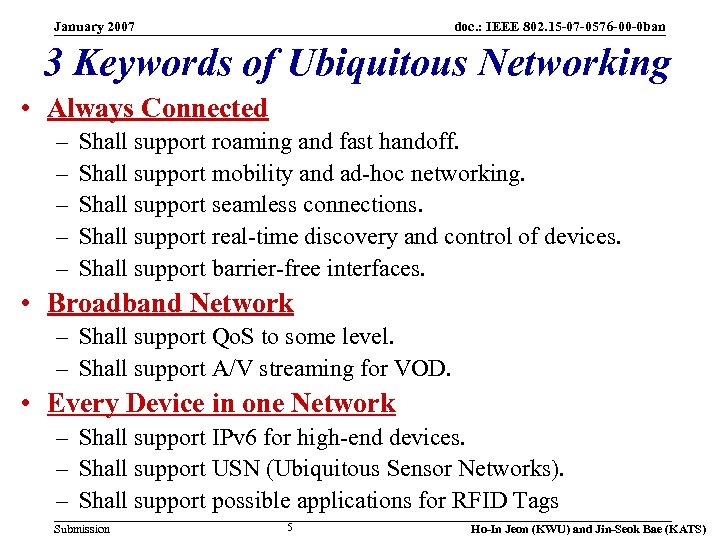 January 2007 doc. : IEEE 802. 15 -07 -0576 -00 -0 ban 3 Keywords of Ubiquitous Networking • Always Connected – – – Shall support roaming and fast handoff. Shall support mobility and ad-hoc networking. Shall support seamless connections. Shall support real-time discovery and control of devices. Shall support barrier-free interfaces. • Broadband Network – Shall support Qo. S to some level. – Shall support A/V streaming for VOD. • Every Device in one Network – Shall support IPv 6 for high-end devices. – Shall support USN (Ubiquitous Sensor Networks). – Shall support possible applications for RFID Tags Submission 5 Ho-In Jeon (KWU) and Jin-Seok Bae (KATS)
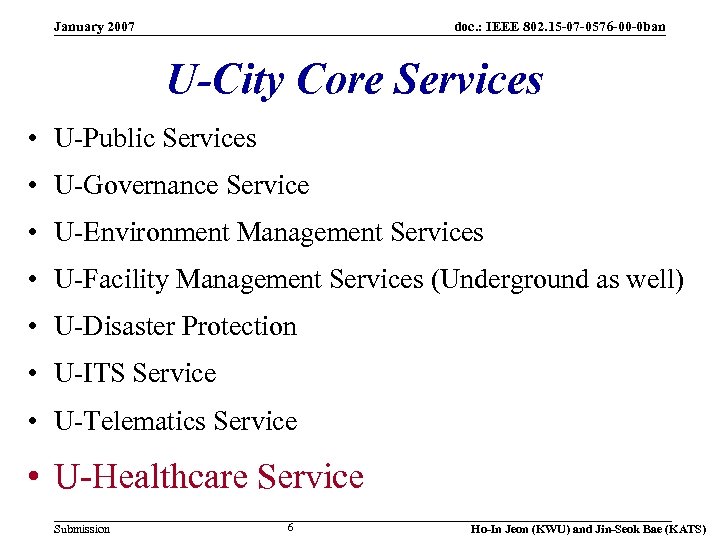 January 2007 doc. : IEEE 802. 15 -07 -0576 -00 -0 ban U-City Core Services • U-Public Services • U-Governance Service • U-Environment Management Services • U-Facility Management Services (Underground as well) • U-Disaster Protection • U-ITS Service • U-Telematics Service • U-Healthcare Service Submission 6 Ho-In Jeon (KWU) and Jin-Seok Bae (KATS)
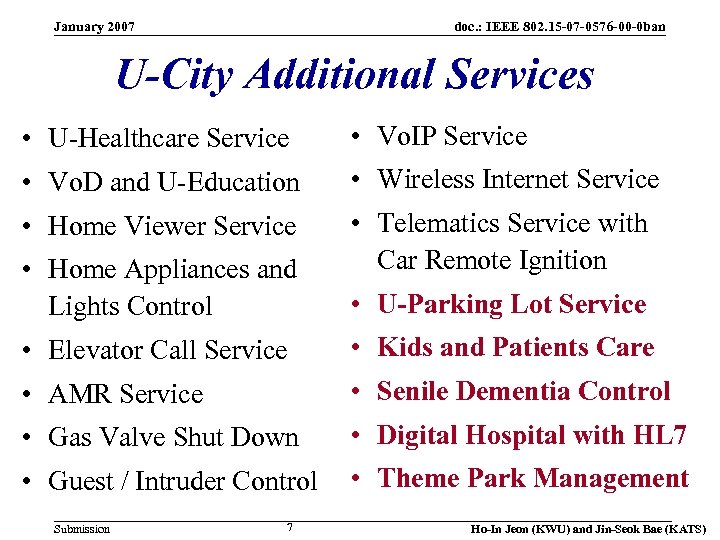 January 2007 doc. : IEEE 802. 15 -07 -0576 -00 -0 ban U-City Additional Services • U-Healthcare Service • Vo. IP Service • Vo. D and U-Education • Wireless Internet Service • Home Viewer Service • Telematics Service with Car Remote Ignition • Home Appliances and Lights Control • U-Parking Lot Service • Elevator Call Service • Kids and Patients Care • AMR Service • Senile Dementia Control • Gas Valve Shut Down • Digital Hospital with HL 7 • Guest / Intruder Control • Theme Park Management Submission 7 Ho-In Jeon (KWU) and Jin-Seok Bae (KATS)
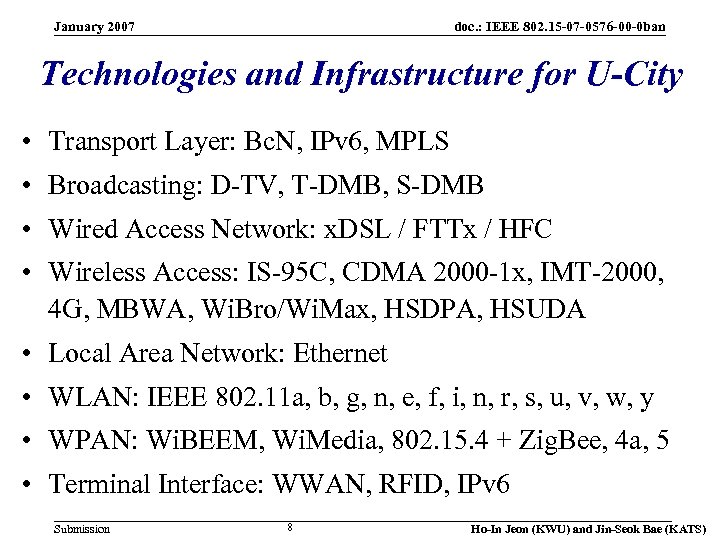 January 2007 doc. : IEEE 802. 15 -07 -0576 -00 -0 ban Technologies and Infrastructure for U-City • Transport Layer: Bc. N, IPv 6, MPLS • Broadcasting: D-TV, T-DMB, S-DMB • Wired Access Network: x. DSL / FTTx / HFC • Wireless Access: IS-95 C, CDMA 2000 -1 x, IMT-2000, 4 G, MBWA, Wi. Bro/Wi. Max, HSDPA, HSUDA • Local Area Network: Ethernet • WLAN: IEEE 802. 11 a, b, g, n, e, f, i, n, r, s, u, v, w, y • WPAN: Wi. BEEM, Wi. Media, 802. 15. 4 + Zig. Bee, 4 a, 5 • Terminal Interface: WWAN, RFID, IPv 6 Submission 8 Ho-In Jeon (KWU) and Jin-Seok Bae (KATS)
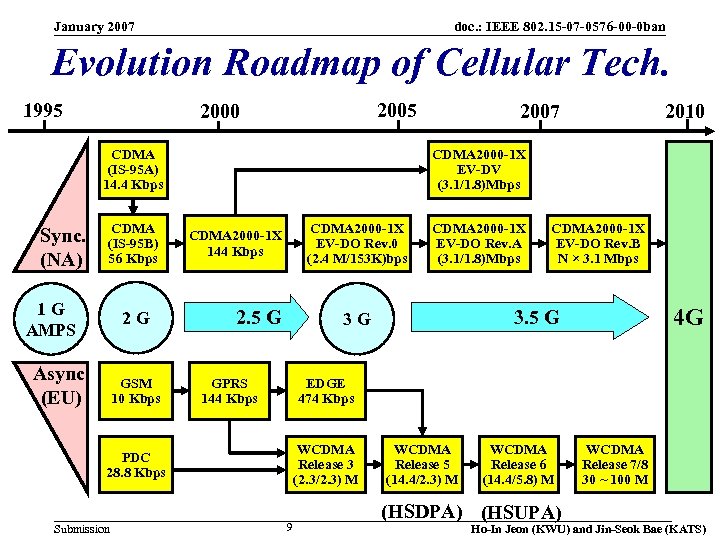 January 2007 doc. : IEEE 802. 15 -07 -0576 -00 -0 ban Evolution Roadmap of Cellular Tech. 1995 2000 CDMA (IS-95 A) 14. 4 Kbps Sync. (NA) CDMA (IS-95 B) 56 Kbps 1 G AMPS 2 G Async. (EU) GSM 10 Kbps CDMA 2000 -1 X EV-DV (3. 1/1. 8)Mbps CDMA 2000 -1 X EV-DO Rev. 0 (2. 4 M/153 K)bps CDMA 2000 -1 X 144 Kbps 2. 5 G CDMA 2000 -1 X EV-DO Rev. A (3. 1/1. 8)Mbps GPRS 144 Kbps CDMA 2000 -1 X EV-DO Rev. B N × 3. 1 Mbps 4 G 3. 5 G 3 G EDGE 474 Kbps WCDMA Release 3 (2. 3/2. 3) M PDC 28. 8 Kbps Submission 2010 2007 9 WCDMA Release 5 (14. 4/2. 3) M WCDMA Release 6 (14. 4/5. 8) M (HSDPA) (HSUPA) WCDMA Release 7/8 30 ~ 100 M Ho-In Jeon (KWU) and Jin-Seok Bae (KATS)
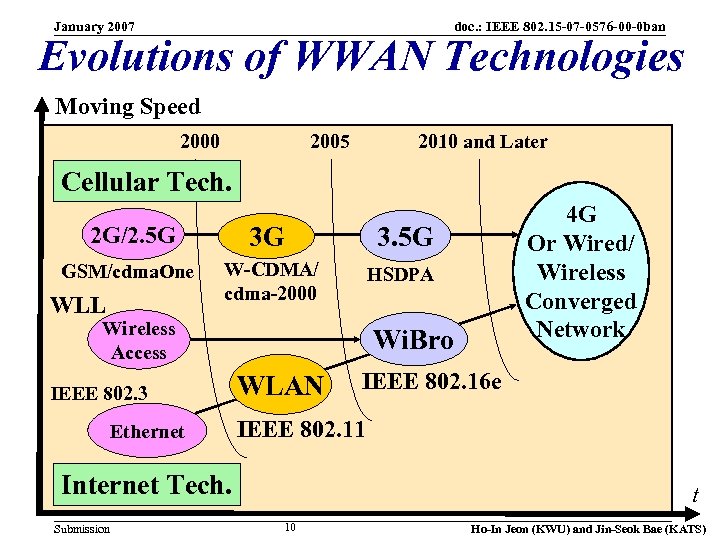 January 2007 doc. : IEEE 802. 15 -07 -0576 -00 -0 ban Evolutions of WWAN Technologies Moving Speed 2000 2005 2010 and Later Cellular Tech. 2 G/2. 5 G 3 G 3. 5 G GSM/cdma. One W-CDMA/ cdma-2000 4 G Or Wired/ Wireless Converged Network HSDPA WLL Wireless Access IEEE 802. 3 Ethernet Wi. Bro WLAN IEEE 802. 11 Internet Tech. Submission IEEE 802. 16 e t 10 Ho-In Jeon (KWU) and Jin-Seok Bae (KATS)
 January 2007 doc. : IEEE 802. 15 -07 -0576 -00 -0 ban Some Service Scenarios with Wi. BEEM Submission 11 Ho-In Jeon (KWU) and Jin-Seok Bae (KATS)
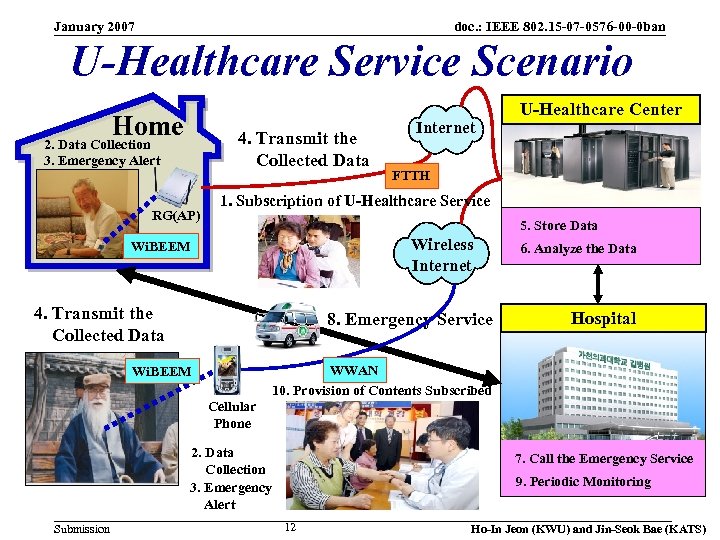 January 2007 doc. : IEEE 802. 15 -07 -0576 -00 -0 ban U-Healthcare Service Scenario Home 2. Data Collection 4. Transmit the Collected Data 3. Emergency Alert RG(AP) Internet U-Healthcare Center FTTH 1. Subscription of U-Healthcare Service 5. Store Data Wireless Internet Wi. BEEM 4. Transmit the Collected Data 8. Emergency Service 6. Analyze the Data Hospital WWAN 10. Provision of Contents Subscribed Wi. BEEM Cellular Phone 2. Data Collection 3. Emergency Alert Submission 7. Call the Emergency Service 9. Periodic Monitoring 12 Ho-In Jeon (KWU) and Jin-Seok Bae (KATS)
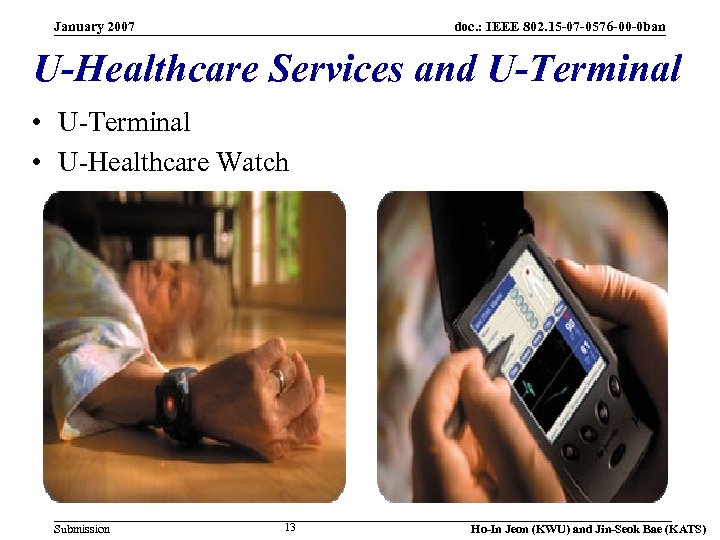 January 2007 doc. : IEEE 802. 15 -07 -0576 -00 -0 ban U-Healthcare Services and U-Terminal • U-Healthcare Watch Submission 13 Ho-In Jeon (KWU) and Jin-Seok Bae (KATS)
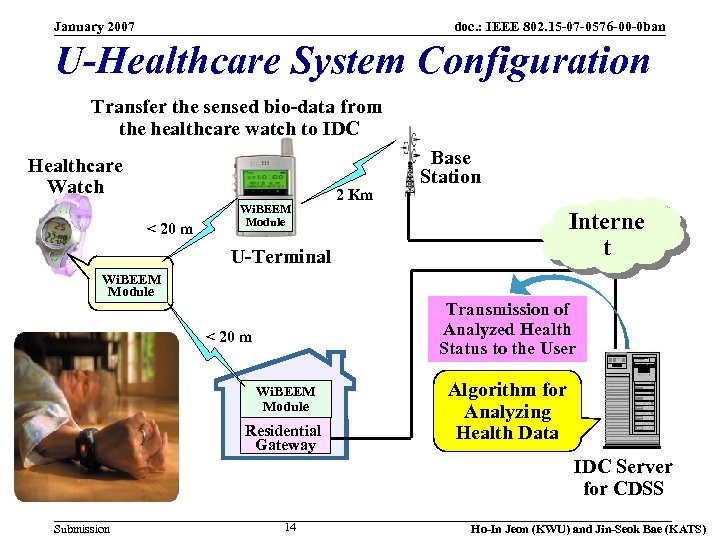 January 2007 doc. : IEEE 802. 15 -07 -0576 -00 -0 ban U-Healthcare System Configuration Transfer the sensed bio-data from the healthcare watch to IDC Healthcare Watch < 20 m Wi. BEEM Module 2 Km Base Station Interne t U-Terminal Wi. BEEM Module Transmission of Analyzed Health Status to the User < 20 m Wi. BEEM Module Residential Gateway Algorithm for Analyzing Health Data IDC Server for CDSS Submission 14 Ho-In Jeon (KWU) and Jin-Seok Bae (KATS)
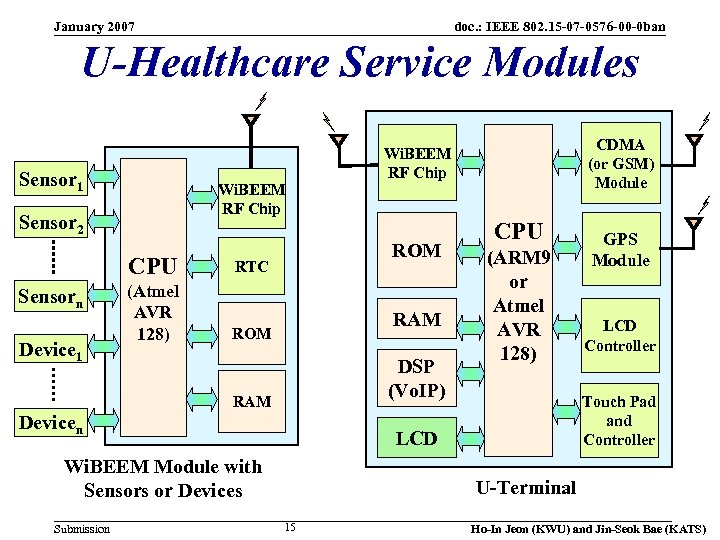 January 2007 doc. : IEEE 802. 15 -07 -0576 -00 -0 ban U-Healthcare Service Modules Sensor 1 Wi. BEEM RF Chip Sensor 2 CPU Sensorn Device 1 (Atmel AVR 128) ROM RTC ROM RAM DSP (Vo. IP) RAM Devicen CPU (ARM 9 or Atmel AVR 128) GPS Module LCD Controller Touch Pad and Controller LCD Wi. BEEM Module with Sensors or Devices Submission CDMA (or GSM) Module Wi. BEEM RF Chip U-Terminal 15 Ho-In Jeon (KWU) and Jin-Seok Bae (KATS)
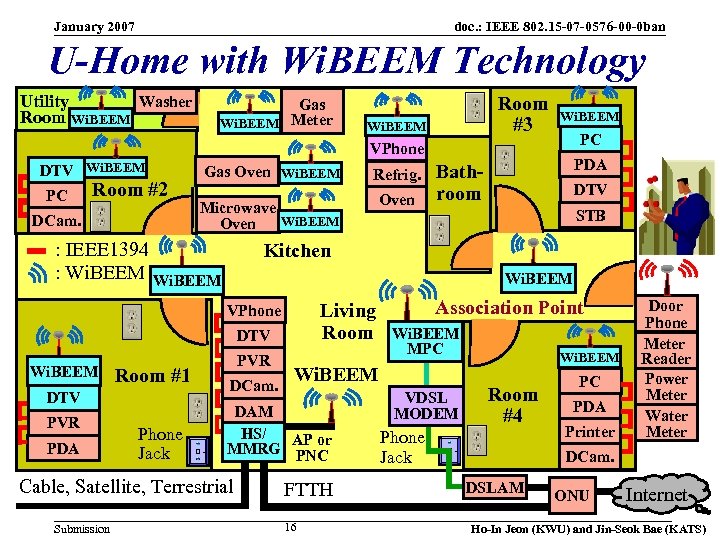 January 2007 doc. : IEEE 802. 15 -07 -0576 -00 -0 ban U-Home with Wi. BEEM Technology Washer Utility Room Wi. BEEM Gas Wi. BEEM Meter Room #3 Wi. BEEM PC VPhone DTV Wi. BEEM PC Room #2 DCam. Gas Oven Wi. BEEM Refrig. Microwave Wi. BEEM Oven : IEEE 1394 : Wi. BEEM DTV PVR PDA Phone Jack PVR DCam. Living Room Association Point Wi. BEEM MPC Wi. BEEM DAM HS/ AP or MMRG PNC Cable, Satellite, Terrestrial Submission STB Wi. BEEM DTV Room #1 DTV Kitchen VPhone Wi. BEEM PDA Bathroom FTTH 16 VDSL MODEM Wi. BEEM Room #4 Phone Jack PC PDA Printer Door Phone Meter Reader Power Meter Water Meter DCam. DSLAM ONU Internet Ho-In Jeon (KWU) and Jin-Seok Bae (KATS)
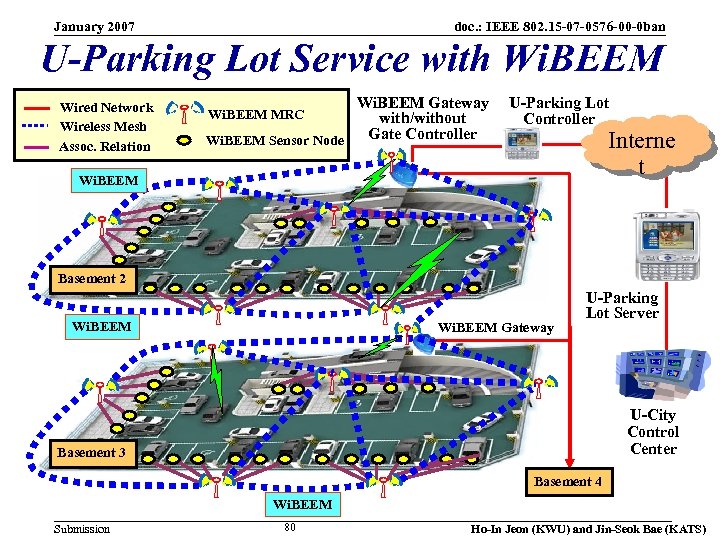
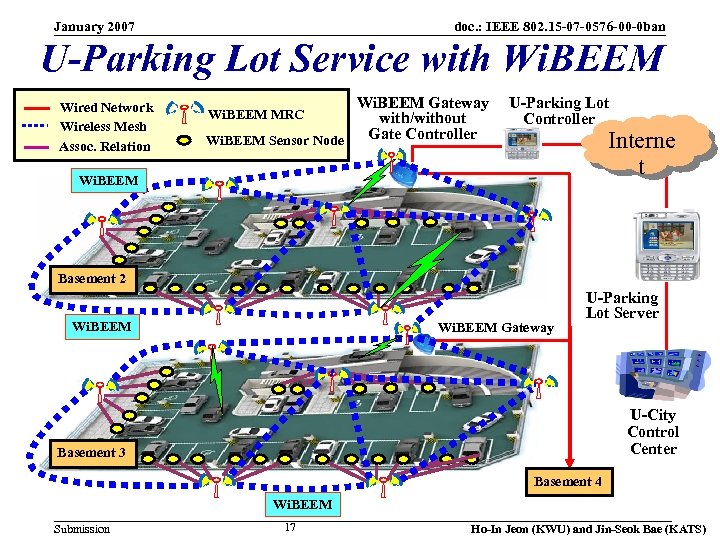 January 2007 doc. : IEEE 802. 15 -07 -0576 -00 -0 ban U-Parking Lot Service with Wi. BEEM Wired Network Wireless Mesh Assoc. Relation Wi. BEEM Gateway with/without Gate Controller Wi. BEEM Sensor Node Wi. BEEM MRC U-Parking Lot Controller Interne t Wi. BEEM Basement 2 Wi. BEEM Gateway U-Parking Lot Server U-City Control Center Basement 3 Basement 4 Wi. BEEM Submission 17 Ho-In Jeon (KWU) and Jin-Seok Bae (KATS)
 January 2007 doc. : IEEE 802. 15 -07 -0576 -00 -0 ban Characteristics of U-Parking Lot Service (1/2) • One MPC will take care of all the MRD’s, the sensor nodes as well as moving cars with U-terminal. • The gate controller functioning as the Gateway could be the best position of MPC. • Association point seems to be always the same. – The MPC appears to be the best Association point for all the incoming cars. – The PNC could be the best short address assigner. • The limitation of the maximum number of children for any router of the wireless network may seriously limit the applicability of the protocol. Submission 18 Ho-In Jeon (KWU) and Jin-Seok Bae (KATS)
 January 2007 doc. : IEEE 802. 15 -07 -0576 -00 -0 ban Characteristics of U-Parking Lot Service (2/2) • Devices are moving fast! (at least 30 Km/h) – Reassociation should be avoided due to the fact that there can be heavy unnecessary association request traffic. – The network address shall be the same for any position. • Traffic Directions – Every traffic from both sensor nodes and the mobile terminal is toward the MPC. – The delivery of the traffic from the MPC to the incoming cars requires fast routing using the RREP type of AODV-like simplified reactive routing algorithm is required and possible. – No need to send RREQ by MPC, rather RREP sent directly by the moving cars. • Disassociation request before leaving the network will be very important for address space reusability. Submission 19 Ho-In Jeon (KWU) and Jin-Seok Bae (KATS)
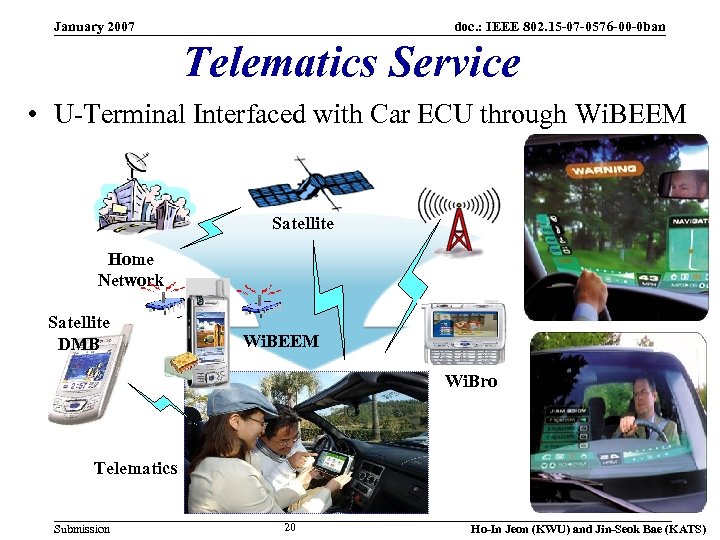 January 2007 doc. : IEEE 802. 15 -07 -0576 -00 -0 ban Telematics Service • U-Terminal Interfaced with Car ECU through Wi. BEEM Satellite Home Network Satellite DMB Wi. BEEM Wi. Bro Telematics Submission 20 Ho-In Jeon (KWU) and Jin-Seok Bae (KATS)
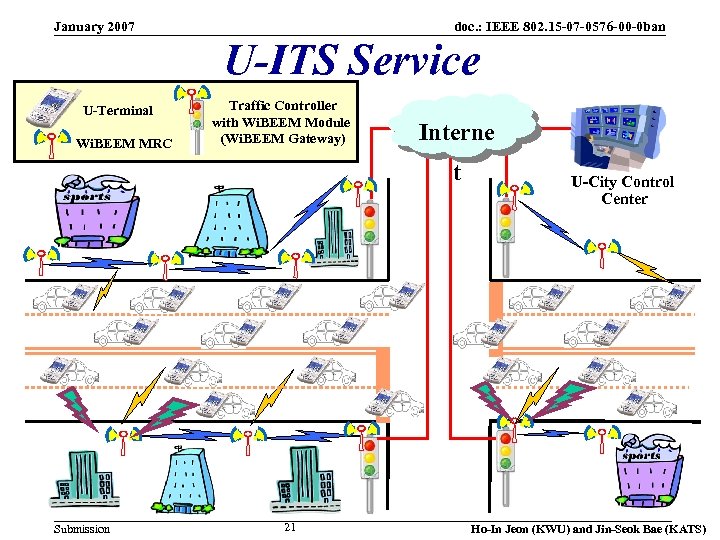 January 2007 doc. : IEEE 802. 15 -07 -0576 -00 -0 ban U-ITS Service U-Terminal Wi. BEEM MRC Traffic Controller with Wi. BEEM Module (Wi. BEEM Gateway) Interne t Submission 21 U-City Control Center Ho-In Jeon (KWU) and Jin-Seok Bae (KATS)
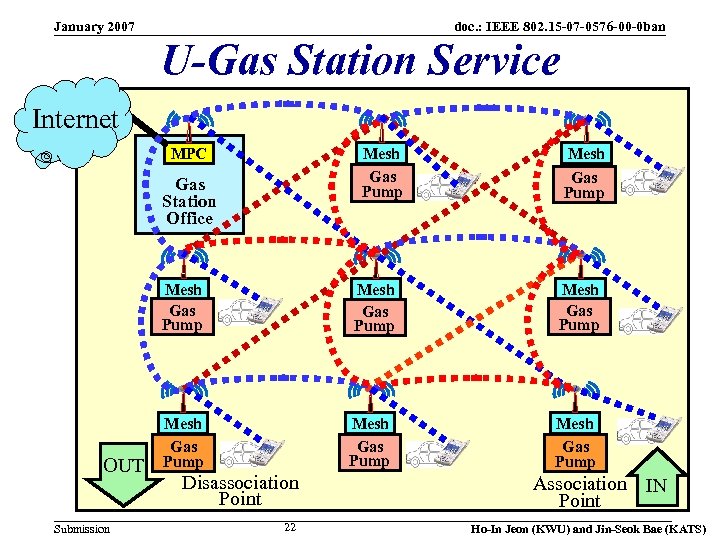 January 2007 doc. : IEEE 802. 15 -07 -0576 -00 -0 ban U-Gas Station Service Internet Mesh Gas Pump MPC Gas Station Office Mesh Gas Pump OUT Submission Mesh Gas Pump Disassociation Point 22 Mesh Gas Pump Association IN Point Ho-In Jeon (KWU) and Jin-Seok Bae (KATS)
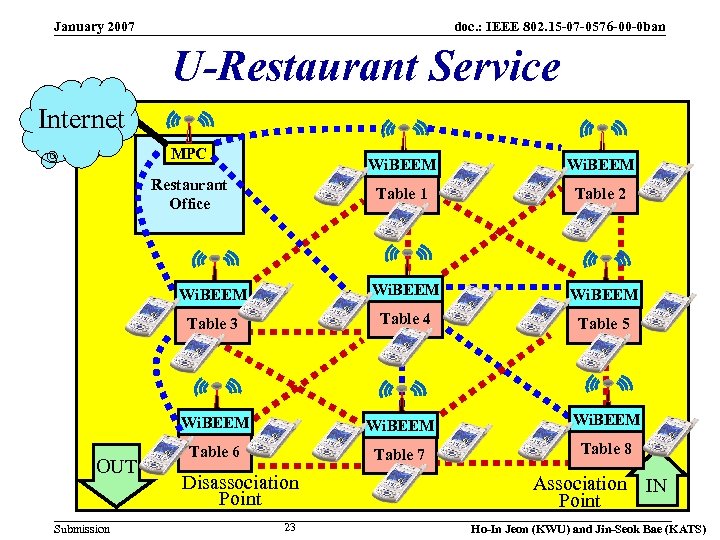 January 2007 doc. : IEEE 802. 15 -07 -0576 -00 -0 ban U-Restaurant Service Internet MPC Wi. BEEM Table 1 Table 2 Wi. BEEM Table 3 Table 4 Table 5 Restaurant Office Wi. BEEM OUT Submission Wi. BEEM Table 6 Table 7 Table 8 Disassociation Point 23 Association IN Point Ho-In Jeon (KWU) and Jin-Seok Bae (KATS)
 January 2007 doc. : IEEE 802. 15 -07 -0576 -00 -0 ban Characteristics of U-Restaurant Services • One MPC at the restaurant office will take care of all the MRDs, the sensor nodes and U-terminals. • The restaurant office could be the best position of MPC with MEU Gateway functionality. • The U-Payment service shall also be available. • The characteristics of the U-Restaurant service is almost same as the U-Gas Station service, while it can be a very dense mode environment. Submission 24 Ho-In Jeon (KWU) and Jin-Seok Bae (KATS)
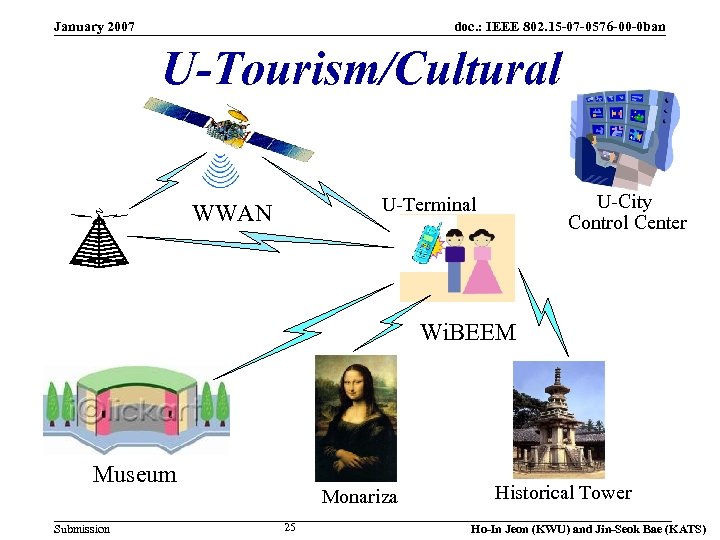 January 2007 doc. : IEEE 802. 15 -07 -0576 -00 -0 ban U-Tourism/Cultural U-City Control Center U-Terminal WWAN Wi. BEEM Museum Submission Monariza 25 Historical Tower Ho-In Jeon (KWU) and Jin-Seok Bae (KATS)
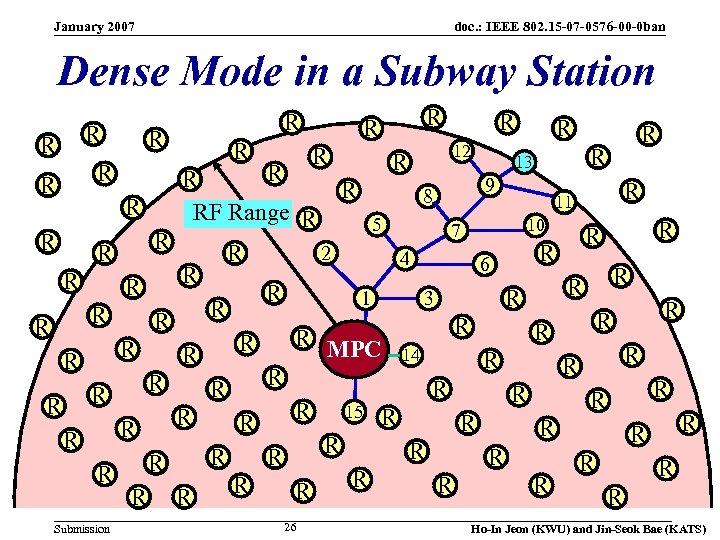 January 2007 doc. : IEEE 802. 15 -07 -0576 -00 -0 ban Dense Mode in a Subway Station R R R R 12 R 13 R R 9 R R 8 11 R RF Range R R 5 10 7 R R 2 R R R 4 6 R R R 1 3 R R R R R MPC R R 14 R R R R 15 R R R R R R R R Submission 26 Ho-In Jeon (KWU) and Jin-Seok Bae (KATS)
 January 2007 doc. : IEEE 802. 15 -07 -0576 -00 -0 ban Characteristics of Dense Mode • Dense mode means that there a lot of nodes within the RF range of each other. • If there are limitations of maximum number of children that can associate, there may be a ridiculous tree topology for the tree routing. • Unnecessary routing will also be needed even if the blue routable device (node 13) may directly want to send his data to the MPC device. Submission 27 Ho-In Jeon (KWU) and Jin-Seok Bae (KATS)
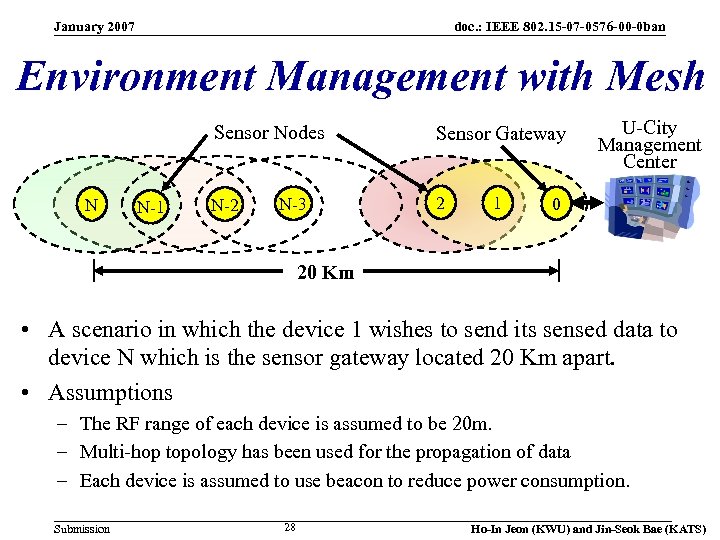 January 2007 doc. : IEEE 802. 15 -07 -0576 -00 -0 ban Environment Management with Mesh Sensor Nodes N N-1 N-2 N-3 Sensor Gateway 2 1 U-City Management Center 0 20 Km • A scenario in which the device 1 wishes to send its sensed data to device N which is the sensor gateway located 20 Km apart. • Assumptions – The RF range of each device is assumed to be 20 m. – Multi-hop topology has been used for the propagation of data – Each device is assumed to use beacon to reduce power consumption. Submission 28 Ho-In Jeon (KWU) and Jin-Seok Bae (KATS)
 January 2007 doc. : IEEE 802. 15 -07 -0576 -00 -0 ban Fundamental Philosophies for U-City • • • Adopt as many standardized technologies as possible. Apply minimum number of technologies. Minimize the number of terminals to be used. Provide maximum number of services. Guarantee the Interoperability for different services in the U-City • Guarantee the Interoperability for different/Similar services in different U-Cities. • One of the solutions could be Wi. BEEM technology and Broadband WWAN. Submission 29 Ho-In Jeon (KWU) and Jin-Seok Bae (KATS)
 January 2007 doc. : IEEE 802. 15 -07 -0576 -00 -0 ban Wi. BEEM: the Solution for These Issues • Mesh Networking Capabilities with very Low Power Consumptions: Multiple Beacons in BOP with Beacon Scheduling • Fast Mobility Support of New Devices: RREP • Single Association Point without Limitation on the Maximum Number of Children: Efficient Address Allocation with NAA • Fast Association of New Device with Dynamic Topology • Fast Routing: RREP-like packet transmitted by the mobile device • Fast Device and Service Discovery: NAA • Disassociation Notifications for Address Space Reusability • Qo. S Support: Needs more research • Apply Wi. BEEM technology to all the services!!! Submission 30 Ho-In Jeon (KWU) and Jin-Seok Bae (KATS)
 January 2007 doc. : IEEE 802. 15 -07 -0576 -00 -0 ban Bluetooth Technology Submission 31 Ho-In Jeon (KWU) and Jin-Seok Bae (KATS)
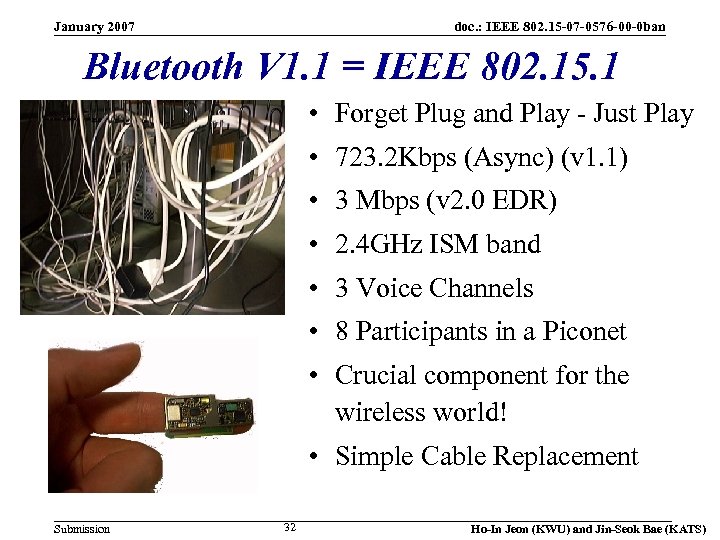 January 2007 doc. : IEEE 802. 15 -07 -0576 -00 -0 ban Bluetooth V 1. 1 = IEEE 802. 15. 1 • Forget Plug and Play - Just Play • 723. 2 Kbps (Async) (v 1. 1) • 3 Mbps (v 2. 0 EDR) • 2. 4 GHz ISM band • 3 Voice Channels • 8 Participants in a Piconet • Crucial component for the wireless world! • Simple Cable Replacement Submission 32 Ho-In Jeon (KWU) and Jin-Seok Bae (KATS)
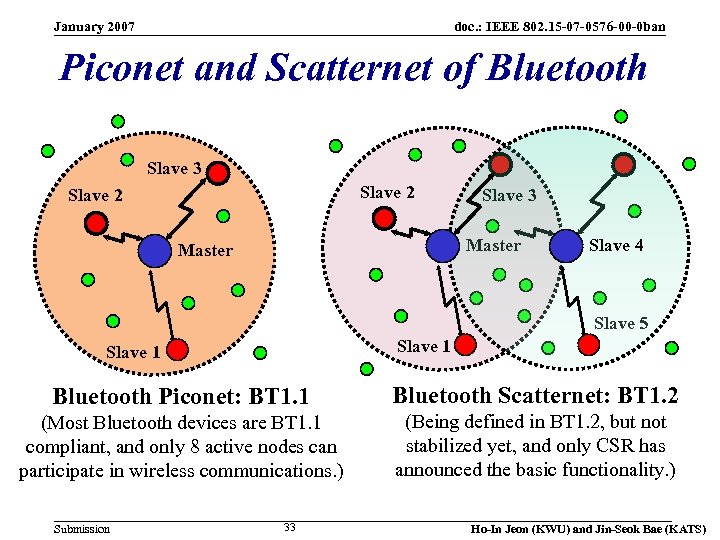 January 2007 doc. : IEEE 802. 15 -07 -0576 -00 -0 ban Piconet and Scatternet of Bluetooth Slave 3 Slave 2 Slave 3 Master Slave 4 Slave 5 Slave 1 Bluetooth Piconet: BT 1. 1 Bluetooth Scatternet: BT 1. 2 (Most Bluetooth devices are BT 1. 1 compliant, and only 8 active nodes can participate in wireless communications. ) (Being defined in BT 1. 2, but not stabilized yet, and only CSR has announced the basic functionality. ) Submission 33 Ho-In Jeon (KWU) and Jin-Seok Bae (KATS)
 January 2007 doc. : IEEE 802. 15 -07 -0576 -00 -0 ban Fundamentals of Bluetooth Technology • Long Association Time: 3 seconds – Scanning the whole channel take a long time. – Mobility cannot be supported. – The FHS (Frequency Hopping Sequence) must be downloaded. • Bandwidth vs. Data Rate – 723. 2 Kbps using 83. 5 MHz Band – Data conflicts with 1/79 whenever new PAN joins the network. • Limited Number of Active Participants: 8 – Limits the applicability drastically. • Scatternet is not supported yet. – Network Expandability problem. Submission 34 Ho-In Jeon (KWU) and Jin-Seok Bae (KATS)
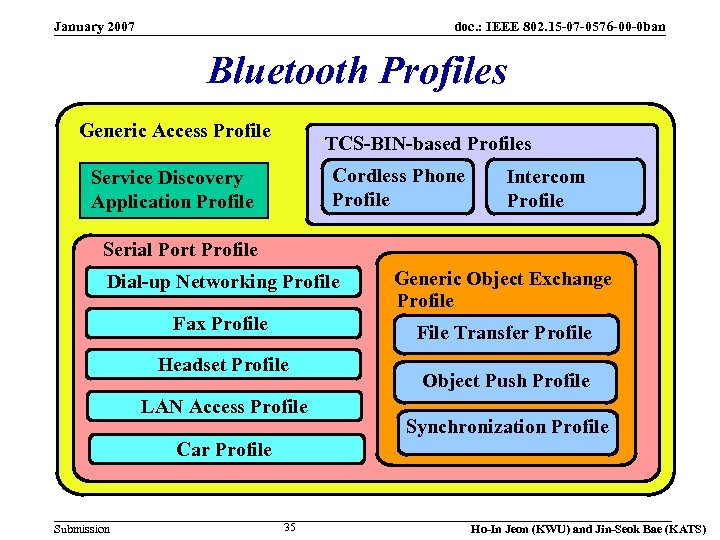 January 2007 doc. : IEEE 802. 15 -07 -0576 -00 -0 ban Bluetooth Profiles Generic Access Profile TCS-BIN-based Profiles Cordless Phone Profile Service Discovery Application Profile Intercom Profile Serial Port Profile Dial-up Networking Profile Generic Object Exchange Profile Fax Profile File Transfer Profile Headset Profile LAN Access Profile Object Push Profile Synchronization Profile Car Profile Submission 35 Ho-In Jeon (KWU) and Jin-Seok Bae (KATS)
 January 2007 doc. : IEEE 802. 15 -07 -0576 -00 -0 ban Zig. Bee over IEEE 802. 15. 4 Submission 36 Ho-In Jeon (KWU) and Jin-Seok Bae (KATS)
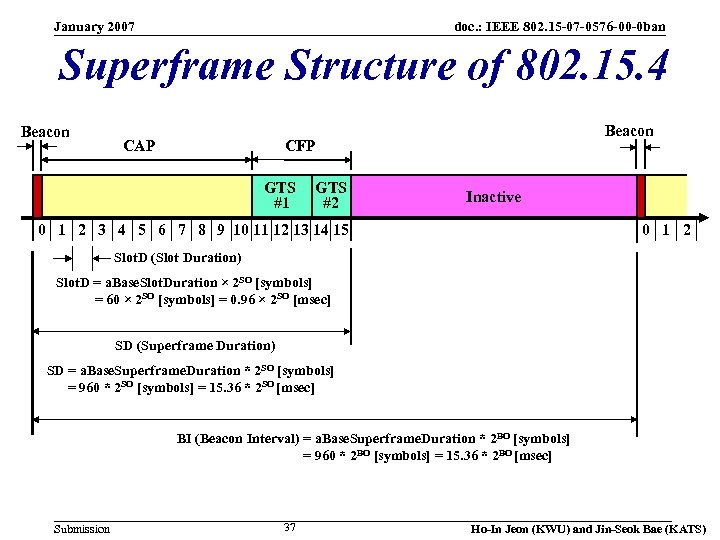 January 2007 doc. : IEEE 802. 15 -07 -0576 -00 -0 ban Superframe Structure of 802. 15. 4 Beacon CFP CAP GTS #1 GTS #2 Inactive 0 1 2 3 4 5 6 7 8 9 10 11 12 13 14 15 0 1 2 Slot. D (Slot Duration) Slot. D = a. Base. Slot. Duration × 2 SO [symbols] = 60 × 2 SO [symbols] = 0. 96 × 2 SO [msec] SD (Superframe Duration) SD = a. Base. Superframe. Duration * 2 SO [symbols] = 960 * 2 SO [symbols] = 15. 36 * 2 SO [msec] BI (Beacon Interval) = a. Base. Superframe. Duration * 2 BO [symbols] = 960 * 2 BO [symbols] = 15. 36 * 2 BO [msec] Submission 37 Ho-In Jeon (KWU) and Jin-Seok Bae (KATS)
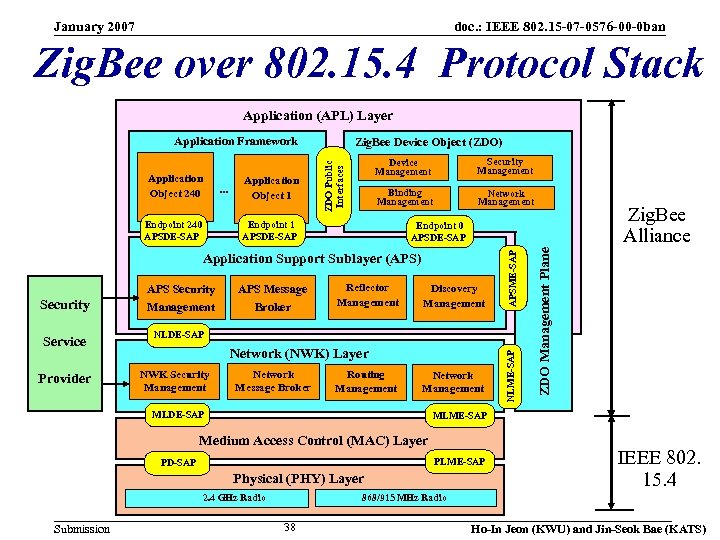 January 2007 doc. : IEEE 802. 15 -07 -0576 -00 -0 ban Zig. Bee over 802. 15. 4 Protocol Stack Application (APL) Layer Application Framework Binding Management Network Management Endpoint 1 APSDE-SAP Application Support Sublayer (APS) Service Provider APS Message Broker Reflector Management Discovery Management NLDE-SAP Network (NWK) Layer NWK Security Management Network Message Broker Routing Management Network Management MLDE-SAP MLME-SAP Medium Access Control (MAC) Layer PLME-SAP PD-SAP Physical (PHY) Layer 2. 4 GHz Radio Submission NLME-SAP Security APS Security Management Zig. Bee Alliance Endpoint 0 APSDE-SAP ZDO Management Plane Application Object 1 Security Management APSME-SAP Endpoint 240 APSDE-SAP … Device Management ZDO Public Interfaces Application Object 240 Zig. Bee Device Object (ZDO) IEEE 802. 15. 4 868/915 MHz Radio 38 Ho-In Jeon (KWU) and Jin-Seok Bae (KATS)
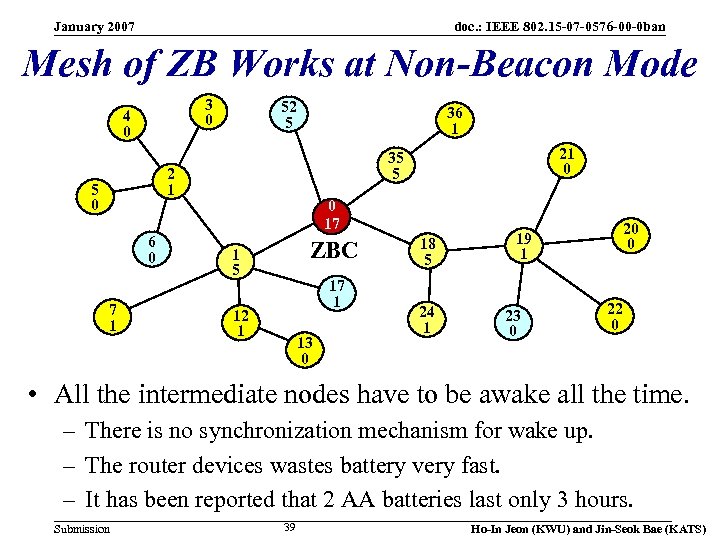 January 2007 doc. : IEEE 802. 15 -07 -0576 -00 -0 ban Mesh of ZB Works at Non-Beacon Mode 3 0 4 0 52 5 36 1 2 1 5 0 6 0 7 1 21 0 35 5 0 17 ZBC 1 5 17 1 12 1 13 0 18 5 24 1 20 0 19 1 23 0 22 0 • All the intermediate nodes have to be awake all the time. – There is no synchronization mechanism for wake up. – The router devices wastes battery very fast. – It has been reported that 2 AA batteries last only 3 hours. Submission 39 Ho-In Jeon (KWU) and Jin-Seok Bae (KATS)
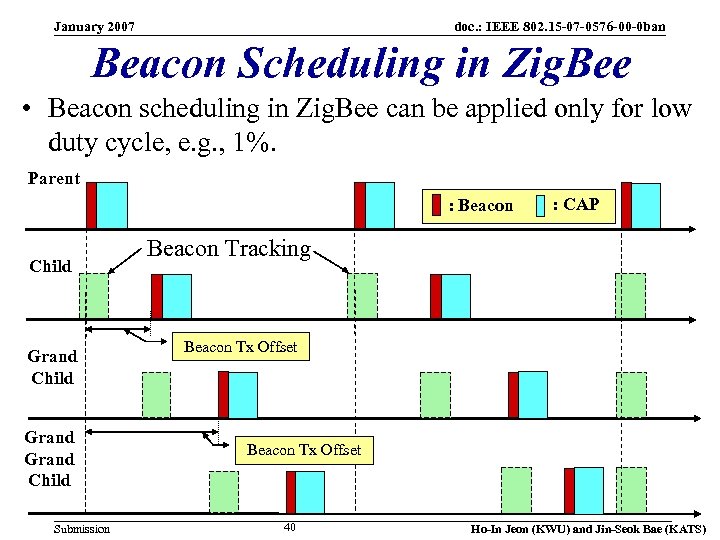 January 2007 doc. : IEEE 802. 15 -07 -0576 -00 -0 ban Beacon Scheduling in Zig. Bee • Beacon scheduling in Zig. Bee can be applied only for low duty cycle, e. g. , 1%. Parent : Beacon Child Grand Child Submission : CAP Beacon Tracking Beacon Tx Offset 40 Ho-In Jeon (KWU) and Jin-Seok Bae (KATS)
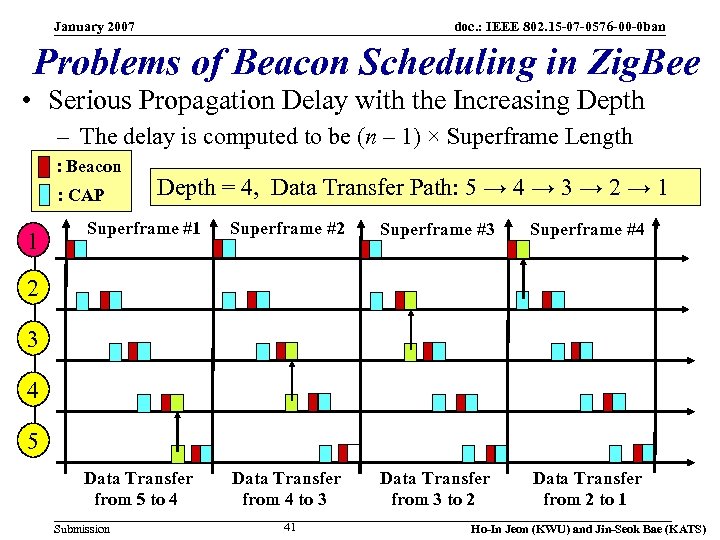 January 2007 doc. : IEEE 802. 15 -07 -0576 -00 -0 ban Problems of Beacon Scheduling in Zig. Bee • Serious Propagation Delay with the Increasing Depth – The delay is computed to be (n – 1) × Superframe Length : Beacon : CAP 1 Depth = 4, Data Transfer Path: 5 → 4 → 3 → 2 → 1 Superframe #2 Superframe #3 Superframe #4 Data Transfer from 5 to 4 Data Transfer from 4 to 3 Data Transfer from 3 to 2 Data Transfer from 2 to 1 2 3 4 5 Submission 41 Ho-In Jeon (KWU) and Jin-Seok Bae (KATS)
 January 2007 doc. : IEEE 802. 15 -07 -0576 -00 -0 ban Basic Parameters for Addressing in ZBA • Hierarchical block addressing for Tree Routing. • The tree topology is specified by three parameters: – Lm = Maximum Tree Depth. – Cm = Maximum Number of Children per Node – Rm = Maximum Number of Routable Devices • Total size of Address Block allocated to the tree: Bsize = 1– Lm + 1 Cm 1 – Cm • Size of the block allocated to a child at level Li+1: L –d– 1 Cskip(d) = Submission 1 + C m – Rm – Cm × Rm m 1 – Rm 42 Ho-In Jeon (KWU) and Jin-Seok Bae (KATS)
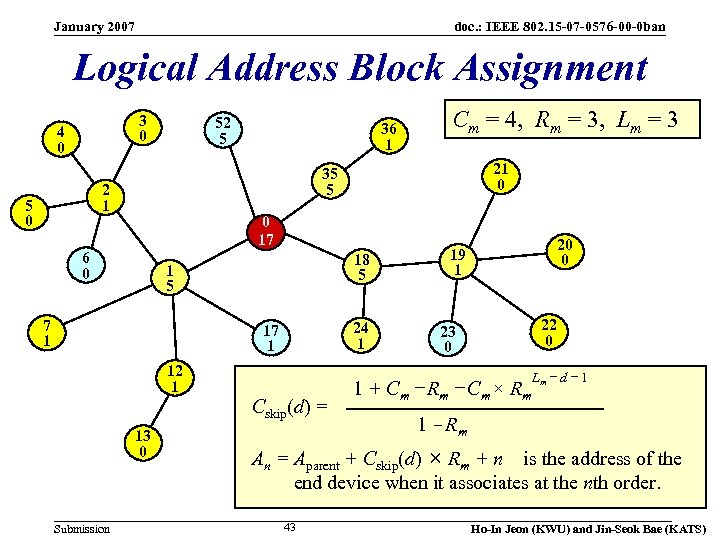 January 2007 doc. : IEEE 802. 15 -07 -0576 -00 -0 ban Logical Address Block Assignment 3 0 4 0 52 5 21 0 0 17 6 0 18 5 1 5 7 1 24 1 17 1 12 1 13 0 Submission Cm = 4, Rm = 3, Lm = 3 35 5 2 1 5 0 36 1 Cskip(d) = 20 0 19 1 22 0 23 0 1 + C m – Rm – Cm × Rm Lm – d – 1 1 – Rm An = Aparent + Cskip(d) × Rm + n is the address of the end device when it associates at the nth order. 43 Ho-In Jeon (KWU) and Jin-Seok Bae (KATS)
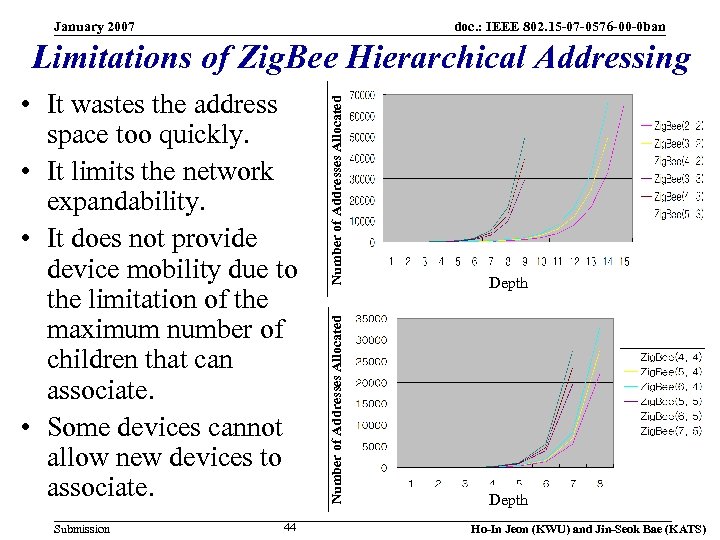 January 2007 doc. : IEEE 802. 15 -07 -0576 -00 -0 ban Submission 44 Number of Addresses Allocated • It wastes the address space too quickly. • It limits the network expandability. • It does not provide device mobility due to the limitation of the maximum number of children that can associate. • Some devices cannot allow new devices to associate. Depth Number of Addresses Allocated Limitations of Zig. Bee Hierarchical Addressing Depth Ho-In Jeon (KWU) and Jin-Seok Bae (KATS)
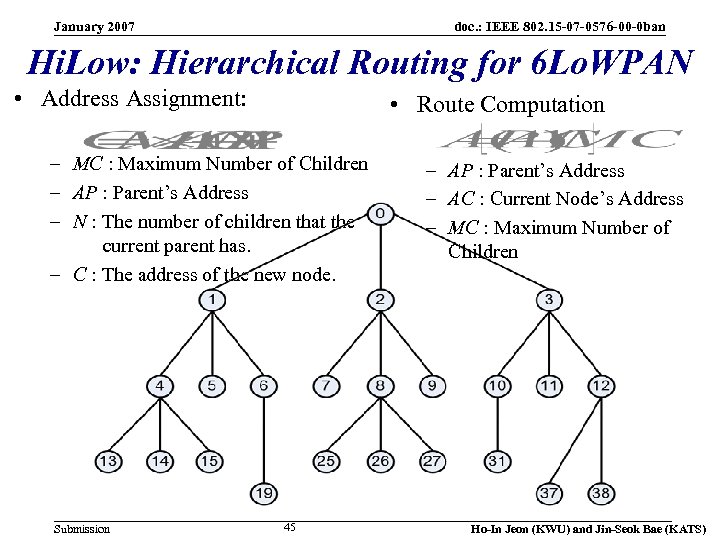 January 2007 doc. : IEEE 802. 15 -07 -0576 -00 -0 ban Hi. Low: Hierarchical Routing for 6 Lo. WPAN • Address Assignment: • Route Computation – MC : Maximum Number of Children – AP : Parent’s Address – N : The number of children that the current parent has. – C : The address of the new node. Submission 45 – AP : Parent’s Address – AC : Current Node’s Address – MC : Maximum Number of Children Ho-In Jeon (KWU) and Jin-Seok Bae (KATS)
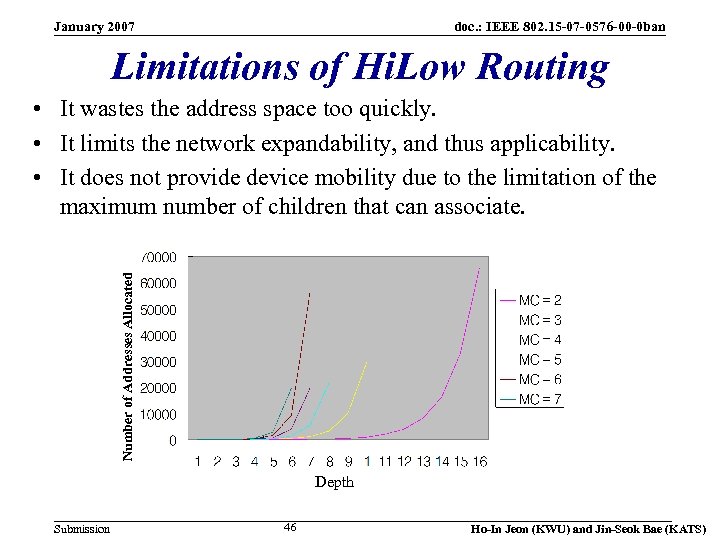 January 2007 doc. : IEEE 802. 15 -07 -0576 -00 -0 ban Limitations of Hi. Low Routing Number of Addresses Allocated • It wastes the address space too quickly. • It limits the network expandability, and thus applicability. • It does not provide device mobility due to the limitation of the maximum number of children that can associate. Depth Submission 46 Ho-In Jeon (KWU) and Jin-Seok Bae (KATS)
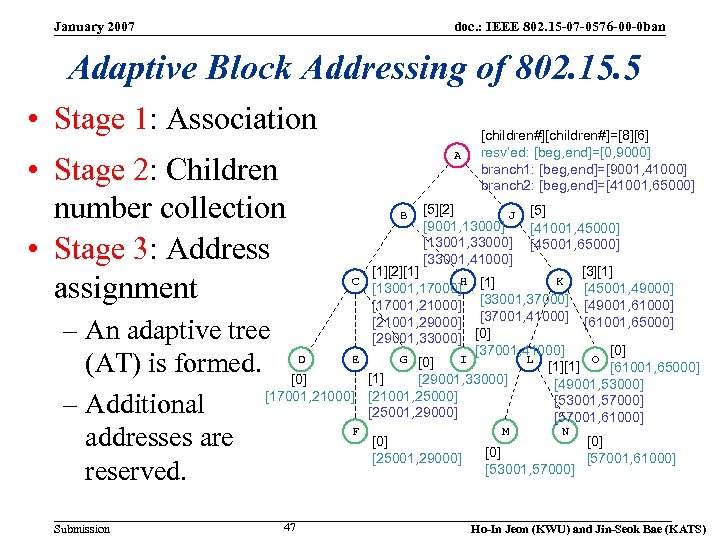 January 2007 doc. : IEEE 802. 15 -07 -0576 -00 -0 ban Adaptive Block Addressing of 802. 15. 5 • Stage 1: Association • Stage 2: Children number collection • Stage 3: Address assignment A B [children#]=[8][6] resv’ed: [beg, end]=[0, 9000] branch 1: [beg, end]=[9001, 41000] branch 2: [beg, end]=[41001, 65000] [5][2] J [9001, 13000] [13001, 33000] [33001, 41000] [5] [41001, 45000] [45001, 65000] [3][1] K [1] [45001, 49000] [33001, 37000] [49001, 61000] [37001, 41000] [61001, 65000] [37001, 41000] [0] D E G [0] I L O [1][1] [61001, 65000] [1] [0] [29001, 33000] [49001, 53000] [17001, 21000] [21001, 25000] [53001, 57000] [25001, 29000] [57001, 61000] – An adaptive tree (AT) is formed. – Additional addresses are reserved. Submission C F 47 [1][2][1] H [13001, 17000] [17001, 21000] [21001, 29000] [29001, 33000] [25001, 29000] M N [0] [57001, 61000] [53001, 57000] Ho-In Jeon (KWU) and Jin-Seok Bae (KATS)
 January 2007 doc. : IEEE 802. 15 -07 -0576 -00 -0 ban Wi. BEEM Protocol for WBAN and U-City Core Services Submission 48 Ho-In Jeon (KWU) and Jin-Seok Bae (KATS)
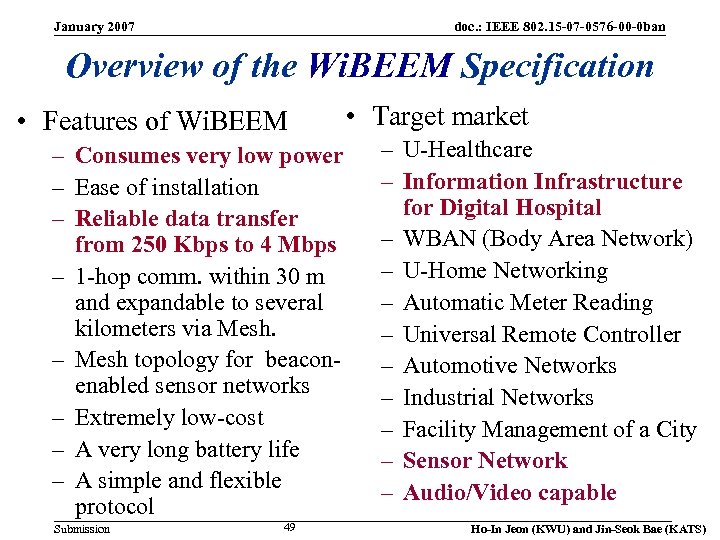 January 2007 doc. : IEEE 802. 15 -07 -0576 -00 -0 ban Overview of the Wi. BEEM Specification • Features of Wi. BEEM – Consumes very low power – Ease of installation – Reliable data transfer from 250 Kbps to 4 Mbps – 1 -hop comm. within 30 m and expandable to several kilometers via Mesh. – Mesh topology for beaconenabled sensor networks – Extremely low-cost – A very long battery life – A simple and flexible protocol Submission 49 • Target market – U-Healthcare – Information Infrastructure for Digital Hospital – WBAN (Body Area Network) – U-Home Networking – Automatic Meter Reading – Universal Remote Controller – Automotive Networks – Industrial Networks – Facility Management of a City – Sensor Network – Audio/Video capable Ho-In Jeon (KWU) and Jin-Seok Bae (KATS)
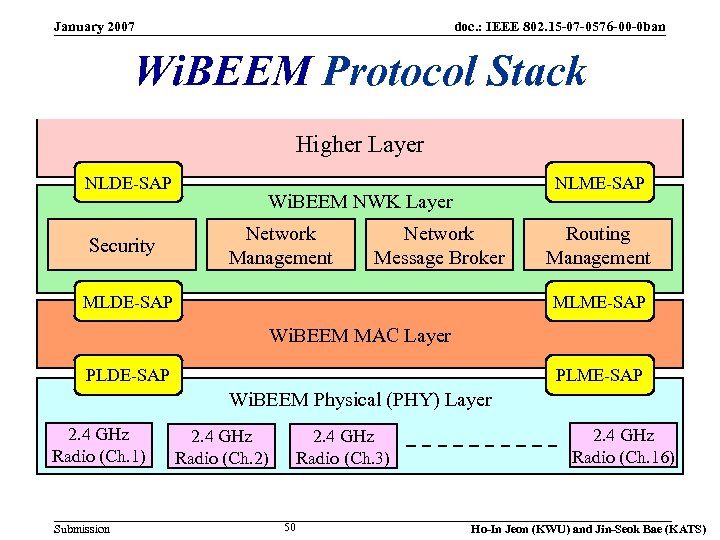 January 2007 doc. : IEEE 802. 15 -07 -0576 -00 -0 ban Wi. BEEM Protocol Stack Higher Layer NLDE-SAP Security NLME-SAP Wi. BEEM NWK Layer Network Management Network Message Broker MLDE-SAP Routing Management MLME-SAP Wi. BEEM MAC Layer PLDE-SAP PLME-SAP Wi. BEEM Physical (PHY) Layer 2. 4 GHz Radio (Ch. 1) Submission 2. 4 GHz Radio (Ch. 3) 2. 4 GHz Radio (Ch. 2) 50 2. 4 GHz Radio (Ch. 16) Ho-In Jeon (KWU) and Jin-Seok Bae (KATS)
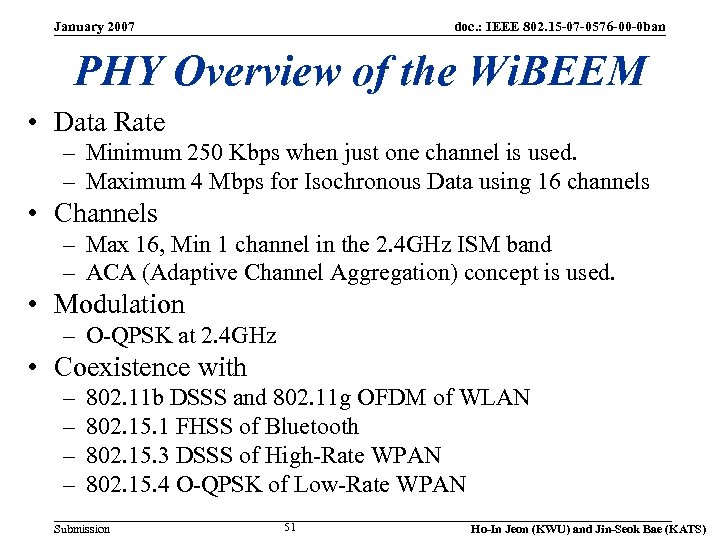 January 2007 doc. : IEEE 802. 15 -07 -0576 -00 -0 ban PHY Overview of the Wi. BEEM • Data Rate – Minimum 250 Kbps when just one channel is used. – Maximum 4 Mbps for Isochronous Data using 16 channels • Channels – Max 16, Min 1 channel in the 2. 4 GHz ISM band – ACA (Adaptive Channel Aggregation) concept is used. • Modulation – O-QPSK at 2. 4 GHz • Coexistence with – – 802. 11 b DSSS and 802. 11 g OFDM of WLAN 802. 15. 1 FHSS of Bluetooth 802. 15. 3 DSSS of High-Rate WPAN 802. 15. 4 O-QPSK of Low-Rate WPAN Submission 51 Ho-In Jeon (KWU) and Jin-Seok Bae (KATS)
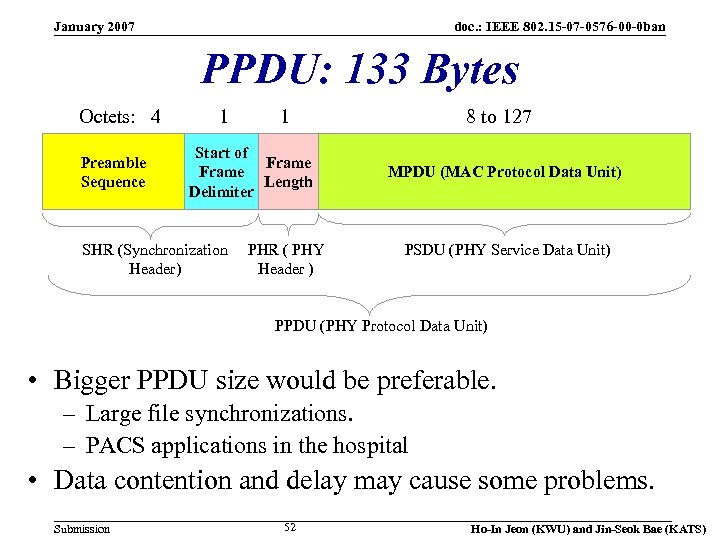 January 2007 doc. : IEEE 802. 15 -07 -0576 -00 -0 ban PPDU: 133 Bytes Octets: 4 Preamble Sequence 1 1 Start of Frame Length Delimiter SHR (Synchronization Header) PHR ( PHY Header ) 8 to 127 MPDU (MAC Protocol Data Unit) PSDU (PHY Service Data Unit) PPDU (PHY Protocol Data Unit) • Bigger PPDU size would be preferable. – Large file synchronizations. – PACS applications in the hospital • Data contention and delay may cause some problems. Submission 52 Ho-In Jeon (KWU) and Jin-Seok Bae (KATS)
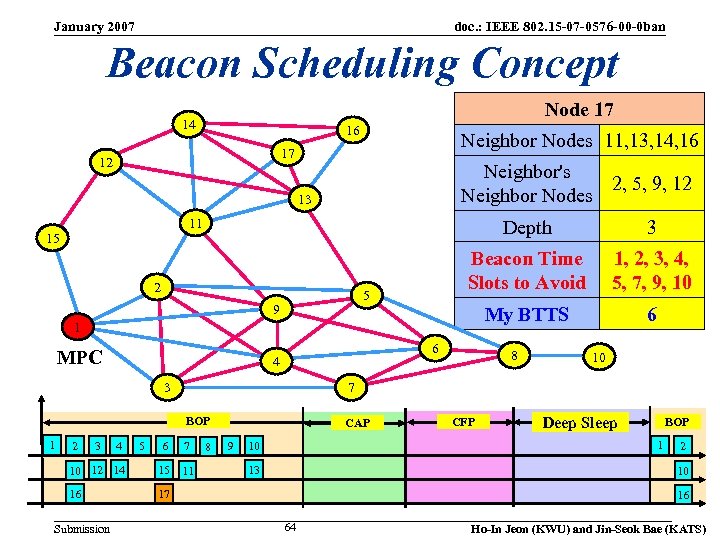
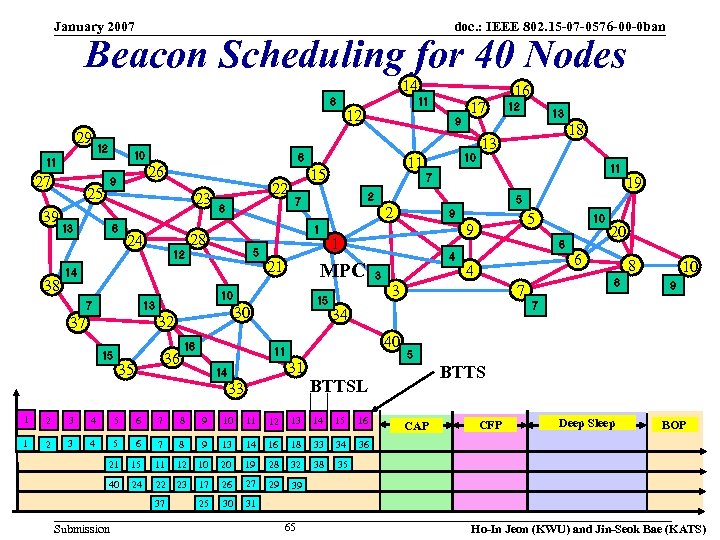
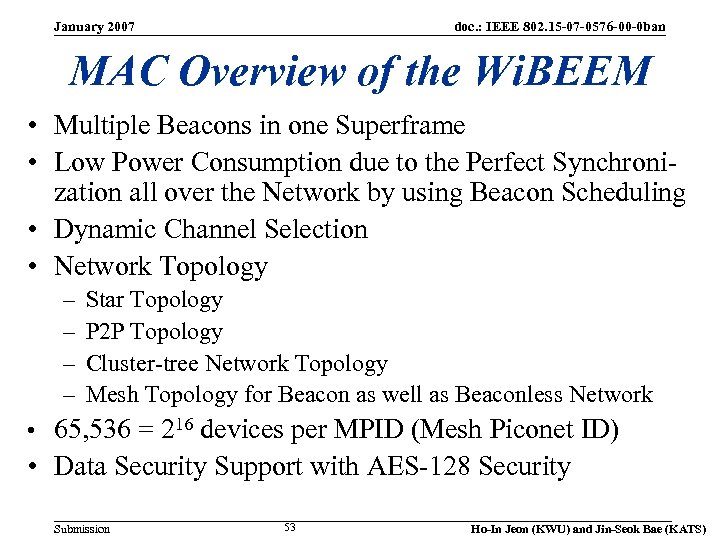 January 2007 doc. : IEEE 802. 15 -07 -0576 -00 -0 ban MAC Overview of the Wi. BEEM • Multiple Beacons in one Superframe • Low Power Consumption due to the Perfect Synchronization all over the Network by using Beacon Scheduling • Dynamic Channel Selection • Network Topology – – Star Topology P 2 P Topology Cluster-tree Network Topology Mesh Topology for Beacon as well as Beaconless Network 65, 536 = 216 devices per MPID (Mesh Piconet ID) • Data Security Support with AES-128 Security • Submission 53 Ho-In Jeon (KWU) and Jin-Seok Bae (KATS)
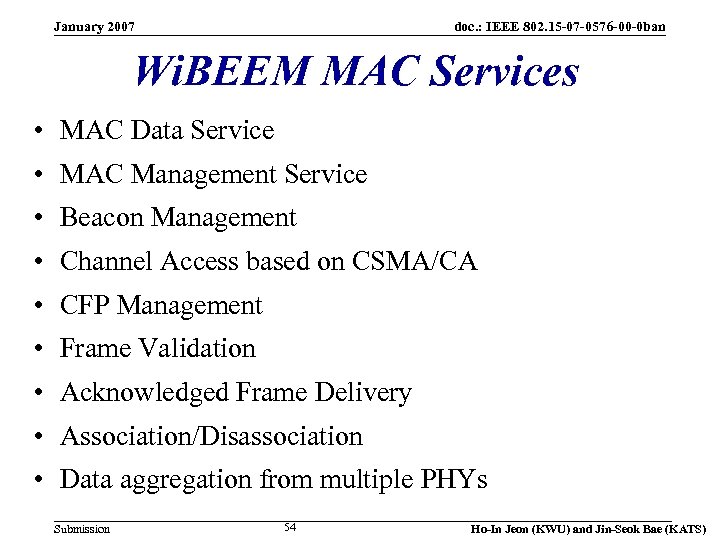 January 2007 doc. : IEEE 802. 15 -07 -0576 -00 -0 ban Wi. BEEM MAC Services • MAC Data Service • MAC Management Service • Beacon Management • Channel Access based on CSMA/CA • CFP Management • Frame Validation • Acknowledged Frame Delivery • Association/Disassociation • Data aggregation from multiple PHYs Submission 54 Ho-In Jeon (KWU) and Jin-Seok Bae (KATS)
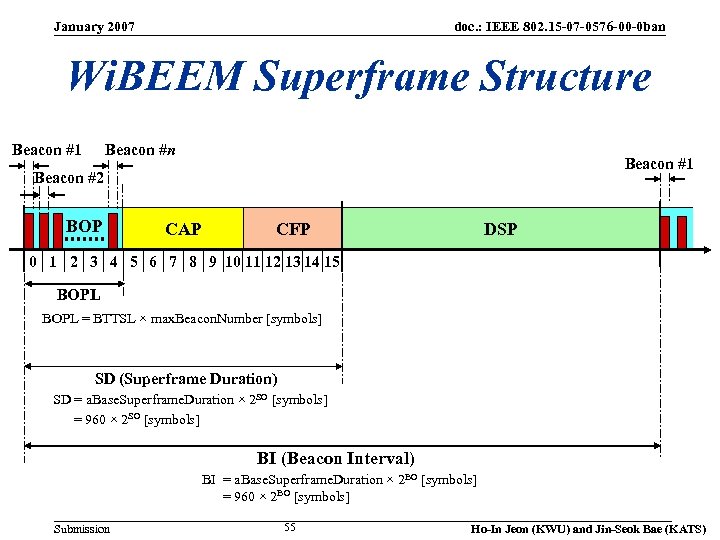 January 2007 doc. : IEEE 802. 15 -07 -0576 -00 -0 ban Wi. BEEM Superframe Structure Beacon #1 Beacon #n Beacon #1 Beacon #2 BOP CAP CFP DSP 0 1 2 3 4 5 6 7 8 9 10 11 12 13 14 15 BOPL = BTTSL × max. Beacon. Number [symbols] SD (Superframe Duration) SD = a. Base. Superframe. Duration × 2 SO [symbols] = 960 × 2 SO [symbols] BI (Beacon Interval) BI = a. Base. Superframe. Duration × 2 BO [symbols] = 960 × 2 BO [symbols] Submission 55 Ho-In Jeon (KWU) and Jin-Seok Bae (KATS)
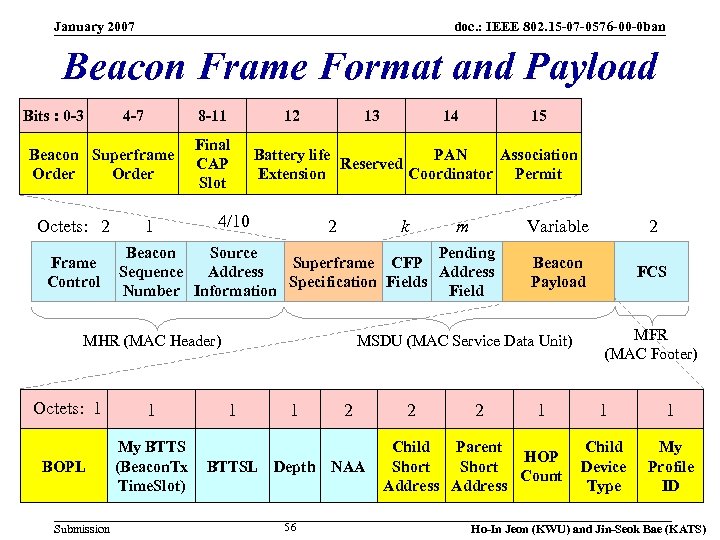 January 2007 doc. : IEEE 802. 15 -07 -0576 -00 -0 ban Beacon Frame Format and Payload Bits : 0 -3 4 -7 8 -11 Beacon Superframe Order Octets: 2 Frame Control 1 12 Final CAP Slot 13 15 Battery life PAN Association Reserved Extension Coordinator Permit 4/10 2 k m Variable Beacon Source Pending Superframe CFP Sequence Address Specification Fields Number Information Field MHR (MAC Header) Octets: 1 1 1 BOPL My BTTS (Beacon. Tx Time. Slot) Submission 14 2 Beacon Payload FCS MSDU (MAC Service Data Unit) 1 1 2 BTTSL Depth NAA 56 2 2 1 Child Parent HOP Short Count Address MFR (MAC Footer) 1 1 Child Device Type My Profile ID Ho-In Jeon (KWU) and Jin-Seok Bae (KATS)
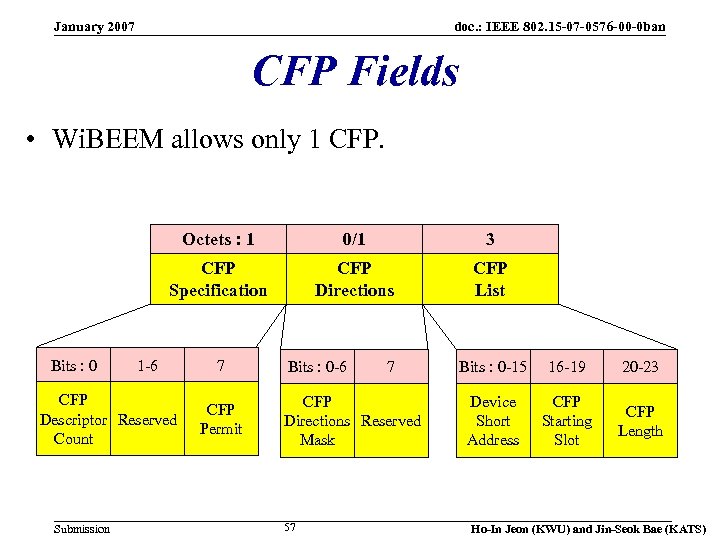 January 2007 doc. : IEEE 802. 15 -07 -0576 -00 -0 ban CFP Fields • Wi. BEEM allows only 1 CFP. Octets : 1 3 CFP Specification Bits : 0 0/1 CFP Directions CFP List 1 -6 CFP Descriptor Reserved Count Submission 7 CFP Permit Bits : 0 -6 7 CFP Directions Reserved Mask 57 Bits : 0 -15 16 -19 20 -23 Device Short Address CFP Starting Slot CFP Length Ho-In Jeon (KWU) and Jin-Seok Bae (KATS)
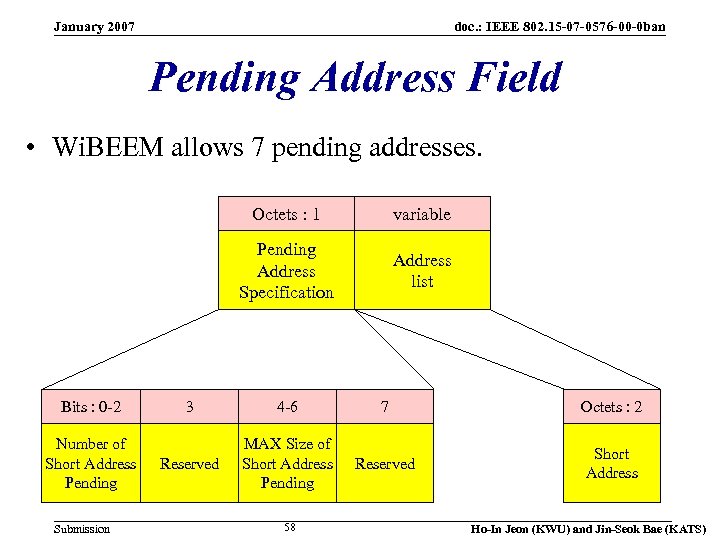 January 2007 doc. : IEEE 802. 15 -07 -0576 -00 -0 ban Pending Address Field • Wi. BEEM allows 7 pending addresses. Octets : 1 Pending Address Specification Bits : 0 -2 Number of Short Address Pending Submission variable Address list 3 4 -6 7 Octets : 2 Reserved MAX Size of Short Address Pending Reserved Short Address 58 Ho-In Jeon (KWU) and Jin-Seok Bae (KATS)
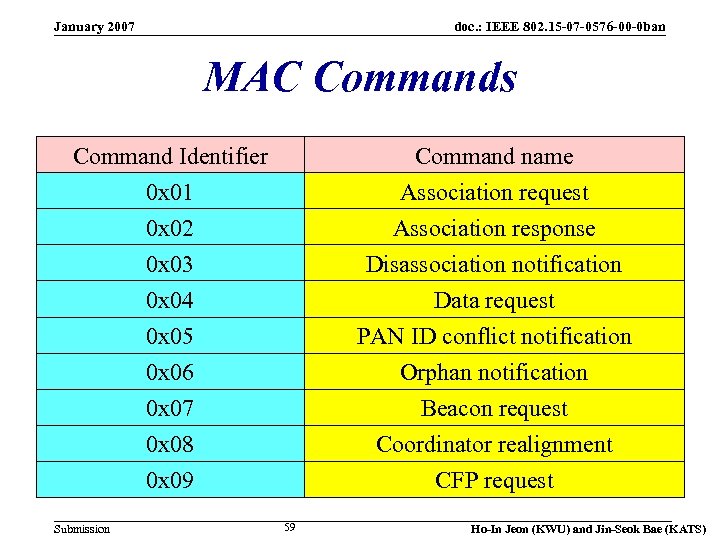 January 2007 doc. : IEEE 802. 15 -07 -0576 -00 -0 ban MAC Commands Command Identifier Command name 0 x 01 Association request 0 x 02 Association response 0 x 03 Disassociation notification 0 x 04 Data request 0 x 05 PAN ID conflict notification 0 x 06 Orphan notification 0 x 07 Beacon request 0 x 08 Coordinator realignment 0 x 09 CFP request Submission 59 Ho-In Jeon (KWU) and Jin-Seok Bae (KATS)
 January 2007 doc. : IEEE 802. 15 -07 -0576 -00 -0 ban Operating Principles of Wi. BEEM Devices • Devices are associated sequentially, one by one. • The relation between parent and children are characterized by association request and response. – My parent and children are my neighbors. – All devices I can hear are my neighbors. • When an association request is granted by multiple nodes, the new node decides to associate with the node which has the lowest depth. • When depth information is the same, he decides to associate with the node which transmits his beacon earlier than others. Submission 60 Ho-In Jeon (KWU) and Jin-Seok Bae (KATS)
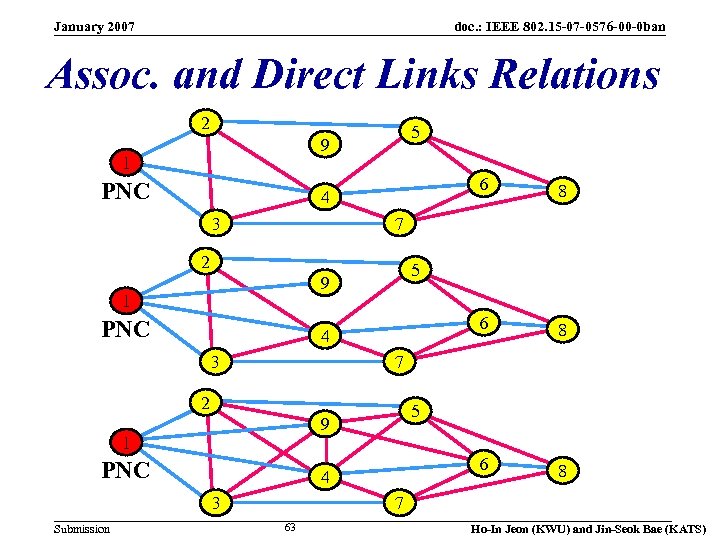
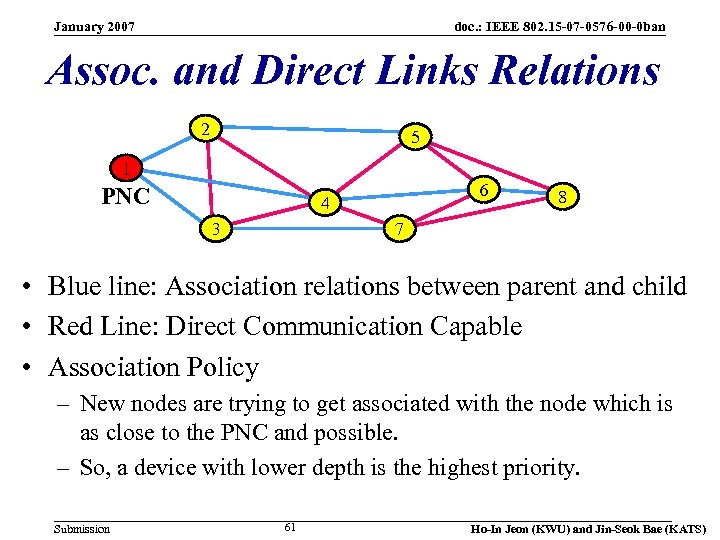 January 2007 doc. : IEEE 802. 15 -07 -0576 -00 -0 ban Assoc. and Direct Links Relations 2 5 1 PNC 6 4 3 8 7 • Blue line: Association relations between parent and child • Red Line: Direct Communication Capable • Association Policy – New nodes are trying to get associated with the node which is as close to the PNC and possible. – So, a device with lower depth is the highest priority. Submission 61 Ho-In Jeon (KWU) and Jin-Seok Bae (KATS)
 January 2007 doc. : IEEE 802. 15 -07 -0576 -00 -0 ban Association Policy • New nodes are trying to get associated with the node which is as close to the PNC and possible. • So, a device with lower depth is the highest priority. . • If RSSI is not high enough for reliable communications, then it can choose other node as its parent. • When an association request is granted by multiple nodes, the new node decides to associate with the node which has the lowest depth. • When depth information is the same, he decides to associate with the node which transmits his beacon earlier than others. Submission 62 Ho-In Jeon (KWU) and Jin-Seok Bae (KATS)
 January 2007 doc. : IEEE 802. 15 -07 -0576 -00 -0 ban Assoc. and Direct Links Relations 2 5 9 1 PNC 6 3 8 6 8 7 2 5 9 1 PNC 4 3 Submission 8 6 4 7 63 Ho-In Jeon (KWU) and Jin-Seok Bae (KATS)
 January 2007 doc. : IEEE 802. 15 -07 -0576 -00 -0 ban Beacon Scheduling Concept Node 17 14 16 Neighbor Nodes 11, 13, 14, 16 17 12 Neighbor's 2, 5, 9, 12 Neighbor Nodes 13 11 15 Depth 2 Beacon Time Slots to Avoid 1, 2, 3, 4, 5, 7, 9, 10 My BTTS 5 9 3 6 1 MPC 6 4 3 2 3 4 5 6 7 10 12 14 15 11 16 8 CAP 9 CFP Deep Sleep BOP 1 10 17 Submission 10 7 BOP 1 8 13 2 10 16 64 Ho-In Jeon (KWU) and Jin-Seok Bae (KATS)
 January 2007 doc. : IEEE 802. 15 -07 -0576 -00 -0 ban Beacon Scheduling for 40 Nodes 14 8 29 12 27 25 39 23 13 6 22 8 28 24 7 21 18 13 32 36 15 35 15 30 16 9 5 9 10 6 4 3 20 6 4 3 8 8 7 10 9 7 34 40 31 5 BTTSL 33 19 1 11 14 11 5 2 MPC 10 37 13 7 2 5 14 7 12 10 11 15 1 12 38 17 9 6 26 9 12 16 13 10 11 11 1 2 3 4 5 6 7 8 9 10 11 12 13 14 15 16 1 2 3 4 5 6 7 8 9 13 14 16 18 33 34 36 21 15 11 12 10 20 19 28 32 38 35 40 24 22 23 17 26 27 29 39 25 30 31 37 Submission 65 CAP CFP Deep Sleep BOP Ho-In Jeon (KWU) and Jin-Seok Bae (KATS)
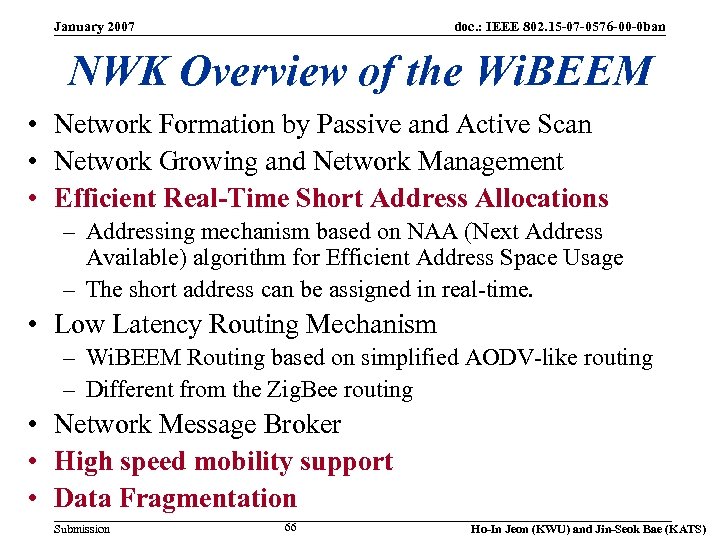 January 2007 doc. : IEEE 802. 15 -07 -0576 -00 -0 ban NWK Overview of the Wi. BEEM • Network Formation by Passive and Active Scan • Network Growing and Network Management • Efficient Real-Time Short Address Allocations – Addressing mechanism based on NAA (Next Address Available) algorithm for Efficient Address Space Usage – The short address can be assigned in real-time. • Low Latency Routing Mechanism – Wi. BEEM Routing based on simplified AODV-like routing – Different from the Zig. Bee routing • Network Message Broker • High speed mobility support • Data Fragmentation Submission 66 Ho-In Jeon (KWU) and Jin-Seok Bae (KATS)
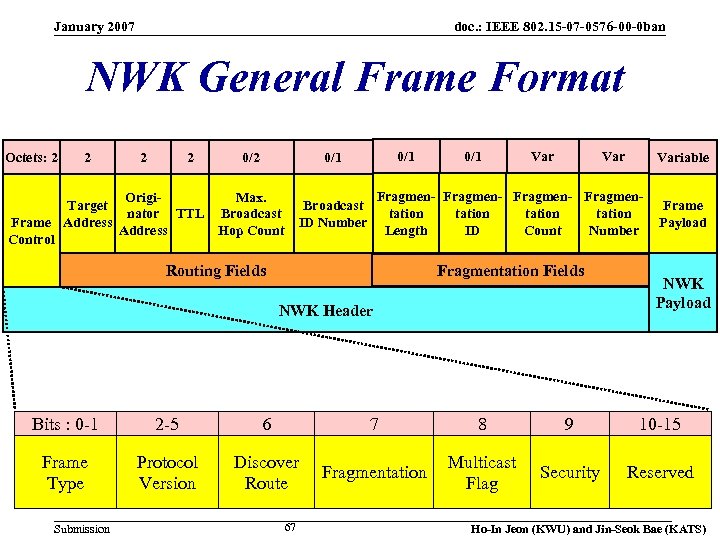 January 2007 doc. : IEEE 802. 15 -07 -0576 -00 -0 ban NWK General Frame Format Octets: 2 2 Origi. Target nator TTL Frame Address Control 0/2 Max. Broadcast Hop Count 0/1 Broadcast ID Number 0/1 Var Variable Fragmen- Fragmentation Length ID Count Number Fragmentation Fields Routing Fields NWK Header Frame Payload NWK Payload Bits : 0 -1 2 -5 6 7 8 9 10 -15 Frame Type Protocol Version Discover Route Fragmentation Multicast Flag Security Reserved Submission 67 Ho-In Jeon (KWU) and Jin-Seok Bae (KATS)
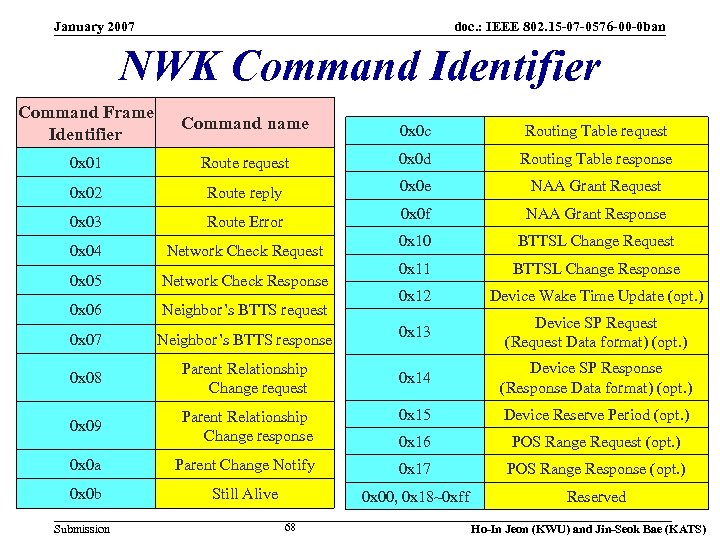 January 2007 doc. : IEEE 802. 15 -07 -0576 -00 -0 ban NWK Command Identifier Command Frame Identifier Command name 0 x 0 c Routing Table request 0 x 01 Route request 0 x 0 d Routing Table response 0 x 02 Route reply 0 x 0 e NAA Grant Request 0 x 03 Route Error 0 x 0 f NAA Grant Response 0 x 04 Network Check Request 0 x 10 BTTSL Change Request 0 x 05 Network Check Response 0 x 11 BTTSL Change Response 0 x 06 Neighbor’s BTTS request 0 x 12 Device Wake Time Update (opt. ) Device SP Request (Request Data format) (opt. ) 0 x 07 Neighbor’s BTTS response 0 x 13 0 x 08 Parent Relationship Change request 0 x 14 Device SP Response (Response Data format) (opt. ) 0 x 09 Parent Relationship Change response 0 x 15 Device Reserve Period (opt. ) 0 x 16 POS Range Request (opt. ) 0 x 0 a Parent Change Notify 0 x 17 POS Range Response (opt. ) 0 x 0 b Still Alive 0 x 00, 0 x 18~0 xff Reserved Submission 68 Ho-In Jeon (KWU) and Jin-Seok Bae (KATS)
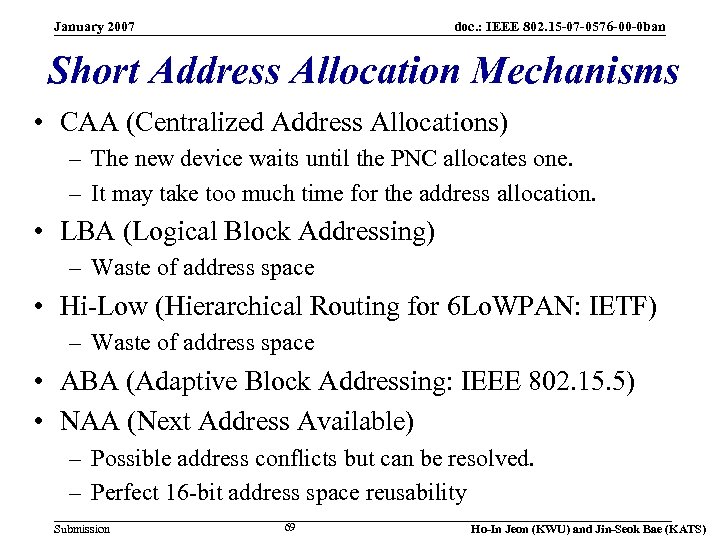 January 2007 doc. : IEEE 802. 15 -07 -0576 -00 -0 ban Short Address Allocation Mechanisms • CAA (Centralized Address Allocations) – The new device waits until the PNC allocates one. – It may take too much time for the address allocation. • LBA (Logical Block Addressing) – Waste of address space • Hi-Low (Hierarchical Routing for 6 Lo. WPAN: IETF) – Waste of address space • ABA (Adaptive Block Addressing: IEEE 802. 15. 5) • NAA (Next Address Available) – Possible address conflicts but can be resolved. – Perfect 16 -bit address space reusability Submission 69 Ho-In Jeon (KWU) and Jin-Seok Bae (KATS)
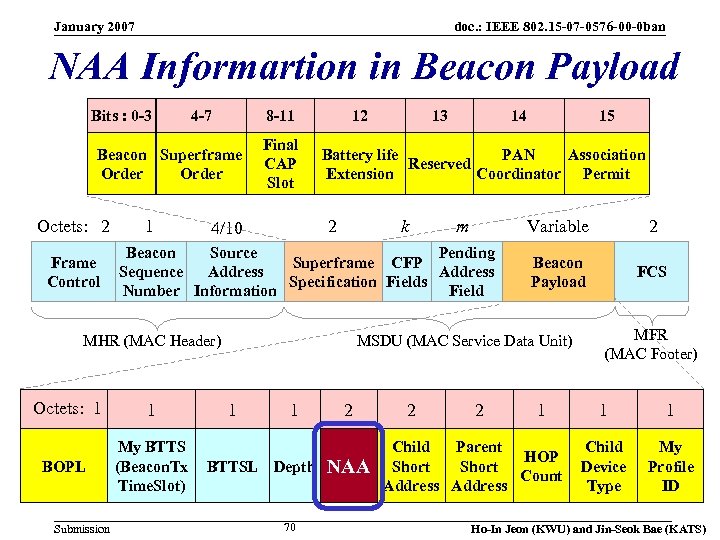 January 2007 doc. : IEEE 802. 15 -07 -0576 -00 -0 ban NAA Informartion in Beacon Payload Bits : 0 -3 4 -7 8 -11 Beacon Superframe Order Octets: 2 Frame Control 1 Final CAP Slot 12 k m Octets: 1 1 1 BOPL My BTTS (Beacon. Tx Time. Slot) 15 Variable Beacon Source Pending Superframe CFP Sequence Address Specification Fields Number Information Field MHR (MAC Header) Submission 14 Battery life PAN Association Reserved Extension Coordinator Permit 2 4/10 13 2 Beacon Payload FCS MSDU (MAC Service Data Unit) 1 1 BTTSL Depth 70 2 NAA 2 2 1 Child Parent HOP Short Count Address MFR (MAC Footer) 1 1 Child Device Type My Profile ID Ho-In Jeon (KWU) and Jin-Seok Bae (KATS)
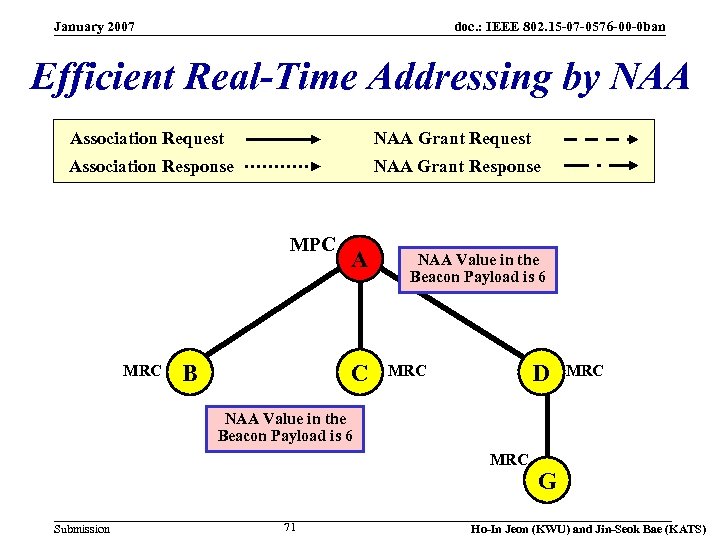 January 2007 doc. : IEEE 802. 15 -07 -0576 -00 -0 ban Efficient Real-Time Addressing by NAA Association Request NAA Grant Request Association Response NAA Grant Response MPC MRC B A C NAA Value in the Beacon Payload is 6 D MRC NAA Value in the Beacon Payload is 6 MRC Submission 71 G Ho-In Jeon (KWU) and Jin-Seok Bae (KATS)
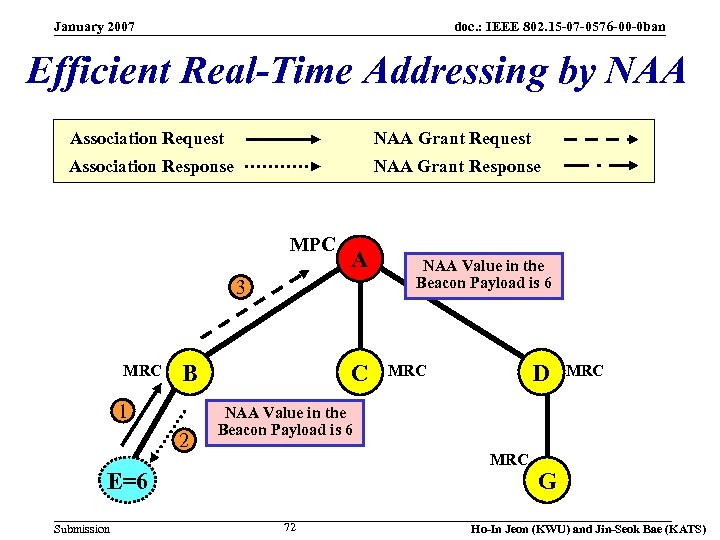 January 2007 doc. : IEEE 802. 15 -07 -0576 -00 -0 ban Efficient Real-Time Addressing by NAA Association Request NAA Grant Request Association Response NAA Grant Response MPC A 3 MRC B 1 2 C D MRC NAA Value in the Beacon Payload is 6 MRC E=6 Submission NAA Value in the Beacon Payload is 6 72 G Ho-In Jeon (KWU) and Jin-Seok Bae (KATS)
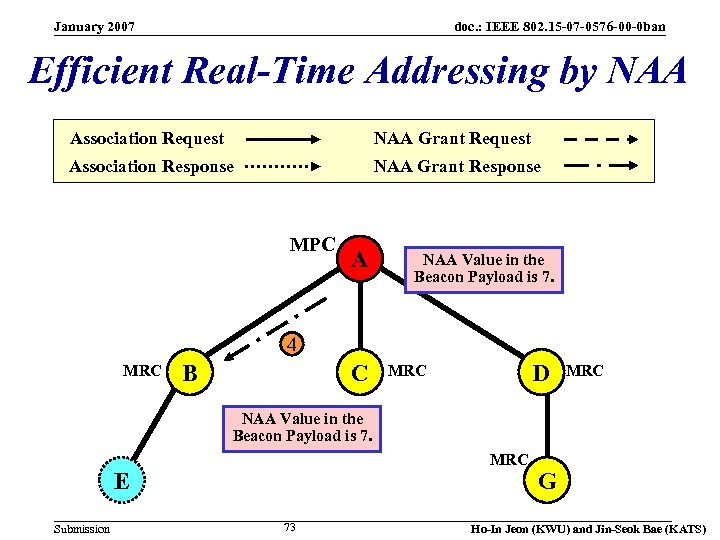 January 2007 doc. : IEEE 802. 15 -07 -0576 -00 -0 ban Efficient Real-Time Addressing by NAA Association Request NAA Grant Request Association Response NAA Grant Response MPC A NAA Value in the Beacon Payload is 7. 4 MRC B C D MRC NAA Value in the Beacon Payload is 7. MRC E Submission 73 G Ho-In Jeon (KWU) and Jin-Seok Bae (KATS)
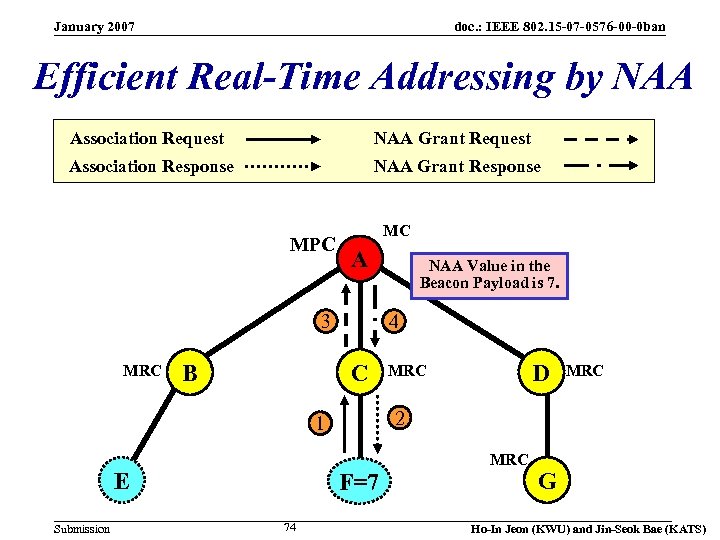 January 2007 doc. : IEEE 802. 15 -07 -0576 -00 -0 ban Efficient Real-Time Addressing by NAA Association Request NAA Grant Request Association Response NAA Grant Response MPC MC A 3 MRC B 4 C Submission F=7 74 D MRC 2 1 E NAA Value in the Beacon Payload is 7. MRC G Ho-In Jeon (KWU) and Jin-Seok Bae (KATS)
 January 2007 doc. : IEEE 802. 15 -07 -0576 -00 -0 ban Advantages of Wi. BEEM Addressing • No address waste. • Device discovery done when the address is granted. • The concept of NAA (Next Address Available) allows the complete reuse of the 16 -bit address space when the node has been disassociated. • Possible address conflicts that can be resolved when two nodes join the network at the same time. • Reasonable delay for resolving the address conflicts. Submission 75 Ho-In Jeon (KWU) and Jin-Seok Bae (KATS)
 January 2007 doc. : IEEE 802. 15 -07 -0576 -00 -0 ban Wi. BEEM Routing • The NAA does not allow the tree routing because of the no-systematic addressing mechanism. • The tree routing, however, limits the applicability of the protocol drastically. – The number of new devices to join in. – Device mobility • Wi. BEEM routing has only one mandatory routing algorithm: – – Does not support Tree routing. Wi. BEEM routing with simplified AOVD-like reactive routing. Different from Zig. Bee routing Different from Hi. Low routing. Submission 76 Ho-In Jeon (KWU) and Jin-Seok Bae (KATS)
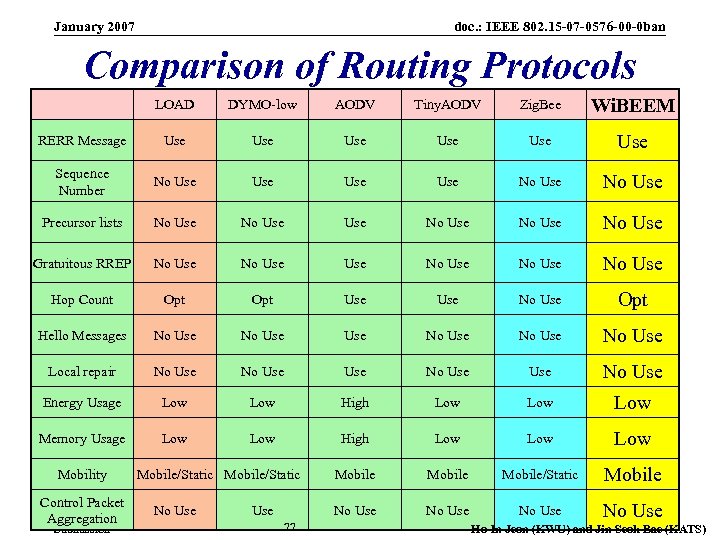 January 2007 doc. : IEEE 802. 15 -07 -0576 -00 -0 ban Comparison of Routing Protocols LOAD DYMO-low AODV Tiny. AODV Zig. Bee Wi. BEEM RERR Message Use Use Use Sequence Number No Use Use No Use Precursor lists No Use Use No Use Gratuitous RREP No Use Use No Use Hop Count Opt Use No Use Opt Hello Messages No Use Use No Use Local repair No Use Use No Use Energy Usage Low High Low Low Memory Usage Low High Low Low Mobile/Static Mobile No Use Mobility Control Packet Aggregation Submission Mobile/Static No Use 77 Ho-In Jeon (KWU) and Jin-Seok Bae (KATS)
 January 2007 doc. : IEEE 802. 15 -07 -0576 -00 -0 ban Implementation of Wi. BEEM Technology : U-Parking Lot System Submission 78 Ho-In Jeon (KWU) and Jin-Seok Bae (KATS)
 January 2007 doc. : IEEE 802. 15 -07 -0576 -00 -0 ban Why U-Parking Lot? • Wide area of parking lot space covering several hundred meters with 4 or 5 floors using Wi. BEEM mesh network. • When the parking lot is in the underground, there is no location information based on GPS processing, and the WPAN mesh will be the only mechanism that can provide location information. • Cars coming into the parking lot can be 32, 000 associating with one single point of the network, and sensors can be upto 32, 536. • Devices are moving as fast as 30 Km. • Very similar to the infrastructure of digital hospital. – Emergency ambulances are coming rapidly. – Need to get information about the car and patient as soon as possible using the digital hospital infrastructure. – While moving, information has to be updated. • Once U-Parking Lot service is implemented, almost every service can be proved. Submission 79 Ho-In Jeon (KWU) and Jin-Seok Bae (KATS)
 January 2007 doc. : IEEE 802. 15 -07 -0576 -00 -0 ban U-Parking Lot Service with Wi. BEEM Wired Network Wireless Mesh Assoc. Relation Wi. BEEM Gateway with/without Gate Controller Wi. BEEM Sensor Node Wi. BEEM MRC U-Parking Lot Controller Interne t Wi. BEEM Basement 2 Wi. BEEM Gateway U-Parking Lot Server U-City Control Center Basement 3 Basement 4 Wi. BEEM Submission 80 Ho-In Jeon (KWU) and Jin-Seok Bae (KATS)
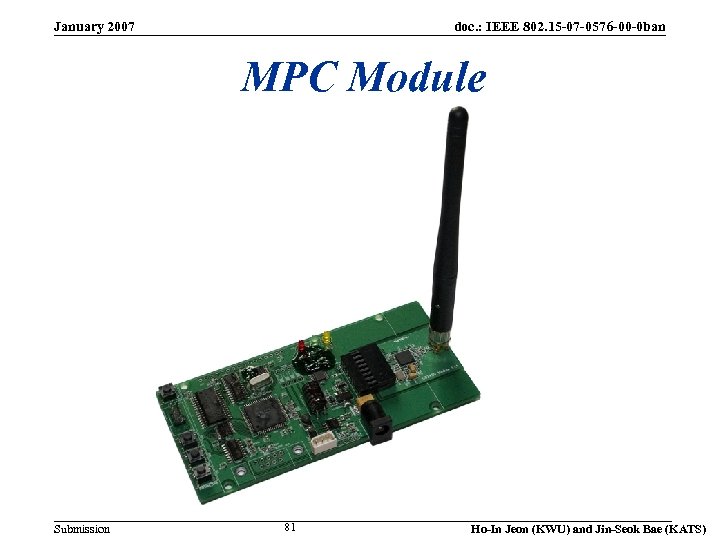 January 2007 doc. : IEEE 802. 15 -07 -0576 -00 -0 ban MPC Module Submission 81 Ho-In Jeon (KWU) and Jin-Seok Bae (KATS)
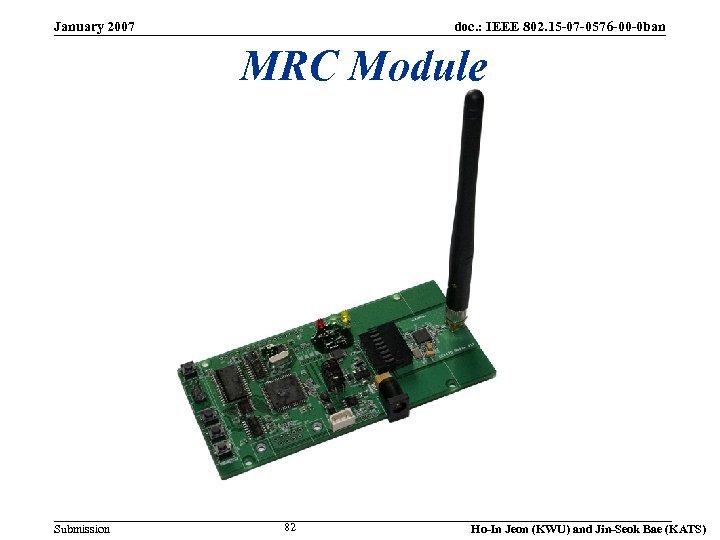 January 2007 doc. : IEEE 802. 15 -07 -0576 -00 -0 ban MRC Module Submission 82 Ho-In Jeon (KWU) and Jin-Seok Bae (KATS)
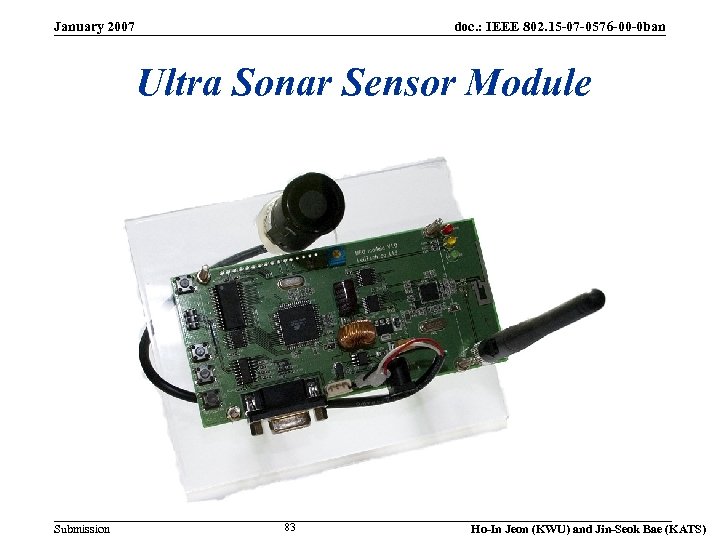 January 2007 doc. : IEEE 802. 15 -07 -0576 -00 -0 ban Ultra Sonar Sensor Module Submission 83 Ho-In Jeon (KWU) and Jin-Seok Bae (KATS)
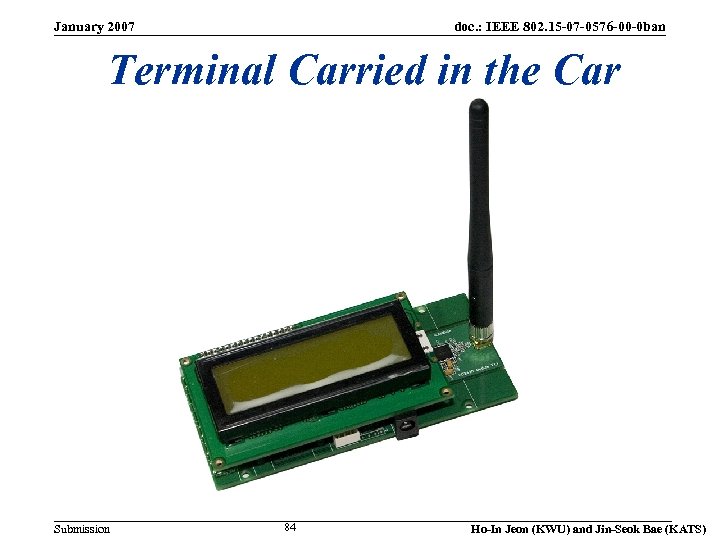 January 2007 doc. : IEEE 802. 15 -07 -0576 -00 -0 ban Terminal Carried in the Car Submission 84 Ho-In Jeon (KWU) and Jin-Seok Bae (KATS)
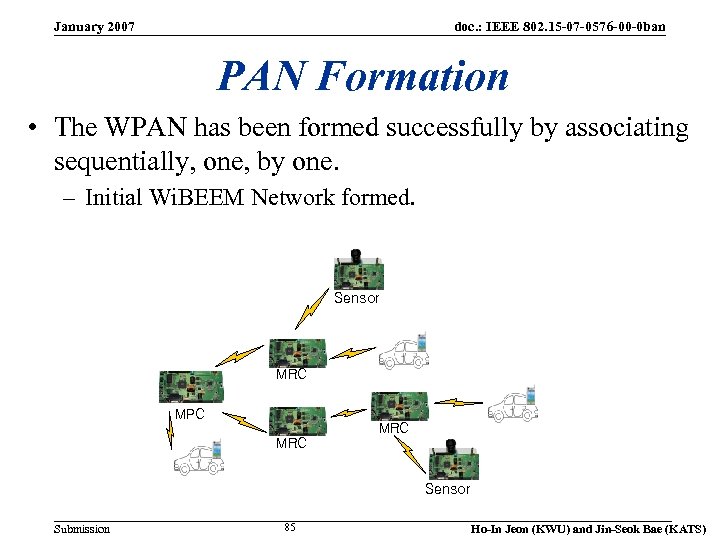 January 2007 doc. : IEEE 802. 15 -07 -0576 -00 -0 ban PAN Formation • The WPAN has been formed successfully by associating sequentially, one, by one. – Initial Wi. BEEM Network formed. Sensor MRC MPC MRC Sensor Submission 85 Ho-In Jeon (KWU) and Jin-Seok Bae (KATS)
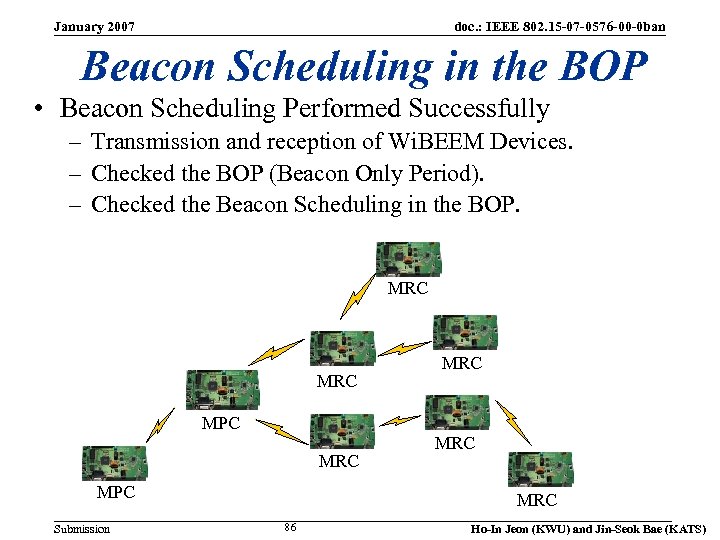 January 2007 doc. : IEEE 802. 15 -07 -0576 -00 -0 ban Beacon Scheduling in the BOP • Beacon Scheduling Performed Successfully – Transmission and reception of Wi. BEEM Devices. – Checked the BOP (Beacon Only Period). – Checked the Beacon Scheduling in the BOP. MRC MRC MPC Submission MRC 86 Ho-In Jeon (KWU) and Jin-Seok Bae (KATS)
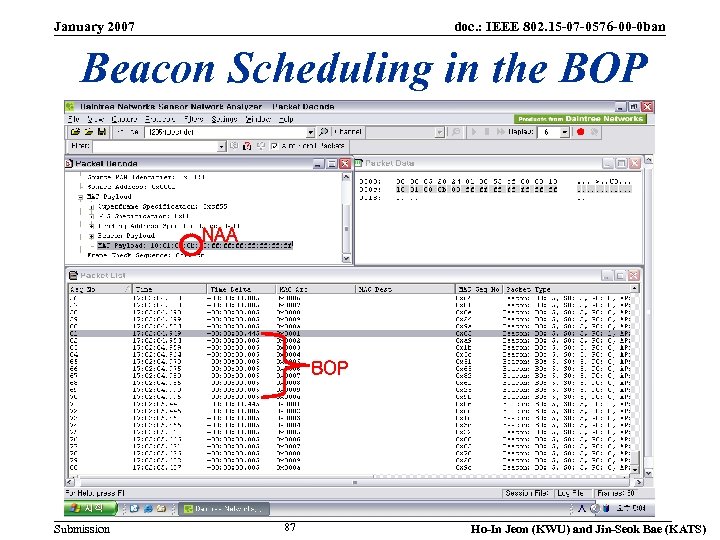 January 2007 doc. : IEEE 802. 15 -07 -0576 -00 -0 ban Beacon Scheduling in the BOP NAA BOP Submission 87 Ho-In Jeon (KWU) and Jin-Seok Bae (KATS)
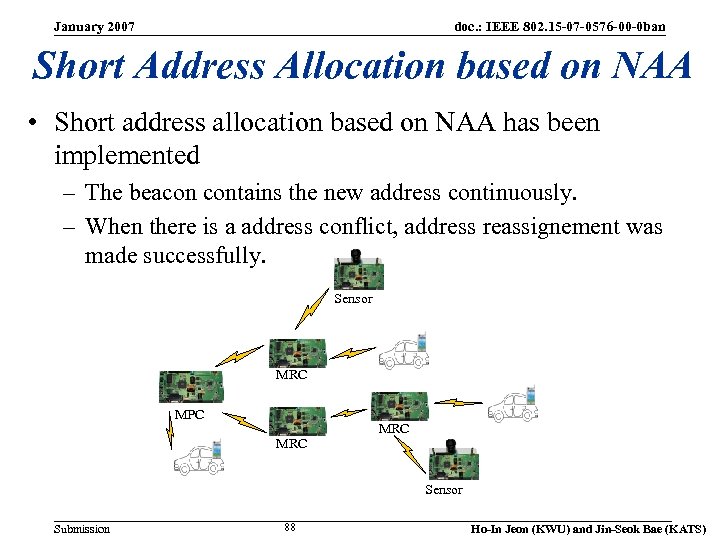 January 2007 doc. : IEEE 802. 15 -07 -0576 -00 -0 ban Short Address Allocation based on NAA • Short address allocation based on NAA has been implemented – The beacon contains the new address continuously. – When there is a address conflict, address reassignement was made successfully. Sensor MRC MPC MRC Sensor Submission 88 Ho-In Jeon (KWU) and Jin-Seok Bae (KATS)
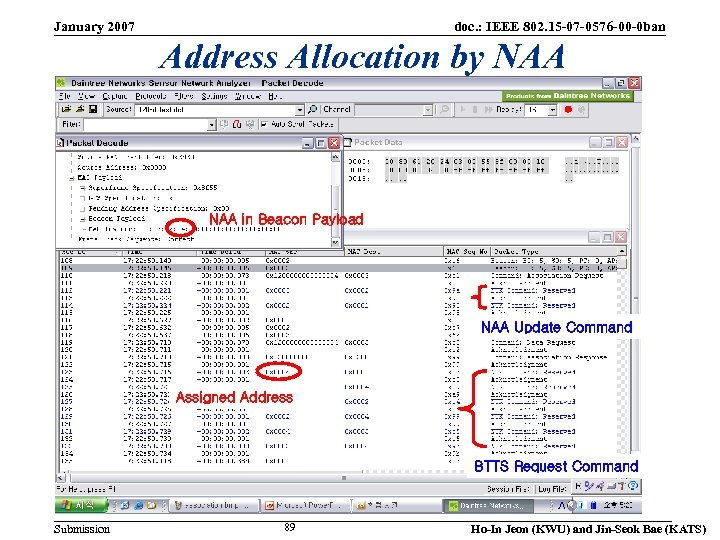 January 2007 doc. : IEEE 802. 15 -07 -0576 -00 -0 ban Address Allocation by NAA in Beacon Payload NAA Update Command Assigned Address BTTS Request Command Submission 89 Ho-In Jeon (KWU) and Jin-Seok Bae (KATS)
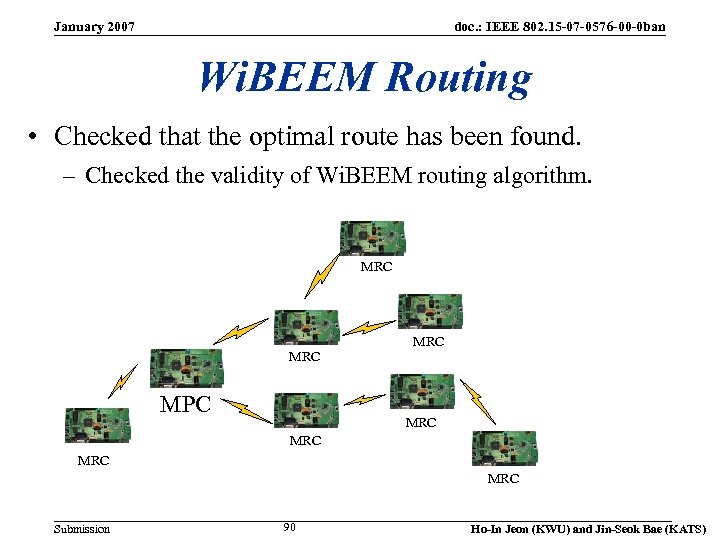 January 2007 doc. : IEEE 802. 15 -07 -0576 -00 -0 ban Wi. BEEM Routing • Checked that the optimal route has been found. – Checked the validity of Wi. BEEM routing algorithm. MRC MPC MRC MRC MRC Submission 90 Ho-In Jeon (KWU) and Jin-Seok Bae (KATS)
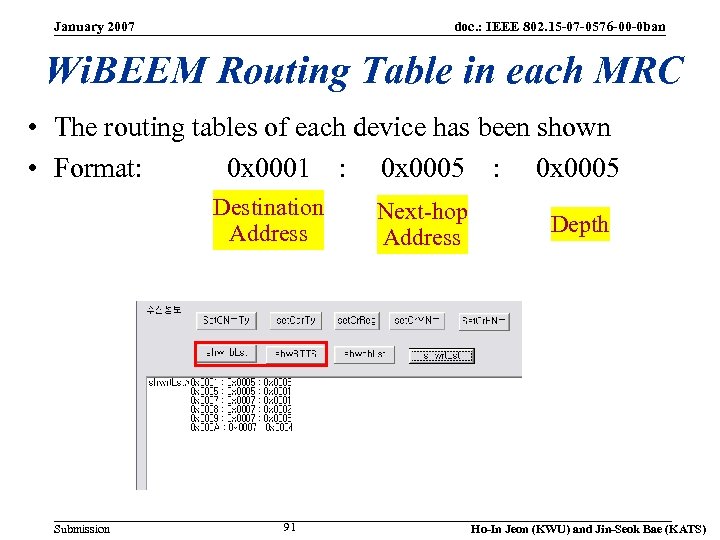 January 2007 doc. : IEEE 802. 15 -07 -0576 -00 -0 ban Wi. BEEM Routing Table in each MRC • The routing tables of each device has been shown • Format: 0 x 0001 : 0 x 0005 Destination Address Submission 91 Next-hop Address Depth Ho-In Jeon (KWU) and Jin-Seok Bae (KATS)
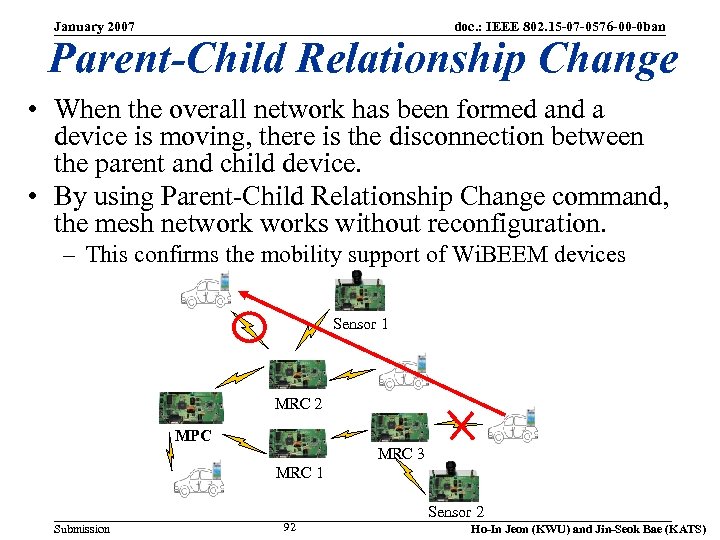 January 2007 doc. : IEEE 802. 15 -07 -0576 -00 -0 ban Parent-Child Relationship Change • When the overall network has been formed and a device is moving, there is the disconnection between the parent and child device. • By using Parent-Child Relationship Change command, the mesh networks without reconfiguration. – This confirms the mobility support of Wi. BEEM devices Sensor 1 MRC 2 MPC MRC 3 MRC 1 Sensor 2 Submission 92 Ho-In Jeon (KWU) and Jin-Seok Bae (KATS)
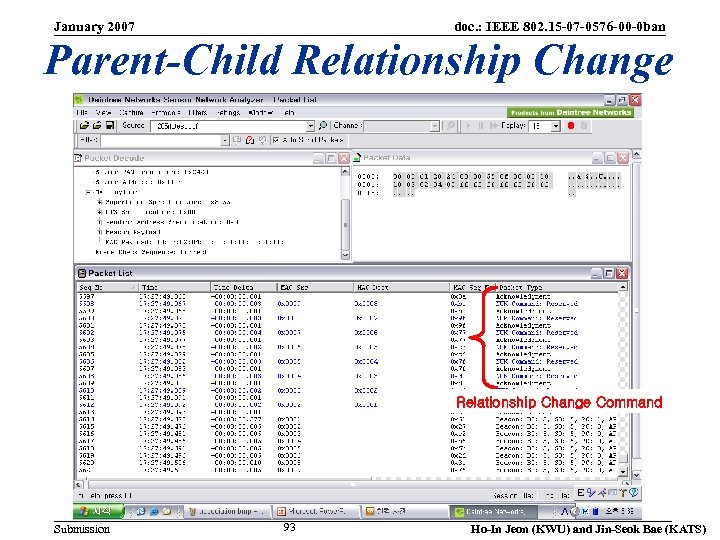 January 2007 doc. : IEEE 802. 15 -07 -0576 -00 -0 ban Parent-Child Relationship Change Command Submission 93 Ho-In Jeon (KWU) and Jin-Seok Bae (KATS)
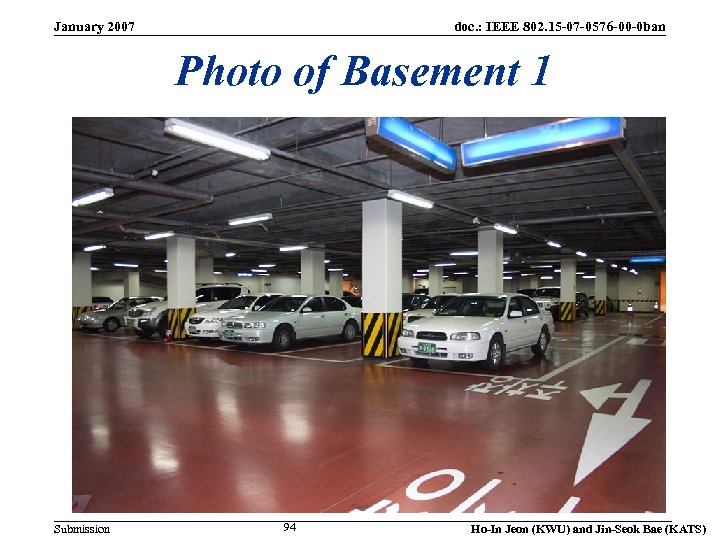 January 2007 doc. : IEEE 802. 15 -07 -0576 -00 -0 ban Photo of Basement 1 Submission 94 Ho-In Jeon (KWU) and Jin-Seok Bae (KATS)
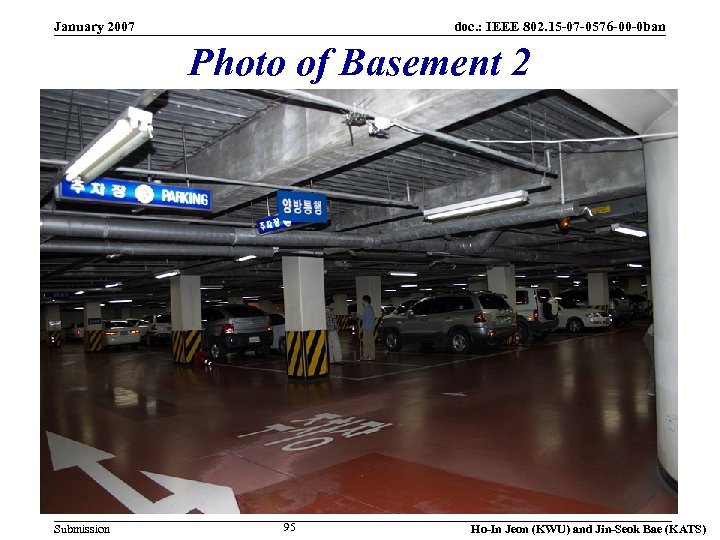 January 2007 doc. : IEEE 802. 15 -07 -0576 -00 -0 ban Photo of Basement 2 Submission 95 Ho-In Jeon (KWU) and Jin-Seok Bae (KATS)
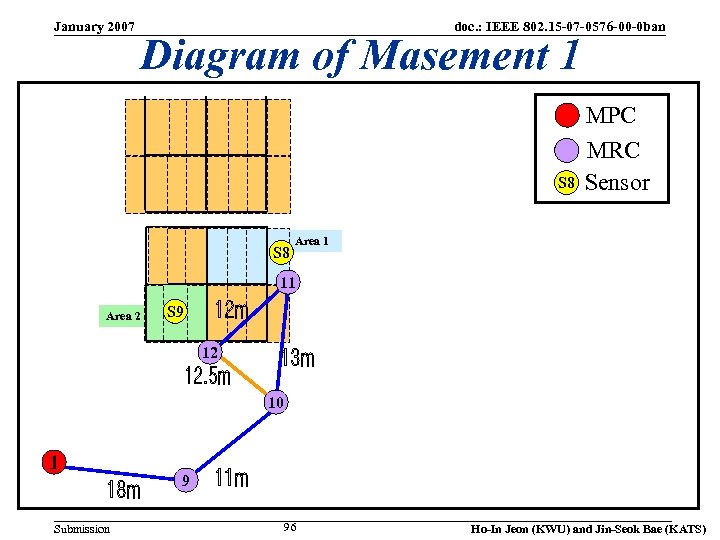 January 2007 doc. : IEEE 802. 15 -07 -0576 -00 -0 ban Diagram of Masement 1 S 8 MPC MRC Sensor Area 1 11 Area 2 S 9 12 10 1 Submission 9 96 Ho-In Jeon (KWU) and Jin-Seok Bae (KATS)
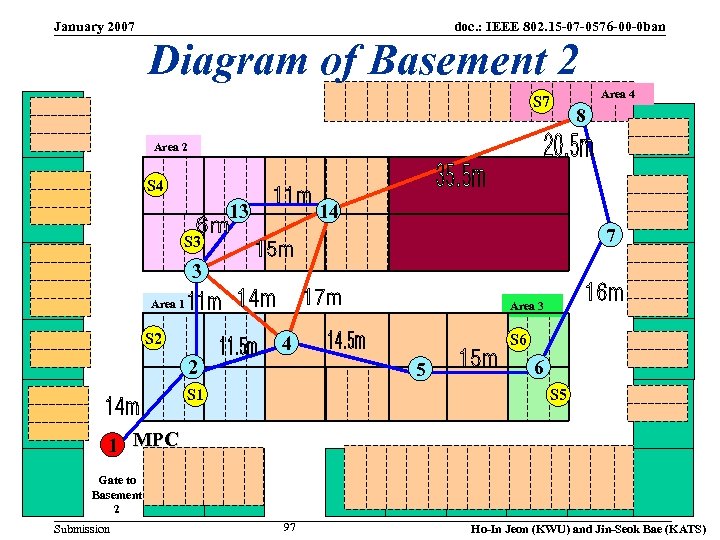 January 2007 doc. : IEEE 802. 15 -07 -0576 -00 -0 ban Diagram of Basement 2 S 7 Area 4 8 Area 2 S 4 13 14 7 S 3 3 Area 1 Area 3 S 2 S 6 4 2 5 S 1 6 S 5 1 MPC Gate to Basement 2 Submission 97 Ho-In Jeon (KWU) and Jin-Seok Bae (KATS)
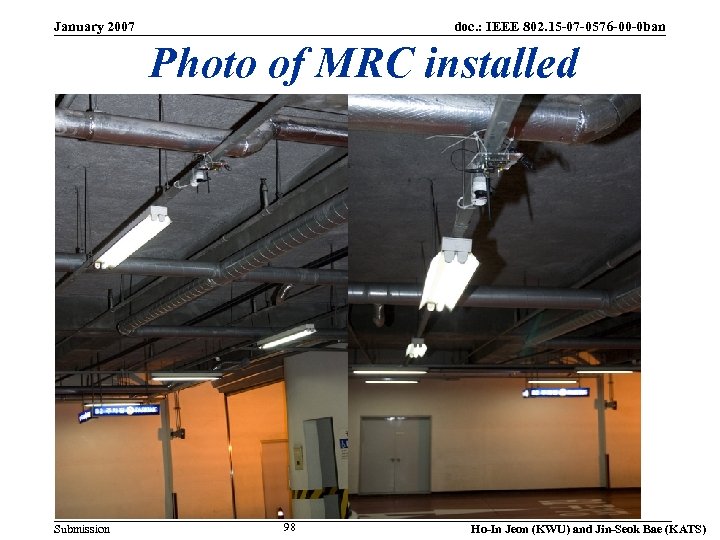 January 2007 doc. : IEEE 802. 15 -07 -0576 -00 -0 ban Photo of MRC installed Submission 98 Ho-In Jeon (KWU) and Jin-Seok Bae (KATS)
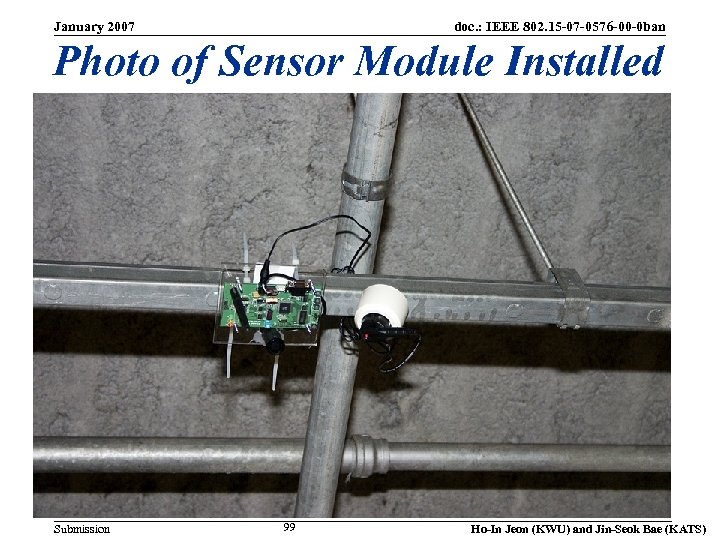 January 2007 doc. : IEEE 802. 15 -07 -0576 -00 -0 ban Photo of Sensor Module Installed Submission 99 Ho-In Jeon (KWU) and Jin-Seok Bae (KATS)
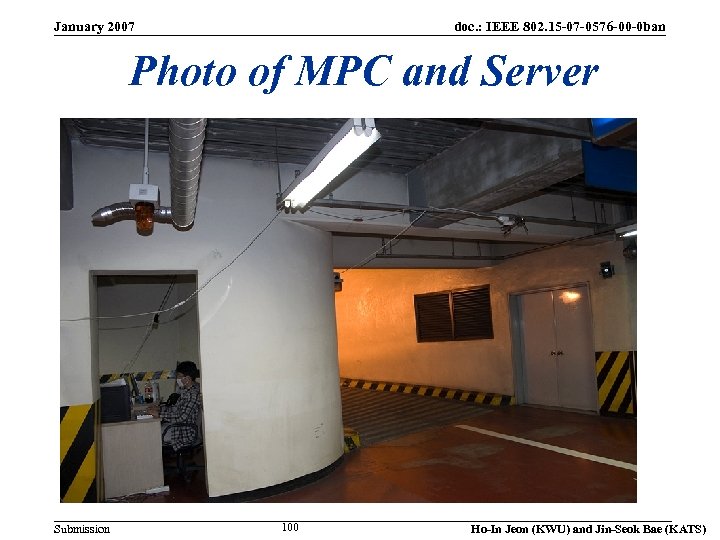 January 2007 doc. : IEEE 802. 15 -07 -0576 -00 -0 ban Photo of MPC and Server Submission 100 Ho-In Jeon (KWU) and Jin-Seok Bae (KATS)
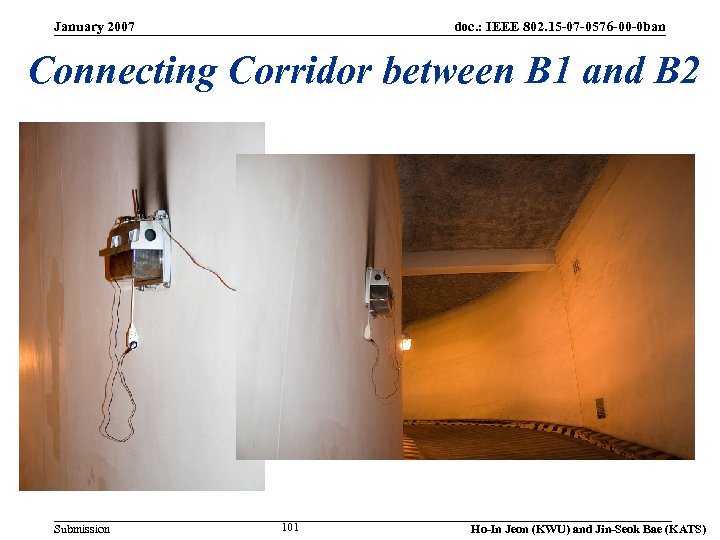 January 2007 doc. : IEEE 802. 15 -07 -0576 -00 -0 ban Connecting Corridor between B 1 and B 2 Submission 101 Ho-In Jeon (KWU) and Jin-Seok Bae (KATS)
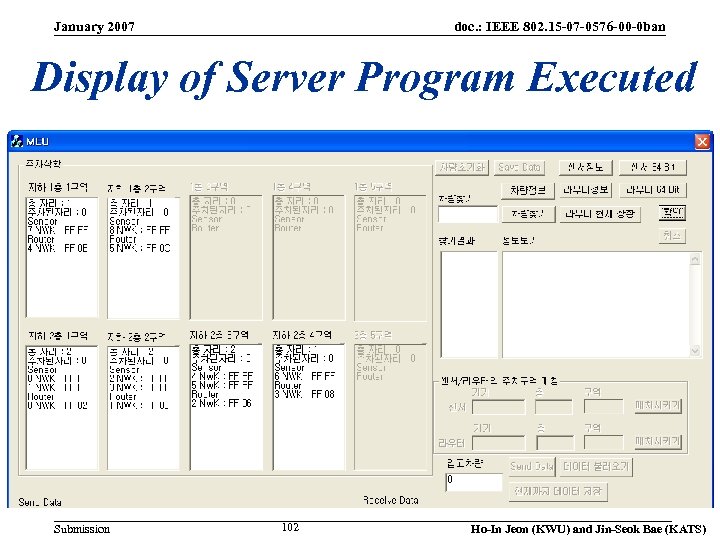 January 2007 doc. : IEEE 802. 15 -07 -0576 -00 -0 ban Display of Server Program Executed Submission 102 Ho-In Jeon (KWU) and Jin-Seok Bae (KATS)
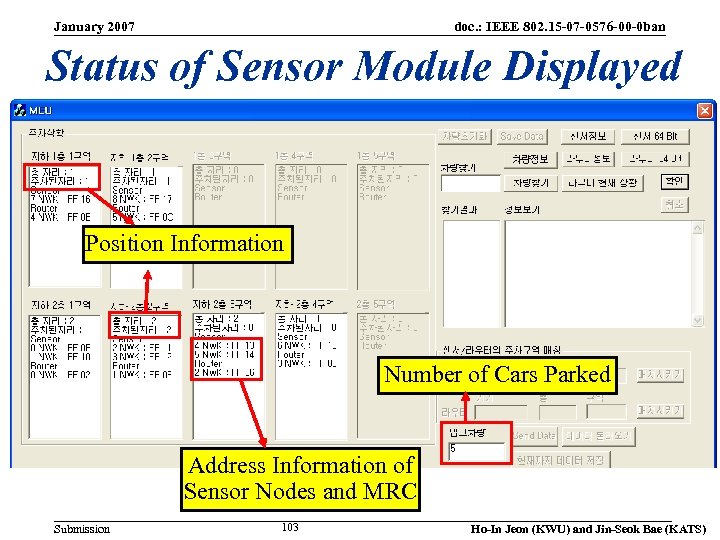 January 2007 doc. : IEEE 802. 15 -07 -0576 -00 -0 ban Status of Sensor Module Displayed Position Information Number of Cars Parked Address Information of Sensor Nodes and MRC Submission 103 Ho-In Jeon (KWU) and Jin-Seok Bae (KATS)
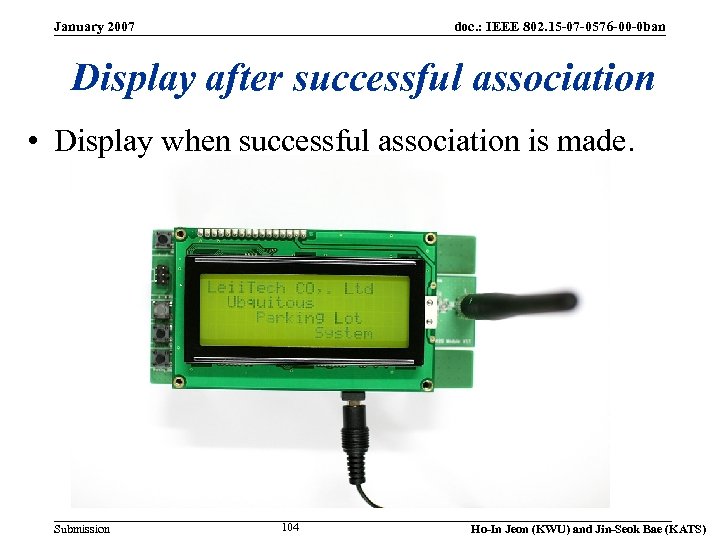 January 2007 doc. : IEEE 802. 15 -07 -0576 -00 -0 ban Display after successful association • Display when successful association is made. Submission 104 Ho-In Jeon (KWU) and Jin-Seok Bae (KATS)
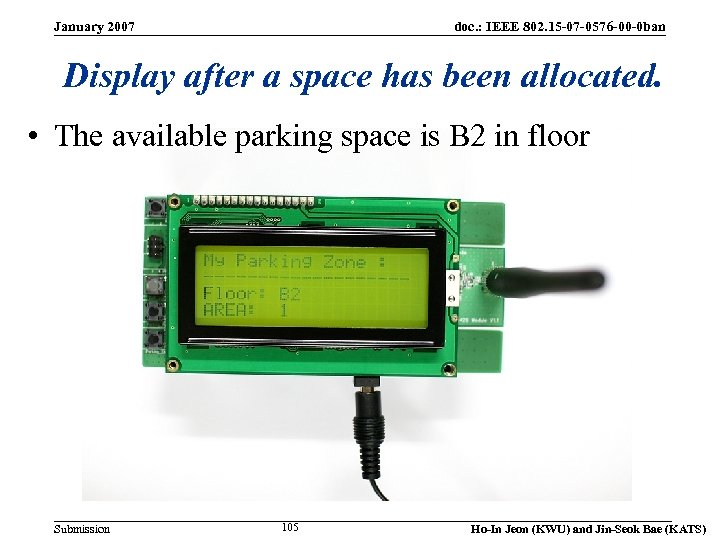 January 2007 doc. : IEEE 802. 15 -07 -0576 -00 -0 ban Display after a space has been allocated. • The available parking space is B 2 in floor Submission 105 Ho-In Jeon (KWU) and Jin-Seok Bae (KATS)
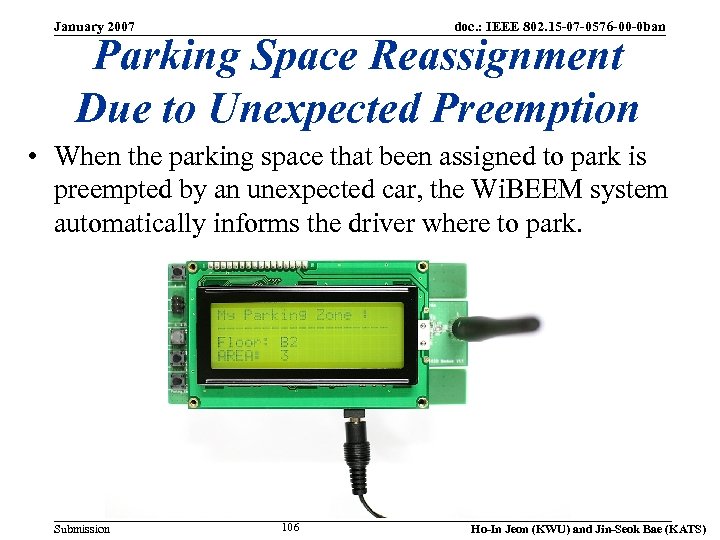 January 2007 doc. : IEEE 802. 15 -07 -0576 -00 -0 ban Parking Space Reassignment Due to Unexpected Preemption • When the parking space that been assigned to park is preempted by an unexpected car, the Wi. BEEM system automatically informs the driver where to park. Submission 106 Ho-In Jeon (KWU) and Jin-Seok Bae (KATS)
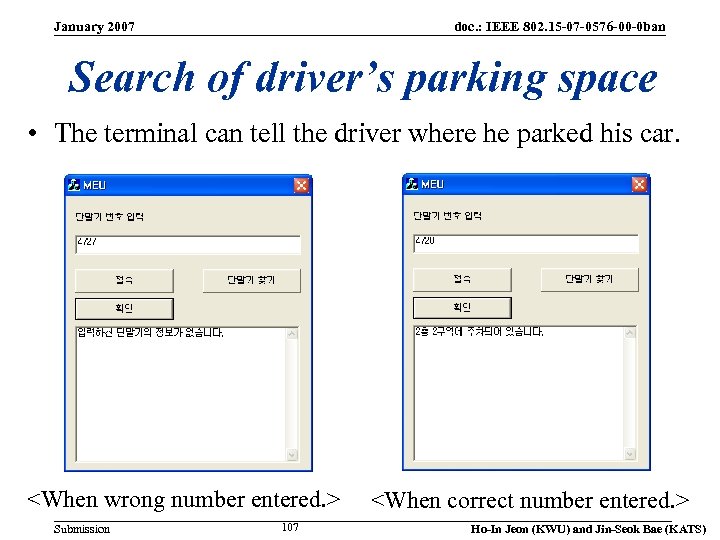 January 2007 doc. : IEEE 802. 15 -07 -0576 -00 -0 ban Search of driver’s parking space • The terminal can tell the driver where he parked his car.
 January 2007 doc. : IEEE 802. 15 -07 -0576 -00 -0 ban 5 C… Submission 108 Ho-In Jeon (KWU) and Jin-Seok Bae (KATS)
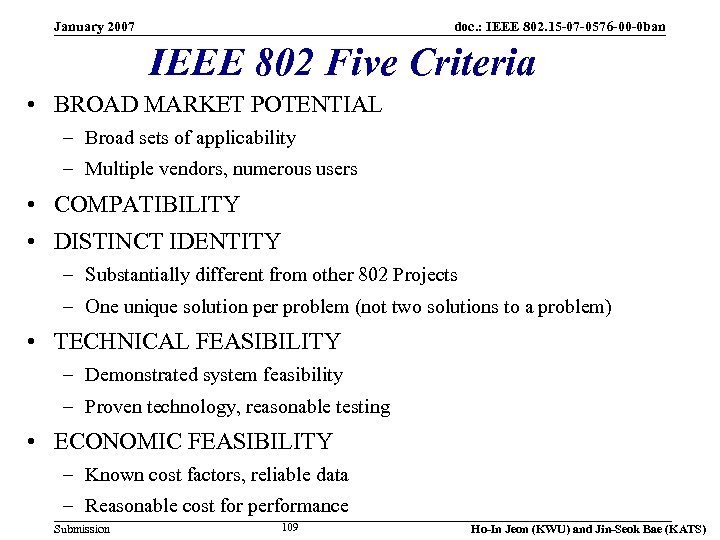 January 2007 doc. : IEEE 802. 15 -07 -0576 -00 -0 ban IEEE 802 Five Criteria • BROAD MARKET POTENTIAL – Broad sets of applicability – Multiple vendors, numerous users • COMPATIBILITY • DISTINCT IDENTITY – Substantially different from other 802 Projects – One unique solution per problem (not two solutions to a problem) • TECHNICAL FEASIBILITY – Demonstrated system feasibility – Proven technology, reasonable testing • ECONOMIC FEASIBILITY – Known cost factors, reliable data – Reasonable cost for performance Submission 109 Ho-In Jeon (KWU) and Jin-Seok Bae (KATS)
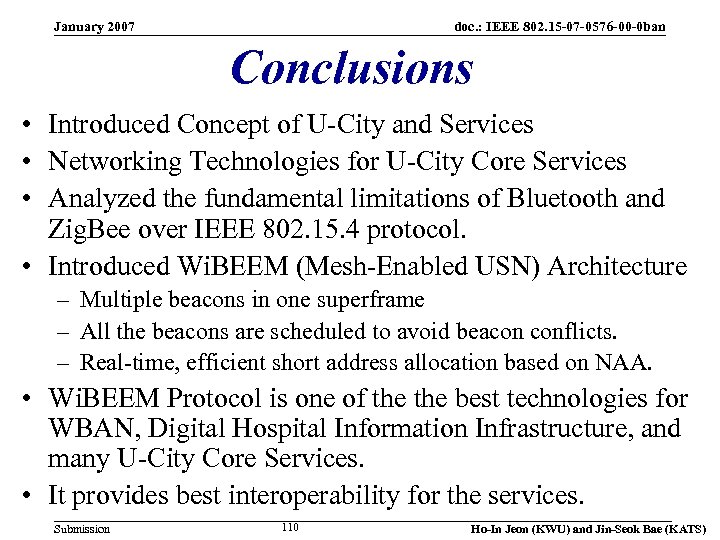 January 2007 doc. : IEEE 802. 15 -07 -0576 -00 -0 ban Conclusions • Introduced Concept of U-City and Services • Networking Technologies for U-City Core Services • Analyzed the fundamental limitations of Bluetooth and Zig. Bee over IEEE 802. 15. 4 protocol. • Introduced Wi. BEEM (Mesh-Enabled USN) Architecture – Multiple beacons in one superframe – All the beacons are scheduled to avoid beacon conflicts. – Real-time, efficient short address allocation based on NAA. • Wi. BEEM Protocol is one of the best technologies for WBAN, Digital Hospital Information Infrastructure, and many U-City Core Services. • It provides best interoperability for the services. Submission 110 Ho-In Jeon (KWU) and Jin-Seok Bae (KATS)
 January 2007 doc. : IEEE 802. 15 -07 -0576 -00 -0 ban Acknowledgment • This work has been supported by KATS. Submission 111 Ho-In Jeon (KWU) and Jin-Seok Bae (KATS)