


 Скачать презентацию January 2006 doc IEEE 802 22 -06 0009
f098a8dbdb38199bddd1dd31c9f7717a.ppt
- Количество слайдов: 192
 January 2006 doc. : IEEE 802. 22 -06/0009 r 0 A PHY/MAC Proposal for IEEE 802. 22 WRAN Systems IEEE P 802. 22 Wireless RANs Date: 2006 -01 -09 Authors: Name Company Address Phone Email Martial Bellec France Telecom France +33 -2 -99 -124806 Martial. bellec@francetelecom. com Yoon Chae Cheong SAIT Korea +82 -31 -280 -9501 Yc. cheong@samsung. com Carlos Cordeiro Philips USA +1 -914 -945 -6091 Carlos. Cordeiro@philips. com Chang-Joo Kim ETRI Korea +82 -42 -860 -1230 cjkim@etri. re. kr Hak-Sun Kim Samsung Electro-mechanics Korea +82 -31 -210 -3500 hszic. kim@samsung. com Joy Laskar Georgia Institute of Technology USA +1 -404 -894 -5268 joy. laskar@ece. gatech. edu Notice: This document has been prepared to assist IEEE 802. 22. It is offered as a basis for discussion and is not binding on the contributing individual(s) or organization(s). The material in this document is subject to change in form and content after further study. The contributor(s) reserve(s) the right to add, amend or withdraw material contained herein. Release: The contributor grants a free, irrevocable license to the IEEE to incorporate material contained in this contribution, and any modifications thereof, in the creation of an IEEE Standards publication; to copyright in the IEEE’s name any IEEE Standards publication even though it may include portions of this contribution; and at the IEEE’s sole discretion to permit others to reproduce in whole or in part the resulting IEEE Standards publication. The contributor also acknowledges and accepts that this contribution may be made public by IEEE 802. 22. Patent Policy and Procedures: The contributor is familiar with the IEEE 802 Patent Policy and Procedures http: //standards. ieee. org/guides/bylaws/sb-bylaws. pdf including the statement "IEEE standards may include the known use of patent(s), including patent applications, provided the IEEE receives assurance from the patent holder or applicant with respect to patents essential for compliance with both mandatory and optional portions of the standard. " Early disclosure to the Working Group of patent information that might be relevant to the standard is essential to reduce the possibility for delays in the development process and increase the likelihood that the draft publication will be approved for publication. Please notify the Chair Carl R. Stevenson as early as possible, in written or electronic form, if patented technology (or technology under patent application) might be incorporated into a draft standard being developed within the IEEE 802. 22 Working Group. If you have questions, contact the IEEE Patent Committee Administrator at patcom@iee. org. > Submission 1 Martial Belec, France Telecom
 January 2006 doc. : IEEE 802. 22 -06/0009 r 0 Co-Authors Name Company Address Phone email Myung-Sun Song ETRI Korea +82 -42 -860 -5046 mssong@etri. re. kr Soon-Ik Jeon ETRI Korea +82 -42 -860 -5947 sijeon@etri. re. kr Gwang-Zeen Ko ETRI Korea +82 -42 -860 -4862 gogogo@etri. re. kr Sung-Hyun Hwang ETRI Korea +82 -42 -860 -1133 shwang@etri. re. kr Soon-Soo Oh ETRI Korea +82 -42 -860 -4974 ssoh@etri. re. kr Bub-Joo Kang ETRI Korea +82 -42 -860 -5446 kbj 64370@etri. re. kr Chung Gu Kang ETRI Korea +82 -2 -3290 -3236 ccgkang@korea. ac. kr Kyung. Hi Chang ETRI Korea +82 -32 -860 -8422 khchang@inha. ac. kr Yoan Shin ETRI Korea +82 -2 -820 -0632 yashin@e. ssu. ac. kr Yun Hee Kim ETRI Korea +82 -31 -201 -3793 yheekim@khu. ac. kr Kyesan Lee ETRI Korea +82 -31 -2032 kyesan@khu. ac. kr Moon Ho Lee ETRI Korea +82 -63 -270 -2463 moonho@chonbuk. ac. kr Denis Callonnec France Telecom France +33 -4 -76 -764412 Denis. Callonnec@francetelecom. com Luis Escobar France Telecom France +33 -2 -45 -294622 Luis. Escobar@francetelecom. com Francois Marx France Telecom France +33 -4 -76 -764109 Francois. Marx@francetelecom. com Patrick Pirat France Telecom France +33 -2 -99 -124806 Ppirat. ext@francetelecom. com Submission 2 Martial Belec, France Telecom
 January 2006 doc. : IEEE 802. 22 -06/0009 r 0 Co-Authors Name Company Address Phone email Kyutae Lim Georgia Institute of Technology USA +1 -404 -385 -6008 ktlim @ece. gatech. edu Youngsik Hur Georgia Institute of Technology USA +1 -404 -385 -6008 yshur @ece. gatech. edu Dagnachew Birru Philips USA +1 -914 -945 -6401 Dagnachew. Birru@philips. com Kiran Challapali Philips USA +1 -914 -945 -6357 Kiran. Challapali@philips. com Vasanth Gaddam Philips USA +1 -914 -945 -6424 Vasanth. Gaddam@philips. com Monisha Ghosh Philips USA +1 -914 -945 -6415 Monisha. Ghosh@philips. com Gene Turkenich Philips USA +1 -914 -945 -6370 Gene. Turkenich@philips. com Duckdong Hwang SAIT Korea +82 31 280 9513 duckdong. hwang@samsung. com Ashish Pandharipande SAIT Korea +82 010 -6335 -7784 pashish@ieee. org Jeong Suk Lee Samsung Electro. Mechanics Korea +82 -31 -210 -3217 js 0305. lee@samsung. com Chang Ho Lee Samsung Electro. Mechanics Korea +82 -31 -210 -3217 changholee@samsung. com Wangmyong Woo Samsung Electro. Mechanics Korea +82 -31 -210 -3217 wmwoo@samsung. com Submission 3 Martial Belec, France Telecom
 January 2006 doc. : IEEE 802. 22 -06/0009 r 0 Co-Authors Name David Mazzarese Baowei Ji Submission Company Samsung Electronics Co. Ltd. Samsung Telecom America Address Phone Korea +82 10 3279 5210 USA +1 -972 -761 -7167 4 email d. mazzarese@samsung. com Baowei. ji@samsung. com Martial Belec, France Telecom
 January 2006 doc. : IEEE 802. 22 -06/0009 r 0 Presentation Outline • Introduction – A Glimpse of IEEE 802. 22 • The PHY Proposal • The MAC Proposal • Conclusions Submission 5 Martial Belec, France Telecom
 January 2006 doc. : IEEE 802. 22 -06/0009 r 0 Presentation Outline • Introduction – A Glimpse of IEEE 802. 22 • The PHY Proposal • The MAC Proposal • Conclusions Submission 6 Martial Belec, France Telecom
 January 2006 Submission doc. : IEEE 802. 22 -06/0009 r 0 7 Martial Belec, France Telecom
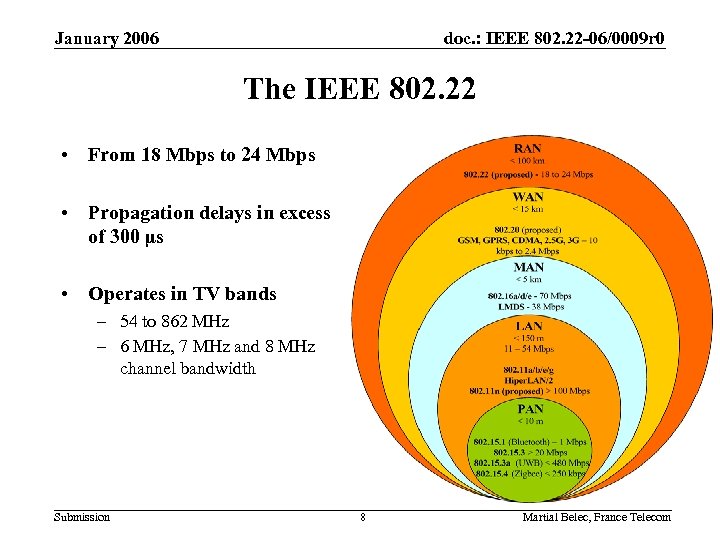 January 2006 doc. : IEEE 802. 22 -06/0009 r 0 The IEEE 802. 22 • From 18 Mbps to 24 Mbps • Propagation delays in excess of 300 µs • Operates in TV bands – 54 to 862 MHz – 6 MHz, 7 MHz and 8 MHz channel bandwidth Submission 8 Martial Belec, France Telecom
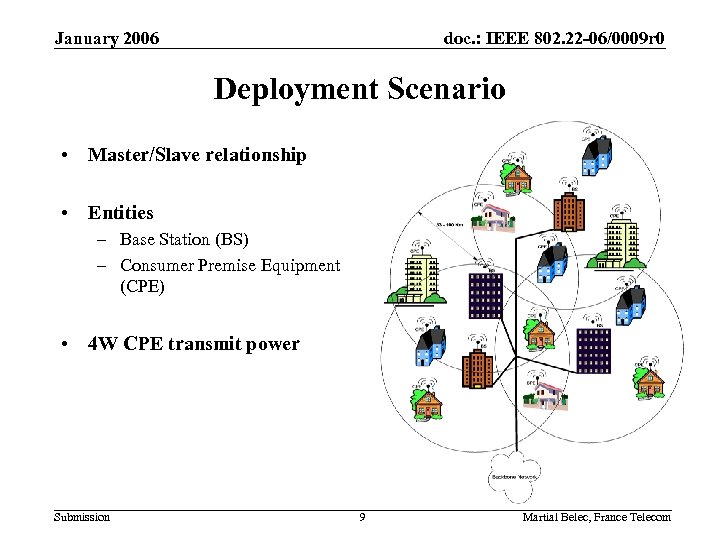 January 2006 doc. : IEEE 802. 22 -06/0009 r 0 Deployment Scenario • Master/Slave relationship • Entities – Base Station (BS) – Consumer Premise Equipment (CPE) • 4 W CPE transmit power Submission 9 Martial Belec, France Telecom
 January 2006 doc. : IEEE 802. 22 -06/0009 r 0 Presentation Outline • Introduction – A Glimpse of IEEE 802. 22 • The PHY Proposal • The MAC Proposal • Conclusions Submission 10 Martial Belec, France Telecom
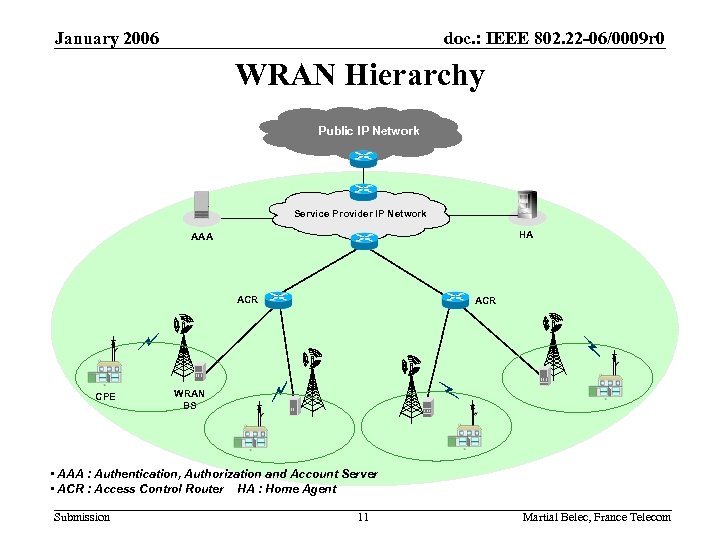 January 2006 doc. : IEEE 802. 22 -06/0009 r 0 WRAN Hierarchy Public IP Network Service Provider IP Network HA AAA ACR CPE ACR WRAN BS • AAA : Authentication, Authorization and Account Server • ACR : Access Control Router HA : Home Agent Submission 11 Martial Belec, France Telecom
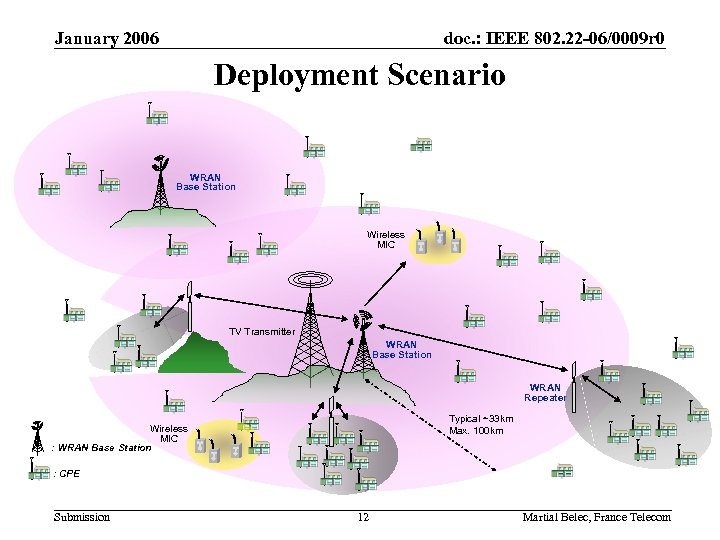 January 2006 doc. : IEEE 802. 22 -06/0009 r 0 Deployment Scenario WRAN Base Station Wireless MIC TV Transmitter WRAN Base Station WRAN Repeater Typical ~33 km Max. 100 km Wireless MIC : WRAN Base Station : CPE Submission 12 Martial Belec, France Telecom
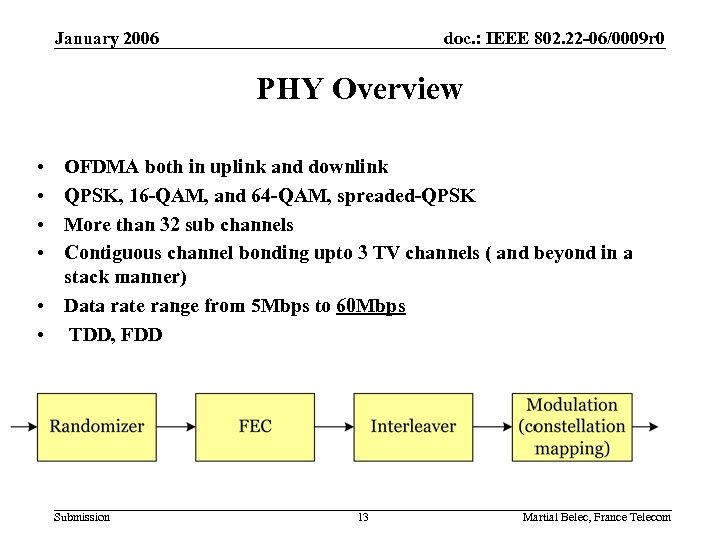 January 2006 doc. : IEEE 802. 22 -06/0009 r 0 PHY Overview • • OFDMA both in uplink and downlink QPSK, 16 -QAM, and 64 -QAM, spreaded-QPSK More than 32 sub channels Contiguous channel bonding upto 3 TV channels ( and beyond in a stack manner) • Data rate range from 5 Mbps to 60 Mbps • TDD, FDD Submission 13 Martial Belec, France Telecom
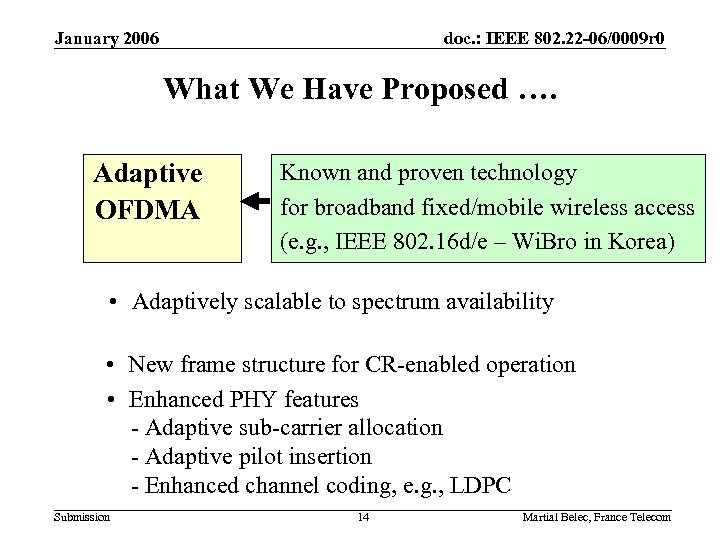 January 2006 doc. : IEEE 802. 22 -06/0009 r 0 What We Have Proposed …. Adaptive OFDMA Known and proven technology for broadband fixed/mobile wireless access (e. g. , IEEE 802. 16 d/e – Wi. Bro in Korea) • Adaptively scalable to spectrum availability • New frame structure for CR-enabled operation • Enhanced PHY features - Adaptive sub-carrier allocation - Adaptive pilot insertion - Enhanced channel coding, e. g. , LDPC Submission 14 Martial Belec, France Telecom
 January 2006 doc. : IEEE 802. 22 -06/0009 r 0 Advantages of Adaptive OFDMA Proposal • Flexible Bandwidth Allocation – To use the partial bandwidth (1, 2, 3, 4, 5, 6, 7, 8 MHz) adaptively, depending on the channel state information (availability) – To fully utilize available bandwidth under a unified PHY framework • Single Sampling Frequency – Sampling frequency is the same, i. e. , 64/7 MHz, for all FFT modes. • Constant Subcarrier Spacing – The subcarrier spacing is constant for all different channel bandwidths Robust to the frequency offset Submission 15 Martial Belec, France Telecom
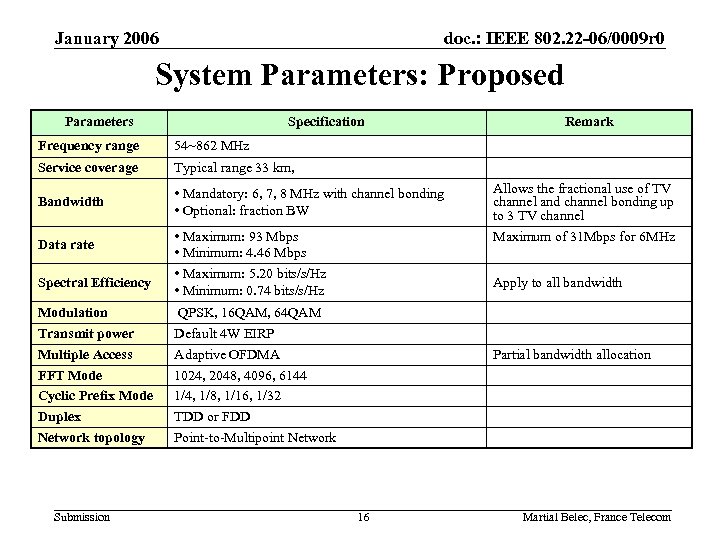 January 2006 doc. : IEEE 802. 22 -06/0009 r 0 System Parameters: Proposed Parameters Specification Frequency range 54~862 MHz Service coverage Typical range 33 km, Bandwidth • Mandatory: 6, 7, 8 MHz with channel bonding • Optional: fraction BW Remark Data rate Spectral Efficiency Modulation Transmit power Multiple Access FFT Mode Cyclic Prefix Mode Duplex Network topology Submission • Maximum: 93 Mbps • Minimum: 4. 46 Mbps • Maximum: 5. 20 bits/s/Hz • Minimum: 0. 74 bits/s/Hz QPSK, 16 QAM, 64 QAM Default 4 W EIRP Adaptive OFDMA 1024, 2048, 4096, 6144 1/4, 1/8, 1/16, 1/32 TDD or FDD Point-to-Multipoint Network Allows the fractional use of TV channel and channel bonding up to 3 TV channel Maximum of 31 Mbps for 6 MHz Apply to all bandwidth Partial bandwidth allocation 16 Martial Belec, France Telecom
 January 2006 doc. : IEEE 802. 22 -06/0009 r 0 Channel Bonding • More data rate • Multi-path Diversity – Small BW signal can have deep fade or flat fade – Wider-bandwidth signal provides more frequency/multipath diversity • Interference – Wider-band reduces the amount of interference Submission 17 Martial Belec, France Telecom
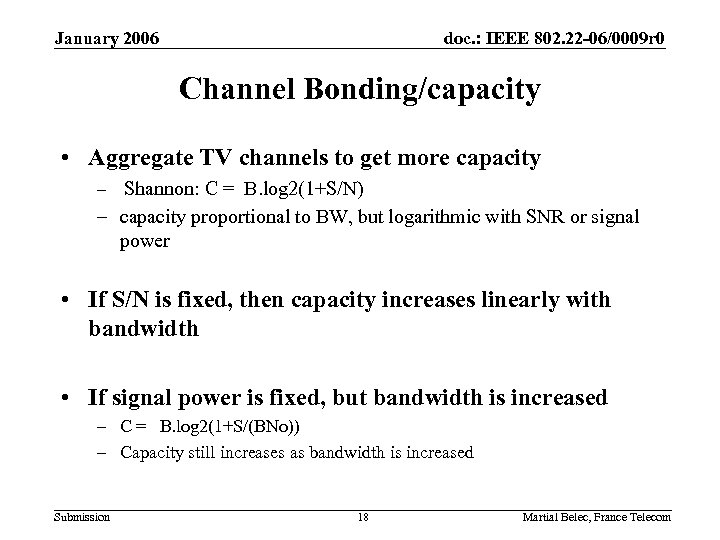 January 2006 doc. : IEEE 802. 22 -06/0009 r 0 Channel Bonding/capacity • Aggregate TV channels to get more capacity – Shannon: C = B. log 2(1+S/N) – capacity proportional to BW, but logarithmic with SNR or signal power • If S/N is fixed, then capacity increases linearly with bandwidth • If signal power is fixed, but bandwidth is increased – C = B. log 2(1+S/(BNo)) – Capacity still increases as bandwidth is increased Submission 18 Martial Belec, France Telecom
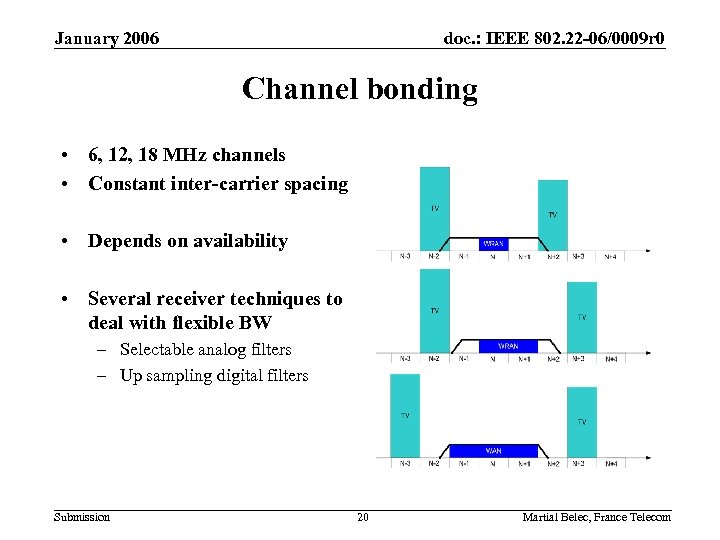 January 2006 doc. : IEEE 802. 22 -06/0009 r 0 Channel bonding • 6, 12, 18 MHz channels • Constant inter-carrier spacing • Depends on availability • Several receiver techniques to deal with flexible BW – Selectable analog filters – Up sampling digital filters Submission 20 Martial Belec, France Telecom
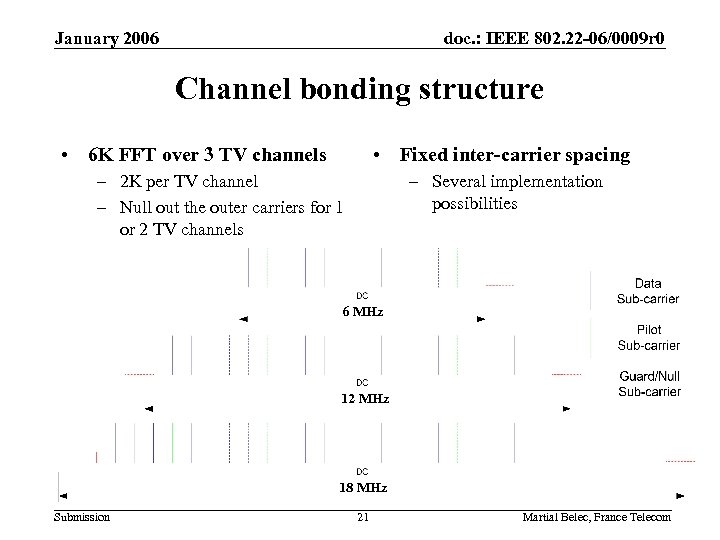 January 2006 doc. : IEEE 802. 22 -06/0009 r 0 Channel bonding structure • 6 K FFT over 3 TV channels • Fixed inter-carrier spacing – 2 K per TV channel – Null out the outer carriers for 1 or 2 TV channels – Several implementation possibilities 6 MHz 12 MHz 18 MHz Submission 21 Martial Belec, France Telecom
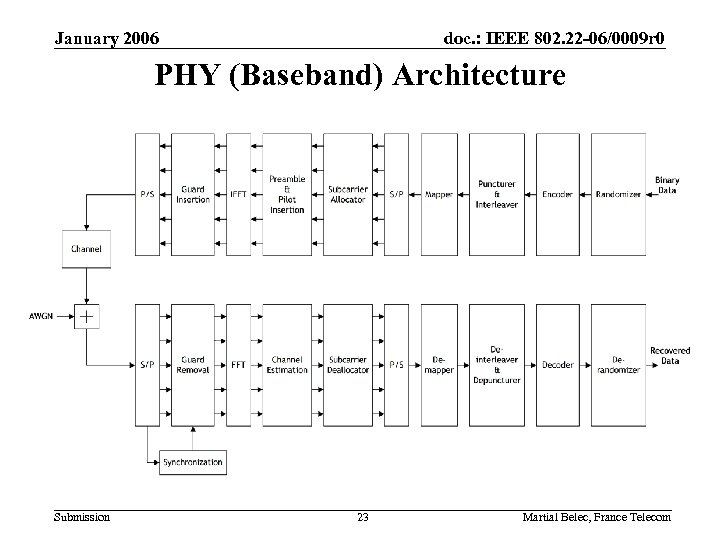 January 2006 doc. : IEEE 802. 22 -06/0009 r 0 PHY (Baseband) Architecture Submission 23 Martial Belec, France Telecom
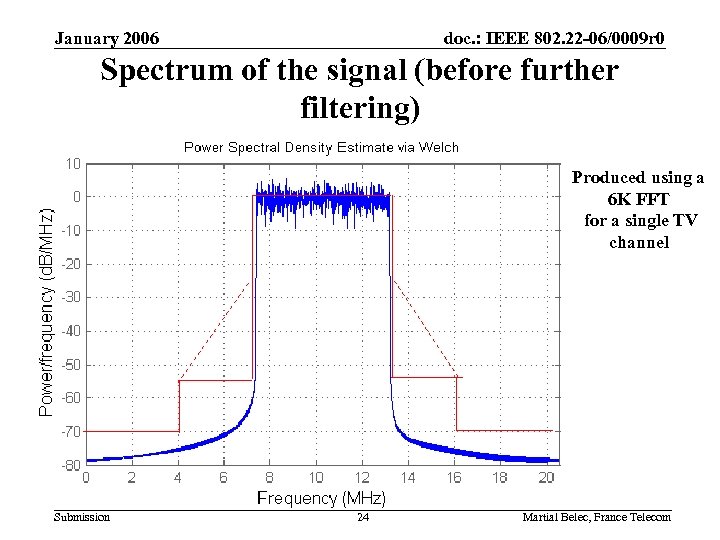 January 2006 doc. : IEEE 802. 22 -06/0009 r 0 Spectrum of the signal (before further filtering) Produced using a 6 K FFT for a single TV channel Submission 24 Martial Belec, France Telecom
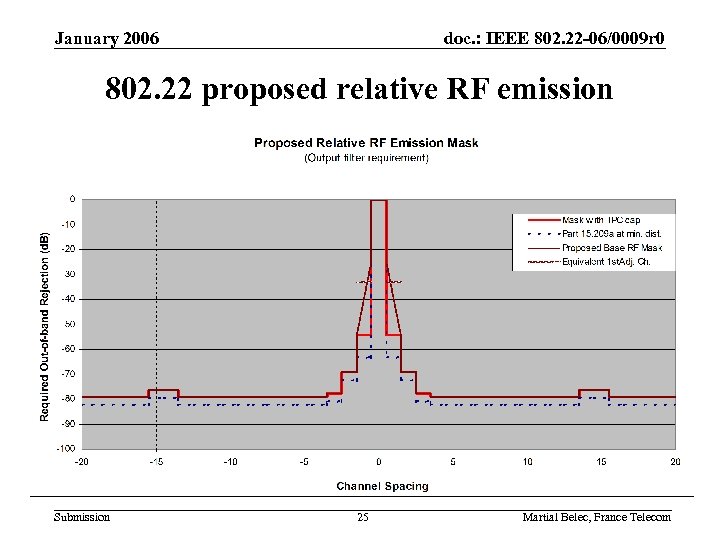 January 2006 doc. : IEEE 802. 22 -06/0009 r 0 802. 22 proposed relative RF emission Submission 25 Martial Belec, France Telecom
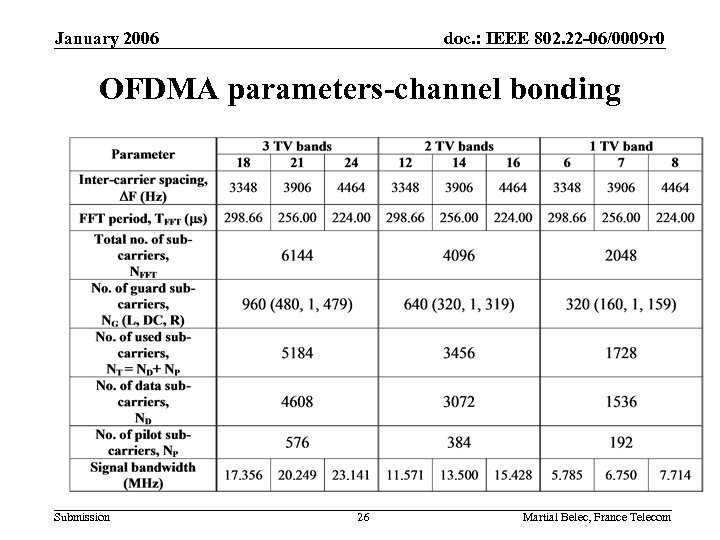 January 2006 doc. : IEEE 802. 22 -06/0009 r 0 OFDMA parameters-channel bonding Submission 26 Martial Belec, France Telecom
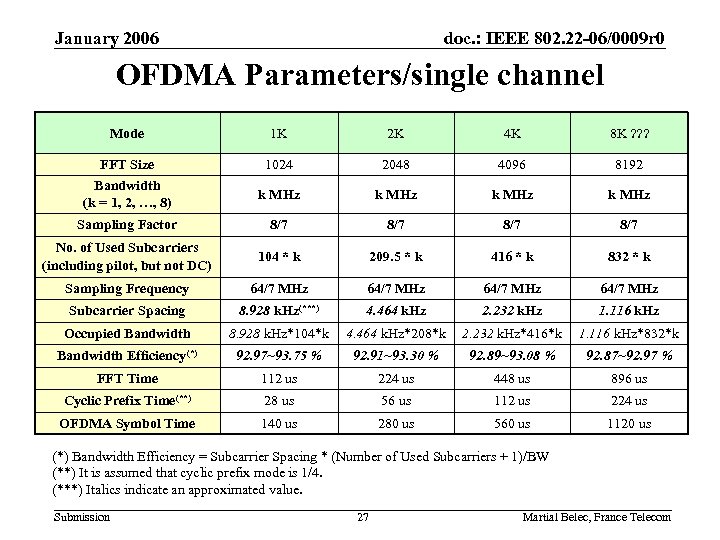 January 2006 doc. : IEEE 802. 22 -06/0009 r 0 OFDMA Parameters/single channel Mode 1 K 2 K 4 K 8 K ? ? ? FFT Size 1024 2048 4096 8192 Bandwidth (k = 1, 2, …, 8) k MHz Sampling Factor 8/7 8/7 No. of Used Subcarriers (including pilot, but not DC) 104 * k 209. 5 * k 416 * k 832 * k Sampling Frequency 64/7 MHz Subcarrier Spacing 8. 928 k. Hz(***) 4. 464 k. Hz 2. 232 k. Hz 1. 116 k. Hz Occupied Bandwidth 8. 928 k. Hz*104*k 4. 464 k. Hz*208*k 2. 232 k. Hz*416*k 1. 116 k. Hz*832*k Bandwidth Efficiency(*) 92. 97~93. 75 % 92. 91~93. 30 % 92. 89~93. 08 % 92. 87~92. 97 % FFT Time 112 us 224 us 448 us 896 us Cyclic Prefix Time(**) 28 us 56 us 112 us 224 us OFDMA Symbol Time 140 us 280 us 560 us 1120 us (*) Bandwidth Efficiency = Subcarrier Spacing * (Number of Used Subcarriers + 1)/BW (**) It is assumed that cyclic prefix mode is 1/4. (***) Italics indicate an approximated value. Submission 27 Martial Belec, France Telecom
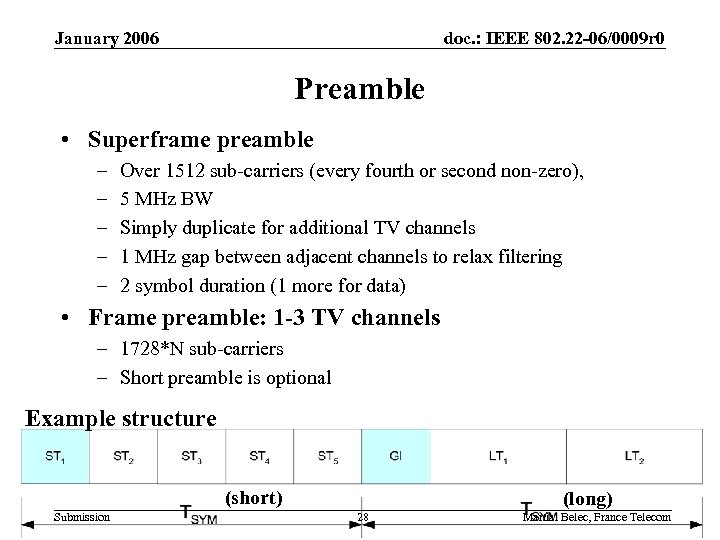 January 2006 doc. : IEEE 802. 22 -06/0009 r 0 Preamble • Superframe preamble – – – Over 1512 sub-carriers (every fourth or second non-zero), 5 MHz BW Simply duplicate for additional TV channels 1 MHz gap between adjacent channels to relax filtering 2 symbol duration (1 more for data) • Frame preamble: 1 -3 TV channels – 1728*N sub-carriers – Short preamble is optional Example structure (short) Submission (long) 28 Martial Belec, France Telecom
 January 2006 doc. : IEEE 802. 22 -06/0009 r 0 Preamble • Preamble has the repetition pattern in the time domain: – Time synchronization – Frequency synchronization – Channel estimation – Cell ID detection • Preamble is modulated using a boosted BPSK modulation Submission 29 Martial Belec, France Telecom
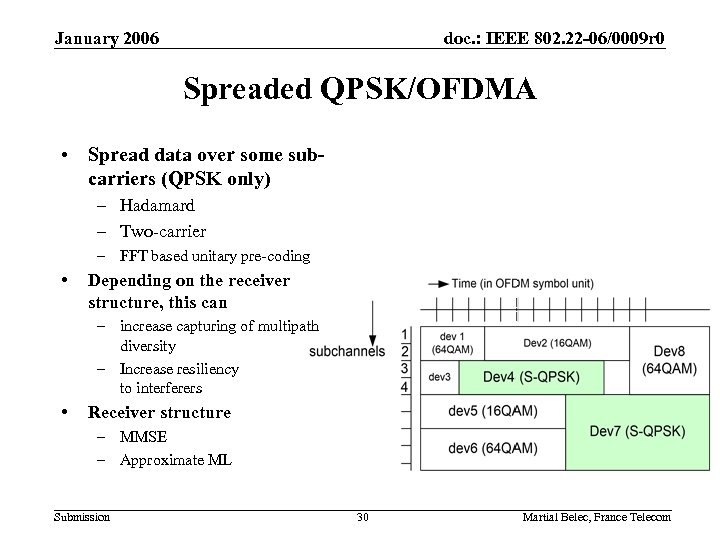 January 2006 doc. : IEEE 802. 22 -06/0009 r 0 Spreaded QPSK/OFDMA • Spread data over some subcarriers (QPSK only) – Hadamard – Two-carrier – FFT based unitary pre-coding • Depending on the receiver structure, this can – increase capturing of multipath diversity – Increase resiliency to interferers • Receiver structure – MMSE – Approximate ML Submission 30 Martial Belec, France Telecom
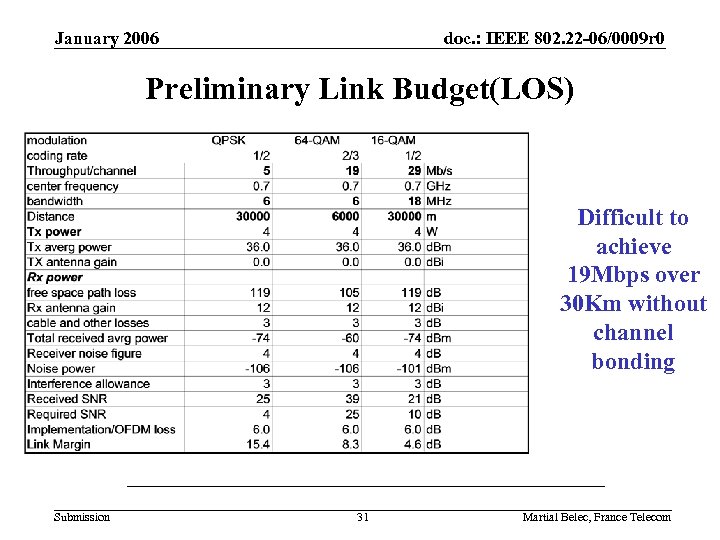 January 2006 doc. : IEEE 802. 22 -06/0009 r 0 Preliminary Link Budget(LOS) Difficult to achieve 19 Mbps over 30 Km without channel bonding Submission 31 Martial Belec, France Telecom
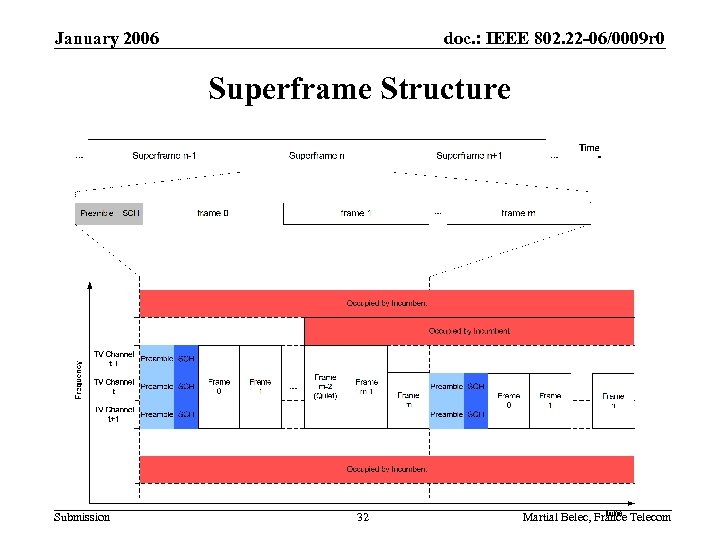 January 2006 doc. : IEEE 802. 22 -06/0009 r 0 Superframe Structure Submission 32 Martial Belec, France Telecom
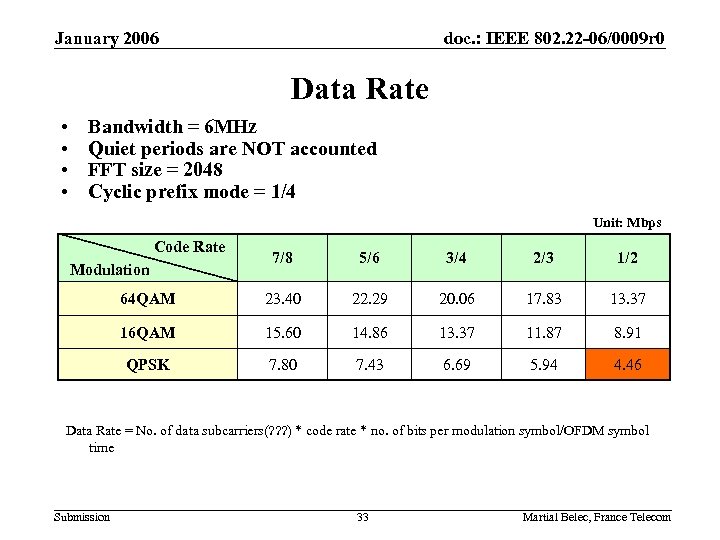 January 2006 doc. : IEEE 802. 22 -06/0009 r 0 Data Rate • • Bandwidth = 6 MHz Quiet periods are NOT accounted FFT size = 2048 Cyclic prefix mode = 1/4 Unit: Mbps Code Rate 7/8 5/6 3/4 2/3 1/2 64 QAM 23. 40 22. 29 20. 06 17. 83 13. 37 16 QAM 15. 60 14. 86 13. 37 11. 87 8. 91 QPSK 7. 80 7. 43 6. 69 5. 94 4. 46 Modulation Data Rate = No. of data subcarriers(? ? ? ) * code rate * no. of bits per modulation symbol/OFDM symbol time Submission 33 Martial Belec, France Telecom
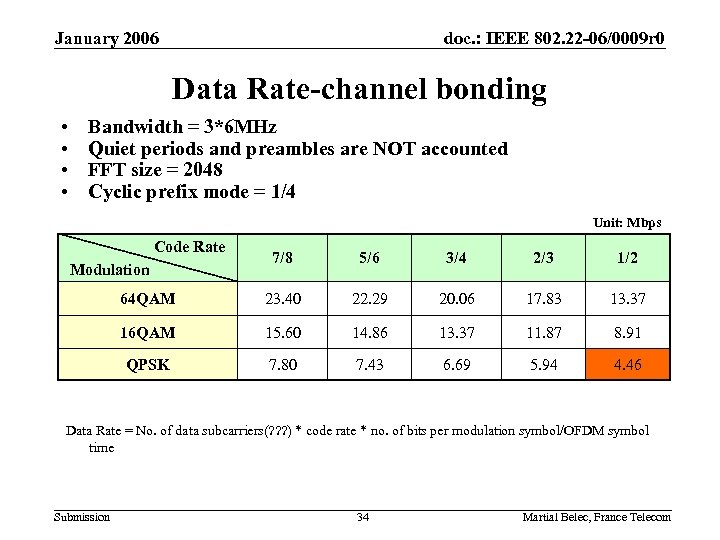 January 2006 doc. : IEEE 802. 22 -06/0009 r 0 Data Rate-channel bonding • • Bandwidth = 3*6 MHz Quiet periods and preambles are NOT accounted FFT size = 2048 Cyclic prefix mode = 1/4 Unit: Mbps Code Rate 7/8 5/6 3/4 2/3 1/2 64 QAM 23. 40 22. 29 20. 06 17. 83 13. 37 16 QAM 15. 60 14. 86 13. 37 11. 87 8. 91 QPSK 7. 80 7. 43 6. 69 5. 94 4. 46 Modulation Data Rate = No. of data subcarriers(? ? ? ) * code rate * no. of bits per modulation symbol/OFDM symbol time Submission 34 Martial Belec, France Telecom
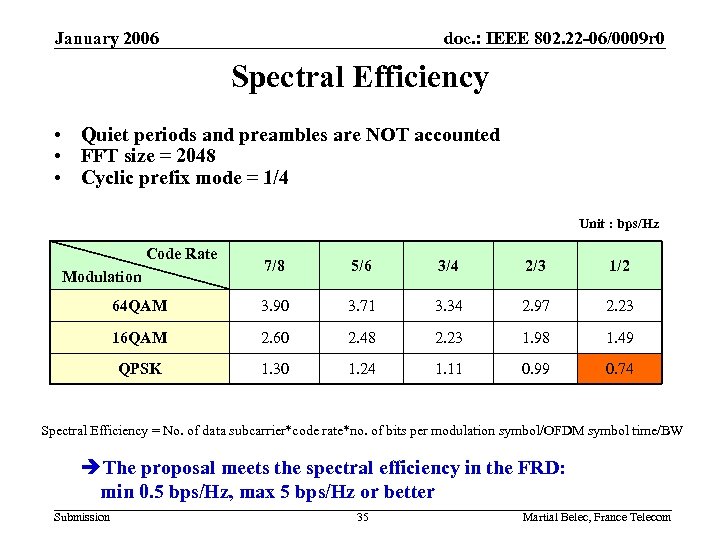 January 2006 doc. : IEEE 802. 22 -06/0009 r 0 Spectral Efficiency • Quiet periods and preambles are NOT accounted • FFT size = 2048 • Cyclic prefix mode = 1/4 Unit : bps/Hz Code Rate 7/8 5/6 3/4 2/3 1/2 64 QAM 3. 90 3. 71 3. 34 2. 97 2. 23 16 QAM 2. 60 2. 48 2. 23 1. 98 1. 49 QPSK 1. 30 1. 24 1. 11 0. 99 0. 74 Modulation Spectral Efficiency = No. of data subcarrier*code rate*no. of bits per modulation symbol/OFDM symbol time/BW The proposal meets the spectral efficiency in the FRD: min 0. 5 bps/Hz, max 5 bps/Hz or better Submission 35 Martial Belec, France Telecom
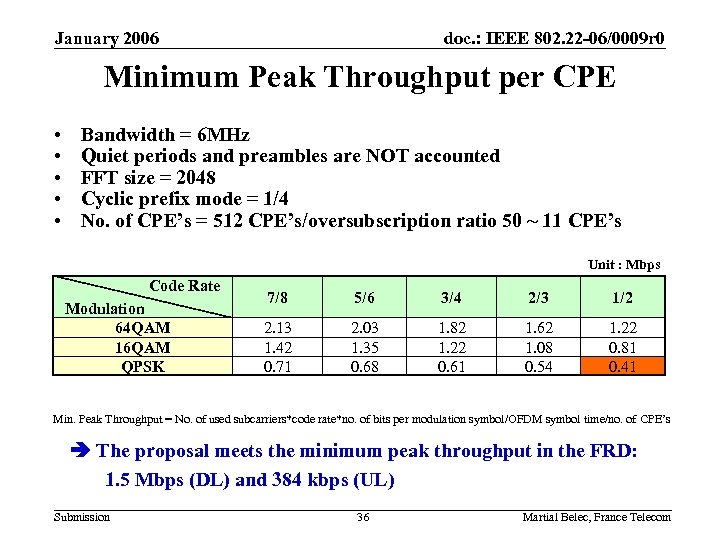 January 2006 doc. : IEEE 802. 22 -06/0009 r 0 Minimum Peak Throughput per CPE • • • Bandwidth = 6 MHz Quiet periods and preambles are NOT accounted FFT size = 2048 Cyclic prefix mode = 1/4 No. of CPE’s = 512 CPE’s/oversubscription ratio 50 ~ 11 CPE’s Unit : Mbps Code Rate Modulation 64 QAM 16 QAM QPSK 7/8 5/6 3/4 2/3 1/2 2. 13 1. 42 0. 71 2. 03 1. 35 0. 68 1. 82 1. 22 0. 61 1. 62 1. 08 0. 54 1. 22 0. 81 0. 41 Min. Peak Throughput = No. of used subcarriers*code rate*no. of bits per modulation symbol/OFDM symbol time/no. of CPE’s The proposal meets the minimum peak throughput in the FRD: 1. 5 Mbps (DL) and 384 kbps (UL) Submission 36 Martial Belec, France Telecom
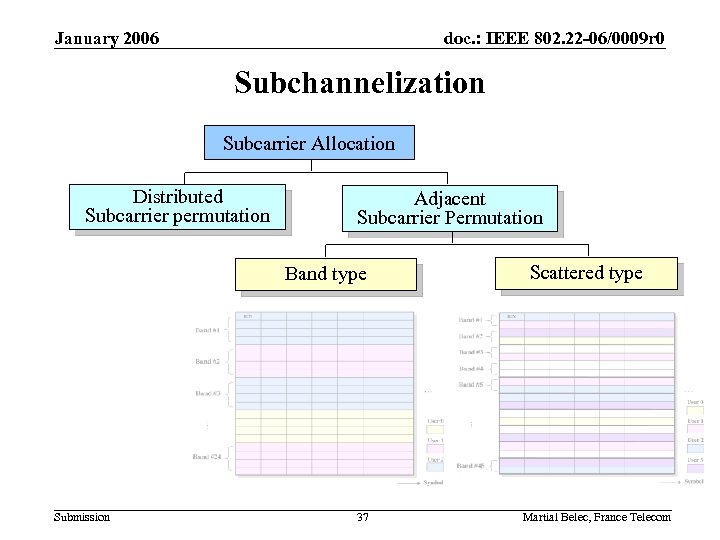 January 2006 doc. : IEEE 802. 22 -06/0009 r 0 Subchannelization Subcarrier Allocation Distributed Subcarrier permutation Adjacent Subcarrier Permutation Band type Submission 37 Scattered type Martial Belec, France Telecom
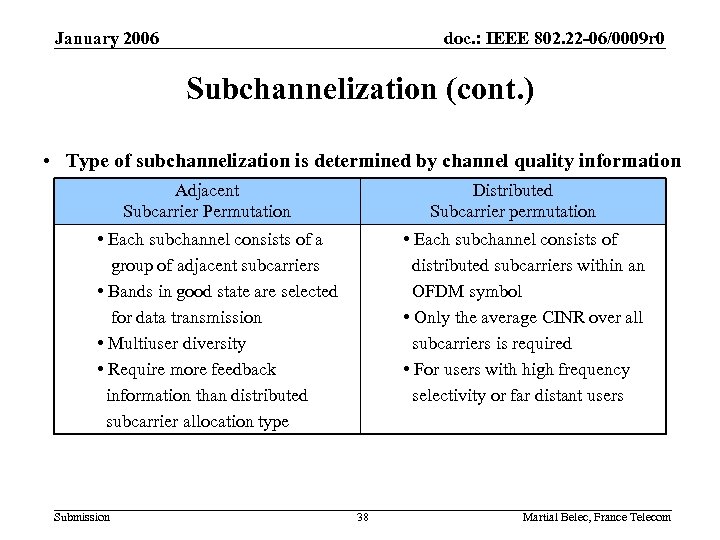 January 2006 doc. : IEEE 802. 22 -06/0009 r 0 Subchannelization (cont. ) • Type of subchannelization is determined by channel quality information Adjacent Subcarrier Permutation Distributed Subcarrier permutation • Each subchannel consists of a group of adjacent subcarriers • Bands in good state are selected for data transmission • Multiuser diversity • Require more feedback information than distributed subcarrier allocation type Submission • Each subchannel consists of distributed subcarriers within an OFDM symbol • Only the average CINR over all subcarriers is required • For users with high frequency selectivity or far distant users 38 Martial Belec, France Telecom
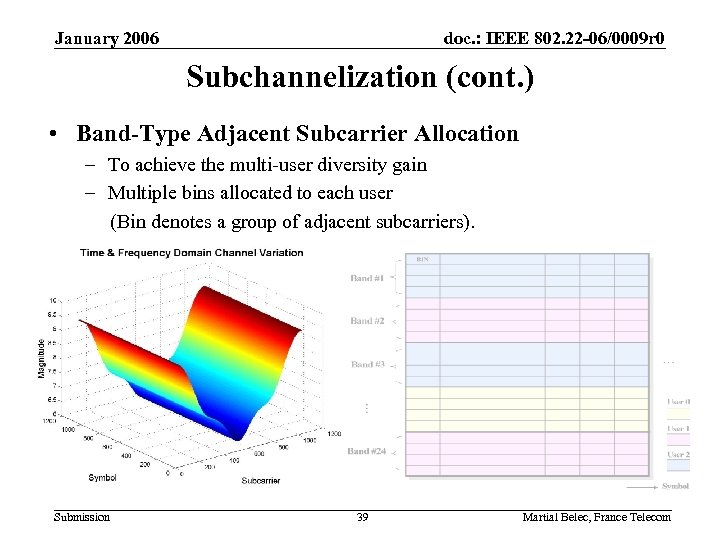 January 2006 doc. : IEEE 802. 22 -06/0009 r 0 Subchannelization (cont. ) • Band-Type Adjacent Subcarrier Allocation – To achieve the multi-user diversity gain – Multiple bins allocated to each user (Bin denotes a group of adjacent subcarriers). Submission 39 Martial Belec, France Telecom
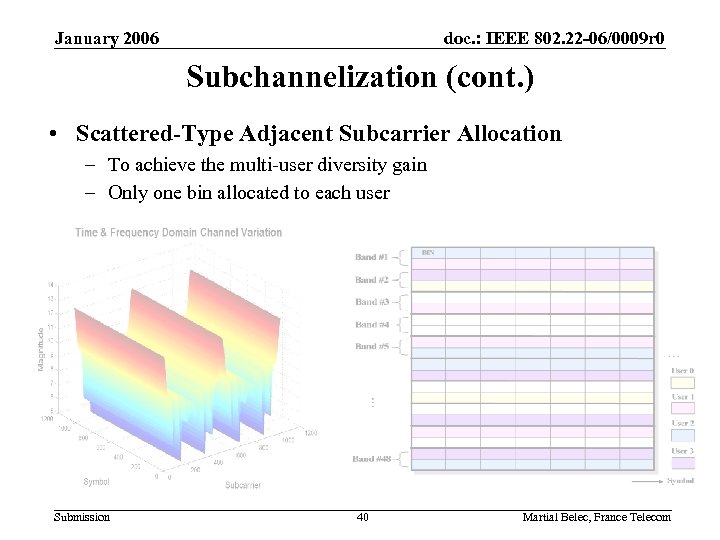 January 2006 doc. : IEEE 802. 22 -06/0009 r 0 Subchannelization (cont. ) • Scattered-Type Adjacent Subcarrier Allocation – To achieve the multi-user diversity gain – Only one bin allocated to each user Submission 40 Martial Belec, France Telecom
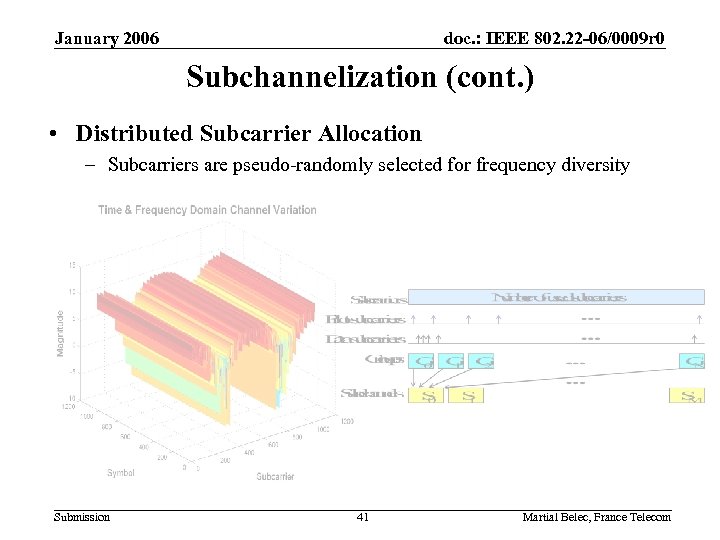 January 2006 doc. : IEEE 802. 22 -06/0009 r 0 Subchannelization (cont. ) • Distributed Subcarrier Allocation – Subcarriers are pseudo-randomly selected for frequency diversity Submission 41 Martial Belec, France Telecom
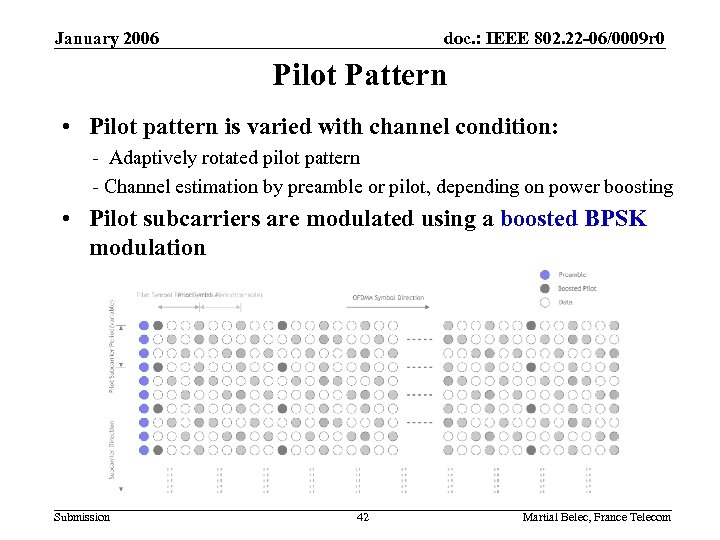 January 2006 doc. : IEEE 802. 22 -06/0009 r 0 Pilot Pattern • Pilot pattern is varied with channel condition: - Adaptively rotated pilot pattern - Channel estimation by preamble or pilot, depending on power boosting • Pilot subcarriers are modulated using a boosted BPSK modulation Submission 42 Martial Belec, France Telecom
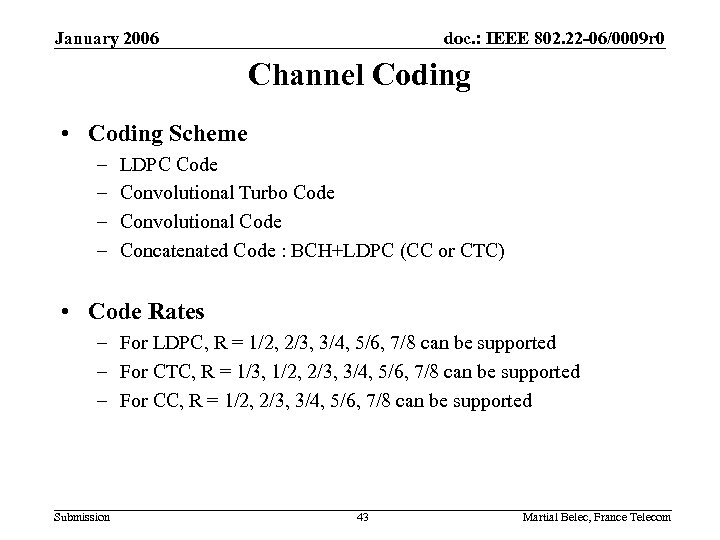 January 2006 doc. : IEEE 802. 22 -06/0009 r 0 Channel Coding • Coding Scheme – – LDPC Code Convolutional Turbo Code Convolutional Code Concatenated Code : BCH+LDPC (CC or CTC) • Code Rates – For LDPC, R = 1/2, 2/3, 3/4, 5/6, 7/8 can be supported – For CTC, R = 1/3, 1/2, 2/3, 3/4, 5/6, 7/8 can be supported – For CC, R = 1/2, 2/3, 3/4, 5/6, 7/8 can be supported Submission 43 Martial Belec, France Telecom
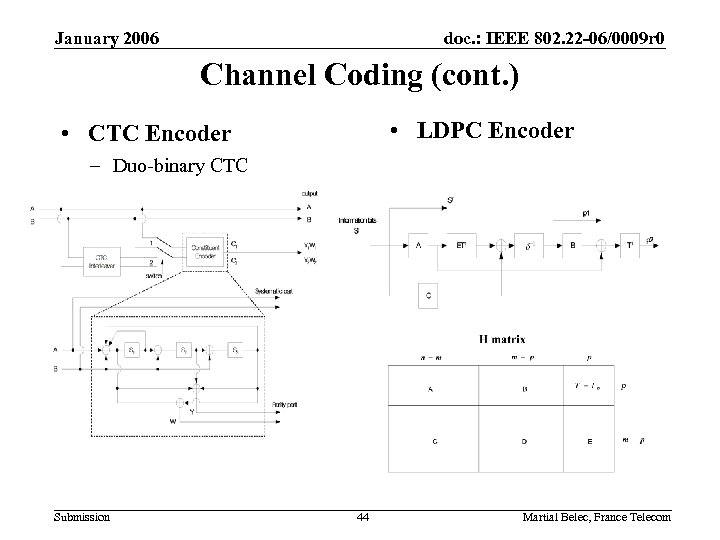 January 2006 doc. : IEEE 802. 22 -06/0009 r 0 Channel Coding (cont. ) • LDPC Encoder • CTC Encoder – Duo-binary CTC Submission 44 Martial Belec, France Telecom
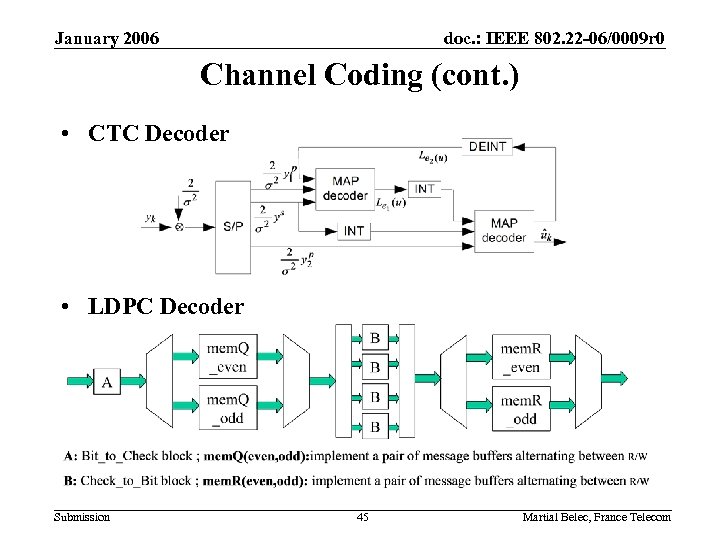 January 2006 doc. : IEEE 802. 22 -06/0009 r 0 Channel Coding (cont. ) • CTC Decoder • LDPC Decoder Submission 45 Martial Belec, France Telecom
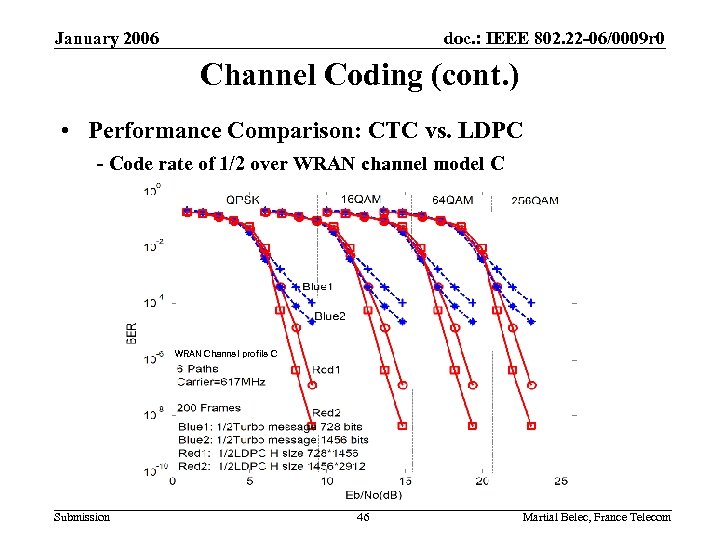 January 2006 doc. : IEEE 802. 22 -06/0009 r 0 Channel Coding (cont. ) • Performance Comparison: CTC vs. LDPC - Code rate of 1/2 over WRAN channel model C WRAN Channel profile C Submission 46 Martial Belec, France Telecom
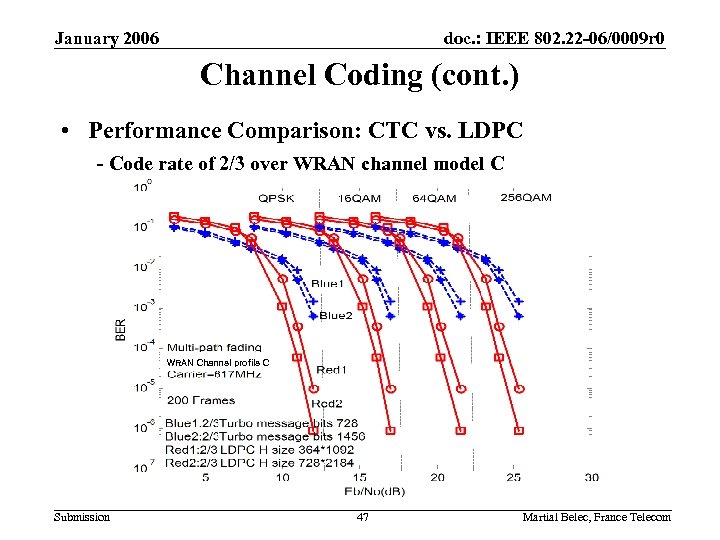 January 2006 doc. : IEEE 802. 22 -06/0009 r 0 Channel Coding (cont. ) • Performance Comparison: CTC vs. LDPC - Code rate of 2/3 over WRAN channel model C WRAN Channel profile C Submission 47 Martial Belec, France Telecom
 January 2006 doc. : IEEE 802. 22 -06/0009 r 0 Duo-binary Turbo-codes Outline • Duo-Binary Turbo Codes • Internal interleaver • Flexibility • Performance • Simulations Submission 48 Martial Belec, France Telecom
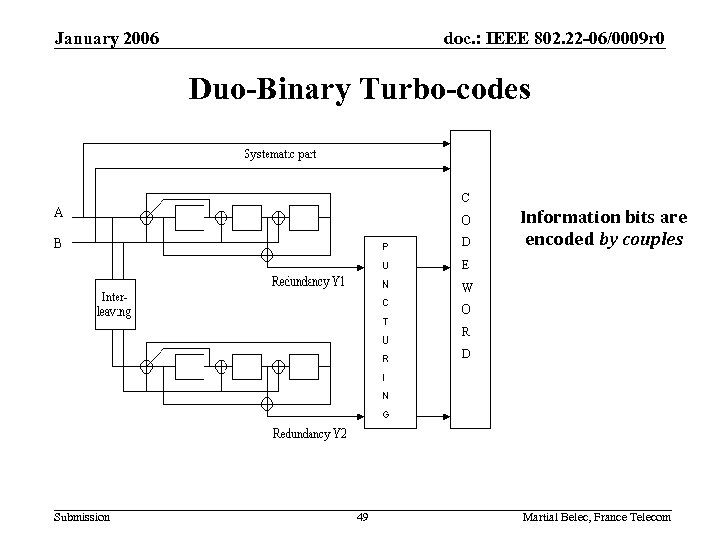 January 2006 doc. : IEEE 802. 22 -06/0009 r 0 Duo-Binary Turbo-codes Information bits are encoded by couples Submission 49 Martial Belec, France Telecom
 January 2006 doc. : IEEE 802. 22 -06/0009 r 0 Duo-Binary Turbo-code • Duo-Binary input: two decoded bit output at a time – Reduction of latency and complexity per decoded bit (compared to Binary TC) – Better convergence • Circular (tail-biting) encoding – No trellis termination overhead • Original interleaving scheme – Larger minimum distances – Improved asymptotic performances Submission 50 Martial Belec, France Telecom
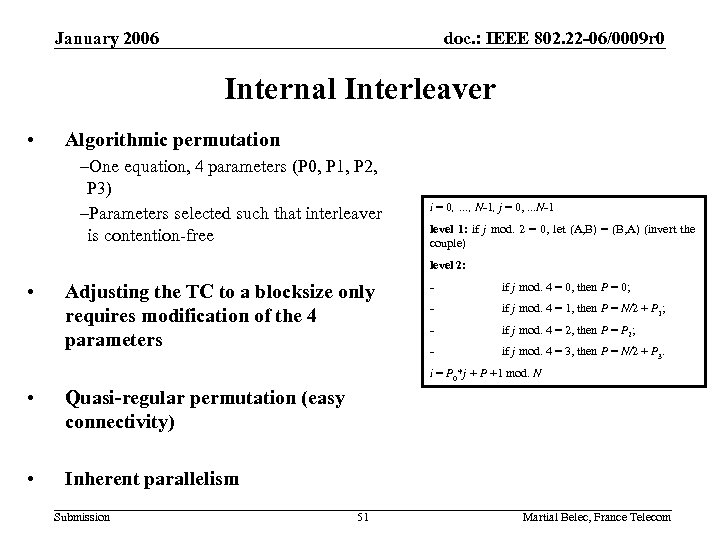 January 2006 doc. : IEEE 802. 22 -06/0009 r 0 Internal Interleaver • Algorithmic permutation –One equation, 4 parameters (P 0, P 1, P 2, P 3) –Parameters selected such that interleaver is contention-free i = 0, …, N-1, j = 0, . . . N-1 level 1: if j mod. 2 = 0, let (A, B) = (B, A) (invert the couple) level 2: • Adjusting the TC to a blocksize only requires modification of the 4 parameters - if j mod. 4 = 0, then P = 0; - if j mod. 4 = 1, then P = N/2 + P 1; - if j mod. 4 = 2, then P = P 2; - if j mod. 4 = 3, then P = N/2 + P 3. i = P 0*j + P +1 mod. N • Quasi-regular permutation (easy connectivity) • Inherent parallelism Submission 51 Martial Belec, France Telecom
 January 2006 doc. : IEEE 802. 22 -06/0009 r 0 Flexibility • Can be easily adjusted to any blocksize –Storage of the 4 parameters for all blocksizes considered –Possibility of a generic approach (default parameters) • All coding rates are possible –Through puncturing patterns –Natural coding rate is ½: increased robustness to puncturing • Performance vs complexity: several adjustments are possible –Number of iterations, Decoding algorithm, … • Implementation: interleaver enables different degrees of parallelism –Can be adjusted to meet complexity/throughput requirements Submission 52 Martial Belec, France Telecom
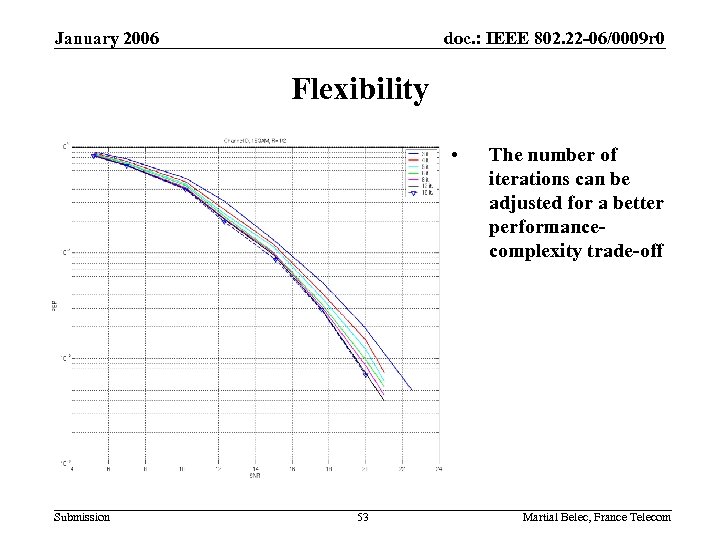 January 2006 doc. : IEEE 802. 22 -06/0009 r 0 Flexibility • Submission 53 The number of iterations can be adjusted for a better performancecomplexity trade-off Martial Belec, France Telecom
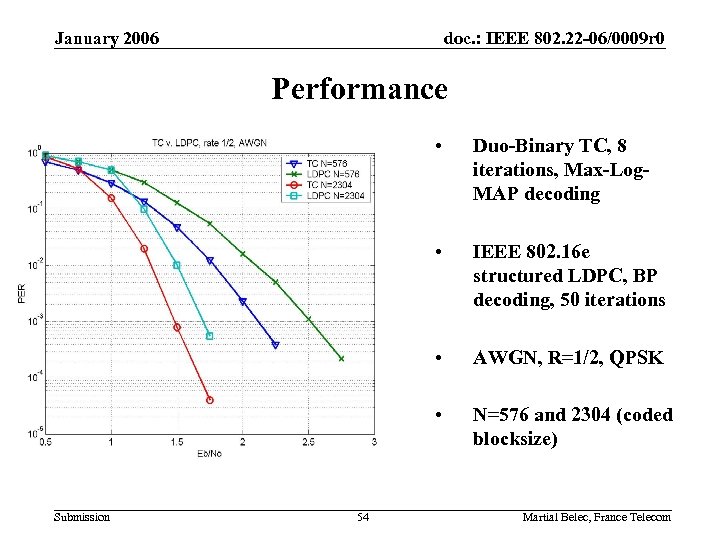 January 2006 doc. : IEEE 802. 22 -06/0009 r 0 Performance • • AWGN, R=1/2, QPSK • 54 IEEE 802. 16 e structured LDPC, BP decoding, 50 iterations • Submission Duo-Binary TC, 8 iterations, Max-Log. MAP decoding N=576 and 2304 (coded blocksize) Martial Belec, France Telecom
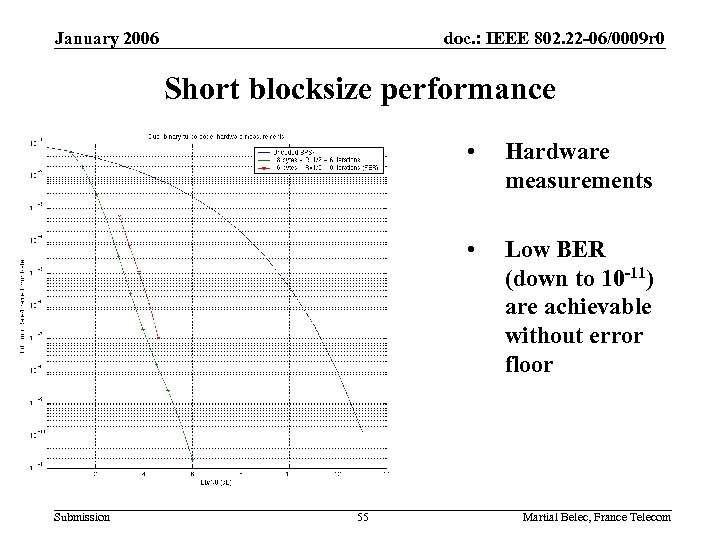 January 2006 doc. : IEEE 802. 22 -06/0009 r 0 Short blocksize performance • • Submission 55 Hardware measurements Low BER (down to 10 -11) are achievable without error floor Martial Belec, France Telecom
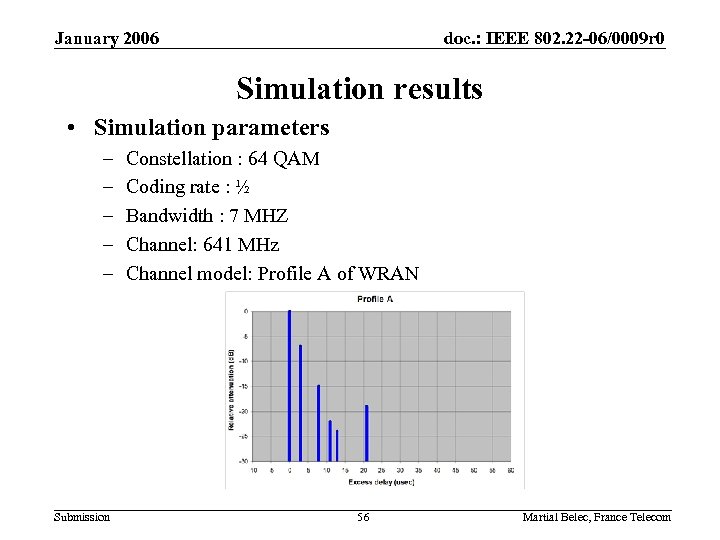 January 2006 doc. : IEEE 802. 22 -06/0009 r 0 Simulation results • Simulation parameters – – – Submission Constellation : 64 QAM Coding rate : ½ Bandwidth : 7 MHZ Channel: 641 MHz Channel model: Profile A of WRAN 56 Martial Belec, France Telecom
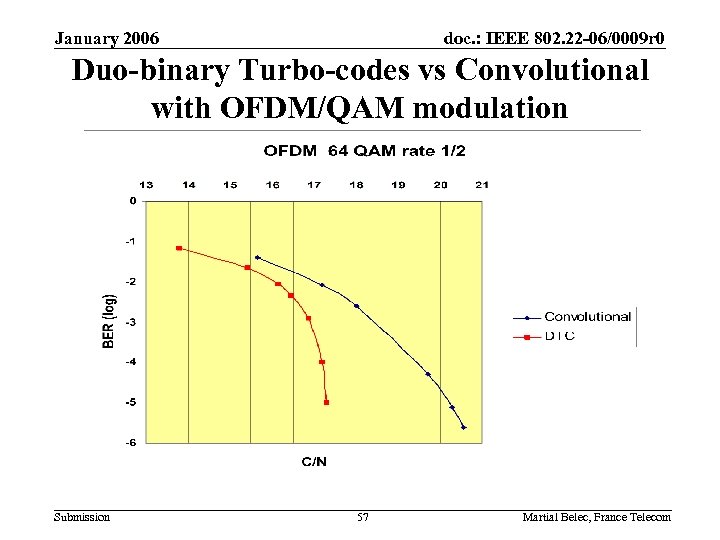 January 2006 doc. : IEEE 802. 22 -06/0009 r 0 Duo-binary Turbo-codes vs Convolutional with OFDM/QAM modulation Submission 57 Martial Belec, France Telecom
 January 2006 doc. : IEEE 802. 22 -06/0009 r 0 Advantages of Duo-binary Turbo-codes • Good performance for a very wide range of blocksizes • Highly flexible scheme, enabling a very fine granularity – Same encoder/decoder for all blocksizes/coding rates. – Several trade-off in performance (number of iterations, decoding algorithm), implementation complexity (degrees of parallelism). • Reasonable complexity – Approximately 35% decrease in complexity per decoded bit compared to Binary TC. Submission 58 Martial Belec, France Telecom
 January 2006 doc. : IEEE 802. 22 -06/0009 r 0 State of the art • Duo-binary Turbo-code is a mature technology • This technology has already been selected by several standardization groups – – Submission IEEE 802. 16 / Wi. MAX; DVB-RCS; DVB-RCT; ETSI HIPERMAN 59 Martial Belec, France Telecom
 January 2006 doc. : IEEE 802. 22 -06/0009 r 0 Summary: Gains brought by DTC • Duo-binary TC offers 3, 5 to 4 d. B • When combined the gain is at least 4, 5 d. B that allows to increase the radius by 7, 6 km (17%) with QPSK modulation in a Gaussian channel. Submission 60 Martial Belec, France Telecom
 January 2006 doc. : IEEE 802. 22 -06/0009 r 0 Transmit Diversity • • • Multiple antennae needed only at the base station. CPE has only one transmit/receive chain. Downlink uses transmit diversity methods. Uplink uses receive diversity for combining. Rate/ range increase for all CPEs with additional complexity only at the base-station. • Especially useful where channel-bonding cannot be used for increased capacity. Submission 61 Martial Belec, France Telecom
 January 2006 doc. : IEEE 802. 22 -06/0009 r 0 Multiple Antenna Techniques for 802. 22 Systems: STBC • Why STBC schemes for 802. 22 systems? – – Easily increase spectral efficiency by utilizing transmit diversity gain Simple detection algorithm unlike the SM Techniques No limit on the number of Rx antennas ==> high flexibility No increase in hardware complexity: the same antennas for receive diversity at BS can be used – Significantly increase cell radius • STBC Schemes – Orthogonal code algorithms: Alamouti’s scheme (2 Tx), Tarokh’s scheme (3, 4 Tx) – Quasi-orthogonal code algorithm (4 Tx), etc. – Considering the spectrum band for 802. 22 systems, the Alamouti scheme employing two TX antennas seems most attractive. Submission 62 Martial Belec, France Telecom
 January 2006 doc. : IEEE 802. 22 -06/0009 r 0 Multiple Antenna Techniques for 802. 22 Systems: Adaptive BF • Why adaptive beam-forming for 802. 22 systems? – Adaptive beam-forming can mitigate the effect of co-channel interference (CCI) inherent to OFDMA systems, thereby increasing frequency reuse factor close to unity. – Since all CPE’s are fixed at known locations, their directions-of- arrival (DOA’s) may easily be obtained and incorporated for adaptive beamforming without need to be tracked. – Large cell in 802. 22 networks also makes beam-forming problem simple from 2 D to 1 D problem: easy DOA estimation (if necessary) or beamforming using a simple array. – In conjunction with the transmit diversity in the forward link and/or receive diversity in the reverse link, adaptive beam-forming may significantly increase cell radius, as required for 802. 22 systems. – Adaptive beam-forming also significantly reduces multi-path delay spread, which enhances system efficiency. Submission 63 Martial Belec, France Telecom
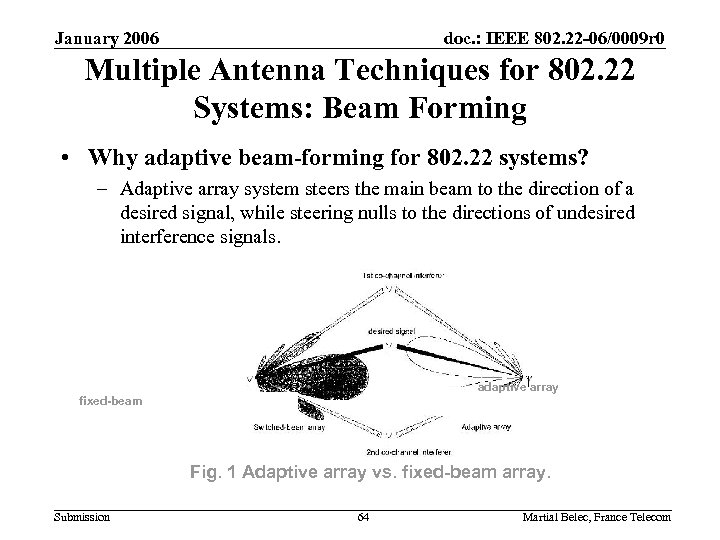 January 2006 doc. : IEEE 802. 22 -06/0009 r 0 Multiple Antenna Techniques for 802. 22 Systems: Beam Forming • Why adaptive beam-forming for 802. 22 systems? – Adaptive array system steers the main beam to the direction of a desired signal, while steering nulls to the directions of undesired interference signals. adaptive array fixed-beam Fig. 1 Adaptive array vs. fixed-beam array. Submission 64 Martial Belec, France Telecom
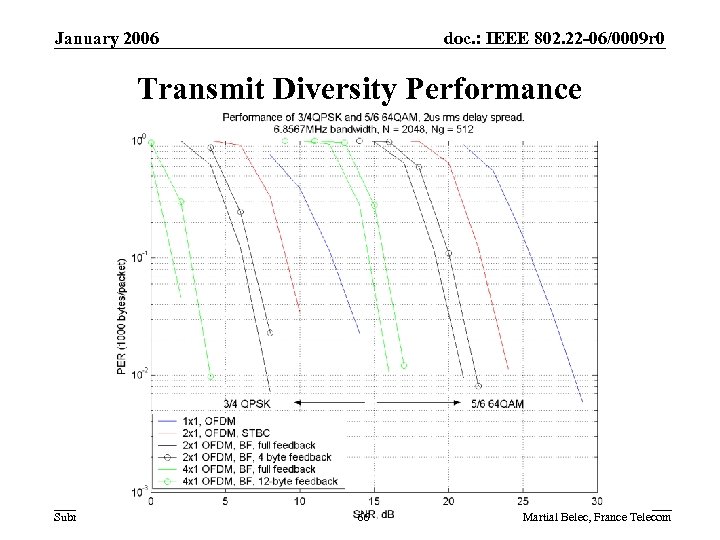
 January 2006 doc. : IEEE 802. 22 -06/0009 r 0 Transmit Diversity Options-summary • Open Loop: – STBC: Optimal only for 2 transmit antennae. – Tone Interleaving: Performance gain is limited in channels with high frequency diversity. • Closed Loop: – Eigen-beamforming at base-station: best performance, however requires full down-link channel information at transmitter. – Reduced-feedback methods: number of feedback bits can be reduced, with ~ 1 d. B performance loss Submission 65 Martial Belec, France Telecom
 January 2006 doc. : IEEE 802. 22 -06/0009 r 0 Transmit Diversity Performance Submission 66 Martial Belec, France Telecom
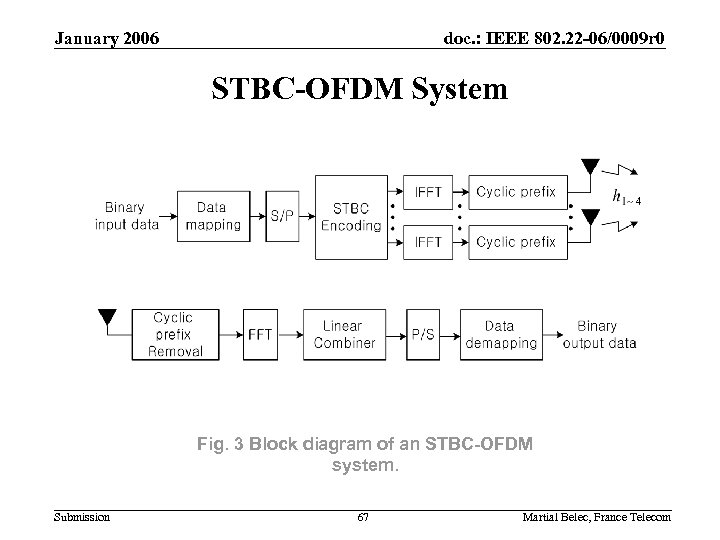 January 2006 doc. : IEEE 802. 22 -06/0009 r 0 STBC-OFDM System Fig. 3 Block diagram of an STBC-OFDM system. Submission 67 Martial Belec, France Telecom
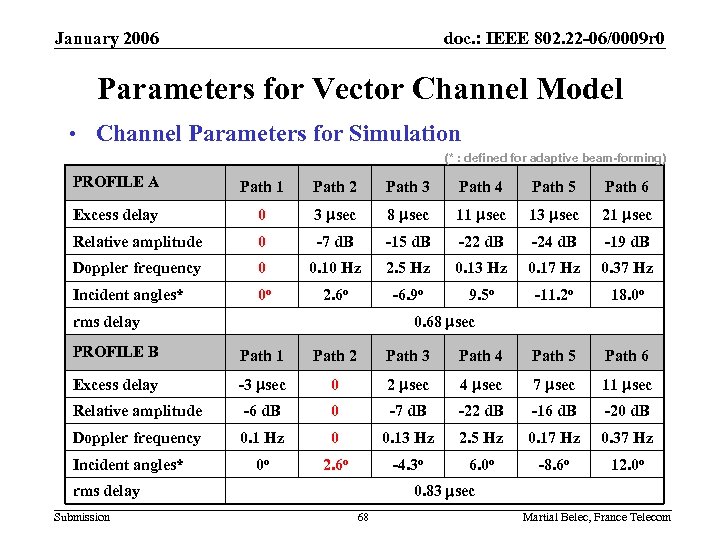 January 2006 doc. : IEEE 802. 22 -06/0009 r 0 Parameters for Vector Channel Model • Channel Parameters for Simulation (* : defined for adaptive beam-forming) PROFILE A Path 1 Path 2 Path 3 Path 4 Path 5 Path 6 Excess delay 0 3 msec 8 msec 11 msec 13 msec 21 msec Relative amplitude 0 -7 d. B -15 d. B -22 d. B -24 d. B -19 d. B Doppler frequency 0 0. 10 Hz 2. 5 Hz 0. 13 Hz 0. 17 Hz 0. 37 Hz Incident angles* 0 o 2. 6 o -6. 9 o 9. 5 o -11. 2 o 18. 0 o 0. 68 msec rms delay PROFILE B Path 1 Path 2 Path 3 Path 4 Path 5 Path 6 Excess delay -3 msec 0 2 msec 4 msec 7 msec 11 msec Relative amplitude -6 d. B 0 -7 d. B -22 d. B -16 d. B -20 d. B Doppler frequency 0. 1 Hz 0 0. 13 Hz 2. 5 Hz 0. 17 Hz 0. 37 Hz 0 o 2. 6 o -4. 3 o 6. 0 o -8. 6 o 12. 0 o Incident angles* 0. 83 msec rms delay Submission 68 Martial Belec, France Telecom
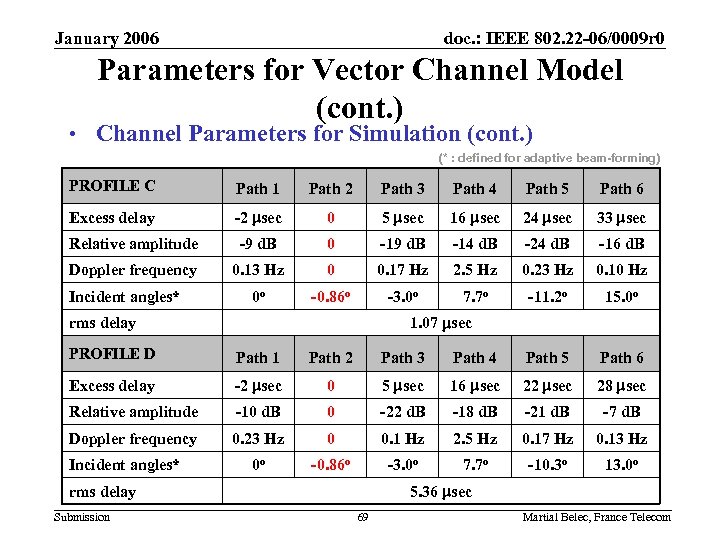 January 2006 doc. : IEEE 802. 22 -06/0009 r 0 Parameters for Vector Channel Model (cont. ) • Channel Parameters for Simulation (cont. ) (* : defined for adaptive beam-forming) PROFILE C Path 1 Path 2 Path 3 Path 4 Path 5 Path 6 Excess delay -2 msec 0 5 msec 16 msec 24 msec 33 msec Relative amplitude -9 d. B 0 -19 d. B -14 d. B -24 d. B -16 d. B Doppler frequency 0. 13 Hz 0 0. 17 Hz 2. 5 Hz 0. 23 Hz 0. 10 Hz 0 o -0. 86 o -3. 0 o 7. 7 o -11. 2 o 15. 0 o Incident angles* 1. 07 msec rms delay PROFILE D Path 1 Path 2 Path 3 Path 4 Path 5 Path 6 Excess delay -2 msec 0 5 msec 16 msec 22 msec 28 msec Relative amplitude -10 d. B 0 -22 d. B -18 d. B -21 d. B -7 d. B Doppler frequency 0. 23 Hz 0 0. 1 Hz 2. 5 Hz 0. 17 Hz 0. 13 Hz 0 o -0. 86 o -3. 0 o 7. 7 o -10. 3 o 13. 0 o Incident angles* 5. 36 msec rms delay Submission 69 Martial Belec, France Telecom
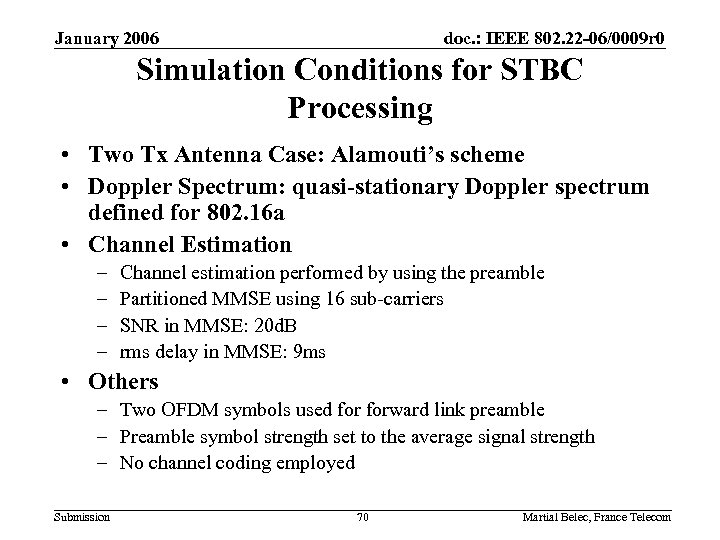 January 2006 doc. : IEEE 802. 22 -06/0009 r 0 Simulation Conditions for STBC Processing • Two Tx Antenna Case: Alamouti’s scheme • Doppler Spectrum: quasi-stationary Doppler spectrum defined for 802. 16 a • Channel Estimation – – Channel estimation performed by using the preamble Partitioned MMSE using 16 sub-carriers SNR in MMSE: 20 d. B rms delay in MMSE: 9 ms • Others – Two OFDM symbols used forward link preamble – Preamble symbol strength set to the average signal strength – No channel coding employed Submission 70 Martial Belec, France Telecom
 January 2006 doc. : IEEE 802. 22 -06/0009 r 0 Simulation Conditions for Adaptive Beamforming • Antenna Array – Array type: Linear equi-spaced array with half wavelength spacing consisting of 8 antenna elements. – Modified spatial smoothing is applied with the sub-array size of 7. – Root-MUSIC is used to estimate the DOA’s of incident signals. – All incident signals are assumed to have zero elevation angle. • Channel Conditions – Model for angular spread: Laplacian model – All clusters are assumed to have the angular spread of 0. 3 o. • Others – – – Submission Coincidence rate for signal identification set to 80%. No. of OFDM symbols for reverse link preamble is 1. No. of sub-carriers assigned to users is 128. No. of sub-carriers per sub-band is 16 for reference signal method. No channel coding employed 71 Martial Belec, France Telecom
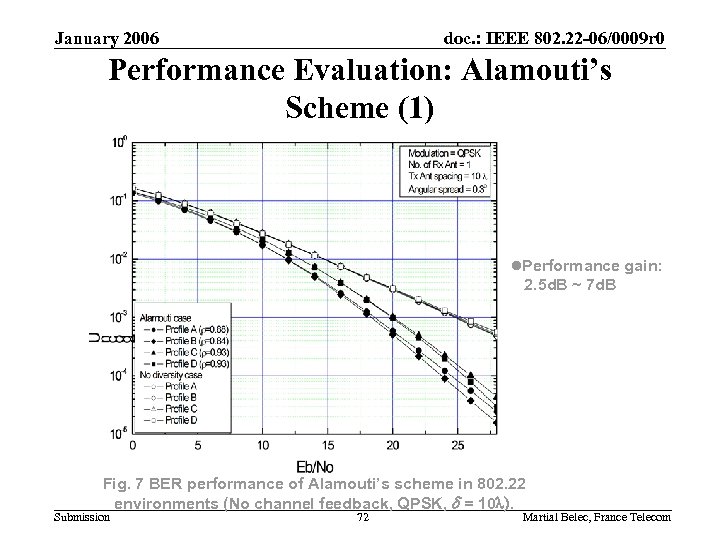 January 2006 doc. : IEEE 802. 22 -06/0009 r 0 Performance Evaluation: Alamouti’s Scheme (1) l. Performance gain: 2. 5 d. B ~ 7 d. B Fig. 7 BER performance of Alamouti’s scheme in 802. 22 environments (No channel feedback, QPSK, d = 10 l). Submission 72 Martial Belec, France Telecom
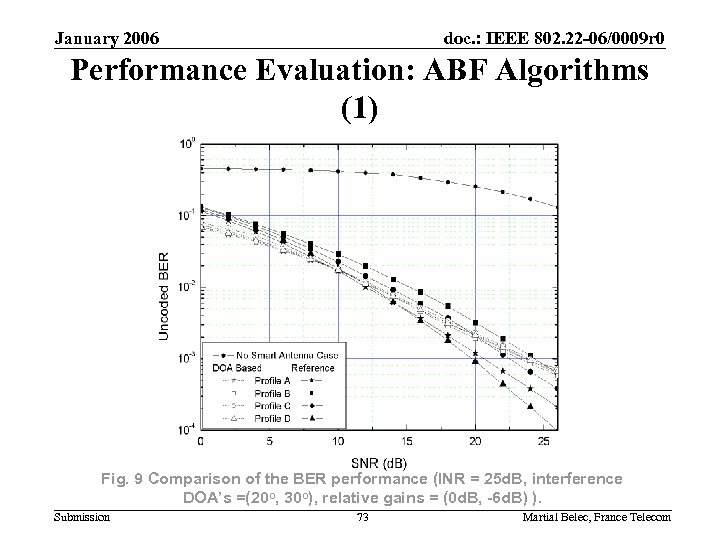 January 2006 doc. : IEEE 802. 22 -06/0009 r 0 Performance Evaluation: ABF Algorithms (1) Fig. 9 Comparison of the BER performance (INR = 25 d. B, interference DOA’s =(20 o, 30 o), relative gains = (0 d. B, -6 d. B) ). Submission 73 Martial Belec, France Telecom
 January 2006 doc. : IEEE 802. 22 -06/0009 r 0 Transmit Diversity Benefits • About 6 – 7 d. B downlink gain with 2 transmit antennae. • About 11 -12 d. B downlink gain with 4 transmit antennae. • Similar gains on uplink, with receive-diversity implemented at base-station. • Gains can be realized with about 4 bytes of feedback per user for 2 transmit antennae and 12 bytes per user for 4 transmit antennae. Submission 74 Martial Belec, France Telecom
 January 2006 doc. : IEEE 802. 22 -06/0009 r 0 Transmit Diversity: Open Issues • Channel model: does sufficient diversity exists to indeed realize the gains? • How often does channel feedback need to be send to transmitter? • Signaling format to allow transmit diversity (open and close loop) options need to be specified at very start of standardization process. Submission 75 Martial Belec, France Telecom
 January 2006 doc. : IEEE 802. 22 -06/0009 r 0 Additional Physical Layer Features • Ranging • TPC Submission 76 Martial Belec, France Telecom
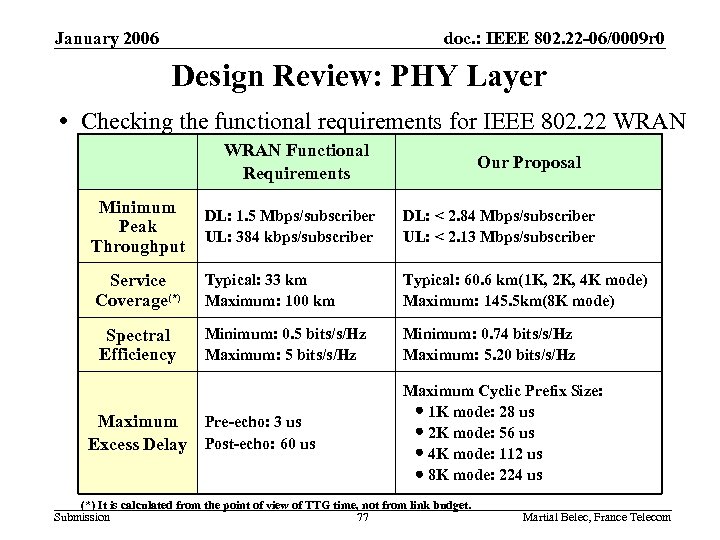 January 2006 doc. : IEEE 802. 22 -06/0009 r 0 Design Review: PHY Layer Checking the functional requirements for IEEE 802. 22 WRAN Functional Requirements Our Proposal Minimum Peak Throughput DL: 1. 5 Mbps/subscriber UL: 384 kbps/subscriber DL: < 2. 84 Mbps/subscriber UL: < 2. 13 Mbps/subscriber Service Coverage(*) Typical: 33 km Maximum: 100 km Typical: 60. 6 km(1 K, 2 K, 4 K mode) Maximum: 145. 5 km(8 K mode) Spectral Efficiency Minimum: 0. 5 bits/s/Hz Maximum: 5 bits/s/Hz Minimum: 0. 74 bits/s/Hz Maximum: 5. 20 bits/s/Hz Maximum Pre-echo: 3 us Excess Delay Post-echo: 60 us Maximum Cyclic Prefix Size: 1 K mode: 28 us 2 K mode: 56 us 4 K mode: 112 us 8 K mode: 224 us (*) It is calculated from the point of view of TTG time, not from link budget. Submission 77 Martial Belec, France Telecom
 January 2006 doc. : IEEE 802. 22 -06/0009 r 0 Spectrum Sensing Submission 78 Martial Belec, France Telecom
 January 2006 doc. : IEEE 802. 22 -06/0009 r 0 Proposed Spectrum Sensing Scheme • • Dual Sensing Strategy: Energy detection and Fine/Feature detection Energy Detection – – • Fine/Feature Detection – – – • • • To meet the speed and power requirement Power spectrum distribution in the entire band is obtained On request basis, detect the power level of selected channel in very short time Examples are MRSS, RSSI To meet the minimum sensitivity requirement Fine sensing is applied for the selected channel Feature Detection: detecting digital modulated signals Examples include CSFD, field-sync detection, FFT based spectral analysis: detecting narrowband analog modulated signals, most of part 74 devices Distributed Sensing Strategy : Frequency usage information is collected and managed at Base-station Either the BS makes the detection decision based on the collective measurement results or CPE’s can make the decision Can be implemented as a stand alone sensing block with an omni-directional antenna Submission 79 Martial Belec, France Telecom
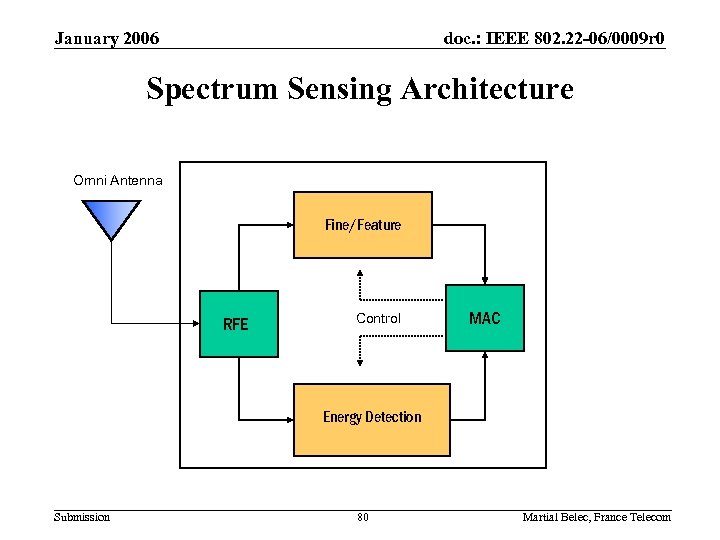 January 2006 doc. : IEEE 802. 22 -06/0009 r 0 Spectrum Sensing Architecture Omni Antenna Fine/Feature RFE Control MAC Energy Detection Submission 80 Martial Belec, France Telecom
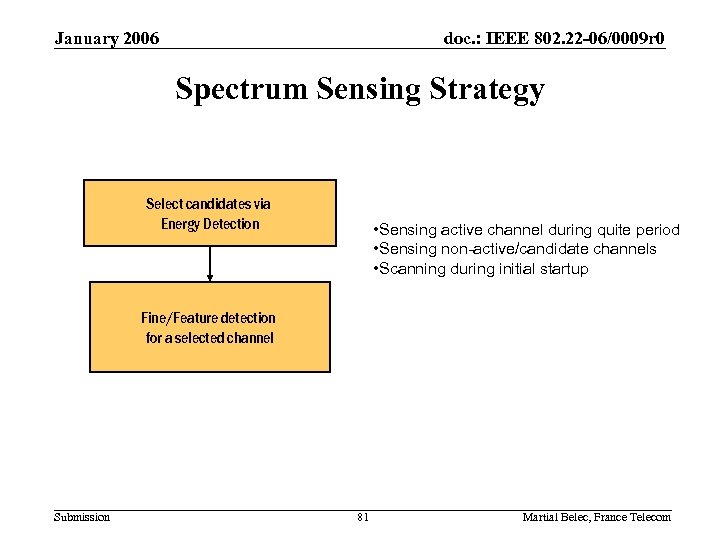 January 2006 doc. : IEEE 802. 22 -06/0009 r 0 Spectrum Sensing Strategy Select candidates via Energy Detection • Sensing active channel during quite period • Sensing non-active/candidate channels • Scanning during initial startup Fine/Feature detection for a selected channel Submission 81 Martial Belec, France Telecom
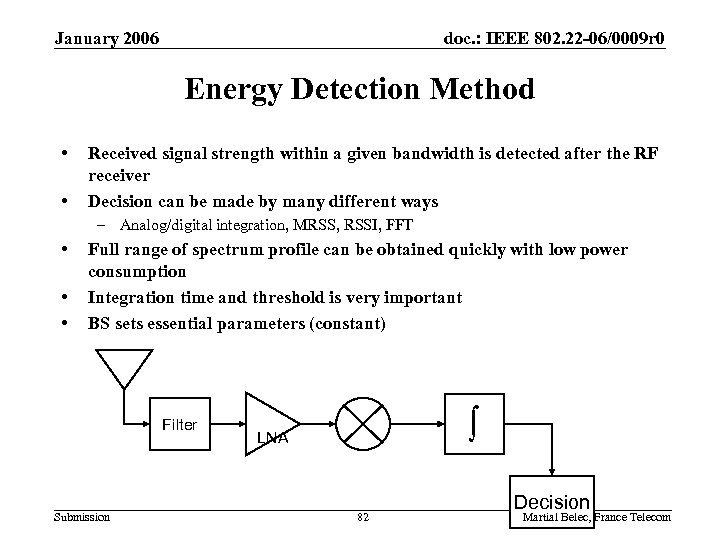 January 2006 doc. : IEEE 802. 22 -06/0009 r 0 Energy Detection Method • • Received signal strength within a given bandwidth is detected after the RF receiver Decision can be made by many different ways – Analog/digital integration, MRSS, RSSI, FFT • • • Full range of spectrum profile can be obtained quickly with low power consumption Integration time and threshold is very important BS sets essential parameters (constant) Filter Submission LNA 82 Decision Martial Belec, France Telecom
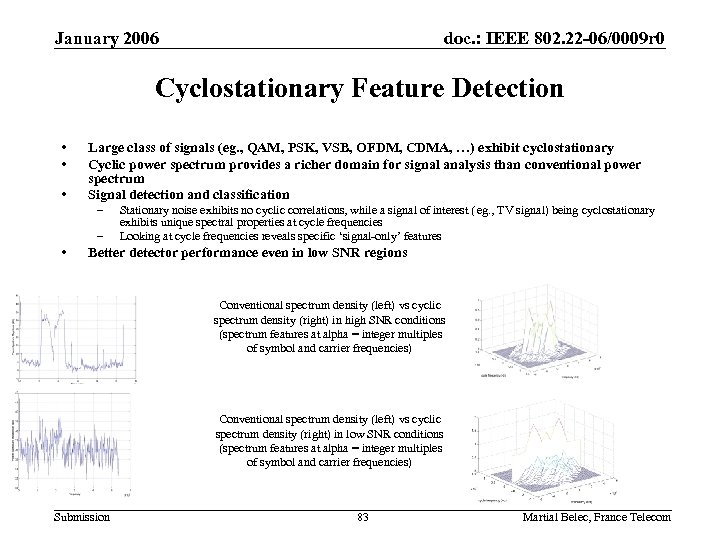 January 2006 doc. : IEEE 802. 22 -06/0009 r 0 Cyclostationary Feature Detection • • • Large class of signals (eg. , QAM, PSK, VSB, OFDM, CDMA, …) exhibit cyclostationary Cyclic power spectrum provides a richer domain for signal analysis than conventional power spectrum Signal detection and classification – – • Stationary noise exhibits no cyclic correlations, while a signal of interest ( eg. , TV signal) being cyclostationary exhibits unique spectral properties at cycle frequencies Looking at cycle frequencies reveals specific ‘signal-only’ features Better detector performance even in low SNR regions Conventional spectrum density (left) vs cyclic spectrum density (right) in high SNR conditions (spectrum features at alpha = integer multiples of symbol and carrier frequencies) Conventional spectrum density (left) vs cyclic spectrum density (right) in low SNR conditions (spectrum features at alpha = integer multiples of symbol and carrier frequencies) Submission 83 Martial Belec, France Telecom
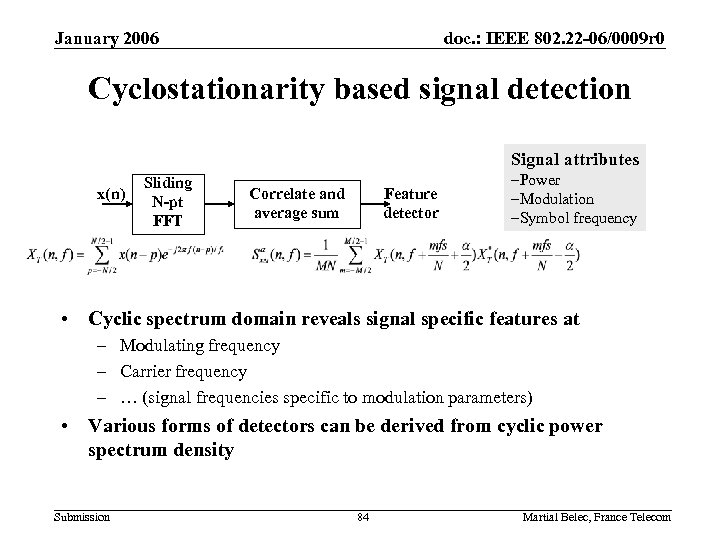 January 2006 doc. : IEEE 802. 22 -06/0009 r 0 Cyclostationarity based signal detection Signal attributes x(n) Sliding N-pt FFT Correlate and average sum Feature detector –Power –Modulation –Symbol frequency • Cyclic spectrum domain reveals signal specific features at – Modulating frequency – Carrier frequency – … (signal frequencies specific to modulation parameters) • Various forms of detectors can be derived from cyclic power spectrum density Submission 84 Martial Belec, France Telecom
 January 2006 doc. : IEEE 802. 22 -06/0009 r 0 DTV signal feature detection using field sync/correlation • Should not be sensitive to frequency selective fading, and receiver impairments (e. g. , frequency error) • Use field sync correlation detection for ATSC, similar correlation for other standards – Compare correlation peak to the mean of the standard deviation of the correlation – Characterized theoretical performance – Experimental tests Submission 85 Martial Belec, France Telecom
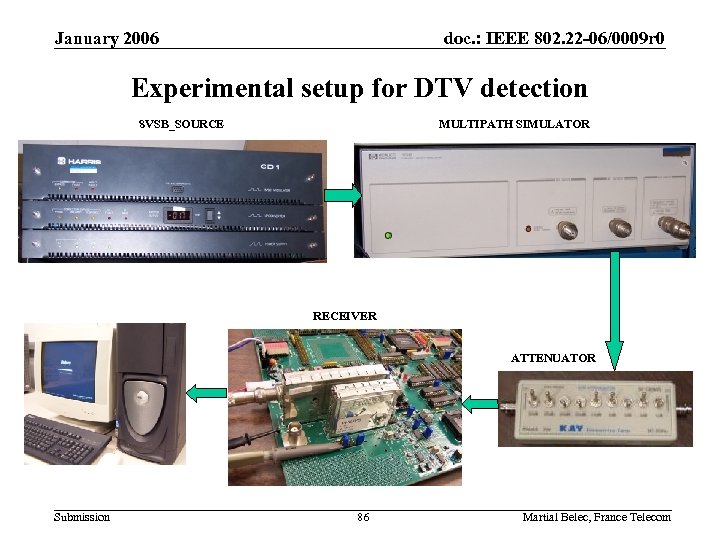 January 2006 doc. : IEEE 802. 22 -06/0009 r 0 Experimental setup for DTV detection 8 VSB_SOURCE MULTIPATH SIMULATOR RECEIVER ATTENUATOR Submission 86 Martial Belec, France Telecom
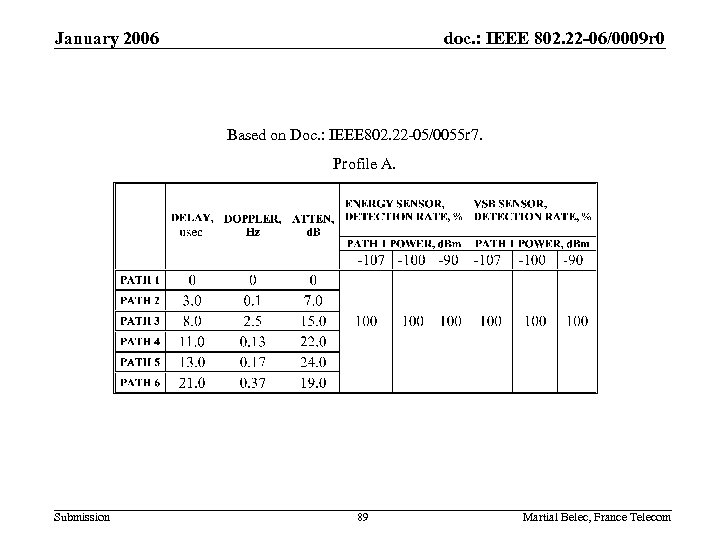 January 2006 doc. : IEEE 802. 22 -06/0009 r 0 Based on Doc. : IEEE 802. 22 -05/0055 r 7. Profile A. Submission 89 Martial Belec, France Telecom
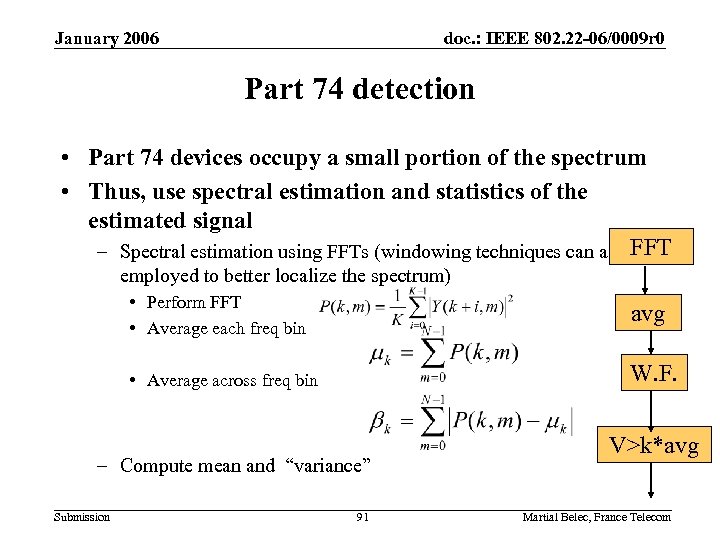 January 2006 doc. : IEEE 802. 22 -06/0009 r 0 Part 74 detection • Part 74 devices occupy a small portion of the spectrum • Thus, use spectral estimation and statistics of the estimated signal – Spectral estimation using FFTs (windowing techniques can also. FFT be employed to better localize the spectrum) • Perform FFT • Average each freq bin avg • Average across freq bin W. F. – Compute mean and “variance” Submission 91 V>k*avg Martial Belec, France Telecom
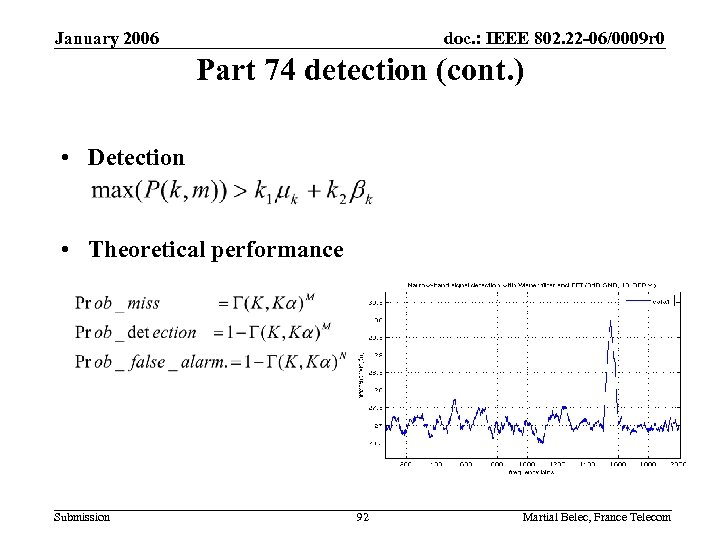 January 2006 doc. : IEEE 802. 22 -06/0009 r 0 Part 74 detection (cont. ) • Detection • Theoretical performance Submission 92 Martial Belec, France Telecom
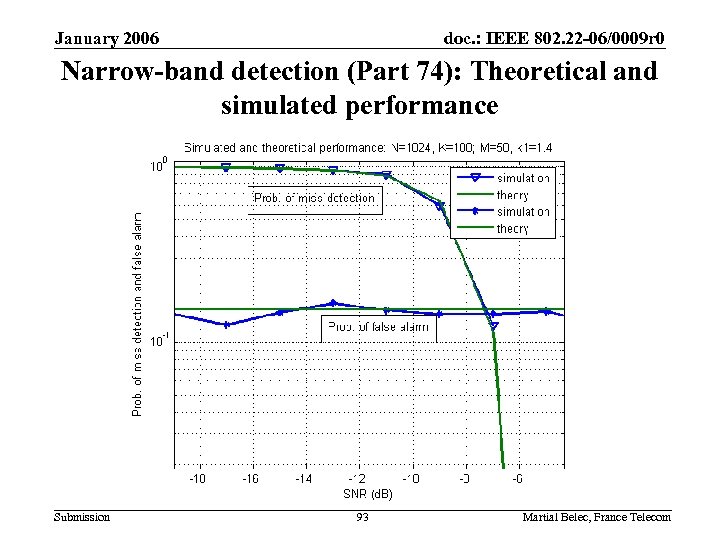 January 2006 doc. : IEEE 802. 22 -06/0009 r 0 Narrow-band detection (Part 74): Theoretical and simulated performance Submission 93 Martial Belec, France Telecom
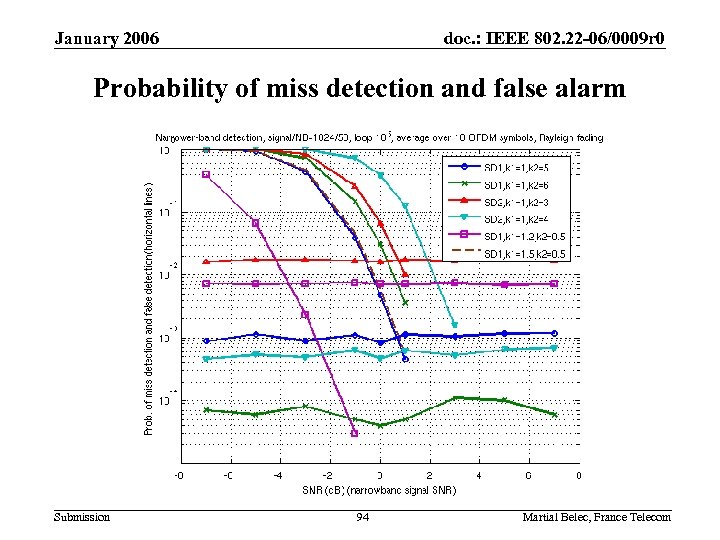 January 2006 doc. : IEEE 802. 22 -06/0009 r 0 Probability of miss detection and false alarm Submission 94 Martial Belec, France Telecom
 January 2006 doc. : IEEE 802. 22 -06/0009 r 0 MRSS: Multi-Resolution Spectrum Sensing • MRSS detect spectral components of incoming signal by the Fourier Transform. • Fourier Transform is performed in analog domain. • MRSS may utilize wavelet transforms as the basis function of the Fourier Transform. • Bandwidth, resolution and center frequency can be controlled by wavelet function Submission 95 Martial Belec, France Telecom
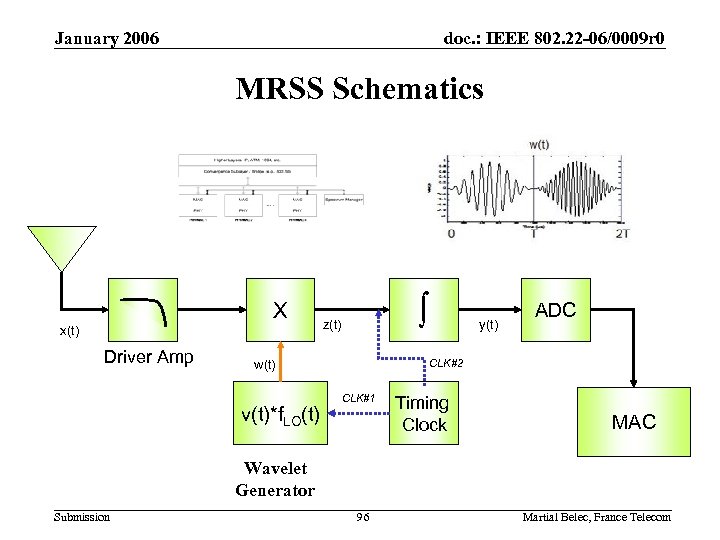 January 2006 doc. : IEEE 802. 22 -06/0009 r 0 MRSS Schematics X x(t) Driver Amp z(t) ADC CLK#2 w(t) v(t)*f. LO(t) y(t) CLK#1 Timing Clock MAC Wavelet Generator Submission 96 Martial Belec, France Telecom
 January 2006 doc. : IEEE 802. 22 -06/0009 r 0 Advantage of MRSS • Full analog signal process – Drastically reduce power consumption – Faster recognition • • Flexibility in sensing resolution and speed Filter is not required on the sensing path Wideband operation Relaxing RF components constraint (Noise, Linearity…) Submission 97 Martial Belec, France Telecom
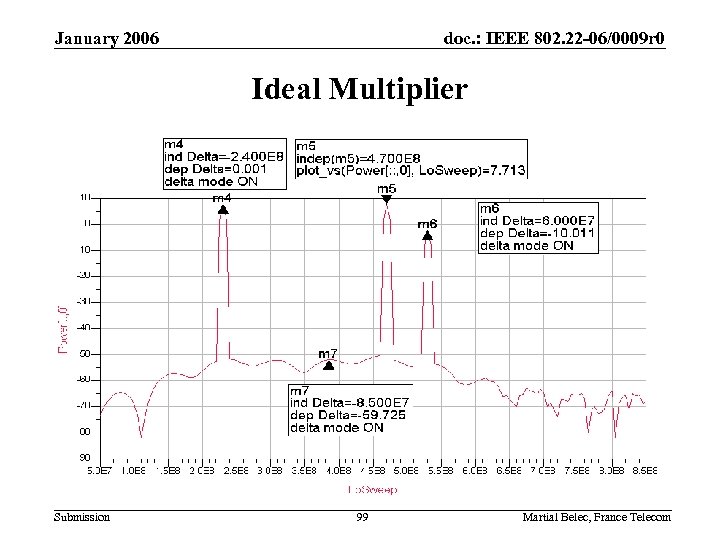
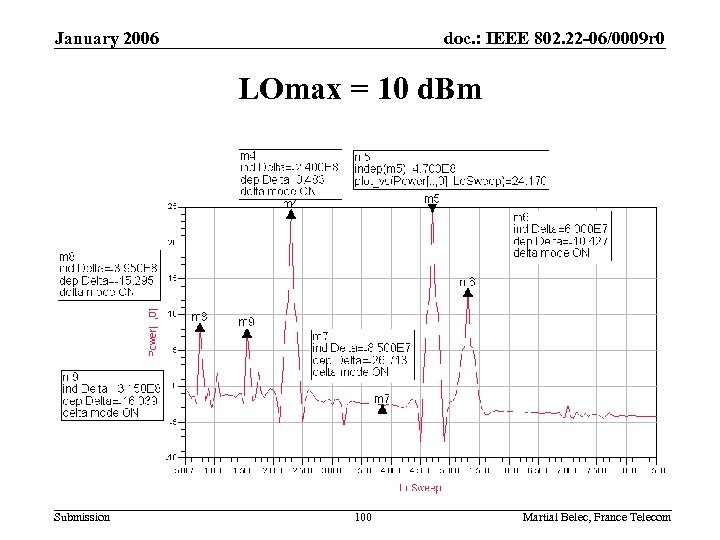
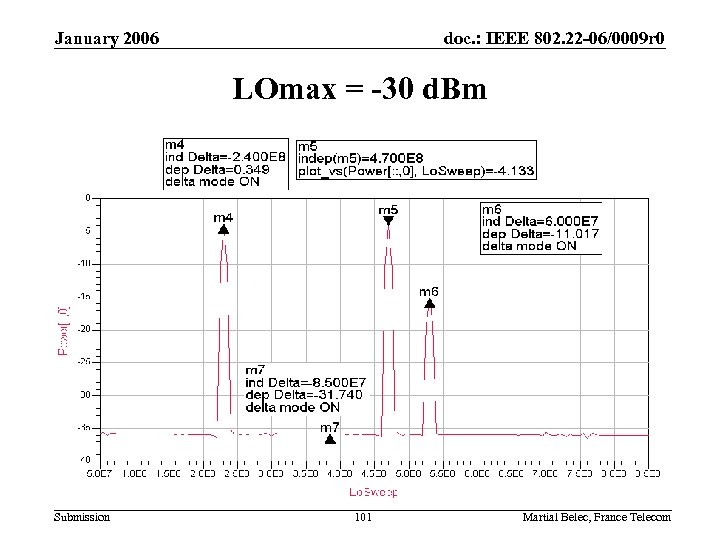
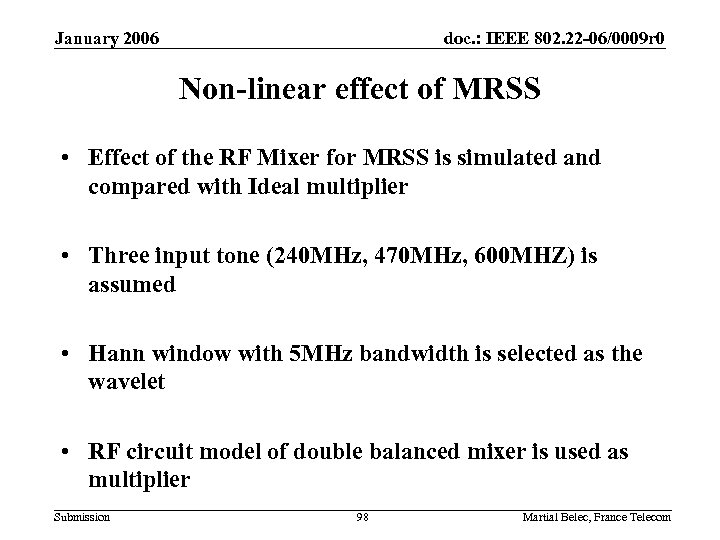 January 2006 doc. : IEEE 802. 22 -06/0009 r 0 Non-linear effect of MRSS • Effect of the RF Mixer for MRSS is simulated and compared with Ideal multiplier • Three input tone (240 MHz, 470 MHz, 600 MHZ) is assumed • Hann window with 5 MHz bandwidth is selected as the wavelet • RF circuit model of double balanced mixer is used as multiplier Submission 98 Martial Belec, France Telecom
 January 2006 doc. : IEEE 802. 22 -06/0009 r 0 Ideal Multiplier Submission 99 Martial Belec, France Telecom
 January 2006 doc. : IEEE 802. 22 -06/0009 r 0 LOmax = 10 d. Bm Submission 100 Martial Belec, France Telecom
 January 2006 doc. : IEEE 802. 22 -06/0009 r 0 LOmax = -30 d. Bm Submission 101 Martial Belec, France Telecom
 January 2006 doc. : IEEE 802. 22 -06/0009 r 0 Result of MRSS • Mixer non-linear effect is significantly depend on the LO power level • RF mixer can be used as the multiplier, if operating in the linear mode • By adjusting LO power for wavelet generator can suppressing the unwanted harmonic component Submission 102 Martial Belec, France Telecom
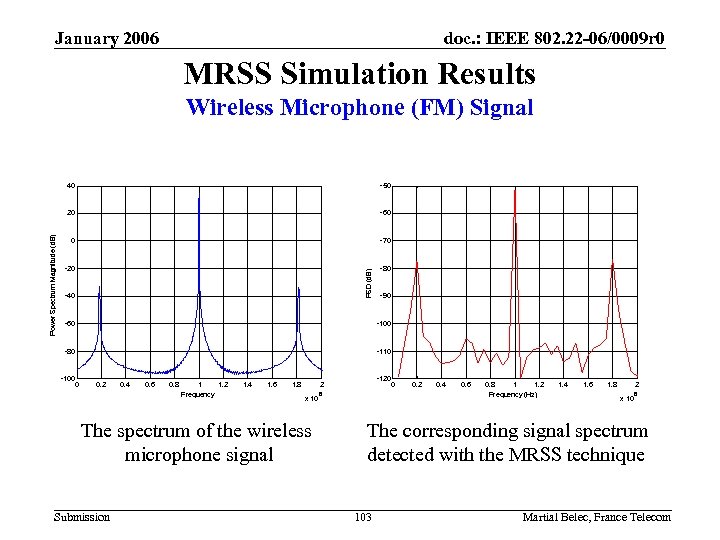 January 2006 doc. : IEEE 802. 22 -06/0009 r 0 MRSS Simulation Results Wireless Microphone (FM) Signal -60 0 -70 -20 -80 PSD (d. B) -50 20 Power Spectrum Magnitude (d. B) 40 -90 -60 -100 -80 -110 -100 0 0. 2 0. 4 0. 6 0. 8 1 1. 2 Frequency 1. 4 1. 6 1. 8 x 10 The spectrum of the wireless microphone signal Submission -120 2 6 0 0. 2 0. 4 0. 6 0. 8 1 1. 2 Frequency (Hz) 1. 4 1. 6 1. 8 2 x 10 6 The corresponding signal spectrum detected with the MRSS technique 103 Martial Belec, France Telecom
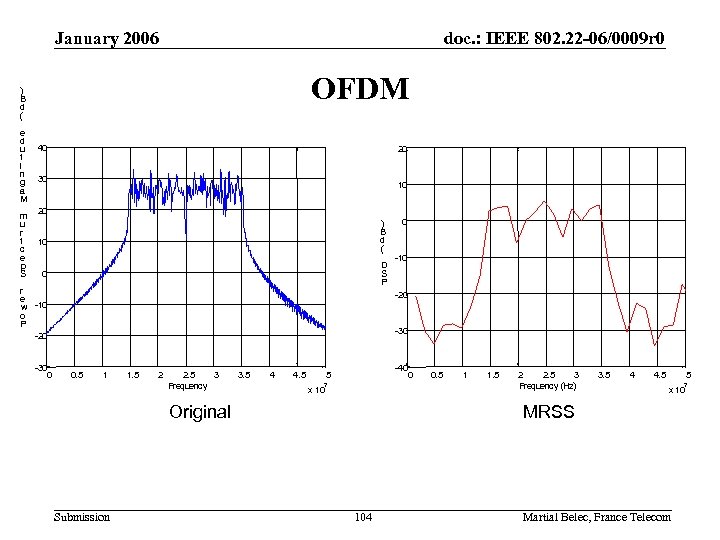 January 2006 doc. : IEEE 802. 22 -06/0009 r 0 OFDM ) B d ( e d u t i n g a M m u r t c e p S 40 20 30 10 20 ) B d ( 10 D S P 0 r e w -10 o P -20 -30 0 -10 -20 -30 0 0. 5 1 1. 5 2 2. 5 3 Frequency 3. 5 4 4. 5 -40 5 7 x 10 Original Submission 0 0. 5 1 1. 5 2 2. 5 3 Frequency (Hz) 3. 5 4 4. 5 5 x 10 MRSS 104 7 Martial Belec, France Telecom
 January 2006 doc. : IEEE 802. 22 -06/0009 r 0 Presentation Outline • Introduction – A Glimpse of IEEE 802. 22 • The PHY Proposal • The MAC Proposal • Conclusions Submission 105 Martial Belec, France Telecom
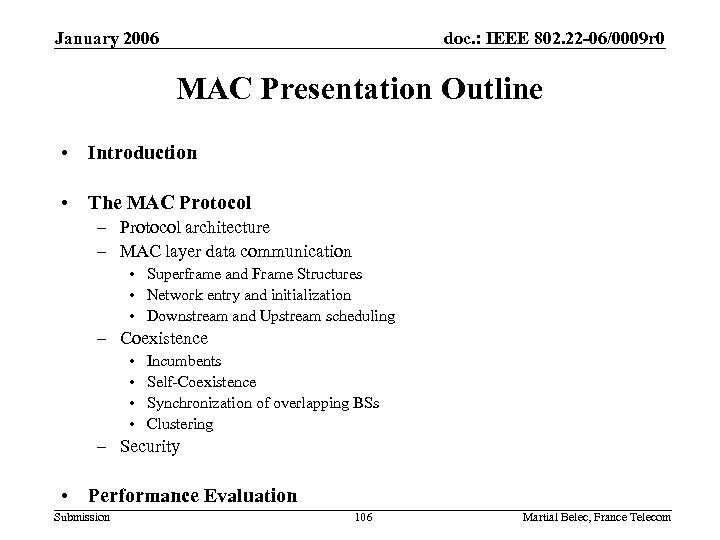 January 2006 doc. : IEEE 802. 22 -06/0009 r 0 MAC Presentation Outline • Introduction • The MAC Protocol – Protocol architecture – MAC layer data communication • Superframe and Frame Structures • Network entry and initialization • Downstream and Upstream scheduling – Coexistence • • Incumbents Self-Coexistence Synchronization of overlapping BSs Clustering – Security • Performance Evaluation Submission 106 Martial Belec, France Telecom
 January 2006 doc. : IEEE 802. 22 -06/0009 r 0 Introduction • A MAC layer is proposed to be used for future IEEE 802. 22 WRANs • Some aspects of MAC have been inspired by the IEEE 802. 16 MAC standard • However, major enhancements have been made – Support of multiple channel operation; – Coexistence with both incumbents and itself (self-coexistence); • • • Incumbent user avoidance and Measurements (incumbents and itself) Channel classification and Management Dynamic resource sharing, Coexistence Beacon Protocol (CBP), and Etiquette Synchronization of overlapping BSs Embedded wireless microphone beacon mechanism – Clustering support; etc. Submission 107 Martial Belec, France Telecom
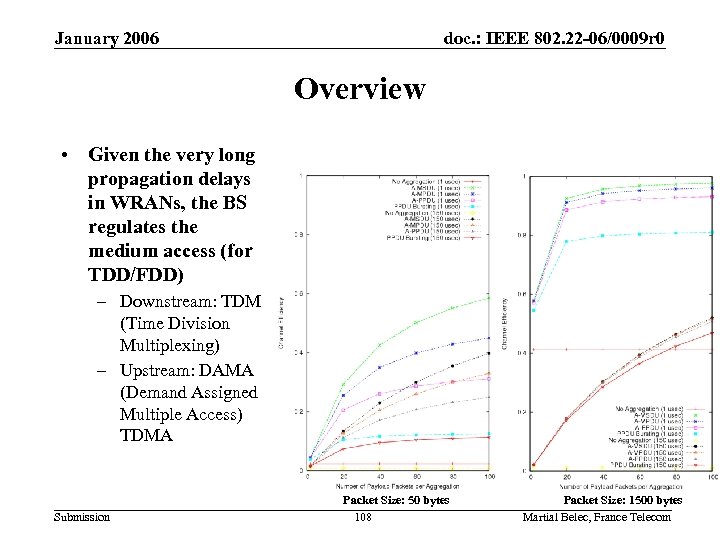 January 2006 doc. : IEEE 802. 22 -06/0009 r 0 Overview • Given the very long propagation delays in WRANs, the BS regulates the medium access (for TDD/FDD) – Downstream: TDM (Time Division Multiplexing) – Upstream: DAMA (Demand Assigned Multiple Access) TDMA Submission Packet Size: 50 bytes 108 Packet Size: 1500 bytes Martial Belec, France Telecom
 January 2006 doc. : IEEE 802. 22 -06/0009 r 0 Overview (cont. ) • Combination of polling, contention and unsolicited bandwidth grants mechanisms • Support of Unicast/Multicast/Broadcast for both management and data • Connection-oriented MAC – Connection identifier (CID) is a key component – Defines a mapping between peer processes – Defines a service flow (Qo. S provisioning) Submission 109 Martial Belec, France Telecom
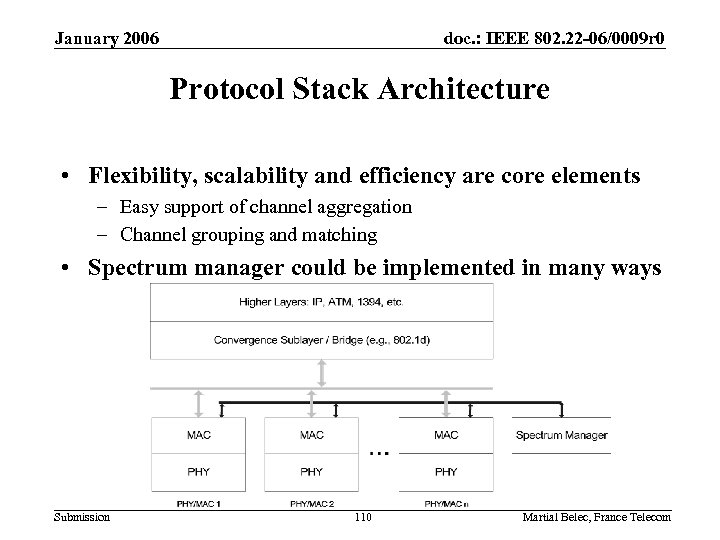 January 2006 doc. : IEEE 802. 22 -06/0009 r 0 Protocol Stack Architecture • Flexibility, scalability and efficiency are core elements – Easy support of channel aggregation – Channel grouping and matching • Spectrum manager could be implemented in many ways Submission 110 Martial Belec, France Telecom
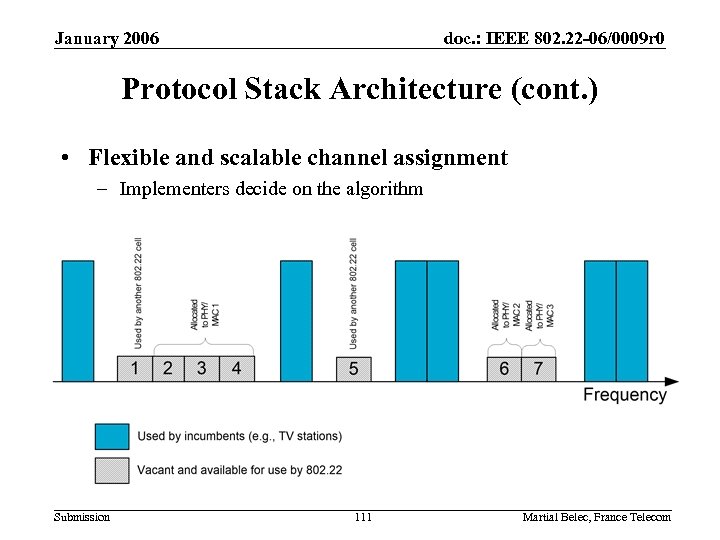 January 2006 doc. : IEEE 802. 22 -06/0009 r 0 Protocol Stack Architecture (cont. ) • Flexible and scalable channel assignment – Implementers decide on the algorithm Submission 111 Martial Belec, France Telecom
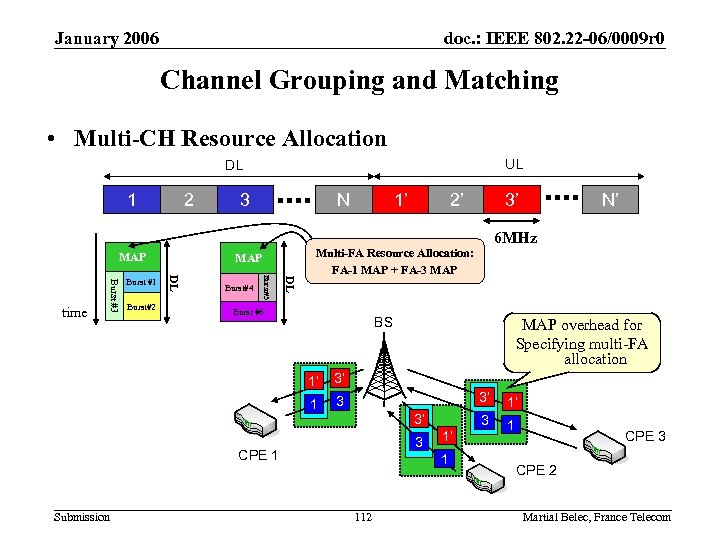 January 2006 doc. : IEEE 802. 22 -06/0009 r 0 Channel Grouping and Matching • Multi-CH Resource Allocation UL DL 1 2 MAP DL Burst#4 Burst#5 Burst#2 N MAP DL Burst #3 time Burst #1 3 1’ 3’ Burst #6 BS MAP overhead for Specifying multi-FA allocation 3’ 1 N’ 6 MHz Multi-FA Resource Allocation: FA-1 MAP + FA-3 MAP 1’ 3 3’ 3’ 3 CPE 1 Submission 2’ 1’ 1 112 1’ 3 1 CPE 3 CPE 2 Martial Belec, France Telecom
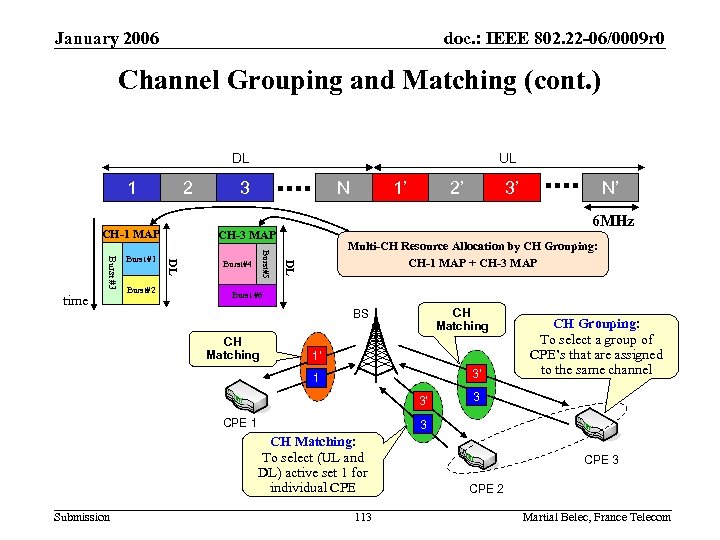 January 2006 doc. : IEEE 802. 22 -06/0009 r 0 Channel Grouping and Matching (cont. ) DL 1 2 CH-1 MAP N Burst#4 1’ 2’ N’ Multi-CH Resource Allocation by CH Grouping: CH-1 MAP + CH-3 MAP Burst #6 CH Matching BS CH Matching 1’ 3’ 1 3’ CPE 1 CH Grouping: To select a group of CPE’s that are assigned to the same channel 3 3 CH Matching: To select (UL and DL) active set 1 for individual CPE Submission 3’ 6 MHz DL Burst#5 Burst#2 3 CH-3 MAP DL Burst #3 time Burst #1 UL 113 CPE 2 Martial Belec, France Telecom
 January 2006 doc. : IEEE 802. 22 -06/0009 r 0 Basic Terms and Definitions • Superframe – Defined and delimited by a preamble and the SCH (superframe control header). It is comprised of a number of Frames • Frame – Comprised of one DS and one US Subframe, where BS and CPEs use to communicate with each other • Subframe – Formed by a number of Bursts • Burst – Defined by a two dimensional segment of logical channel (frequency) and MAC slot (time). It may comprise of multiple MAC PDUs belonging to multiple CPEs • MAC PDU – The smallest unit of transmission/reception by the MAC. It is comprised of the MAC header, the payload, and CRC Submission 114 Martial Belec, France Telecom
 January 2006 doc. : IEEE 802. 22 -06/0009 r 0 Motivation for Channel Bonding • The problem – How to offer enhanced capacity and range? • The fact – Spectrum occupancy measurements conducted by Shared Spectrum Company from January/2004 to August/2005 have shown that: • “There is a significant amount of spectrum available in continuous blocks that are 1 MHz and wider ” • “A dynamic spectrum sharing radio with a low agility, contiguous waveform will provide high utility” • The solution – Simultaneous use of multiple contiguous TV channels Submission 115 Martial Belec, France Telecom
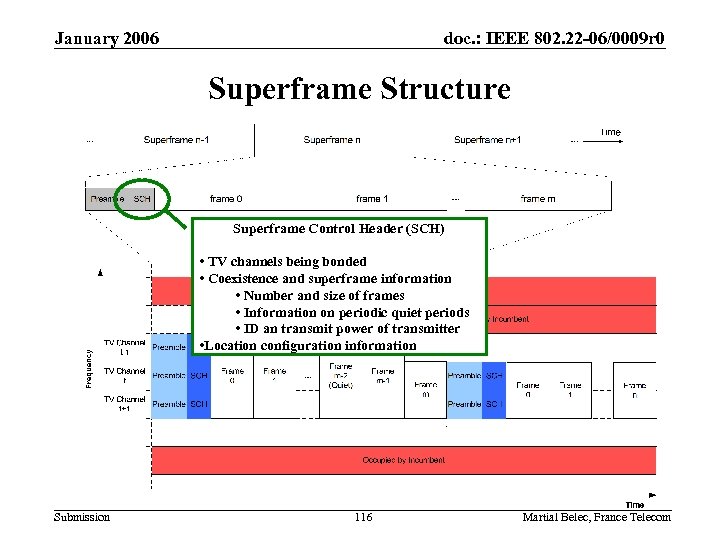 January 2006 doc. : IEEE 802. 22 -06/0009 r 0 Superframe Structure Superframe Control Header (SCH) • TV channels being bonded • Coexistence and superframe information • Number and size of frames • Information on periodic quiet periods • ID an transmit power of transmitter • Location configuration information Submission 116 Martial Belec, France Telecom
 January 2006 doc. : IEEE 802. 22 -06/0009 r 0 Frame Structure • MAC is based on TDD/FDD frame structure • The MAC frame structure is comprised of two parts – A downstream (DS) subframe – An upstream (US) subframe Submission 117 Martial Belec, France Telecom
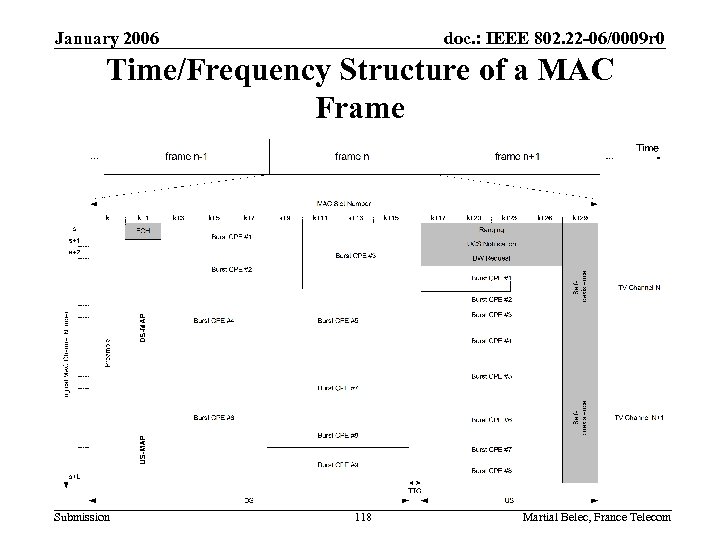 January 2006 doc. : IEEE 802. 22 -06/0009 r 0 Time/Frequency Structure of a MAC Frame Submission 118 Martial Belec, France Telecom
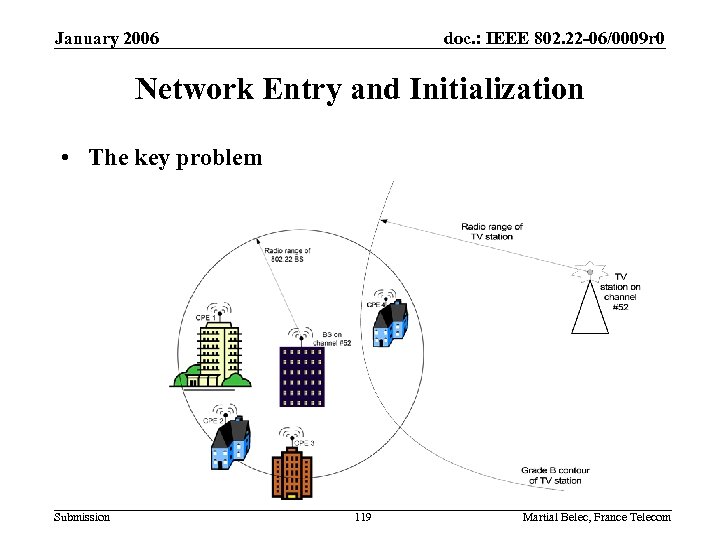 January 2006 doc. : IEEE 802. 22 -06/0009 r 0 Network Entry and Initialization • The key problem Submission 119 Martial Belec, France Telecom
 January 2006 doc. : IEEE 802. 22 -06/0009 r 0 Network Entry and Initialization (BS) • BS consults TV usage database and regional WRAN information base to find potentially empty channels • BS performs sensing over these channels to check if they are indeed empty Submission 120 Martial Belec, France Telecom
 January 2006 doc. : IEEE 802. 22 -06/0009 r 0 Network Entry and Initialization (CPE) 1. 2. 3. 4. 5. 6. 7. 8. 9. Scan channels searching for a BS. Once SCH is received, ascertain that the use of the channel(s) is permitted (i. e. , does not interfere with incumbents). Synchronize to the BS. Obtain the transmit parameters from the BS, which are contained in the UCD message. Perform ranging and Negotiate basic capabilities. Authorize CPE and Perform key exchange. Perform registration. If indicated as desired by the CPE during registration (REGREQ message), perform other optional initialization procedures such as establish IP connectivity, establish time of day, and transfer operational parameters. Set up connections. Submission 121 Martial Belec, France Telecom
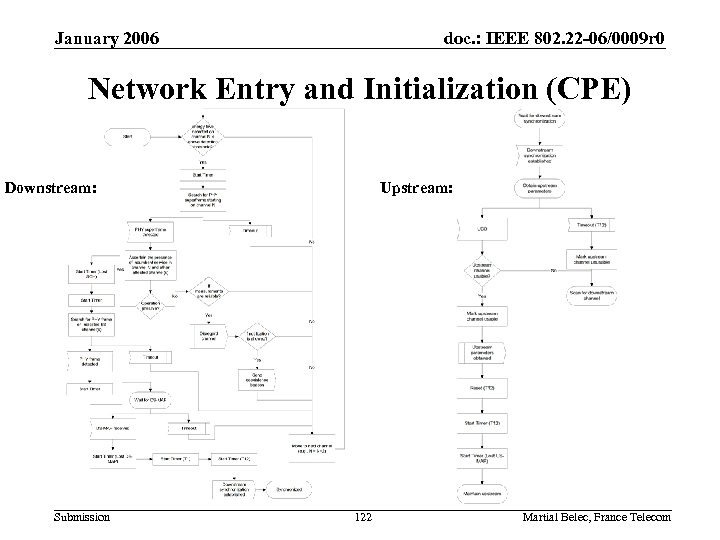 January 2006 doc. : IEEE 802. 22 -06/0009 r 0 Network Entry and Initialization (CPE) Downstream: Submission Upstream: 122 Martial Belec, France Telecom
 January 2006 doc. : IEEE 802. 22 -06/0009 r 0 Downstream (DS) Transmissions • DS = core messages + data (transmitted in bursts) – Two core DS messages: DCD and DS-MAP – Bursts identified by DIUC (Downstream Interval Usage Code) – Each burst may contain data for several CPEs • DCD (Downstream Channel Descriptor) – Establishes association between DIUC and actual PHY parameters (e. g. , modulation and coding) • DS-MAP (Downstream map) – Defines the usage (i. e. , scheduling) of the downstream – Critical, hence first message in each frame – For self-coexistence purposes, the BS may choose to use part of DS subframe for CBP protocol operation Submission 123 Martial Belec, France Telecom
 January 2006 doc. : IEEE 802. 22 -06/0009 r 0 Upstream (US) Transmissions • US = core messages + data (contention and bursts) – Two core DS messages: UCD and US-MAP – Bursts identified by UIUC (Upstream Interval Usage Code) – The upstream can be segmented into several UIUC • Contention-based – Initialization, Bandwidth Request, Urgent Coexistence Situation (UCS), CBP slots (SCS) • Data Bursts • UCD (Upstream Channel Descriptor) – Establishes association between UIUC and actual PHY parameters (e. g. , modulation and coding) • US-MAP (Upstream map) – Defines the usage (i. e. , scheduling) of the upstream – Contains “grants”addressed to a particular CPE or a set of CPEs (e. g. , for selfcoexistence) Submission 124 Martial Belec, France Telecom
 January 2006 doc. : IEEE 802. 22 -06/0009 r 0 Bandwidth Management: Request/Grant Scheme • Self correcting – No acknowledgement – All errors are handled the same way (i. e. , periodic aggregate requests) • Bandwidth requests – Are always per connection – Can specify DS/US Traffic Constraint IEs for better self-coexistence • Bandwidth grants – Can be either per connection or per CPE – Grants (given as durations) are carried in US-MAP messages – CPE converts time into amount of data using information about the UIUC Submission 125 Martial Belec, France Telecom
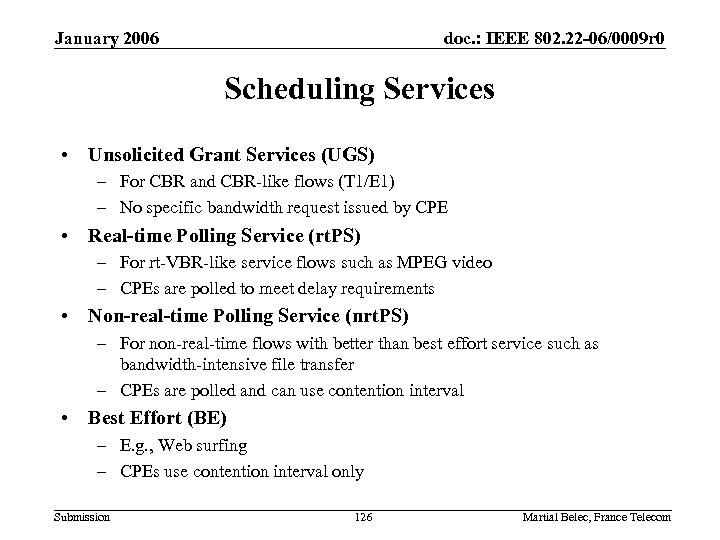 January 2006 doc. : IEEE 802. 22 -06/0009 r 0 Scheduling Services • Unsolicited Grant Services (UGS) – For CBR and CBR-like flows (T 1/E 1) – No specific bandwidth request issued by CPE • Real-time Polling Service (rt. PS) – For rt-VBR-like service flows such as MPEG video – CPEs are polled to meet delay requirements • Non-real-time Polling Service (nrt. PS) – For non-real-time flows with better than best effort service such as bandwidth-intensive file transfer – CPEs are polled and can use contention interval • Best Effort (BE) – E. g. , Web surfing – CPEs use contention interval only Submission 126 Martial Belec, France Telecom
 January 2006 doc. : IEEE 802. 22 -06/0009 r 0 MAC Presentation Outline • Introduction • The MAC Protocol – Protocol architecture – MAC layer data communication • Superframe and Frame Structures • Network entry and initialization • Downstream and Upstream scheduling – Coexistence • • Incumbents Self-Coexistence Synchronization of overlapping BSs Clustering – Security • Performance Evaluation Submission 127 Martial Belec, France Telecom
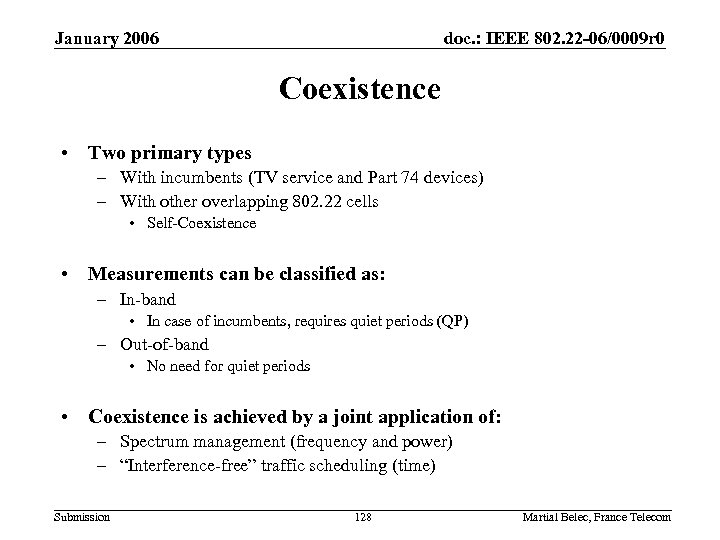 January 2006 doc. : IEEE 802. 22 -06/0009 r 0 Coexistence • Two primary types – With incumbents (TV service and Part 74 devices) – With other overlapping 802. 22 cells • Self-Coexistence • Measurements can be classified as: – In-band • In case of incumbents, requires quiet periods (QP) – Out-of-band • No need for quiet periods • Coexistence is achieved by a joint application of: – Spectrum management (frequency and power) – “Interference-free” traffic scheduling (time) Submission 128 Martial Belec, France Telecom
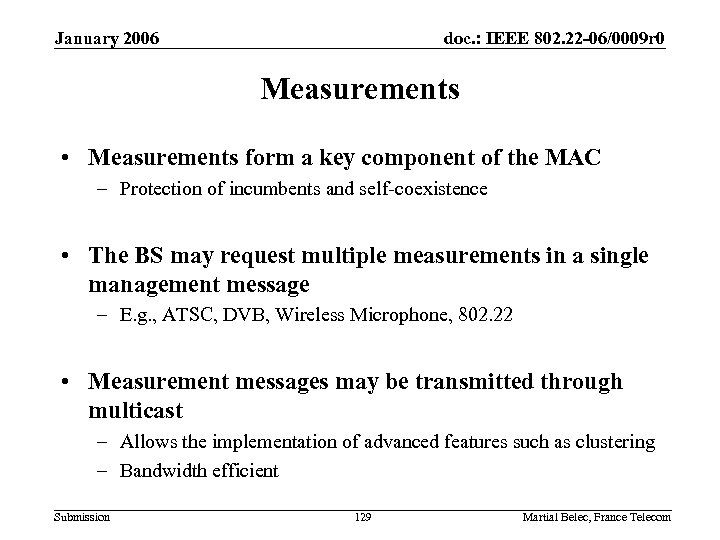 January 2006 doc. : IEEE 802. 22 -06/0009 r 0 Measurements • Measurements form a key component of the MAC – Protection of incumbents and self-coexistence • The BS may request multiple measurements in a single management message – E. g. , ATSC, DVB, Wireless Microphone, 802. 22 • Measurement messages may be transmitted through multicast – Allows the implementation of advanced features such as clustering – Bandwidth efficient Submission 129 Martial Belec, France Telecom
 January 2006 doc. : IEEE 802. 22 -06/0009 r 0 Measurements (cont. ) • Bulk Measurement Request (BLM-REQ) – Transmitted by the BS to CPEs – Includes information such as • Channels to measure • Multiple single measurement requests • Bulk Measurement Response (BLM-RSP) – Transmitted by CPE to BS – If needed, acknowledges the receipt of the BLM-REQ message • Bulk Measurement Report (BLM-REP) – Transmitted by CPE to BS – Returns multiple single measurement reports • Bulk Measurement Acknowledgement (BLM-ACK) – Transmitted by BS to CPE – Acknowledges receipt of measurement report Submission 130 Martial Belec, France Telecom
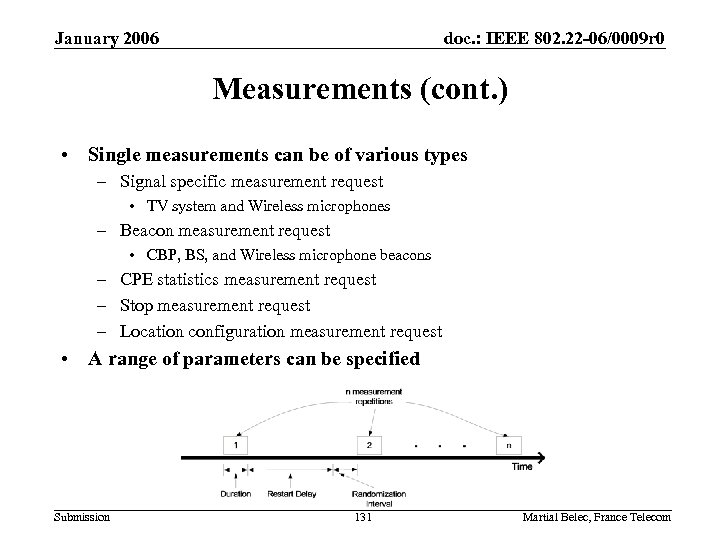 January 2006 doc. : IEEE 802. 22 -06/0009 r 0 Measurements (cont. ) • Single measurements can be of various types – Signal specific measurement request • TV system and Wireless microphones – Beacon measurement request • CBP, BS, and Wireless microphone beacons – CPE statistics measurement request – Stop measurement request – Location configuration measurement request • A range of parameters can be specified Submission 131 Martial Belec, France Telecom
 January 2006 doc. : IEEE 802. 22 -06/0009 r 0 Measurements (cont. ) • There is almost a one-to-one correspondence between measurement requests and reports • Some of the individual reports are: – Signal specific measurement report • TV/Wireless Microphone system type, measured value, precision, etc. – Beacon measurement report • Information on any CBP, BS, or Wireless microphone beacons received – CPE statistics measurement report • E. g. , Packet error rate – Location configuration measurement report • If known, location information (GPS, triangulization, and so on) Submission 132 Martial Belec, France Telecom
 January 2006 doc. : IEEE 802. 22 -06/0009 r 0 Channel Management • Channel management is key to effective network coordination, coexistence and sharing • Included in two modes – Embedded – Non-embedded • A set of messages are defined to allow flexible management of channels, including: – Add/remove channel(s) to/from current set of channels – Switch channel(s) of operation – Quiet selected channel(s) – possibly to perform in-band measurement Submission 133 Martial Belec, France Telecom
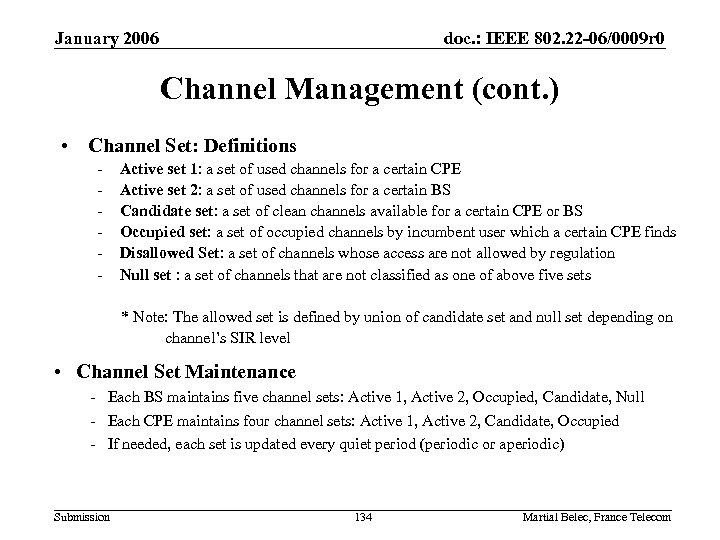 January 2006 doc. : IEEE 802. 22 -06/0009 r 0 Channel Management (cont. ) • Channel Set: Definitions - Active set 1: a set of used channels for a certain CPE Active set 2: a set of used channels for a certain BS Candidate set: a set of clean channels available for a certain CPE or BS Occupied set: a set of occupied channels by incumbent user which a certain CPE finds Disallowed Set: a set of channels whose access are not allowed by regulation Null set : a set of channels that are not classified as one of above five sets * Note: The allowed set is defined by union of candidate set and null set depending on channel’s SIR level • Channel Set Maintenance - Each BS maintains five channel sets: Active 1, Active 2, Occupied, Candidate, Null - Each CPE maintains four channel sets: Active 1, Active 2, Candidate, Occupied - If needed, each set is updated every quiet period (periodic or aperiodic) Submission 134 Martial Belec, France Telecom
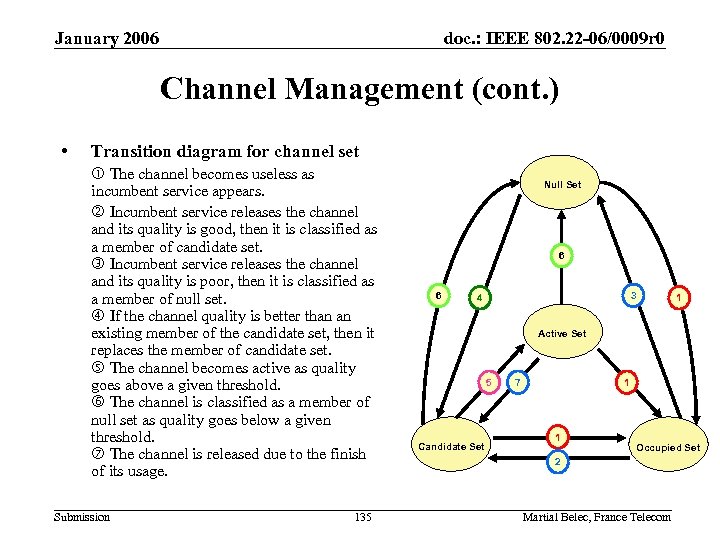 January 2006 doc. : IEEE 802. 22 -06/0009 r 0 Channel Management (cont. ) • Transition diagram for channel set The channel becomes useless as incumbent service appears. Incumbent service releases the channel and its quality is good, then it is classified as a member of candidate set. Incumbent service releases the channel and its quality is poor, then it is classified as a member of null set. If the channel quality is better than an existing member of the candidate set, then it replaces the member of candidate set. The channel becomes active as quality goes above a given threshold. The channel is classified as a member of null set as quality goes below a given threshold. The channel is released due to the finish of its usage. Submission 135 Null Set 6 6 3 4 1 Active Set 5 Candidate Set 7 1 1 Occupied Set 2 Martial Belec, France Telecom
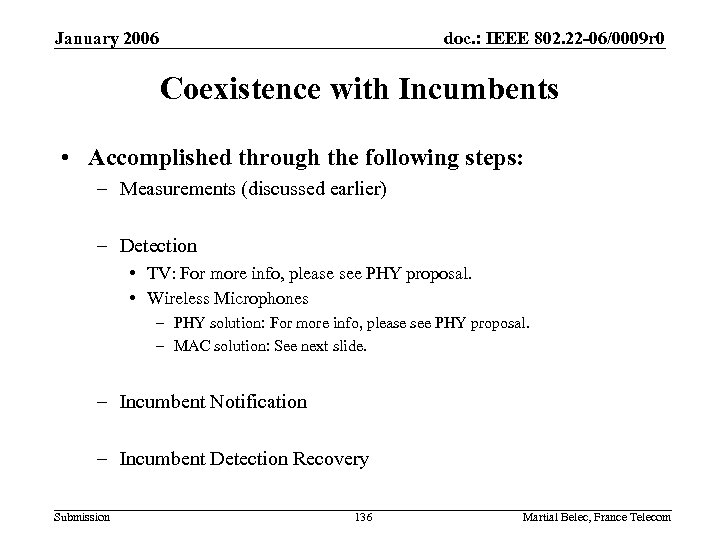 January 2006 doc. : IEEE 802. 22 -06/0009 r 0 Coexistence with Incumbents • Accomplished through the following steps: – Measurements (discussed earlier) – Detection • TV: For more info, please see PHY proposal. • Wireless Microphones – PHY solution: For more info, please see PHY proposal. – MAC solution: See next slide. – Incumbent Notification – Incumbent Detection Recovery Submission 136 Martial Belec, France Telecom
 January 2006 doc. : IEEE 802. 22 -06/0009 r 0 Coexistence with Incumbents • Accomplished through the following steps: – Measurements (discussed earlier) – Detection • TV: For more info, please see PHY proposal. • Wireless Microphones – PHY solution: For more info, please see PHY proposal. – MAC solution: See next slide. – Incumbent Notification – Incumbent Detection Recovery Submission 137 Martial Belec, France Telecom
 January 2006 doc. : IEEE 802. 22 -06/0009 r 0 MAC Layer Detection of Wireless Microphones • From the transmitter perspective, wireless microphone beacons (WMB) can be of two types – Embedded • 802. 22 device which has the additional capability of emitting WMBs – Non-embedded • Currently addressed by the Part 74 Task Group • Based on the proposed MAC layer, we have developed an embedded WMB approach that: – Reliably detects multiple collocated 802. 22 networks – Upon sending WMBs, this mechanism causes minimal, if any, harmful interference to collocated 802. 22 networks – Once either BSs or CPEs detect the WMB, a dissemination is made and all present 802. 22 networks vacate the channel Submission 138 Martial Belec, France Telecom
 January 2006 doc. : IEEE 802. 22 -06/0009 r 0 Incumbent Notification • The problem – How CPEs notify the BS about the presence of incumbents in a timely fashion? • Two modes are proposed: – Explicit Notification is executed first – Implicit Notification in case Explicit Notification fails Submission 139 Martial Belec, France Telecom
 January 2006 doc. : IEEE 802. 22 -06/0009 r 0 Incumbent Notification: Explicit Mode • Two solutions are possible – CPEs with upstream bandwidth allocation • Send report provided bandwidth and time are available; and • Set dedicated bits in MAC header – CPEs without upstream bandwidth allocation • Urgent Coexistence Situation (UCS) Notification slots reserved specifically for incumbent notification purposes – Can use either contention-based or contention-based CDMA access • The size of a slot fits the smallest MAC frame necessary to perform the incumbent notification: the MAC header • In both solutions, there is NO need to wait for a quiet period (QP) before recovery – CPEs can notify the BS at any point Submission 140 Martial Belec, France Telecom
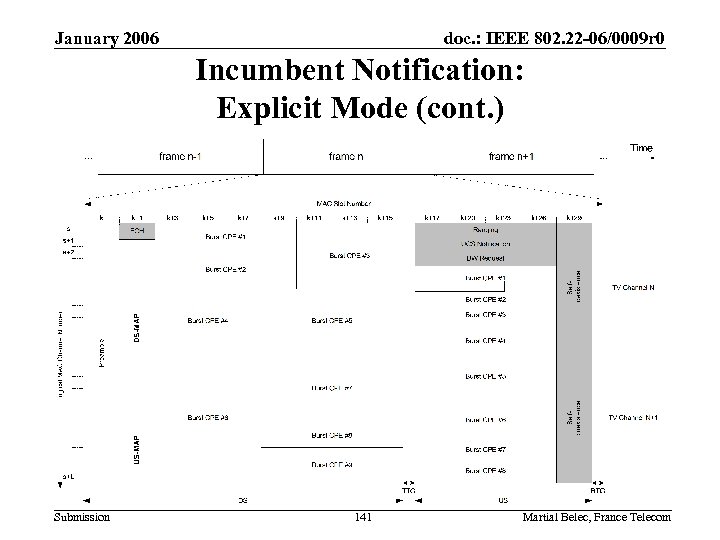 January 2006 doc. : IEEE 802. 22 -06/0009 r 0 Incumbent Notification: Explicit Mode (cont. ) Submission 141 Martial Belec, France Telecom
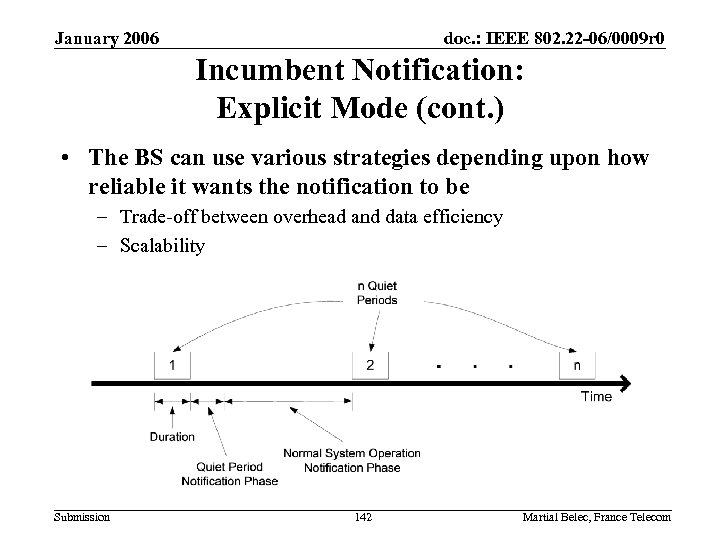 January 2006 doc. : IEEE 802. 22 -06/0009 r 0 Incumbent Notification: Explicit Mode (cont. ) • The BS can use various strategies depending upon how reliable it wants the notification to be – Trade-off between overhead and data efficiency – Scalability Submission 142 Martial Belec, France Telecom
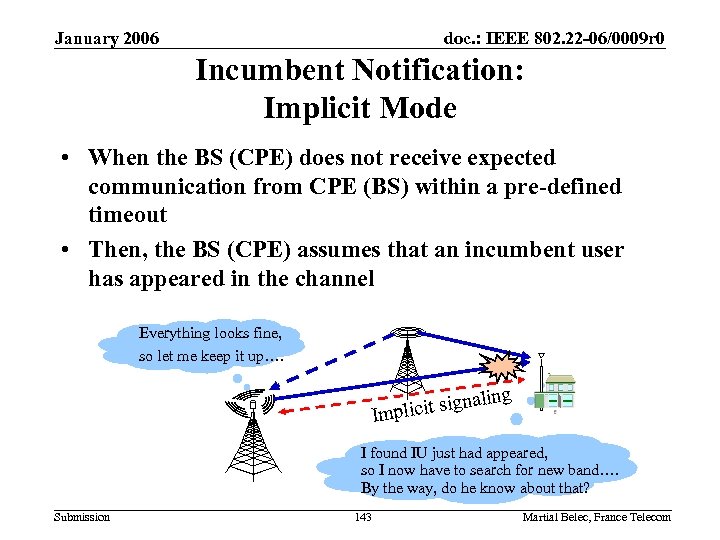 January 2006 doc. : IEEE 802. 22 -06/0009 r 0 Incumbent Notification: Implicit Mode • When the BS (CPE) does not receive expected communication from CPE (BS) within a pre-defined timeout • Then, the BS (CPE) assumes that an incumbent user has appeared in the channel Everything looks fine, so let me keep it up…. ling na plicit sig Im I found IU just had appeared, so I now have to search for new band…. By the way, do he know about that? Submission 143 Martial Belec, France Telecom
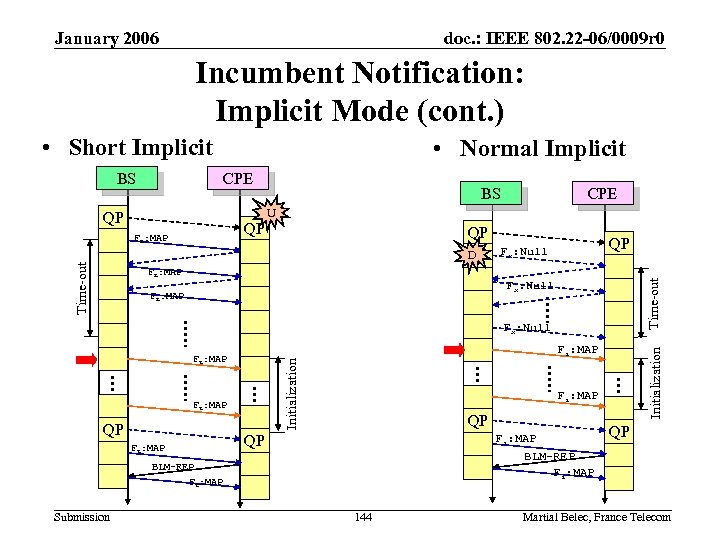 January 2006 doc. : IEEE 802. 22 -06/0009 r 0 Incumbent Notification: Implicit Mode (cont. ) • Short Implicit BS • Normal Implicit CPE BS U QP QP D Fx: MAP QP Fx: Null Time-out Fx: MAP Fx: Null . . . Fz: MAP QP Fz: MAP . . . Initialization Fz: MAP QP Fz: MAP BLM-REP Fz: MAP QP BLM-REP Fz: MAP Submission Fz: MAP 144 . . . Initialization QP Time-out CPE QP Martial Belec, France Telecom
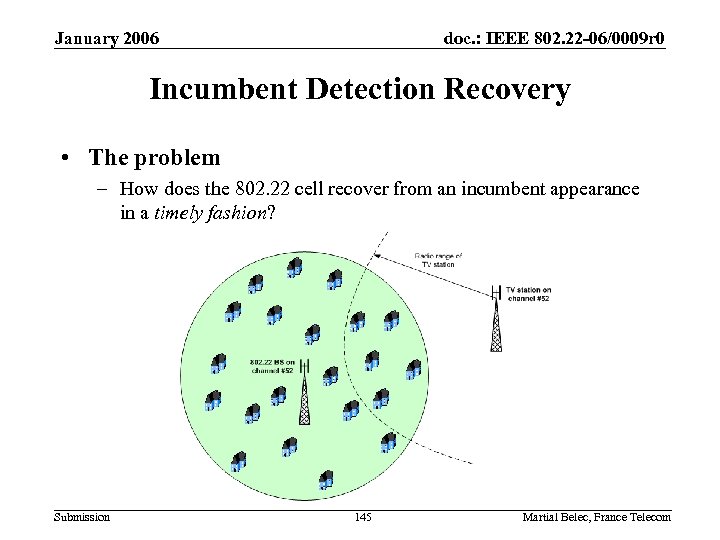 January 2006 doc. : IEEE 802. 22 -06/0009 r 0 Incumbent Detection Recovery • The problem – How does the 802. 22 cell recover from an incumbent appearance in a timely fashion? Submission 145 Martial Belec, France Telecom
 January 2006 doc. : IEEE 802. 22 -06/0009 r 0 Incumbent Detection Recovery (cont. ) • The Incumbent Detection Recovery Protocol (IDRP) – Introduces the concept of Candidate/Backup Channel(s) – The 802. 22 network not only performs in-band measurements, but also out-of-band measurements • Out-of-band measurements will determine suitable Candidate/Backup Channel(s) – The 802. 22 network falls back to a Candidate/Backup Channel in case communication is preempted by an incumbent – The algorithms at both the BS and CPEs are provided • These algorithms also account for the case when no Candidate/Backup Channel is available Submission 146 Martial Belec, France Telecom
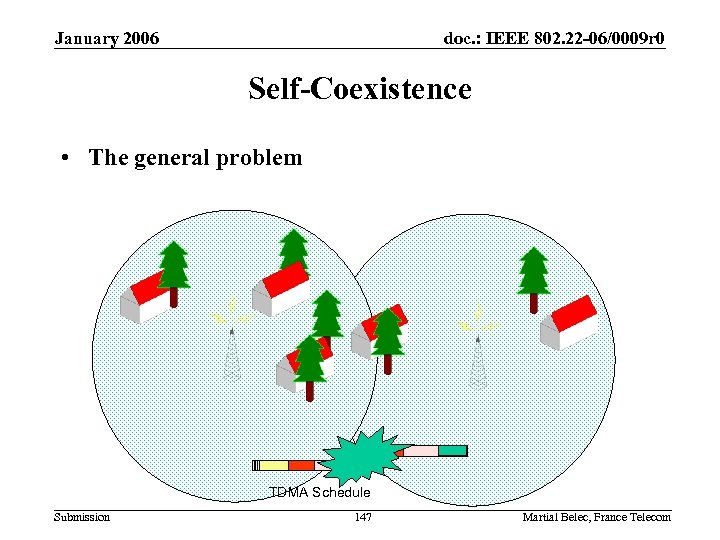 January 2006 doc. : IEEE 802. 22 -06/0009 r 0 Self-Coexistence • The general problem TDMA Schedule Submission 147 Martial Belec, France Telecom
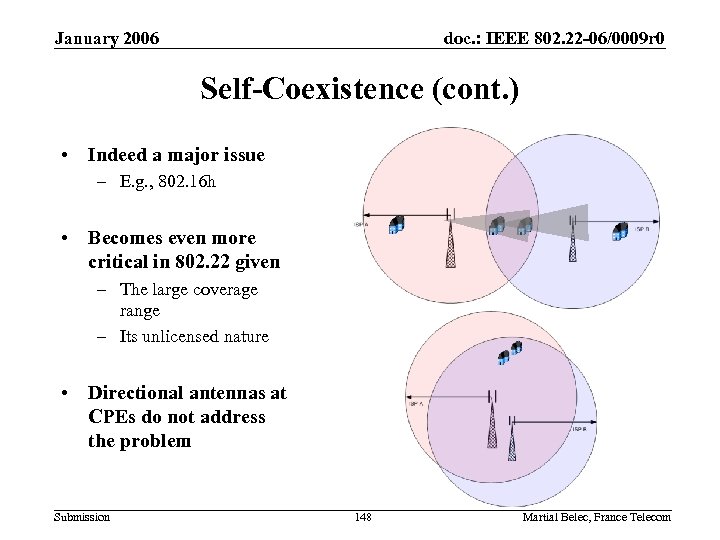 January 2006 doc. : IEEE 802. 22 -06/0009 r 0 Self-Coexistence (cont. ) • Indeed a major issue – E. g. , 802. 16 h • Becomes even more critical in 802. 22 given – The large coverage range – Its unlicensed nature • Directional antennas at CPEs do not address the problem Submission 148 Martial Belec, France Telecom
 January 2006 doc. : IEEE 802. 22 -06/0009 r 0 Self-Coexistence (cont. ) • Some approaches to better self-coexistence – Over the backhaul (i. e. , wired) • Pros – 802. 22 can wash its hands (throw the “hot potato” to somebody else) • Cons – Will there be really a “common backhaul” between competing WISPs? Can 802. 22 rely on that? – What if this “common backhaul” is down? – Can 802. 22 rely on the “upper layers” to take care of self-coexistence? – Coordination is an active process (e. g. , quiet periods), and not a “once-in-a-month thing” – Over-the-air • Pros – Built-in and self-healing 802. 22 system • Cons – More complex MAC layer (but just a little more) Submission 149 Martial Belec, France Telecom
 January 2006 doc. : IEEE 802. 22 -06/0009 r 0 Self-Coexistence (cont. ) • Two solutions are proposed – BS beacon based – The Coexistence Beacon Protocol (CBP), which enables • Sharing in time and frequency • Dynamic resource offering and renting • Etiquette for channel assignment • Both solutions: – Can be implemented either over-the-air or via a backbone • Here, we focus on the over-the-air implementation – Allow either one-way or two-way (i. e. , negotiation) communication • The BS and its CPEs shall participate in the self-coexistence task Submission 150 Martial Belec, France Telecom
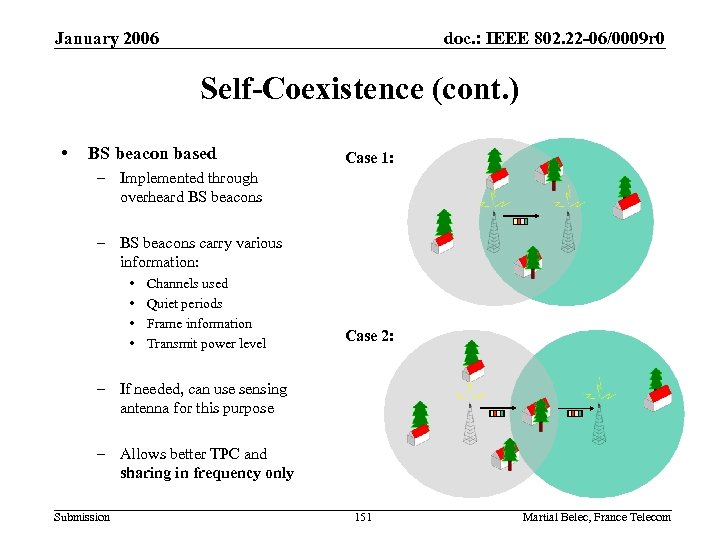 January 2006 doc. : IEEE 802. 22 -06/0009 r 0 Self-Coexistence (cont. ) • BS beacon based Case 1: – Implemented through overheard BS beacons – BS beacons carry various information: • • Channels used Quiet periods Frame information Transmit power level Case 2: – If needed, can use sensing antenna for this purpose – Allows better TPC and sharing in frequency only Submission 151 Martial Belec, France Telecom
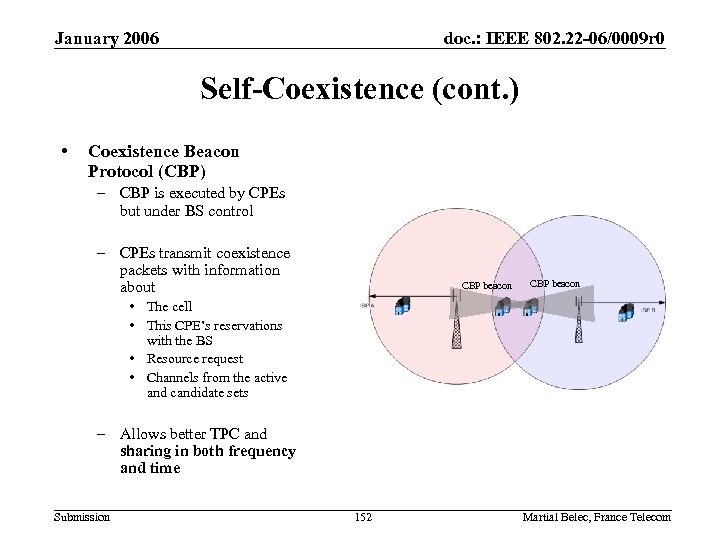 January 2006 doc. : IEEE 802. 22 -06/0009 r 0 Self-Coexistence (cont. ) • Coexistence Beacon Protocol (CBP) – CBP is executed by CPEs but under BS control – CPEs transmit coexistence packets with information about CBP beacon • The cell • This CPE’s reservations with the BS • Resource request • Channels from the active and candidate sets – Allows better TPC and sharing in both frequency and time Submission 152 Martial Belec, France Telecom
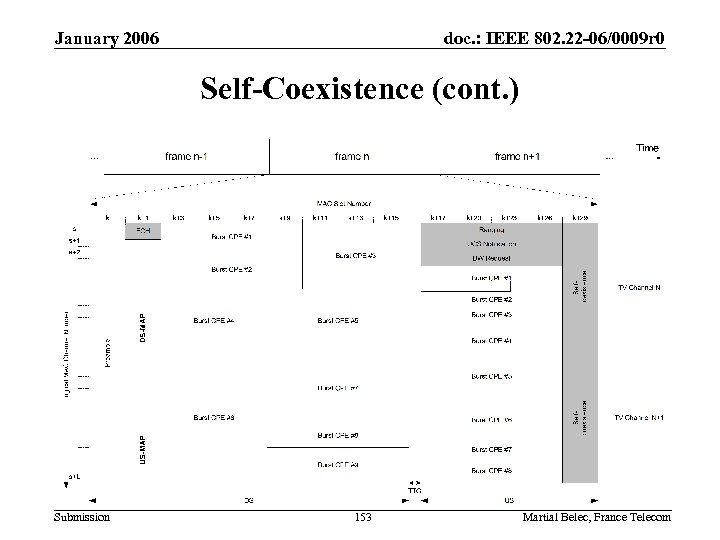 January 2006 doc. : IEEE 802. 22 -06/0009 r 0 Self-Coexistence (cont. ) Submission 153 Martial Belec, France Telecom
 January 2006 doc. : IEEE 802. 22 -06/0009 r 0 But what does the CPEs do with this information? • Report it to its associated BS • Future upstream bandwidth reservation requests can contain time allocation constraints – For example, a CPE can specify: “Give me 100 Kb of airtime, but not between T 1 and T 2” • Note on the BS – Traffic Constraint (TRC-REQ/RSP) management messages are also available to the BS • For example, can be used before the BS allocates any time for the CPE • Allow the BS to inquire CPE about possible time allocation constraints Submission 154 Martial Belec, France Telecom
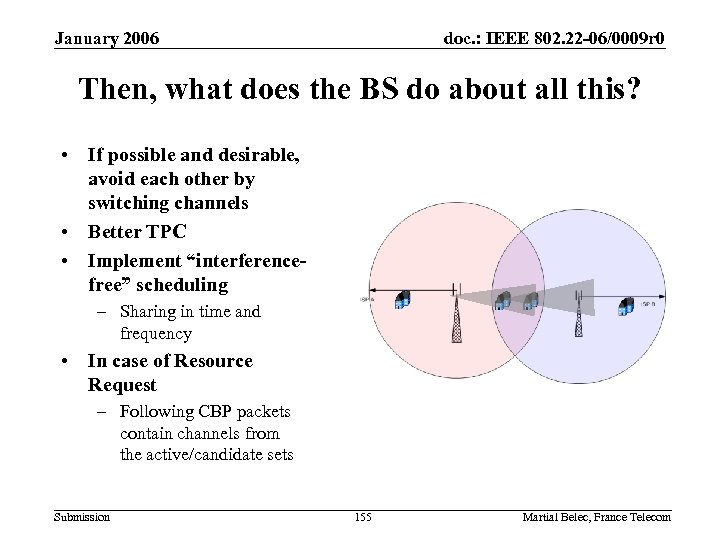 January 2006 doc. : IEEE 802. 22 -06/0009 r 0 Then, what does the BS do about all this? • If possible and desirable, avoid each other by switching channels • Better TPC • Implement “interferencefree” scheduling – Sharing in time and frequency • In case of Resource Request – Following CBP packets contain channels from the active/candidate sets Submission 155 Martial Belec, France Telecom
 January 2006 doc. : IEEE 802. 22 -06/0009 r 0 Resource Renting • When – A BS (Offerer) already acquired TV channels, and if other BSs (Renter) cannot secure the required resource (in the case where vacant TV Channels are not available) • Then – Renter can request a resource partition to the Offerer • Resource partition ratio between different BSs is outside of this proposal (pre-determined) Submission 156 Martial Belec, France Telecom
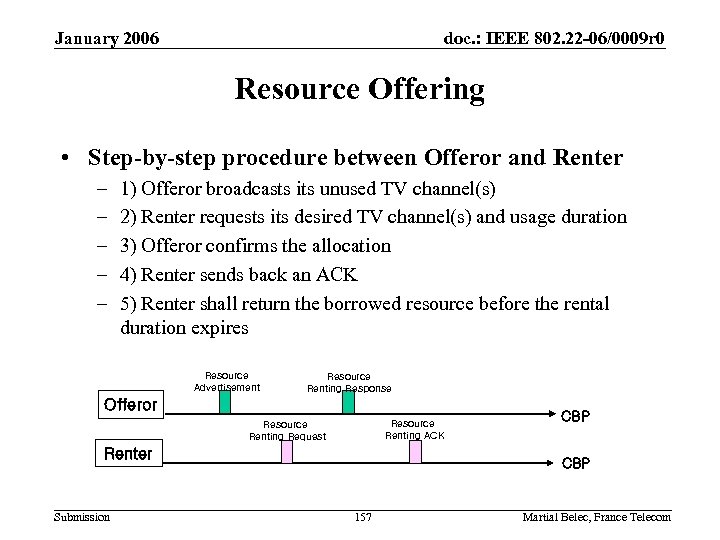 January 2006 doc. : IEEE 802. 22 -06/0009 r 0 Resource Offering • Step-by-step procedure between Offeror and Renter – – – 1) Offeror broadcasts its unused TV channel(s) 2) Renter requests its desired TV channel(s) and usage duration 3) Offeror confirms the allocation 4) Renter sends back an ACK 5) Renter shall return the borrowed resource before the rental duration expires Resource Advertisement Resource Renting Response Offeror Resource Renting ACK Resource Renting Request Renter Submission CBP 157 Martial Belec, France Telecom
 January 2006 doc. : IEEE 802. 22 -06/0009 r 0 Etiquette for Channel Assignment • The renter-offerer mechanism is used to gather channel usage information in neighboring BSs • The etiquette is then used to select the appropriate channel that minimizes interference among collocated/neighboring WRANs Submission 158 Martial Belec, France Telecom
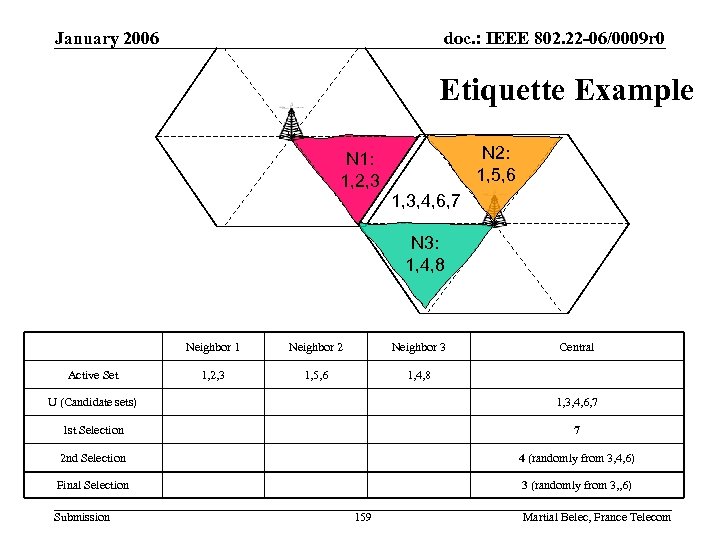 January 2006 doc. : IEEE 802. 22 -06/0009 r 0 Etiquette Example N 2: 1, 5, 6 N 1: 1, 2, 3 1, 3, 4, 6, 7 N 3: 1, 4, 8 Neighbor 1 Active Set Neighbor 2 Neighbor 3 1, 2, 3 1, 5, 6 Central 1, 4, 8 U (Candidate sets) 1, 3, 4, 6, 7 1 st Selection 7 2 nd Selection 4 (randomly from 3, 4, 6) Final Selection 3 (randomly from 3, , 6) Submission 159 Martial Belec, France Telecom
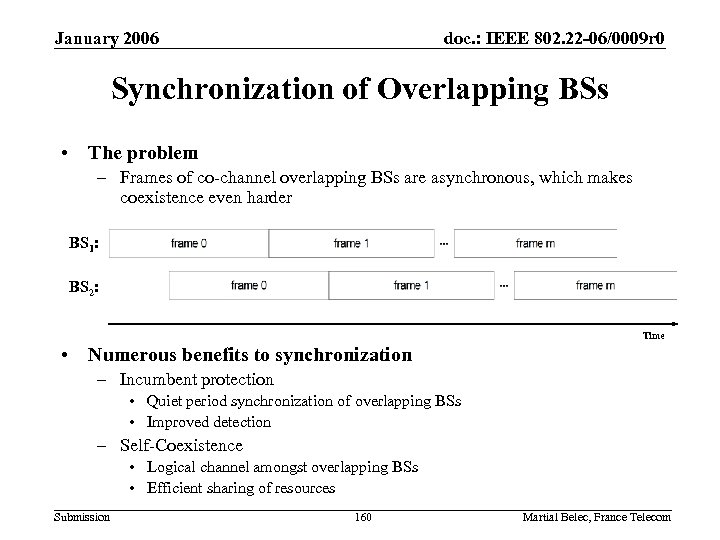 January 2006 doc. : IEEE 802. 22 -06/0009 r 0 Synchronization of Overlapping BSs • The problem – Frames of co-channel overlapping BSs are asynchronous, which makes coexistence even harder BS 1: BS 2: Time • Numerous benefits to synchronization – Incumbent protection • Quiet period synchronization of overlapping BSs • Improved detection – Self-Coexistence • Logical channel amongst overlapping BSs • Efficient sharing of resources Submission 160 Martial Belec, France Telecom
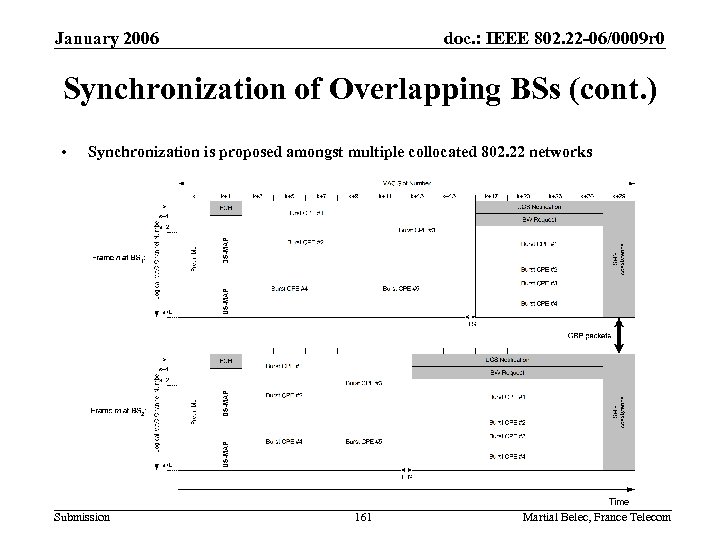 January 2006 doc. : IEEE 802. 22 -06/0009 r 0 Synchronization of Overlapping BSs (cont. ) • Synchronization is proposed amongst multiple collocated 802. 22 networks Submission 161 Martial Belec, France Telecom
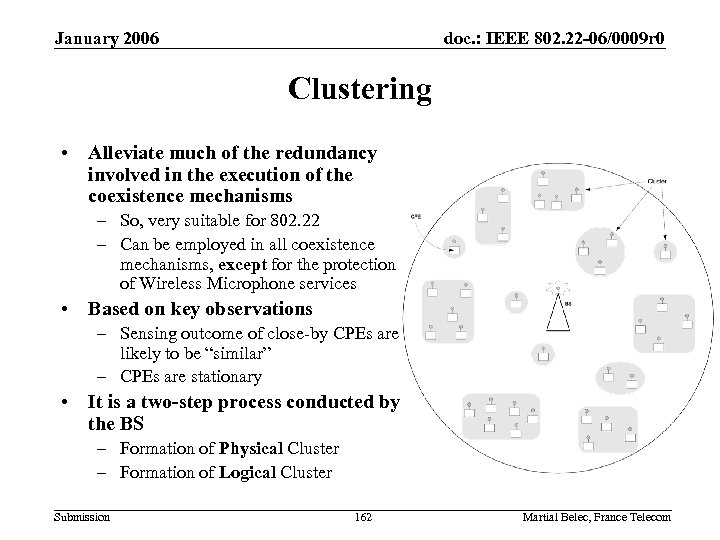 January 2006 doc. : IEEE 802. 22 -06/0009 r 0 Clustering • Alleviate much of the redundancy involved in the execution of the coexistence mechanisms – So, very suitable for 802. 22 – Can be employed in all coexistence mechanisms, except for the protection of Wireless Microphone services • Based on key observations – Sensing outcome of close-by CPEs are likely to be “similar” – CPEs are stationary • It is a two-step process conducted by the BS – Formation of Physical Cluster – Formation of Logical Cluster Submission 162 Martial Belec, France Telecom
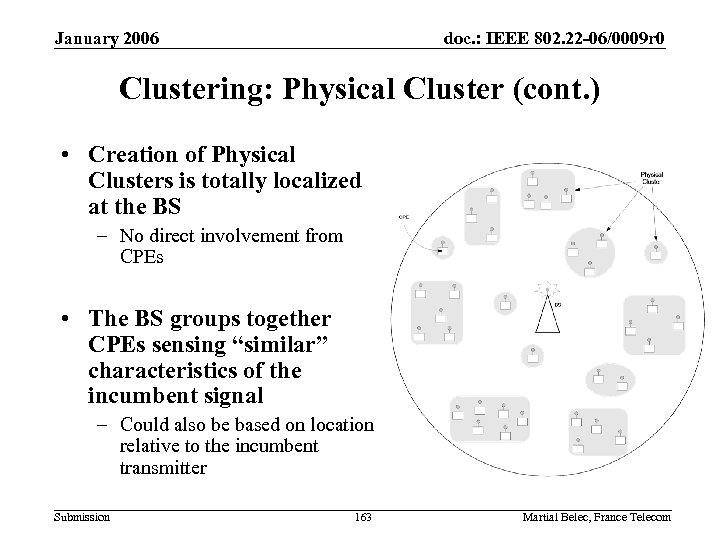 January 2006 doc. : IEEE 802. 22 -06/0009 r 0 Clustering: Physical Cluster (cont. ) • Creation of Physical Clusters is totally localized at the BS – No direct involvement from CPEs • The BS groups together CPEs sensing “similar” characteristics of the incumbent signal – Could also be based on location relative to the incumbent transmitter Submission 163 Martial Belec, France Telecom
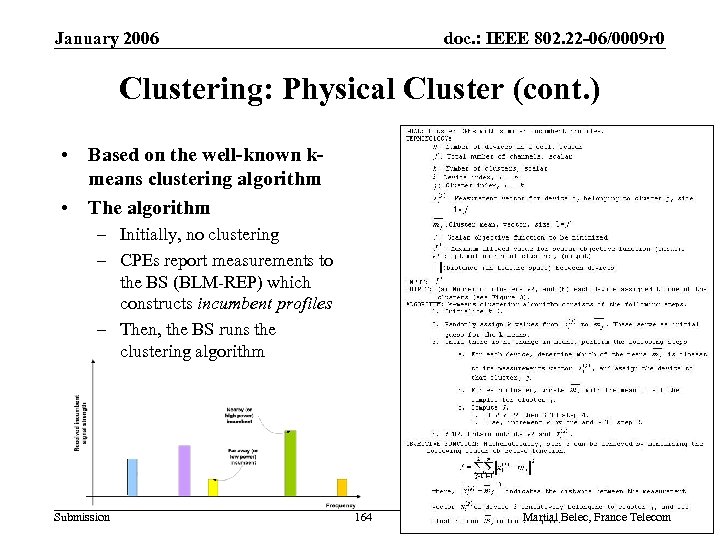 January 2006 doc. : IEEE 802. 22 -06/0009 r 0 Clustering: Physical Cluster (cont. ) • Based on the well-known kmeans clustering algorithm • The algorithm – Initially, no clustering – CPEs report measurements to the BS (BLM-REP) which constructs incumbent profiles – Then, the BS runs the clustering algorithm Submission 164 Martial Belec, France Telecom
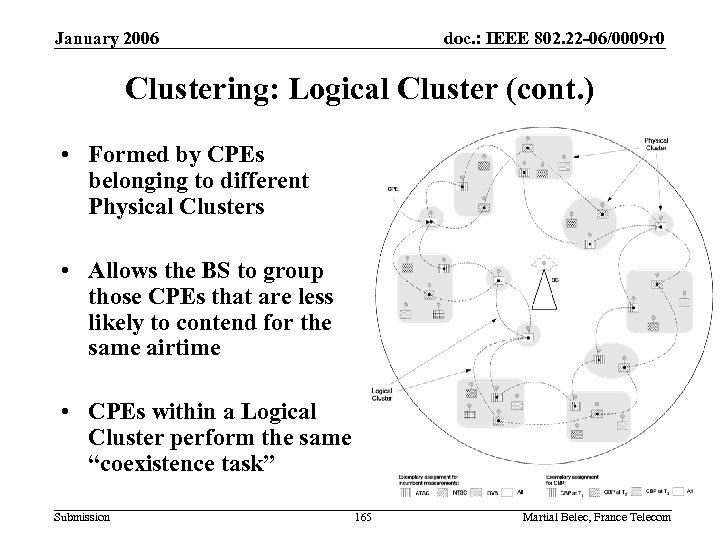 January 2006 doc. : IEEE 802. 22 -06/0009 r 0 Clustering: Logical Cluster (cont. ) • Formed by CPEs belonging to different Physical Clusters • Allows the BS to group those CPEs that are less likely to contend for the same airtime • CPEs within a Logical Cluster perform the same “coexistence task” Submission 165 Martial Belec, France Telecom
 January 2006 doc. : IEEE 802. 22 -06/0009 r 0 MAC Presentation Outline • Introduction • The MAC Protocol – Protocol architecture – MAC layer data communication • Superframe and Frame Structures • Network entry and initialization • Downstream and Upstream scheduling – Coexistence • • Incumbents Self-Coexistence Synchronization of overlapping BSs Clustering – Security • Performance Evaluation Submission 166 Martial Belec, France Telecom
 January 2006 doc. : IEEE 802. 22 -06/0009 r 0 Security Sublayer • Based on IEEE 802. 16 e/D 12 security sublayer – Generic security framework made specifically for BWA networks – Meets all the security requirements identified for the 802. 22 WRAN Standard – Deeply studied and improved by various security experts (including IEEE and IETF ones) • Composed of two sublayers – A Privacy Key Management protocol (PKM) which provides authentication, authorization and secure key distribution between the BS and the CPE – An encapsulation protocol which provides data packets protection Submission 167 Martial Belec, France Telecom
 January 2006 doc. : IEEE 802. 22 -06/0009 r 0 Security Sublayer (cont. ) • Mutual Authentication of the devices – Either using RSA and digital certificates – Or using EAP and EAP-method specific credentials • Authentication of the subscribers (optional) – Using EAP and EAP-method specific credentials • Authorization based on authenticated CPE and/or subscriber identity – Give access to dedicated service flows Submission 168 Martial Belec, France Telecom
 January 2006 doc. : IEEE 802. 22 -06/0009 r 0 Security Sublayer (cont. ) • Data packets encryption – Using strong cryptographic algorithms (AES) • Management frames integrity protection – Using keyed message authentication codes • Protection against Deny of Service and other attacks – – Submission Protection of management frames against forgery and replay attacks Protection of data frames against replay attacks Protection of EAP packets during subscribers authentication Protection of every key negotiation phase, using digital signatures and random numbers 169 Martial Belec, France Telecom
 January 2006 doc. : IEEE 802. 22 -06/0009 r 0 MAC Presentation Outline • Introduction • The MAC Protocol – Protocol architecture – MAC layer data communication • Superframe and Frame Structures • Network entry and initialization • Downstream and Upstream scheduling – Coexistence • • Incumbents Self-Coexistence Synchronization of overlapping BSs Clustering – Security • Performance Evaluation Submission 170 Martial Belec, France Telecom
 January 2006 doc. : IEEE 802. 22 -06/0009 r 0 Performance Evaluation • All aspects of the MAC are being implemented in OPNET – OPNET is considered the most well-reputated and reliable network simulation tool available today • In all simulations: – In case of quiet periods (QP), every CPE performs detection in all in-band channels (e. g. , N-1, N, and N+1 in case of a single TV channel) – DFS model is implemented as per the requirements document – No fragmentation or packing • Some common simulation parameters – – Submission Superframe size = 12 frames, where Frame size = 40 ms Packet size = 1 Kbyte Detection time per TV channel = 13 ms 64 -QAM rate 2/3 and Symbol time = 310 µs 171 Martial Belec, France Telecom
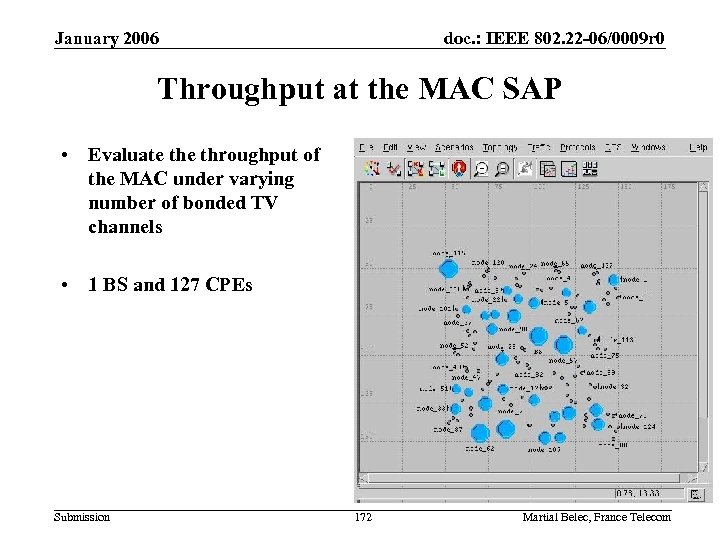 January 2006 doc. : IEEE 802. 22 -06/0009 r 0 Throughput at the MAC SAP • Evaluate throughput of the MAC under varying number of bonded TV channels • 1 BS and 127 CPEs Submission 172 Martial Belec, France Telecom
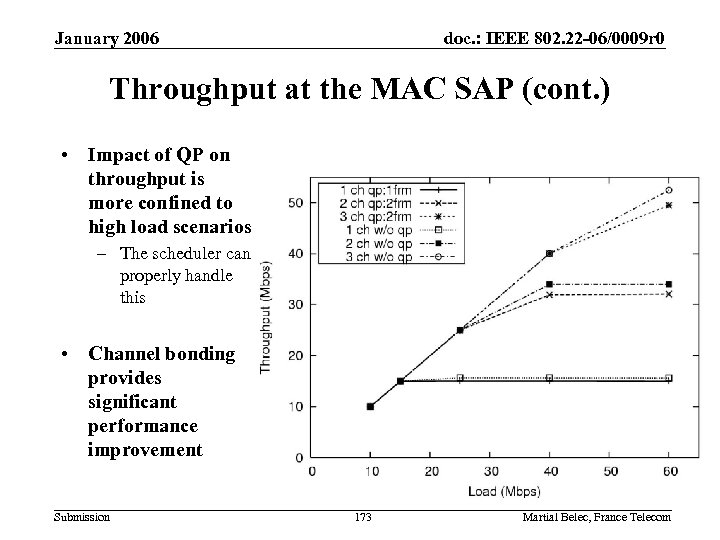 January 2006 doc. : IEEE 802. 22 -06/0009 r 0 Throughput at the MAC SAP (cont. ) • Impact of QP on throughput is more confined to high load scenarios – The scheduler can properly handle this • Channel bonding provides significant performance improvement Submission 173 Martial Belec, France Telecom
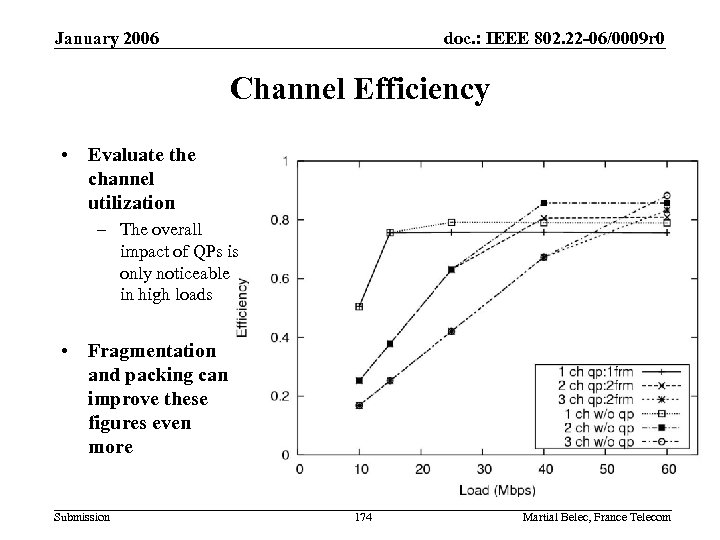 January 2006 doc. : IEEE 802. 22 -06/0009 r 0 Channel Efficiency • Evaluate the channel utilization – The overall impact of QPs is only noticeable in high loads • Fragmentation and packing can improve these figures even more Submission 174 Martial Belec, France Telecom
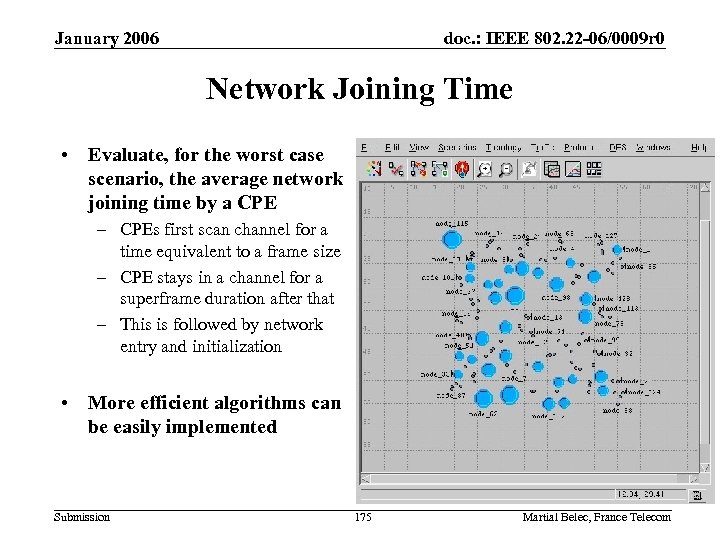 January 2006 doc. : IEEE 802. 22 -06/0009 r 0 Network Joining Time • Evaluate, for the worst case scenario, the average network joining time by a CPE – CPEs first scan channel for a time equivalent to a frame size – CPE stays in a channel for a superframe duration after that – This is followed by network entry and initialization • More efficient algorithms can be easily implemented Submission 175 Martial Belec, France Telecom
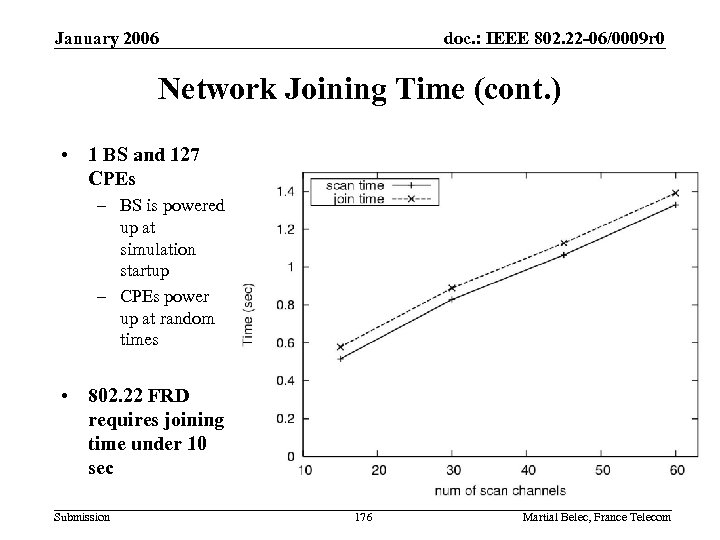 January 2006 doc. : IEEE 802. 22 -06/0009 r 0 Network Joining Time (cont. ) • 1 BS and 127 CPEs – BS is powered up at simulation startup – CPEs power up at random times • 802. 22 FRD requires joining time under 10 sec Submission 176 Martial Belec, France Telecom
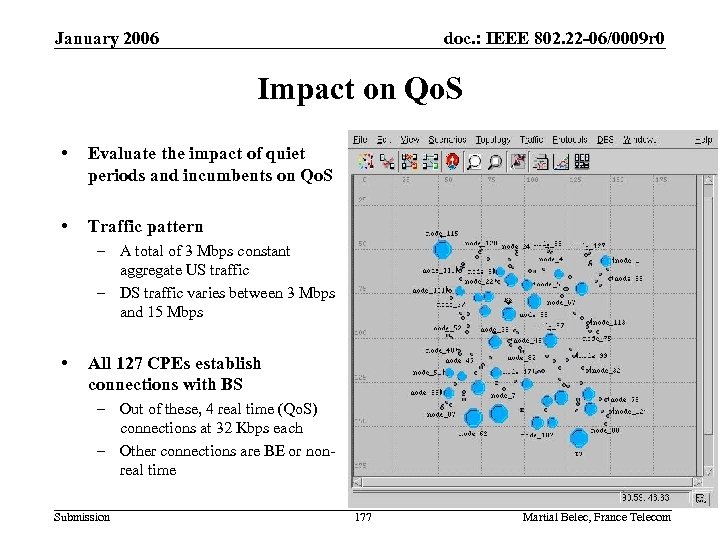 January 2006 doc. : IEEE 802. 22 -06/0009 r 0 Impact on Qo. S • Evaluate the impact of quiet periods and incumbents on Qo. S • Traffic pattern – A total of 3 Mbps constant aggregate US traffic – DS traffic varies between 3 Mbps and 15 Mbps • All 127 CPEs establish connections with BS – Out of these, 4 real time (Qo. S) connections at 32 Kbps each – Other connections are BE or nonreal time Submission 177 Martial Belec, France Telecom
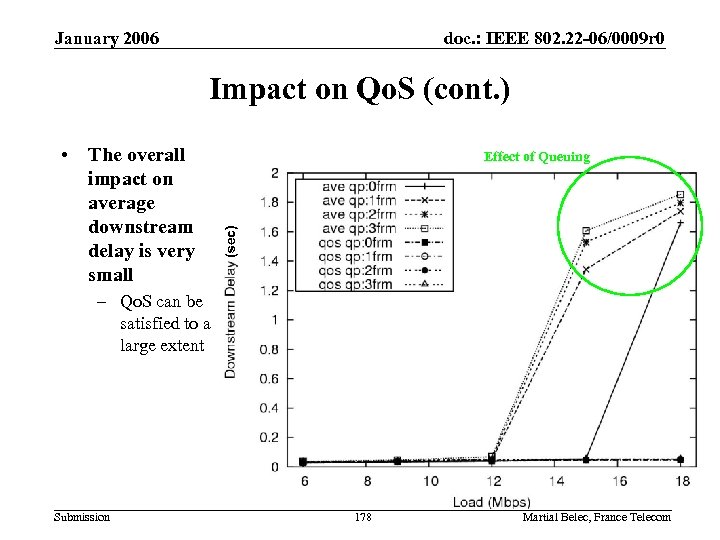 January 2006 doc. : IEEE 802. 22 -06/0009 r 0 Impact on Qo. S (cont. ) Effect of Queuing (sec) • The overall impact on average downstream delay is very small – Qo. S can be satisfied to a large extent Submission 178 Martial Belec, France Telecom
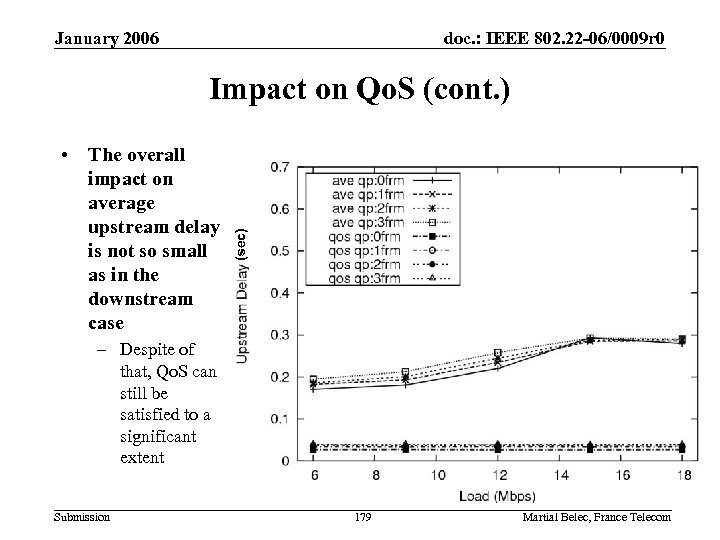 January 2006 doc. : IEEE 802. 22 -06/0009 r 0 • The overall impact on average upstream delay is not so small as in the downstream case (sec) Impact on Qo. S (cont. ) – Despite of that, Qo. S can still be satisfied to a significant extent Submission 179 Martial Belec, France Telecom
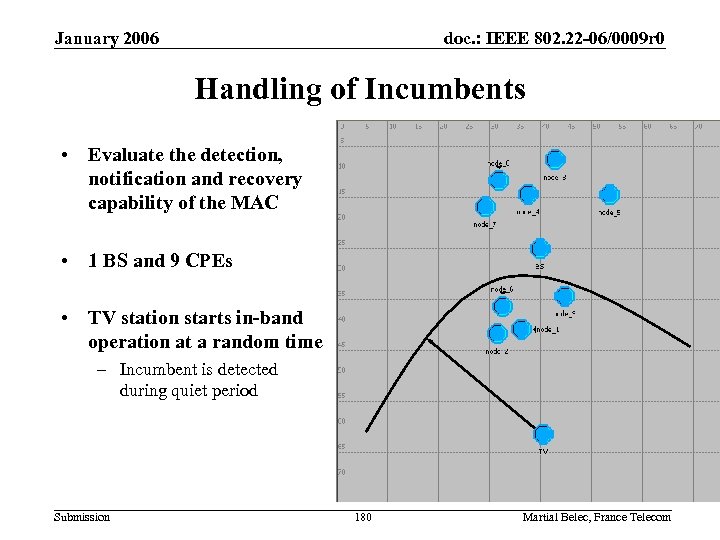 January 2006 doc. : IEEE 802. 22 -06/0009 r 0 Handling of Incumbents • Evaluate the detection, notification and recovery capability of the MAC • 1 BS and 9 CPEs • TV station starts in-band operation at a random time – Incumbent is detected during quiet period Submission 180 Martial Belec, France Telecom
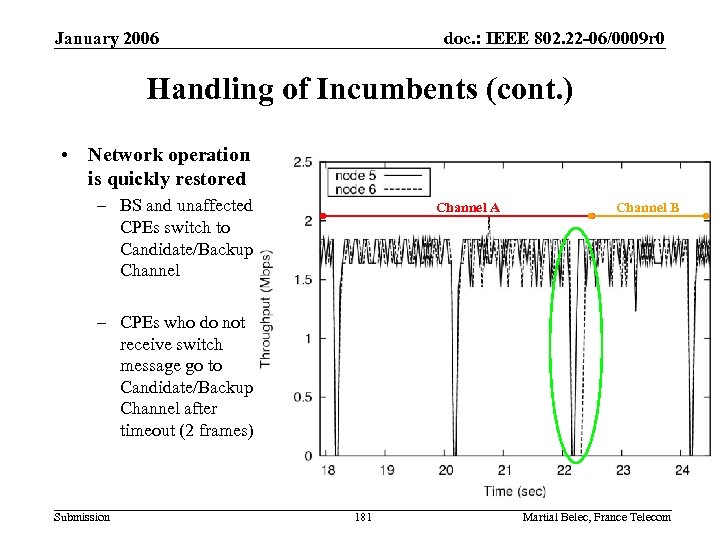 January 2006 doc. : IEEE 802. 22 -06/0009 r 0 Handling of Incumbents (cont. ) • Network operation is quickly restored – BS and unaffected CPEs switch to Candidate/Backup Channel A Channel B – CPEs who do not receive switch message go to Candidate/Backup Channel after timeout (2 frames) Submission 181 Martial Belec, France Telecom
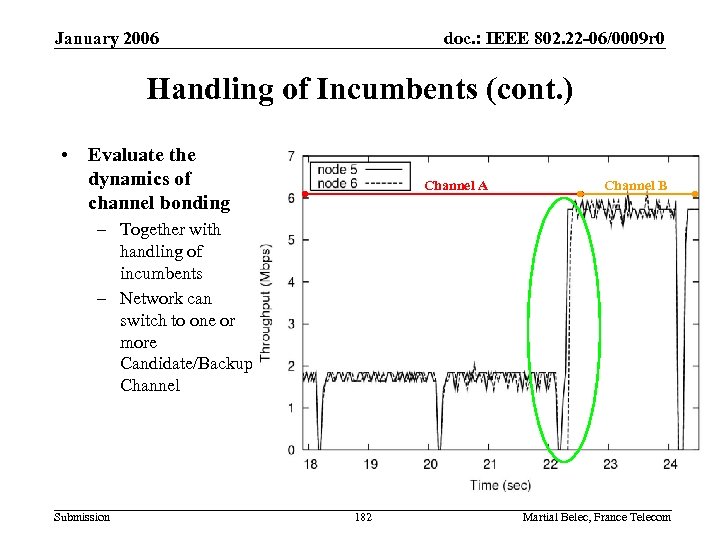 January 2006 doc. : IEEE 802. 22 -06/0009 r 0 Handling of Incumbents (cont. ) • Evaluate the dynamics of channel bonding Channel A Channel B – Together with handling of incumbents – Network can switch to one or more Candidate/Backup Channel Submission 182 Martial Belec, France Telecom
 January 2006 doc. : IEEE 802. 22 -06/0009 r 0 Presentation Outline • Introduction – A Glimpse of IEEE 802. 22 • The PHY Proposal • The MAC Proposal • Conclusions Submission 183 Martial Belec, France Telecom
 January 2006 doc. : IEEE 802. 22 -06/0009 r 0 Conclusions • Proposed a PHY and MAC that addresses the requirements set forth by the 802. 22 WG • PHY – Based on OFDMA – Flexible channel configurations – TV and Part 74 service detection and protection • MAC – Coexistence is a key feature • Incumbent protection • Self-coexistence – CBP, dynamic resource sharing, channel bonding, etc. Submission 184 Martial Belec, France Telecom
 January 2006 doc. : IEEE 802. 22 -06/0009 r 0 Appendix A • WRAN maximum transmit power constraint for interference management and coexistence Submission 185 Martial Belec, France Telecom
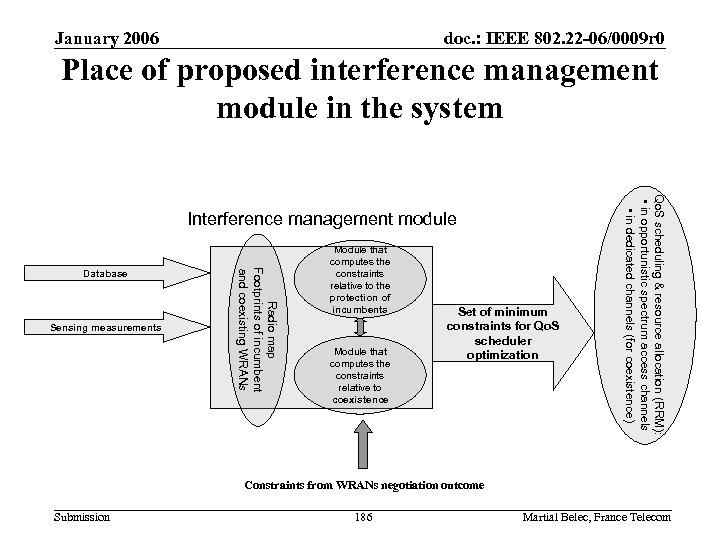 January 2006 doc. : IEEE 802. 22 -06/0009 r 0 Place of proposed interference management module in the system Sensing measurements Radio map Footprints of incumbent and coexisting WRANs Database Module that computes the constraints relative to the protection of incumbents Module that computes the constraints relative to coexistence Set of minimum constraints for Qo. S scheduler optimization Qo. S scheduling & resource allocation (RRM): • in opportunistic spectrum access channels • in dedicated channels (for coexistence) Interference management module Constraints from WRANs negotiation outcome Submission 186 Martial Belec, France Telecom
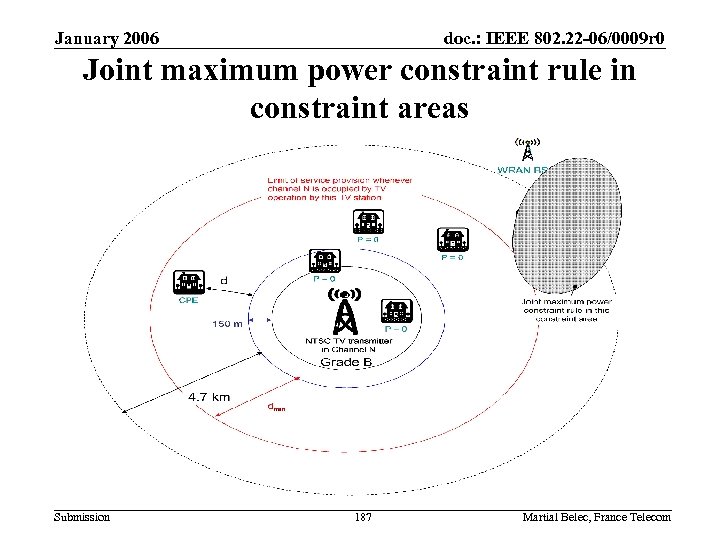 January 2006 doc. : IEEE 802. 22 -06/0009 r 0 Joint maximum power constraint rule in constraint areas Submission 187 Martial Belec, France Telecom
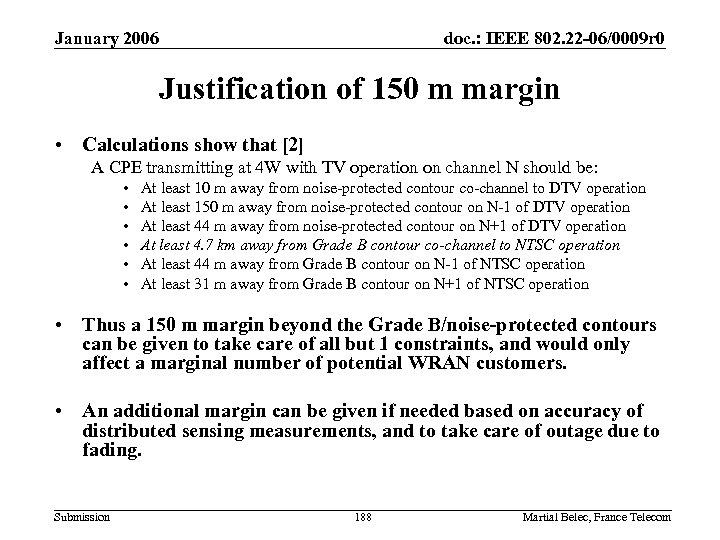 January 2006 doc. : IEEE 802. 22 -06/0009 r 0 Justification of 150 m margin • Calculations show that [2] A CPE transmitting at 4 W with TV operation on channel N should be: • • • At least 10 m away from noise-protected contour co-channel to DTV operation At least 150 m away from noise-protected contour on N-1 of DTV operation At least 44 m away from noise-protected contour on N+1 of DTV operation At least 4. 7 km away from Grade B contour co-channel to NTSC operation At least 44 m away from Grade B contour on N-1 of NTSC operation At least 31 m away from Grade B contour on N+1 of NTSC operation • Thus a 150 m margin beyond the Grade B/noise-protected contours can be given to take care of all but 1 constraints, and would only affect a marginal number of potential WRAN customers. • An additional margin can be given if needed based on accuracy of distributed sensing measurements, and to take care of outage due to fading. Submission 188 Martial Belec, France Telecom
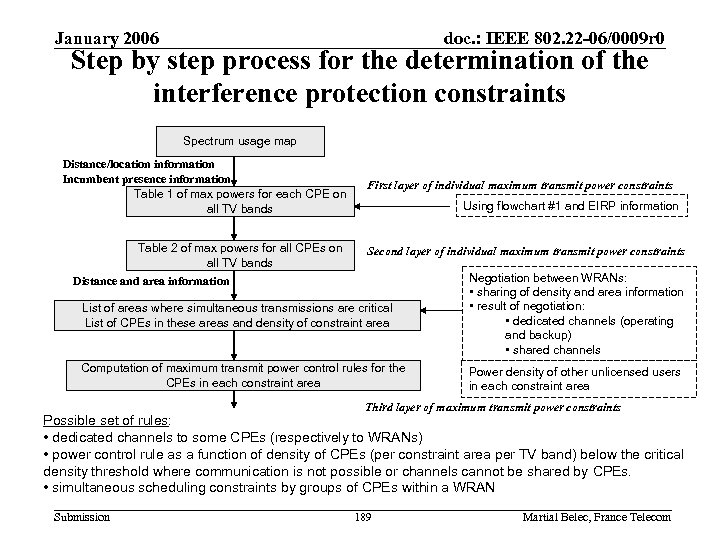 January 2006 doc. : IEEE 802. 22 -06/0009 r 0 Step by step process for the determination of the interference protection constraints Spectrum usage map Distance/location information Incumbent presence information Table 1 of max powers for each CPE on all TV bands Table 2 of max powers for all CPEs on all TV bands First layer of individual maximum transmit power constraints Using flowchart #1 and EIRP information Second layer of individual maximum transmit power constraints List of areas where simultaneous transmissions are critical List of CPEs in these areas and density of constraint area Negotiation between WRANs: • sharing of density and area information • result of negotiation: • dedicated channels (operating and backup) • shared channels Computation of maximum transmit power control rules for the CPEs in each constraint area Power density of other unlicensed users in each constraint area Distance and area information Third layer of maximum transmit power constraints Possible set of rules: • dedicated channels to some CPEs (respectively to WRANs) • power control rule as a function of density of CPEs (per constraint area per TV band) below the critical density threshold where communication is not possible or channels cannot be shared by CPEs. • simultaneous scheduling constraints by groups of CPEs within a WRAN Submission 189 Martial Belec, France Telecom
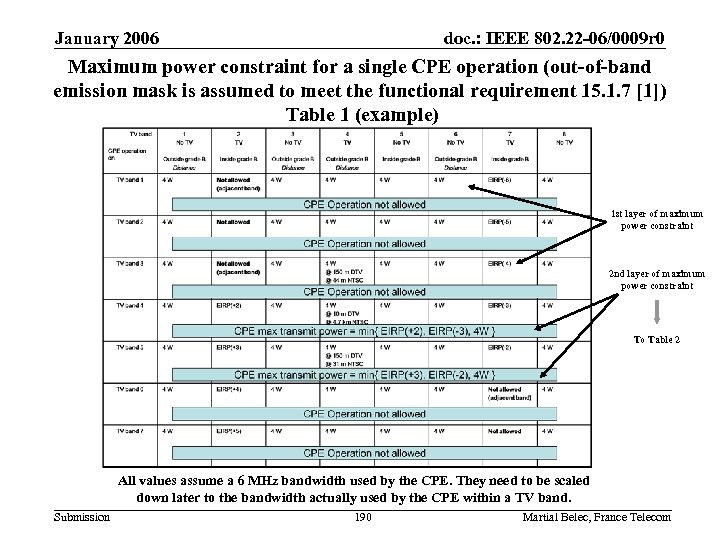 January 2006 doc. : IEEE 802. 22 -06/0009 r 0 Maximum power constraint for a single CPE operation (out-of-band emission mask is assumed to meet the functional requirement 15. 1. 7 [1]) Table 1 (example) 1 st layer of maximum power constraint 2 nd layer of maximum power constraint To Table 2 All values assume a 6 MHz bandwidth used by the CPE. They need to be scaled down later to the bandwidth actually used by the CPE within a TV band. Submission 190 Martial Belec, France Telecom
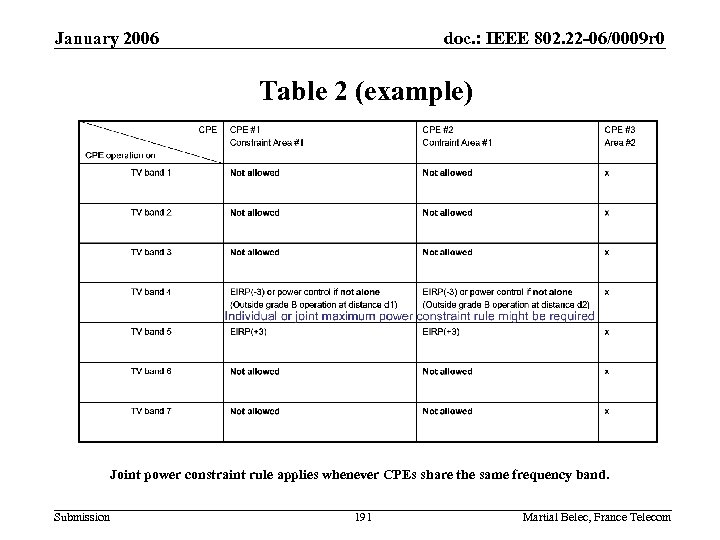 January 2006 doc. : IEEE 802. 22 -06/0009 r 0 Table 2 (example) Joint power constraint rule applies whenever CPEs share the same frequency band. Submission 191 Martial Belec, France Telecom
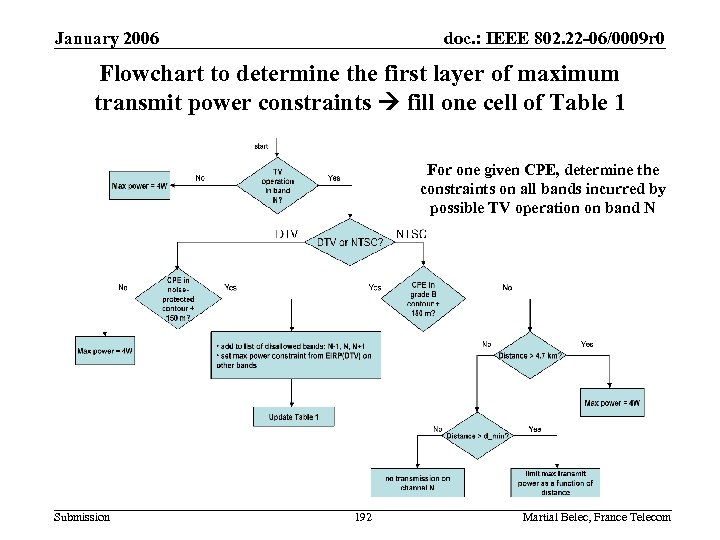 January 2006 doc. : IEEE 802. 22 -06/0009 r 0 Flowchart to determine the first layer of maximum transmit power constraints fill one cell of Table 1 For one given CPE, determine the constraints on all bands incurred by possible TV operation on band N Submission 192 Martial Belec, France Telecom
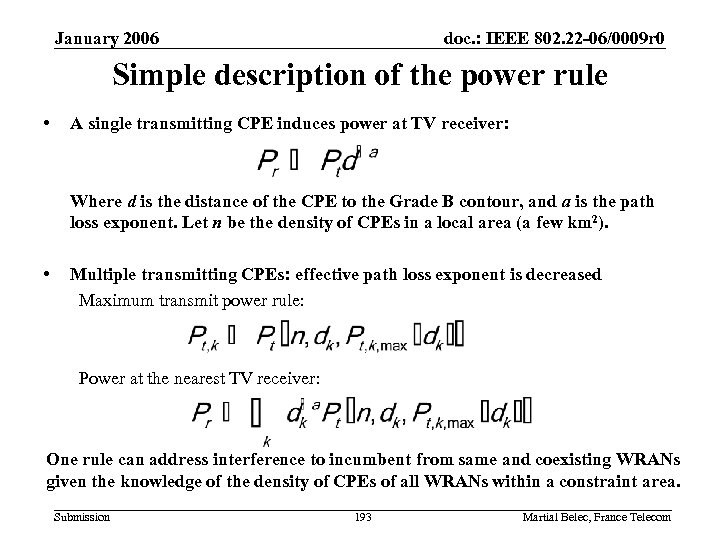 January 2006 doc. : IEEE 802. 22 -06/0009 r 0 Simple description of the power rule • A single transmitting CPE induces power at TV receiver: Where d is the distance of the CPE to the Grade B contour, and a is the path loss exponent. Let n be the density of CPEs in a local area (a few km 2). • Multiple transmitting CPEs: effective path loss exponent is decreased Maximum transmit power rule: Power at the nearest TV receiver: One rule can address interference to incumbent from same and coexisting WRANs given the knowledge of the density of CPEs of all WRANs within a constraint area. Submission 193 Martial Belec, France Telecom
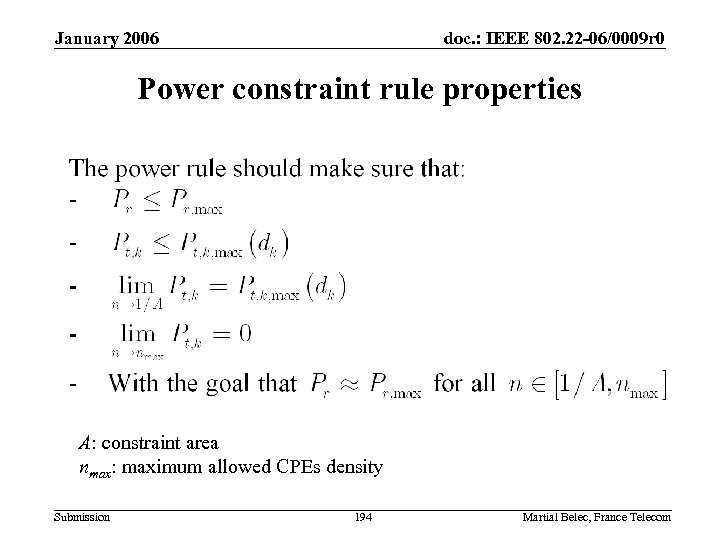 January 2006 doc. : IEEE 802. 22 -06/0009 r 0 Power constraint rule properties A: constraint area nmax: maximum allowed CPEs density Submission 194 Martial Belec, France Telecom
 January 2006 doc. : IEEE 802. 22 -06/0009 r 0 Appendix B • Coexistence with other LE systems (Contention -Based Protocol) Submission 195 Martial Belec, France Telecom
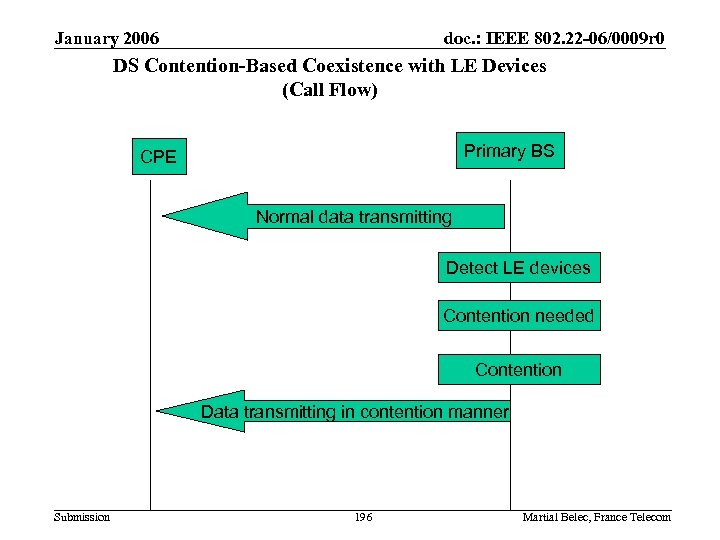 January 2006 doc. : IEEE 802. 22 -06/0009 r 0 DS Contention-Based Coexistence with LE Devices (Call Flow) Primary BS CPE Normal data transmitting Detect LE devices Contention needed Contention Data transmitting in contention manner Submission 196 Martial Belec, France Telecom
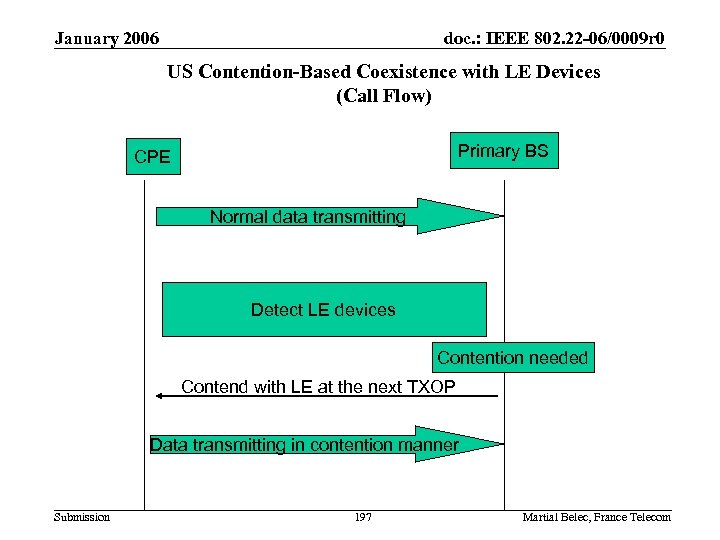 January 2006 doc. : IEEE 802. 22 -06/0009 r 0 US Contention-Based Coexistence with LE Devices (Call Flow) Primary BS CPE Normal data transmitting Detect LE devices Contention needed Contend with LE at the next TXOP Data transmitting in contention manner Submission 197 Martial Belec, France Telecom