


 Скачать презентацию January 2003 doc IEEE 802 15 -03 044
7ba9beee267999920c984f6df3227b21.ppt
- Количество слайдов: 13
 January 2003 doc. : IEEE 802. 15 -03/044 r 0 Project: IEEE P 802. 15 Working Group for Wireless Personal Area Networks (WPANs) Submission Title: [PULSERS presentation to IEEE 802. 15. 4] Date Submitted: [January 2003] Source: [Ph. Rouzet STMicroelectronics] on behalf of PULSERS Company [STM] Address [STMicroelectronics, 39 Chemin du Champ des Filles 1228 Geneve Plan-les-Ouates, Switzerland] Voice [+41 22 929 58 66], Fax [+41 22 929 29 70] E-Mail[Philippe Rouzet@st. com] Re: [] Abstract: [This contribution describes the on-going process of putting in place a UWB focused European Project called PULSERS, which is applying for the 6 th framework of the European Community telecommunication projects] Purpose: [In this presentation, we describe the process of putting in place a comprehensive UWB project for the 6 th framework, as well as the motivations and main targets for such a project. The framework is supposed to last for about 5 years with several calls for projects within this period of time. PULSERS is a strong initiative with more than 45 organizations wishing to apply, and with the goal of contributing to regulation, standardization, algorithms and IPs development, and demonstrator implementation. High speed communication systems, meshed networks and low data rate sensor networks are targeted. ] Notice: This document has been prepared to assist the IEEE P 802. 15. It is offered as a basis for discussion and is not binding on the contributing individual or organization. The material in this document is subject to change in form and content after further study. The contributor reserves the right to add, amend or withdraw material contained herein. Release: The contributors acknowledge and accepts that this contribution becomes the property of IEEE and may be made publicly available by P 802. 15. Submission 1 Philippe Rouzet – on behalf of Pulsers
 January 2003 doc. : IEEE 802. 15 -03/044 r 0 PULSERS Pervasive Ultra-wideband Low Spectral Energy Radio Systems A European Initiative for Integrated UWB System Research Walter Hirt IBM Zurich Research Rüschlikon, Switzerland (hir@zurich. ibm. com) Domenico Porcino Philips Research Redhill, UK (domenico. porcino@philips. com) Philippe Rouzet STMicroelectronics NV Plan-Les-Ouates-Geneva Switzerland (philippe. rouzet@st. com) Joint IEEE Interim 802. 11, 802. 15, 802. 18, 802. 19 and 802. 20 Standards Meetings Fort Lauderdale, FL, USA January 13 -17, 2003 Submission 2 Philippe Rouzet – on behalf of Pulsers
 January 2003 doc. : IEEE 802. 15 -03/044 r 0 A European Initiative for Integrated UWB System Research “What is a Pervasive Wireless System? ” § A state of wireless networking where a user moves seamlessly from one area to another unhindered by bandwidth and incompatible wireless methods. § Seamless and wireless networking not just between users but between users and intelligent appliances and between such appliances themselves. § Wireless (indoor) networking where data transactions and network operation and management are supported by up-to-date and precise terminal location information. Submission 3 Philippe Rouzet – on behalf of Pulsers
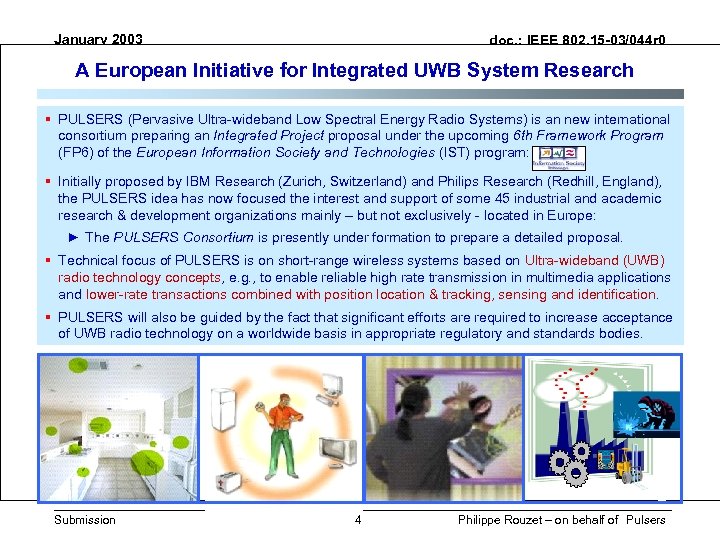 January 2003 doc. : IEEE 802. 15 -03/044 r 0 A European Initiative for Integrated UWB System Research § PULSERS (Pervasive Ultra-wideband Low Spectral Energy Radio Systems) is an new international consortium preparing an Integrated Project proposal under the upcoming 6 th Framework Program (FP 6) of the European Information Society and Technologies (IST) program: § Initially proposed by IBM Research (Zurich, Switzerland) and Philips Research (Redhill, England), the PULSERS idea has now focused the interest and support of some 45 industrial and academic research & development organizations mainly – but not exclusively - located in Europe: ► The PULSERS Consortium is presently under formation to prepare a detailed proposal. § Technical focus of PULSERS is on short-range wireless systems based on Ultra-wideband (UWB) radio technology concepts, e. g. , to enable reliable high rate transmission in multimedia applications and lower-rate transactions combined with position location & tracking, sensing and identification. § PULSERS will also be guided by the fact that significant efforts are required to increase acceptance of UWB radio technology on a worldwide basis in appropriate regulatory and standards bodies. Submission 4 Philippe Rouzet – on behalf of Pulsers
 January 2003 doc. : IEEE 802. 15 -03/044 r 0 Main Objectives Ø User Scenarios and Applications – Define new, perhaps unconventional user scenarios and applications which leverage the unique advantages and properties offered by UWB-RT; determine requirements on the qualitative and quantitative PHY/MAC and higher layer specifications (e. g. , joint data and positioning). Ø Performance and Algorithms – Perform a comparative performance analysis (theory, simulation and experiments) to assess the merits of various coding, modulation, multiple-access and positioning schemes for UWB radio applications; include pulsed and alternate (ultra-)wideband signaling methods. Ø Interference and Coexistence – Determine interference and coexistence effects of – and on – UWB devices in heterogeneous network situations; coordinate and cooperate with related organizations. Ø Semiconductor and Circuit Technologies – Advancements in the use of high-speed, mixed-signal semiconductor processes (e. g. , CMOS, Si. Ge/Bi. CMOS, Ga. As, In. Ph) and design methods, enabling high-volume, low-power and cost-effective “system on chip” (So. C) or “system on package” (So. P) solutions. Ø Implementation and Demonstration – Implement/demonstrate selected user scenarios in terms of UWB hardware and specific software and trial application functions (e. g. , data, positioning, sensing) in ambient intelligent environments. Ø Regulation and Standardization – Support a global consensus on UWB radio regulation and work towards consolidated proposals and submissions to international bodies standardizing UWB radio devices and services. Submission 5 Philippe Rouzet – on behalf of Pulsers
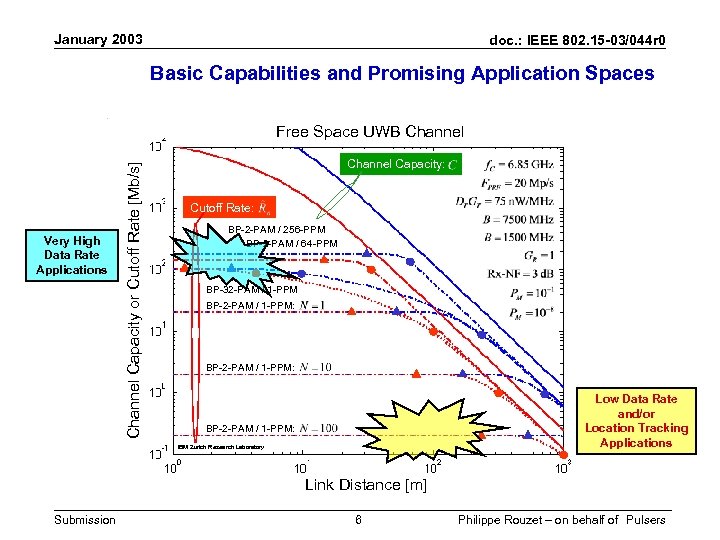 January 2003 doc. : IEEE 802. 15 -03/044 r 0 Basic Capabilities and Promising Application Spaces Very High Data Rate Applications Channel Capacity or Cutoff Rate ~ [Mb/s] Free Space UWB Channel Capacity: Cutoff Rate: BP-2 -PAM / 256 -PPM BP-2 -PAM / 64 -PPM BP-32 -PAM / 1 -PPM BP-2 -PAM / 1 -PPM: Low Data Rate and/or Location Tracking Applications BP-2 -PAM / 1 -PPM: IBM Zurich Research Laboratory Link Distance [m] Submission 6 Philippe Rouzet – on behalf of Pulsers
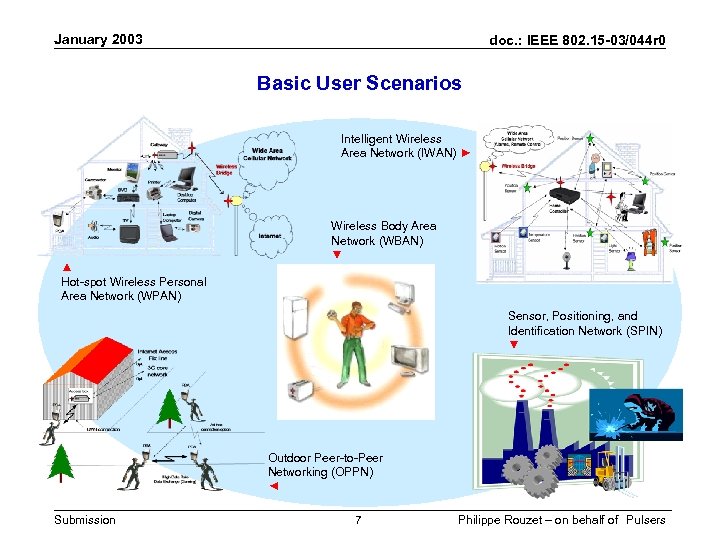 January 2003 doc. : IEEE 802. 15 -03/044 r 0 Basic User Scenarios Intelligent Wireless Area Network (IWAN) ► ▲ Hot-spot Wireless Personal Area Network (WPAN) Wireless Body Area Network (WBAN) ▼ Sensor, Positioning, and Identification Network (SPIN) ▼ Outdoor Peer-to-Peer Networking (OPPN) ◄ Submission 7 Philippe Rouzet – on behalf of Pulsers
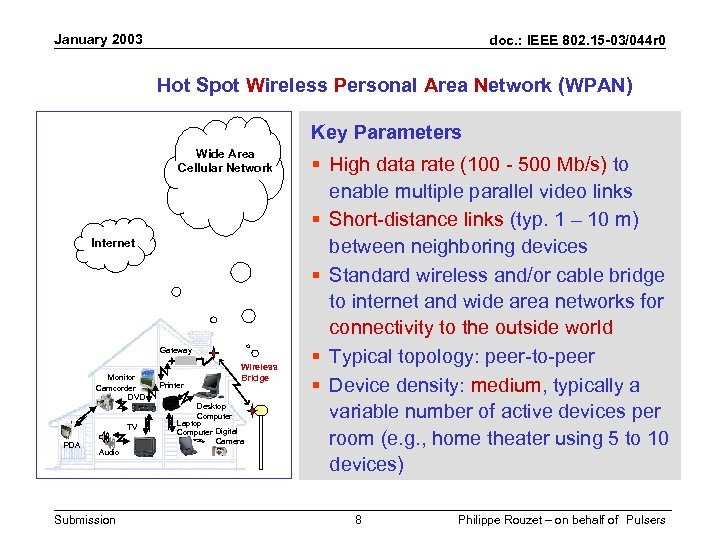 January 2003 doc. : IEEE 802. 15 -03/044 r 0 Hot Spot Wireless Personal Area Network (WPAN) Key Parameters Wide Area Cellular Network Internet Gateway Monitor Camcorder DVD TV PDA Audio Submission Printer Wireless Bridge Desktop Computer Laptop Computer Digital Camera § High data rate (100 - 500 Mb/s) to enable multiple parallel video links § Short-distance links (typ. 1 – 10 m) between neighboring devices § Standard wireless and/or cable bridge to internet and wide area networks for connectivity to the outside world § Typical topology: peer-to-peer § Device density: medium, typically a variable number of active devices per room (e. g. , home theater using 5 to 10 devices) 8 Philippe Rouzet – on behalf of Pulsers
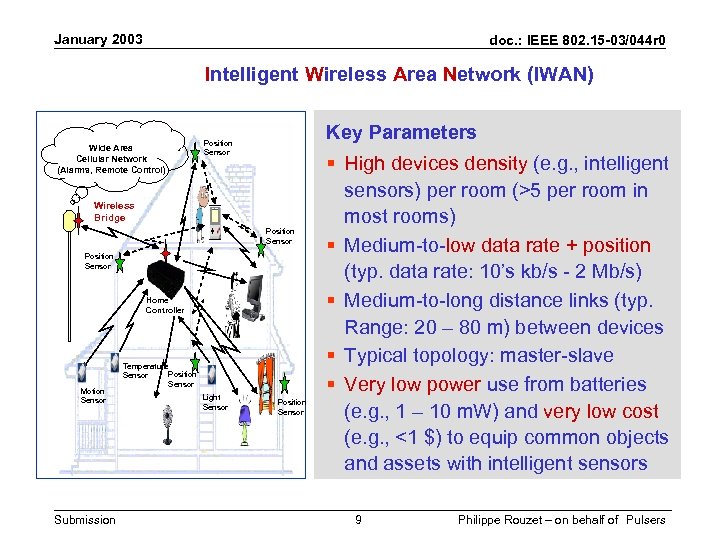 January 2003 doc. : IEEE 802. 15 -03/044 r 0 Intelligent Wireless Area Network (IWAN) Wide Area Cellular Network (Alarms, Remote Control) Key Parameters Position Sensor Wireless Bridge Position Sensor Home Controller Motion Sensor Submission Temperature Position Sensor Light Sensor Position Sensor § High devices density (e. g. , intelligent sensors) per room (>5 per room in most rooms) § Medium-to-low data rate + position (typ. data rate: 10’s kb/s - 2 Mb/s) § Medium-to-long distance links (typ. Range: 20 – 80 m) between devices § Typical topology: master-slave § Very low power use from batteries (e. g. , 1 – 10 m. W) and very low cost (e. g. , <1 $) to equip common objects and assets with intelligent sensors 9 Philippe Rouzet – on behalf of Pulsers
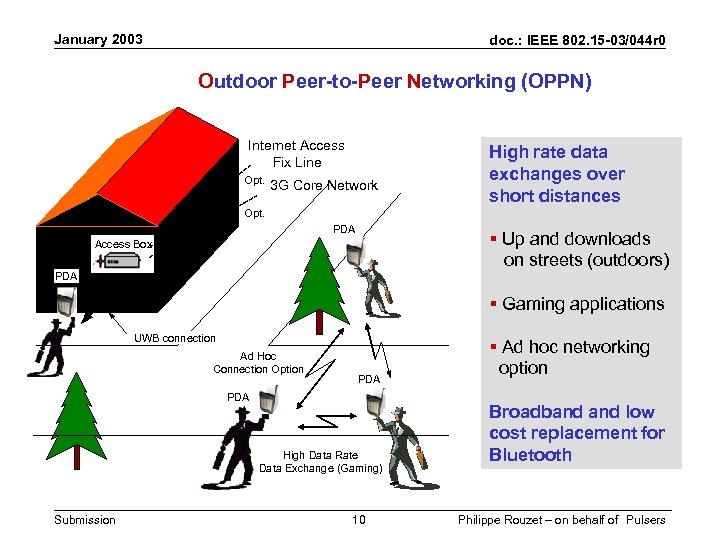 January 2003 doc. : IEEE 802. 15 -03/044 r 0 Outdoor Peer-to-Peer Networking (OPPN) Internet Access Fix Line Opt. 3 G Core Network High rate data exchanges over short distances Opt. PDA § Up and downloads on streets (outdoors) Access Box PDA § Gaming applications UWB connection Ad Hoc Connection Option PDA High Data Rate Data Exchange (Gaming) Submission 10 § Ad hoc networking option Broadband low cost replacement for Bluetooth Philippe Rouzet – on behalf of Pulsers
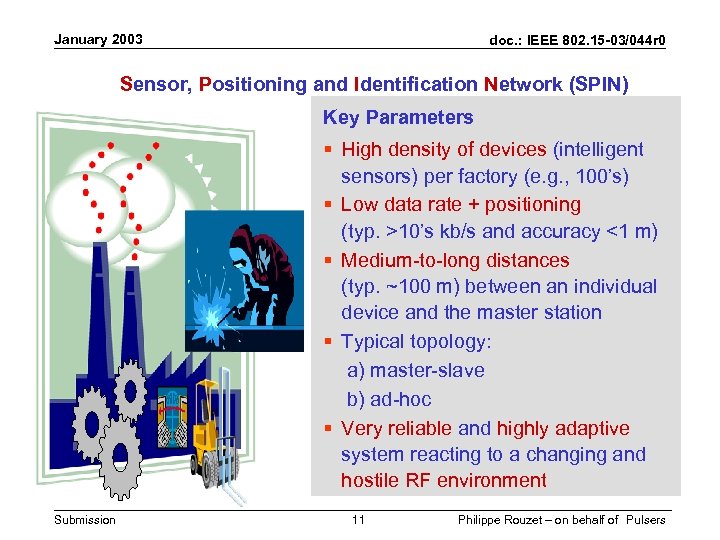 January 2003 doc. : IEEE 802. 15 -03/044 r 0 Sensor, Positioning and Identification Network (SPIN) Key Parameters § High density of devices (intelligent sensors) per factory (e. g. , 100’s) § Low data rate + positioning (typ. >10’s kb/s and accuracy <1 m) § Medium-to-long distances (typ. ~100 m) between an individual device and the master station § Typical topology: a) master-slave b) ad-hoc § Very reliable and highly adaptive system reacting to a changing and hostile RF environment Submission 11 Philippe Rouzet – on behalf of Pulsers
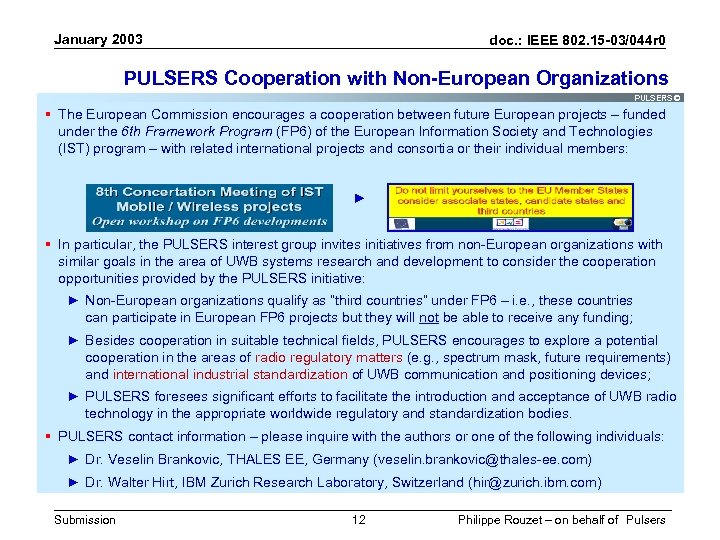 January 2003 doc. : IEEE 802. 15 -03/044 r 0 PULSERS Cooperation with Non-European Organizations PULSERS © § The European Commission encourages a cooperation between future European projects – funded under the 6 th Framework Program (FP 6) of the European Information Society and Technologies (IST) program – with related international projects and consortia or their individual members: ► § In particular, the PULSERS interest group invites initiatives from non-European organizations with similar goals in the area of UWB systems research and development to consider the cooperation opportunities provided by the PULSERS initiative: ► Non-European organizations qualify as “third countries” under FP 6 – i. e. , these countries can participate in European FP 6 projects but they will not be able to receive any funding; ► Besides cooperation in suitable technical fields, PULSERS encourages to explore a potential cooperation in the areas of radio regulatory matters (e. g. , spectrum mask, future requirements) and international industrial standardization of UWB communication and positioning devices; ► PULSERS foresees significant efforts to facilitate the introduction and acceptance of UWB radio technology in the appropriate worldwide regulatory and standardization bodies. § PULSERS contact information – please inquire with the authors or one of the following individuals: ► Dr. Veselin Brankovic, THALES EE, Germany (veselin. brankovic@thales-ee. com) ► Dr. Walter Hirt, IBM Zurich Research Laboratory, Switzerland (hir@zurich. ibm. com) Submission 12 Philippe Rouzet – on behalf of Pulsers
 January 2003 doc. : IEEE 802. 15 -03/044 r 0 Summary § PULSERS defined the operational contexts and user scenarios for UWB applications requiring data communication and location tracking or a combination of both § Four main user scenarios have been identified: - Hot spot wireless personal area network (WPAN); - Intelligent wireless area network (IWAN); - Outdoor peer-to-peer networking (OPPN); - Sensor, positioning and identification network (SPIN). § Started to determine the requirements in terms of communication needs (e. g. , data rate, link distance, ad-hoc or centralized network) and location information (e. g. , distance, direction, and position accuracy). § Next steps include definition of requirements for the physical layer (PHY) and medium access control (MAC). § The need for a globally harmonized spectrum regulation is considered a critical asset - coordinated actions are planned or have already started. § PULSERS will apply for an Integrated Project under IST-FP 6 (Call 1). Submission 13 Philippe Rouzet – on behalf of Pulsers