 Скачать презентацию Janet 6 Building a national 100 GE network
ca14dc0c4b2dec433433b46b8981c9f7.ppt
- Количество слайдов: 24



Janet 6 Building a national 100 GE network Rob Evans
What is Janet? • “The UK’s research and education network. ” – Connects higher education and further education – Schools via local authority aggregation networks – Research institutions • Where do we connect them to? – Other research and education networks • Via GEANT – Pan-European R&E backbone – Connects to other global R&E networks – The Internet • Transit • Peering
Since when? • I’m glad you asked that… • …since 30 years ago this year. – Feel free to burst into a chorus of ‘happy birthday. ’ • On the backbone, we’ve seen – X. 25 • Who needs IP anyway? – IP over X. 25 • Oh, we do. Blasted Internet. – SMDS • Judging from all our network diagrams, a ‘cloud’ service. – ATM – Po. S • No, not that, packet over SONET • 2. 5 G, 10 G, 40 G Po. S (we liked Po. S, lots of counters and alarms) – 100 GE
Super. JANET 5 • Started operation in 2006 • Transmission layer managed by Verizon Business – …but dedicated to Janet • IP layer managed in-house • POS – 10 G POS – 40 G POS • See presentation at UKNOF 12 • I’ll be asking questions on POLMUX-QPSK later • 100 GE • See presentation at UKNOF 19, I told you I was building capacity to last until 2013 • It’s now 2013^H 4. – All good things must come to an end • Especially those bought under a fixed-term contract
Janet 6: Prologue • Requirements gathering • Reliability – Application outsourcing • Google Apps • Microsoft Live@EDU – Remote teaching – R&E networks haven’t been “experimental” for a long time • Scalability – – – LHC ITER SKA You know, “big data” Costs • Power, space, engineering resource • Flexibility
Requirements • Separacy – Personal opinion: don’t trust the network! – PSN • ISO 27001 • Impact Levels • Confidentiality, Integrity, Availability – We have a lot of public sector customers
What did we want? • Dark fibre. – All the cool kids are doing it – Some ‘novel’ requests coming in the research environment • Stable frequency distribution • Control of the transmission equipment – – Remove one layer of overhead Better knowledge of underlying infrastructure Together with the dark fibre, upgrade when we need to Better understanding of implications of new technologies • ‘Thin’ transmission layer? – – DWDM (coherent? ) OTN optics in the routers Getting there for 10 G Some way off for 100 G Still need to pay the OEO penalty
European procurement • “Competitive dialogue” process • Two procurements – Dark fibre – Transmission equipment • PQQ, ITPD, several rounds of dialogue, final tender – Pre-qualification questionnaire – Dialogue • • Prepare (and later refine) requirements Half a day of dialogue per bidder Feed that back into requirements Up to six bidders in each procurement, two procurements – 9 month long process • I swear this is the only slide on EC procurement process
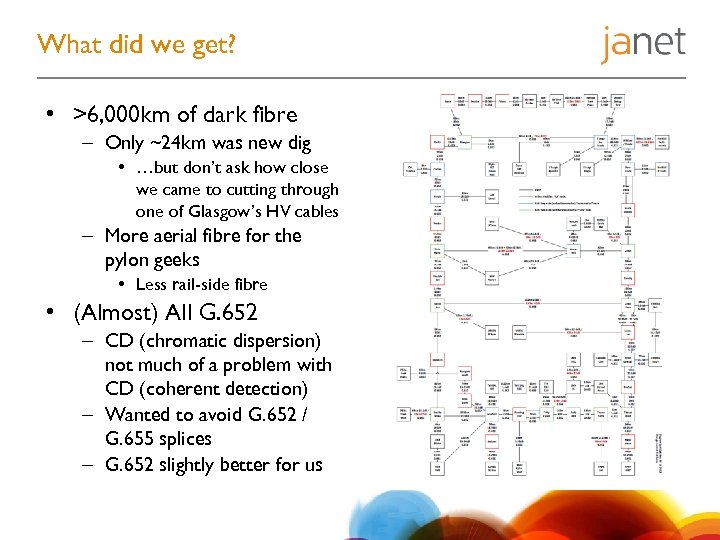
What did we get? • >6, 000 km of dark fibre – Only ~24 km was new dig • …but don’t ask how close we came to cutting through one of Glasgow’s HV cables – More aerial fibre for the pylon geeks • Less rail-side fibre • (Almost) All G. 652 – CD (chromatic dispersion) not much of a problem with CD (coherent detection) – Wanted to avoid G. 652 / G. 655 splices – G. 652 slightly better for us
What did we get: Transmission kit • Ciena 6500 transmission equipment – Coherent optical • 100 GE from one end of the country to the other without regeneration – No dispersion compensation – Minimum wavelength capacity of 40 Gbit/s • Also 100 Gbit/s • 4 x 10 GE, 40 GE, 10 x 10 GE, 100 GE • (There is e. DCO 10 G, but not worth burning a lambda for. ) – Up to 88 wavelengths • We’ll probably run out of rack space first
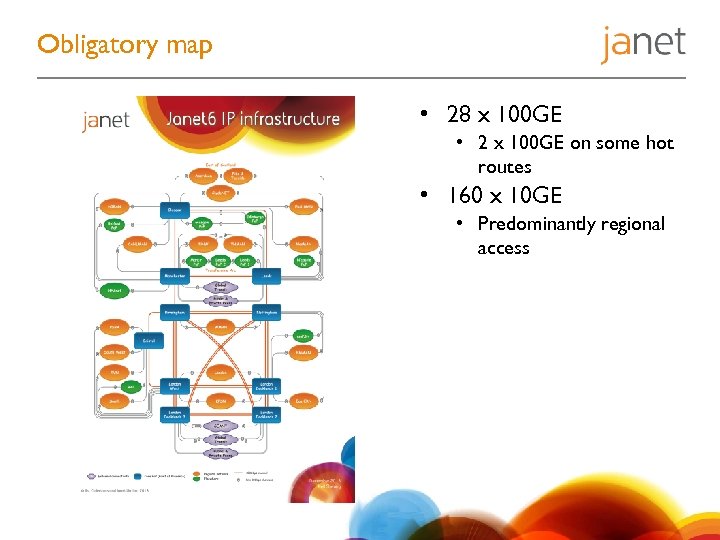
Obligatory map • 28 x 100 GE • 2 x 100 GE on some hot routes • 160 x 10 GE • Predominantly regional access
What did we get? • Juniper T-4000 routers – An upgrade from the T-1600 we had already – 2 x 100 GE or 24 x 10 GE per slot – Cost per 100 GE ~ ⅓ that of T-1600 • Also gets rid of the VLAN steering / multicast bit hack – Some have 7 x 100 GE interfaces in
100 GE Optics • 100 GBASE-SR 10 or 100 GBASE-LR$ – Oh, sorry, hanging shift key, 100 GBASE-LR 4. – Just to reach between transmission equipment and routers in neighbouring racks • LR 4 – Uses normal single-mode fibre patch cords • Which we have plenty of • Which we know how to clean and test – Fits in with existing ODFs • SR 10 – Uses 24 core multimode cables with MPO connectors • Which we had none of – Doesn’t fit in with existing ODFs. – Is much, much less expensive than LR 4. – Like £ 1 M cheaper across the network. • SR 10 it is then
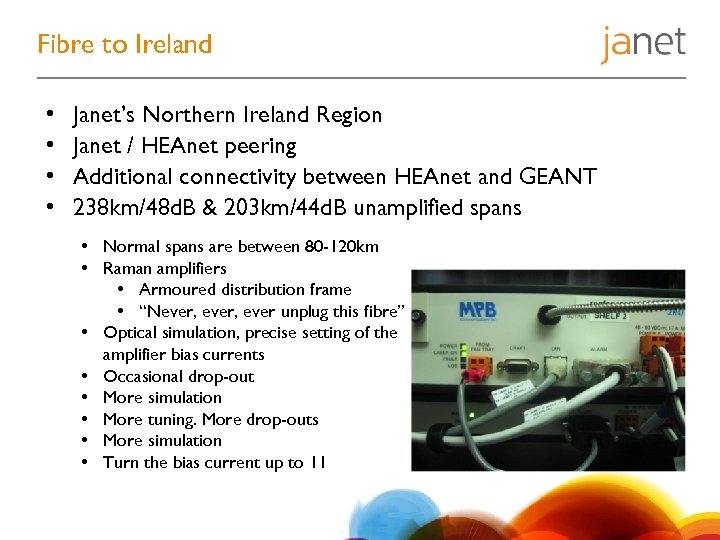
Fibre to Ireland • • Janet’s Northern Ireland Region Janet / HEAnet peering Additional connectivity between HEAnet and GEANT 238 km/48 d. B & 203 km/44 d. B unamplified spans • Normal spans are between 80 -120 km • Raman amplifiers • Armoured distribution frame • “Never, ever unplug this fibre” • Optical simulation, precise setting of the amplifier bias currents • Occasional drop-out • More simulation • More tuning. More drop-outs • More simulation • Turn the bias current up to 11
More submarine fibres • Fibre to Ireland – Long spans and additional amplification reduces channel count • Aberdeen to Dundee – Resilient route is 124 km without amplification – Submarine amplifiers
Acceptance testing • 6, 000 km of duplex fibre. – 12, 000 km of fibre – Splices (at least) every 2 km – OTDR reports from each direction on the fibre • Check each figure manually – Chromatic Dispersions – Polarisation Mode Dispersion reports – I was in the US for a meeting, optical specialist was with family in India, project manager was in the UK. • Po. Ps – ~80 of them – Rack layouts, cabling, acceptance reports, quality assurance reports.
Some challenges • Working to a tight schedule – The Super. JANET 5 contract finished on 23 rd October, 2013 – We had to complete build and migration by that date • Meetings – Someone calculated 512 hours • I’m not sure if that is total or per week. • Emails – One of the project managers counted 19, 000 • Janet engineers, Ciena’s installation subcontractor, router installation, DC power installation, fibre engineers – Bradley Stoke, 4 th March 2013 – 22 engineers due on site on same day • Sandbags
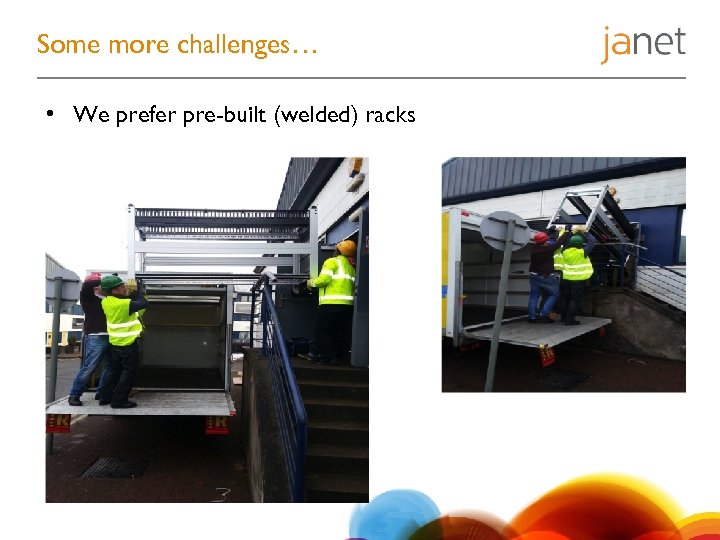
Some more challenges… • We prefer pre-built (welded) racks
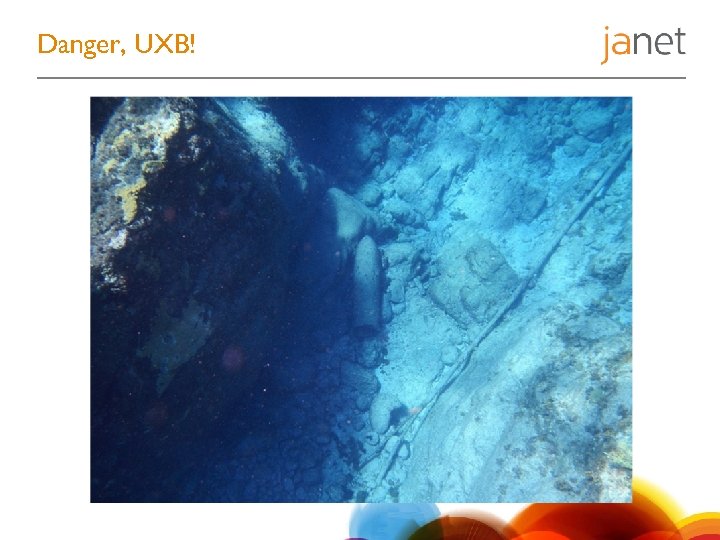
Danger, UXB!
Operational support • Only managed limited amounts of DWDM until now • Multiple NMS systems – HP Open. View for IP • SNIPS as a backup – Ciena On. Center for older transmission equipment • • Lots of windows open Bring the alarms together in one place Write modules for an open source NMS Work in progress
Some observations • Dark fibre – – 10 -15 year contract Not many potential providers Most prefer to sell services What will it be like when we want to renew? • What’s in a name? – Janet 6 is nothing to do with IPv 6 – It does IPv 6, of course, but so did SJ 4 and SJ 5 • Tunnels for more than 15 years, dual-stack for more than 10.
Some more observations • Power and cooling still scare some datacentre operators – – – Especially telco-focused colo providers T-4000 requires 12 60 A -48 V DC feeds Each 6500 shelf requires 2 60 A -48 V DC feeds Some Po. Ps have 5/6 shelves Dialogue required to give realistic power draw figures Empty racks • 155, 000 ft 2 of colo space just for transmission & routing kit
Where next? • Expanding fibre footprint – ‘e-Infrastructure’ – Met Office, European Bioinformatics Institute, Francis Crick – Regions • Increase density of transmission equipment – Adding new chassis is expensive in terms of power and space – QAM, flexgrid, LCOS WSS • Increase density of routers – See above – Prefer to fit more into one chassis than install more chassis • Changing how we distribute traffic? – More local content delivery – More optical bypassing • Saves at intermediate hops, but increases interfaces at major Po. Ps.

Questions? Janet, Lumen House Library Avenue, Harwell Oxford Didcot, Oxfordshire t: +44 (0) 1235 822200 f: +44 (0) 1235 822399 e: Service@ja. net
Скачать презентацию Janet 6 Building a national 100 GE network
ca14dc0c4b2dec433433b46b8981c9f7.ppt