 Скачать презентацию Jane Austen 16 December 1775 18
janeausten-120328113114-phpapp02.ppt
- Количество слайдов: 11



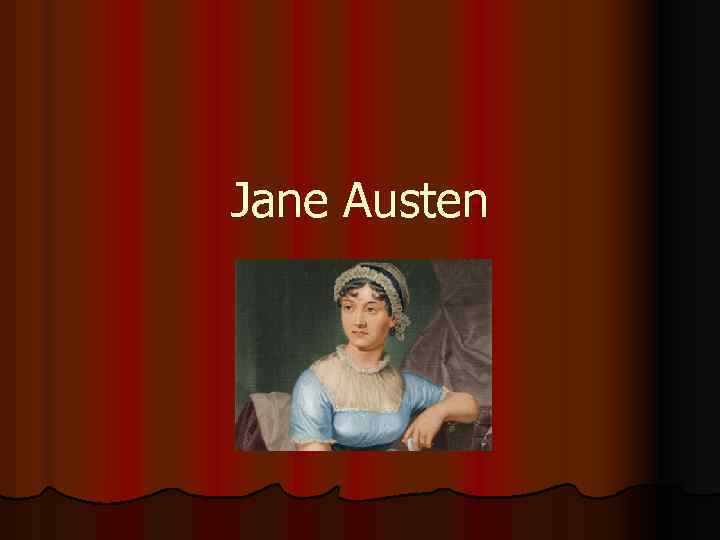
Jane Austen
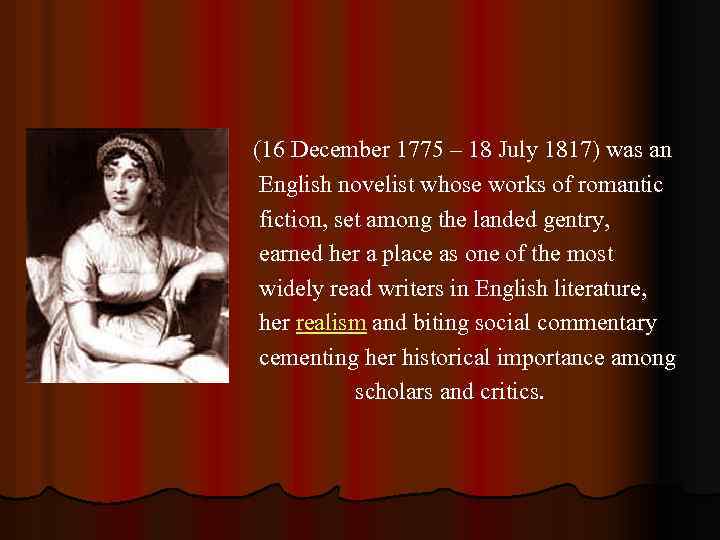
(16 December 1775 – 18 July 1817) was an English novelist whose works of romantic fiction, set among the landed gentry, earned her a place as one of the most widely read writers in English literature, her realism and biting social commentary cementing her historical importance among scholars and critics.
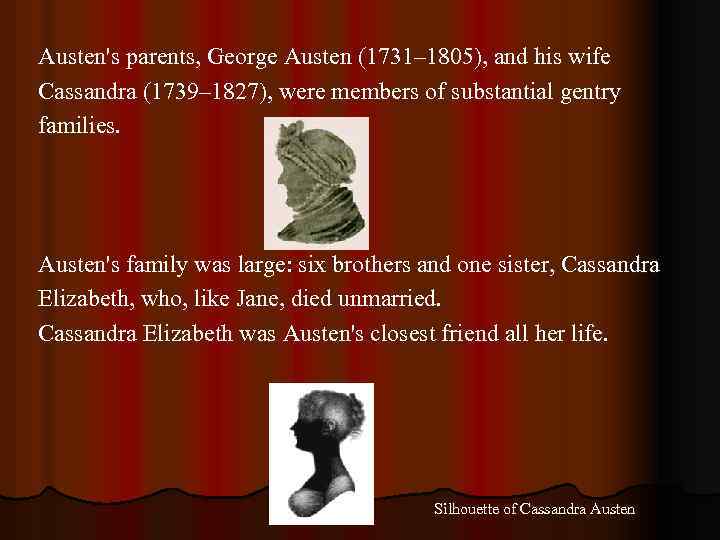
Austen's parents, George Austen (1731– 1805), and his wife Cassandra (1739– 1827), were members of substantial gentry families. Austen's family was large: six brothers and one sister, Cassandra Elizabeth, who, like Jane, died unmarried. Cassandra Elizabeth was Austen's closest friend all her life. Silhouette of Cassandra Austen
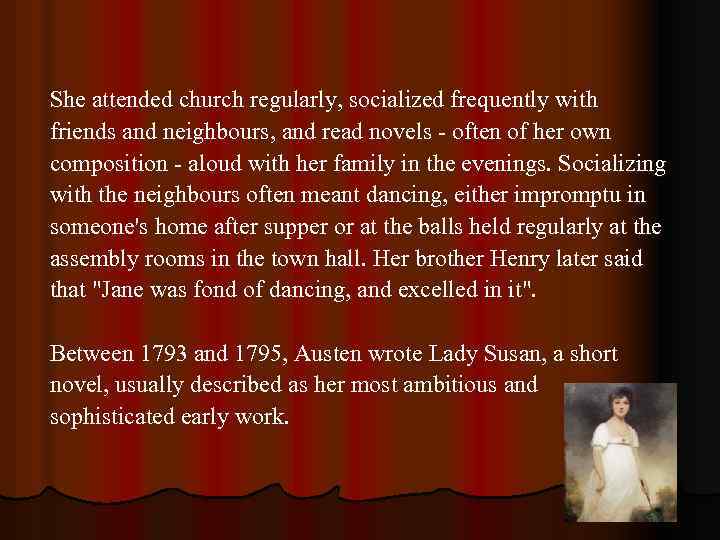
She attended church regularly, socialized frequently with friends and neighbours, and read novels - often of her own composition - aloud with her family in the evenings. Socializing with the neighbours often meant dancing, either impromptu in someone's home after supper or at the balls held regularly at the assembly rooms in the town hall. Her brother Henry later said that "Jane was fond of dancing, and excelled in it". Between 1793 and 1795, Austen wrote Lady Susan, a short novel, usually described as her most ambitious and sophisticated early work.
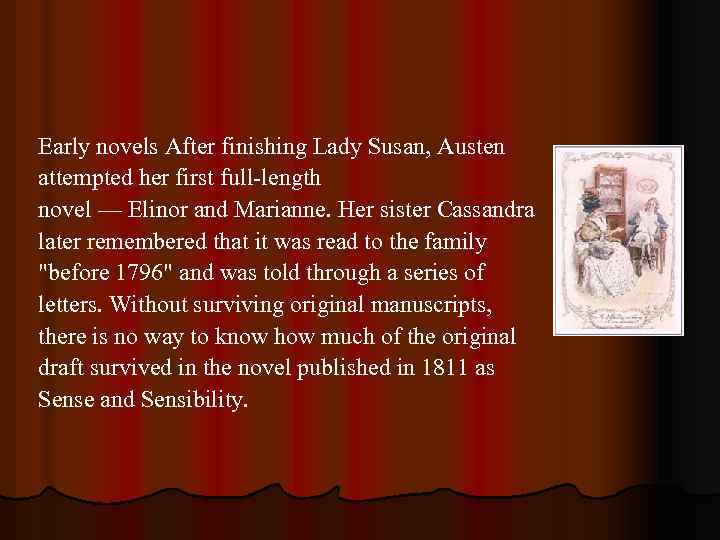
Early novels After finishing Lady Susan, Austen attempted her first full-length novel — Elinor and Marianne. Her sister Cassandra later remembered that it was read to the family "before 1796" and was told through a series of letters. Without surviving original manuscripts, there is no way to know how much of the original draft survived in the novel published in 1811 as Sense and Sensibility.
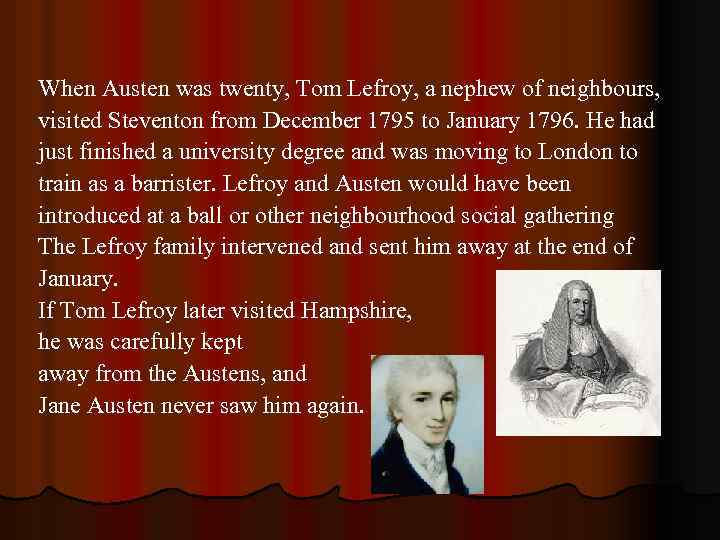
When Austen was twenty, Tom Lefroy, a nephew of neighbours, visited Steventon from December 1795 to January 1796. He had just finished a university degree and was moving to London to train as a barrister. Lefroy and Austen would have been introduced at a ball or other neighbourhood social gathering The Lefroy family intervened and sent him away at the end of January. If Tom Lefroy later visited Hampshire, he was carefully kept away from the Austens, and Jane Austen never saw him again.
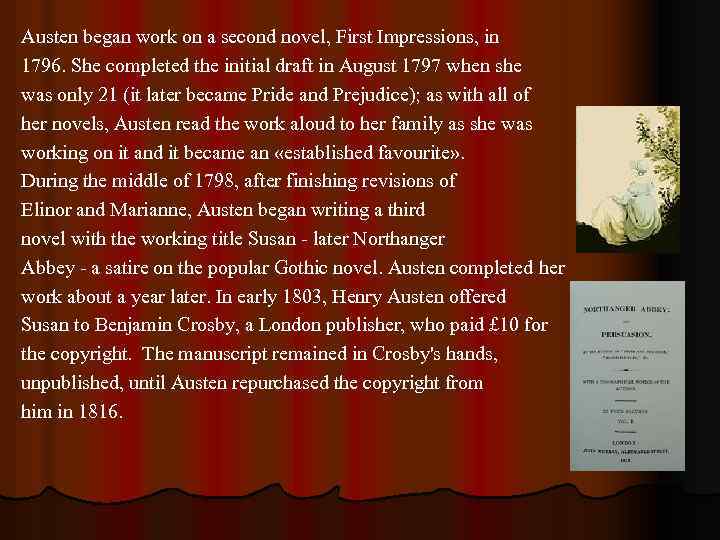
Austen began work on a second novel, First Impressions, in 1796. She completed the initial draft in August 1797 when she was only 21 (it later became Pride and Prejudice); as with all of her novels, Austen read the work aloud to her family as she was working on it and it became an «established favourite» . During the middle of 1798, after finishing revisions of Elinor and Marianne, Austen began writing a third novel with the working title Susan - later Northanger Abbey - a satire on the popular Gothic novel. Austen completed her work about a year later. In early 1803, Henry Austen offered Susan to Benjamin Crosby, a London publisher, who paid £ 10 for the copyright. The manuscript remained in Crosby's hands, unpublished, until Austen repurchased the copyright from him in 1816.
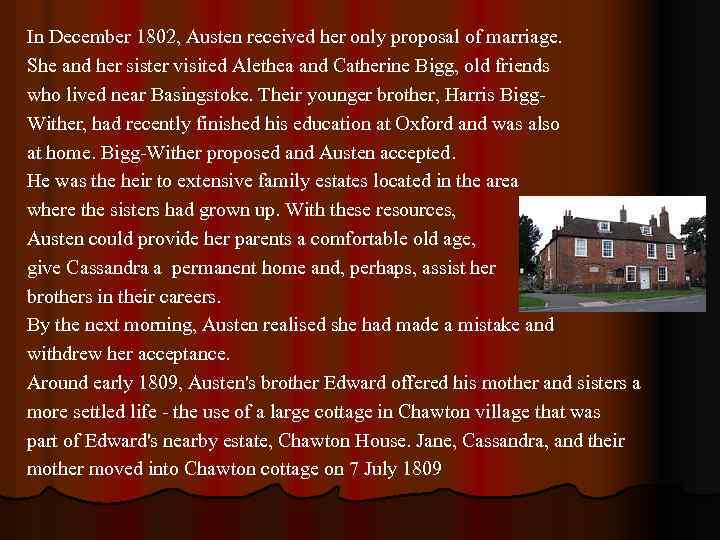
In December 1802, Austen received her only proposal of marriage. She and her sister visited Alethea and Catherine Bigg, old friends who lived near Basingstoke. Their younger brother, Harris Bigg. Wither, had recently finished his education at Oxford and was also at home. Bigg-Wither proposed and Austen accepted. He was the heir to extensive family estates located in the area where the sisters had grown up. With these resources, Austen could provide her parents a comfortable old age, give Cassandra a permanent home and, perhaps, assist her brothers in their careers. By the next morning, Austen realised she had made a mistake and withdrew her acceptance. Around early 1809, Austen's brother Edward offered his mother and sisters a more settled life - the use of a large cottage in Chawton village that was part of Edward's nearby estate, Chawton House. Jane, Cassandra, and their mother moved into Chawton cottage on 7 July 1809
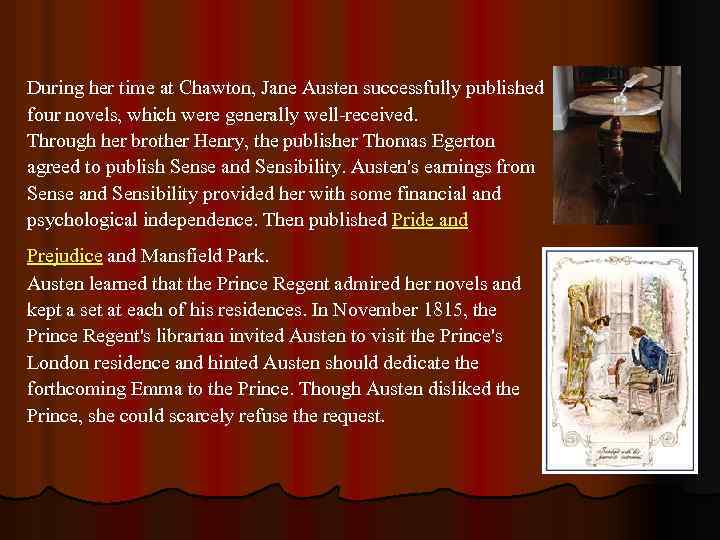
During her time at Chawton, Jane Austen successfully published four novels, which were generally well-received. Through her brother Henry, the publisher Thomas Egerton agreed to publish Sense and Sensibility. Austen's earnings from Sense and Sensibility provided her with some financial and psychological independence. Then published Pride and Prejudice and Mansfield Park. Austen learned that the Prince Regent admired her novels and kept a set at each of his residences. In November 1815, the Prince Regent's librarian invited Austen to visit the Prince's London residence and hinted Austen should dedicate the forthcoming Emma to the Prince. Though Austen disliked the Prince, she could scarcely refuse the request.
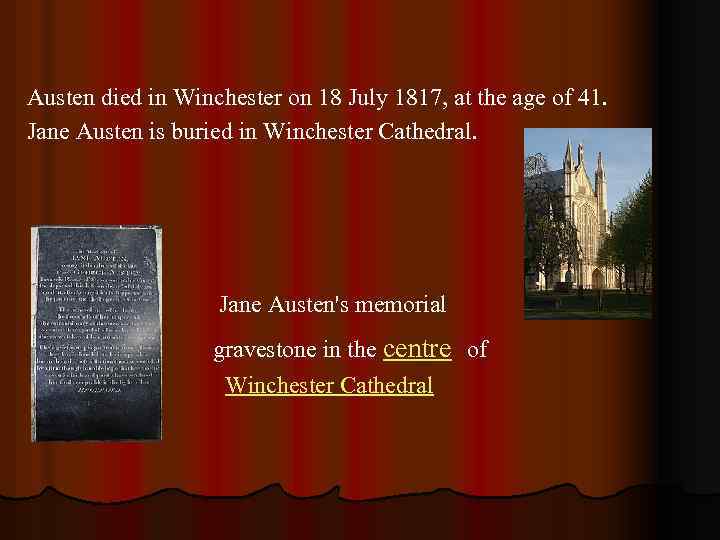
Austen died in Winchester on 18 July 1817, at the age of 41. Jane Austen is buried in Winchester Cathedral. Jane Austen's memorial gravestone in the centre of Winchester Cathedral
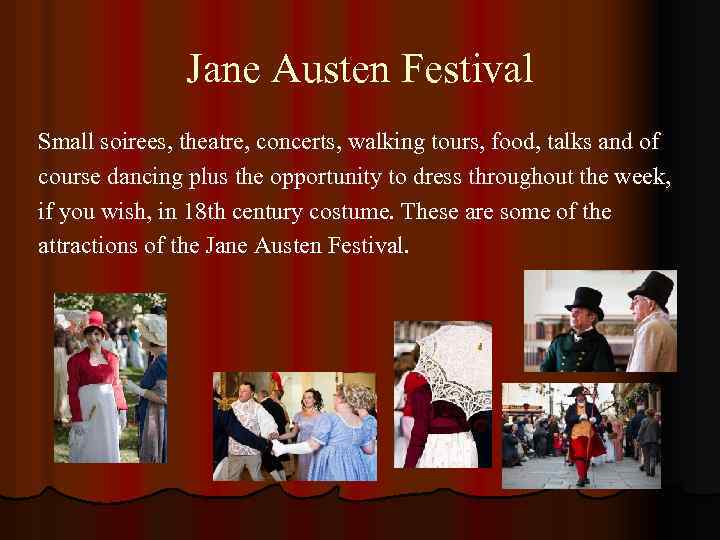
Jane Austen Festival Small soirees, theatre, concerts, walking tours, food, talks and of course dancing plus the opportunity to dress throughout the week, if you wish, in 18 th century costume. These are some of the attractions of the Jane Austen Festival.
Скачать презентацию Jane Austen 16 December 1775 18
janeausten-120328113114-phpapp02.ppt