 Скачать презентацию jan hrouzek hermeslab sk Uncertainty Estimation of Analytical Results
cc24eb68b8f2b4c6c505fa990f184d2e.ppt
- Количество слайдов: 27



jan. hrouzek@hermeslab. sk Uncertainty Estimation of Analytical Results in Forensic Analysis Ing. Ján Hrouzek, Ph. D. * Ing. Svetlana Hrouzková, Ph. D. Hermes Labsystems, Púchovská 12, SK-831 06 Bratislava *Department of Analytical Chemistry, FCh. FT, Slovak University of Technology in Bratislava, Radlinského 9, SK-812 37 Bratislava 7 th. International Symposium on Forensic Sciences, Papiernička, Slovakia, September 30, 2005
Uncertainty Estimation r fo r r 17025 fo ISO fo f or EN 45001
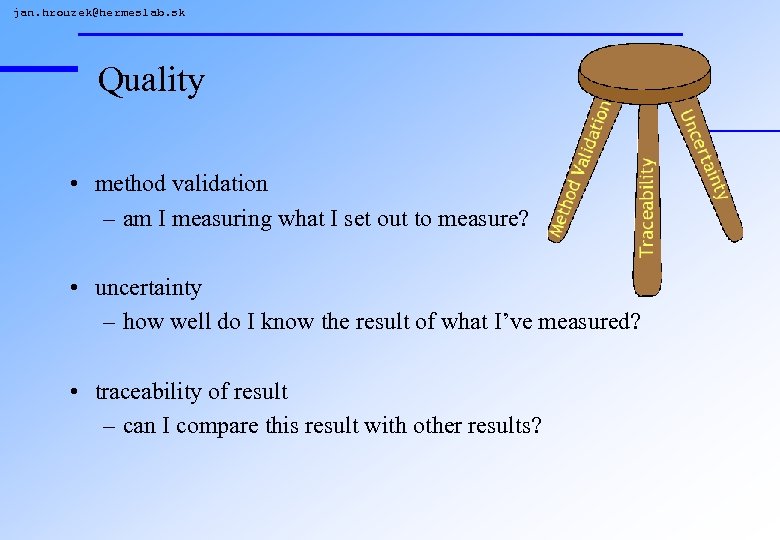
jan. hrouzek@hermeslab. sk Quality • method validation – am I measuring what I set out to measure? • uncertainty – how well do I know the result of what I’ve measured? • traceability of result – can I compare this result with other results?

jan. hrouzek@hermeslab. sk Quality vs. Time SHALL I RUSH YOUR RUSH JOB BEFORE I START THE RUSH JOB I WAS RUSHING WHEN YOU RUSHED IN ?
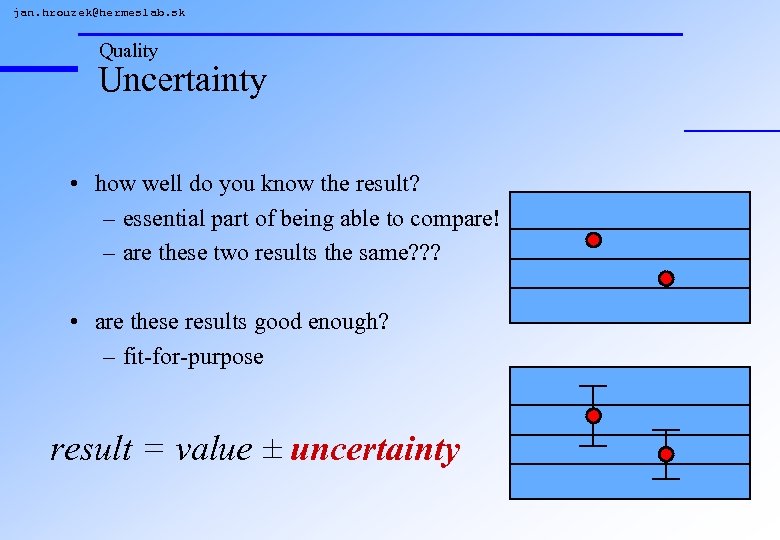
jan. hrouzek@hermeslab. sk Quality Uncertainty • how well do you know the result? – essential part of being able to compare! – are these two results the same? ? ? • are these results good enough? – fit-for-purpose result = value ± uncertainty
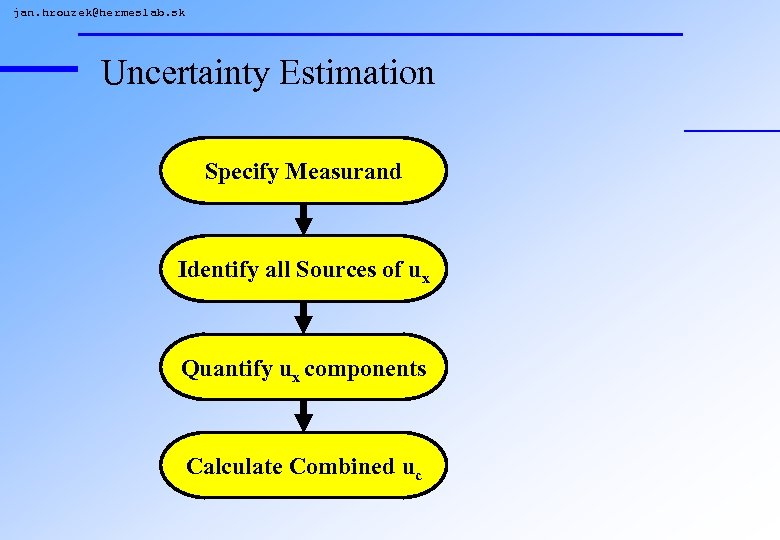
jan. hrouzek@hermeslab. sk Uncertainty Estimation Specify Measurand Identify all Sources of ux Quantify ux components Calculate Combined uc
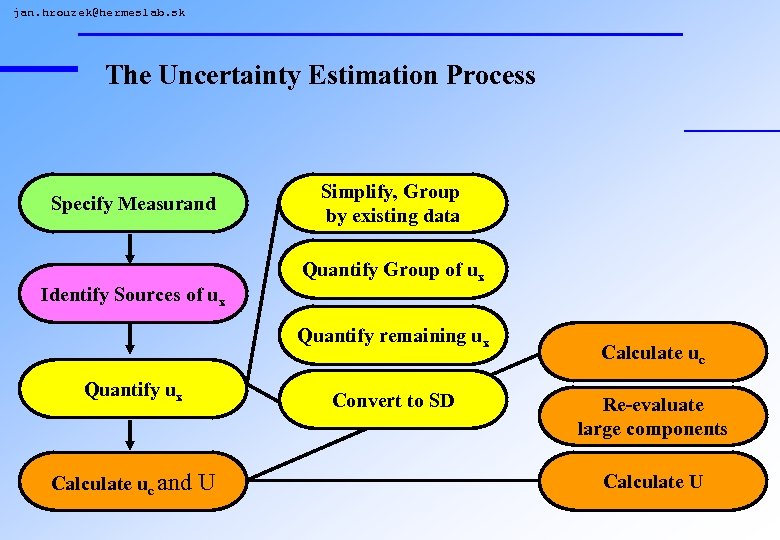
jan. hrouzek@hermeslab. sk The Uncertainty Estimation Process Specify Measurand Identify Sources of ux Simplify, Group by existing data Quantify Group of ux Quantify remaining ux Quantify ux Calculate uc and Convert to SD U Calculate uc Re-evaluate large components Calculate U
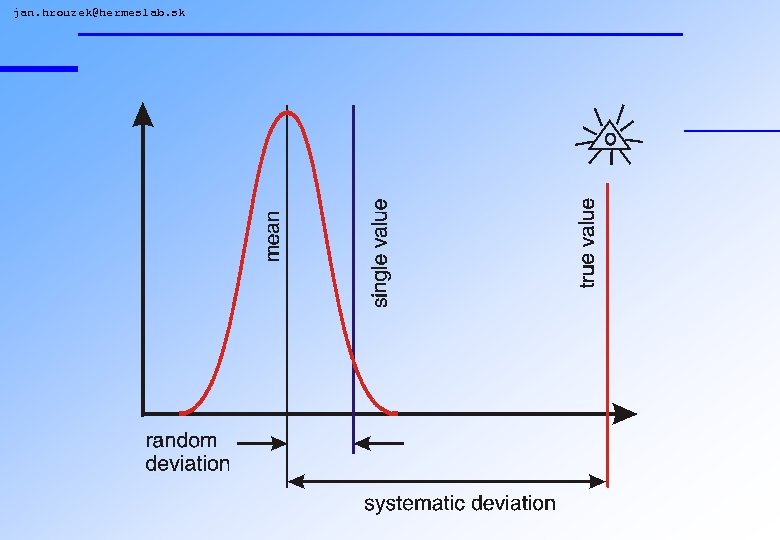
jan. hrouzek@hermeslab. sk
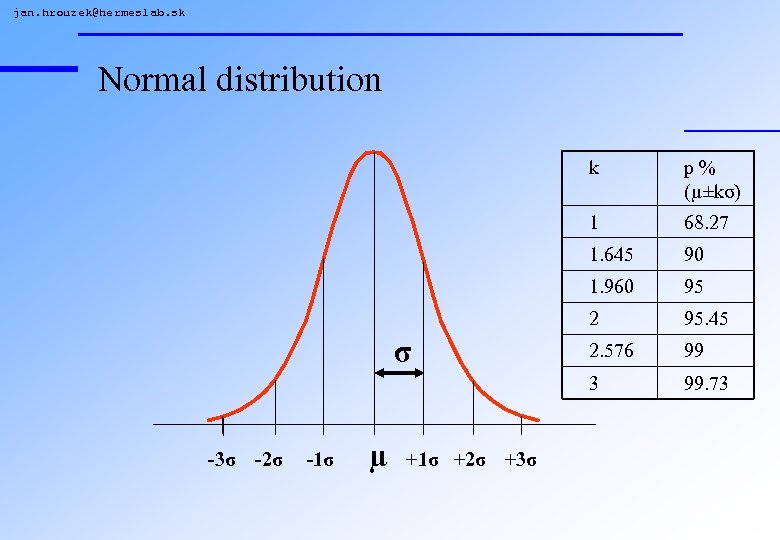
jan. hrouzek@hermeslab. sk Normal distribution k 1 +1σ +2σ +3σ 95. 45 2. 576 99 3 µ 95 2 -1σ 90 1. 960 -3σ -2σ 68. 27 1. 645 σ p% (µ±kσ) 99. 73
jan. hrouzek@hermeslab. sk Specify Measurand • Write down a clear statement of what is being measured, including the relationship between the measurand the input quantities (e. g. measured quantities, constants, calibration standard values etc. ) upon which it depends. • Where possible, include corrections for known systematic effects. • The specification information should be given in the relevant Standard Operating Procedure (SOP) or other method description.
jan. hrouzek@hermeslab. sk Identify Uncertainty Sources • List the possible sources of uncertainty. This will include sources that contribute to the uncertainty on the parameters in the relationship specified in Step 1, but may include other sources and must include sources arising from chemical assumptions. • Tool forming a structured list is the Cause and Effect diagram. • Appendix D. Analysing Uncertainty Sources based on S. L. R. Ellison, V. J. Barwick; Accred. Qual. Assur. 3 101 -105 (1998)
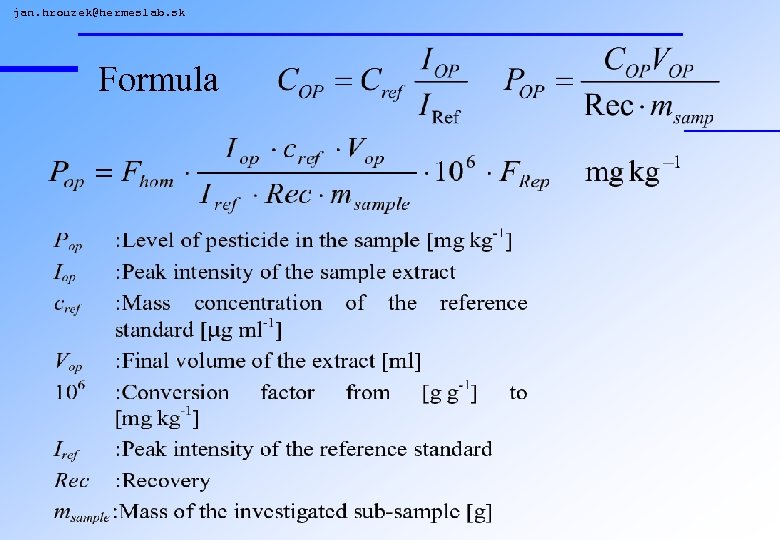
jan. hrouzek@hermeslab. sk Formula
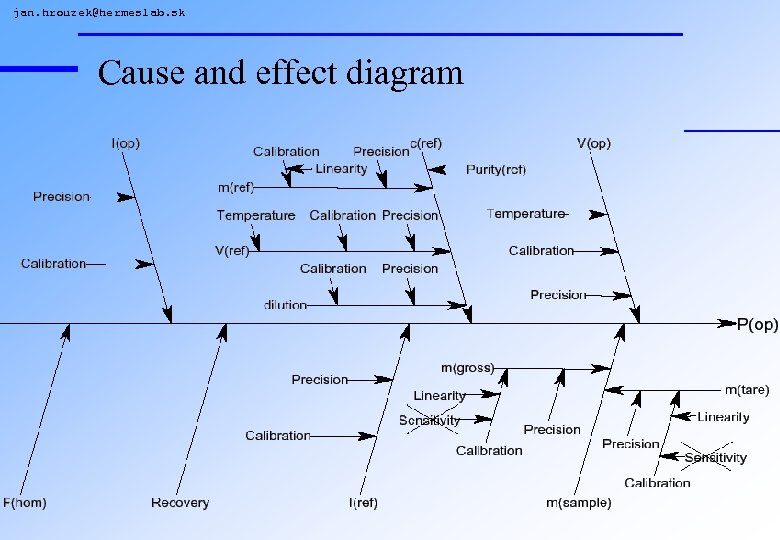
jan. hrouzek@hermeslab. sk Cause and effect diagram
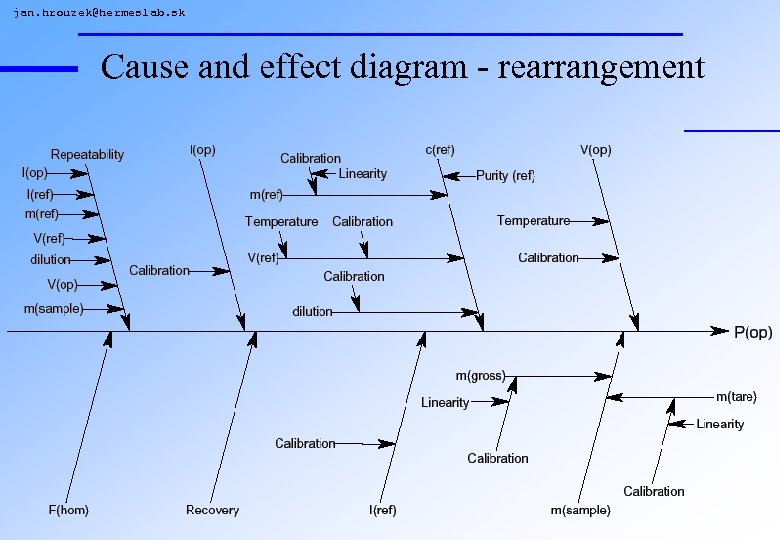
jan. hrouzek@hermeslab. sk Cause and effect diagram - rearrangement
jan. hrouzek@hermeslab. sk Quantify Uncertainty Components • Measure or estimate the size of the uncertainty component associated with each potential source of uncertainty identified. • It is often possible to estimate or determine a single contribution to uncertainty associated with a number of separate sources. • It is also important to consider whether available data accounts sufficiently for all sources of uncertainty. If necessary plan additional experiments and studies carefully to ensure that all sources of uncertainty are adequately accounted for.
jan. hrouzek@hermeslab. sk How to quantify grouped components • Uncertainty estimation using prior collaborative method development and validation study data • Uncertainty estimation using in-house development and validation studies • Evaluation of uncertainty for empirical methods • Evaluation of uncertainty for ad-hoc methods
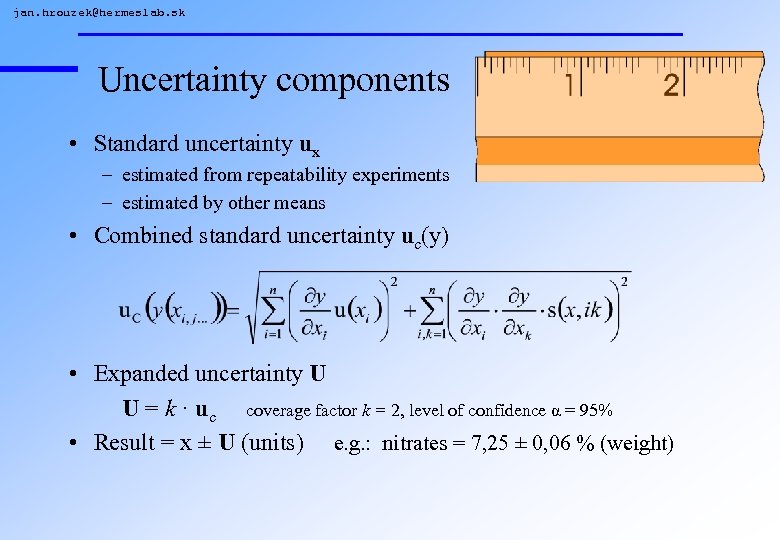
jan. hrouzek@hermeslab. sk Uncertainty components • Standard uncertainty ux – estimated from repeatability experiments – estimated by other means • Combined standard uncertainty uc(y) • Expanded uncertainty U U = k · uc coverage factor k = 2, level of confidence α = 95% • Result = x ± U (units) e. g. : nitrates = 7, 25 ± 0, 06 % (weight)
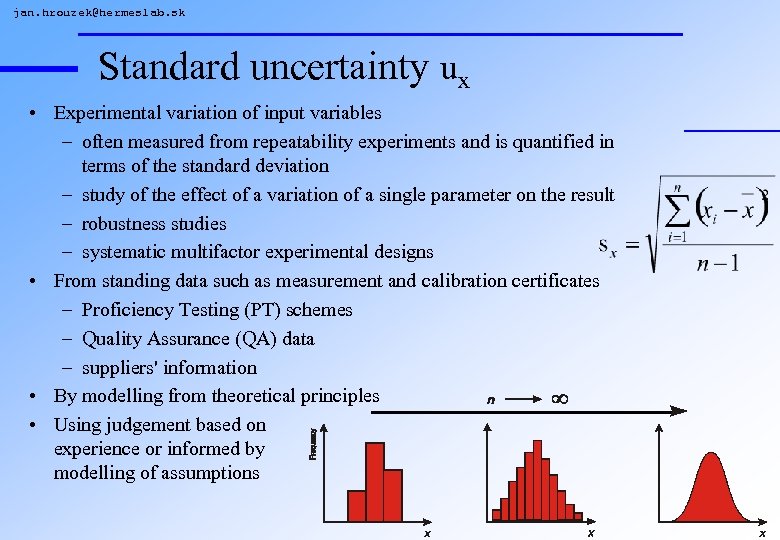
jan. hrouzek@hermeslab. sk Standard uncertainty ux • Experimental variation of input variables – often measured from repeatability experiments and is quantified in terms of the standard deviation – study of the effect of a variation of a single parameter on the result – robustness studies – systematic multifactor experimental designs • From standing data such as measurement and calibration certificates – Proficiency Testing (PT) schemes – Quality Assurance (QA) data – suppliers' information • By modelling from theoretical principles • Using judgement based on experience or informed by modelling of assumptions
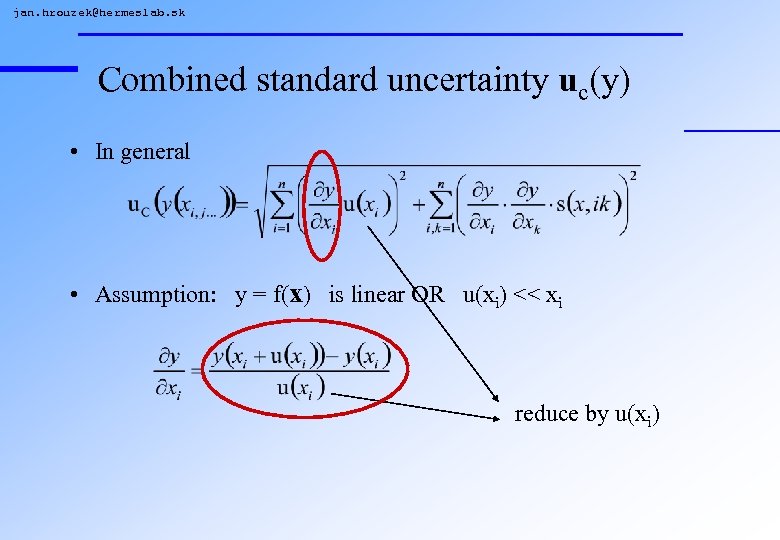
jan. hrouzek@hermeslab. sk Combined standard uncertainty uc(y) • In general • Assumption: y = f(x) is linear OR u(xi) << xi reduce by u(xi)
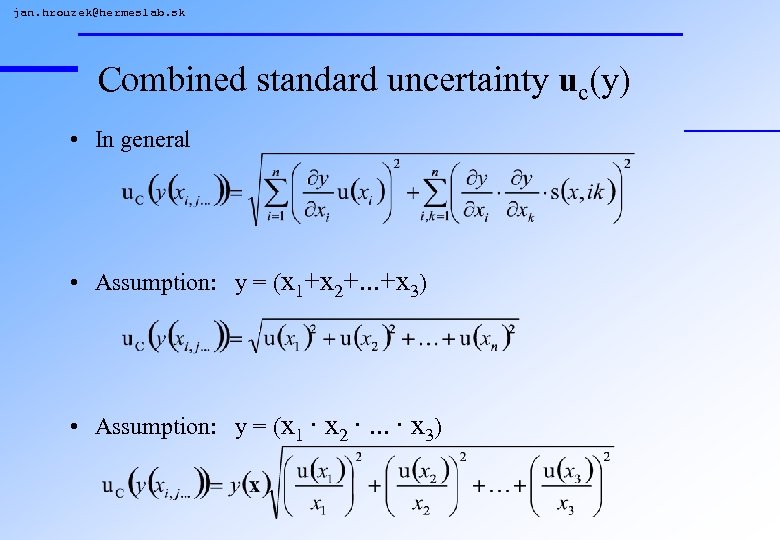
jan. hrouzek@hermeslab. sk Combined standard uncertainty uc(y) • In general • Assumption: y = (x 1+x 2+. . . +x 3) • Assumption: y = (x 1 · x 2 ·. . . · x 3)
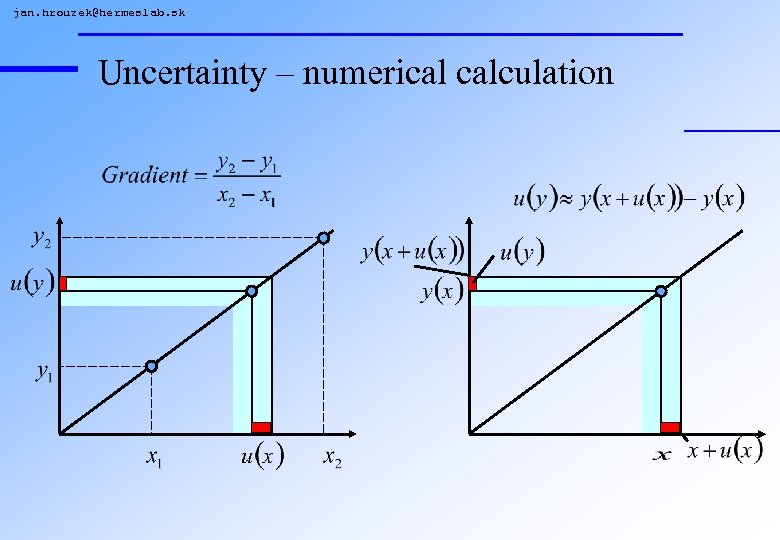
jan. hrouzek@hermeslab. sk Uncertainty – numerical calculation
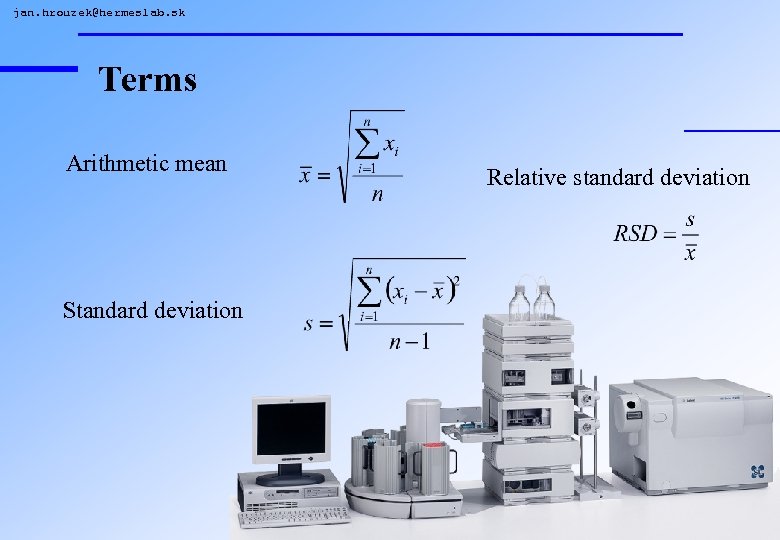
jan. hrouzek@hermeslab. sk Terms Arithmetic mean Standard deviation Relative standard deviation
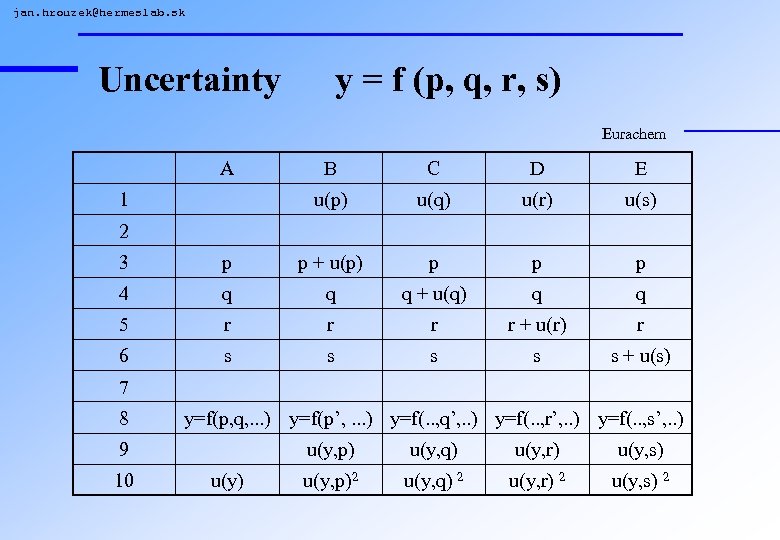
jan. hrouzek@hermeslab. sk Uncertainty y = f (p, q, r, s) Eurachem A C D E u(p) 1 B u(q) u(r) u(s) 2 3 p p + u(p) p p p 4 q q q + u(q) q q 5 r r + u(r) r 6 s s s + u(s) 7 8 y=f(p, q, . . . ) y=f(p’, . . . ) y=f(. . , q’, . . ) y=f(. . , r’, . . ) y=f(. . , s’, . . ) 9 10 u(y, p) u(y, q) u(y, r) u(y, s) u(y, p)2 u(y, q) 2 u(y, r) 2 u(y, s) 2
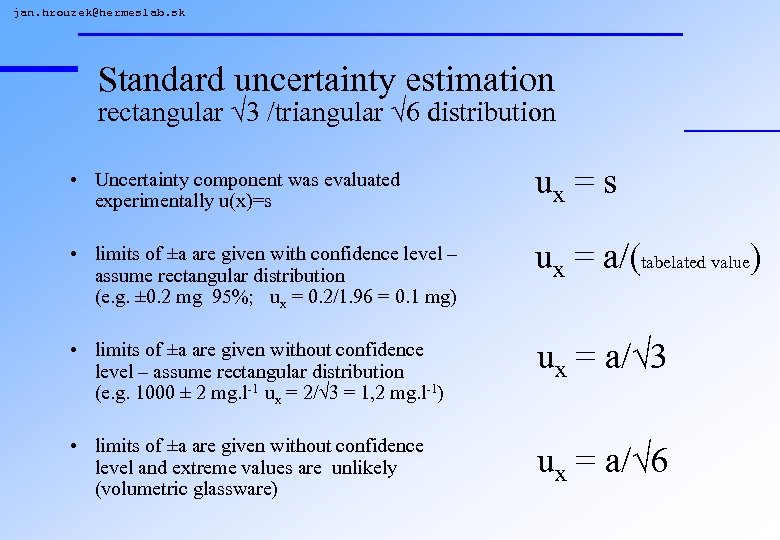
jan. hrouzek@hermeslab. sk Standard uncertainty estimation rectangular 3 /triangular 6 distribution • Uncertainty component was evaluated experimentally u(x)=s ux = s • limits of ±a are given with confidence level – assume rectangular distribution (e. g. ± 0. 2 mg 95%; ux = 0. 2/1. 96 = 0. 1 mg) ux = a/(tabelated value) • limits of ±a are given without confidence level – assume rectangular distribution (e. g. 1000 ± 2 mg. l-1 ux = 2/ 3 = 1, 2 mg. l-1) ux = a/ 3 • limits of ±a are given without confidence level and extreme values are unlikely (volumetric glassware) ux = a/ 6
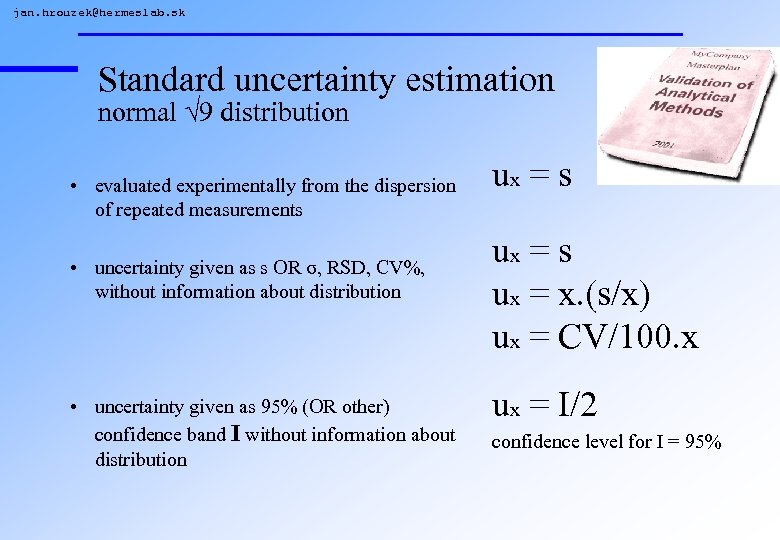
jan. hrouzek@hermeslab. sk Standard uncertainty estimation normal 9 distribution • evaluated experimentally from the dispersion of repeated measurements • uncertainty given as s OR σ, RSD, CV%, without information about distribution • uncertainty given as 95% (OR other) confidence band I without information about distribution ux = s ux = x. (s/x) ux = CV/100. x ux = I/2 confidence level for I = 95%
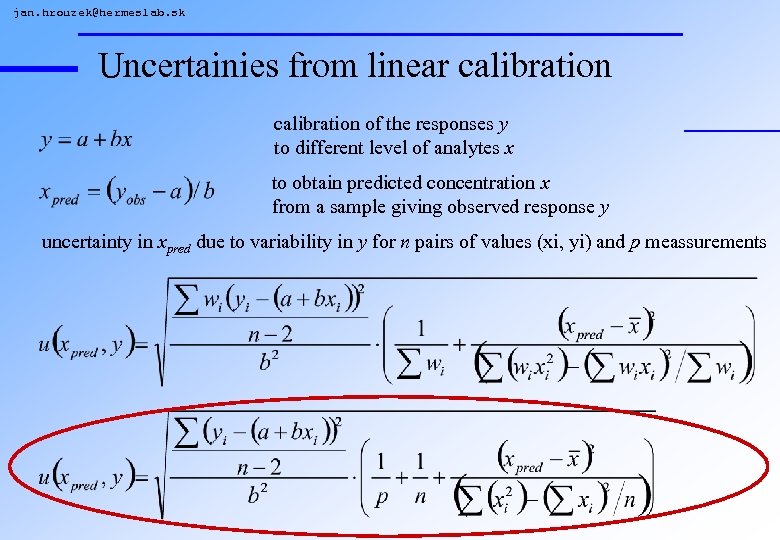
jan. hrouzek@hermeslab. sk Uncertainies from linear calibration of the responses y to different level of analytes x to obtain predicted concentration x from a sample giving observed response y uncertainty in xpred due to variability in y for n pairs of values (xi, yi) and p meassurements
jan. hrouzek@hermeslab. sk Uncertainty Estimation of Analytical Results in Forensic Analysis Ing. Ján Hrouzek, Ph. D. * Ing. Svetlana Hrouzková, Ph. D. Hermes Labsystems, Púchovská 12, SK-831 06 Bratislava *Department of Analytical Chemistry, FCh. FT, Slovak University of Technology in Bratislava, Radlinského 9, SK-812 37 Bratislava 7 th. International Symposium on Forensic Sciences, Papiernička, Slovakia, September 30, 2005
Скачать презентацию jan hrouzek hermeslab sk Uncertainty Estimation of Analytical Results
cc24eb68b8f2b4c6c505fa990f184d2e.ppt