 Скачать презентацию James Watt By Danil Levchenko Timeline 1736
James Watt.ppt
- Количество слайдов: 6



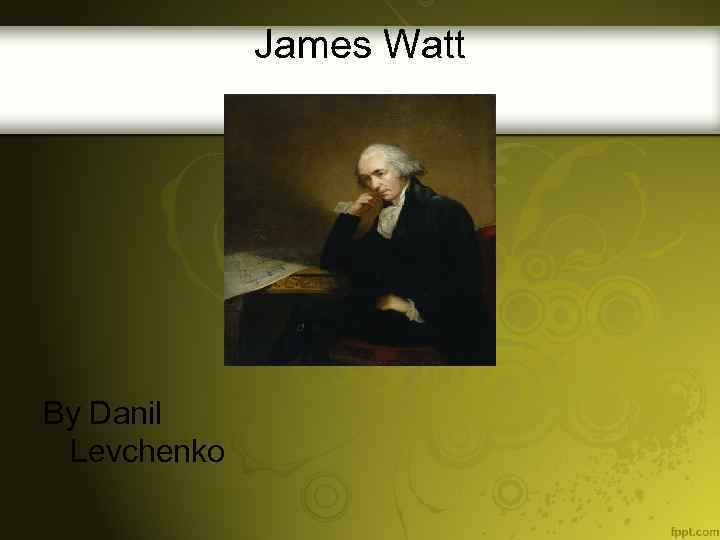
James Watt By Danil Levchenko
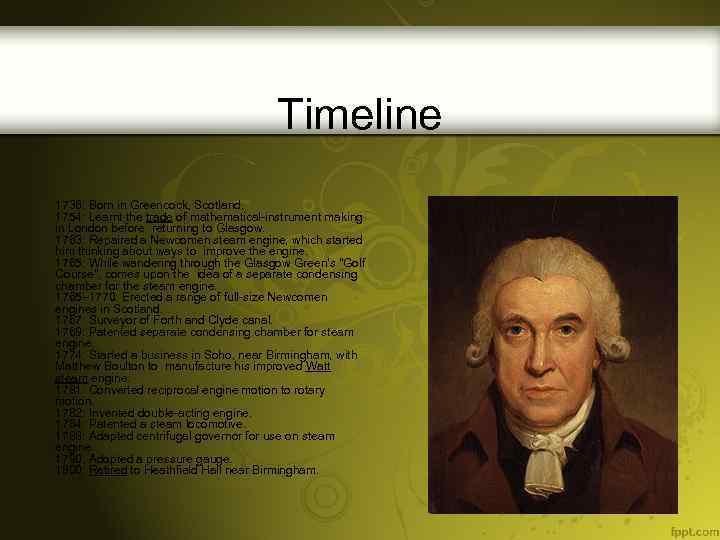
Timeline 1736: Born in Greencock, Scotland. 1754: Learnt the trade of mathematical-instrument making in London before returning to Glasgow. 1763: Repaired a Newcomen steam engine, which started him thinking about ways to improve the engine. 1765: While wandering through the Glasgow Green's "Golf Course", comes upon the idea of a separate condensing chamber for the steam engine. 1765– 1770: Erected a range of full-size Newcomen engines in Scotland. 1767: Surveyor of Forth and Clyde canal. 1769: Patented separate condensing chamber for steam engine. 1774: Started a business in Soho, near Birmingham, with Matthew Boulton to manufacture his improved Watt steam engine. 1781: Converted reciprocal engine motion to rotary motion. 1782: Invented double-acting engine. 1784: Patented a steam locomotive. 1788: Adapted centrifugal governor for use on steam engine. 1790: Adopted a pressure gauge. 1800: Retired to Heathfield Hall near Birmingham.
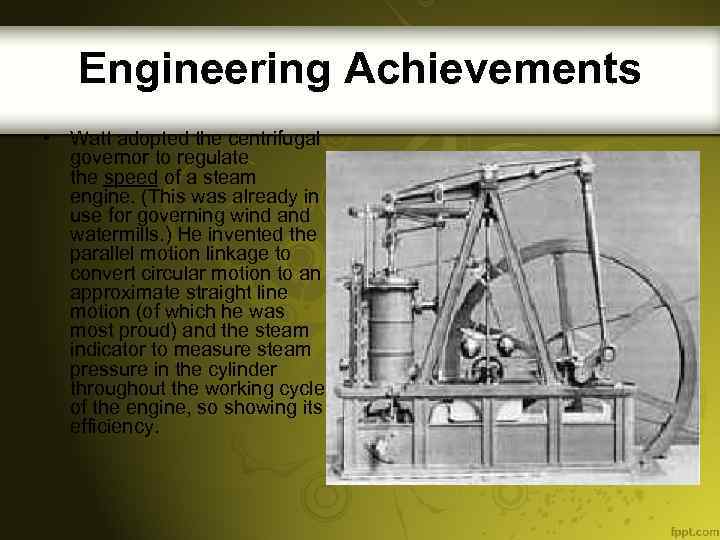
Engineering Achievements • Watt adopted the centrifugal governor to regulate the speed of a steam engine. (This was already in use for governing wind and watermills. ) He invented the parallel motion linkage to convert circular motion to an approximate straight line motion (of which he was most proud) and the steam indicator to measure steam pressure in the cylinder throughout the working cycle of the engine, so showing its efficiency.
Engineering Achievements • Watt greatly helped the development of the embryonic steam engine into a viable and economic means of power generation. He realised that the Newcomen steam engine wasting nearly three quarters of the steam energy in heating the piston and chamber. Watt developed a separate condenser chamber which significantly increased the efficiency. Further refinements (insulation of the steam cylinder, the double-acting engine, a counter, an indicator, and a throttle valve) made the steam engine his life's work.
Engineering Achievements • Watt was opposed to the use of high pressure steam, and is held by some to have held back the technical development of the steam engine by other engineers, until his patents expired in 1800. With his partner Matthew Boulton he battled against rival engineers such as Jonathan Hornblower who tried to develop engines which did not fall foul of his 'catch-all' patents. Boulton proved an excellent businessman, and both men eventually made fortunes.

The End.
Скачать презентацию James Watt By Danil Levchenko Timeline 1736
James Watt.ppt