


 Скачать презентацию Jaana Porra Ph D University of Houston jaana uh
cd99fc8e77ab535fcaa7389a6801c6e0.ppt
- Количество слайдов: 39
 Jaana Porra, Ph. D. University of Houston jaana@uh. edu E-Vallankumous Kaupankäynnissä
 Electronic Commerce Benefits the Economy and the Media • Since 1995 the Internet seems to have surpassed traditional computer network technologies in price, popularity and performance. • Electronic Commerce is a Media Event and an Economical Development intertwined: • The difference between appearances (what appears to be happening) and reality (what is happening) is blurred -- sometimes intentionally.
 The Internet Explosion Started in the U. S. in 1996 • Hoffman, et. al. , Vanderbilt University, 1996: – Internet user profile shifted from a highly educated, young male to more mainstream – An estimated 28. 8 million people in the US who were 16 years and older had access to the Internet – 16. 4 million used the Internet – 11. 5 million used the Web – 1. 51 million had used the Web to purchase something
 The Internet Explosion was not as Obvious in Most Businesses • KPMG survey, Management Accounting-London, 1996: – Top 100 UK companies (annual revenue > 200 m) expected 1 in every 5 sales to come directly via the Internet by 2001 representing a total of 170 billion – In 1996 more than 80% of the surveyed companies could not attribute any sales to the Internet – Of their sales, not more than 2%-3% took place over the Internet – But they expected 17% of the sales to take place over the Internet by 2001 – Only 59% of the companies had allocated marketing budget to the Internet – 50% had a budget of less than 10, 000
 First Electronic Commerce Doubts Surfaced in 1997 • Fox, “Web Advertising a Slow Go, ” CACM, April, 1997: – “As the Web grows at an astounding rate and most Internet-related companies lose their start-up money at a furious pace, Web publishers, content providers, and search engine creators are looking for advertising revenue to keep them afloat. ” --The New York Times
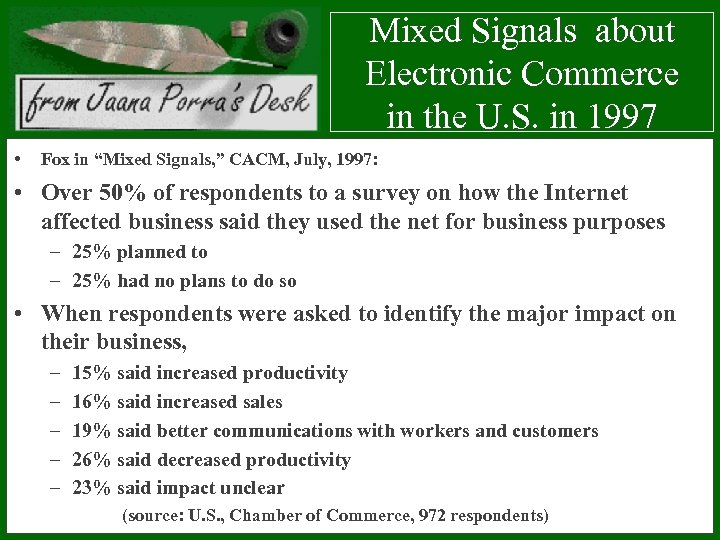 Mixed Signals about Electronic Commerce in the U. S. in 1997 • Fox in “Mixed Signals, ” CACM, July, 1997: • Over 50% of respondents to a survey on how the Internet affected business said they used the net for business purposes – 25% planned to – 25% had no plans to do so • When respondents were asked to identify the major impact on their business, – – – 15% said increased productivity 16% said increased sales 19% said better communications with workers and customers 26% said decreased productivity 23% said impact unclear (source: U. S. , Chamber of Commerce, 972 respondents)
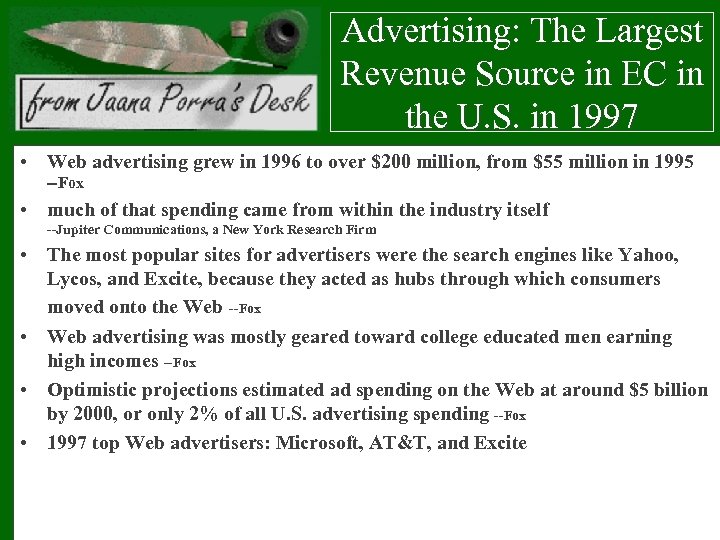 Advertising: The Largest Revenue Source in EC in the U. S. in 1997 • Web advertising grew in 1996 to over $200 million, from $55 million in 1995 --Fox • much of that spending came from within the industry itself --Jupiter Communications, a New York Research Firm • The most popular sites for advertisers were the search engines like Yahoo, Lycos, and Excite, because they acted as hubs through which consumers moved onto the Web --Fox • Web advertising was mostly geared toward college educated men earning high incomes --Fox • Optimistic projections estimated ad spending on the Web at around $5 billion by 2000, or only 2% of all U. S. advertising spending --Fox • 1997 top Web advertisers: Microsoft, AT&T, and Excite
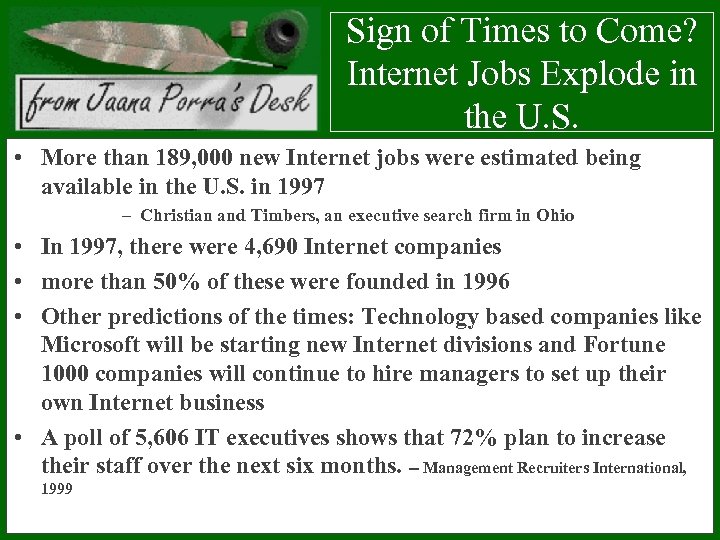 Sign of Times to Come? Internet Jobs Explode in the U. S. • More than 189, 000 new Internet jobs were estimated being available in the U. S. in 1997 – Christian and Timbers, an executive search firm in Ohio • In 1997, there were 4, 690 Internet companies • more than 50% of these were founded in 1996 • Other predictions of the times: Technology based companies like Microsoft will be starting new Internet divisions and Fortune 1000 companies will continue to hire managers to set up their own Internet business • A poll of 5, 606 IT executives shows that 72% plan to increase their staff over the next six months. -- Management Recruiters International, 1999
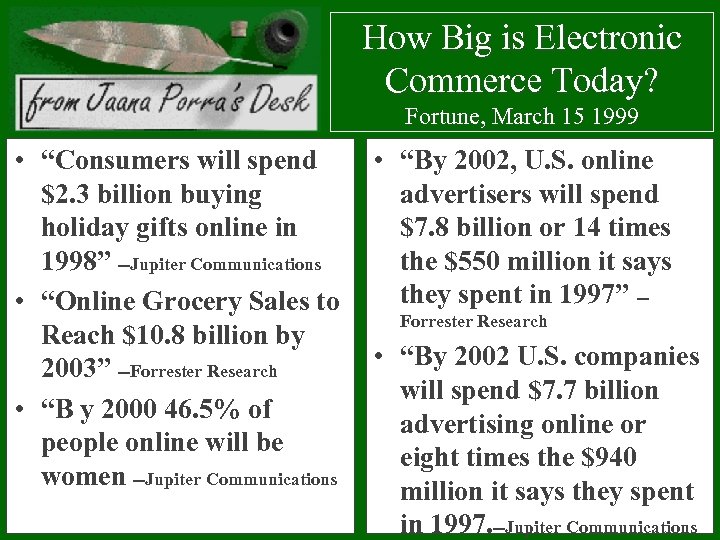 How Big is Electronic Commerce Today? Fortune, March 15 1999 • “Consumers will spend • “By 2002, U. S. online $2. 3 billion buying advertisers will spend holiday gifts online in $7. 8 billion or 14 times 1998” --Jupiter Communications the $550 million it says they spent in 1997” - • “Online Grocery Sales to Forrester Research Reach $10. 8 billion by • “By 2002 U. S. companies 2003” --Forrester Research will spend $7. 7 billion • “B y 2000 46. 5% of advertising online or people online will be eight times the $940 women --Jupiter Communications million it says they spent in 1997. --Jupiter Communications
 How do We Know? Fortune, March 15, 1999 • “Jupiter informed the world in November 2 nd about the $2. 3 billion holiday spending. ” • “Within a month that prediction had been sited by 99 media outlets from the New York Times to Footwear News, from CNN to China Morning Post” • “Message: Companies are making money. If yours isn’t one of them, you need help. ==> Internet forecasting is a great way to make money. ” • “Typically e-forecasts are just marketing tools, ways to get onto customer’s radar screens and into its pocket books. ” • “sometimes Internet predictions are just someone’s opinions put into a numeric format because people seem to like numbers”
 More Media Hype than Real Change in the Way Companies do Business? • Results show that most large corporations and multinationals are making little use of the Internet, treating it simply as a publishing medium. –Dutta and Segev, 1999 • Most customers are hitting web sites to browse. The conversion percentage for on-line retailers was no more than 8 percent (in a typical retail store is as high as 35 percent). – Mc. Kinsey, 1999 • Internet may be cannibalizing other sales channels. –Mc. Kinsey, 1999 • Most Internet companies that have gone public in the past two years will never be profitable. – Willis, 1999 • But firms that are selling products or services on the Internet are often making money on their Internet operations. Many such firms report that their on-line business is “profitable beyond expectations. ” – Porra and Parks, 2000
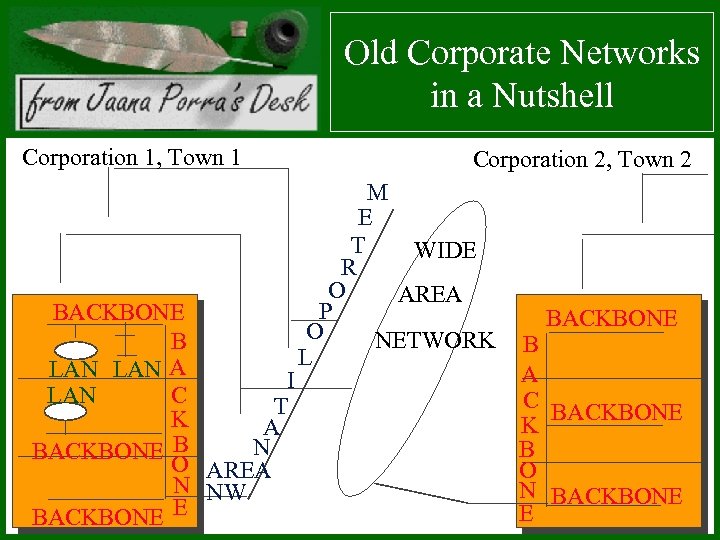 Old Corporate Networks in a Nutshell Corporation 1, Town 1 BACKBONE B LAN A I LAN C T K A N BACKBONE B O AREA N NW BACKBONE E Corporation 2, Town 2 M E T WIDE R O AREA P O NETWORK L BACKBONE B A C BACKBONE K B O N BACKBONE E
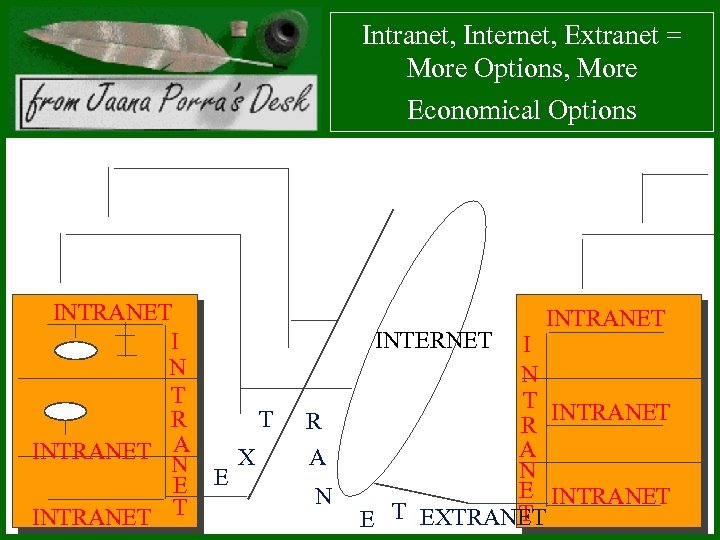 Intranet, Internet, Extranet = More Options, More Economical Options INTRANET I N T R T INTRANET A X N E E INTRANET T INTERNET R A N INTRANET I N T INTRANET R A N E INTRANET T EXTRANET
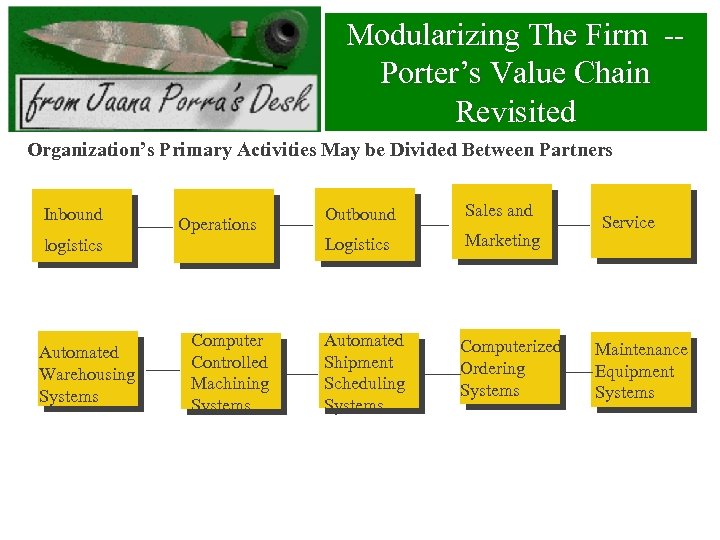 Modularizing The Firm -Porter’s Value Chain Revisited Organization’s Primary Activities May be Divided Between Partners Inbound logistics Automated Warehousing Systems Computer Controlled Machining Systems Sales and Logistics Operations Outbound Marketing Automated Shipment Scheduling Systems Computerized Ordering Systems Service Maintenance Equipment Systems
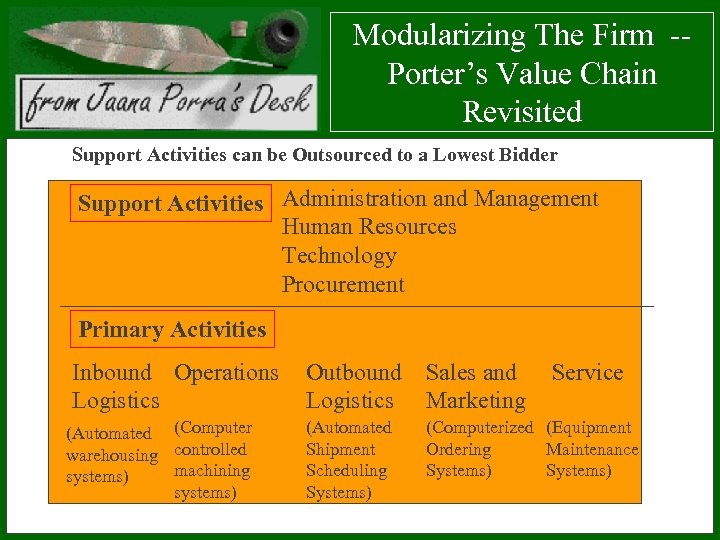 Modularizing The Firm -Porter’s Value Chain Revisited Support Activities can be Outsourced to a Lowest Bidder Support Activities Administration and Management Human Resources Technology Procurement Primary Activities Inbound Operations Logistics (Automated (Computer warehousing controlled machining systems) Outbound Logistics Sales and Marketing Service (Automated Shipment Scheduling Systems) (Computerized (Equipment Ordering Maintenance Systems)
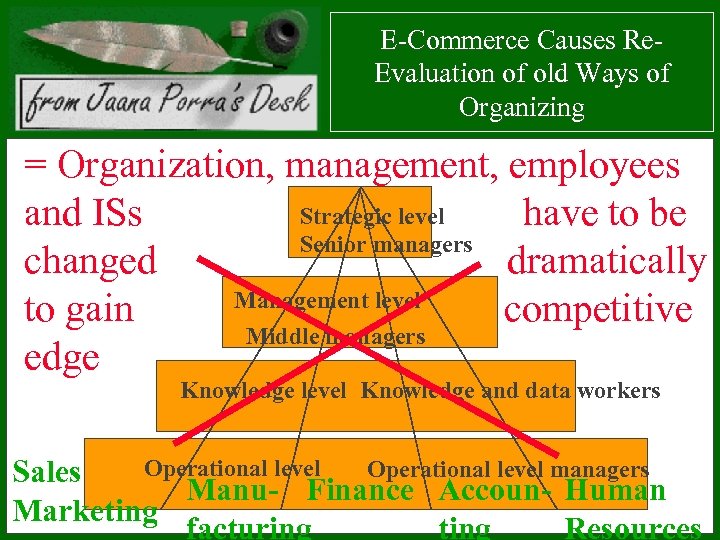 E-Commerce Causes Re. Evaluation of old Ways of Organizing = Organization, management, employees Strategic level and ISs have to be Senior managers changed dramatically Management level to gain competitive Middle managers edge Knowledge level Knowledge and data workers Operational level managers Sales Manu- Finance Accoun- Human Marketing facturing ting Resources
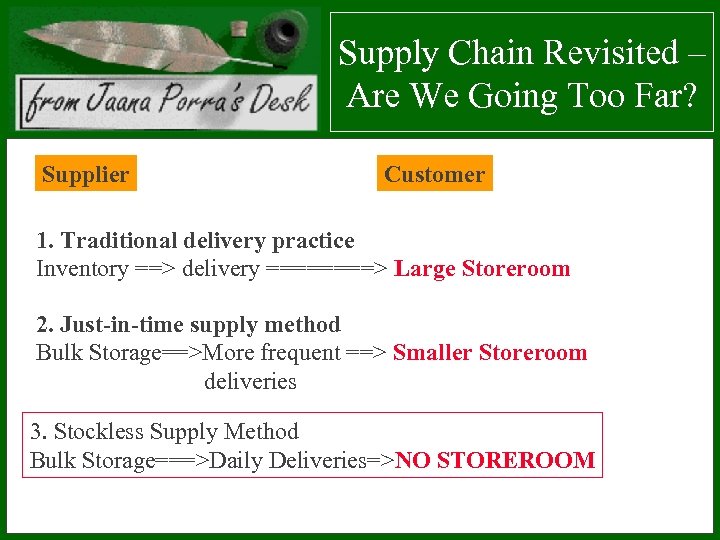 Supply Chain Revisited – Are We Going Too Far? Supplier Customer 1. Traditional delivery practice Inventory ==> delivery ====> Large Storeroom 2. Just-in-time supply method Bulk Storage==>More frequent ==> Smaller Storeroom deliveries 3. Stockless Supply Method Bulk Storage===>Daily Deliveries=>NO STOREROOM
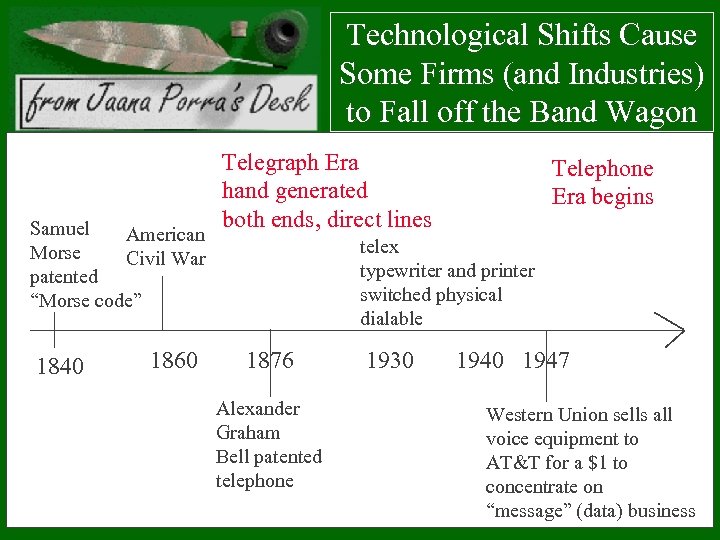 Technological Shifts Cause Some Firms (and Industries) to Fall off the Band Wagon Samuel American Morse Civil War patented “Morse code” 1840 1860 Telegraph Era hand generated both ends, direct lines Telephone Era begins telex typewriter and printer switched physical dialable 1876 Alexander Graham Bell patented telephone 1930 1947 Western Union sells all voice equipment to AT&T for a $1 to concentrate on “message” (data) business
 Technological Shifts Result in Business Failure and Novel Opportunity for New Entrants • The main reason for • Because of its pace of organizational failure is change information inability to rapidly technology pose a respond to the changing particular threat to environment organizations • Changing environment is • Examples: often caused by rapid – from telegraph to telephone advances in technology – from the 1980’s which effectively cause Information Systems to technological electronic commerce discontinuation points
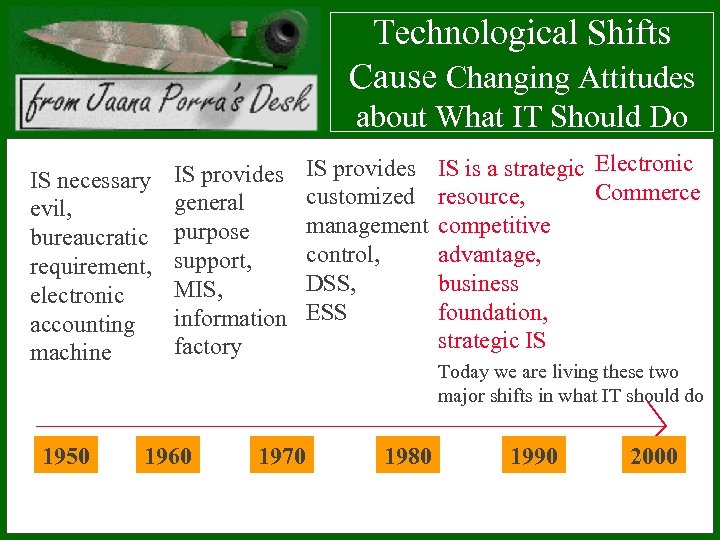 Technological Shifts Cause Changing Attitudes about What IT Should Do IS necessary IS provides customized management control, DSS, ESS IS provides general evil, bureaucratic purpose requirement, support, MIS, electronic information accounting factory machine 1950 1960 1970 IS is a strategic Electronic Commerce resource, competitive advantage, business foundation, strategic IS Today we are living these two major shifts in what IT should do 1980 1990 2000
 The Recent Outsourcing Trend May Be a Necessary Step in the on-going Technological Shift • The 1990’s “competitive advantage” technology shift caused an attitude change. IT that does not provide competitive advantage is best downsized and outsourced. • “Electronic commerce” technological shift is again changing attitudes about what IT should do. • In many firms e-commerce foregrounds IT. Electronic commerce information systems are the business. “When our site is down, it is like all our buildings burned down. It is like we no longer exist. ”
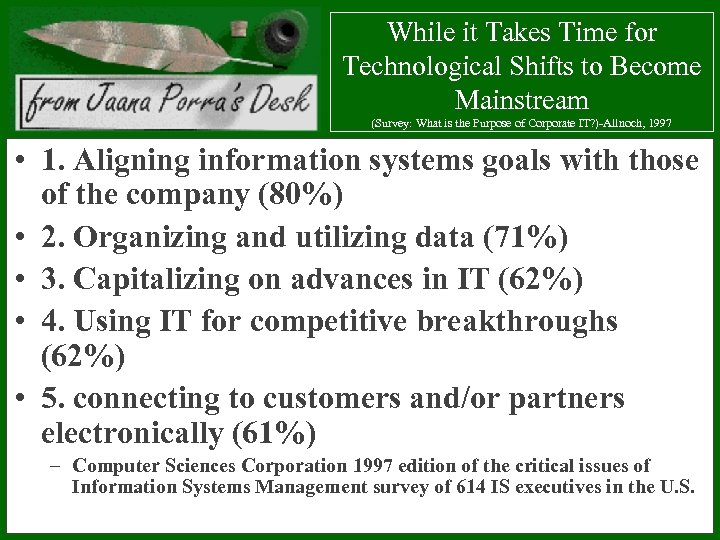 While it Takes Time for Technological Shifts to Become Mainstream (Survey: What is the Purpose of Corporate IT? )-Allnoch, 1997 • 1. Aligning information systems goals with those of the company (80%) • 2. Organizing and utilizing data (71%) • 3. Capitalizing on advances in IT (62%) • 4. Using IT for competitive breakthroughs (62%) • 5. connecting to customers and/or partners electronically (61%) – Computer Sciences Corporation 1997 edition of the critical issues of Information Systems Management survey of 614 IS executives in the U. S.
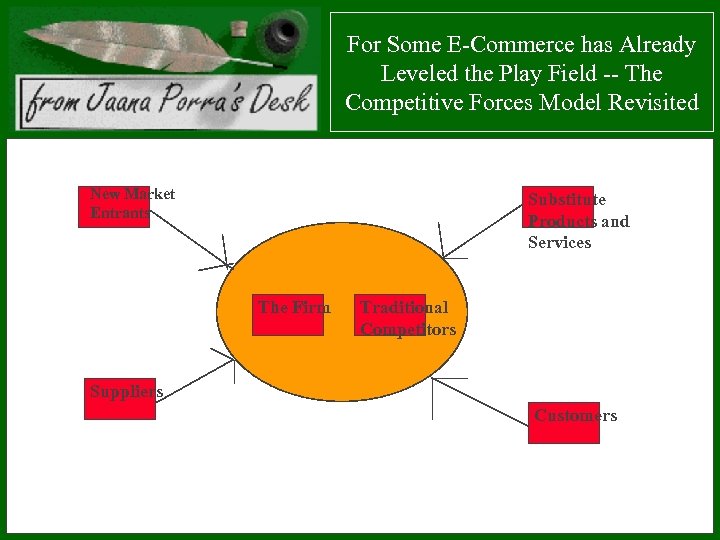 For Some E-Commerce has Already Leveled the Play Field -- The Competitive Forces Model Revisited New Market Entrants Substitute Products and Services The Firm Traditional Competitors Suppliers Customers
 How Strategic is Electronic Commerce in 2000? • Many large corporations today believe that electronic commerce is very important for their future. • But they do not yet see the need to aggressively compete in this market place. • As with most new technologies, it may take 10 -15 years before electronic commerce is an essential part of corporate business. • When this occurs, expect shifts in business comparable with the Western Union – At&T shift – those with superior e-commerce implementations survive.
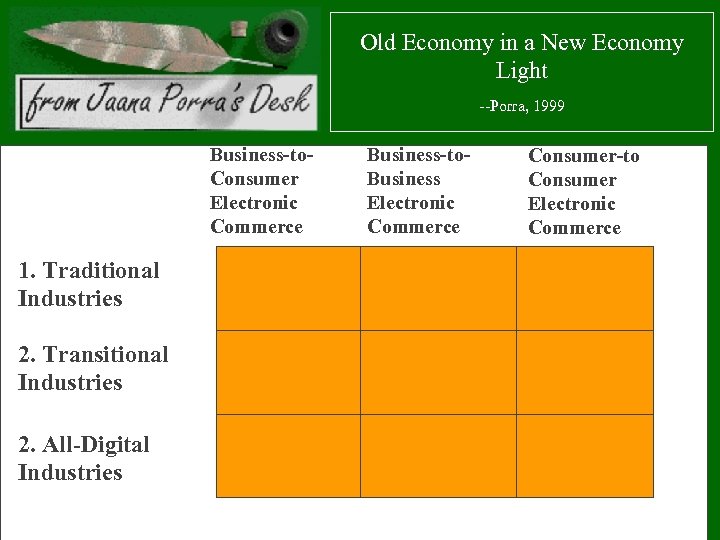 Old Economy in a New Economy Light --Porra, 1999 Business-to. Consumer Electronic Commerce 1. Traditional Industries 2. Transitional Industries 2. All-Digital Industries Business-to. Business Electronic Commerce Consumer-to Consumer Electronic Commerce
 How Is Electronic Commerce Changing Business? • Electronic commerce is changing the way products are acquired, manufactured, marketed, ordered, paid for, sold and distributed == electronic commerce value chain • Electronic commerce value chain means that traditional Industry order is renegotiated in cyberspace • For example, buyer – seller relationships, intermediation relationships, product, service
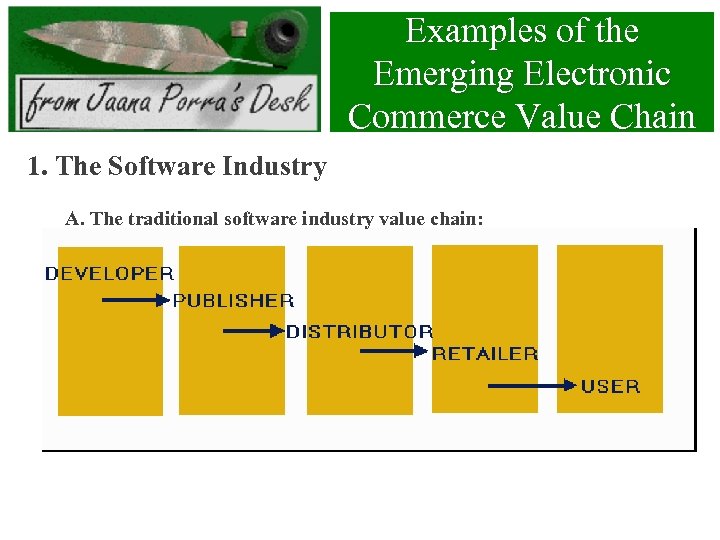 Examples of the Emerging Electronic Commerce Value Chain 1. The Software Industry A. The traditional software industry value chain:
 Traditional Software Industry Model The traditional software industry value chain was based on arrangements between involved parties: • Software Developer • Software Publisher • Software Distributor • Software Retailer • Software User Examples of arrangements: new customers are for retailers; existing customers for distributors; retailers only sell new products not upgrades, etc.
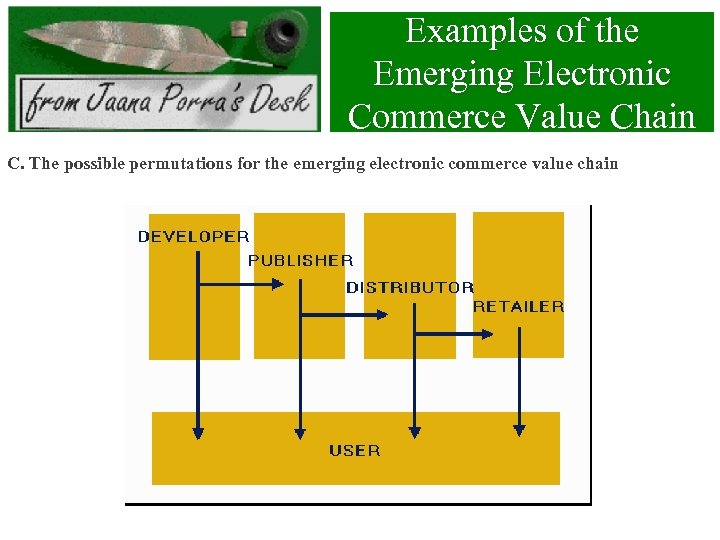 Examples of the Emerging Electronic Commerce Value Chain C. The possible permutations for the emerging electronic commerce value chain
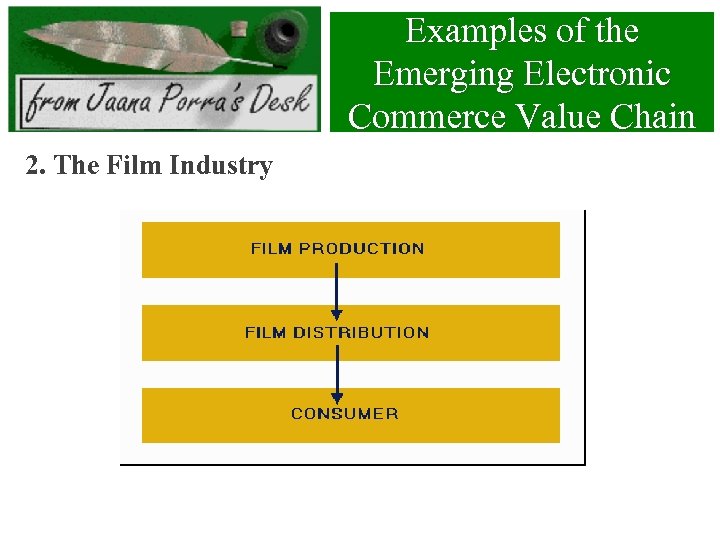 Examples of the Emerging Electronic Commerce Value Chain 2. The Film Industry
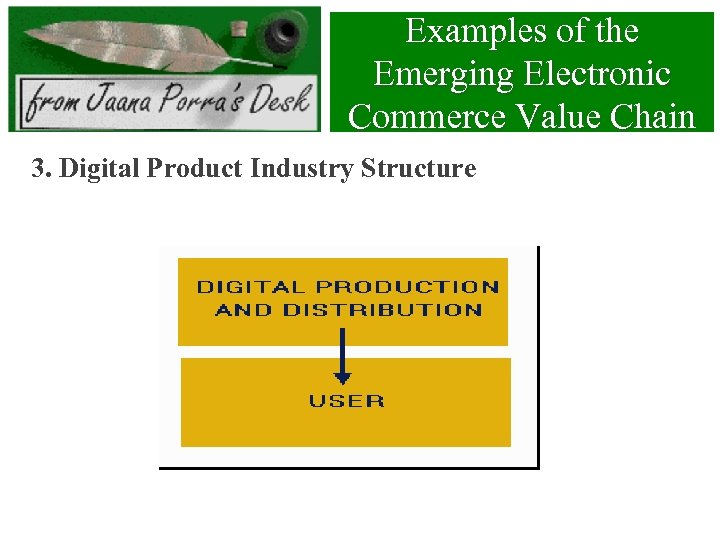 Examples of the Emerging Electronic Commerce Value Chain 3. Digital Product Industry Structure
 Electronic Software Commerce Model • In theory, all permutations between the software user and any sequences of Digital Product Developer, Digital Product Publisher, Digital Product Distributor, and Digital Product Retailer are possible • Electronic commerce infrastructure needed • An electronic commerce infrastructure is emerging at three levels of – Electronic commerce business models – Electronic commerce software applications – electronic commerce network
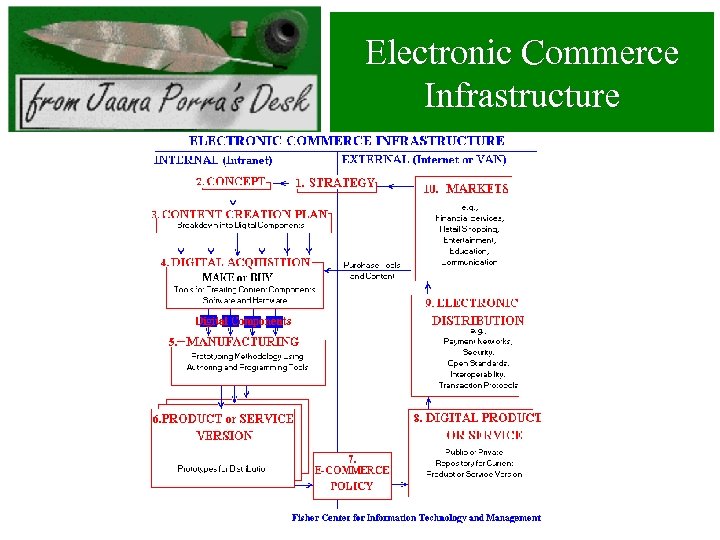 Electronic Commerce Infrastructure
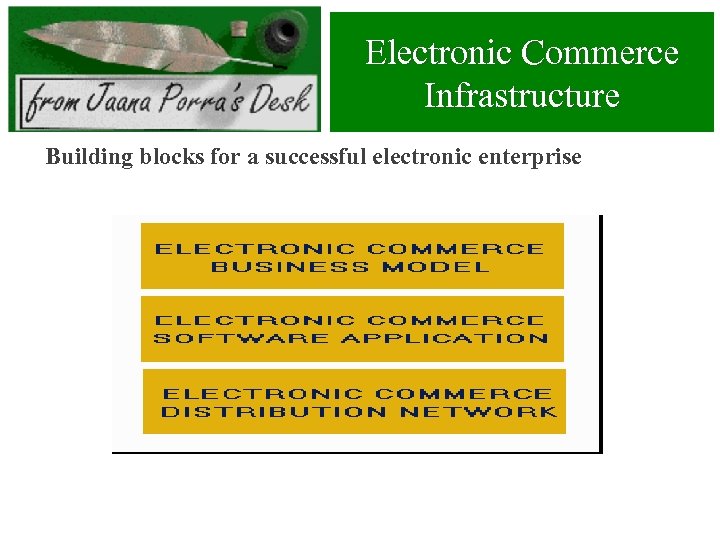 Electronic Commerce Infrastructure Building blocks for a successful electronic enterprise
 Three Generations of Cyberspace Business Models • Making money on product or service: First generation Internet business models are product driven (companies sell products or services over the Internet) • Making money on virtual community: Second generation Internet business models are community driven (companies sell access to their member base) • Making money on information about product, service or member: Third generation Internet business models are information driven (companies sell information about products, services or members)
 Future? • Shopping agents – Best product at a best price wins – Prices hyper-fluctuate. Firms are as good as their last trade. Firms are commodities. • Internet juggernauts (instant strategic partnerships) -- Alliance can start competing in the market almost immediately by relying on each partner's special expertise. Hyper-temporary alliances. Strategically launched e-commerce wars. • Corporate Nielsen ratings -- Internet is a television. Customers and partners review and view firms like television broadcast shows. Next firm is just a mouse click away.
 Future? • Supply chain racehorses -- Internet commerce means putting “the supply chain in front of the orderdelivering racehorse. ” Supply chains are commodities. They can be retired, trained and traded by supply chain brokers. • Abrupt ends – Internet may be overused. What if the lights go out? Will your firm survive? • Strategic alliances a’la Internet – portals for gourmet coffee, golf equipment and steel products. • Internet Wall Mart – On-line Giga stores take it all.
 Future Scenarios? • Virus epidemics – eradicate firms maybe even economies. • Internet Spin offs – New economy leaves the old economy -- to dust. -- Every firm must be an Internet firm. • Internet wealth versus real wealth – “One of the few ways of creating real wealth on the Internet is to have a successful IPO, sell the inflated shares and buy other companies’ stock. ” • The Internet generation is loyal to the Internet not to the firms that use it.
 Kiitos! © 2000 Jaana Porra University of Houston