


 Скачать презентацию J 200 Journalism and Mass Communications Week IX
0cada97aa14edc66b34d10f7a6157bba.ppt
- Количество слайдов: 31
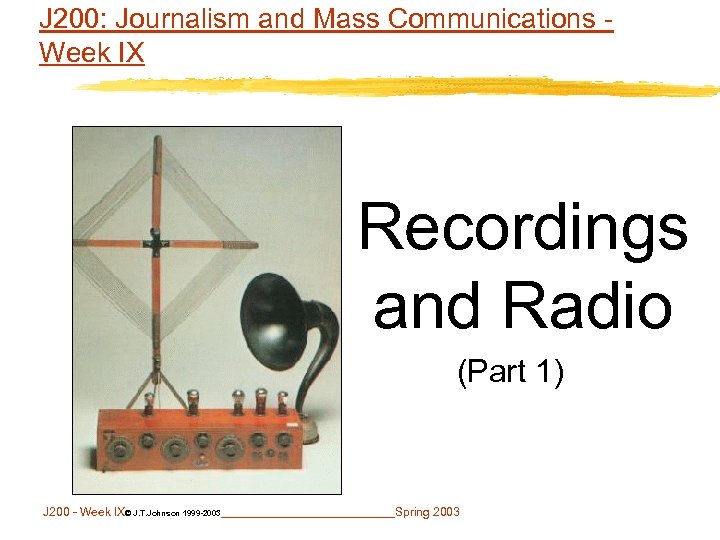 J 200: Journalism and Mass Communications Week IX z. Radioreceiver SITIDOGLIO type R 31. Long and Medium Wave, interchangeable coils. 'Endodyne" circuit. 5 tubes. Battery supply. 1924 Recordings and Radio (Part 1) J 200 - Week IX© J. T. Johnson 1999 -2003 _____________Spring 2003
 Recordings and Radio. (So what? ) § How major industries evolved around records and radio § How gov’t. regulation of radio began, evolved and morphed into TV, etc. regulations. § Consequences that radio had for records, newspapers and TV, and what TV did to radio § Challenges that fragmentation and digitization pose for the industries J 200 - Week IX© J. T. Johnson 1999 -2003 _____________Spring 2003
 Sights and Sounds: Radio Industry BROADCAST STATION TOTALS AS OF DECEMBER 31, 2002 § AM RADIO § FM EDUCATIONAL § TOTAL 4, 804 6, 173 2, 354 13, 331 Source: FCC at http: //www. fcc. gov/mb/bureau_chief/fydec 31 st. doc J 200 - Week IX© J. T. Johnson 1999 -2003 _____________Spring 2003
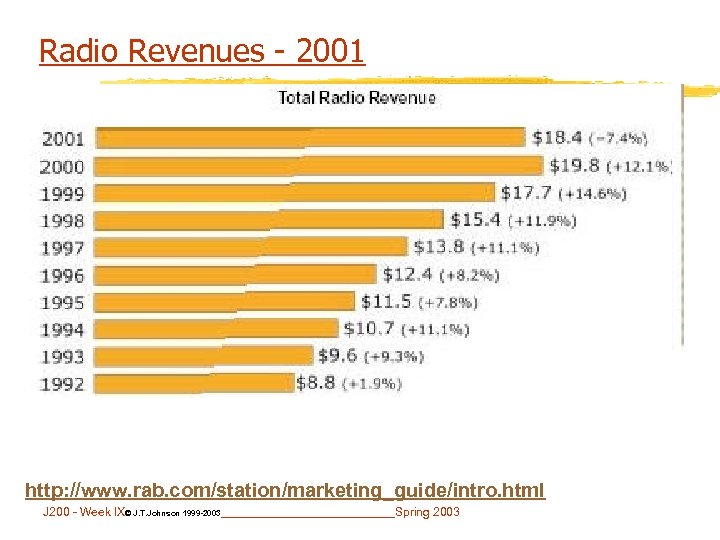 Radio Revenues - 2001 http: //www. rab. com/station/marketing_guide/intro. html J 200 - Week IX© J. T. Johnson 1999 -2003 _____________Spring 2003
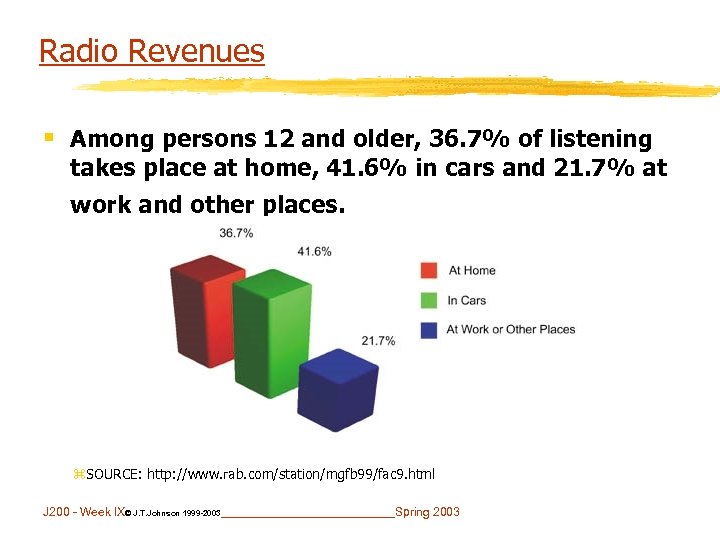 Radio Revenues § Among persons 12 and older, 36. 7% of listening takes place at home, 41. 6% in cars and 21. 7% at work and other places. z. SOURCE: http: //www. rab. com/station/mgfb 99/fac 9. html J 200 - Week IX© J. T. Johnson 1999 -2003 _____________Spring 2003
 Concentration of ownership § Radio ownership in San Francisco http: //www. publicintegrity. org/telecom/an alysis/default. aspx? action=msa J 200 - Week IX© J. T. Johnson 1999 -2003 _____________Spring 2003
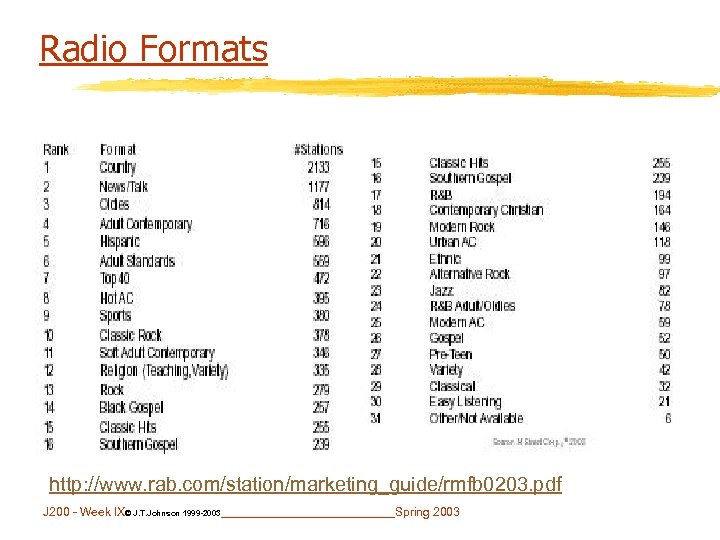 Radio Formats http: //www. rab. com/station/marketing_guide/rmfb 0203. pdf J 200 - Week IX© J. T. Johnson 1999 -2003 _____________Spring 2003
 Sound & Sight Timeline: Sweeping trends § Evolution to using electro-mechanical devices to transmit sound and images § These devices could be mass produced § Requires machine-tool industry § Requires organizational/mgmt. skills § Evolution toward a systemic “connectedness” of communications; something beyond person-to-person J 200 - Week IX© J. T. Johnson 1999 -2003 _____________Spring 2003
 Sound & Sight Timeline § "The telegraph permitted the development, in the favorite metaphor of the day, of a thoroughly encephalated social nervous system in which signaling was divorced from musculature. It was the telegraph and the railroad -- the actual, painful construction of an integrated system -- that provided the entrance gate for the organic metaphors that dominated nineteenth-century thought. “ -- James Carey Time, Space, and the Telegraph (1995) J 200 - Week IX© J. T. Johnson 1999 -2003 _____________Spring 2003
 Years of electro-mechanical invention § Mid-19 th century: § Moving toward more practical understanding of electricity and how it might become applied technology § By 1830 s, various “needle” telegraph systems § 1838: Samuel Morse creates a code which allows complex messages to be conveyed over long distances. J 200 - Week IX© J. T. Johnson 1999 -2003 _____________Spring 2003
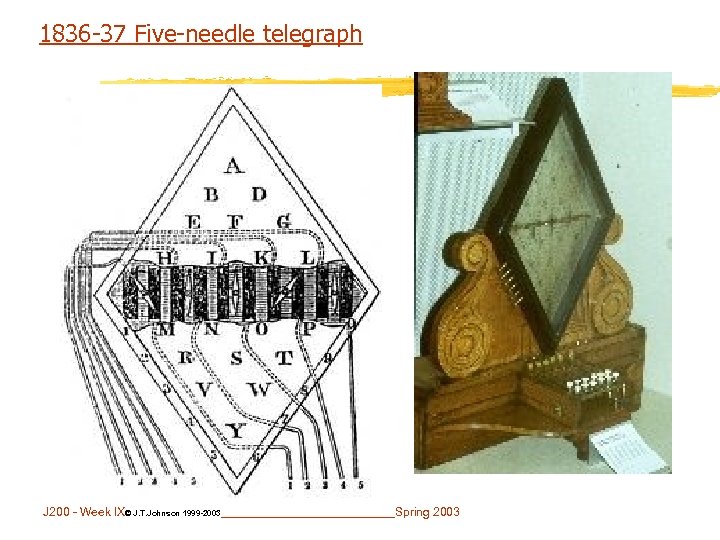 1836 -37 Five-needle telegraph J 200 - Week IX© J. T. Johnson 1999 -2003 _____________Spring 2003
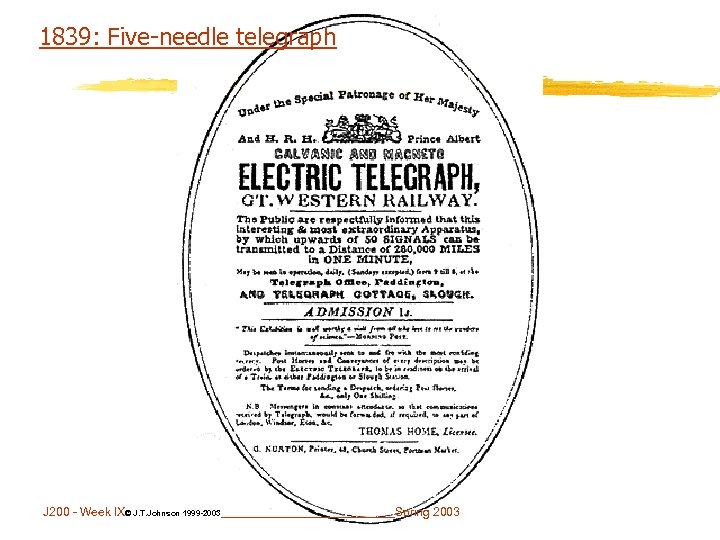 1839: Five-needle telegraph J 200 - Week IX© J. T. Johnson 1999 -2003 _____________Spring 2003
 Sound & Sight Timeline § 1843: Principle for facsimile transmission over wires was first patented seven years after the invention of the electric telegraph, by Scottish psychologist Alexander Bain. § 1844, Samuel Morse opened the first telegraph line between Washington and Baltimore. J 200 - Week IX© J. T. Johnson 1999 -2003 _____________Spring 2003
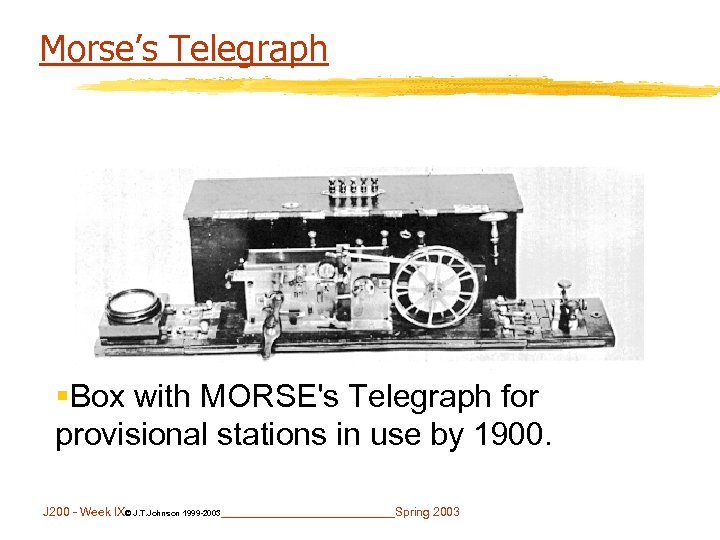 Morse’s Telegraph §Box with MORSE's Telegraph for provisional stations in use by 1900. J 200 - Week IX© J. T. Johnson 1999 -2003 _____________Spring 2003
 Telegraphy spanning the seas § 1842: Samuel Morse grappling with the problem of running telegraph cables under water. Successfully laid under-water cable from Castle Garden to Governor's Island in New York harbor. J 200 - Week IX© J. T. Johnson 1999 -2003 _____________Spring 2003
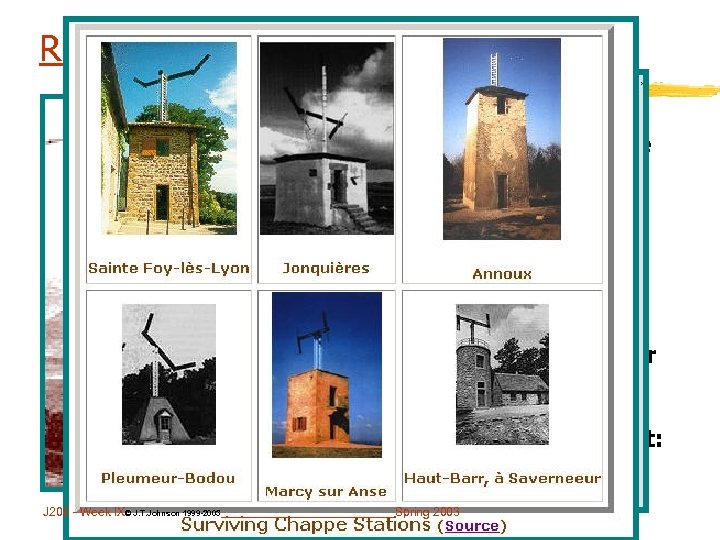 Relative cost of telegraph The semaphore system provided a strategic advantage for France. But almost 30 times more expensive per message than the electric telegraph. Using $US: § Semaphore line, 120 miles (Paris to Lille) § 15 towers ($1, 500, 000) § At least 15 full-time operators ($450, 000/year). § Operates at most ten hours a day. § Sends roughly 2 words per minute (1 symbol per minute, at 2 symbols per phrase, using the efficient directors' codebook). § Cost to send one word one mile, at 10% interest: $0. 0114 J 200 - Week IX© J. T. Johnson 1999 -2003 _____________Spring 2003
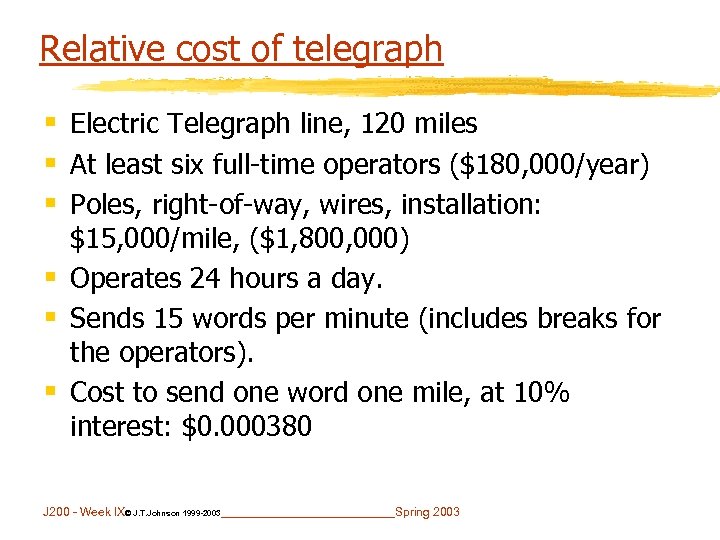 Relative cost of telegraph § Electric Telegraph line, 120 miles § At least six full-time operators ($180, 000/year) § Poles, right-of-way, wires, installation: $15, 000/mile, ($1, 800, 000) § Operates 24 hours a day. § Sends 15 words per minute (includes breaks for the operators). § Cost to send one word one mile, at 10% interest: $0. 000380 J 200 - Week IX© J. T. Johnson 1999 -2003 _____________Spring 2003
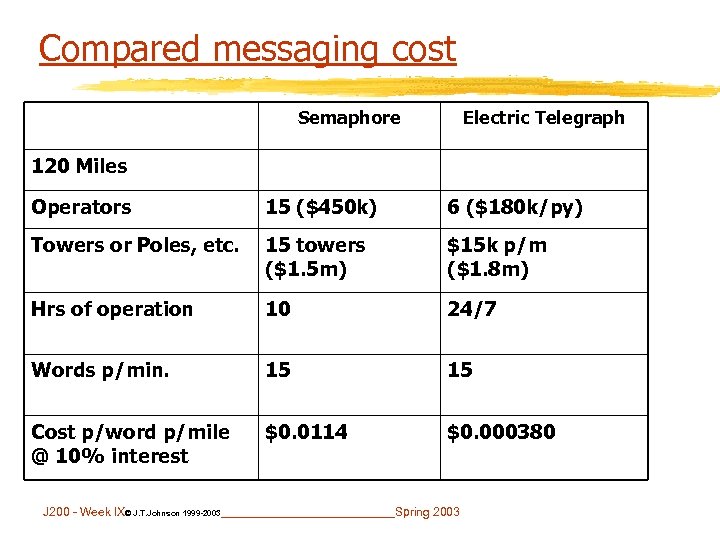 Compared messaging cost Semaphore Electric Telegraph 120 Miles Operators 15 ($450 k) 6 ($180 k/py) Towers or Poles, etc. 15 towers ($1. 5 m) $15 k p/m ($1. 8 m) Hrs of operation 10 24/7 Words p/min. 15 15 Cost p/word p/mile @ 10% interest $0. 0114 $0. 000380 J 200 - Week IX© J. T. Johnson 1999 -2003 _____________Spring 2003
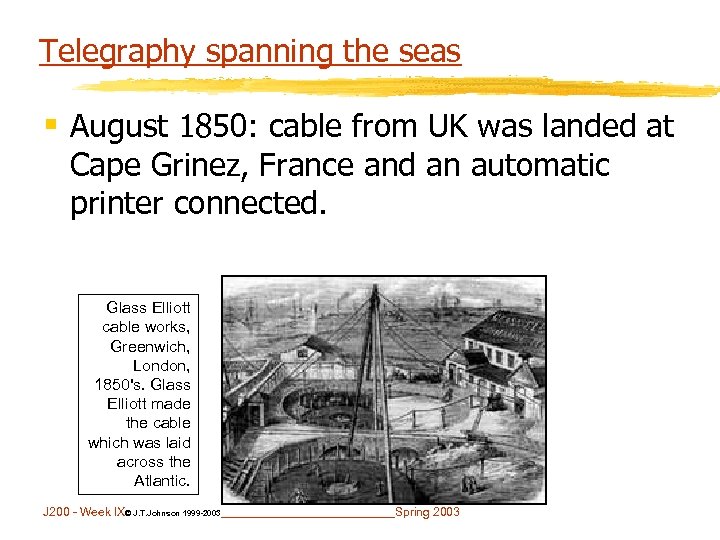 Telegraphy spanning the seas § August 1850: cable from UK was landed at Cape Grinez, France and an automatic printer connected. Glass Elliott cable works, Greenwich, London, 1850's. Glass Elliott made the cable which was laid across the Atlantic. J 200 - Week IX© J. T. Johnson 1999 -2003 _____________Spring 2003
 Telegraphy spanning the seas § Two attempts in 1857 to lay a trans- Atlantic cable from the UK to the U. S. § On Aug. 16 1858 Queen Victoria sent a message to President Buchanan. The message took 16. 5 hours to transmit. J 200 - Week IX© J. T. Johnson 1999 -2003 _____________Spring 2003
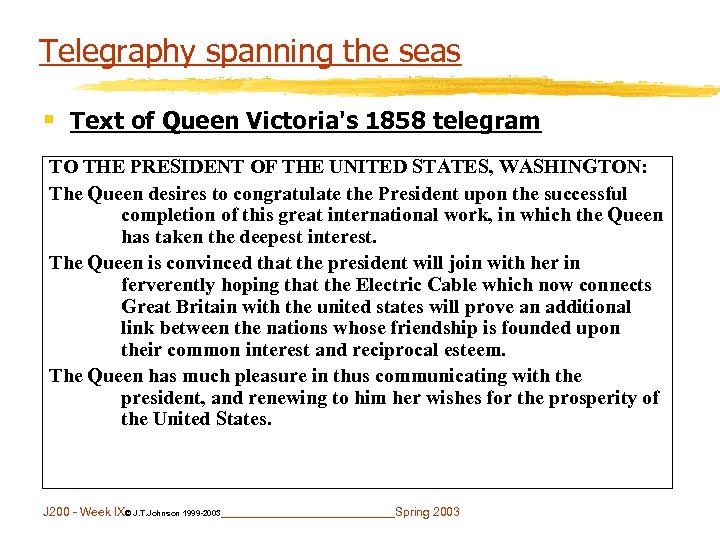 Telegraphy spanning the seas § Text of Queen Victoria's 1858 telegram TO THE PRESIDENT OF THE UNITED STATES, WASHINGTON: The Queen desires to congratulate the President upon the successful completion of this great international work, in which the Queen has taken the deepest interest. The Queen is convinced that the president will join with her in ferverently hoping that the Electric Cable which now connects Great Britain with the united states will prove an additional link between the nations whose friendship is founded upon their common interest and reciprocal esteem. The Queen has much pleasure in thus communicating with the president, and renewing to him her wishes for the prosperity of the United States. J 200 - Week IX© J. T. Johnson 1999 -2003 _____________Spring 2003
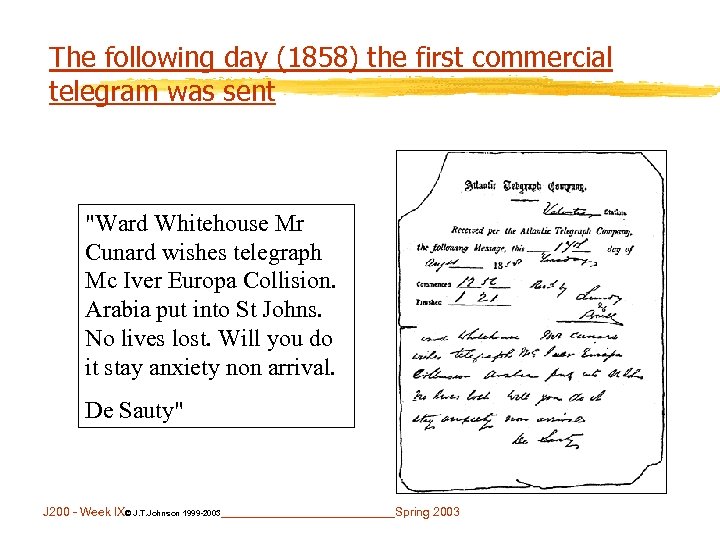 The following day (1858) the first commercial telegram was sent "Ward Whitehouse Mr Cunard wishes telegraph Mc Iver Europa Collision. Arabia put into St Johns. No lives lost. Will you do it stay anxiety non arrival. De Sauty" J 200 - Week IX© J. T. Johnson 1999 -2003 _____________Spring 2003
 Telegraphy spanning the seas § Discouragement, and the U. S. Civil War, drew attention away from the Atlantic cable until mid-1860 s. § Success in 1865 J 200 - Week IX© J. T. Johnson 1999 -2003 _____________Spring 2003
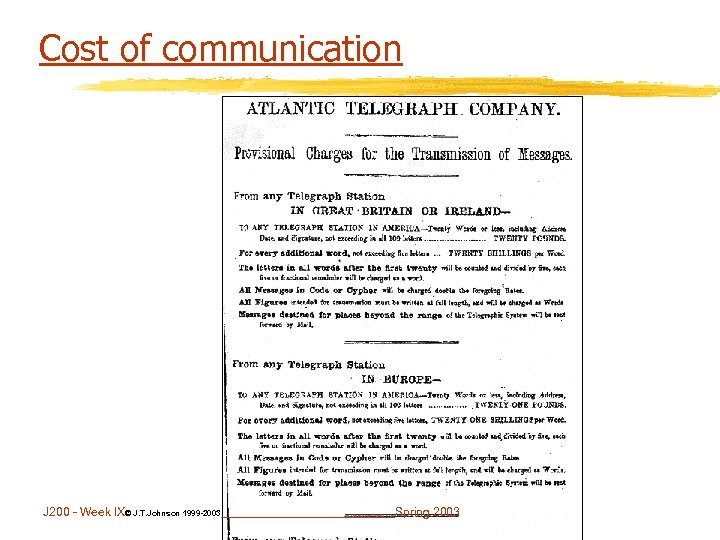 Cost of communication J 200 - Week IX© J. T. Johnson 1999 -2003 _____________Spring 2003
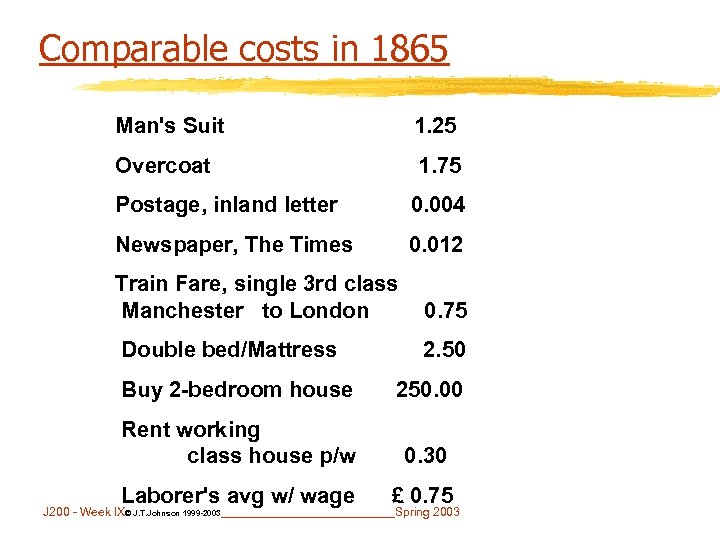 Comparable costs in 1865 Man's Suit 1. 25 Overcoat 1. 75 Postage, inland letter 0. 004 Newspaper, The Times 0. 012 Train Fare, single 3 rd class Manchester to London 0. 75 Double bed/Mattress 2. 50 Buy 2 -bedroom house 250. 00 Rent working class house p/w 0. 30 Laborer's avg w/ wage £ 0. 75 J 200 - Week IX© J. T. Johnson 1999 -2003 _____________Spring 2003
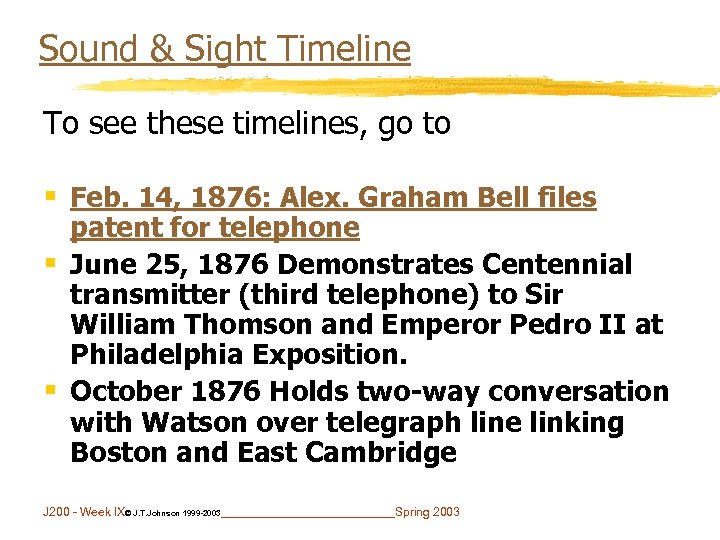 Sound & Sight Timeline To see these timelines, go to § Feb. 14, 1876: Alex. Graham Bell files patent for telephone § June 25, 1876 Demonstrates Centennial transmitter (third telephone) to Sir William Thomson and Emperor Pedro II at Philadelphia Exposition. § October 1876 Holds two-way conversation with Watson over telegraph line linking Boston and East Cambridge J 200 - Week IX© J. T. Johnson 1999 -2003 _____________Spring 2003
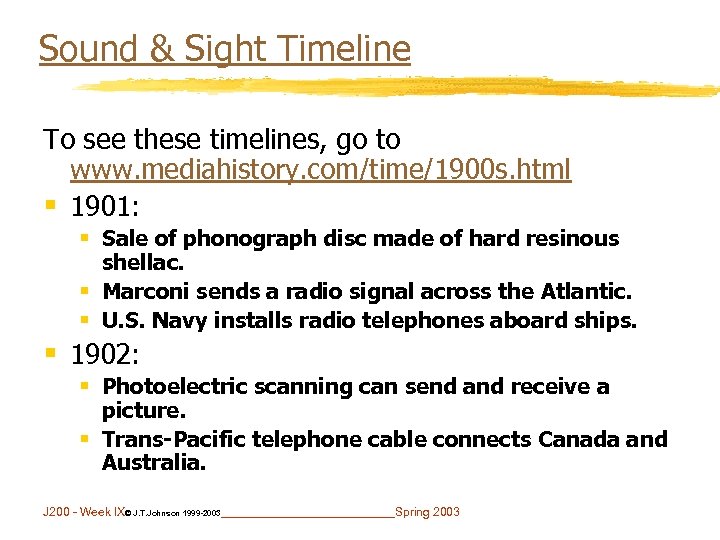 Sound & Sight Timeline To see these timelines, go to www. mediahistory. com/time/1900 s. html § 1901: § Sale of phonograph disc made of hard resinous shellac. § Marconi sends a radio signal across the Atlantic. § U. S. Navy installs radio telephones aboard ships. § 1902: § Photoelectric scanning can send and receive a picture. § Trans-Pacific telephone cable connects Canada and Australia. J 200 - Week IX© J. T. Johnson 1999 -2003 _____________Spring 2003
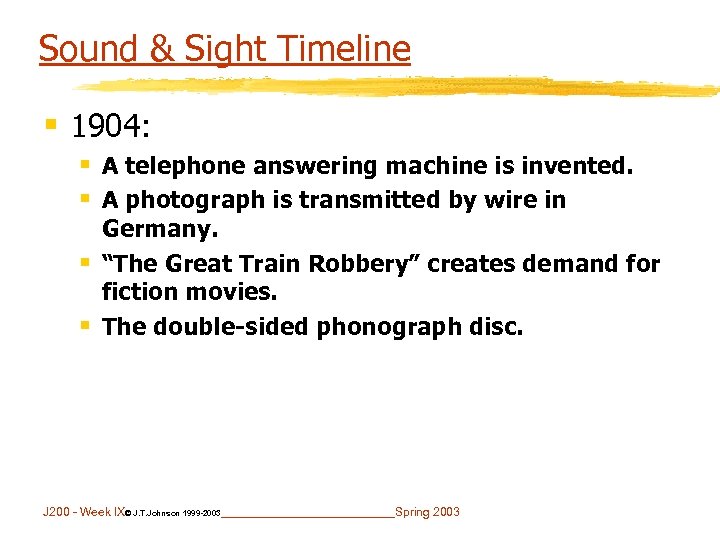 Sound & Sight Timeline § 1904: § A telephone answering machine is invented. § A photograph is transmitted by wire in Germany. § “The Great Train Robbery” creates demand for fiction movies. § The double-sided phonograph disc. J 200 - Week IX© J. T. Johnson 1999 -2003 _____________Spring 2003
 Sound & Sight Timeline § 1905: § In Pittsburgh the first nickelodeon opens. § Photography, printing, and post combine in the year's craze, picture postcards. § In France, Pathe colors black and white films by machine. § The juke box; 24 choices. J 200 - Week IX© J. T. Johnson 1999 -2003 _____________Spring 2003
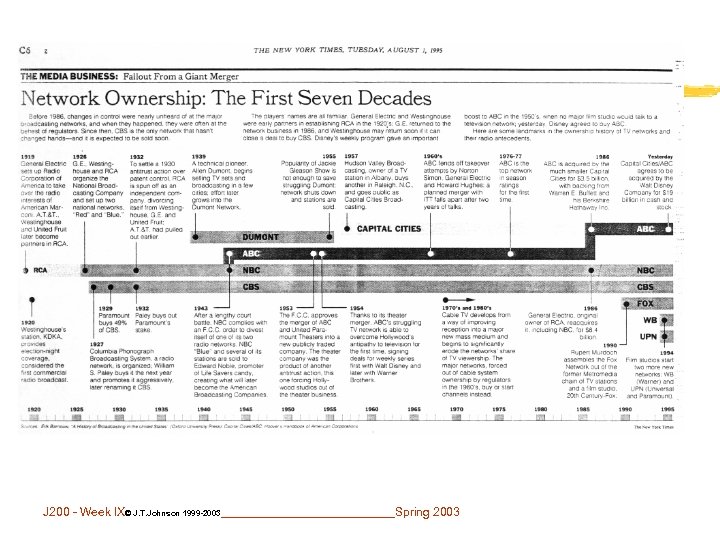 NYT: Network Ownership Timeline J 200 - Week IX© J. T. Johnson 1999 -2003 _____________Spring 2003
 Radio History § “Broadcasting’s Forgotten Father: The Charles Herrold Story” Between 1912 and 1917, 10 years before licensed radio broadcasting, Charles David Herrold transmitted weekly entertainment programs from his wireless college in San Jose, California. This documentary by Mike Adams chronicles the inventor’s (1875 -1948) life and work. (Video Cassette - 57 minutes - Color – 1994) J 200 - Week IX© J. T. Johnson 1999 -2003 _____________Spring 2003