


 Скачать презентацию IUFRO Taskforce Illegal Logging and FLEG T -processes Andreas
063718d5aab2cb942daee9fb8495a69d.ppt
- Количество слайдов: 14
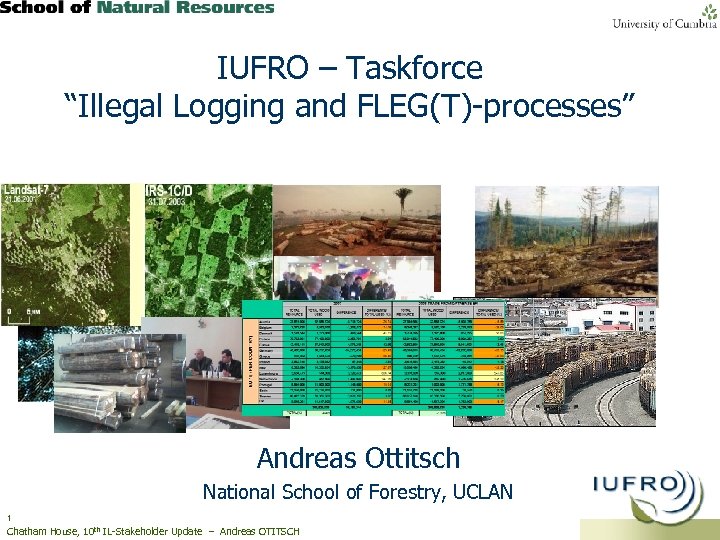 IUFRO – Taskforce “Illegal Logging and FLEG(T)-processes” Andreas Ottitsch National School of Forestry, UCLAN 1 Chatham House, 10 th IL-Stakeholder Update – Andreas OTITSCH
 IUFRO Taskforce “Illegal Logging and FLEG(T) - Processes • International Union of Forest Research Organisations (IUFRO) and IUFRO-Taskforces • Objectives and Activities of IUFRO-TF “IL & FLEG(T)” • Examples from compilation of scientific work • Options for Co-Operation and Participation 2 Chatham House, 10 th IL-Stakeholder Update – Andreas OTITSCH
 International Union of Forest Research Organisations (IUFRO) • Scientific co-operation and networking since 1892 – 2007: 700+ member institutions, 110+ countries, 15. 000+ individual scientists involved – Forest science, education, training Funding: • 6 Scientific Divisions (organised along scientific disciplines) Except for IUFRO-Secretariat in Vienna, all IUFRO-activities – www. iufro. org are based on voluntary contributions by scientists on time & resources paid for by their employers (service to scientific community, scholarly activities…. ) • 10 Taskforces • Purpose of IUFRO-Taskforces – Co-operation on specific issues of relevance to ALL disciplines within forest sciences – Intensification of scientific networking – Identification of contributions of science to societal debate 3 Chatham House, 10 th IL-Stakeholder Update – Andreas OTITSCH
 WHY a IUFRO-Taskforce? • “Illegal Logging” at centre of national and international forest sector debates • Large amount of information produced • Relatively scarce body of “peer-reviewed” publications • • Research at some centres (e. g. CIFOR), and MANY individual institutions Relevant research across many disciplines: • Need for more overview – E. g. Search result “Science Direct” for “illegal logging” 1996 – 2007: 20 publications – Much of the available information (e. g. NGO-reports, published consultant reports) is “grey literature” as far as scientific community is concerned! – – Policy, Economics, rural development, sociology Ecology (species, habitats) Technical disciplines (e. g. remote sensing, DNA-tracing) …………… 4 Chatham House, 10 th IL-Stakeholder Update – Andreas OTITSCH
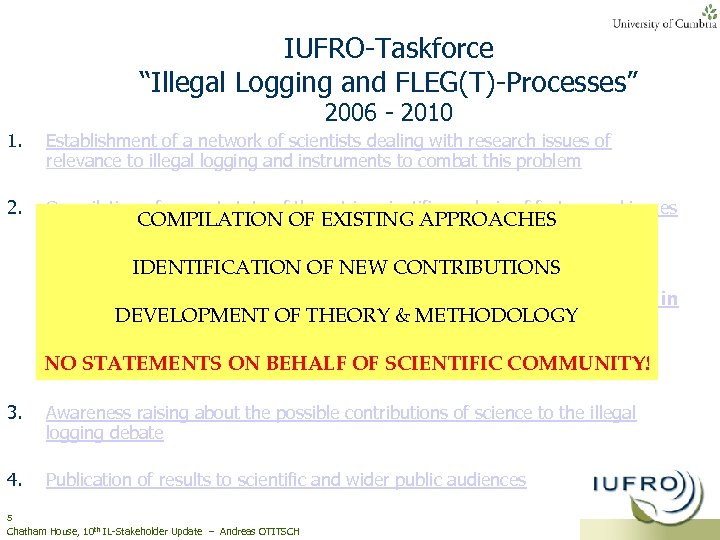 IUFRO-Taskforce “Illegal Logging and FLEG(T)-Processes” 2006 - 2010 1. Establishment of a network of scientists dealing with research issues of relevance to illegal logging and instruments to combat this problem 2. Compilation of current state of the art in scientific analysis of factors and issues COMPILATION in the illegal logging debate. OF EXISTING APPROACHES IDENTIFICATION OF NEW CONTRIBUTIONS i. Scientific studies on causes and forms of illegal logging ii. Analysis of methods to assess extent of illegal logging and trade in DEVELOPMENT products illegally logged forest OF THEORY & METHODOLOGY iii. Scientific studies on consequences of illegal logging and trade NO STATEMENTS on BEHALF OF SCIENTIFIC COMMUNITY! iv. Scientific studies. ON existing and planned countermeasures 3. Awareness raising about the possible contributions of science to the illegal logging debate 4. Publication of results to scientific and wider public audiences 5 Chatham House, 10 th IL-Stakeholder Update – Andreas OTITSCH
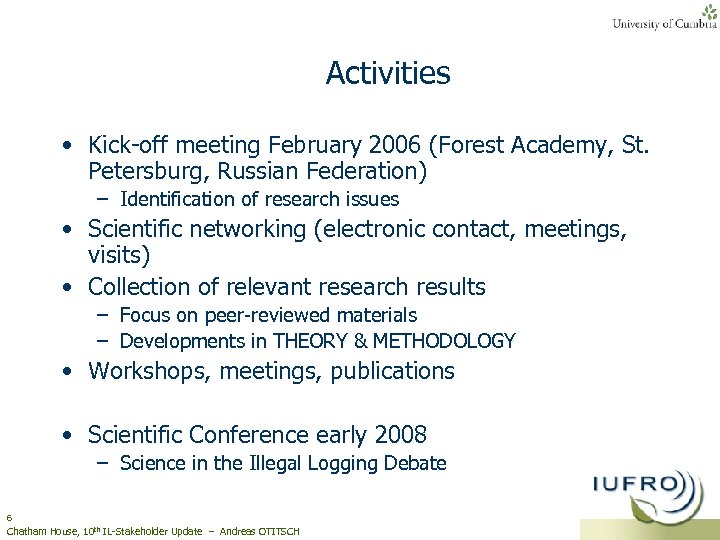 Activities • Kick-off meeting February 2006 (Forest Academy, St. Petersburg, Russian Federation) – Identification of research issues • Scientific networking (electronic contact, meetings, visits) • Collection of relevant research results – Focus on peer-reviewed materials – Developments in THEORY & METHODOLOGY • Workshops, meetings, publications • Scientific Conference early 2008 – Science in the Illegal Logging Debate 6 Chatham House, 10 th IL-Stakeholder Update – Andreas OTITSCH
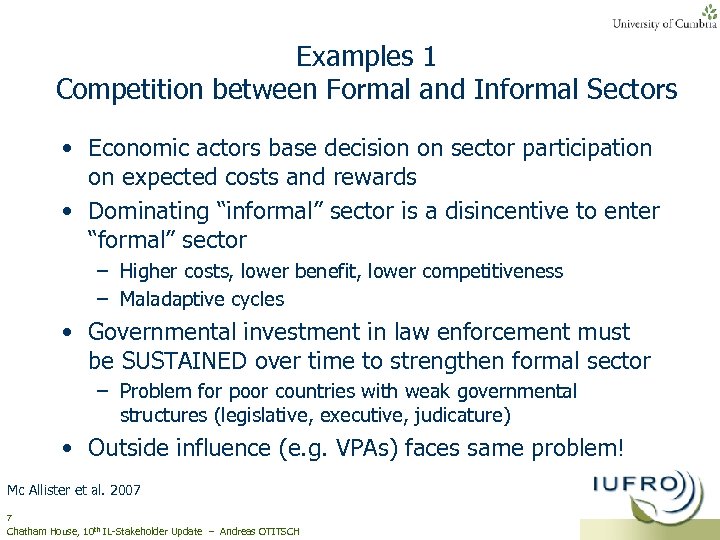 Examples 1 Competition between Formal and Informal Sectors • Economic actors base decision on sector participation on expected costs and rewards • Dominating “informal” sector is a disincentive to enter “formal” sector – Higher costs, lower benefit, lower competitiveness – Maladaptive cycles • Governmental investment in law enforcement must be SUSTAINED over time to strengthen formal sector – Problem for poor countries with weak governmental structures (legislative, executive, judicature) • Outside influence (e. g. VPAs) faces same problem! Mc Allister et al. 2007 7 Chatham House, 10 th IL-Stakeholder Update – Andreas OTITSCH
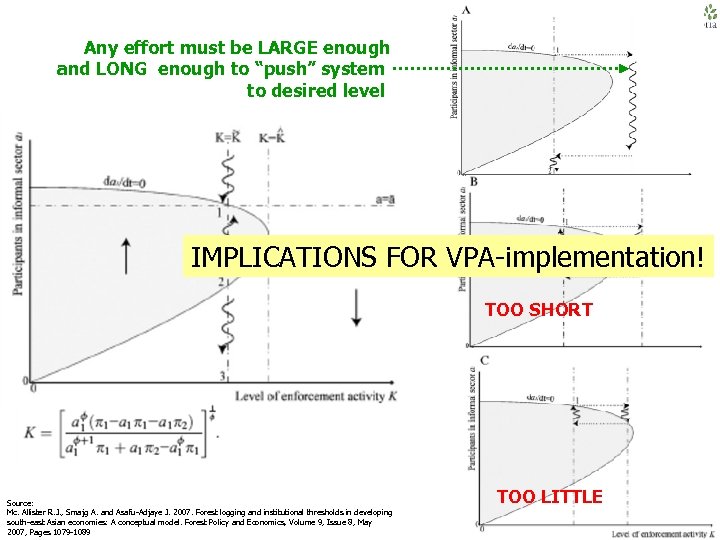 Any effort must be LARGE enough and LONG enough to “push” system to desired level IMPLICATIONS FOR VPA-implementation! TOO SHORT Source: Mc. Allister R. J. , Smajg A. and Asafu-Adjaye J. 2007. Forest logging and institutional thresholds in developing 8 south-east Asian economies: A conceptual model. Forest Policy and Economics, Volume 9, Issue 8, May 2007, Pages 1079 -1089 Chatham House, 10 th IL-Stakeholder Update – Andreas OTITSCH TOO LITTLE
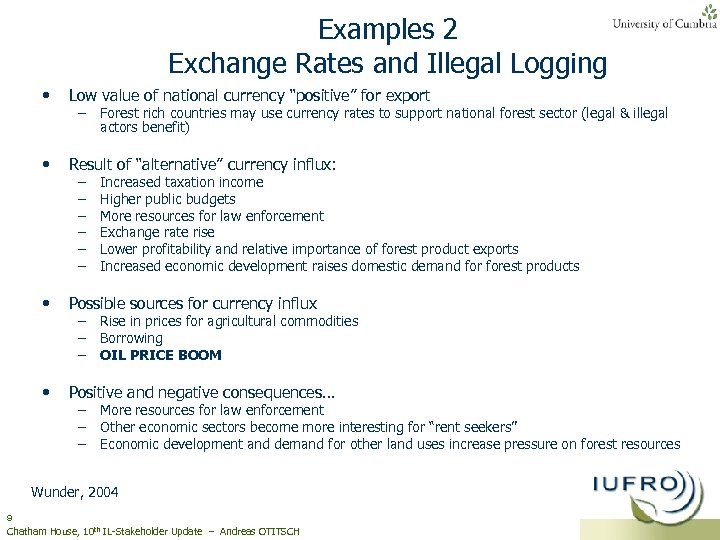 Examples 2 Exchange Rates and Illegal Logging • Low value of national currency “positive” for export • Result of “alternative” currency influx: • Possible sources for currency influx • Positive and negative consequences… – – – – Forest rich countries may use currency rates to support national forest sector (legal & illegal actors benefit) Increased taxation income Higher public budgets More resources for law enforcement Exchange rate rise Lower profitability and relative importance of forest product exports Increased economic development raises domestic demand forest products Rise in prices for agricultural commodities Borrowing OIL PRICE BOOM More resources for law enforcement Other economic sectors become more interesting for “rent seekers” Economic development and demand for other land uses increase pressure on forest resources Wunder, 2004 9 Chatham House, 10 th IL-Stakeholder Update – Andreas OTITSCH
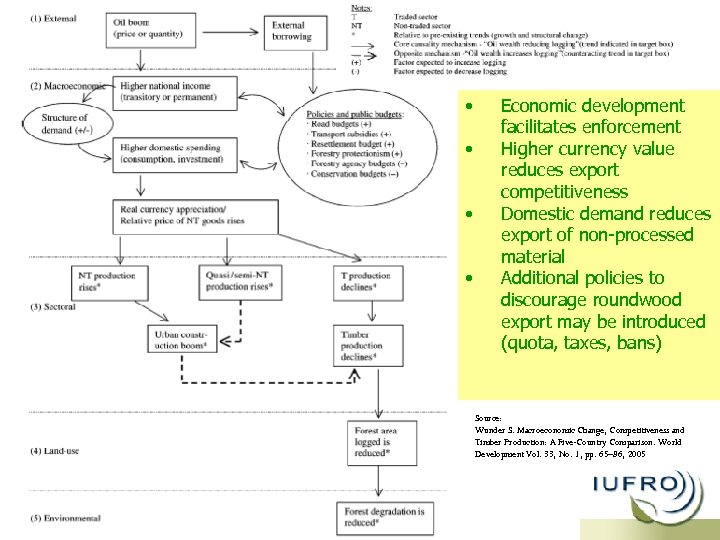 • • Economic development facilitates enforcement Higher currency value reduces export competitiveness Domestic demand reduces export of non-processed material Additional policies to discourage roundwood export may be introduced (quota, taxes, bans) Source: Wunder S. Macroeconomic Change, Competitiveness and Timber Production: A Five-Country Comparison. World Development Vol. 33, No. 1, pp. 65– 86, 2005 10 Chatham House, 10 th IL-Stakeholder Update – Andreas OTITSCH
 Examples 3 Recommended literature! • Tacconi L. (2007) Illegal Logging – Law Enforcement, Livelihoods and the Timber Trade, Earthscan, London, Stirling VA Excellent collection of articles on a wide array of issues of relevance to the illegal logging debate, based on CIFOR’s research in Asia and Latin America 11 Chatham House, 10 th IL-Stakeholder Update – Andreas OTITSCH
 Planned outputs • Compilation of existing scientific work – Soon available from TF-webpages! • • • Scientific networking More peer-reviewed publications Better theoretical conceptualisation of issues More interest within research community Negotiations on scientific book focussing on FLEG(T)- processes • New research activities – Theory-based evaluation of existing policies and processes 12 Chatham House, 10 th IL-Stakeholder Update – Andreas OTITSCH
 Options for Co-Operation and Participation • Information about relevant research projects • Information about publications – Peer reviewed papers – Scientific books • Identification of “grey” material suitable for peerreviewed publication – Reports, papers prepared for / published by national/international institutions (GO & NGO) • Objective is to encourage authoring of more peer-reviewed material! • Recognition of methods used in support of international processes 13 Chatham House, 10 th IL-Stakeholder Update – Andreas OTITSCH
 Further Information: IUFRO-Taskforce “Illegal Logging and FLEG(T) – processes http: //www. iufro. org/science/task-forces/flegt Andreas OTTITSCH Email 1: AOttitsch@uclan. ac. uk (Aug 1 st: Andreas. Ottitsch@cumbria. ac. uk) Email 2: Andreas. Ottitsch@a 1. net National School of Forestry Newton Rigg, CA 11 0 AH, Penrith, UK Tel. : +44 1772 894223 / +43 664 320 16 28 (mobile) 14 August 1 st 2007 – Launch of Uo. C www. cumbria. ac. uk Chatham House, 10 th IL-Stakeholder Update – Andreas OTITSCH