


 Скачать презентацию ITU-WTO WORKSHOP ON TELECOM ICT REGULATION AGREEMENT
b8b7200def175db89da27ed217a007aa.ppt
- Количество слайдов: 29
 ITU-WTO WORKSHOP ON TELECOM & ICT REGULATION AGREEMENT ON GOVERNMENT PROCUREMENT (GPA) Roger Kampf WTO Secretariat Geneva, 2 December 2004 1
 I. Government Procurement in General 2
 What Is “Government Procurement” ? • Key elements (c. f. the definitions in Arts. III. 8 and XVII of the GATT 1947 and Art. XIII. 1 of the GATS): – Procurement – By governmental agencies – Of products or services – For governmental purposes (and not with a view to commercial resale or use in the production of goods for commercial sale) 3
 GP and General Policies • Good governance, optimal use of resources, domestic policy issues • Transparency, fair and equitable procedures • International trade aspects • In general, two major principles in conflict: Competition – Maximization of competition – Advantages: • Better quality • Lower prices • Efficiency of public expenditure Preferential policies – Reduction of competition – Direct assistance to certain domestic enterprises/industries – Types : Price preference margins, offsets, set-asides 4
 II. Overview of WTO Work in the field of Government Procurement 5
 Government Procurement and the Multilateral Trading System • Government procurement historically excluded from key principles of multilateral trade agreements: - Goods (1947) : GATT Articles III: 8 and XVII: 2 - Services (1994) : GATS Article XIII: 1 • But growing awareness of (i) need to have sound national procurement systems in place, and (ii) trade restrictive effects of discriminatory procurement policies (such as preferences, offsets, set-asides) 6
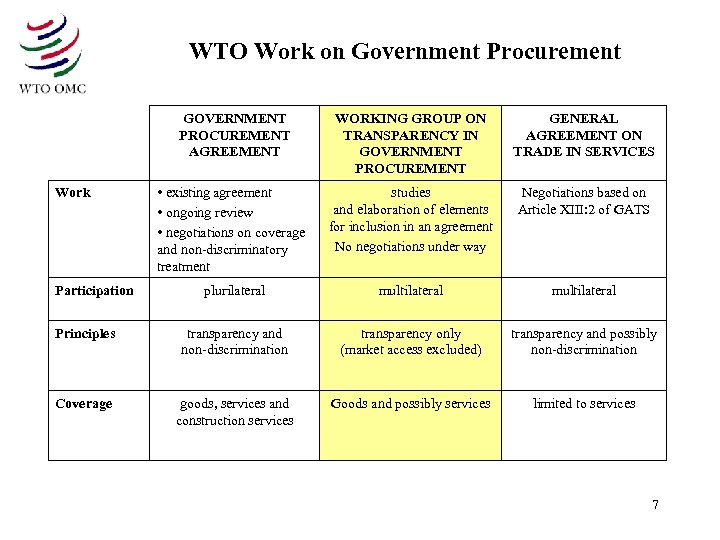 WTO Work on Government Procurement GOVERNMENT PROCUREMENT AGREEMENT WORKING GROUP ON TRANSPARENCY IN GOVERNMENT PROCUREMENT GENERAL AGREEMENT ON TRADE IN SERVICES • existing agreement • ongoing review • negotiations on coverage and non-discriminatory treatment studies and elaboration of elements for inclusion in an agreement No negotiations under way Negotiations based on Article XIII: 2 of GATS plurilateral multilateral Principles transparency and non-discrimination transparency only (market access excluded) transparency and possibly non-discrimination Coverage goods, services and construction services Goods and possibly services limited to services Work Participation 7
 III. Plurilateral Agreement on Government Procurement (“GPA”) 8
 Nature and Membership • Plurilateral - not all WTO Members bound • 13 Members (counting EC with its 25 member States as one member) – All traditional developed countries except Australia and New Zealand – PLUS Israel; Hong Kong, China; Korea; Singapore • Countries acceding to the WTO – Regularly requested to seek accession to GPA as condition of accession to WTO 9
 Structure • Text of Agreement : Article I - XXIV • Appendix I – Entities (Annexes 1 - 3) – Services, construction services (Annexes 4 -5) – General Notes • Appendix II to IV : Publications for – Intended Procurement/Post-award Notices – Permanent List of Qualified Suppliers in case of Selective Tendering Procedures – Laws, regulations etc. 10
 Main Principles • National Treatment / treatment no less favourable than that accorded to any other Party • Basic transparency obligations (publication of laws, regulations, etc) • Provisions to ensure fair and transparent procedures • Exceptions – General exceptions (Article XXIII) – Derogations from Article III (General Notes) – Developing countries (Article V) – Offsets (Article XVI) • Special and Differential Treatment 11
 Enforcement: Key Features • Core principles for mandatory domestic bid challenge system: – non-discriminatory, timely, transparent and effective procedures – review body – interim measures – Corrections • Application of WTO Dispute Settlement, supplemented by some specific rules due to plurilateral nature of GPA 12
 Ongoing Work • Negotiations under way since 1997 – Revision of the text to introduce improvements (simplify it and facilitate the accession of new members) • Negotiations commencing in 2004 – Extension of coverage among all Parties on the basis of mutual reciprocity – Eliminating any remaining discriminatory measures and practices 13
 IV. Transparency in Government Procurement 14
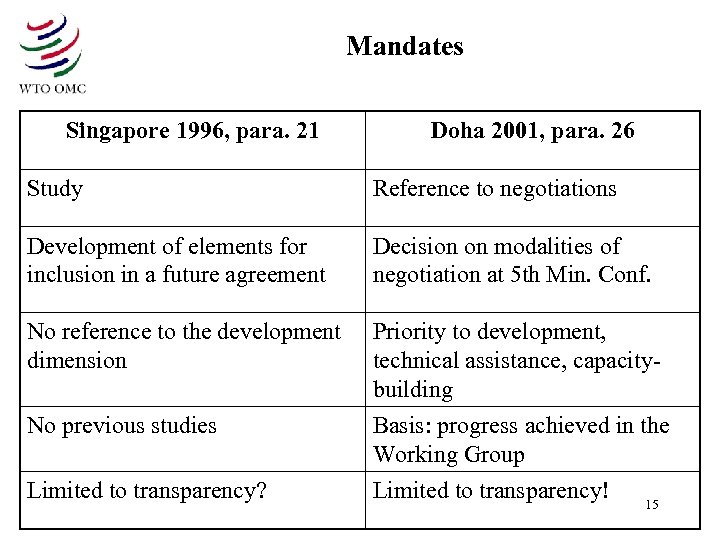 Mandates Singapore 1996, para. 21 Doha 2001, para. 26 Study Reference to negotiations Development of elements for inclusion in a future agreement Decision on modalities of negotiation at 5 th Min. Conf. No reference to the development dimension Priority to development, technical assistance, capacitybuilding No previous studies Basis: progress achieved in the Working Group Limited to transparency! 15 Limited to transparency?
 Post Cancún: “July 2004 Package” • No substantive results at MC in Cancún • Three options for Singapore issues: – Negotiations, – Studies, or – Cessation of work • Option selected: transparency in government procurement (and competition and investment) no longer forms part of the Doha Work Programme. Consequently, no work towards negotiations within the WTO during the Doha Round. 16
 V. Government Procurement and the GATS 17
 GATS Negotiations: Basic Elements • Basic transparency obligation in GATS Art. III applies • No market access or non-discrimination obligations (cf. GATS Art. XIII: 1), except for financial services for members having adhered to the Understanding on Commitments in Financial Services (cf Section B. 2. ) • Mandate in GATS Art. XIII: 2 to hold multilateral negotiations 18
 GATS Negotiations: State of Play • Dealt with by Working Party on GATS Rules established by the Council for Trade in Services • Interlinked with other topics (i. e. emergency safeguards and subsidies) covered by WPGR • Scope of the mandate (coverage of market access ? ) • Potential overlap with WG on Transparency no longer exists • Several proposals made to define modalities how to cover GP in GATS schedules • Limited Progress to date 19
 VI. Telecommunications and the VII. Plurilateral GPA 20
 Coverage of Telecom Operators (1) • Only few GPA members cover telecom operators: – Nippon Telegraph and Telephone Co (not for procurement of public electrical telecom equipment and of services related to operational safety of telecommunications) – Korea Telecom (except purchases of common telecom commodity products and telecom network equipment) – Bezek (Israel): limited to US goods and services, but willing to negotiate opening of telecom sector with other GPA members on reciprocal basis • Example of broader coverage under bilateral 21 agreements: EU-Switzerland
 Coverage of Telecom Operators (2) • Withdrawal of NTT and Korea Telecom from GPA proposed, but pending because of objection by other GPA members • Basic question = definition of “effective elimination of government control or influence” in Article XXIV: 6(b) GPA: – ownership – legal status – exposure to effective de jure/de facto competition ? 22
 Coverage of Telecommunications Services (1) • Legal basis: Appendix I, Annex 4 of the GPA • Details of coverage: – Canada: electronic/voice mail, on-line information and data base retrieval, electronic data interchange, fax services – EC, Iceland, Liechtenstein, Norway, Switzerland : telecommunication services, except voice telephony, telex, radiotelephony, paging and satellite services – Hong Kong, China: value-added telecom services, basic telecom services, telecom-related services. But: subject to exclusive license – Japan: limited to electronic/voice mail, on-line information and data base retrieval, electronic data interchange, fax services, code and protocol conversion, on-line information and/or data processing 23
 Coverage of Telecommunications Services (2) • Details of coverage (cont’d): – Korea: limited to on-line information and data base retrieval, electronic data interchange, fax services – Singapore: limited to electronic/voice mail, on-line information and data base retrieval, electronic data interchange – US (only country following negative list approach): enhanced (value-added) telecommunications services • No specific comments undertaken by: – Israel – Netherlands for Aruba 24
 Exceptions in General Notes • Canada: non-application to EU • EC, Iceland, Liechtenstein, Norway, Switzerland: application on reciprocal basis only; exclusion of contracts awarded by covered central and sub-central entities in connection with activities in the field of telecommunications • Hong Kong, China: commitments on telecommunications services subject to terms of licence held by Hong Kong Telecommunications International Ltd until 30 September 2006 for certain exclusive services • Japan: non-application to Canada for procurement by sub-central and other entities • Korea: non-application to Canada for procurement by sub-central and other entities; reciprocal coverage of telecom services • US: reciprocal coverage of telecom services 25
 Thresholds Applying to Procurement of Goods and Services (Except Construction Services) • Central entities: 130. 000 SDR • Sub-central entities: 200. 000 SDR, except for: – Israel (250. 000 SDR) – Canada and US (355. 000 SDR) • Other entities: 400. 000 SDR, except for: – Canada, Israel (355. 000 SDR) – Japan (130. 000 SDR) – Korea (450. 000 SDR) • Possibility to apply discriminatory sanctions for procurement below thresholds – example: in 1993, US bars EU suppliers from bidding for contracts concerning purchase of telecom equipment below thresholds, EU applies counter-sanctions 26
 Summary Overview: Coverage of telecommunications under the GPA • Purchase by entities listed in Appendix I, Annexes 1 to 3 (central, sub-central and other entities) • Of telecom equipment and telecom services, to the extent listed in Annex 4 (services) and not otherwise excluded • Subject to the application of reciprocity / exclusive licensing / non-application clauses contained in Notes to Annexes and General Notes • Above thresholds fixed individually by each GPA member 27
 Link between GPA and GATS • Basis: broad coverage of telecommunication services under GPA • Reality: access to government markets often limited because of general restrictions applying to the supply of services maintained under GATS • Reflected explicitly in certain GPA members’ notes to Annex 4 or in their General Notes 28
 Negotiations on Coverage and Discriminatory Measures • Handling of pending notifications proposing withdrawal of telecom operators ? • Inclusion of new entities ? • Extension of coverage in relation to telecommunication services ? 29