


 Скачать презентацию ITU Workshop on E-health services in low-resource settings
92b0a22f3876c3c81b7a8c8eec196ad5.ppt
- Количество слайдов: 21
 ITU Workshop on “E-health services in low-resource settings: Requirements and ITU role” (Tokyo, Japan, 4 -5 February 2013) Challenges in developing Countries & E-Health Rajendra Pratap Gupta, Member , World Economic Forum’s Global Agenda Council – Digital Health 2012 -14 Office. rajendra@gmail. com Tokyo, Japan, 4 -5 February 2013
 e. Health was born out of the challenges of - constrained financial resources, Clinical resources, infrastructure, increasing need of healthcare in rural / remote settings and advancements in ICT Rajendra Pratap Gupta Tokyo, Japan, 4 -5 February 2013 2
 e. Health is no more an innovation now. It is a basic necessity of every healthcare system Rajendra Pratap Gupta Tokyo, Japan, 4 -5 February 2013 3
 e. Health – Push & Pull MCH – IMR – MMR Rural Health Screenings Secondary prevention amongst affluent class – NCDs Second opinion or referrals & teleradiology Geriatric Care Medical tourism Tokyo, Japan, 4 -5 February 2013 4
 Priorities for the Developing World MDGs 4 & 5 – MCH Healthcare delivery in rural areas NCDs Training of *HCWs * HCW – Healthcare Workers Tokyo, Japan, 4 -5 February 2013 5
 MDGs 4 & 5 In India , MMR is 212 / 100, 000 live births. 1 death every 10 minutes. Target is to get MMR down to 109 / 100, 000 live births by 2015 IMR is 48 / 1000 live births & needs to be brought to 42 / 1000 by 2015 Tokyo, Japan, 4 -5 February 2013 6
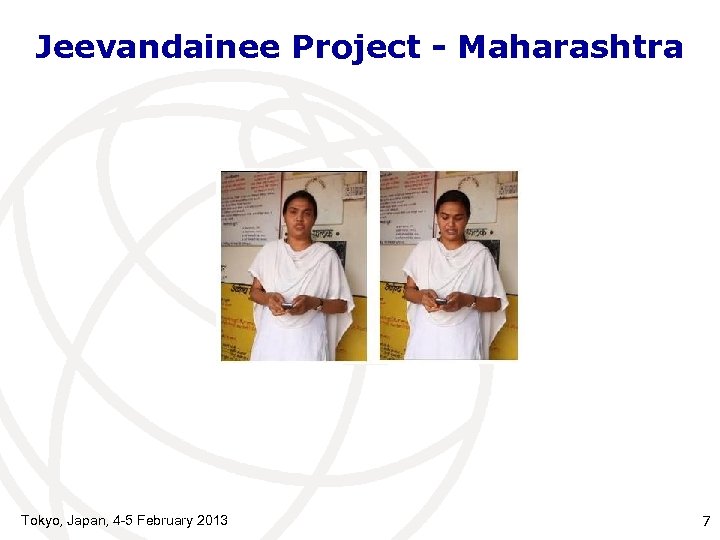 Jeevandainee Project - Maharashtra Tokyo, Japan, 4 -5 February 2013 7
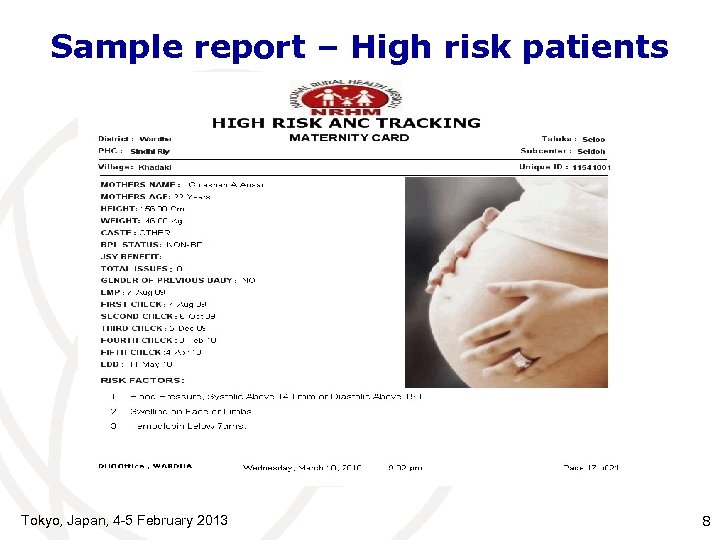 Sample report – High risk patients Tokyo, Japan, 4 -5 February 2013 8
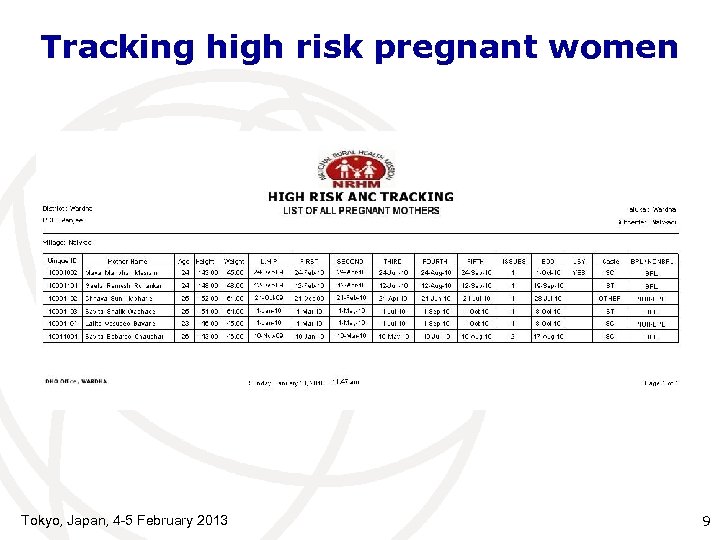 Tracking high risk pregnant women Tokyo, Japan, 4 -5 February 2013 9
 Outcome Cost of intervention per village < $ 100 In a year and half of being in operation; Maternal mortality dropped from 91 /100, 000 to 51 / 100, 000 A drop of 43. 95 % in MMR Tokyo, Japan, 4 -5 February 2013 10
 Healthcare Delivery in Rural areas 70 %( about 830 million ) of India’s population lives in rural areas India has about 6, 40, 000 villages Absenteeism of doctors is 40 % in rural settings Tokyo, Japan, 4 -5 February 2013 11
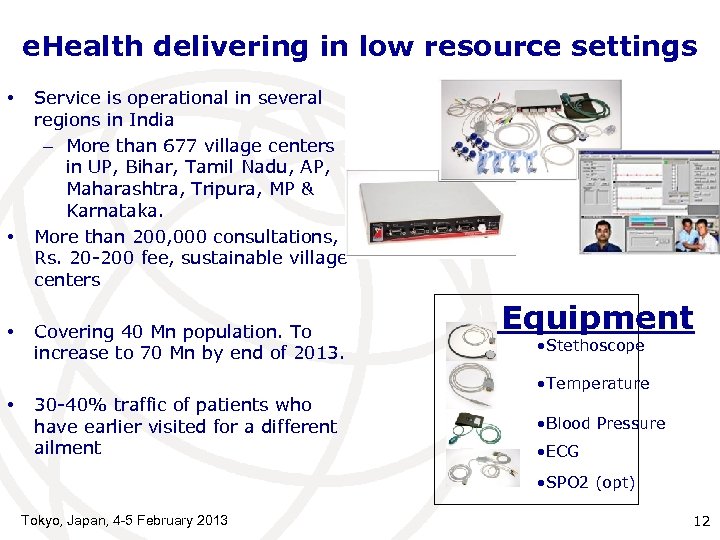 e. Health delivering in low resource settings • • • Service is operational in several regions in India – More than 677 village centers in UP, Bihar, Tamil Nadu, AP, Maharashtra, Tripura, MP & Karnataka. More than 200, 000 consultations, Rs. 20 -200 fee, sustainable village centers Covering 40 Mn population. To increase to 70 Mn by end of 2013. Equipment • Stethoscope • Temperature • 30 -40% traffic of patients who have earlier visited for a different ailment • Blood Pressure • ECG • SPO 2 (opt) Tokyo, Japan, 4 -5 February 2013 12
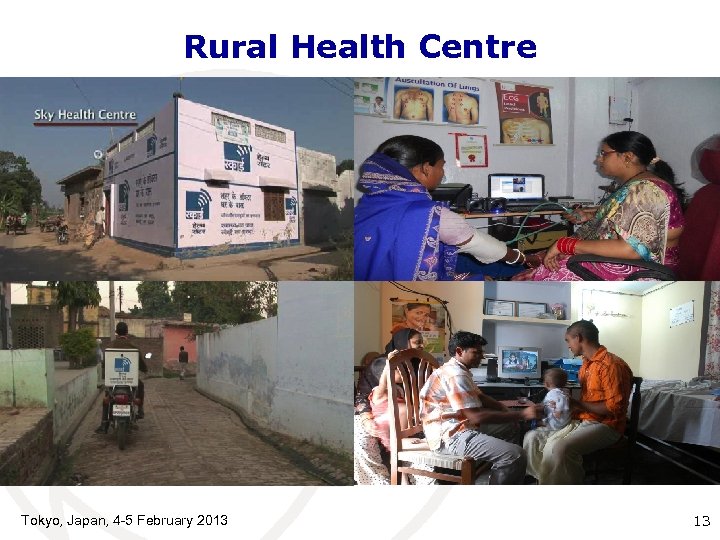 Rural Health Centre Tokyo, Japan, 4 -5 February 2013 13
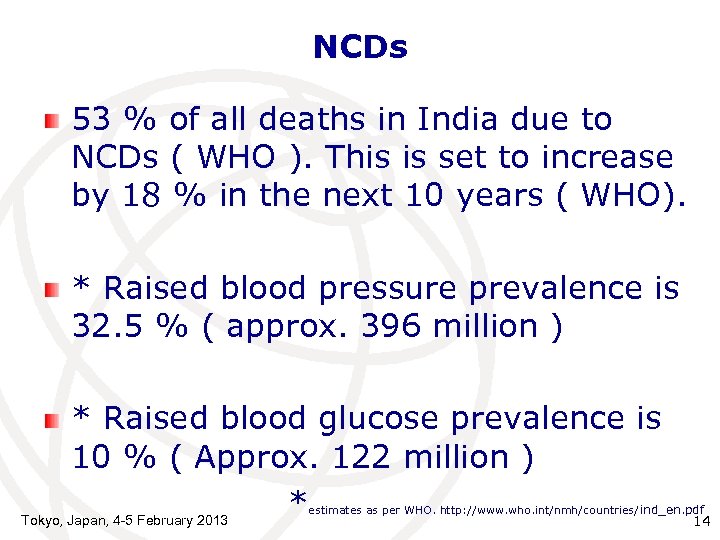 NCDs 53 % of all deaths in India due to NCDs ( WHO ). This is set to increase by 18 % in the next 10 years ( WHO). * Raised blood pressure prevalence is 32. 5 % ( approx. 396 million ) * Raised blood glucose prevalence is 10 % ( Approx. 122 million ) * Tokyo, Japan, 4 -5 February 2013 estimates as per WHO. http: //www. who. int/nmh/countries/ ind_en. pdf 14
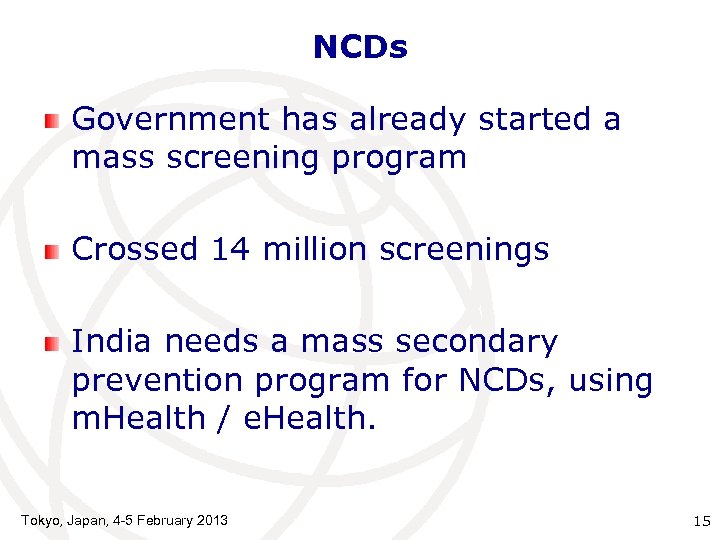 NCDs Government has already started a mass screening program Crossed 14 million screenings India needs a mass secondary prevention program for NCDs, using m. Health / e. Health. Tokyo, Japan, 4 -5 February 2013 15
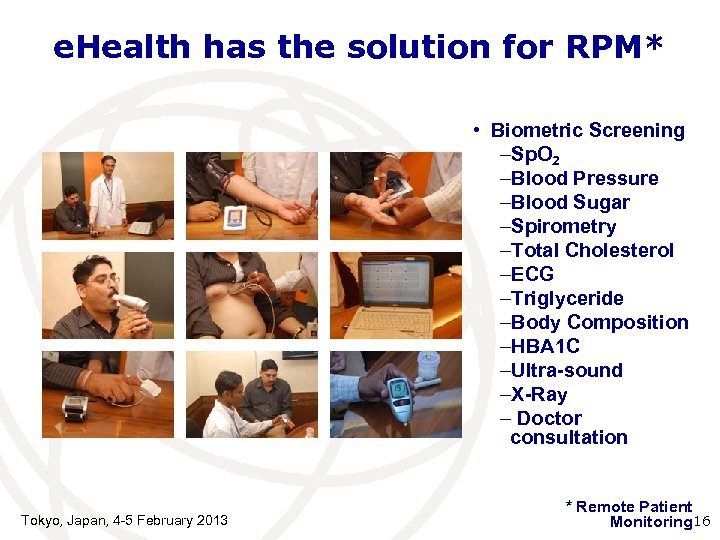 e. Health has the solution for RPM* • Biometric Screening –Sp. O 2 –Blood Pressure –Blood Sugar –Spirometry –Total Cholesterol –ECG –Triglyceride –Body Composition –HBA 1 C –Ultra-sound –X-Ray – Doctor consultation Tokyo, Japan, 4 -5 February 2013 * Remote Patient Monitoring 16
 Training of *HCWs India has approx. 866000 *ASHAs No. of ASHAs to increase in future A new 3 year course for HCWs (Rural) Training , capacity building & retraining - a big challenge ! * Tokyo, Japan, 4 -5 February 2013 HCW – Healthcare Workers. ASHA- Accredited Social Health Activist 17
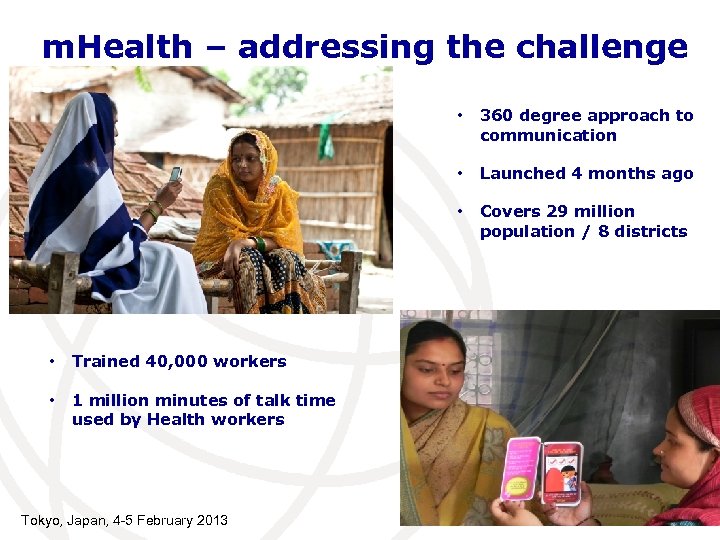 m. Health – addressing the challenge • • Covers 29 million population / 8 districts Trained 40, 000 workers • Launched 4 months ago • • 360 degree approach to communication 1 million minutes of talk time used by Health workers Tokyo, Japan, 4 -5 February 2013 18 18
 Challenges for e. Health Lack of data in support of e. Health Successful & scalable e. Health projects Technical competence amongst policy makers to understand e. Health Tokyo, Japan, 4 -5 February 2013 19
 Challenges for e. Health VOI ( Value On Investment ) should be considered for e. Health and not just financial ROI ( Return On Investment ). BOO ( Build , Own & Operate model ) or BOOT ( Build , Own , Operate & Transfer model ) under PPP ( Private Public Partnership model ). Tokyo, Japan, 4 -5 February 2013 20
 Conclusions and Recommendations When it comes to e. Health , we have achieved ‘technical maturity’ , but the lack of ‘organizational maturity’ is proving to be a big bottleneck in unlocking the potential of e. Health Rajendra Pratap Gupta Tokyo, Japan, 4 -5 February 2013 21