


 Скачать презентацию ITU-T Workshop on New challenges for Telecommunication Security
d02363d6e2c0dd8815e8732e0a54f68c.ppt
- Количество слайдов: 46
 ITU-T Workshop on “New challenges for Telecommunication Security Standardizations" Geneva, 9 -10 February 2009 New Business Models for Network Operators David Goodman Profile Product Line Manager Subscriber Data Management, Converged Core Nokia Siemens Networks Geneva, 9 -10 February 2009 International Telecommunication Union
 Content Vision 2015 Subscriber Data Consolidation Telco 2. 0 Identity Management Summary Geneva, 9 -10 February 2009 International Telecommunication Union 2
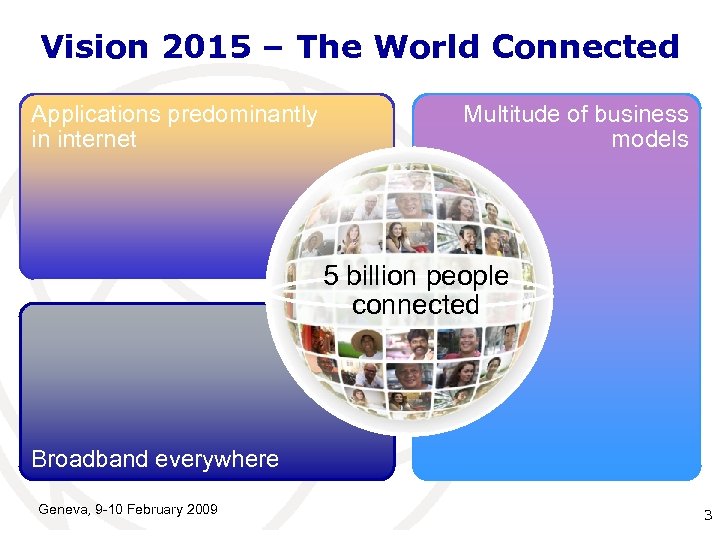 Vision 2015 – The World Connected Applications predominantly in internet Multitude of business models 5 billion people connected Broadband everywhere Geneva, 9 -10 February 2009 International Telecommunication Union 3
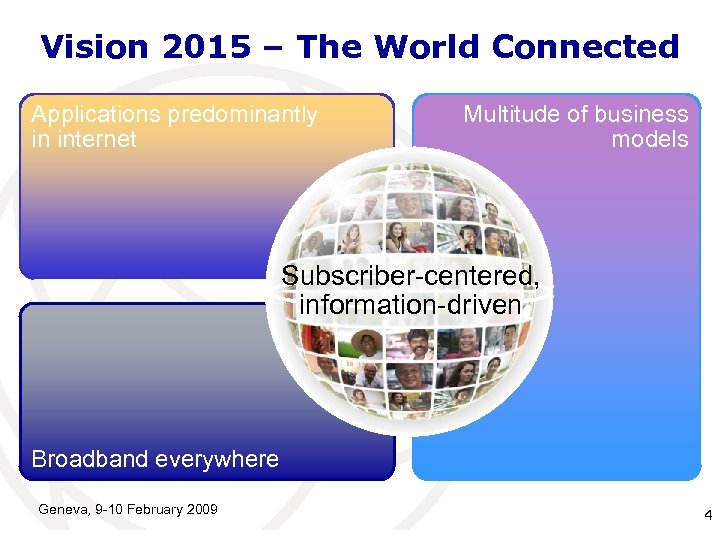 Vision 2015 – The World Connected Applications predominantly in internet Multitude of business models Subscriber-centered, information-driven Broadband everywhere Geneva, 9 -10 February 2009 International Telecommunication Union 4
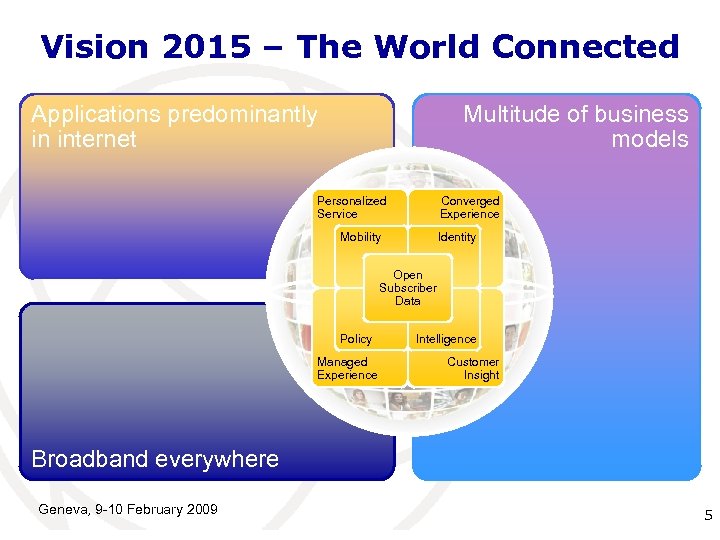 Vision 2015 – The World Connected Applications predominantly in internet Multitude of business models Personalized Service Converged Experience Mobility Identity Open Subscriber Data Policy Managed Experience Intelligence Customer Insight Broadband everywhere Geneva, 9 -10 February 2009 International Telecommunication Union 5
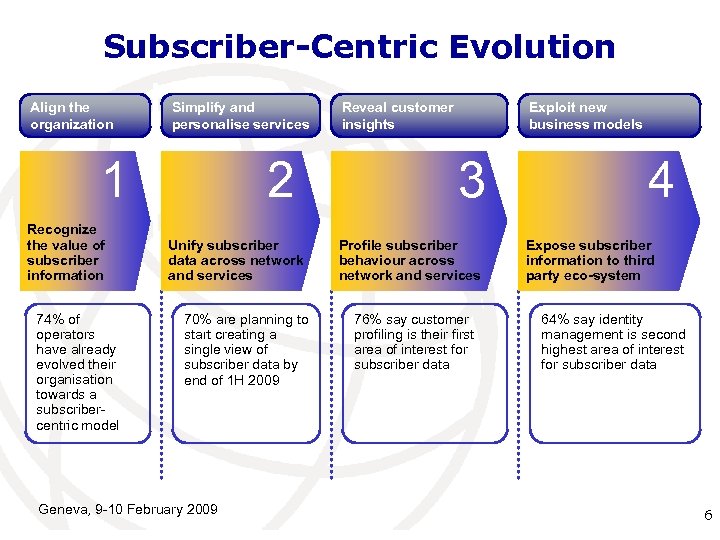 Subscriber-Centric Evolution Align the organization Simplify and personalise services 1 Recognize the value of subscriber information 74% of operators have already evolved their organisation towards a subscribercentric model 2 Unify subscriber data across network and services 70% are planning to start creating a single view of subscriber data by end of 1 H 2009 Geneva, 9 -10 February 2009 Reveal customer insights Exploit new business models 3 Profile subscriber behaviour across network and services 76% say customer profiling is their first area of interest for subscriber data 4 Expose subscriber information to third party eco-system 64% say identity management is second highest area of interest for subscriber data International Telecommunication Union 6
 Content Vision 2015 Subscriber Data Consolidation Telco 2. 0 Identity Management Summary Geneva, 9 -10 February 2009 International Telecommunication Union 7
 Silo Networks, Silo Data Service providers have become detached from their real-time subscriber data – which severely limits their capacity to appropriately interact with customers and partners. Allows new competitors emerging from the content or retail sectors to exploit the new possibilities of aggregate services coming from Web 2. 0 communities or the convergence of fixed and mobile services. Geneva, 9 -10 February 2009 International Telecommunication Union 8
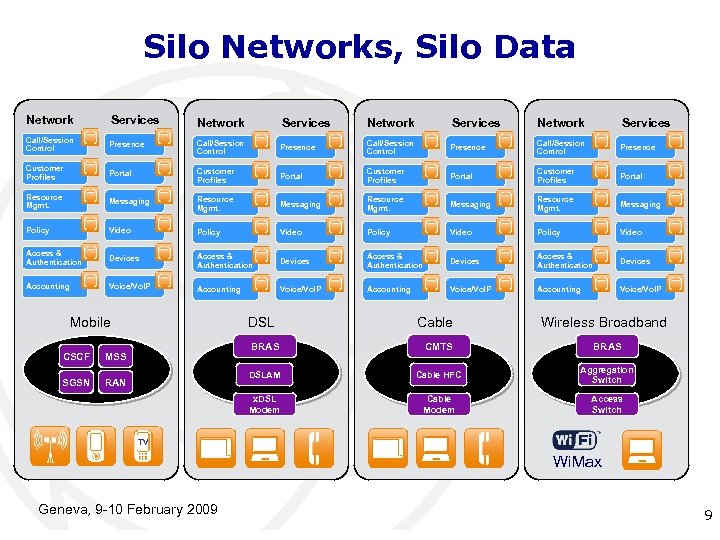 Silo Networks, Silo Data Network Services Call/Session Control Presence Customer Profiles Portal Resource Mgmt. Messaging Policy Video Access & Authentication Devices Accounting Voice/Vo. IP Mobile DSL Cable Wireless Broadband RAN CMTS BRAS DSLAM MSS SGSN BRAS Cable HFC Aggregation Switch x. DSL Modem CSCF Cable Modem Access Switch TV Wi. Max Geneva, 9 -10 February 2009 International Telecommunication Union 9
 The Telco Inheritance At present, for many service providers, customer data is spread across many different systems – often across different departments and in totally incompatible formats – with all the ultimately unnecessary cost, efficiency, error, duplication, synchronization, support and integration overheads that accompany such an approach. Given the history of the telecommunications sector, such an inheritance has been unavoidable What’s important now is to make sure that the inheritance of data fragmentation doesn’t continue to cause further complications and headaches in the future. Geneva, 9 -10 February 2009 International Telecommunication 10 Union
 Anytime, Anyplace, Anywhere As the metabolism of the whole industry gears up several notches at once, network architectures and their underlying IT systems must be able to respond in real-time to increasingly complex interactions as customers move between devices, access technologies, payment methods and even identities The future of telecommunications being predicated on an ability to offer speech, content and applications ‘anytime, anyplace, anywhere’ – to the same rigorous standards of service quality Geneva, 9 -10 February 2009 International Telecommunication 11 Union
 Holding The Vision This vision will be severely limited by an inability to bring together relevant subscriber data: As customers move from cellular to Wi. Fi networks or home PC´s, their device preferences are lost and services become annoyingly inconsistent. As domestic broadband customers surf between their IPTV, web, email, RSS feeds and MMS, their service preferences and supporting data fail to transfer As tele-workers move between personal and business time during a normal day, they are faced with having to constantly re-key and re-log network identity information to gain access to the right environment. Service providers have limited ability to combine contextual information with interests, communities and content to offer attractive and premium-priced aggregated services. Geneva, 9 -10 February 2009 International Telecommunication 12 Union
 Identifying The Subscriber If a network operator is to make the essential next step towards providing what are truly personalized services, then a consolidated, realtime, de-fragmented picture of the subscriber must be available to act as the catalyst for rapid service creation, deployment and delivery Geneva, 9 -10 February 2009 International Telecommunication 13 Union
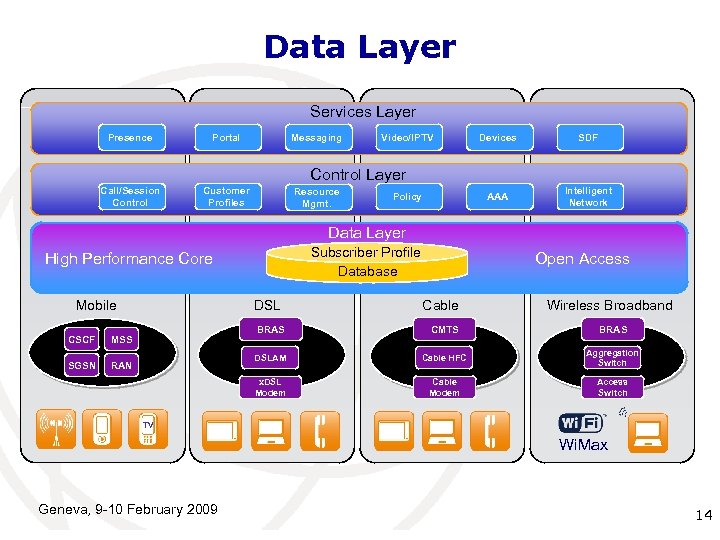 Data Layer Services Layer Presence Portal Messaging Video/IPTV Devices SDF AAA Intelligent Network Control Layer Call/Session Control Customer Profiles Resource Mgmt. Policy Data Layer Subscriber Profile Database High Performance Core Mobile DSL Open Access Cable Wireless Broadband SGSN BRAS RAN BRAS DSLAM MSS CMTS Cable HFC Aggregation Switch x. DSL Modem CSCF Cable Modem Access Switch TV Wi. Max Geneva, 9 -10 February 2009 International Telecommunication 14 Union
 Standards-based Architecture An open, standards-based architecture that sits at the heart of the network creating a horizontal and unified subscriber data layer across all applications. Separating application logic from the subscriber data liberates and unifies customer data that is currently locked away in silo, closed and often proprietary systems. Through this unified approach, mobile, fixed and broadband service providers can take control of their subscriber information, unlocking and securely sharing data across an array of applications, networks and partners. By consolidating this data, applications are able to share one complete, rich and consistent view of the subscriber data instead of limiting its usage. Geneva, 9 -10 February 2009 International Telecommunication 15 Union
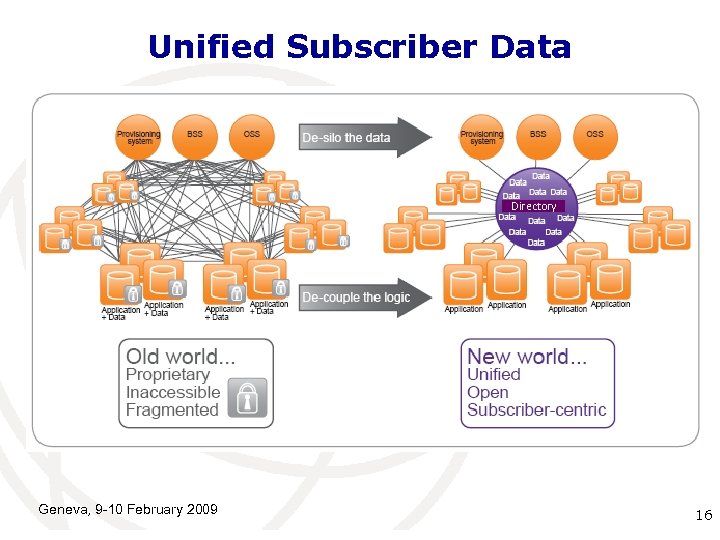 Unified Subscriber Data Directory Geneva, 9 -10 February 2009 International Telecommunication 16 Union
 Data Consolidation Data consolidation achieves this through several ways: By creating one operator common data model, subscriber data can be harmonized across the network into one logical data layer, removing data inconsistencies and duplications. This ensures a distributed data architecture can be centrally managed throughout its life cycle, essential to the evolution and integrity of the data model. Where data cannot be consolidated, it is federated from silo data sources to bring it into one complete view All data appears to form one common information model, but may be stored in a third-party SQL RDBMS database By having one database, only one point of integration is exposed for all applications Geneva, 9 -10 February 2009 International Telecommunication 17 Union
 Simplification This simplifies subscriber and service provisioning, eliminates application integration complexity – and means that only one database ever needs to be updated. Wasted network capacity is eliminated by simplifying network architecture, reducing server and storage requirements, and sub-optimal usage of database software licenses System resilience and scalability can be more optimally managed through data consolidation, delivering carrier-scale availability through a highly distributed real time architecture. Geneva, 9 -10 February 2009 International Telecommunication 18 Union
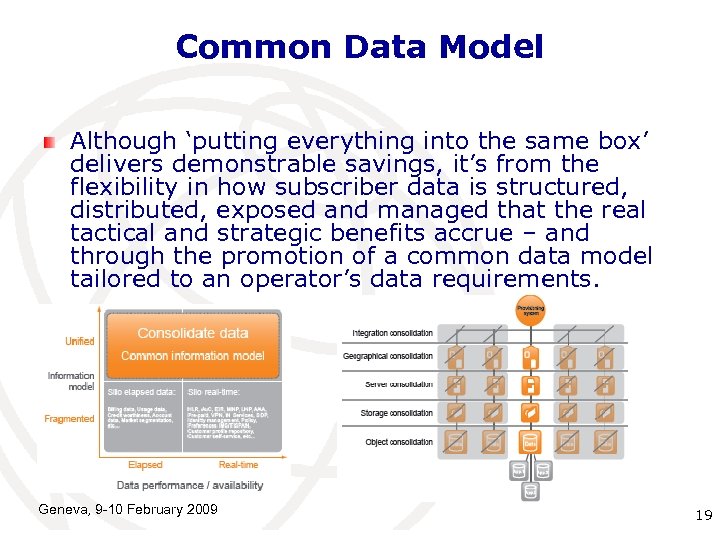 Common Data Model Although ‘putting everything into the same box’ delivers demonstrable savings, it’s from the flexibility in how subscriber data is structured, distributed, exposed and managed that the real tactical and strategic benefits accrue – and through the promotion of a common data model tailored to an operator’s data requirements. Geneva, 9 -10 February 2009 International Telecommunication 19 Union
 Content Vision 2015 Subscriber Data Consolidation Telco 2. 0 Identity Management Summary Geneva, 9 -10 February 2009 International Telecommunication 20 Union
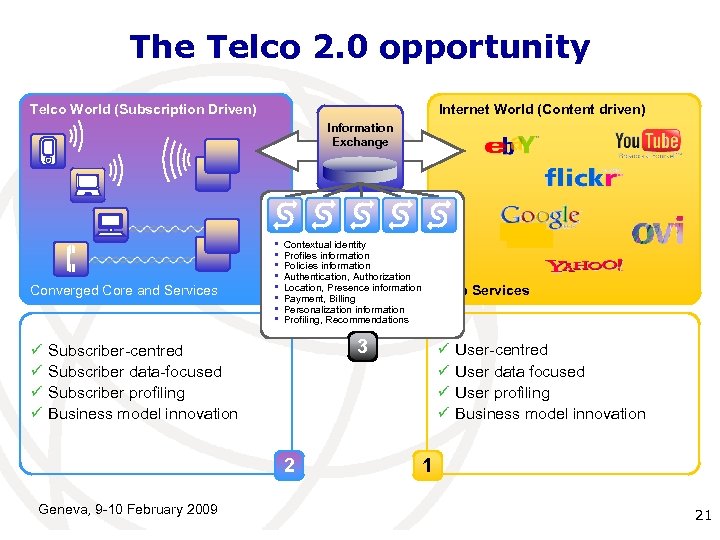 The Telco 2. 0 opportunity Telco World (Subscription Driven) Internet World (Content driven) Information Exchange Converged Core and Services ü ü • • Contextual identity Profiles information Policies information Authentication, Authorization Location, Presence information Payment, Billing Personalization information Profiling, Recommendations 3 Subscriber-centred Subscriber data-focused Subscriber profiling Business model innovation 2 Geneva, 9 -10 February 2009 Web Services ü ü User-centred User data focused User profiling Business model innovation 1 International Telecommunication 21 Union
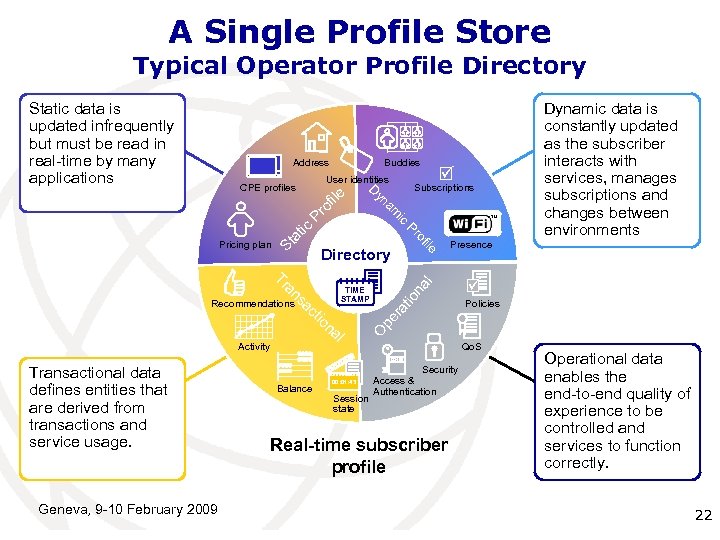 A Single Profile Store Typical Operator Profile Directory Static data is updated infrequently but must be read in real-time by many applications Address Buddies User identities Presence ile ic na l ile of at Pr St TM ic Pr am of yn Directory a Tr a ns TIME STAMP Recommendations Policies O l na io ct Activity pe ra tio Pricing plan Subscriptions D CPE profiles Qo. S 123456 Transactional data defines entities that are derived from transactions and service usage. Geneva, 9 -10 February 2009 Security Balance Dynamic data is constantly updated as the subscriber interacts with services, manages subscriptions and changes between environments 00: 01: 43 Session state Access & Authentication Real-time subscriber profile Operational data enables the end-to-end quality of experience to be controlled and services to function correctly. International Telecommunication 22 Union
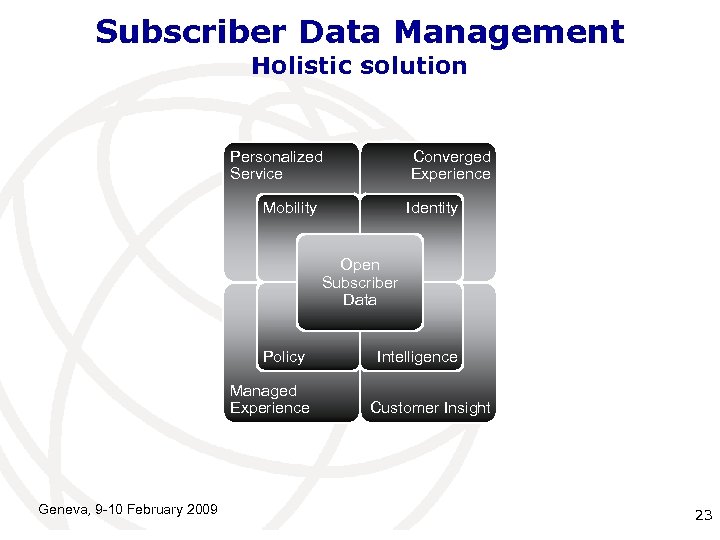 Subscriber Data Management Holistic solution Personalized Service Converged Experience Mobility Identity Open Subscriber Data Policy Managed Experience Geneva, 9 -10 February 2009 Intelligence Customer Insight International Telecommunication 23 Union
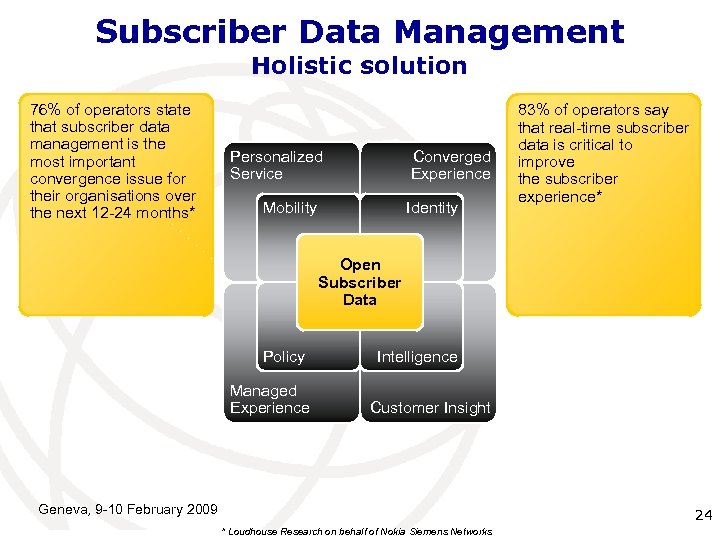 Subscriber Data Management Holistic solution 76% of operators state that subscriber data management is the most important convergence issue for their organisations over the next 12 -24 months* Personalized Service Converged Experience Mobility Identity 83% of operators say that real-time subscriber data is critical to improve the subscriber experience* Open Subscriber Data Policy Managed Experience Intelligence Customer Insight International Telecommunication 24 Union Geneva, 9 -10 February 2009 * Loudhouse Research on behalf of Nokia Siemens Networks
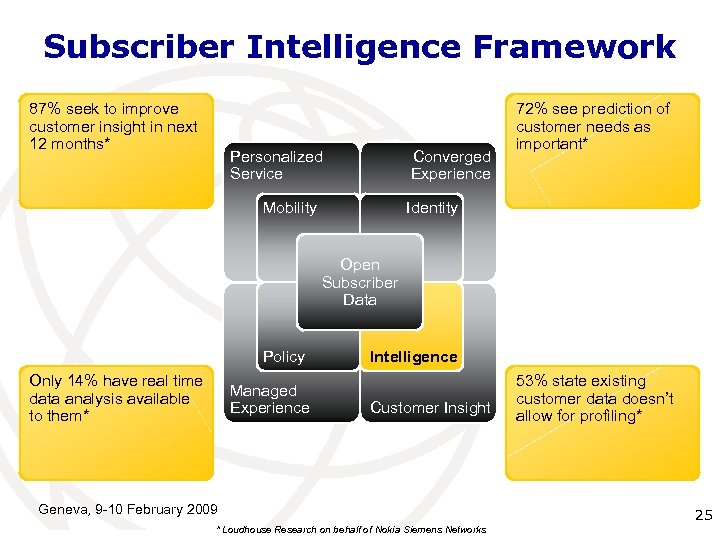 Subscriber Intelligence Framework 87% seek to improve customer insight in next 12 months* Personalized Service Converged Experience Mobility 72% see prediction of customer needs as important* Identity Open Subscriber Data Policy Only 14% have real time data analysis available to them* Managed Experience Intelligence Customer Insight Geneva, 9 -10 February 2009 * Loudhouse Research on behalf of Nokia Siemens Networks 53% state existing customer data doesn’t allow for profiling* International Telecommunication 25 Union
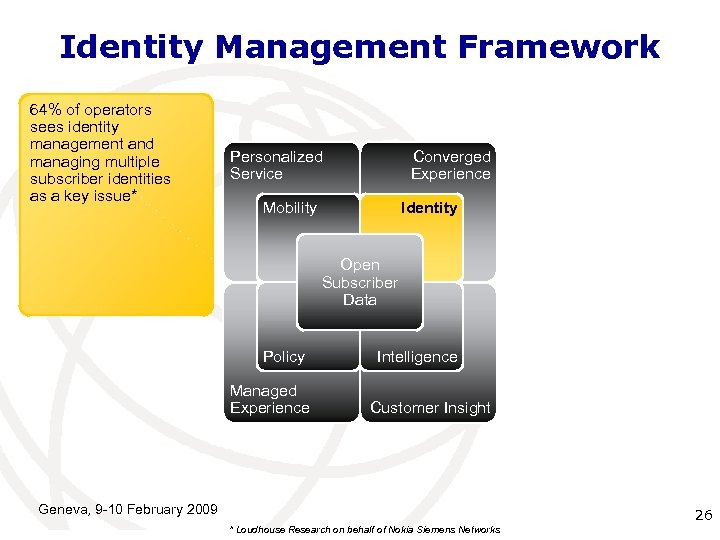 Identity Management Framework 64% of operators sees identity management and managing multiple subscriber identities as a key issue* Personalized Service Converged Experience Mobility Identity Open Subscriber Data Policy Managed Experience Intelligence Customer Insight International Telecommunication 26 Union Geneva, 9 -10 February 2009 * Loudhouse Research on behalf of Nokia Siemens Networks
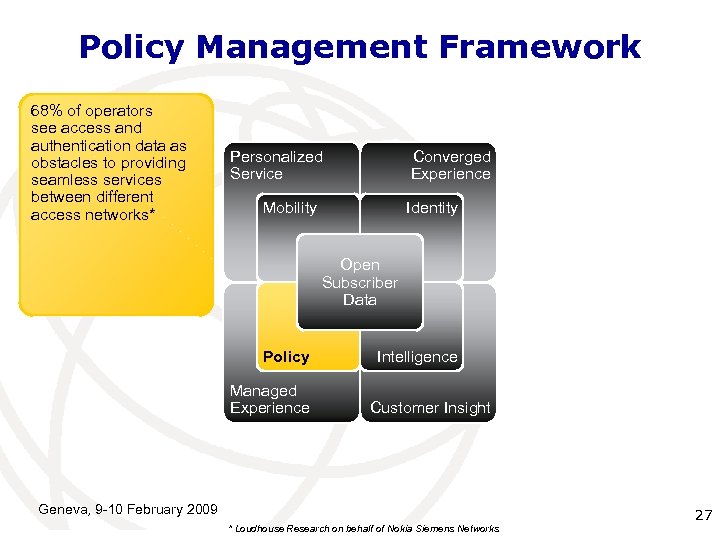 Policy Management Framework 68% of operators see access and authentication data as obstacles to providing seamless services between different access networks* Personalized Service Converged Experience Mobility Identity Open Subscriber Data Policy Managed Experience Intelligence Customer Insight Geneva, 9 -10 February 2009 * Loudhouse Research on behalf of Nokia Siemens Networks International Telecommunication 27 Union
 Content Vision 2015 Subscriber Data Consolidation Telco 2. 0 Identity Management Summary Geneva, 9 -10 February 2009 International Telecommunication 28 Union
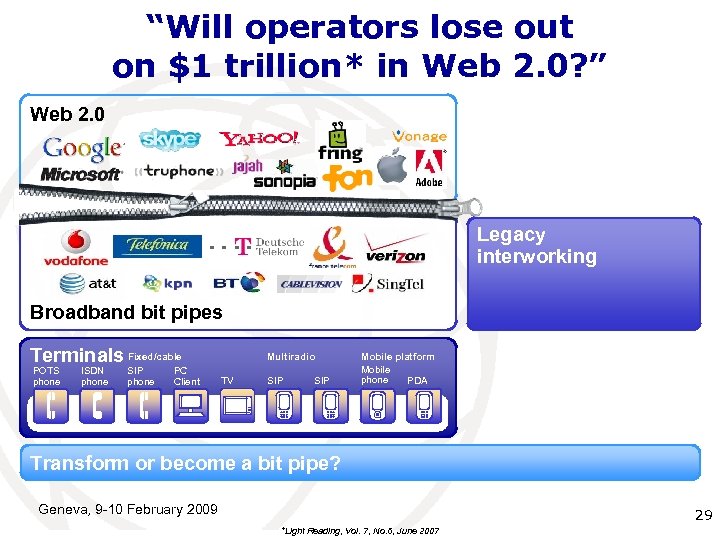 “Will operators lose out on $1 trillion* in Web 2. 0? ” Web 2. 0 Legacy interworking Broadband bit pipes Terminals Fixed/cable POTS phone ISDN phone SIP phone PC Client Multiradio TV SIP Mobile platform Mobile phone PDA Transform or become a bit pipe? International Telecommunication 29 Union Geneva, 9 -10 February 2009 *Light Reading, Vol. 7, No. 6, June 2007
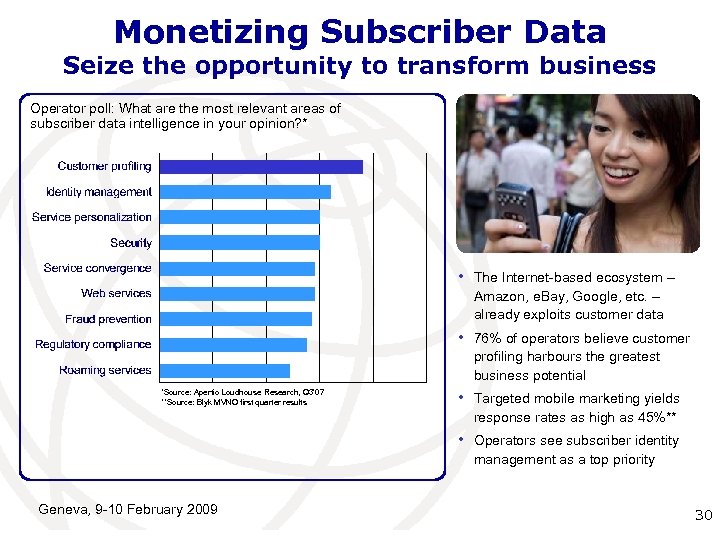 Monetizing Subscriber Data Seize the opportunity to transform business Operator poll: What are the most relevant areas of subscriber data intelligence in your opinion? * • The Internet-based ecosystem – Amazon, e. Bay, Google, etc. – already exploits customer data • 76% of operators believe customer profiling harbours the greatest business potential *Source: Apertio Loudhouse Research, Q 3’ 07 **Source: Blyk MVNO first quarter results • Targeted mobile marketing yields response rates as high as 45%** • Operators see subscriber identity management as a top priority Geneva, 9 -10 February 2009 International Telecommunication 30 Union
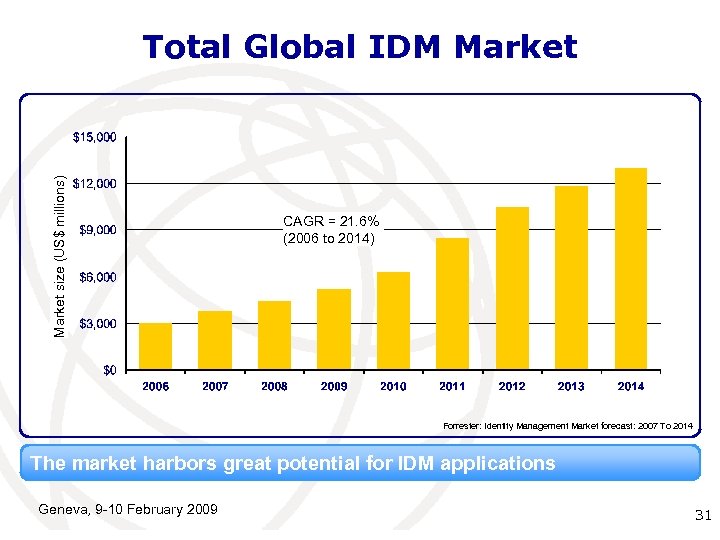 Market size (US$ millions) Total Global IDM Market CAGR = 21. 6% (2006 to 2014) Forrester: Identity Management Market forecast: 2007 To 2014 The market harbors great potential for IDM applications Geneva, 9 -10 February 2009 International Telecommunication 31 Union
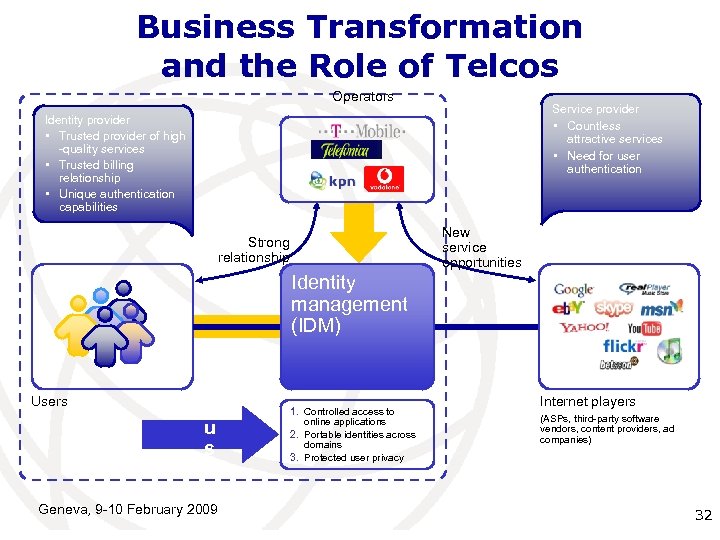 Business Transformation and the Role of Telcos Operators Service provider • Countless attractive services • Need for user authentication Identity provider • Trusted provider of high -quality services • Trusted billing relationship • Unique authentication capabilities New service opportunities Strong relationship Identity management (IDM) Users F o c u s o n Geneva, 9 -10 February 2009 1. Controlled access to online applications 2. Portable identities across domains 3. Protected user privacy Internet players (ASPs, third-party software vendors, content providers, ad companies) International Telecommunication 32 Union
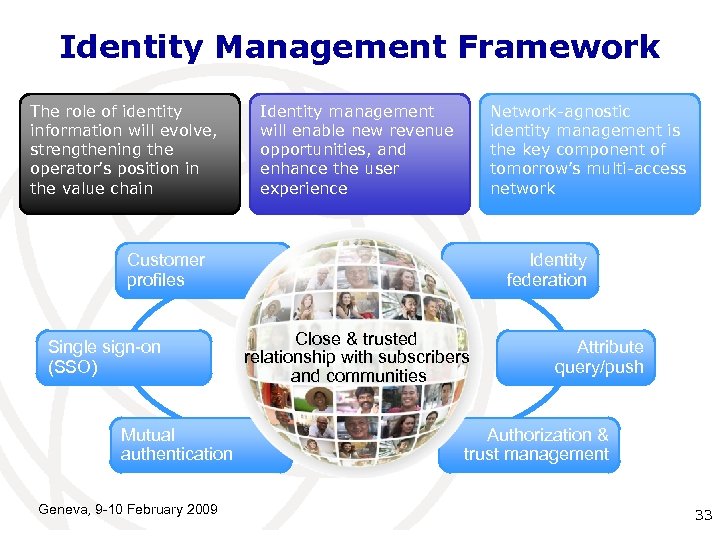 Identity Management Framework The role of identity information will evolve, strengthening the operator’s position in the value chain Identity management will enable new revenue opportunities, and enhance the user experience Network-agnostic identity management is the key component of tomorrow’s multi-access network Customer profiles Single sign-on (SSO) Mutual authentication Geneva, 9 -10 February 2009 Identity federation Close & trusted relationship with subscribers and communities Attribute query/push Authorization & trust management International Telecommunication 33 Union
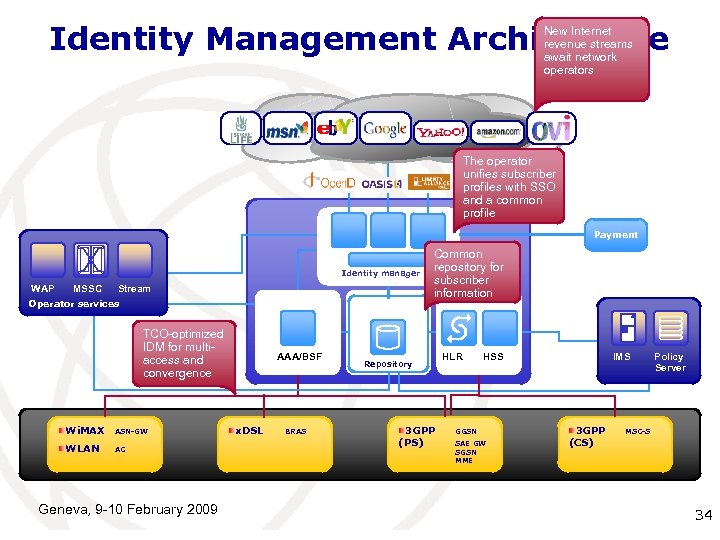 Identity Management Architecture New Internet revenue streams await network operators The operator unifies subscriber profiles with SSO and a common profile Payment Identity manager WAP MSSC Stream Operator services TCO-optimized IDM for multiaccess and convergence Wi. MAX WLAN ASN-GW AC Geneva, 9 -10 February 2009 AAA/BSF x. DSL BRAS Common repository for subscriber information Repository 3 GPP (PS) HLR HSS GGSN SAE GW SGSN MME IMS 3 GPP (CS) Policy Server MSC-S International Telecommunication 34 Union
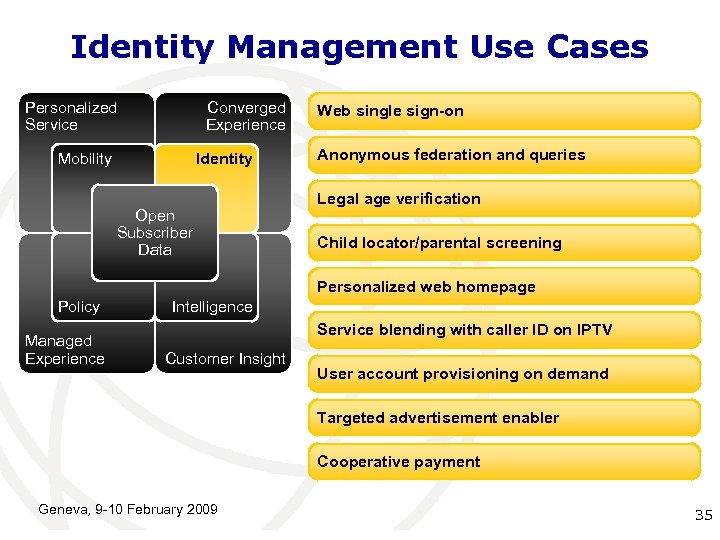 Identity Management Use Cases Personalized Service Converged Experience Mobility Identity Open Subscriber Data Web single sign-on Anonymous federation and queries Legal age verification Child locator/parental screening Personalized web homepage Policy Managed Experience Intelligence Service blending with caller ID on IPTV Customer Insight User account provisioning on demand Targeted advertisement enabler Cooperative payment Geneva, 9 -10 February 2009 International Telecommunication 35 Union
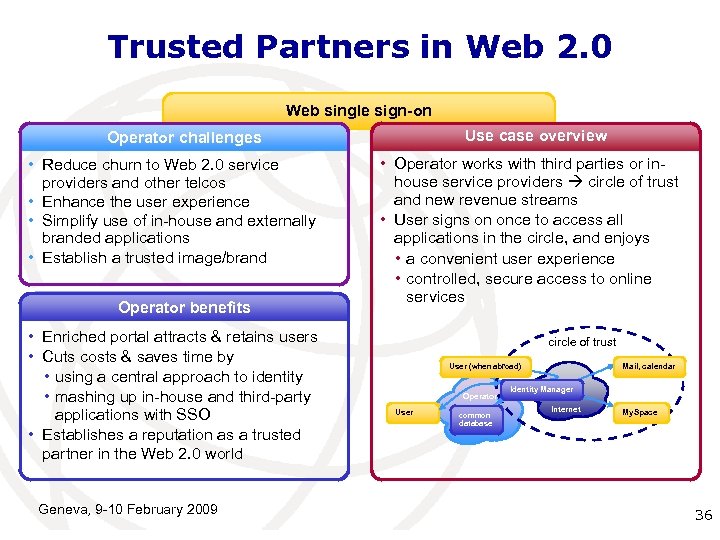 Trusted Partners in Web 2. 0 Web single sign-on Use case overview Operator challenges • Reduce churn to Web 2. 0 service providers and other telcos • Enhance the user experience • Simplify use of in-house and externally branded applications • Establish a trusted image/brand Operator benefits • Enriched portal attracts & retains users • Cuts costs & saves time by • using a central approach to identity • mashing up in-house and third-party applications with SSO • Establishes a reputation as a trusted partner in the Web 2. 0 world Geneva, 9 -10 February 2009 • Operator works with third parties or inhouse service providers circle of trust and new revenue streams • User signs on once to access all applications in the circle, and enjoys • a convenient user experience • controlled, secure access to online services circle of trust User (when abroad) Operator User common database Mail, calendar Identity Manager Internet My. Space International Telecommunication 36 Union
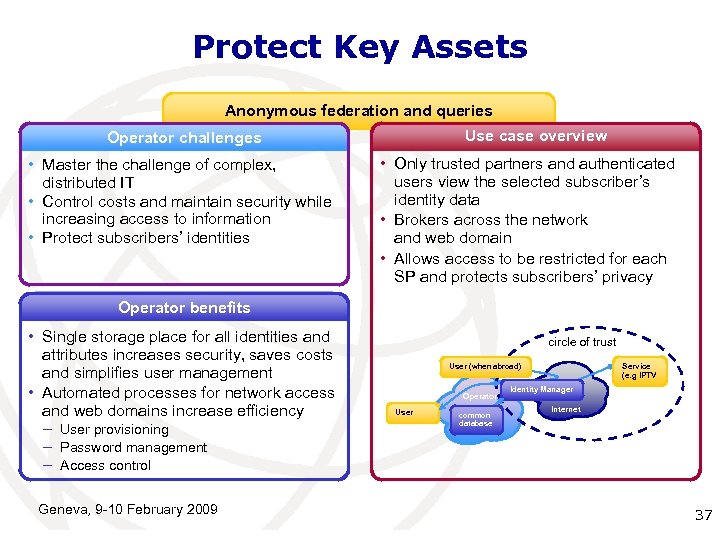 Protect Key Assets Anonymous federation and queries Use case overview Operator challenges • Master the challenge of complex, distributed IT • Control costs and maintain security while increasing access to information • Protect subscribers’ identities • Only trusted partners and authenticated users view the selected subscriber’s identity data • Brokers across the network and web domain • Allows access to be restricted for each SP and protects subscribers’ privacy Operator benefits • Single storage place for all identities and attributes increases security, saves costs and simplifies user management • Automated processes for network access and web domains increase efficiency – User provisioning – Password management – Access control Geneva, 9 -10 February 2009 circle of trust Service (e. g IPTV User (when abroad) Operator User common database Identity Manager Internet International Telecommunication 37 Union
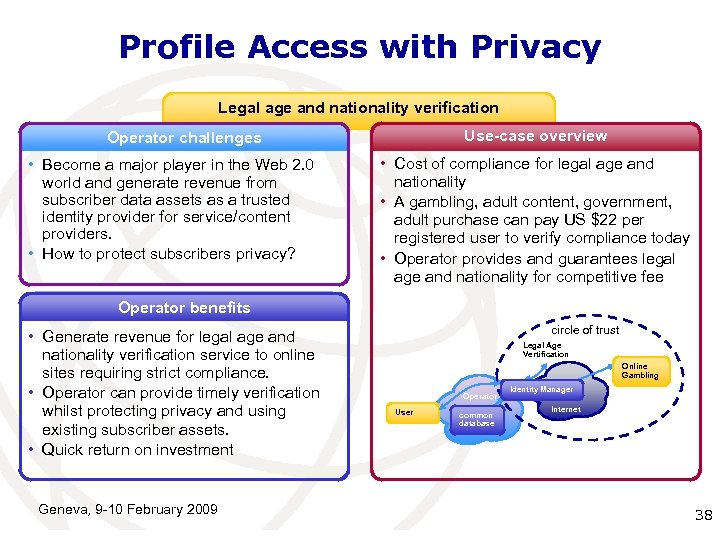 Profile Access with Privacy Legal age and nationality verification Use-case overview Operator challenges • Become a major player in the Web 2. 0 world and generate revenue from subscriber data assets as a trusted identity provider for service/content providers. • How to protect subscribers privacy? • Cost of compliance for legal age and nationality • A gambling, adult content, government, adult purchase can pay US $22 per registered user to verify compliance today • Operator provides and guarantees legal age and nationality for competitive fee Operator benefits • Generate revenue for legal age and nationality verification service to online sites requiring strict compliance. • Operator can provide timely verification whilst protecting privacy and using existing subscriber assets. • Quick return on investment Geneva, 9 -10 February 2009 circle of trust Legal Age Vertification Online Gambling Operator User common database Identity Manager Internet International Telecommunication 38 Union
 Content Vision 2015 Subscriber Data Consolidation Telco 2. 0 Identity Management Summary Geneva, 9 -10 February 2009 International Telecommunication 39 Union
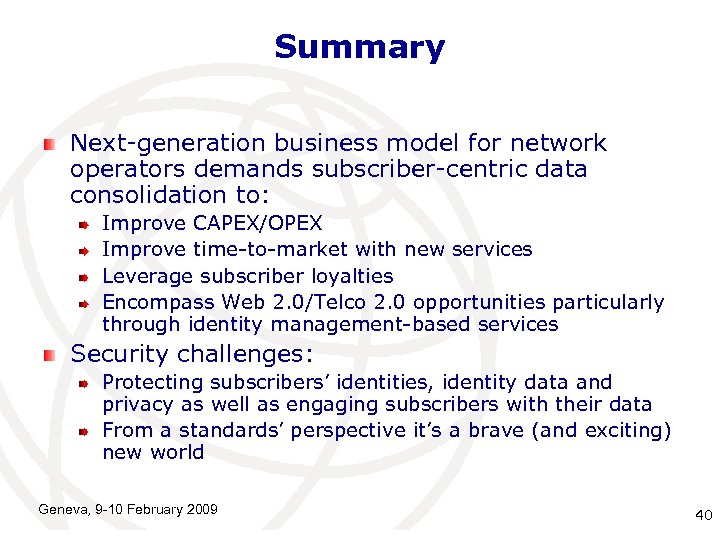 Summary Next-generation business model for network operators demands subscriber-centric data consolidation to: Improve CAPEX/OPEX Improve time-to-market with new services Leverage subscriber loyalties Encompass Web 2. 0/Telco 2. 0 opportunities particularly through identity management-based services Security challenges: Protecting subscribers’ identities, identity data and privacy as well as engaging subscribers with their data From a standards’ perspective it’s a brave (and exciting) new world Geneva, 9 -10 February 2009 International Telecommunication 40 Union
 Postscript An ITU-T success story Geneva, 9 -10 February 2009 International Telecommunication 41 Union
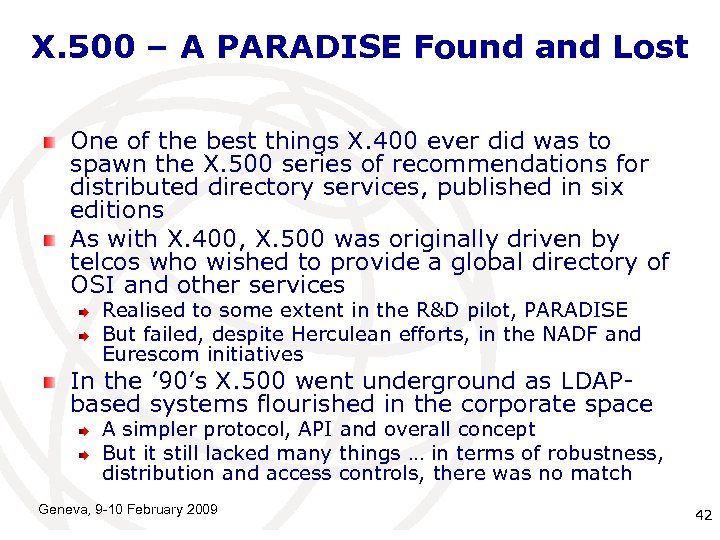 X. 500 – A PARADISE Found and Lost One of the best things X. 400 ever did was to spawn the X. 500 series of recommendations for distributed directory services, published in six editions As with X. 400, X. 500 was originally driven by telcos who wished to provide a global directory of OSI and other services Realised to some extent in the R&D pilot, PARADISE But failed, despite Herculean efforts, in the NADF and Eurescom initiatives In the ’ 90’s X. 500 went underground as LDAPbased systems flourished in the corporate space A simpler protocol, API and overall concept But it still lacked many things … in terms of robustness, distribution and access controls, there was no match Geneva, 9 -10 February 2009 International Telecommunication 42 Union
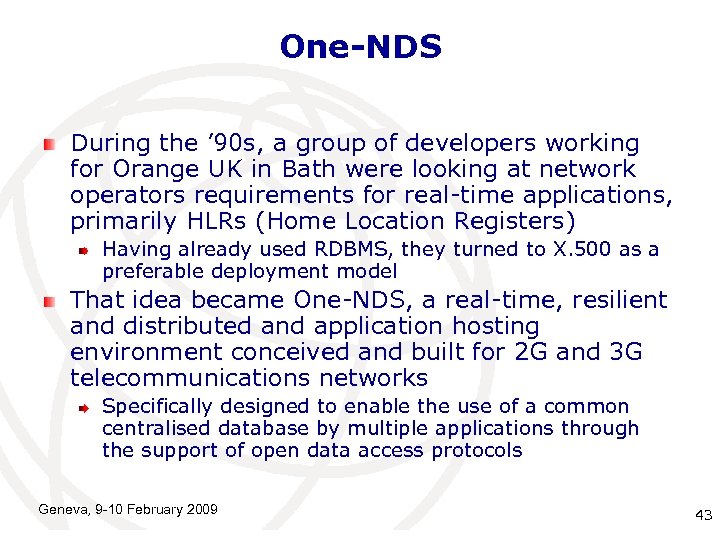 One-NDS During the ’ 90 s, a group of developers working for Orange UK in Bath were looking at network operators requirements for real-time applications, primarily HLRs (Home Location Registers) Having already used RDBMS, they turned to X. 500 as a preferable deployment model That idea became One-NDS, a real-time, resilient and distributed and application hosting environment conceived and built for 2 G and 3 G telecommunications networks Specifically designed to enable the use of a common centralised database by multiple applications through the support of open data access protocols Geneva, 9 -10 February 2009 International Telecommunication 43 Union
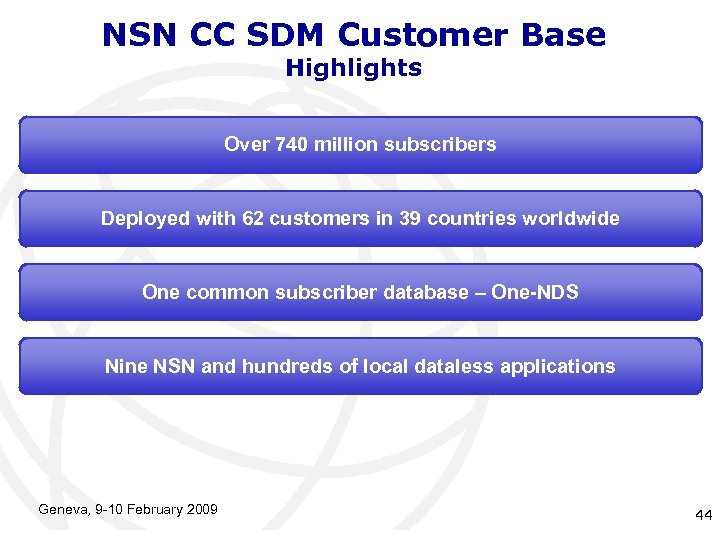 NSN CC SDM Customer Base Highlights Over 740 million subscribers Deployed with 62 customers in 39 countries worldwide One common subscriber database – One-NDS Nine NSN and hundreds of local dataless applications Geneva, 9 -10 February 2009 International Telecommunication 44 Union
 Summary What goes around, comes around … … let’s keep up the good work! Geneva, 9 -10 February 2009 International Telecommunication 45 Union
 Thank you! david. goodman@nsn. com Geneva, 9 -10 February 2009 International Telecommunication 46 Union