


 Скачать презентацию ITU-T Study Group 16 Multimedia Services Systems and
00ab14819d047a64be0be88f1b8d2f68.ppt
- Количество слайдов: 22
 ITU-T Study Group 16 Multimedia Services, Systems and Terminals Summary of Results Study Period 2001 -2004 Pierre-André Probst /Switzerland 1
 Contents • Terms of reference • Management Team • SG Organization • Statistics • Highlights of achievements / Projects / FGs • Workshops • Future work • Conclusions ITU-T Study Group 16 MM Services, Systems and Terminals 2
 Terms of Reference • Studies related to service definition and multimedia systems (MM), including the associated terminals (including facsimile terminals), modems and signal processing. Lead SG for: • ⇨ MM services, systems and terminals ⇨ E-business and e-commerce ITU-T Study Group 16 MM Services, Systems and Terminals 3
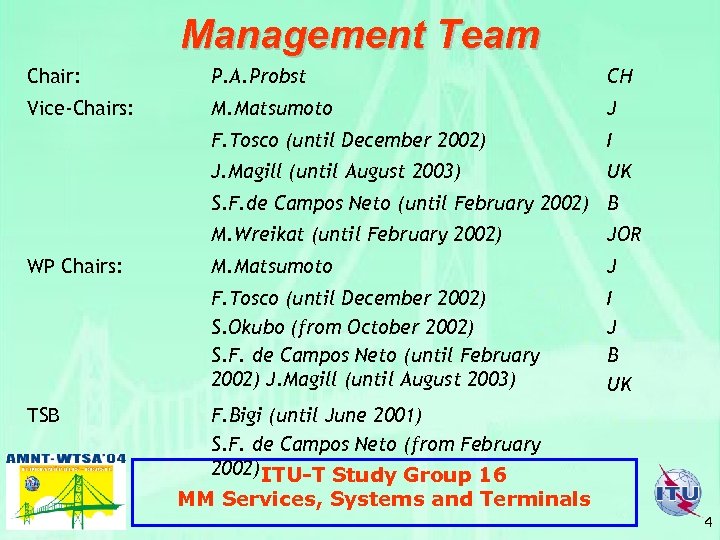 Management Team Chair: P. A. Probst CH Vice-Chairs: M. Matsumoto J F. Tosco (until December 2002) I J. Magill (until August 2003) UK S. F. de Campos Neto (until February 2002) B M. Wreikat (until February 2002) TSB M. Matsumoto J F. Tosco (until December 2002) S. Okubo (from October 2002) S. F. de Campos Neto (until February 2002) J. Magill (until August 2003) WP Chairs: JOR I J B UK F. Bigi (until June 2001) S. F. de Campos Neto (from February 2002) ITU-T Study Group 16 MM Services, Systems and Terminals 4
 • • Study Group Structure WP 1 - Modems and facsimile terminals Terminal and interworking aspects of modems and facsimile, MM facilities for customers with disabilities like text telephony. WP 2 - MM-platform and interworking MM systems characteristics and their interworking over different platforms (PSTN, ISDN, IP-based networks, Mobile). WP 3 - Media coding Algorithms for speech, audio and video coding and associated software tools. WP 4 - MM framework Lead SG activities (Mediacom 2004: coordination of MM standard development in and outside ITU-T) and overall MM services and applications aspects, including end-to-end architecture. ITU-T Study Group 16 MM Services, Systems and Terminals 5
 Statistics (I) • Sixty-nine Rapporteurs meetings held • Eight normal and 429 delayed contributions received • Six SG meetings and two WP meetings held • SG participants : ⇨ Max: 187 (2000 -11) ⇨ Min: 109 (2003 -05) ⇨ Average: 134 ITU-T Study Group 16 MM Services, Systems and Terminals 6
 Statistics (II) • 69 new & 136 revised Recommendations approved 22 Questions assigned by WTSA-2000 Four new or revised Questions during study period 20 Questions proposed for the next study period • • • ITU-T Study Group 16 MM Services, Systems and Terminals 7
 Highlights of achievements (I) • Modems, facsimile terminals and accessibility to MM systems: - Support of modems connections over IP-based networks (V. 150 series). - Improvement of facsimile terminals standards (colour fax: T. 42) and real-time communication for Group 3 facsimile over IP based networks (T. 38). - Promotion of text conversation standards and development of protocols to support these facilities in and over IP based networks. ITU-T Study Group 16 MM Services, Systems and Terminals 8
 Highlights of achievements (II) • MM Platform and Interworking (1/2): - New version of Media Gateway Protocol (H. 248) and development of new packages (41 in total). - MM Systems over ISDN (H. 320): introduction of support for H. 264 and use of additional video channels (H. 239). - MM Systems over IP-based networks (H. 323): development and approval of Version 5 which includes a number additional functions, enhancement to H. 323 related Recs like H. 225. 0 (call signalling) and H. 460 series (generic extensible framework). - Security for MM systems (H. 235): further development to Version and approval of Version 3, which includes RAS and NAT/Firewall related aspects. ITU-T Study Group 16 MM Services, Systems and Terminals 9
 Highlights of achievements (III) • MM Platform and Interworking (2/2): - Directory services: development of a new series (H. 350) allowing the use of LDAP and X. 500 directory services for MM conferencing (7 Recs covering H. 323, H. 320, H. 235, SIP and non-standard protocols, call forwarding and preferences). - Mobility management for H. 323 systems: development of a new series of Recs (H. 500) addressing mobility management of H. 323 terminals and users (H. 510), security procedures (H. 530) and intra/inter domains management related aspects (H. 501). - Reference architecture for controlling the Qo. S and service priority of MM services in heterogeneous networks: approval of a new Rec H. 360. ITU-T Study Group 16 MM Services, Systems and Terminals 10
 Highlights of achievements (IV) • Media coding (1/2) - Development of a new generation of video coding standards (H. 264) in cooperation with MPEG for all applications (distributive and interactive communications) on different platforms (fixed and mobile including IP-based networks), bit rate reduction of more than 50 % for the same level of quality (adopted by the DVD-Forum for High Definition-DVD standard). - Still image coding: continuation of the collaborative work with JPEG (maintenance of the T. 80 and T. 800 series of Recs). Cooperation to be strengthened in future (e. g joint meeting in 2005). - Wideband speech coding around 16 kbit/s: alignment of G. 722. 2 with 3 GPP AMR-WB specifications (Adaptive Multi-Rate Wideband) ITU-T Study Group 16 MM Services, Systems and Terminals 11
 Highlights of achievements (V) • Media coding (2/2) - 4 kbit/s speech coding: considerable efforts spent to identify and assess two possible candidates towards a single standard. No consensus was possible among the proponents, the work is suspended since October 2002. - Variable bit rate coding of speech signals: definition of target performance objectives to support a large number of applications (3 G wireless services, VOIP, very low bit rate PSTN, CME, PCME, …), corresponding Recs are planned for 2005/2006. - Maintenance of existing standards and of software tools for audio coding development ITU-T Study Group 16 MM Services, Systems and Terminals 12
 Highlights of achievements (VI) • MM Framework (MEDIACOM-2004) (1/2) - Development and approval of basic Recs for triple-play service deployment based on x. DSL technologies in the access network: - creation of a Focus Group in accordance with A. 7 - development and approval of two Recs covering the Architecture (H. 610) and AOMP aspects (H. 611), based on technical specifications prepared in the FS-VDSL Focus Group. - TDR/ETS: considerable efforts spent to identify the MM needs of the different players involved in ETS and TDR, approval of a new question (Q I/16) and creation of the PCP-TDR (Partnership Coordination Panel) as informal platform to contribute to the coordination in the development of ETS/TDR standards in and outside ITU-T among the various organisations involved in this field. ITU-T Study Group 16 MM Services, Systems and Terminals 13
 Highlights of achievements (VII) • MM Framework (MEDIACOM-2004) (2/2) - e-Health: approval of a new question (Q J/16: MM Framework for e-Health application) to study the standardisation of MM service facilities to support the various e-Health applications (e. g. telemedecine) and creation of an informal platform (e. HSCG: e-Health Standardisation Coordination Group) to exchange information and identify possible standardisation issues among the different communities involved in this area. - Development of a Metadata Framework to allow content and/or broadcast program information to be delivered over different networks and terminals (F. MDF). ITU-T Study Group 16 MM Services, Systems and Terminals 14
 Highlights of achievements (VIII) • • Lead SG Activities: Multimedia (MEDIACOM-2004) - Project Steering Committee mechanism used for the coordination with IETF (e. g. H 248, H. 350) and MPEG (e. g. H. 264). - Coordination of SG 16 involvement in the IP, GII and NGN projects. - Organisation of and participation to several workshops (see next slide). - Workshop follow up on SG 16 relevant issues (updating of the work programme and of the questions). Lead SG Activities: e-commerce and e-business -relevant issues of MM transactions have been addressed in the work on SG 16 questions (e. g. under Q G/16 on security) - participation to the UN-ECE Mo. U management team meetings - new set of questions includes the trends towards “e-everything” ITU-T Study Group 16 MM Services, Systems and Terminals 15
![§ § § Workshops (I) IP-Networking and Mediacom-2004 [with SG 13] (Geneva, 24 -27](https://present5.com/presentation/00ab14819d047a64be0be88f1b8d2f68/image-16.jpg "§ § § Workshops (I) IP-Networking and Mediacom-2004 [with SG 13] (Geneva, 24 -27") § § § Workshops (I) IP-Networking and Mediacom-2004 [with SG 13] (Geneva, 24 -27 April 2001) Multimedia in the 21 st century (Porto Seguro, Brazil, 4 -5 June 2001) Multimedia Convergence (IP Cablecom / Mediacom 2004/ Interactivity in Multimedia) [with SG 9 and ITU-R SG 6] (Geneva, 12 -15 March 2002) Satellites in IP and Multimedia [lead SG 13] (Geneva, 9 -11 December 2002) Telecommunications for Disaster Relief [with SG 2] (Geneva, 17 -19 February 2003) ITU-T Study Group 16 MM Services, Systems and Terminals 16
§ § § Workshops (I) IP-Networking and Mediacom-2004 [with SG 13] (Geneva, 24 -27 April 2001) Multimedia in the 21 st century (Porto Seguro, Brazil, 4 -5 June 2001) Multimedia Convergence (IP Cablecom / Mediacom 2004/ Interactivity in Multimedia) [with SG 9 and ITU-R SG 6] (Geneva, 12 -15 March 2002) Satellites in IP and Multimedia [lead SG 13] (Geneva, 9 -11 December 2002) Telecommunications for Disaster Relief [with SG 2] (Geneva, 17 -19 February 2003) ITU-T Study Group 16 MM Services, Systems and Terminals 16
![Workshops (II) § § § Standardization in E-Health [with ITU-D] (Geneva, 23 -25 May](https://present5.com/presentation/00ab14819d047a64be0be88f1b8d2f68/image-17.jpg "Workshops (II) § § § Standardization in E-Health [with ITU-D] (Geneva, 23 -25 May") Workshops (II) § § § Standardization in E-Health [with ITU-D] (Geneva, 23 -25 May 2003) Next Generation Networks: What, When and How? "Encompassing Services, Transport Convergence, mobility issues and more. . . " [Lead SG 13] (Geneva, 9 -10 July 2003) Accessibility I: ITU Takes Deaf People's Accessibility Needs Into Account - a plenary Session within the Telecommunications for the Deaf (TDI) Conference (Las Vegas, Nevada, USA, 14 -16 July 2003) ITU-T Study Group 16 MM Services, Systems and Terminals 17
Workshops (II) § § § Standardization in E-Health [with ITU-D] (Geneva, 23 -25 May 2003) Next Generation Networks: What, When and How? "Encompassing Services, Transport Convergence, mobility issues and more. . . " [Lead SG 13] (Geneva, 9 -10 July 2003) Accessibility I: ITU Takes Deaf People's Accessibility Needs Into Account - a plenary Session within the Telecommunications for the Deaf (TDI) Conference (Las Vegas, Nevada, USA, 14 -16 July 2003) ITU-T Study Group 16 MM Services, Systems and Terminals 17
 Workshops (III) § § § Accessibility II: Communication by all means: Accessibility for all in telecommunications enabled by multimedia standards - a special session at the Telecom 2003 Forum) (Geneva, 12 -17 October 2003) Standardization in Telecommunications for motor vehicles [with SG 12] (Geneva, 24 -25 November 2003) High-level workshop on International Standards for Medical Technologies - World Health Organization (WHO) [lead WSC = ITU + ISO + IEC] (Geneva, 26 -27 February 2004) ITU-T Study Group 16 MM Services, Systems and Terminals 18
 Workshops (IV) § § H. 350, Directory services for multimedia networks [organized by Vi. De. Net/Internet 2] (Indianapolis, Indiana, USA, 25 March 2004) All Star Network Access [lead SG 15] (Geneva, 2 -4 June 2004) Home Networks Home and Services [with SG 9] (Tokyo, Japan, 16 -17 June 2004) Advances in the Emerging Standard H. 264/AVC [organized by US International Society for Optical Engineering – SPIE] (2 -6 August 2004) ITU-T Study Group 16 MM Services, Systems and Terminals 19
 Future Work (I) • MM service capabilities trends: - Large offer of multimedia services and applications (“Anytime, Anywhere, Anyone”), increased complexity of customer segmentation. - Convergence with broadcasting at the service and network levels. - Increased customer needs for higher bandwidth and terminal/service/users mobility (fix/mobile convergence). - Importance of content creation and delivery. ITU-T Study Group 16 MM Services, Systems and Terminals 20
 Future Work (II) • Impact on SG 16 future work: - Address the higher layers capabilities for ubiquitous services (e-everything) - Decoupling between the higher and lower layers of the NGN (architecture) - Continue to address the interworking issues (evolution of platforms) - Strengthen the coordination efforts (MEDIACOM) within ITU-T/ITU and with other SDOs and Forum/Consortia and make extensive use of existing tools (A-Series of Recs. ) ITU-T Study Group 16 MM Services, Systems and Terminals 21
 Acknowledgements • To SG 16 customers ! • To the management team of the SG, • To the TSB counselors, • To the TSB secretariat, • To the TSB Director, ITU-T Study Group 16 MM Services, Systems and Terminals 22