


 Скачать презентацию ITU Structure and Radio Astronomy Masatoshi Ohishi NAOJ
d26b08931103dca0826412b92b53b92b.ppt
- Количество слайдов: 57
 ITU Structure and Radio Astronomy Masatoshi Ohishi NAOJ February 14, 2008 RAFCAP meeting in Pune 1
 http: //www. itu. int/ February 14, 2008 RAFCAP meeting in Pune 2
 February 14, 2008 RAFCAP meeting in Pune 3
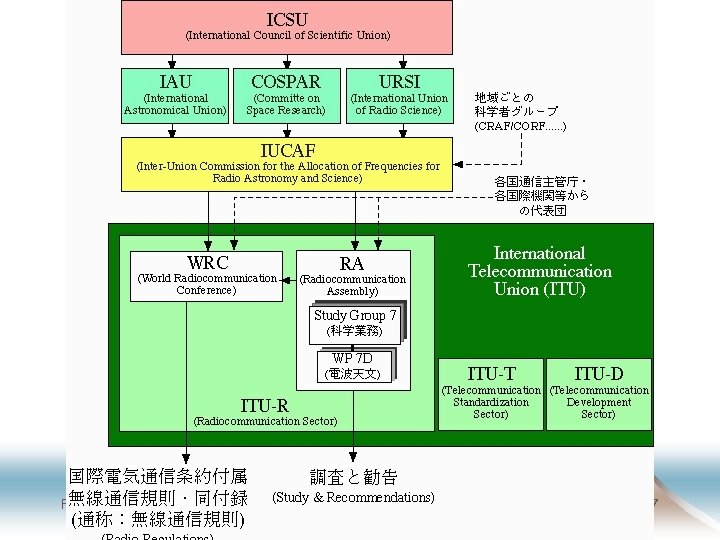
 Members of the ITU s s Member States (190) Administrations Sector Members such as private companies (more than 650) Regional Groups International Organizations such as IUCAF February 14, 2008 RAFCAP meeting in Pune 4
 Regional Groups CEPT – Europe s CITEL – North and South America s APT – Asia-Pacific region s Arab group s African group They prepare common proposals for WRC agenda items. s February 14, 2008 RAFCAP meeting in Pune 5
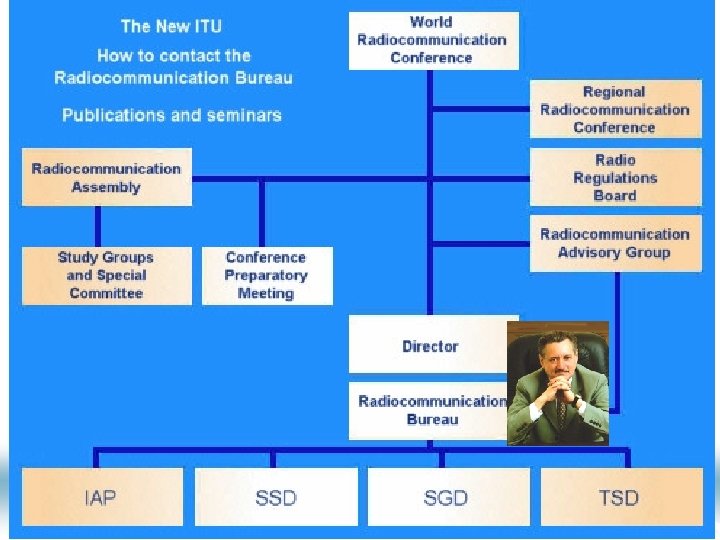 Structure of the ITU-R February 14, 2008 RAFCAP meeting in Pune 6
 February 14, 2008 RAFCAP meeting in Pune 7
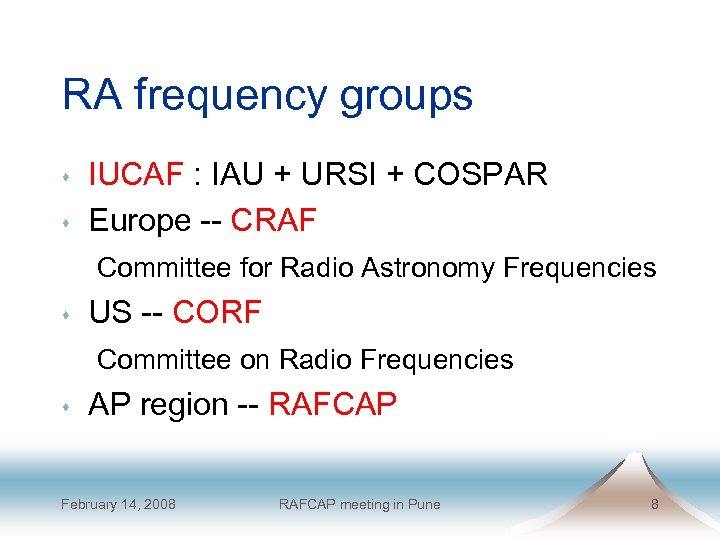 RA frequency groups IUCAF : IAU + URSI + COSPAR s Europe -- CRAF Committee for Radio Astronomy Frequencies s US -- CORF Committee on Radio Frequencies s AP region -- RAFCAP s February 14, 2008 RAFCAP meeting in Pune 8
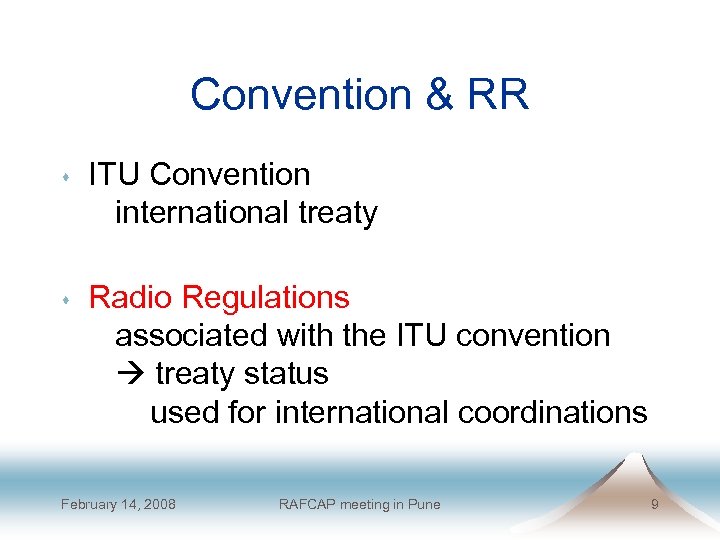 Convention & RR s ITU Convention international treaty s Radio Regulations associated with the ITU convention treaty status used for international coordinations February 14, 2008 RAFCAP meeting in Pune 9
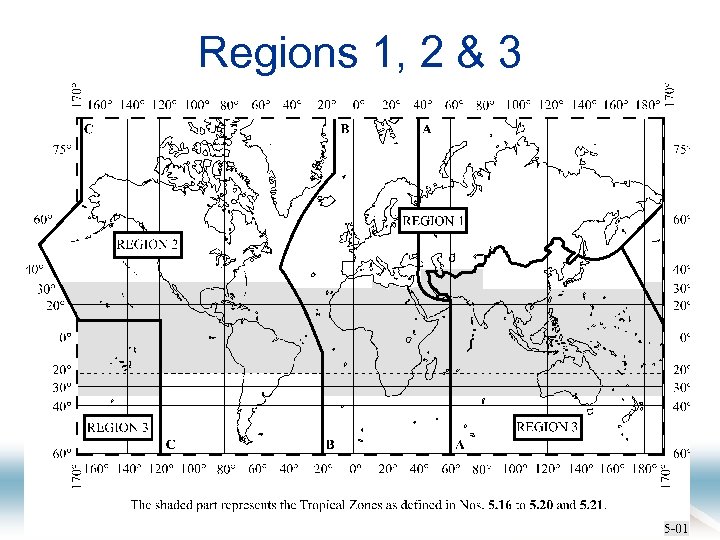 Regions 1, 2 & 3 February 14, 2008 RAFCAP meeting in Pune 10
 Radio Astronomy Service 1. 58 radio astronomy service: A service involving the use of radio astronomy. Historically RAS was restricted to groundbased one. Now RAS includes spacebased observations. February 14, 2008 RAFCAP meeting in Pune 11
 Footnote # of Radio Regulation Radio Astronomy in ITU 1. 13 radio astronomy: Astronomy based on the reception of radio waves of cosmic origin. 1. 5 radio waves or hertzian waves: Electromagnetic waves of frequencies arbitrarily lower than 3 000 GHz, propagated in space without artificial guide. February 14, 2008 RAFCAP meeting in Pune 12
 RAS ≠ radiocommunication 1. 3 telecommunication: Any transmission, emission or reception of signs, signals, writings, images and sounds or intelligence of any nature by wire, radio, optical or other electromagnetic systems (CS). 1. 138 emission: Radiation produced, or the production of radiation, by a radio transmitting station. 1. 137 radiation: The outward flow of energy from any source in the form of radio waves. 1. 6 radiocommunication: Telecommunication by means of radio waves (CS) (CV). February 14, 2008 RAFCAP meeting in Pune 13
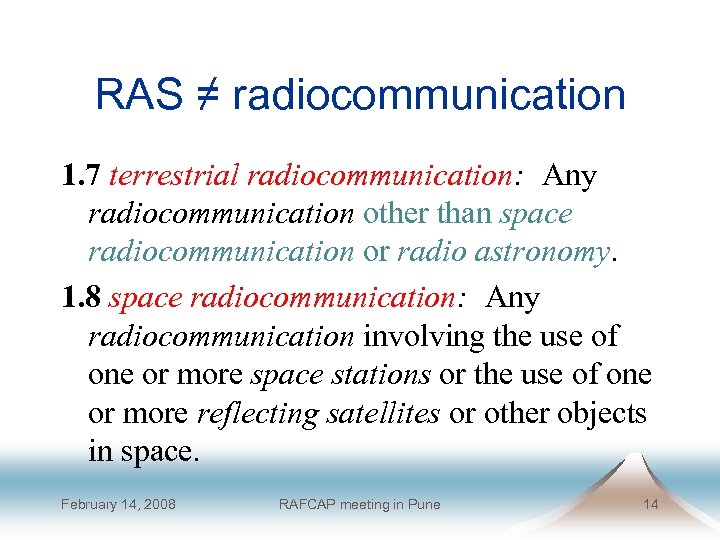 RAS ≠ radiocommunication 1. 7 terrestrial radiocommunication: Any radiocommunication other than space radiocommunication or radio astronomy. 1. 8 space radiocommunication: Any radiocommunication involving the use of one or more space stations or the use of one or more reflecting satellites or other objects in space. February 14, 2008 RAFCAP meeting in Pune 14
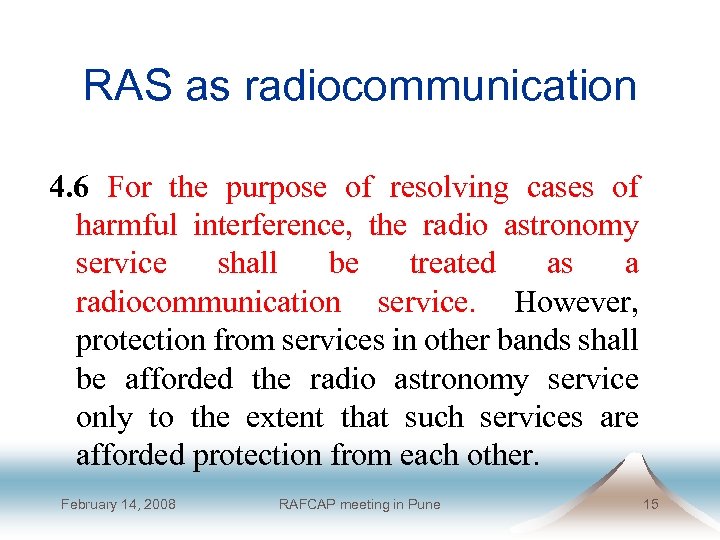 RAS as radiocommunication 4. 6 For the purpose of resolving cases of harmful interference, the radio astronomy service shall be treated as a radiocommunication service. However, protection from services in other bands shall be afforded the radio astronomy service only to the extent that such services are afforded protection from each other. February 14, 2008 RAFCAP meeting in Pune 15
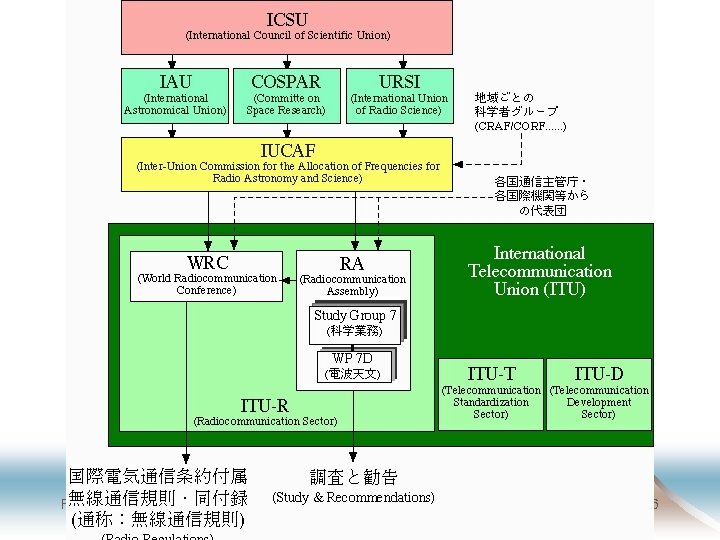 February 14, 2008 RAFCAP meeting in Pune 16
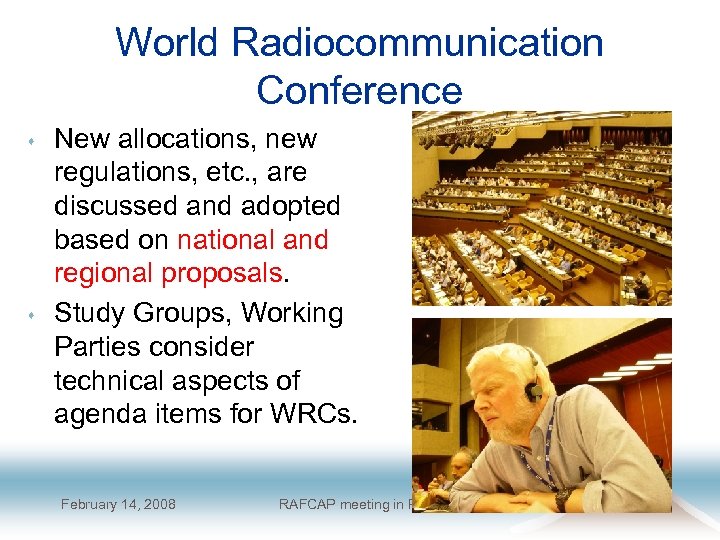 World Radiocommunication Conference s s New allocations, new regulations, etc. , are discussed and adopted based on national and regional proposals. Study Groups, Working Parties consider technical aspects of agenda items for WRCs. February 14, 2008 RAFCAP meeting in Pune 17
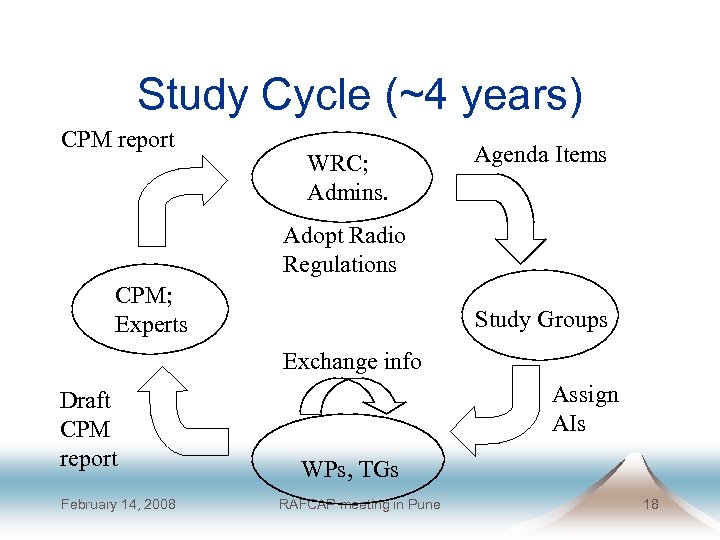 Study Cycle (~4 years) CPM report WRC; Admins. Agenda Items Adopt Radio Regulations CPM; Experts Study Groups Exchange info Draft CPM report February 14, 2008 Assign AIs WPs, TGs RAFCAP meeting in Pune 18
 Study Groups s drafting Technical bases for Radiocommunication Conferences developing Draft Recommendations compiling Handbooks February 14, 2008 RAFCAP meeting in Pune 19
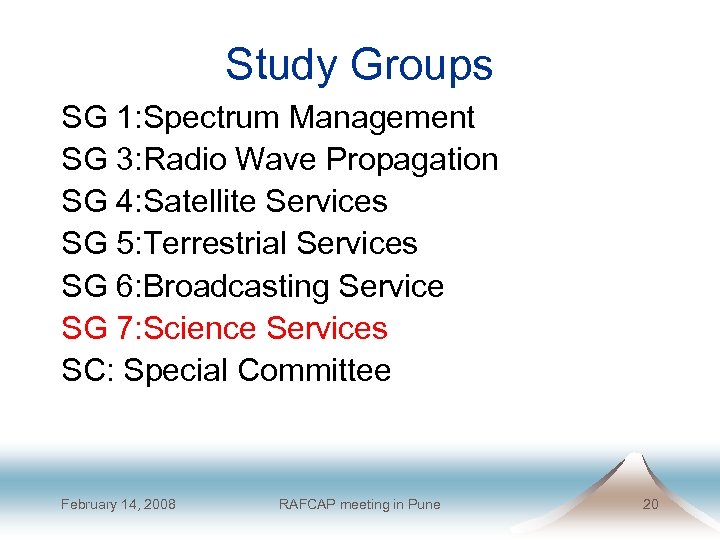 Study Groups SG 1: Spectrum Management SG 3: Radio Wave Propagation SG 4: Satellite Services SG 5: Terrestrial Services SG 6: Broadcasting Service SG 7: Science Services SC: Special Committee February 14, 2008 RAFCAP meeting in Pune 20
 Working Parties s Study Groups are organized into Working Parties and Task Groups s Deal with specific aspects of Study Group work Issues related with multiple SGs Joint WPs, Joint TGs s February 14, 2008 RAFCAP meeting in Pune 21
 SG 1 WP 1 A : Spectrum engineering techniques WP 1 B : Spectrum management methodologies WP 1 C : Spectrum monitoring (TG 1/9 : Compatibility between different passive and active services) February 14, 2008 RAFCAP meeting in Pune 22
 SG 3 WP 3 J WP 3 K WP 3 L WP 3 M Propagation fundamentals Point-to-area propagation Ionospheric propagation Point-to-point and Earthspace propagation February 14, 2008 RAFCAP meeting in Pune 23
 SG 4 WP 4 A : Efficient orbit / spectrum utilization WP 4 B : Systems, air interfaces, performance and availability objectives for FSS, BSS and MSS, including IPbased applications and satellite news gathering WP 4 C : All mobile-satellite services and radiodetermination-satellite service February 14, 2008 RAFCAP meeting in Pune 24
 SG 5 (WPs) WP 5 A: Land mobile service excluding IMT, amateur and amateur-satellite service WP 5 B: Maritime mobile service including Global Maritime Distress and Safety System (GMDSS), aeronautical mobile service and radiodetermination service WP 5 C: Fixed wireless systems, HF systems in the Fixed and Land Mobile Services WP 5 D: IMT Systems JTG 5 -6: Studies on the use of the band 790862 MHz by mobile applications and by other February 14, 2008 RAFCAP meeting in Pune 25 services
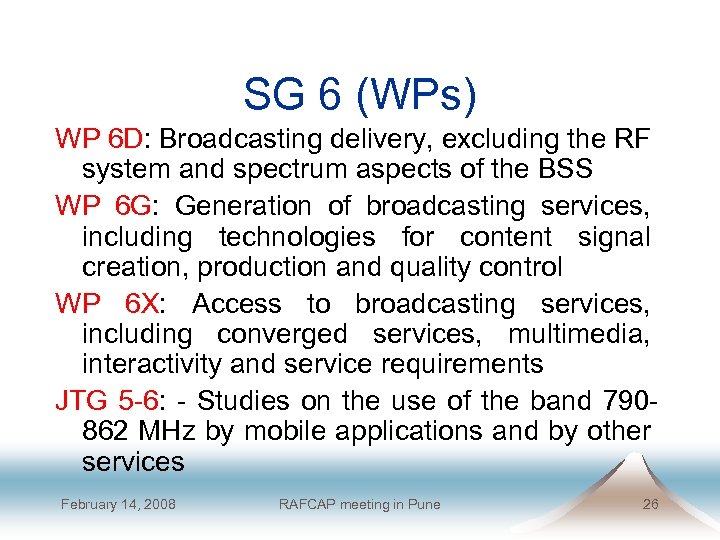 SG 6 (WPs) WP 6 D: Broadcasting delivery, excluding the RF system and spectrum aspects of the BSS WP 6 G: Generation of broadcasting services, including technologies for content signal creation, production and quality control WP 6 X: Access to broadcasting services, including converged services, multimedia, interactivity and service requirements JTG 5 -6: - Studies on the use of the band 790862 MHz by mobile applications and by other services February 14, 2008 RAFCAP meeting in Pune 26
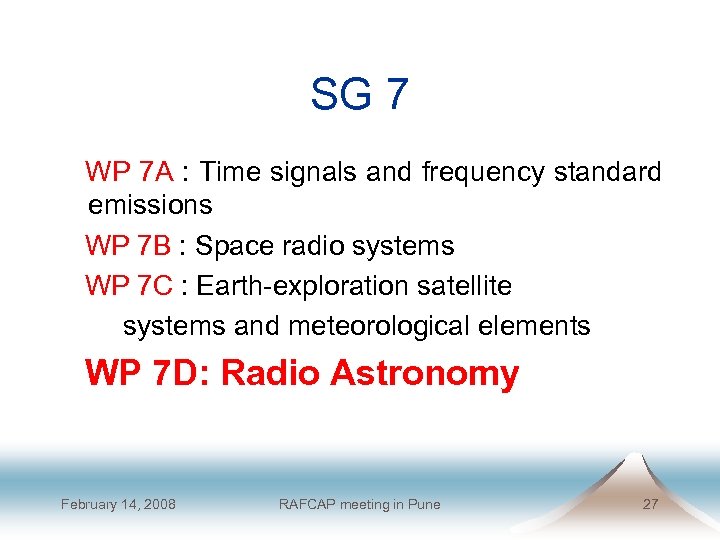 SG 7 WP 7 A : Time signals and frequency standard emissions WP 7 B : Space radio systems WP 7 C : Earth-exploration satellite systems and meteorological elements WP 7 D: Radio Astronomy February 14, 2008 RAFCAP meeting in Pune 27
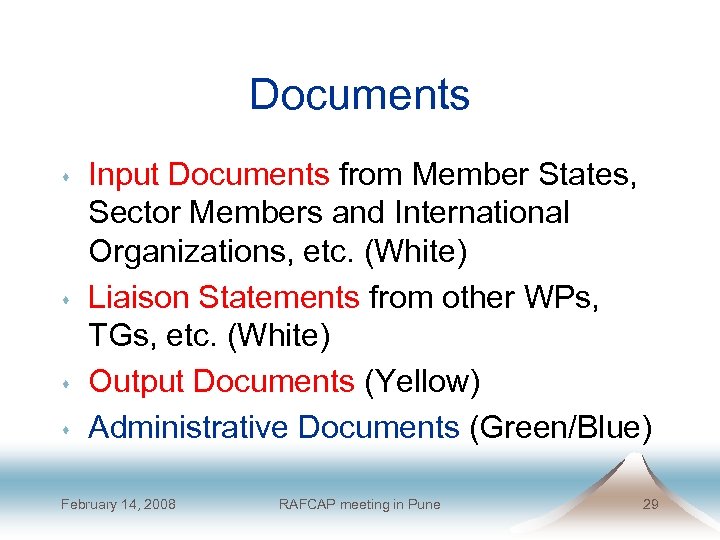 Documents s s Input Documents from Member States, Sector Members and International Organizations, etc. (White) Liaison Statements from other WPs, TGs, etc. (White) Output Documents (Yellow) Administrative Documents (Green/Blue) February 14, 2008 RAFCAP meeting in Pune 29
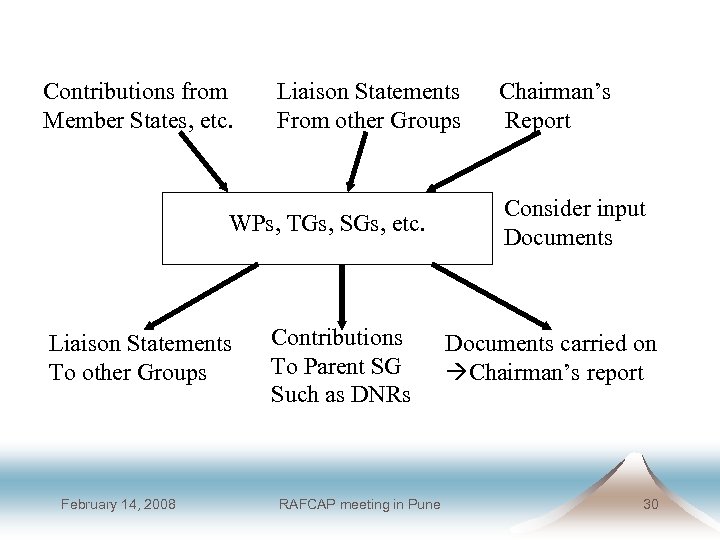 Contributions from Member States, etc. Liaison Statements From other Groups WPs, TGs, SGs, etc. Liaison Statements To other Groups February 14, 2008 Contributions To Parent SG Such as DNRs RAFCAP meeting in Pune Chairman’s Report Consider input Documents carried on Chairman’s report 30
 ITU Web page s s http: //www. itu. int/ top page http: //www. itu. int/ITU-R/ Submitted documents appear on the Web. You need a TIES account to download files. February 14, 2008 RAFCAP meeting in Pune 31
 Recommendations The ITU-R Recommendations provide a body of technical, operational and regulatory / procedural information that has been agreed upon by the participating administrations. February 14, 2008 RAFCAP meeting in Pune 32
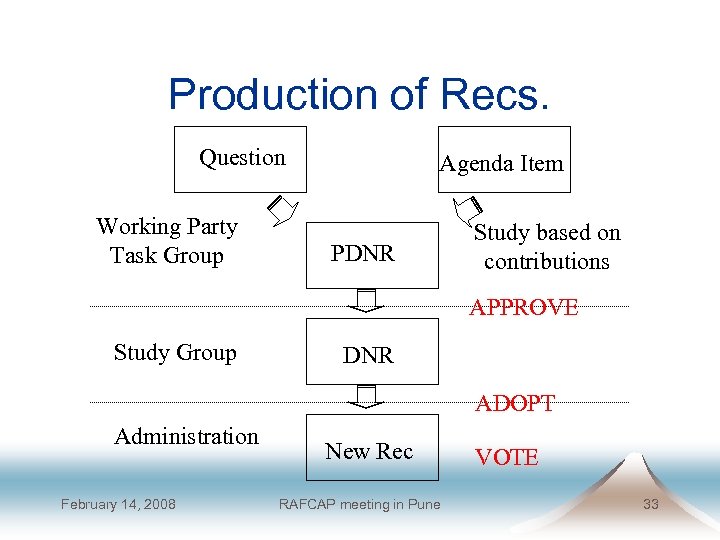 Production of Recs. Question Working Party Task Group Agenda Item PDNR Study based on contributions APPROVE Study Group DNR ADOPT Administration February 14, 2008 New Rec RAFCAP meeting in Pune VOTE 33
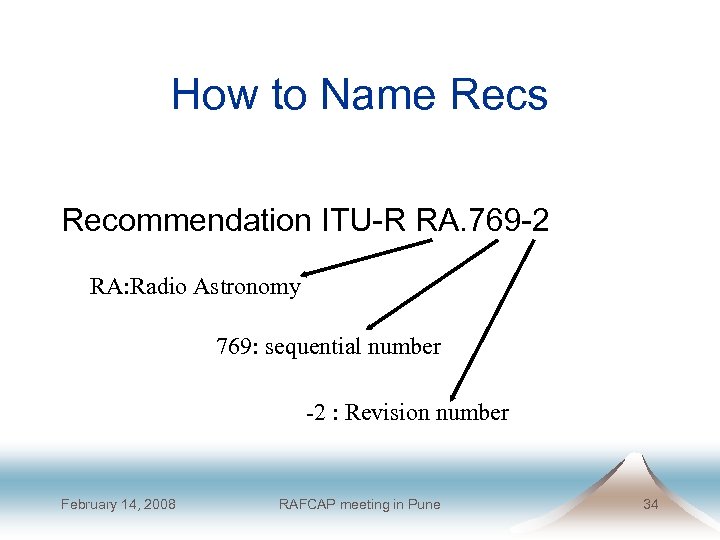 How to Name Recs Recommendation ITU-R RA. 769 -2 RA: Radio Astronomy 769: sequential number -2 : Revision number February 14, 2008 RAFCAP meeting in Pune 34
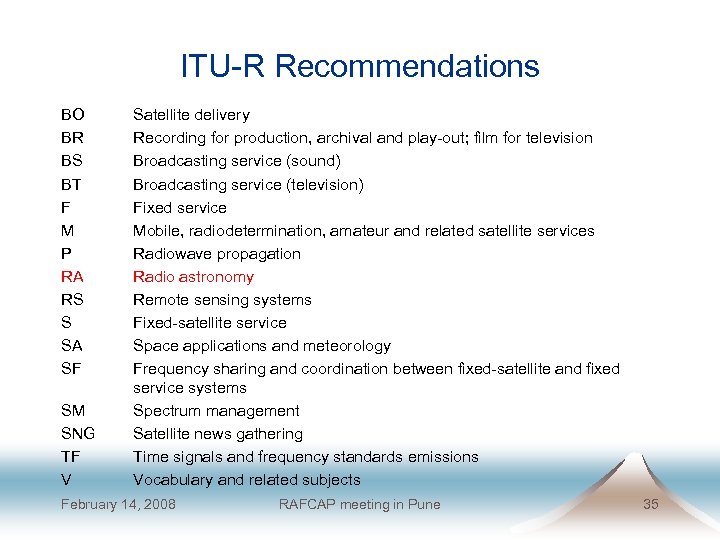 ITU-R Recommendations BO BR BS BT F M P RA RS S SA SF SM SNG TF V Satellite delivery Recording for production, archival and play-out; film for television Broadcasting service (sound) Broadcasting service (television) Fixed service Mobile, radiodetermination, amateur and related satellite services Radiowave propagation Radio astronomy Remote sensing systems Fixed-satellite service Space applications and meteorology Frequency sharing and coordination between fixed-satellite and fixed service systems Spectrum management Satellite news gathering Time signals and frequency standards emissions Vocabulary and related subjects February 14, 2008 RAFCAP meeting in Pune 35
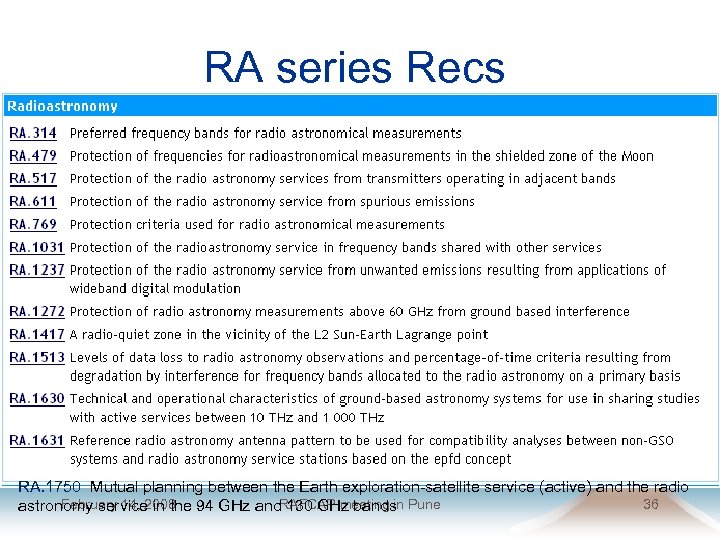 RA series Recs RA. 1750 Mutual planning between the Earth exploration-satellite service (active) and the radio February 14, 2008 RAFCAP meeting in Pune 36 astronomy service in the 94 GHz and 130 GHz bands
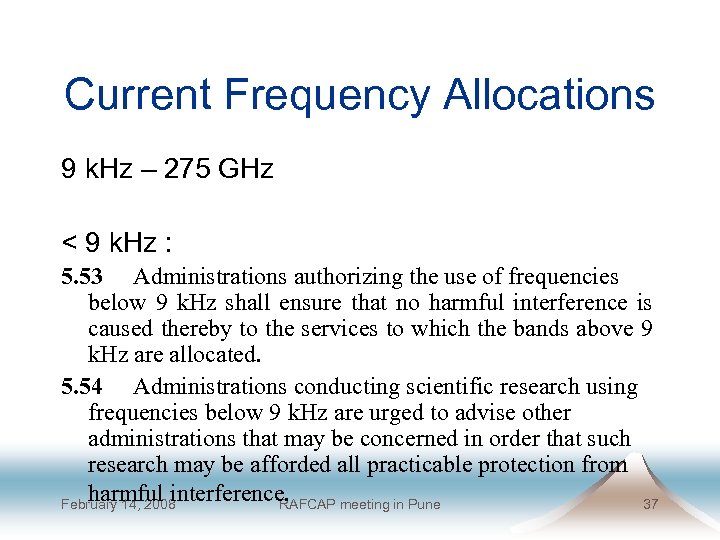 Current Frequency Allocations 9 k. Hz – 275 GHz < 9 k. Hz : 5. 53 Administrations authorizing the use of frequencies below 9 k. Hz shall ensure that no harmful interference is caused thereby to the services to which the bands above 9 k. Hz are allocated. 5. 54 Administrations conducting scientific research using frequencies below 9 k. Hz are urged to advise other administrations that may be concerned in order that such research may be afforded all practicable protection from harmful interference. February 14, 2008 RAFCAP meeting in Pune 37
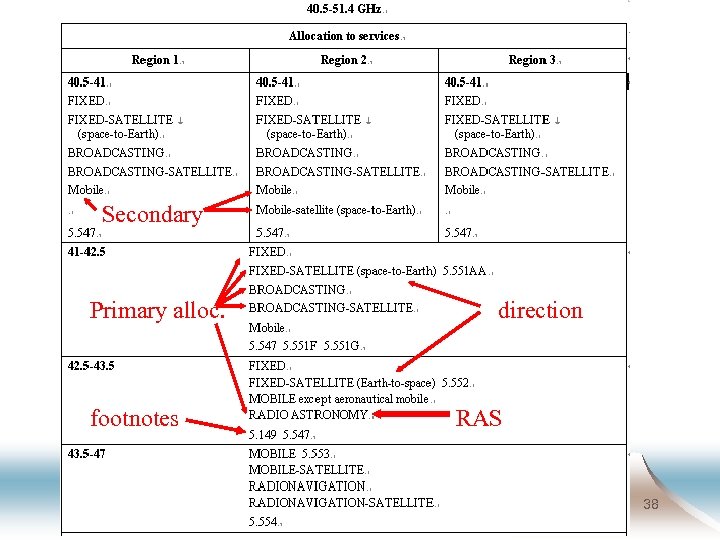 Secondary Primary alloc. direction footnotes February 14, 2008 RAS RAFCAP meeting in Pune 38
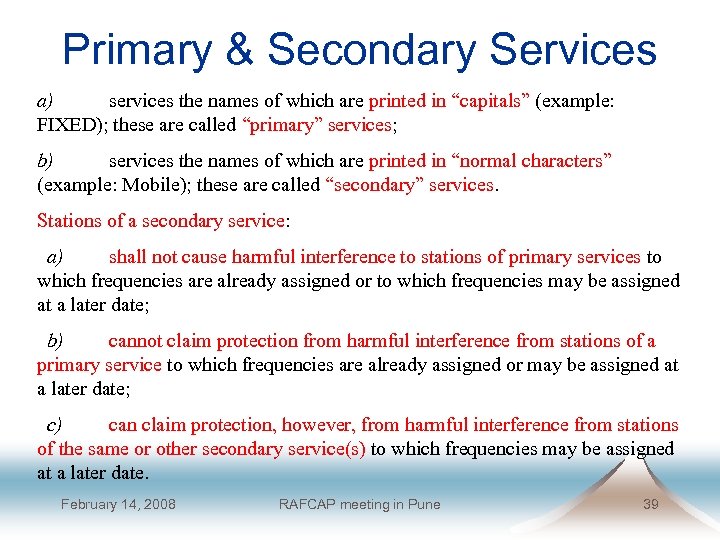 Primary & Secondary Services a) services the names of which are printed in “capitals” (example: FIXED); these are called “primary” services; b) services the names of which are printed in “normal characters” (example: Mobile); these are called “secondary” services. Stations of a secondary service: a) shall not cause harmful interference to stations of primary services to which frequencies are already assigned or to which frequencies may be assigned at a later date; b) cannot claim protection from harmful interference from stations of a primary service to which frequencies are already assigned or may be assigned at a later date; c) can claim protection, however, from harmful interference from stations of the same or other secondary service(s) to which frequencies may be assigned at a later date. February 14, 2008 RAFCAP meeting in Pune 39
 Allocation > 275 GHz No allocation at present (only footnote 5. 565) s s Revision of FN 5. 565 – agenda for WRC -2011 (up to 3000 GHz) February 14, 2008 RAFCAP meeting in Pune 40
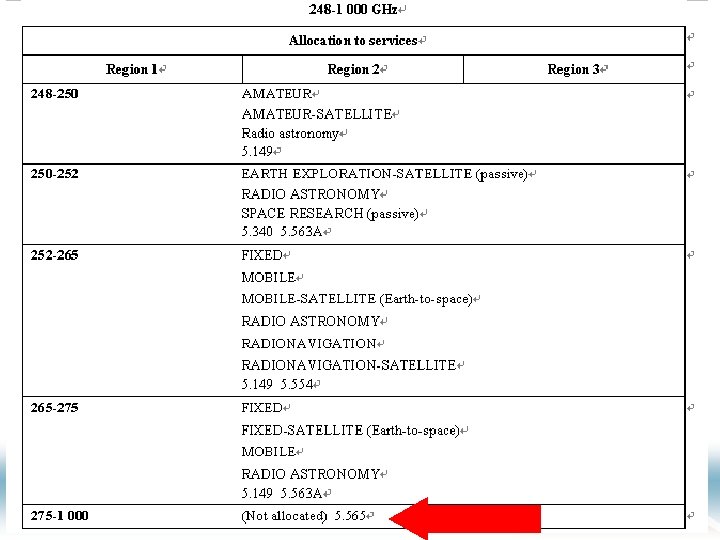 February 14, 2008 RAFCAP meeting in Pune 41
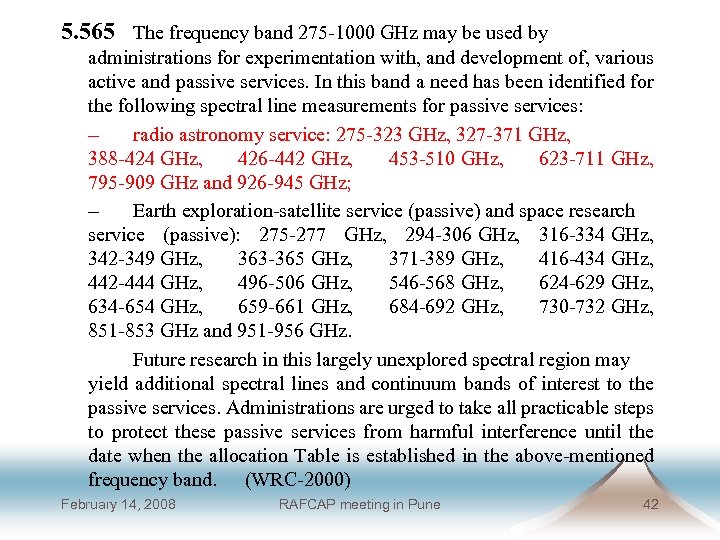 5. 565 The frequency band 275 -1000 GHz may be used by administrations for experimentation with, and development of, various active and passive services. In this band a need has been identified for the following spectral line measurements for passive services: – radio astronomy service: 275‑ 323 GHz, 327‑ 371 GHz, 388‑ 424 GHz, 426‑ 442 GHz, 453‑ 510 GHz, 623‑ 711 GHz, 795‑ 909 GHz and 926 -945 GHz; – Earth exploration-satellite service (passive) and space research service (passive): 275 -277 GHz, 294‑ 306 GHz, 316‑ 334 GHz, 342‑ 349 GHz, 363‑ 365 GHz, 371‑ 389 GHz, 416‑ 434 GHz, 442‑ 444 GHz, 496‑ 506 GHz, 546‑ 568 GHz, 624‑ 629 GHz, 634‑ 654 GHz, 659‑ 661 GHz, 684‑ 692 GHz, 730‑ 732 GHz, 851‑ 853 GHz and 951‑ 956 GHz. Future research in this largely unexplored spectral region may yield additional spectral lines and continuum bands of interest to the passive services. Administrations are urged to take all practicable steps to protect these passive services from harmful interference until the date when the allocation Table is established in the above-mentioned frequency band. (WRC‑ 2000) February 14, 2008 RAFCAP meeting in Pune 42
 RA bands defined in ITU s Frequency usages are regulated in ITU s RA bands rights to be protected February 14, 2008 RAFCAP meeting in Pune 43
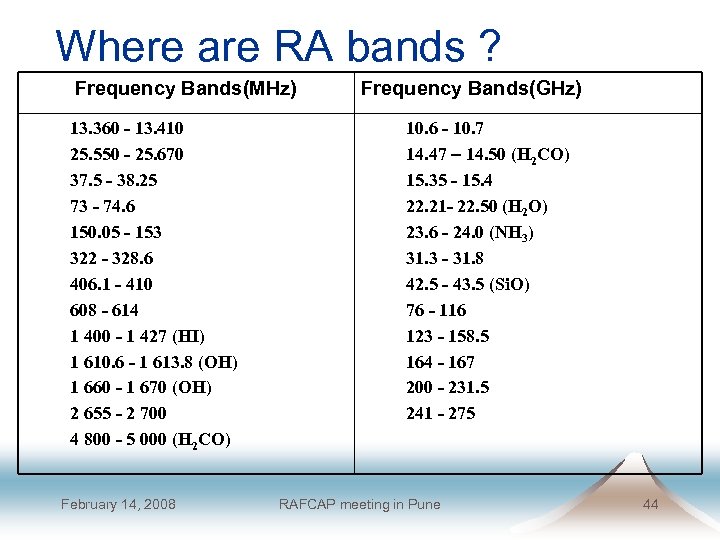 Where are RA bands ? Frequency Bands(MHz) 13. 360 - 13. 410 25. 550 - 25. 670 37. 5 - 38. 25 73 - 74. 6 150. 05 - 153 322 - 328. 6 406. 1 - 410 608 - 614 1 400 - 1 427 (HI) 1 610. 6 - 1 613. 8 (OH) 1 660 - 1 670 (OH) 2 655 - 2 700 4 800 - 5 000 (H 2 CO) February 14, 2008 Frequency Bands(GHz) 10. 6 - 10. 7 14. 47 – 14. 50 (H 2 CO)0 15. 35 - 15. 40 22. 21 - 22. 50 (H 2 O) 23. 6 - 24. 0 (NH 3) 31. 3 - 31. 80 42. 5 - 43. 5 (Si. O) 76 - 116 123 - 158. 5 164 - 16700 200 - 231. 500 241 - 275 RAFCAP meeting in Pune 44
 Shared RA bands In many RA bands, other services are also allocated. INTERFERENCE !? It is necessary to coordinate between RAS and other services. February 14, 2008 RAFCAP meeting in Pune 46
 Adjacent to RA bands In many cases, there are satellite services (FSS, MSS, BSS, etc) in downlink !! RA can not avoid interference by choosing sites. February 14, 2008 RAFCAP meeting in Pune 47
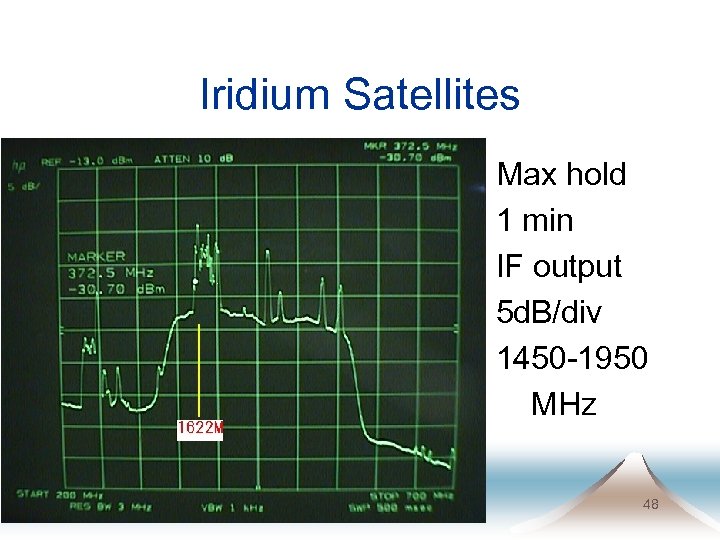 Iridium Satellites Max hold 1 min IF output 5 d. B/div 1450 -1950 MHz February 14, 2008 RAFCAP meeting in Pune 48
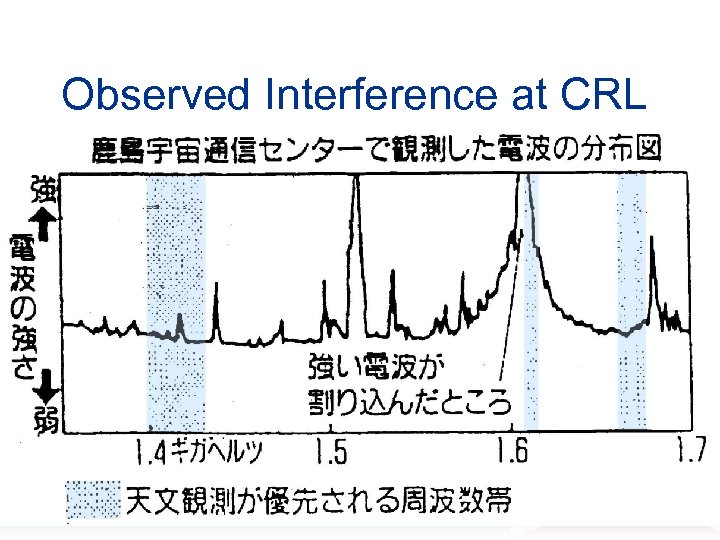 Observed Interference at CRL February 14, 2008 RAFCAP meeting in Pune 49
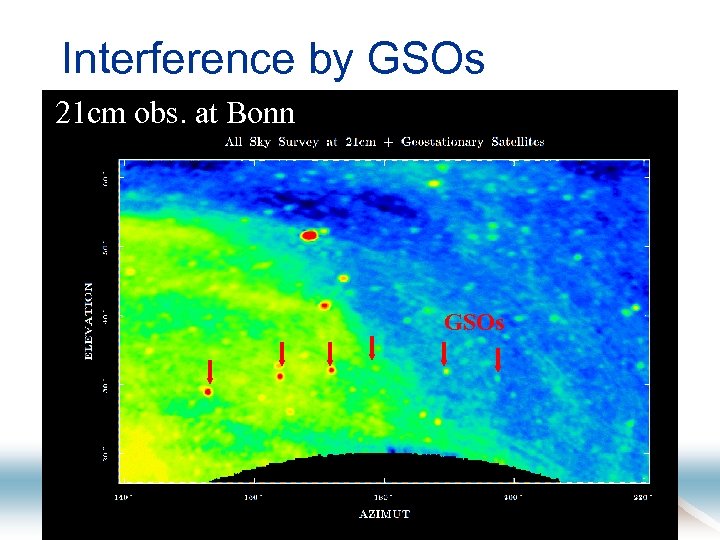 Interference by GSOs 21 cm obs. at Bonn GSOs February 14, 2008 RAFCAP meeting in Pune 50
 Radio Frequency Interference Radio contaminations by artificial transmission (Telecomm. , Radar, etc. ) s Serious Problem for low-frequency RA observations s RFI will occur in higher frequencies s February 14, 2008 RAFCAP meeting in Pune 51
 Necessary bandwidth 1. 152 necessary bandwidth: For a given class of emission, the width of the frequency band which is just sufficient to ensure the transmission of information at the rate and with the quality required under specified conditions. February 14, 2008 RAFCAP meeting in Pune 52
 Unwanted emissions 1. 144 out-of-band emission: Emission on a frequency or frequencies immediately outside the necessary bandwidth which results from the modulation process, but excluding spurious emissions. 1. 145 spurious emission: Emission on a frequency or frequencies which are outside the necessary bandwidth and the level of which may be reduced without affecting the corresponding transmission of information. Spurious emissions include harmonic emissions, parasitic emissions, intermodulation products and frequency conversion products, but exclude out-of-band emissions. 1. 146 unwanted emissions: Consist of spurious emissions and out-of-band emissions. February 14, 2008 RAFCAP meeting in Pune 53
 Appendix to Article 3 (before WRC-03) For the purpose of setting limits, all emissions, including harmonic emissions, intermodulation products, frequency conversion products and parasitic emissions, which fall at frequencies separated from the centre frequency of the emission by ± 250%, or more, of the necessary bandwidth of the emission will generally be considered as spurious emissions. February 14, 2008 RAFCAP meeting in Pune 54
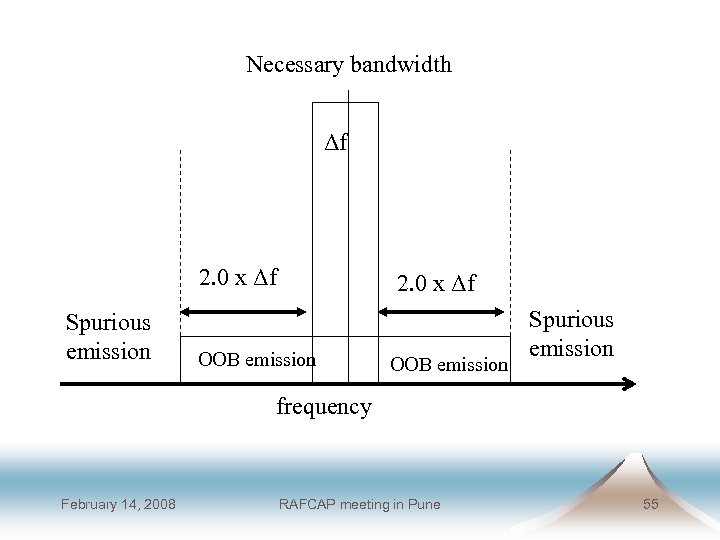 Necessary bandwidth Δf 2. 0 x Δf Spurious emission 2. 0 x Δf OOB emission Spurious emission frequency February 14, 2008 RAFCAP meeting in Pune 55
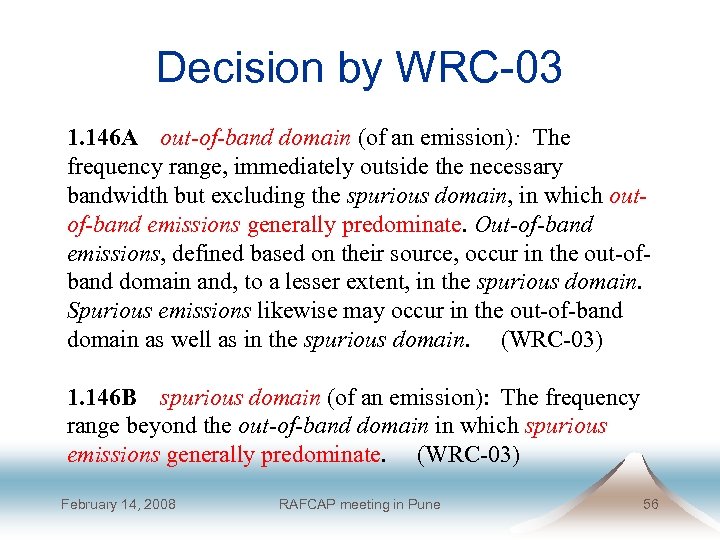 Decision by WRC-03 1. 146 A out-of-band domain (of an emission): The frequency range, immediately outside the necessary bandwidth but excluding the spurious domain, in which outof-band emissions generally predominate. Out-of-band emissions, defined based on their source, occur in the out-ofband domain and, to a lesser extent, in the spurious domain. Spurious emissions likewise may occur in the out-of-band domain as well as in the spurious domain. (WRC-03) 1. 146 B spurious domain (of an emission): The frequency range beyond the out-of-band domain in which spurious emissions generally predominate. (WRC-03) February 14, 2008 RAFCAP meeting in Pune 56
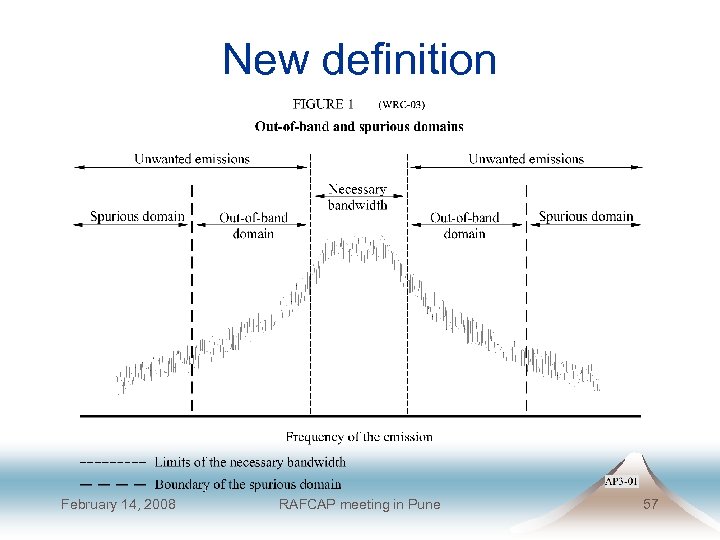 New definition February 14, 2008 RAFCAP meeting in Pune 57
 February 14, 2008 RAFCAP meeting in Pune 58
 February 14, 2008 RAFCAP meeting in Pune 59