


 Скачать презентацию ITU Regional Standardization Forum for Africa Kampala Uganda
e28b798a9a97c09f866e5e84ec61b4a3.ppt
- Количество слайдов: 16
 ITU Regional Standardization Forum for Africa (Kampala, Uganda, 23 -25 June 2014) Highlights of the work of Q 14/5 Peter Ulanga, Universal Communications Service Access Fund of Tanzania ulanga@ucaf. go. tz Kampala, Uganda, 23 June 2014
 Question 14/5: “Setting up a low-cost sustainable telecommunication infrastructure for rural communications in developing countries” Rapporteur: Franz Zichy, USA Associate Rapporteur: Peter Ulanga, Tanzania Kampala, Uganda, 23 June 2014 2
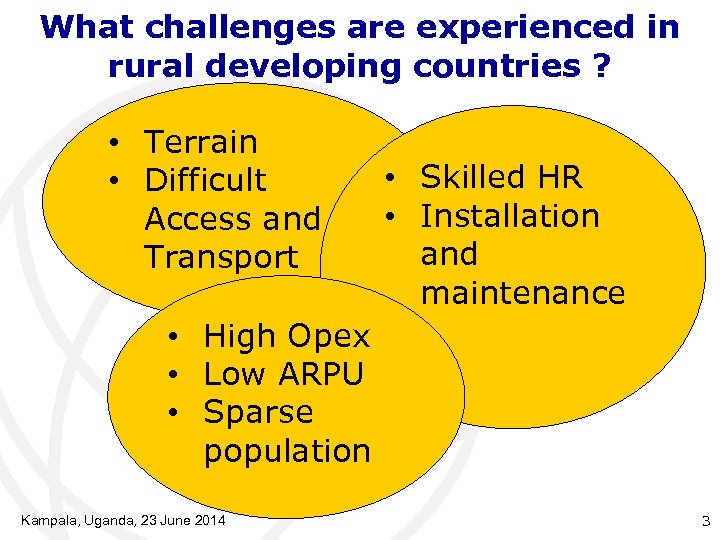 What challenges are experienced in rural developing countries ? • Terrain • Difficult Access and Transport • Skilled HR • Installation and maintenance • High Opex • Low ARPU • Sparse population Kampala, Uganda, 23 June 2014 3
 What possible solutions ? 1) Low-cost trunk transmission lines to rural stations with sufficient bandwidth; 2) Wireless and wired networks connecting rural stations and end-users; 3) Low energy consumption cost effective infrastructure; ( could they Work off-grid) 4) Solution should be easy to deploy and setup; 5) Solution should be robust and have low maintenance requirements; 6) The system should be environmentally friendly throughout its lifecycle. Kampala, Uganda, 23 June 2014 4
 How is it envisaged to solve the problems? 1) Low-cost trunk transmission lines to rural stations with sufficient bandwidth; 2) Wireless and wired networks connecting rural stations and end-users; • Terrain • Difficult Access and Transport Kampala, Uganda, 23 June 2014 5
 How is it envisaged to solve the problems? 3) Low energy consumption cost effective infrastructure; ( could they Work off-grid) 5) Solution should be robust and have low maintenance requirements; • High Opex • Low ARPU • Sparse population Kampala, Uganda, 23 June 2014 6
 How is it envisaged to solve the problems? 4) Solution should be easy to deploy and setup; 5) Solution should be robust and have low maintenance requirements; • Skilled HR • Installation and maintenance Kampala, Uganda, 23 June 2014 7
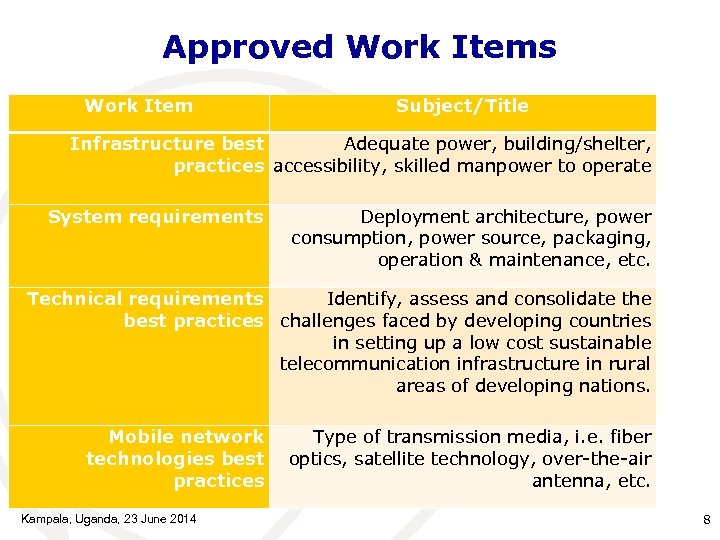 Approved Work Items Work Item Subject/Title Infrastructure best Adequate power, building/shelter, practices accessibility, skilled manpower to operate System requirements Deployment architecture, power consumption, power source, packaging, operation & maintenance, etc. Technical requirements Identify, assess and consolidate the best practices challenges faced by developing countries in setting up a low cost sustainable telecommunication infrastructure in rural areas of developing nations. Mobile network technologies best practices Kampala, Uganda, 23 June 2014 Type of transmission media, i. e. fiber optics, satellite technology, over-the-air antenna, etc. 8
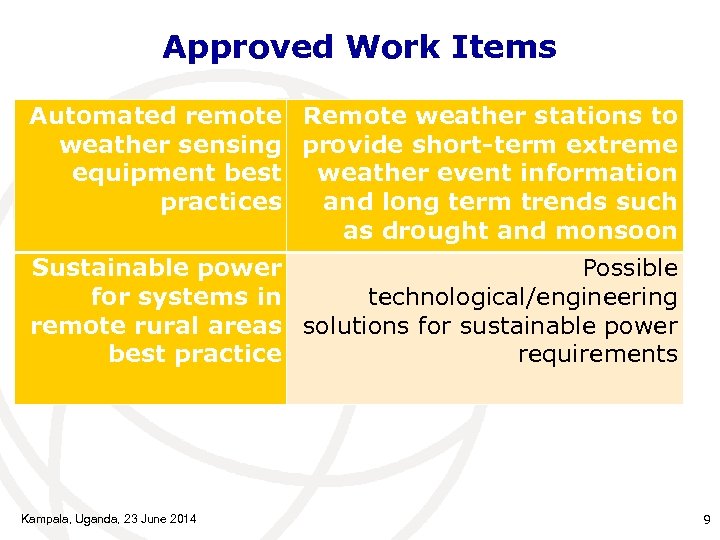 Approved Work Items Automated remote Remote weather stations to weather sensing provide short-term extreme equipment best weather event information practices and long term trends such as drought and monsoon Sustainable power Possible Work Item Subject/Title for systems in technological/engineering remote rural areas solutions for sustainable power best practice requirements Kampala, Uganda, 23 June 2014 9
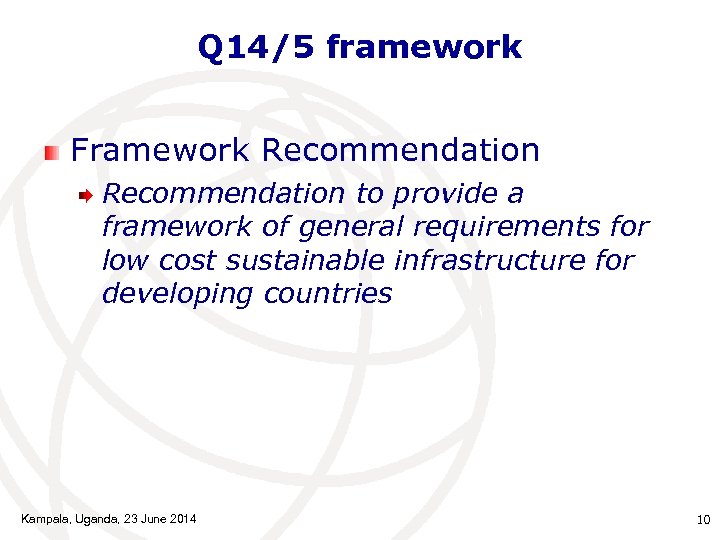 Q 14/5 framework Framework Recommendation to provide a framework of general requirements for low cost sustainable infrastructure for developing countries Kampala, Uganda, 23 June 2014 10
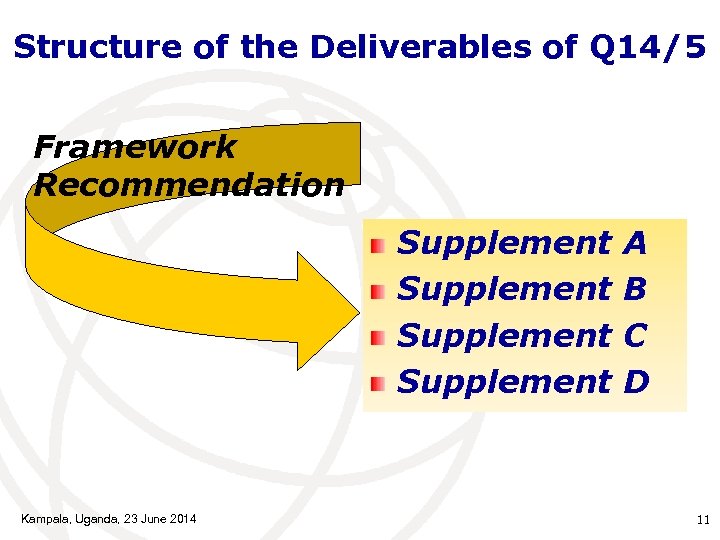 Structure of the Deliverables of Q 14/5 Framework Recommendation Supplement Kampala, Uganda, 23 June 2014 A B C D 11
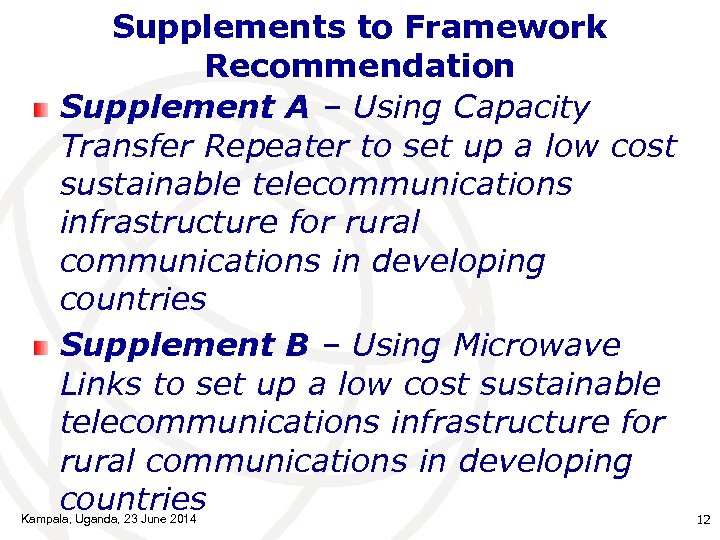 Supplements to Framework Recommendation Supplement A – Using Capacity Transfer Repeater to set up a low cost sustainable telecommunications infrastructure for rural communications in developing countries Supplement B – Using Microwave Links to set up a low cost sustainable telecommunications infrastructure for rural communications in developing countries Kampala, Uganda, 23 June 2014 12
 Supplements to the Framework Recommendation Supplement C – Using Fiber Optic Cable to set up a low cost sustainable telecommunications infrastructure for rural communications in developing countries Supplement D – Using Hybrid Satellites to set up a low cost sustainable telecommunications infrastructure for rural communications in developing countries Kampala, Uganda, 23 June 2014 13
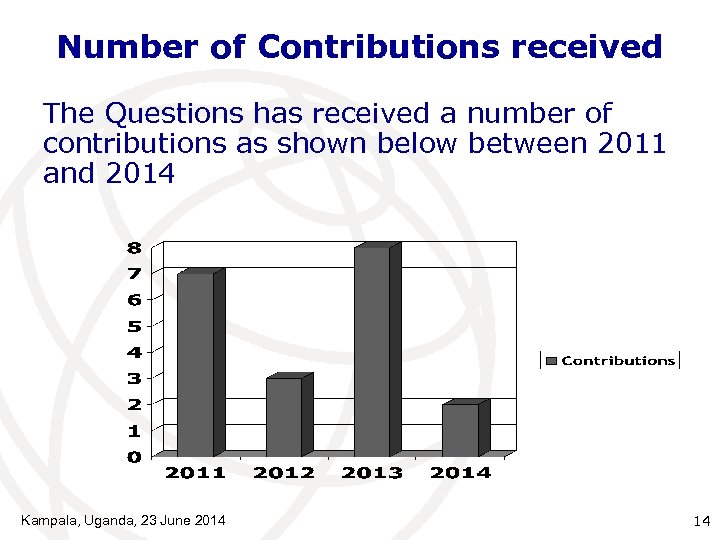 Number of Contributions received The Questions has received a number of contributions as shown below between 2011 and 2014 Kampala, Uganda, 23 June 2014 14
 Highlights of the Contributions Largest number of contributions are related to infrastructure best practices (9 contributions) The second largest number of contributions on mobile network best practices (8 contributions) Kampala, Uganda, 23 June 2014 The third largest number of contributions is in systems requirements( 5 contributions) Other work items have 3 or less contributions 15
 Conclusions and Recommendations Contributions from Africa are required to ensure relevant deliverables of the work of Q 14/5 We need more contributions on areas of systems requirement to cover different aspects of low-cost technologies requirements in rural areas Kampala, Uganda, 23 June 2014 16