


 Скачать презентацию ITU Regional Standardization Forum for Africa Kampala Uganda
0667b612db06cc0e5187105dfd223b01.ppt
- Количество слайдов: 21
 ITU Regional Standardization Forum for Africa (Kampala, Uganda, 23 -25 June 2014) Qo. S systems in Uganda Echeda Robert, Compliance Specialist, Uganda Communications Commission recheda@ucc. co. ug Kampala, Uganda, 23 June 2014
 Uganda Communications Commission (UCC) established by the Communications act 2007 (which was revised in 2013) as the regulator of the Communications Sector in Uganda. Its core mandate is to promote the interests of consumers and operators as regards the quality of communications services and equipment. UCC has licensed 6 PLMN networks, 5 ISP, 2 fiber cable operators, 3 Mast operators and 3 technical service providers each operator is required to ensure services meet the basic Qo. S standards. Kampala, Uganda, 23 June 2014 2
 Qo. S legal Framework The Communications act Qo. S regulations License requirement The Name and Shame Policy Kampala, Uganda, 23 June 2014 3
 Mandate of UCC to set national standards and ensure compliance with national and international standards and obligations laid down by international communication agreements and treaties to which Uganda is a party. promote and safeguard the interests of consumers and operators as regards the quality of communications services and equipment. establish an intelligent network monitoring system to monitor traffic, revenue and quality of service of operators Kampala, Uganda, 23 June 2014 4
 Roles of UCC Establish Quality of Service Framework. Qo. S assurance through periodic monitoring and evaluation. Adopt internationally inter-operative standards Establish equipment type approval regulations Carry out and certify Type approval of epment. Manage scare resource Establish and maintain a mutually conducive environment for operators, the public and authorities Promote consumer awareness through public dialogues and stakeholder workshops. Kampala, Uganda, 23 June 2014 5
 Roles of service providers Operators to provide services that meet the minimum requirements of Qo. S standard. Establish Monitoring system, customer support centers and proactively address consumer complaints. Ensure redundancy of network infrastructure Ensure use of type approved equipment Ensure optimum usage of authorized scare resource through use of efficient technologies. Establish open standard interoperable points of interconnect and share resources where technically feasible. Ensure integrity of network systems and protect consumer’s privacy or confidentiality of information. Kampala, Uganda, 23 June 2014 6
 Consumers Buy Type approved terminals Ensure proper use of services ensure to Use services of licensed operators Demand Pay for services used Use the right channels for Complains May resort to UCC for arbitration Kampala, Uganda, 23 June 2014 7
 Qo. S Monitoring system Drive tests along routes of high traffic in towns with the highest traffic. Auto generation of calls from Mobile unit, the call profile is: setup time out of 12 s, duration of 60 s and a call window of 90 s based on common usage patterns. Parameters monitored Call success rate, Dropped call rate, Blocked call rate, call setup success rate. Data collected in the 10 major towns Kampala, Uganda, 23 June 2014 8
 Monitoring Ctn Other statistics submitted by operators include network outage stats, Consumer Compliant reports and network performance statistics. Kampala, Uganda, 23 June 2014 9
 Parameters Congestion: Probability of not accessing a traffic Channel- TCH congestion – (0. 5%) Call Drop Rate: Percentage number of calls that are dropped after connection to the system or Network during the call duration - (<2%) Call Block Rate: Percentage number of calls that are blocked after call set up - (<2%) Percentage of good quality calls: the percentage of Good calls made within the hour – (>95%) Success call rate: Success call is one which terminates with ‘no’ answer’ on voice mail service, announcement that subscriber is not available, with a busy signal, with an announcement that wrong number has been dialled, and in conversation – (>99% ) Network Availability: time that the network resources Are available to the consume, >95% for MSCs and BSS And >95% for BTS Kampala, Uganda, 23 June 2014 10
 Evaluation and enforcement Following conclusion of monitoring, the major cause and areas of failure are identified through a consultative forum with respective operator and remedial action plan developed. The comparative performance of the operators are published in public media. The remedial plan is periodically monitored for effectiveness and potential impact to Qo. S performance. The UCC may institute other measures of enforcement like penalities for repeated failure to achieve minimum targets. Kampala, Uganda, 23 June 2014 11
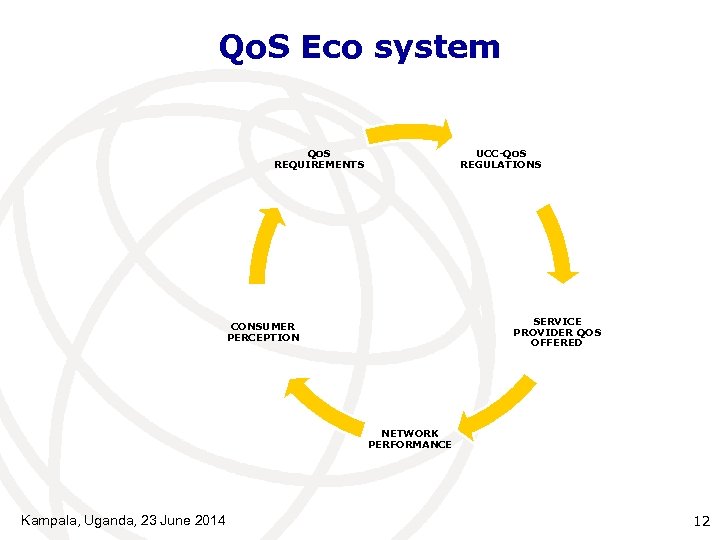 Qo. S Eco system Qo. S REQUIREMENTS UCC-Qo. S REGULATIONS SERVICE PROVIDER QOS OFFERED CONSUMER PERCEPTION NETWORK PERFORMANCE Kampala, Uganda, 23 June 2014 12
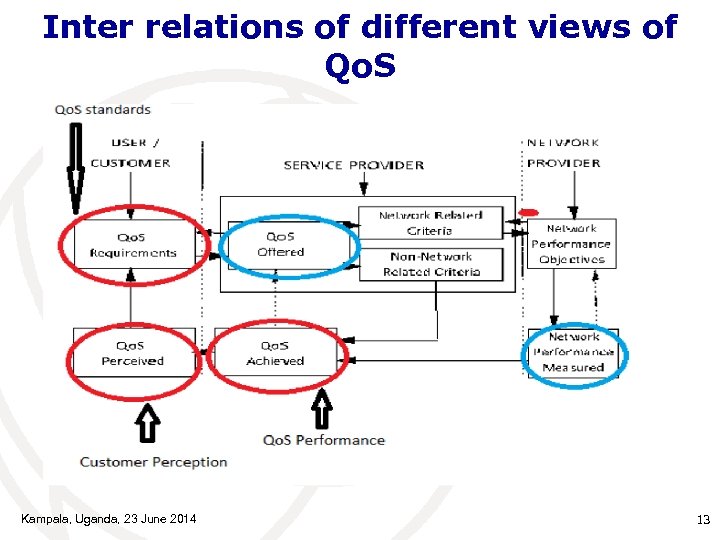 Inter relations of different views of Qo. S Kampala, Uganda, 23 June 2014 13
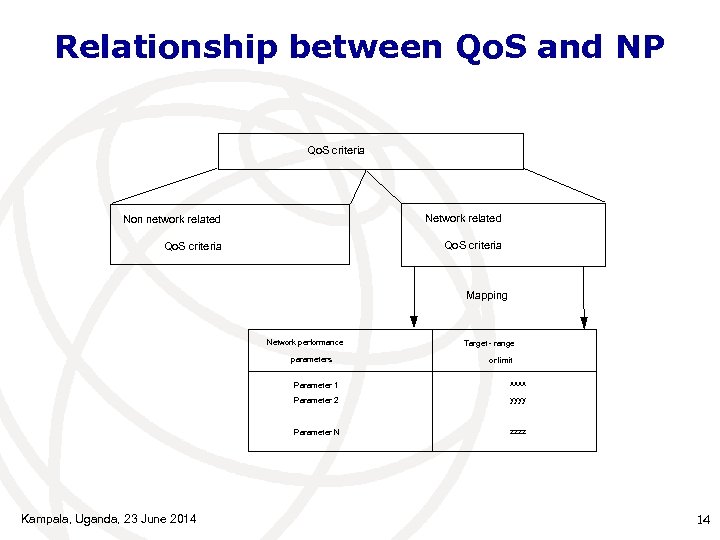 Relationship between Qo. S and NP Qo. S criteria Non network related Network related Qo. S criteria Mapping Network performance parameters Target - range or limit Parameter 1 Parameter 2 yyyy Parameter N Kampala, Uganda, 23 June 2014 xxxx zzzz 14
 Methodology for Mapping Qo. S to Network performance The user's Qo. S requirements is the starting point. This is mapped to Qo. S offered parameters by the service provider. These are mapped to network and non-network related performance parameters. The network related parameters are mapped into NP parameters and target values are assigned. A set of monitoring systems keeps track of the desired performance. The achieved end-to-end Qo. S performance is derived from the measurements and combined with the non network related Qo. S performance is compared with the users/customer's Qo. S perceived and Corrective action is taken to address the difference. Kampala, Uganda, 23 June 2014 15
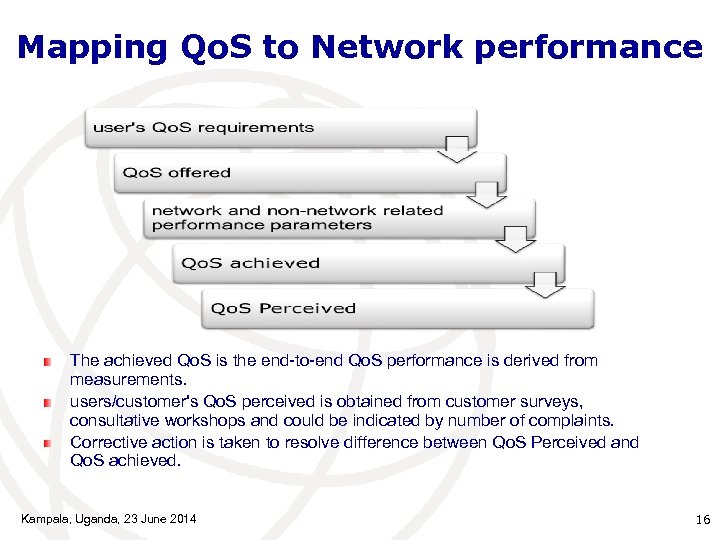 Mapping Qo. S to Network performance The achieved Qo. S is the end-to-end Qo. S performance is derived from measurements. users/customer's Qo. S perceived is obtained from customer surveys, consultative workshops and could be indicated by number of complaints. Corrective action is taken to resolve difference between Qo. S Perceived and Qo. S achieved. Kampala, Uganda, 23 June 2014 16
 Relationship btn Qo. S and NP An example of mapping of Qo. S into NP is shown below: - Qo. S requirement for telephony: not more than x % of connections made to experience difficulty on the clarity of conversation; - the NP requirements are the parameters identified as contributing to call clarity: transmission loss, noise (impulsive and non impulsive), echo, delay, crosstalk, voice clipping, (and possibly others); end-to-end target values for each parameter may be specified. The sum effect should result in not more than x % of calls experiencing difficulty in call clarity. Kampala, Uganda, 23 June 2014 17
 Challenges Correlating Qo. S targets to consumer perception Correlating Qo. S achieved to Qo. S perceived by the consumer. Correlating Qo. S perception to network performance. Establishing the cause of failure and determine the appropriate remedial action. Addressing thefts, vandalism, unstable power and delays in issuing way leaves. Kampala, Uganda, 23 June 2014 18
 Conclusion Uganda has established technical and legal mechanisms for monitoring and enforcement of Qo. S to ensure consumer’s interests are addressed. Monitoring is designed to benchmark respective operator performance against set target and identify major cause and areas of failure for remedial action. Over the years as subscriber numbers grow and services are unified on one platform there is a growing need for proactive monitoring of end to end performance facilitated by methodology of relating Qo. S performance target to performance target of network requirements for the service. Kampala, Uganda, 23 June 2014 19
 RECCOMENDATION A standard Guideline to correlate Qo. S performance targets to performance targets of the network requirements for the service. Kampala, Uganda, 23 June 2014 20
 TO BE CONTINUED ITUT SG 12 AFR Kampala, Uganda, 23 June 2014