


 Скачать презентацию ITU and the Impact of Internet Protocol IP
4413cd352840d33caea385ff57df5385.ppt
- Количество слайдов: 53
 ITU and the Impact of Internet Protocol (IP) Networks IP Symposium for CEE, CIS and Baltic States Moscow, Russia 16 -19 September 2003 Robert Shaw
 Agenda • • • Mission Structure Some telecommunication trends ITU IP-related activities Conclusion International Telecommunication Union
 International Telecommunication Union • International organization where governments and private sector coordinate global telecom networks and services • Founded in 1865, it is the oldest specialized agency of the UN system • 189 Member States, 650 Sector Members, 75 Sector Associates International Telecommunication Union
 International Telecommunication Union • Headquarters Geneva, 11 regional offices, 790 staff / 83 nationalities • 2002 budget = circa USD 115 m • Secretary-General: Yoshio Utsumi (Japan) Deputy Sec-General: Roberto Blois (Brazil) International Telecommunication Union
 ITU mission • Maintain and extend international cooperation in telecommunications • Technical and policy assistance to developing countries • To harmonize actions of Member States and promote cooperation between Member States and Sector Members International Telecommunication Union
 ITU mission • To promote at international level, the adoption of a broader approach to issues of telecommunications in the global information economy and society • To extend the benefits of telecoms to all the world’s inhabitants • “Helping the world communicate” International Telecommunication Union
 But what does ITU actually do? • • • Spectrum allocation and registration Coordination of national spectrum planning International telecoms/ICT standardization Collaboration in international tariff-setting Cooperation in telecoms and ICTs development assistance • Measures for ensuring safety of life • Policy reviews, information exchange • Extension of universal access International Telecommunication Union
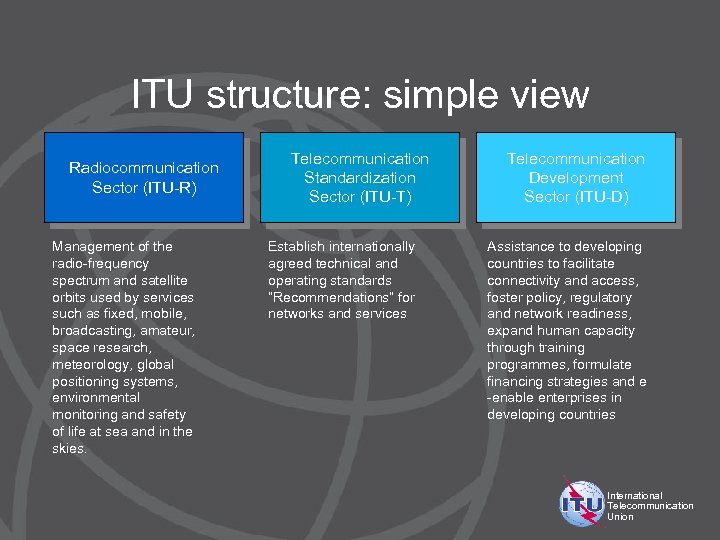 ITU structure: simple view Radiocommunication Sector (ITU-R) Management of the radio-frequency spectrum and satellite orbits used by services such as fixed, mobile, broadcasting, amateur, space research, meteorology, global positioning systems, environmental monitoring and safety of life at sea and in the skies. Telecommunication Standardization Sector (ITU-T) Establish internationally agreed technical and operating standards “Recommendations” for networks and services Telecommunication Development Sector (ITU-D) Assistance to developing countries to facilitate connectivity and access, foster policy, regulatory and network readiness, expand human capacity through training programmes, formulate financing strategies and e -enable enterprises in developing countries International Telecommunication Union
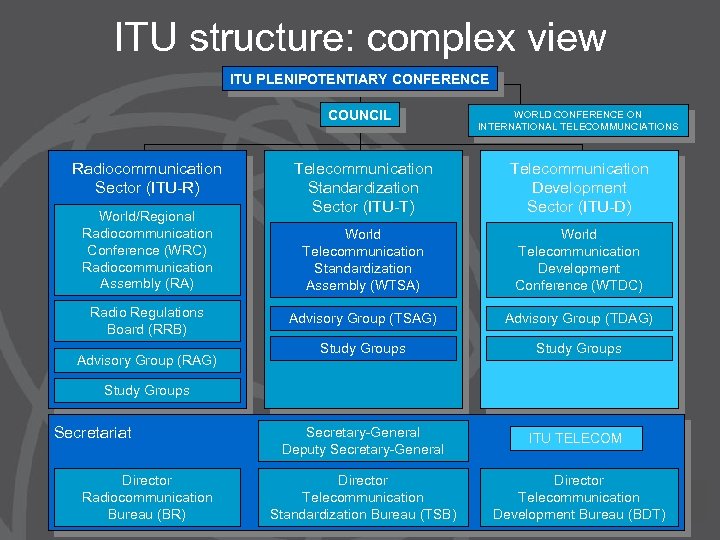 ITU structure: complex view ITU PLENIPOTENTIARY CONFERENCE COUNCIL Radiocommunication Sector (ITU-R) World/Regional Radiocommunication Conference (WRC) Radiocommunication Assembly (RA) Radio Regulations Board (RRB) Advisory Group (RAG) WORLD CONFERENCE ON INTERNATIONAL TELECOMMUNCIATIONS Telecommunication Standardization Sector (ITU-T) Telecommunication Development Sector (ITU-D) World Telecommunication Standardization Assembly (WTSA) World Telecommunication Development Conference (WTDC) Advisory Group (TSAG) Advisory Group (TDAG) Study Groups Secretary-General Deputy Secretary-General ITU TELECOM Study Groups Secretariat Director Radiocommunication Bureau (BR) Director Telecommunication Standardization Bureau (TSB) Director International Telecommunication Development Bureau (BDT) Union
 Understanding telecommunication trends: growth of the Internet • 10 -15 years ago – – Focused around academia and research Primarily North American Not-for-profit Used primarily for email and file transfer • 1990’s – – – Growth throughout OECD countries Begun “privatisation” of backbone Primarily a channel for the Web and email “Dot. com” mania rules Wide misunderstanding that Internet was suitable platform to subsume all existing networks & services International – Wide disparity in connectivity Telecommunication Union
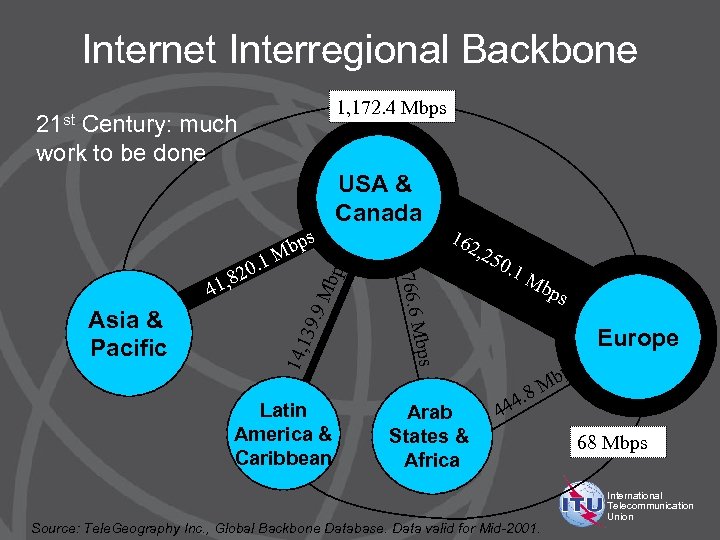 Internet Interregional Backbone 1, 172. 4 Mbps 21 st Century: much work to be done . 9 M 14, Latin America & Caribbean , 25 0. 1 Mb Mbps Asia & Pacific 139 8 41, 162 766. 6 bps M 0. 1 2 bps USA & Canada Arab States & Africa ps Europe. 8 44 4 s bp M Source: Tele. Geography Inc. , Global Backbone Database. Data valid for Mid-2001. 68 Mbps International Telecommunication Union
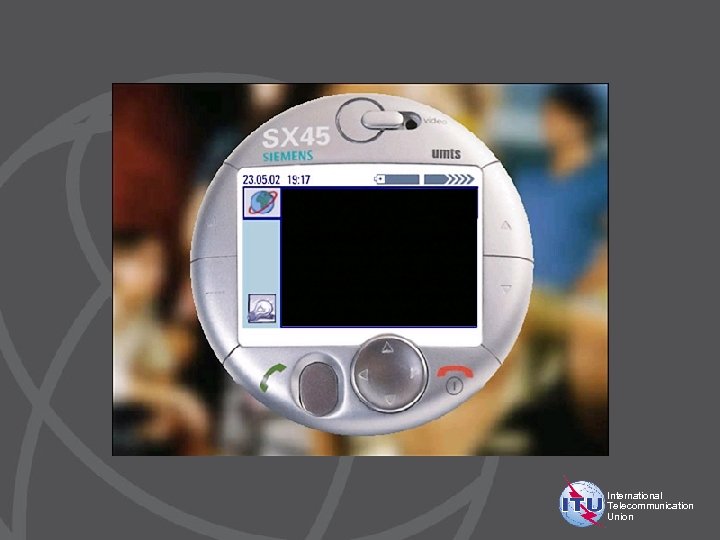
 More recent trends • Birth of Broadband – see http: //www. itu. int/birthofbroadband • Growth in wireless networks and mobile data services – Mobile Internet and multimedia applications • Mobile overtakes fixed – Developing countries have seen the greatest impact of mobile communications providing access to basic telecommunication services International Telecommunication Union
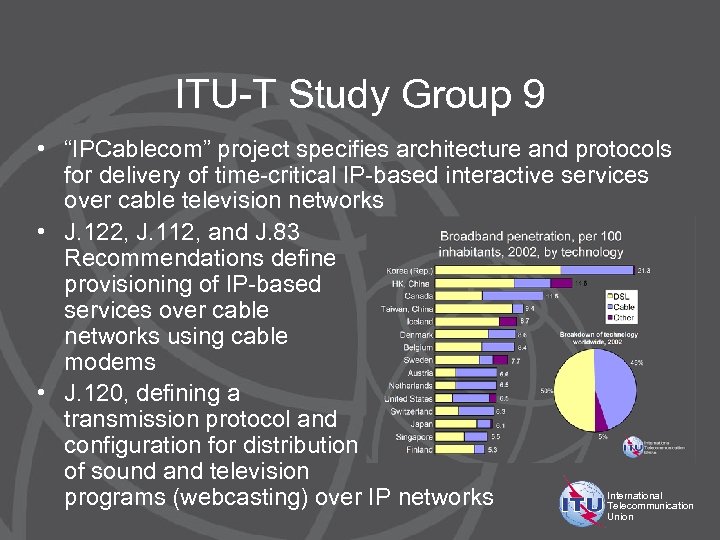
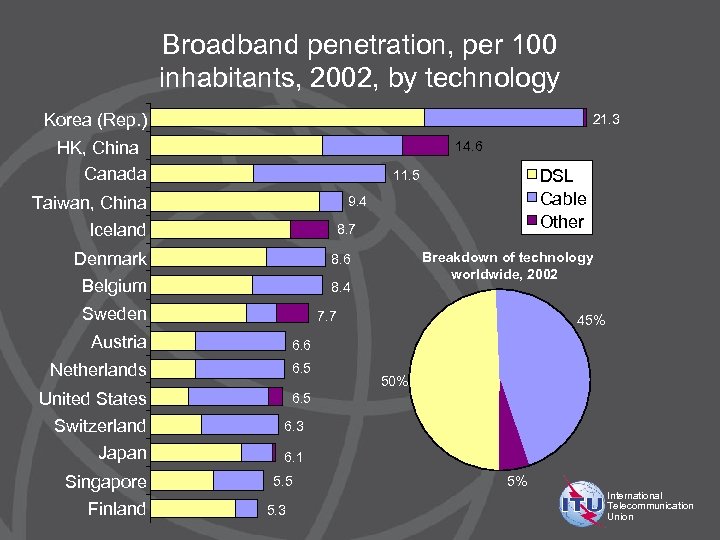 Broadband penetration, per 100 inhabitants, 2002, by technology Korea (Rep. ) 21. 3 HK, China Canada 14. 6 DSL Cable Other 11. 5 Taiwan, China 9. 4 Iceland 8. 7 Denmark 8. 6 Belgium 8. 4 Sweden Breakdown of technology worldwide, 2002 7. 7 Austria 6. 6 Netherlands 6. 5 United States 45% 6. 5 Switzerland 6. 3 Japan 50% 6. 1 Singapore Finland 5. 5 5. 3 5% International Telecommunication Union
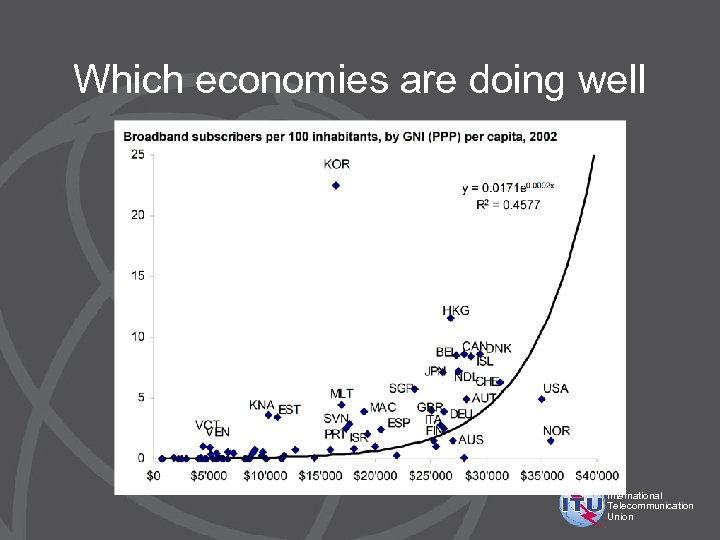 Which economies are doing well International Telecommunication Union
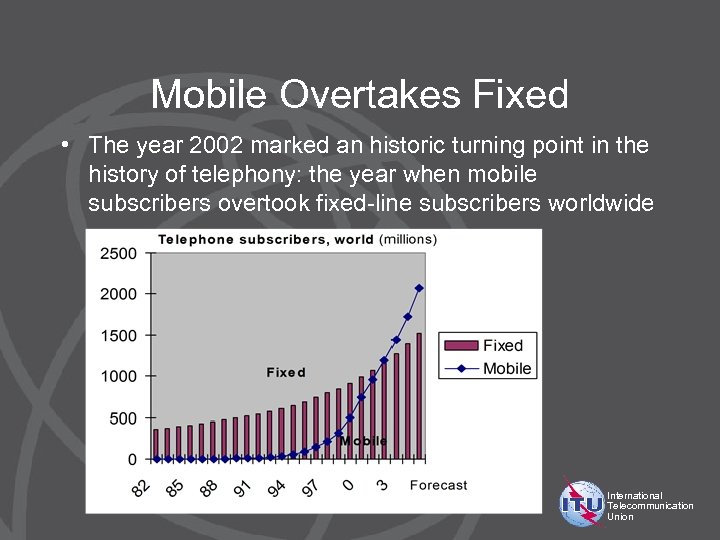 Mobile Overtakes Fixed • The year 2002 marked an historic turning point in the history of telephony: the year when mobile subscribers overtook fixed-line subscribers worldwide International Telecommunication Union
 Mobile Overtakes Fixed • No single causal effects: phenomenon has taken place across geographic criteria such as countries, regions, and continents and across socio-demographic criteria such as gender, income, or age and across economic criteria such as price premium for mobile or GDP per capita International Telecommunication Union
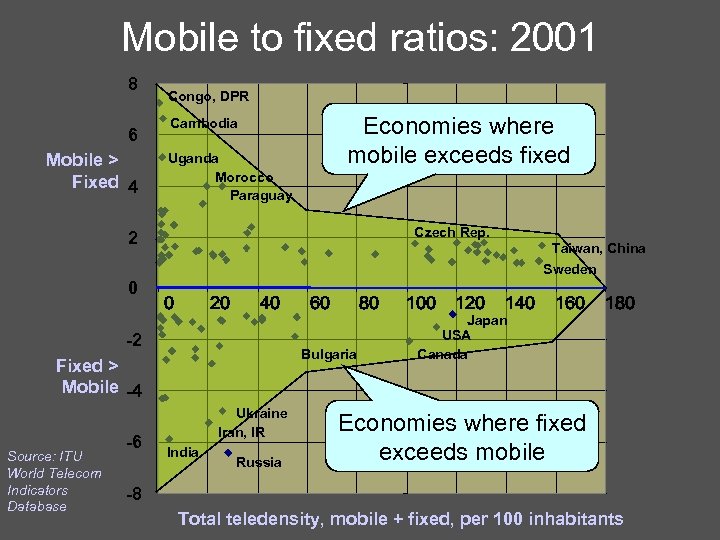 Mobile to fixed ratios: 2001 8 6 Mobile > Fixed 4 Congo, DPR Economies where mobile exceeds fixed Cambodia Uganda Morocco Paraguay Czech Rep. 2 0 Taiwan, China Sweden 0 20 40 -2 -6 80 Bulgaria Fixed > Mobile -4 Source: ITU World Telecom Indicators Database 60 Ukraine Iran, IR India Russia 100 120 140 Japan USA Canada 160 180 Economies where fixed exceeds mobile -8 Total teledensity, mobile + fixed, per 100 inhabitants
 Understanding telecommunication trends: 20 years of sector reform • ~20 years ago, AT&T formally agreed to the break-up of the Bell system • 10 years ago, around 10 countries had some measure of fixed-line competition • 5 years ago, in concluding the WTO basic telecoms agreement, some 70 countries committed to telecoms market liberalization • Countries with privatized operators and some degree of competition are in majority among ITU Member States • World now numbers 102 separate regulatory bodies, up from 30 in 1994 International Telecommunication Union
 But many challenges to the policy & regulatory environment • All policy makers and regulators - both new and old struggling to address changes resulting from convergence of information and communication (ICT) sectors • Build-out of networked economies and national information societies have raised public policy stakes • National telecommunication infrastructures are platform for deployment of advanced national infocommunications networks • Result: broader ICT perspective from policy makers and regulators International Telecommunication Union
 How has the Internet impacted ITU? • Support for IP-related technologies is now strategic element in design, development and use of most telecommunication networks; • Has had major impact on ITU’s core activities in radiocommunication, telecom standardization and development programmes • Has broadened ITU’s mandate from coordination of global telephony and radiocommunication systems to information and communication (ICT) networks services and technologies – includes IP-based networks and the Internet International Telecommunication Union
 Convergence • Growth of the Internet and other IP-based networks and their requirements for bandwidth and capacity drive innovation in access and transport networks, examples: – leveraging copper wire “last-mile” networks through digital subscriber line (“DSL”) technologies – re‑architecturing of cable networks to support IP services – advances in optical networking technologies International Telecommunication Union
 Convergence cont’d • Trend towards integration and interoperability of IPbased and PSTN network services and applications • Emergence of differentiated Quality of Service (“Qo. S”) IP-based services • Managed end-to-end performance needed for new applications requiring real-time traffic (e. g. , video, voice) • New network management, Qo. S, traffic engineering, pricing & accounting models emerging International Telecommunication Union
 In the future • Telephone network (fixed and mobile) and Internet will converge to Next Generation Networks (NGN) • Probably packet based (IP & ATM) with necessary extensions to give a level of service equal to or better than current PSTN carrier networks • Telephony and multimedia may be just another application over the Internet but to make this happen, there needs to be: – Substantial standards work – Substantial resource investment International Telecommunication Union
 What is needed for “Carrier Grade IP”? • What is the underlying demand, business case and the likely timing? • International and national work based on open standards is needed to introduce interoperable NGN: – – – architecture and protocols end to end Qo. S service platforms network management lawful interception Security • Much current ITU standards work relates to NGN International Telecommunication Union
 ITU Telecom Standardization Sector (ITU-T) • See www. itu. int/itu-t/ • Director: Houlin Zhao (China) • Standardization activities are segmented into “Study Groups” that focus on different topic areas (e. g. , security, access & transport networks, multimedia, signalling, numbering, naming and addressing, tariffing, IP and NGN) • Unique forum for public-private partnership • Cooperative activities with many organizations and forums including regional telecom forums, IETF, ISO, IEC, ETSI, etc. International Telecommunication Union
 ITU Telecom Standardization Sector (ITU-T) cont’d • During last 5 years, large reorientation towards IP-related standardization and accelerated procedures • Majority of ITU-T activities are now related to IP and NGN activities – www. itu. int/ITUT/studygroups/com 13/ip/documents/IPproj. V 7. pdf • Common interest areas between ITU-T and IETF at: – www. itu. int/ITU-T/studygroups/com 13/ip/ietf International Telecommunication Union
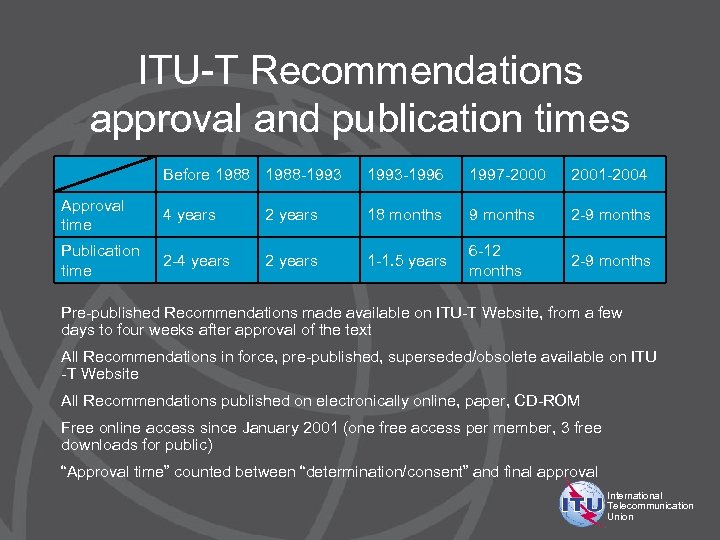 ITU-T Recommendations approval and publication times Before 1988 -1993 -1996 1997 -2000 2001 -2004 Approval time 4 years 2 years 18 months 9 months 2 -9 months Publication time 2 -4 years 2 years 1 -1. 5 years 6 -12 months 2 -9 months Pre-published Recommendations made available on ITU-T Website, from a few days to four weeks after approval of the text All Recommendations in force, pre-published, superseded/obsolete available on ITU -T Website All Recommendations published on electronically online, paper, CD-ROM Free online access since January 2001 (one free access per member, 3 free downloads for public) “Approval time” counted between “determination/consent” and final approval International Telecommunication Union
 ITU-T Study Group 2 • Lead study group on naming, numbering, addressing, and routing issues, examples: – E. 164 international numbering plan – E. 212 mobile (“IMSI”) codes – ENUM: mapping between the Internet Domain Name System (DNS) and the E. 164 numbering plan – E. 164 numbering resources for IP telephony (e. g. UPT 878 code allocated for testing) – ITU-T SG for ongoing activities related to management of Internet names and addresses (MINA) issues International Telecommunication Union
 ITU-T Study Group 3 • In 2000, SG 3 adopted draft recommendation “D. 50” on the cost sharing of international Internet connection between administrations, and continues the study on applicability of principles contained in that Recommendation; • Result of tensions over costs of full leased circuits to Internet “backbone” and argued lack of transparency over peering and interconnection rules • Very short Recommendation that says “thou shall negotiate and agree in good faith” International Telecommunication Union
 Diverse views on Internet interconnection and peering rules • One view from unnamed government policy maker: – “ITU is trying to apply legacy telephony interconnection rules to the Internet!” • Another view from an Internet expert: – “when this situation has existed in other industries, gov't intervention has always resulted. even when the scope is international. i've not been able to puzzle out the reason why the world's gov'ts have not stepped in with some basic interconnection requirements for IP carriers. “ – Paul Vixie, Author of DNS BIND, runs F root server – www. merit. edu/mail. archives/nanog/2002 -06/msg 00937. html International Telecommunication Union
 ITU-T Study Group 4 • Lead Study Group on telecommunication management network (“TMN”) issues • Framework for unified management of integrated circuit-switched and packet-based networks (with initial emphasis on IP-based networks) • Also active in IMT-2000 3 rd generation mobile and beyond network management for service provisioning and security International Telecommunication Union
 ITU-T Study Group 9 • “IPCablecom” project specifies architecture and protocols for delivery of time-critical IP-based interactive services over cable television networks • J. 122, J. 112, and J. 83 Recommendations define provisioning of IP-based services over cable networks using cable modems • J. 120, defining a transmission protocol and configuration for distribution of sound and television International programs (webcasting) over IP networks Telecommunication Union
 ITU-T Study Group 11 • Standardized signalling for IP and advanced network applications, Intelligent Networks (“IN”) • Key role in: – Signalling support of mobility services (e. g. , IMT-2000) – IP related signalling (e. g. , bearer independent call control (BICC), see Q. 1901) – Signalling transport over IP and Interactions between IN and IP-based networks – Use of SIP for user access and network-to-network interfacing International Telecommunication Union
 ITU-T Study Group 12 • Lead Study Group coordinating Quality of Service (Qo. S) • End-to-end transmission performance of networks • Transmission requirements for IP gateways and terminals • Voiceband services via IP networks • Perceptual appreciation of quality of speech • Qo. S issues related to IP networks…. (e. g. G. 1010) • Multimedia Qo. S/performance • In-service non-intrusive assessment of Vo. IP International Telecommunication Union
 ITU-T Study Group 13 • ITU-T lead Study Group for Internet Protocol (IP), BISDN, GII and satellite matters, for example: – – Y. 1310: Transport of IP over ATM in Public Networks Y. 1221: Traffic control and congestion control in IP networks Y. 1310. 2: IP-MPLS transfer and control protocols Y. 1541: Network performance objectives for IP-based services allocations (relates to Qo. S classes) • See ITU IP Project at – www. itu. int/ITUT/studygroups/com 13/ip/documents/IPproj. V 7. pdf • Next Generation Networks 2004 Project – www. itu. int/ITU-T/studygroups/com 13/ngn 2004 International Telecommunication Union
 ITU-T Study Group 15 • Lead Study Group on Access Network Transport and related to the Optical Networking technologies • Standardizes high-speed access over copper wire loops using Digital Subscriber Line (“DSL”) • Standardizes optical access networks for delivery of broadband services • Working on optical transport of Internet packets: IP over Wavelength Division Multiplexing (WDM), DWDM, CWDM • Important work related to Fibre to the Home, SMEs International Telecommunication Union
 ITU-T Study Group 16 • Lead Study Group on multimedia services and systems • Produced Recommendations that are widely used in IP-based and other (including mixed) network architectures. • Examples include: – standards for IP telephony (e. g. , H. 323 series) – modems (e. g. , V. 90, V. 92) – audio and video codecs (e. g. , G. 723. 1 and G. 729 series, H. 260 series) – H. 248 “media-gateway” series for interworking between IP networks & PSTN International Telecommunication Union
 ITU-T Study Group 16 cont’d • H. 264: advanced new video coding – MPEG-4 Part 10 – half bandwidth requirement for same quality as MPEG-2 (e. g. , used on DVD players) – Important for future streaming applications over IP-based networks and the Internet • Emergency services • Wideband voice codecs • H. 350 series: directory services for VOIP address lookup International Telecommunication Union
 ITU-T Study Group 17 • Lead Study Group on frame relay (fast packet), communication systems security and language description techniques (e. g. , ASN. 1) • Responsible for X. 509; reference standard for authentication services using asymmetric cryptography and Public Key Infrastructure (“PKI”) services • X. 509 is widely used in digital signature technologies and for E-commerce on IP-based networks International Telecommunication Union
 ITU-T Study Group 17 cont’d • Some recent work: – X. 85/Y. 1321: IP over Synchronous Digital Hierarchy (SDH) Networks – New versions of frame relay standards offering improved support for IP networks – X. 842: Information technology - Security techniques - Guidelines on the use and management of trusted third party services – X. 843: Information technology - Security techniques - Specification of TTP services to support the application of digital signatures International Telecommunication Union
 ITU-T Study Group 17 cont’d • Fostering security related activities, new work started in – – Security management Telebiometrics Mobile security www. itu. int/itut/studygroups/com 17/cssecurity. html International Telecommunication Union
 Special Study Group (SSG) on IMT-2000 and Beyond • ITU’s IMT-2000 initiative is a cross-sector project with technology defined in interdependent set of ITU-R and ITU-T Recommendations – ITU-R standardized 3 G radio transmission technology family: e. g. CDMA 2000, W-CDMA, TD-SCDMA • • • Interworking with IP networks Interworking with other fixed networks Multimedia terminals and services Emergency and priority calls Geographic position/location services International Telecommunication Union
 Telecommunication Development Sector (ITU-D) • • • See www. itu. int/itu-d/ Director: Hammadoun Touré (Mali) Regulatory assistance and technical cooperation Many IP and Internet related initiatives Internet Training Centres Initiative for Developing Countries (partnerships with Cisco, Alcatel) • Source of well-known telecommunication indicators reports and databases (used by World Economic Forum, World Bank, others) • Regional and area offices (11) International Telecommunication Union
 Telecommunication Development Sector cont’d • Study Groups: a few “Questions” related to Internet Protocol networks: – 19/1: Implementation of IP telephony in developing countries – 12 -1/2: Examination of broadband communications over traditional copper wires, taking into account certain aspects of technologies, systems and applications – 19/2: Strategy for transition from circuit-switched networks to packet-switched networks – 20/2: Examination of access technologies for broadband communications International Telecommunication Union
 Examples of numerous ITU-D activities related to ICT networks • Technical assistance, advice, case studies, national IP-based networks design consulting, symposia; a few examples: – South-South Cooperation and Cost-effective Access to the Internet in Africa (Cameroon, 15 -17 July 2003) – IP Symposium for Africa (Rwanda, 7 -9 July 2003) – ITU Symposium: African ICT Roadmap to Achieve NEPAD Objectives (Arusha, 1 -3 April 2003) – IP Networking and IPv 6 for Engineers working in PTOs in the framework of the Centre of Excellence (Mauritania, 19 -23 May 2002); – IP Technologies and Applications for Arab region (Tunisia, 17 -19 June 2002) International Telecommunication Union
 ITU-D Sector Reform Unit (SRU) • See www. itu. int/ITU-D/treg/ • SRU organizes annual “Symposium for Regulators” allowing world’s policy makers and regulators to share country experiences • Prepares annual reports on latest “Trends in Telecommunication Reform” International Telecommunication Union
 Effective regulation and Internet case studies • Country Case Studies on Effective Regulation – ITU Member States request information and models with regard to independence and operation of regulatory agencies – With assistance of Member States, ITU prepares and publishes case studies on how administrations established regulatory bodies and the results – Morocco, Peru, Botswana, Brazil, Singapore – See www. itu. int/ITU-D/treg/Case_Studies/ • Internet case studies show countries have fostered deployment of IP-based networks – See numerous country case studies at www. itu. int/spu/ International Telecommunication Union
 Strategy and Policy Unit (SPU) • Strategic research/workshops/reports on topical issues: – – – – – Promoting Broadband Competition Policy in Telecommunications Improving IP Connectivity in the Least Developed Countries Trust in Critical Network Infrastructures Multilingual Domain Names 3 G Licensing Broadband Fixed Mobile Interconnect IP Telephony (VOIP) Electronic Signatures and Certification Authorities • http: //ww. itu. int/spu/ International Telecommunication Union
 New SPU Publication • New publication available September 2003: “Birth of Broadband” – http: //www. itu. int/birthofbroadband/ • ITU Promoting Broadband Workshop – http: //www. itu. int/osg/spu/ni/promotebroadband/ – Background paper and country case studies – Broadband penetration very uneven throughout the world so we look to leading economies for what works (Korea, Japan, Canada, Hong Kong) International Telecommunication Union
 • ITU has lead role in organizing WSIS – World Summit on the Information Society (Geneva, 2003 & Tunis, 2005) – Website: www. itu. int/wsis/ – to develop “common vision and understanding of the information society and the adoption of a declaration and plan of action for implementation by Governments, international institutions and all sectors of civil society” International Telecommunication Union
 • Key issues for the Summit: – – – – Mainstreaming ICTs into development Promoting cultural and linguistic diversity Building human capacity Extending access, connectivity and infrastructure Creating an enabling legal and policy environment Building partnerships and mobilizing resources Confidence and security in use of ICTs Protecting fundamental freedoms • Including developing countries in the international ICT policy coordination process is major challenge International Telecommunication Union
 Thank you International Telecommunication Union Helping the world communicate International Telecommunication Union
 International Telecommunication Union