 Скачать презентацию ITSC Virtual Community Discussion Jim Isaak Matt Loeb
88bf9590bdf47b4e36531083393e4ef3.ppt
- Количество слайдов: 34



ITSC Virtual Community Discussion Jim Isaak Matt Loeb 11 August 2004
Questions l l What is nature of Virtual Community Opportunity? How strategic is it to IEEE now and over time? What is currently happening? What is our path forward to meet the strategic needs as we see them?
What do we mean? l l Yahoo Groups (460+), Community Zero, (Blackboard, Web CT, Wiki’s, etc. ) Threaded discussions, posted documents, Calendars, email “transparent”, chat options Potential replacement for: Email lists w/archiving, web sites, Longer term: conferencing, virtual conference, tutorials, etc. (Real time or “digested” time) Students vs Gold vs Platinum member viewpoints
Today l Matt: what’s been happening l l RAB interest; Other groups (CS, etc. ) Role in ITSC strategy Role in IEEE Strategy “what are the reasonable extremes” What path forward?

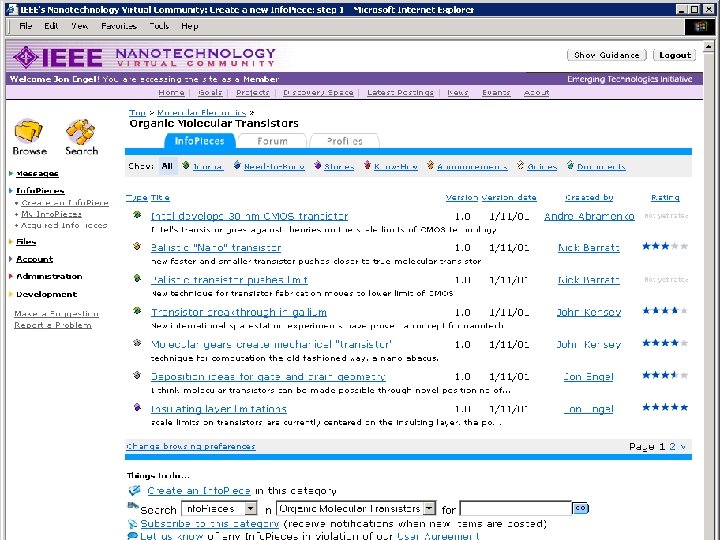
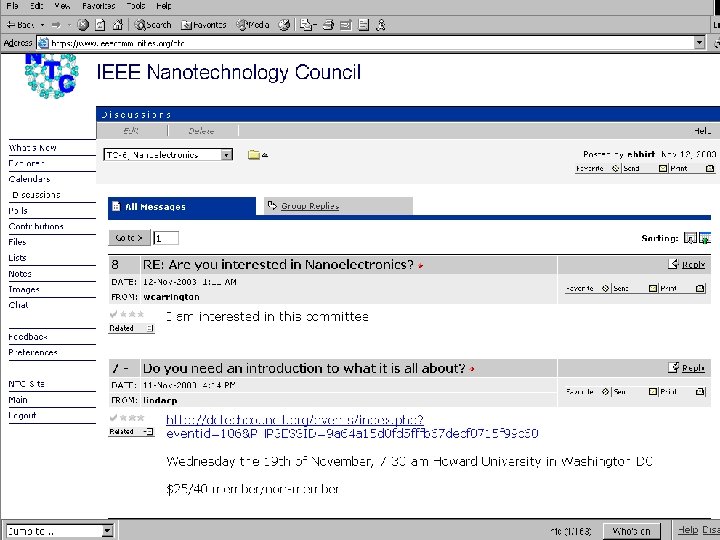
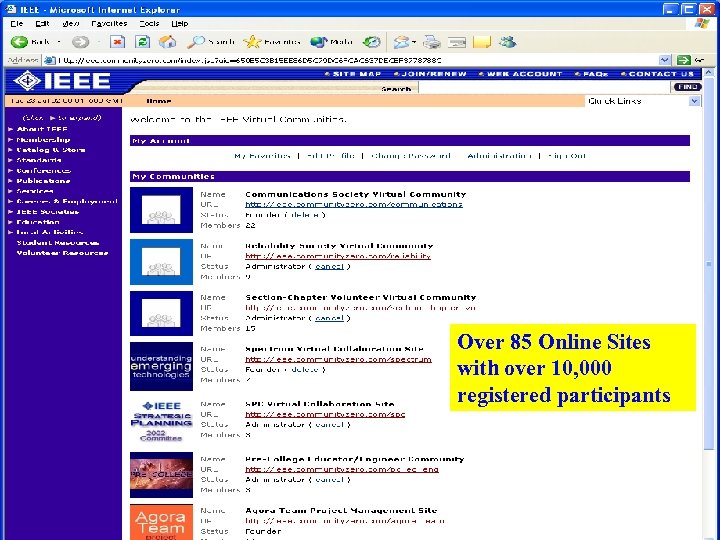
Over 85 Online Sites with over 10, 000 registered participants
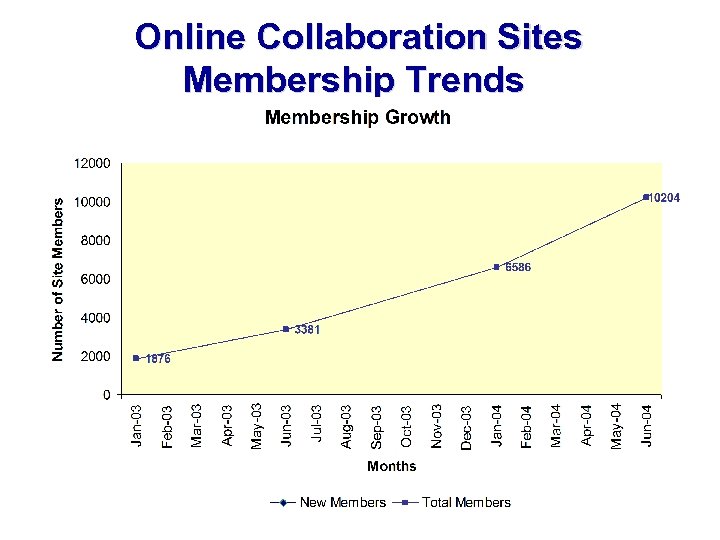
Online Collaboration Sites Membership Trends
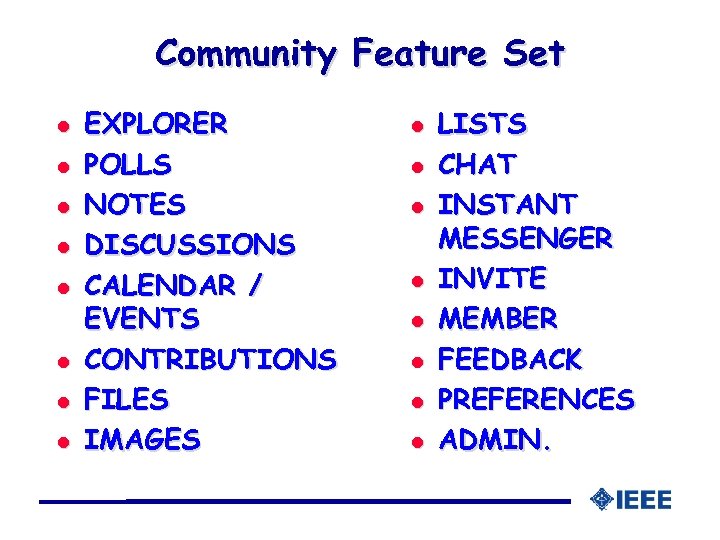
Community Feature Set l l l l EXPLORER POLLS NOTES DISCUSSIONS CALENDAR / EVENTS CONTRIBUTIONS FILES IMAGES l l l l LISTS CHAT INSTANT MESSENGER INVITE MEMBER FEEDBACK PREFERENCES ADMIN.
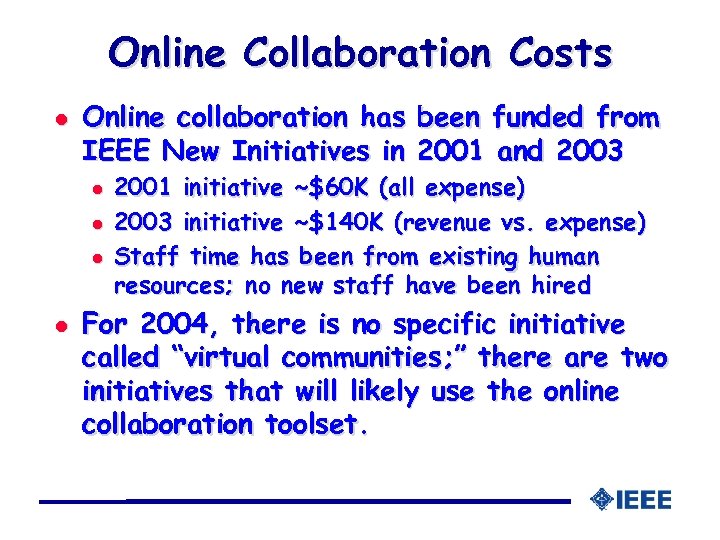
Online Collaboration Costs l Online collaboration has been funded from IEEE New Initiatives in 2001 and 2003 l l 2001 initiative ~$60 K (all expense) 2003 initiative ~$140 K (revenue vs. expense) Staff time has been from existing human resources; no new staff have been hired For 2004, there is no specific initiative called “virtual communities; ” there are two initiatives that will likely use the online collaboration toolset.
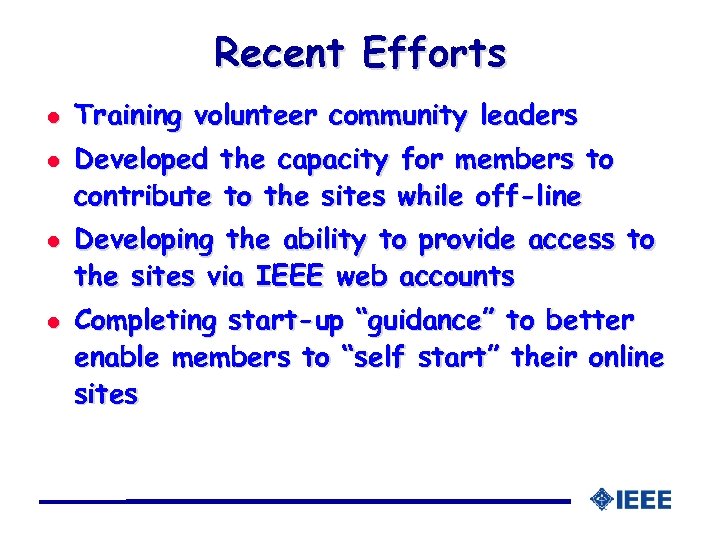
Recent Efforts l l Training volunteer community leaders Developed the capacity for members to contribute to the sites while off-line Developing the ability to provide access to the sites via IEEE web accounts Completing start-up “guidance” to better enable members to “self start” their online sites
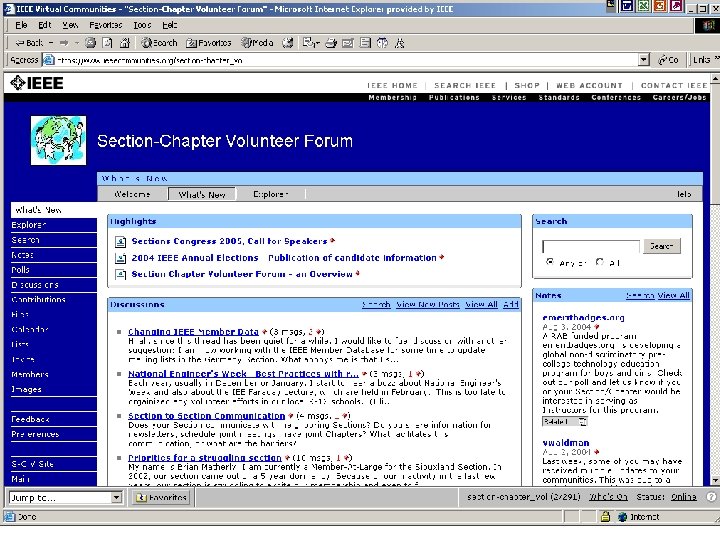
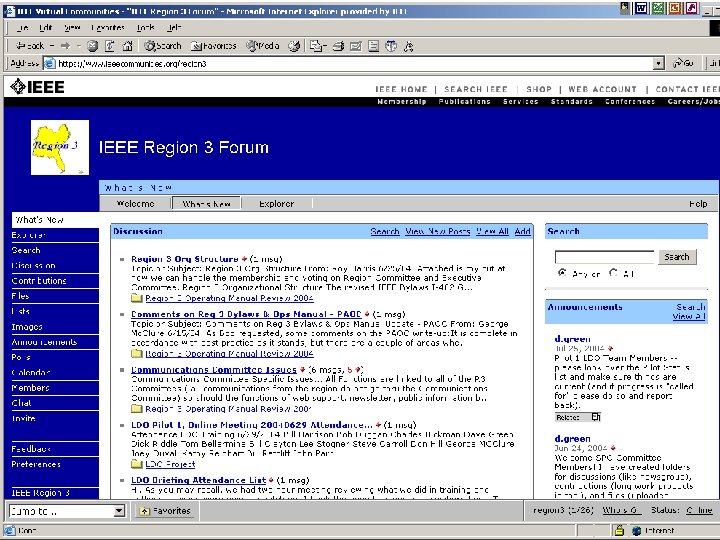
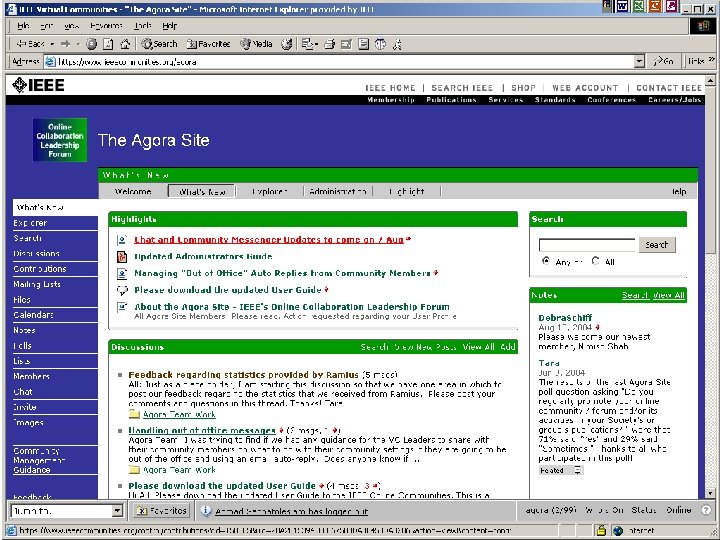
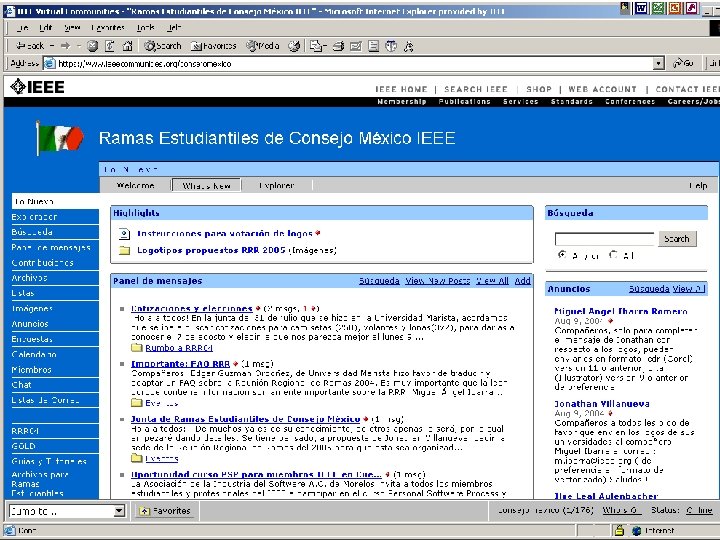
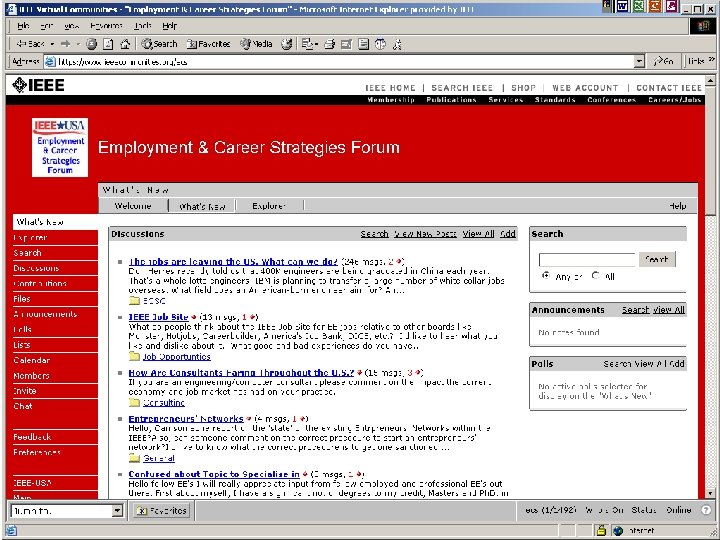
Takeaways l One big R&D experiment l We provide a toolset l We recruit and rely on volunteer “pioneers” l We provide encouragement l l We document everything we do to enable our ability to share/replicate the experience We enable, communicate, and nurture
Takeaways l We’re seeing evidence that online collaboration is l Enabling the voice of the member l Leveraging member expertise l l Appeals to the next generation of IEEE members Understanding the use and value of online collaboration is important to IEEE’s future
The tool is under constant review l l l The current tool is stable, but not perfect Alternatives are available RAB Initiative to consider making communities available as a member benefit which would create wider-scale usage of tool Currently evaluating Fusion Productions and Yahoo! Once user options are assessed, analysis of technology options and provider proposals will occur

Thank you. Questions/Comments


Comments on IEEE Virtual Communities David Green IEEE Board of Director’s Caucus Seattle, WA 14 November 2003
Overview l l Need for (Asynchronous) Electronic Communication IEEE’s Virtual Communities (Tool Set)
Perspective l My use -- electronic collaboration l l l with my projects across the University, l l with my students, with IEEE in Region 3 and elsewhere Small groups 5 -70 people No claim that Electronic Communication much less virtual communities is the solution to all problems
Need for Electronic Communication l Collaborate l Share l Avoid Travel Costs l $ spent by IEEE l Time (and $) spent by volunteer
Why is Async necessary l l Asynchronous -> not all parties “on-line” at the same time Resolution of schedule issues often exceed benefit of synchronous activity l Geographical issues l Participant availability issues l Reflection is good, is needed l Writing (is often) harder than reading
Why E-mail is not enough l Positives: l l Membership of discussion changes l l l Hard to “catch up” Hard to “ignore then retrieve” “Large” messages (replies, …) l l Push, “One-stop”, Disconnected Operation, Cross platform (note mail’s push is really “one-stop pull” for most people) Fails to deliver the whole story when multiple parties reply in non-workflow manner Mining information becomes difficult due to size Many mail tools mangle the older messages Archival
Why Web Posting is not enough l l Positives: Cross Platform, Broadcast, Mechanisms for Structure Traditional web posting by multiple parities has difficulties and significant tool set or training/practice issues Generally awkward for collaboration without someone taking the role of editor (webmaster) Pull (by itself)
Other Async Tools l l Newsgroups, Wiki-webs, Blogs Each tool has use, benefit, standardized protocol, etc. but significant start up costs for many volunteers All are pull (by themselves) These solutions plus one’s work solutions generate significant monitoring issues (multi -pull)
Experience with VCs l Virtual Communities l l l New Initiatives Committee Region 3 (projects) Section Chapter Support Agora Site IEEE-USA Employment Assistance The success of these groups (and the other tools tried by Region 3) is based more on the commitment to the topic, commitment to the methodology of the tool, and the willingness to survive the learning the tool than the tool
Features for Effective Electronic Collaboration l Next slide: features, VC Support l l VCs are a “work in progress”, usage and participation provides basis for future generations of tools Focus on asynchronous features Grade is my opinion based on my usage developed for this presentation not yet fed back through the process Tough balance to achieve (performance versus cross platform)
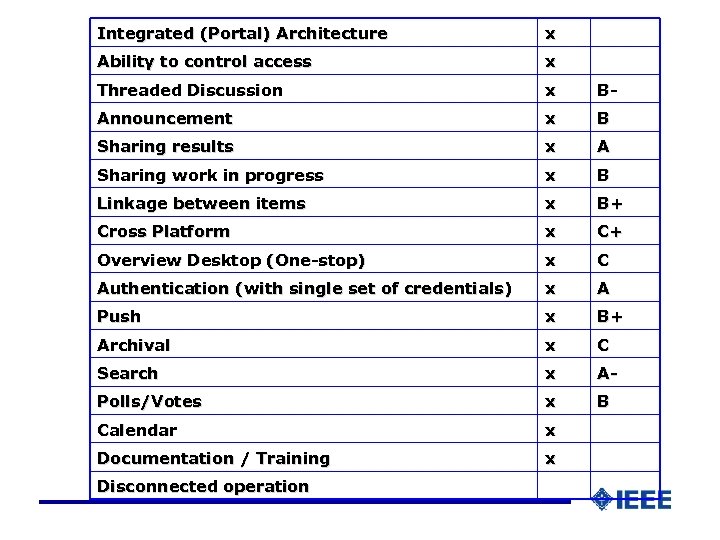
Integrated (Portal) Architecture x Ability to control access x Threaded Discussion x B- Announcement x B Sharing results x A Sharing work in progress x B Linkage between items x B+ Cross Platform x C+ Overview Desktop (One-stop) x C Authentication (with single set of credentials) x A Push x B+ Archival x C Search x A- Polls/Votes x B Calendar x Documentation / Training x Disconnected operation
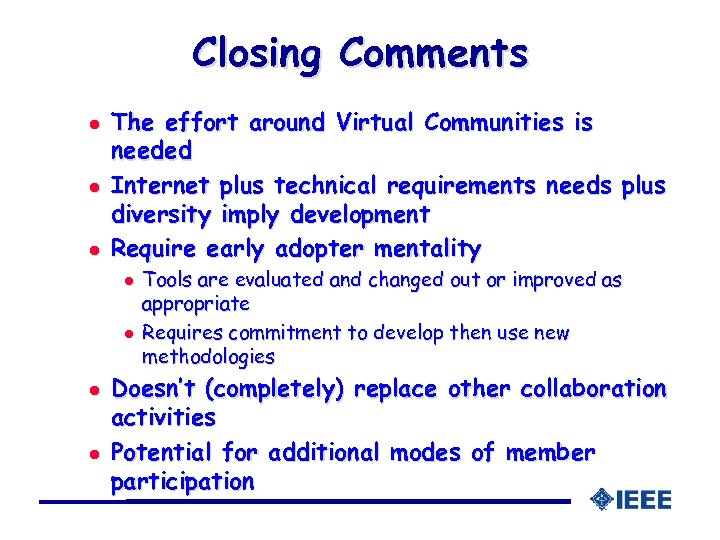
Closing Comments l l l The effort around Virtual Communities is needed Internet plus technical requirements needs plus diversity imply development Require early adopter mentality l l Tools are evaluated and changed out or improved as appropriate Requires commitment to develop then use new methodologies Doesn’t (completely) replace other collaboration activities Potential for additional modes of member participation
Скачать презентацию ITSC Virtual Community Discussion Jim Isaak Matt Loeb
88bf9590bdf47b4e36531083393e4ef3.ppt