


 Скачать презентацию ITS Now and the Future Shelley Row Director
79aad9da59af16724cff78bbf74cb129.ppt
- Количество слайдов: 41
 ITS: Now and the Future Shelley Row Director, ITS Joint Program Office Research and Innovative Technology Administration U. S. Department of Transportation January 14, 2008 Transportation Research Board 87 th Annual Meeting
 What to Expect in 2008 • Current Program: A year of research results • Future Program: A strategic vision and action plan 2
 Current Program: A Year of Research Results Clarus – 8 states and 3 Canadian provinces have integrated their road weather data into a nationally available system – 3 multi-state teams have drafted Concepts of Operation that define Clarus-based applications – Regional demonstrations to build these applications are starting in ‘ 08 – Innovations: • Most advanced quality checking of road weather (pavementspecific) observations ever • Demonstrating international data exchange and shared development of road weather information systems 3
 Current Program: A Year of Research Results • Electronic Freight Management – Developed and evaluated an open architecture information exchange to improve cargo visibility and the efficiency of a truck-air-truck supply chain. – Six month operational test with an active supply chain was conducted May - Dec. ‘ 07 – Early results: • Reduced freight forwarder time to prepare transportation status by 4 hours per day each (>75%) • Improved data accuracy at container freight station by at least 12% • Eliminated manual data entry and re-keying errors • Validated information exchange protocols / standards – Ready to advance industry adoption 4
 Current Program: A Year of Research Results Integrated Corridor Management – Pioneer sites completed concepts of operation – Finishing requirements documents – Up to three sites selected for analysis, modeling and simulation of ICM in Summer ‘ 08 – Modeling Innovations: • Combine macro-, meso- and micro-scopic modeling to conduct full multimodal corridor modeling addressing interacting effects of – Transit service enhancements – Responses to traveler information – Tolling, HOT lanes, and congestion pricing – Varying corridor conditions: weather, incident patterns, demand 5
 Current Program: A Year of Research Results Integrated Vehicle-Based Safety Systems – Prototype testing for Phase I is nearing completion – Expect to initiate Phase II including field testing for light and heavy vehicle platforms Spring ’ 08 – Fall ’ 08: Initiate light & heavy vehicle full-scale Field Operational Tests (FOT) – Test Innovations: • Multiple warning systems integrated into a vehicle • Arbitration between warning systems • FOTs to assess real-world system effectiveness 6
 Current Program: A Year of Research Results Maintenance Decision Support System – Version 5. 0: incorporates radar and satellite images, updates the road temperature model, and generates alerts to predicted problems – Moved from a research project to a market ready technology – Innovations: • First program to convert weather forecasts into a transportation decision tool • Integrated AVL data into MDSS for tactical tool and strategic use 7
 Current Program: A Year of Research Results Mobility Services for All Americans – Phase I sites design development in Summer ‘ 08 – Two sites selected for field testing to begin in ‘ 08 – Test Innovations: • Electronically connected human services transportation network • Optimizing human services transportation providers for efficient service • Single point of contact for the customer – Multi-modal trip planner: First door-to-door multimodal regional trip planner 8
 Current Program: A Year of Research Results Next Generation 911 – Concept of Operations, Requirements and Architecture documents completed in ’ 07 – Proof of Concept: combination Lab / Live PSAP testing of selected components of the NG 911 architecture (Spring 2008) – Test Innovations: • Ability to place 911 “calls” to PSAPs via text message • Ability to transmit telematics data directly to PSAPs • Ability to interconnect individual PSAP networks 9
 Current Program: A Year of Research Results Vehicle Infrastructure Integration – Safe Trip 21: demo in November ‘ 08 – Proof of concept test underway in MI and CA • Innovations: – Most extensive DSRC/WAVE protocol test bed to date (56 RSEs) – Prioritization of radio channel access for safety (while also supporting other applications) – Multi-channel DSRC radios use entire 75 MHz DSRC bandwidth to assure capacity; Supports many vehicles and many services – System supports wide diversity of applications with single radio - Local safety systems, network services, V 2 V, Probe Data, Advisories, etc – Groundbreaking method to maintain privacy & anonymity while ensuring legitimacy of messages & data – Common vehicle data interface across vehicle OEMs – Applications development starting with stakeholder discussions 10 – New public web site: http: //www. vehicle-infrastructure. org/
 Current Program: A Year of Research Results ITS Standards Program – SAFETEA-LU Section 5307, Part 4 directed ITS Standards Expert Panel – TRB Published June 18, 2007 Report Recommendation: • “Articulate a strategic vision of the role of standards in furthering the development and use of ITS and define USDOT’s role in realizing this vision. ” – JPO developing Standards Program Strategic Plan • Process defined by March ’ 08, plan complete Fall ’ 08 • Will engage relevant stakeholders in process 11
 Current Program: A Year of Research Results Professional Capacity Building – New look at workforce development, education and training – Engage associations and universities in discussion to leverage and coordinate all resources 12
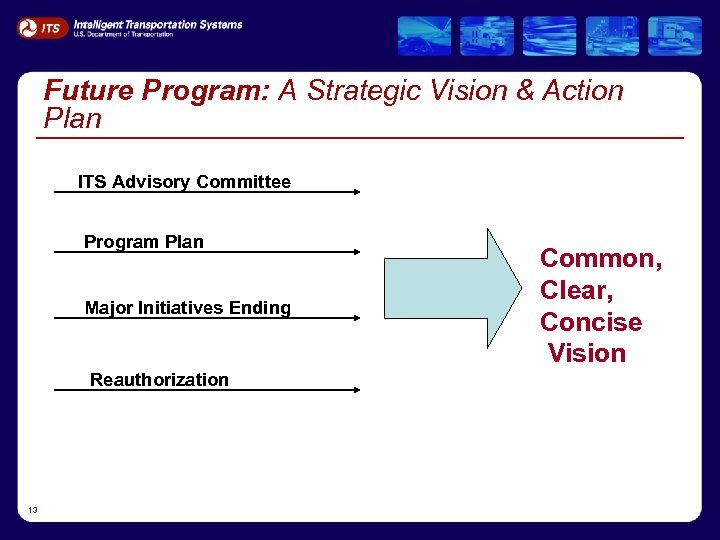 Future Program: A Strategic Vision & Action Plan ITS Advisory Committee Program Plan Major Initiatives Ending Reauthorization 13 Common, Clear, Concise Vision
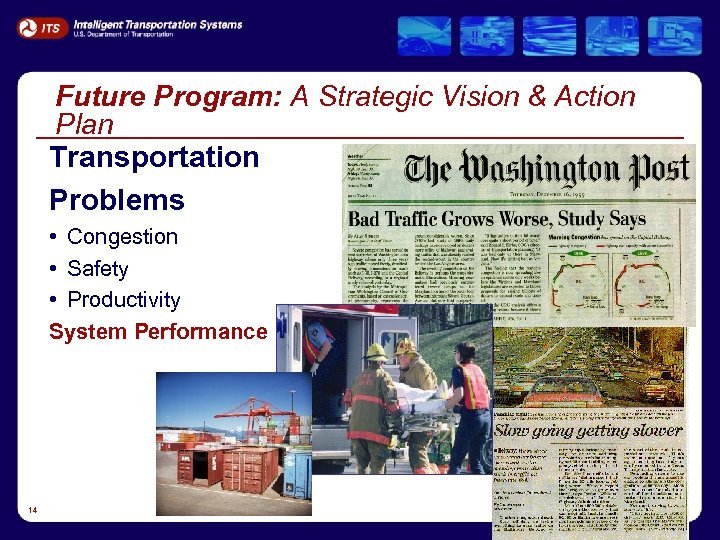 Future Program: A Strategic Vision & Action Plan Transportation Problems • Congestion • Safety • Productivity System Performance 14
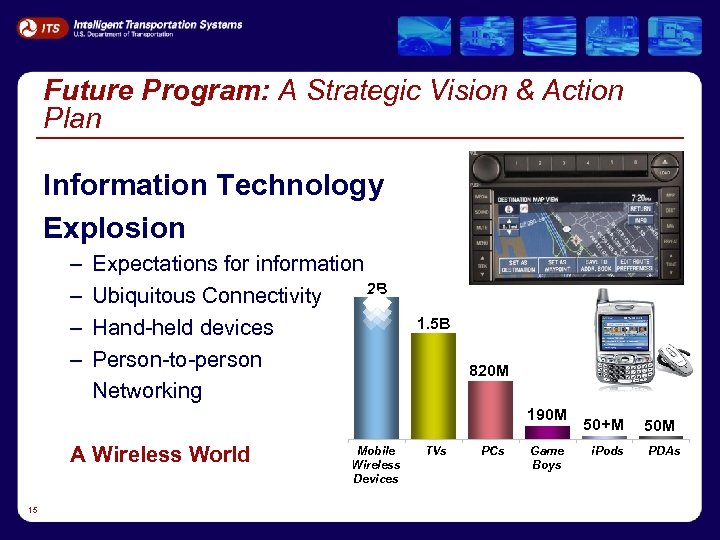 Future Program: A Strategic Vision & Action Plan Information Technology Explosion – – Expectations for information 2 B Ubiquitous Connectivity Hand-held devices Person-to-person Networking 1. 5 B 820 M 190 M A Wireless World 15 Mobile Wireless Devices TVs PCs Game Boys 50+M i. Pods 50 M PDAs
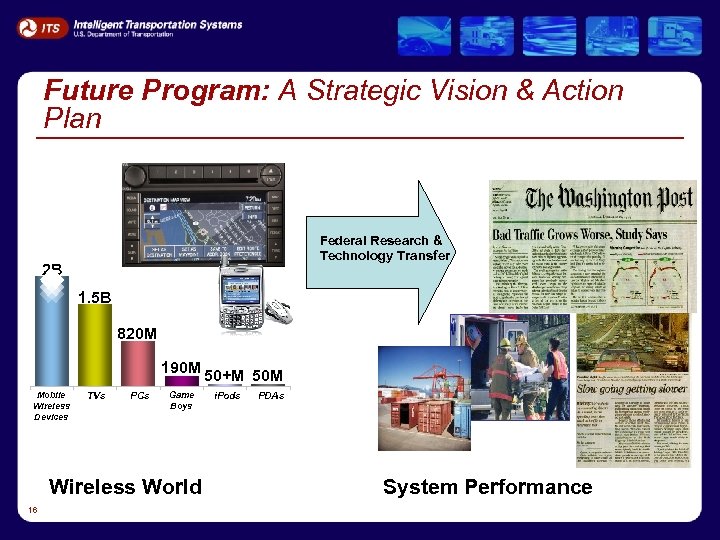 Future Program: A Strategic Vision & Action Plan Federal Research & Technology Transfer 2 B 1. 5 B 820 M 190 M 50+M Mobile Wireless Devices TVs PCs Game Boys Wireless World 16 i. Pods 50 M PDAs System Performance
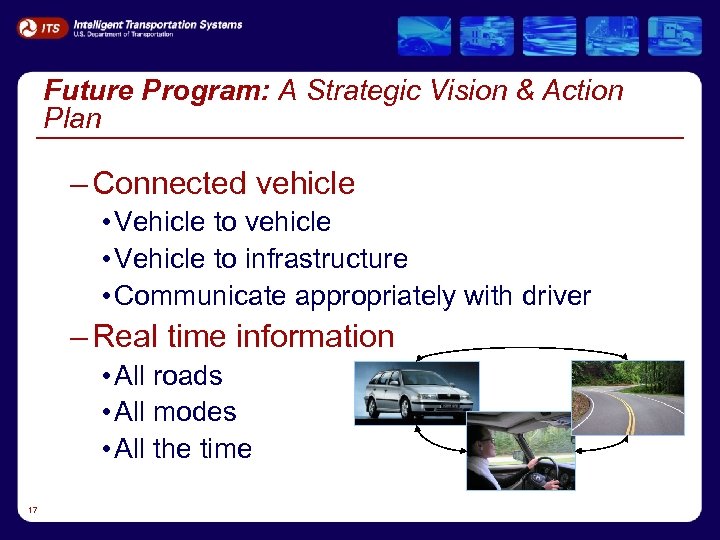 Future Program: A Strategic Vision & Action Plan – Connected vehicle • Vehicle to infrastructure • Communicate appropriately with driver – Real time information • All roads • All modes • All the time 17
 Future Program: A Strategic Vision & Action Plan Observations: Public Sector • General acceptance of technology in transportation – ITS use has grown: TIM, signals, freeway mgt, transit mgt, toll collection, CVISN – ITS investment is slow; – Constrained resources • Growth in public/private partnerships • Growth in tolling & pricing – Data limitations (extent and quality) limit value – Looking for new models for data acquisition 18
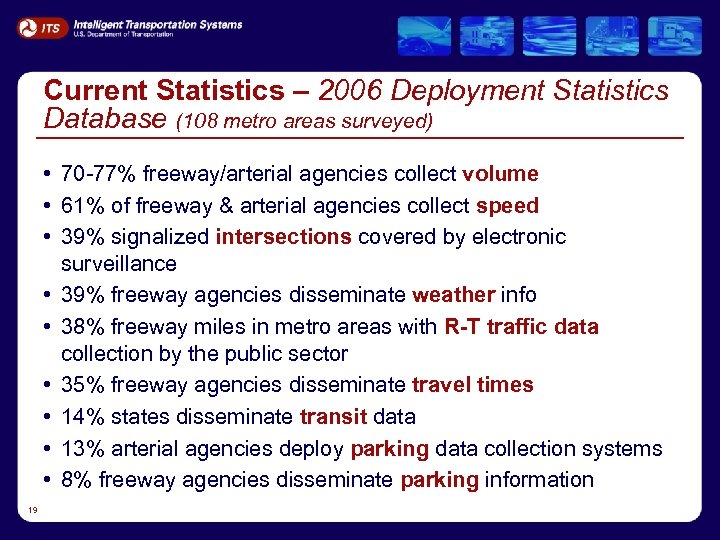 Current Statistics – 2006 Deployment Statistics Database (108 metro areas surveyed) • 70 -77% freeway/arterial agencies collect volume • 61% of freeway & arterial agencies collect speed • 39% signalized intersections covered by electronic surveillance • 39% freeway agencies disseminate weather info • 38% freeway miles in metro areas with R-T traffic data collection by the public sector • 35% freeway agencies disseminate travel times • 14% states disseminate transit data • 13% arterial agencies deploy parking data collection systems • 8% freeway agencies disseminate parking information 19
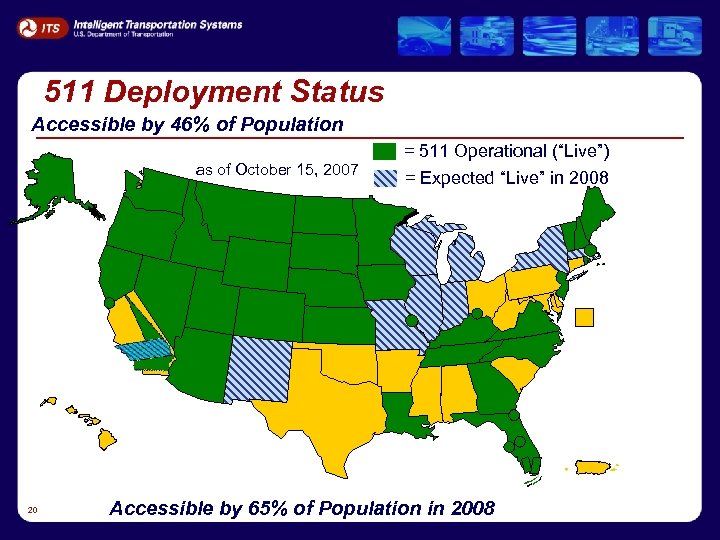 511 Deployment Status Accessible by 46% of Population as of October 15, 2007 = 511 Operational (“Live”) = Expected “Live” in 2008 D. C. 20 Accessible by 65% of Population in 2008
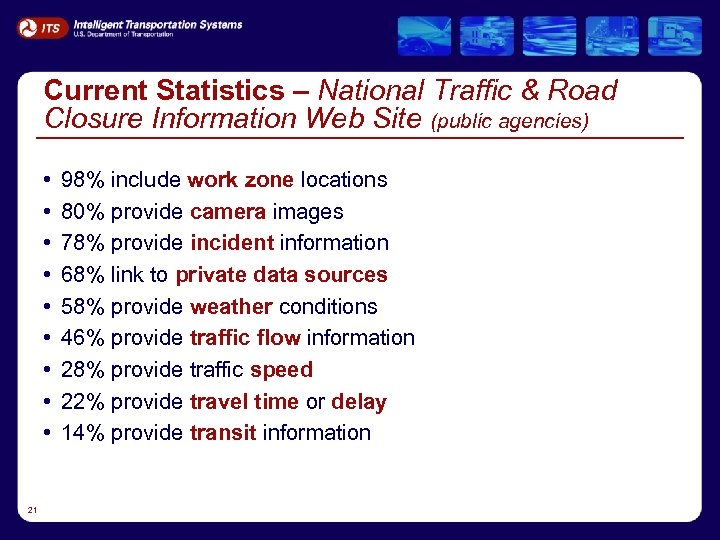 Current Statistics – National Traffic & Road Closure Information Web Site (public agencies) • • • 21 98% include work zone locations 80% provide camera images 78% provide incident information 68% link to private data sources 58% provide weather conditions 46% provide traffic flow information 28% provide traffic speed 22% provide travel time or delay 14% provide transit information
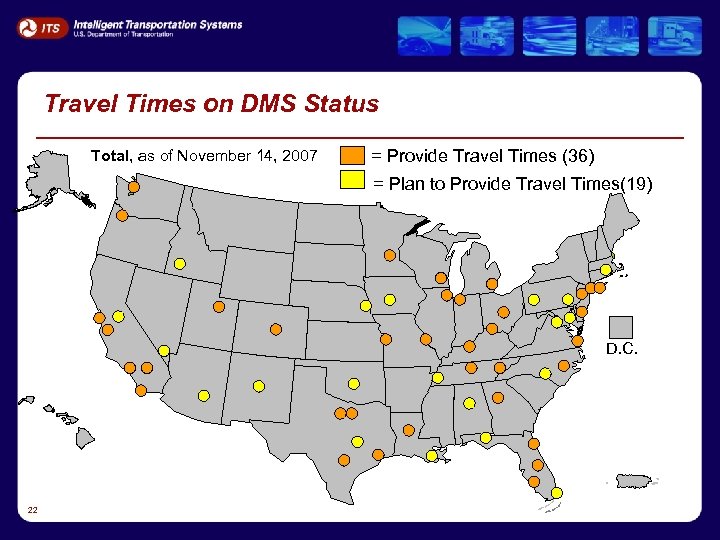 Travel Times on DMS Status Total, as of November 14, 2007 = Provide Travel Times (36) = Plan to Provide Travel Times(19) D. C. 22
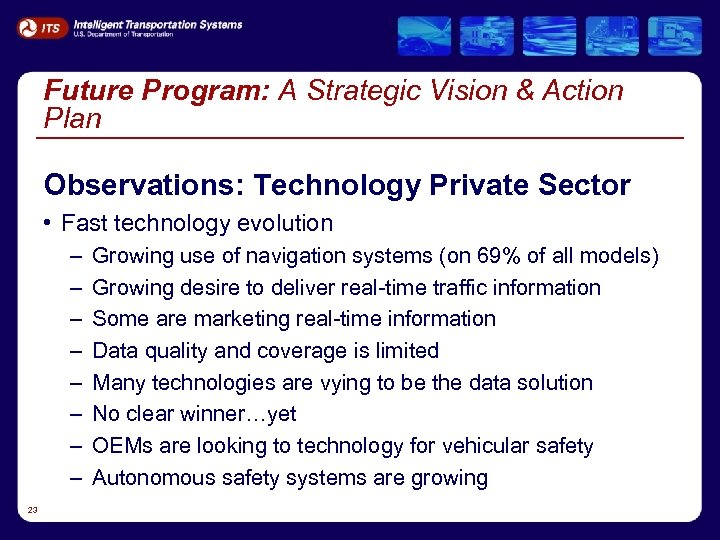 Future Program: A Strategic Vision & Action Plan Observations: Technology Private Sector • Fast technology evolution – – – – 23 Growing use of navigation systems (on 69% of all models) Growing desire to deliver real-time traffic information Some are marketing real-time information Data quality and coverage is limited Many technologies are vying to be the data solution No clear winner…yet OEMs are looking to technology for vehicular safety Autonomous safety systems are growing
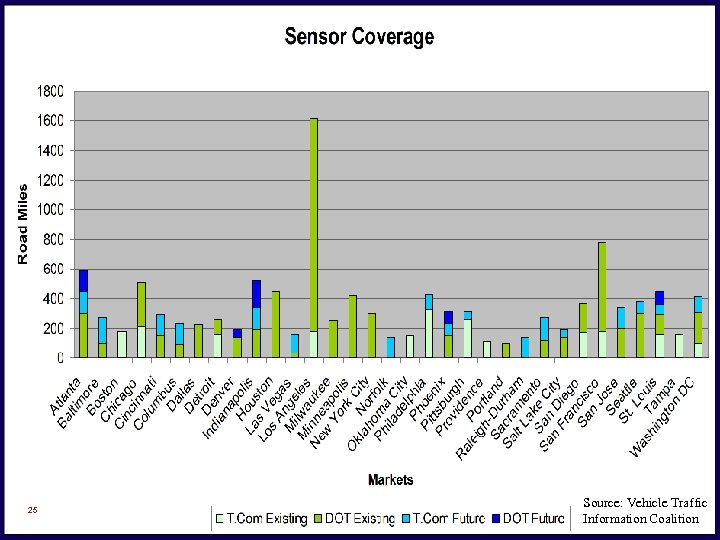
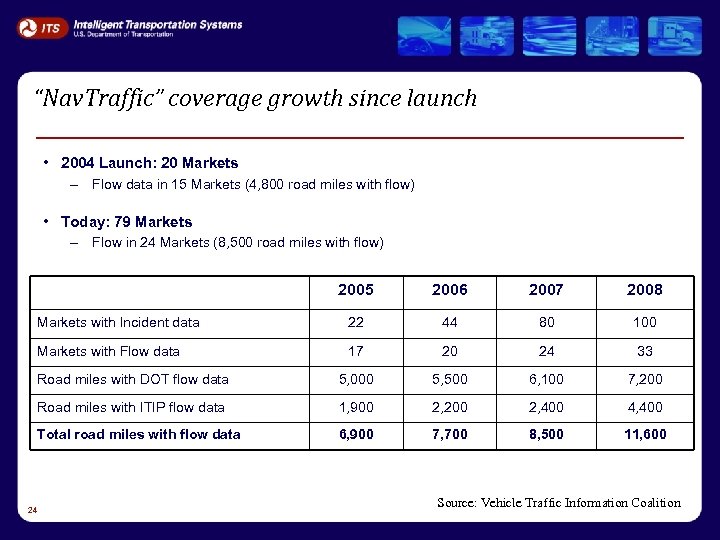 “Nav. Traffic” coverage growth since launch • 2004 Launch: 20 Markets – Flow data in 15 Markets (4, 800 road miles with flow) • Today: 79 Markets – Flow in 24 Markets (8, 500 road miles with flow) 2005 2006 2007 2008 Markets with Incident data 22 44 80 100 Markets with Flow data 17 20 24 33 Road miles with DOT flow data 5, 000 5, 500 6, 100 7, 200 Road miles with ITIP flow data 1, 900 2, 200 2, 400 4, 400 Total road miles with flow data 6, 900 7, 700 8, 500 11, 600 24 Source: Vehicle Traffic Information Coalition
 25 Source: Vehicle Traffic Information Coalition
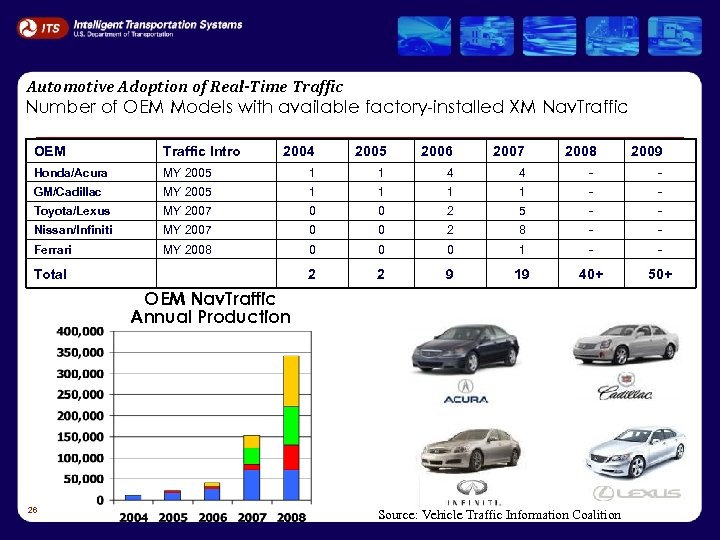 Automotive Adoption of Real-Time Traffic Number of OEM Models with available factory-installed XM Nav. Traffic OEM Traffic Intro 2004 2005 2006 2007 2008 2009 Honda/Acura MY 2005 1 1 4 4 - - GM/Cadillac MY 2005 1 1 - - Toyota/Lexus MY 2007 0 0 2 5 - - Nissan/Infiniti MY 2007 0 0 2 8 - - Ferrari MY 2008 0 0 0 1 - - 2 2 9 19 40+ 50+ Total OEM Nav. Traffic Annual Production 26 Source: Vehicle Traffic Information Coalition
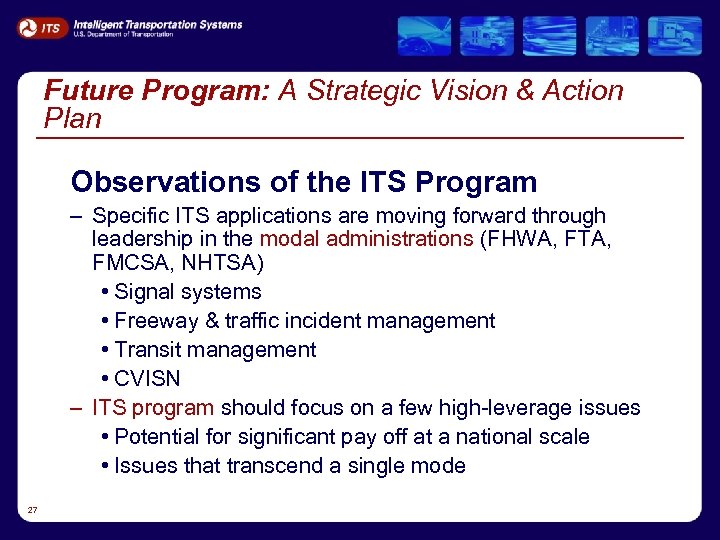 Future Program: A Strategic Vision & Action Plan Observations of the ITS Program – Specific ITS applications are moving forward through leadership in the modal administrations (FHWA, FTA, FMCSA, NHTSA) • Signal systems • Freeway & traffic incident management • Transit management • CVISN – ITS program should focus on a few high-leverage issues • Potential for significant pay off at a national scale • Issues that transcend a single mode 27
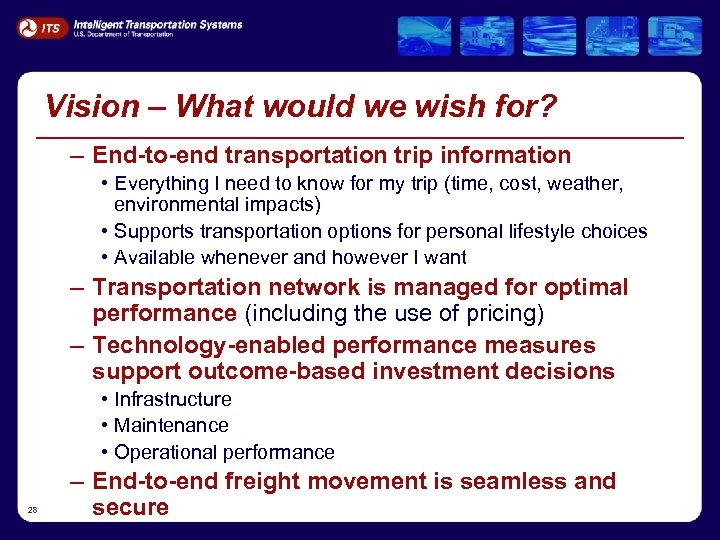 Vision – What would we wish for? – End-to-end transportation trip information • Everything I need to know for my trip (time, cost, weather, environmental impacts) • Supports transportation options for personal lifestyle choices • Available whenever and however I want – Transportation network is managed for optimal performance (including the use of pricing) – Technology-enabled performance measures support outcome-based investment decisions • Infrastructure • Maintenance • Operational performance 28 – End-to-end freight movement is seamless and secure
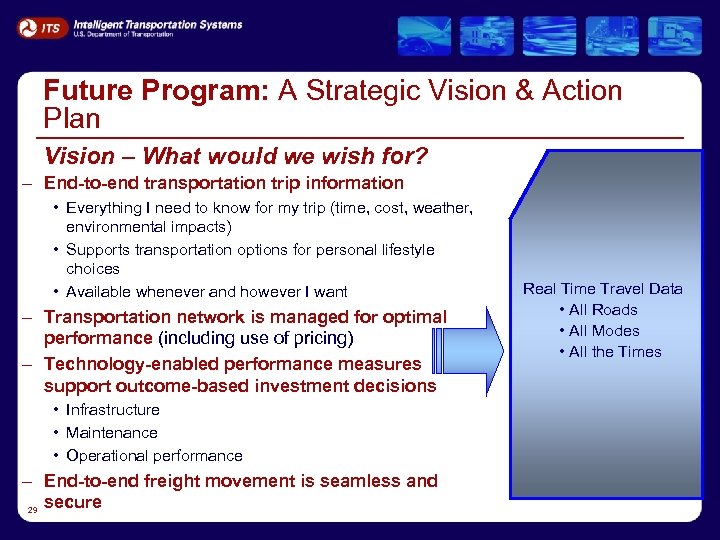 Future Program: A Strategic Vision & Action Plan Vision – What would we wish for? – End-to-end transportation trip information • Everything I need to know for my trip (time, cost, weather, environmental impacts) • Supports transportation options for personal lifestyle choices • Available whenever and however I want – Transportation network is managed for optimal performance (including use of pricing) – Technology-enabled performance measures support outcome-based investment decisions • Infrastructure • Maintenance • Operational performance – End-to-end freight movement is seamless and secure 29 Real Time Travel Data • All Roads • All Modes • All the Times
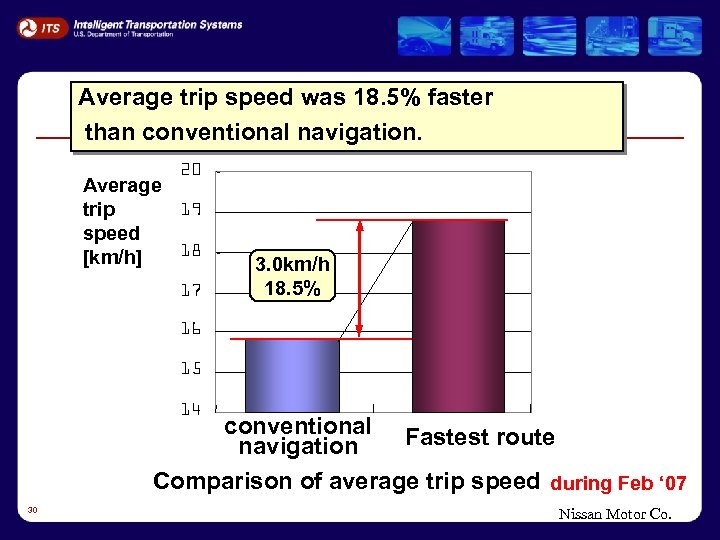 Average trip speed was 18. 5% faster than conventional navigation. 20 Average 19 trip speed 18 [km/h] 17 3. 0 km/h 18. 5% 16 15 14 conventional Fastest route navigation Comparison of average trip speed during Feb ‘ 07 30 Nissan Motor Co.
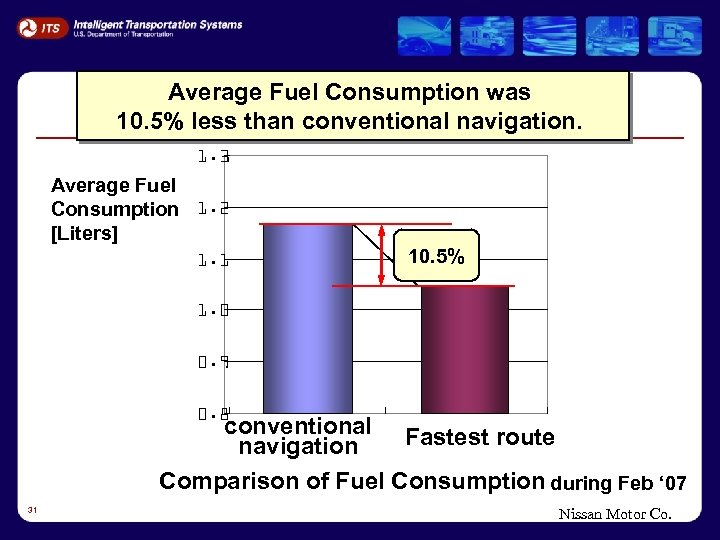 Average Fuel Consumption was 10. 5% less than conventional navigation. 1. 3 Average Fuel Consumption 1. 2 [Liters] 1. 1 10. 5% 1. 0 0. 9 0. 8 conventional Fastest route navigation Comparison of Fuel Consumption during Feb ‘ 07 31 Nissan Motor Co.
 Vision – What would we wish for? – Vehicles can “see” what’s happening around them and communicate appropriately with drivers • Vehicles are wrapped in information • Everyone has technology-enabled safety in their vehicles • Information is communicated to drivers appropriately – Technology in transportation reduces negative impact on the environment (air quality & fuel consumption) • Improved system performance • Improved driver decision-making 32
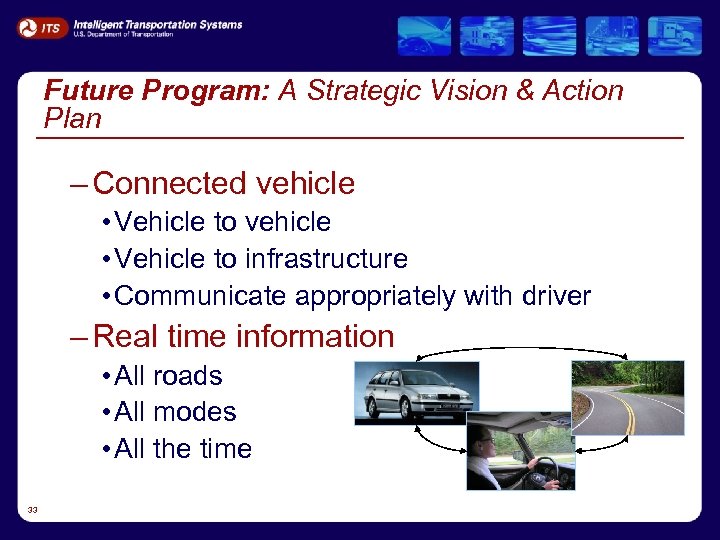 Future Program: A Strategic Vision & Action Plan – Connected vehicle • Vehicle to infrastructure • Communicate appropriately with driver – Real time information • All roads • All modes • All the time 33
 Future Program: A Strategic Vision & Action Plan • Reconceive public and private roles and responsibilities • Understand the benefits – – Safety Mobility Productivity Environmental • Look to the next generation technology solutions • Leverage worldwide research 34
 Mission & Goal Areas • JPO’s mission is to lead the creation of information and communications technology solutions to achieve the best performing surface transportation system in the world. • Goal Areas – Safety – Mobility – Environment – 21 st Century Institutions and Partnerships 35
 Goal: Safety Theme: Prevent fatalities and injuries on the surface transportation network • Connected Vehicle – Create capability for all vehicles to have 360 degree awareness of hazards, and communicate appropriately with drivers 36
 Goal: Mobility Theme: Improve network performance for movement of people and goods • Realize complete transportation system visibility – Real Time data on all roads, all modes, all the time • Enable performance measurement across the transportation system • Catalyze the development of applications to optimize network performance • Enable delivery of end-to-end transportation information for trip planning (personal & business) 37
 Goal: Environment/Energy Theme: Minimize impact of surface transportation on the environment by reducing the carbon footprint and increasing fuel efficiency • Conduct research to understand relationship between technology-enabled congestion reduction and environmental impacts (carbon footprint & fuel efficiency) • Conduct research to understand the relationship of the combined impacts of safety, mobility, and environment on the transportation system 38
 Goal: 21 st Century Institutions and Partnerships Theme: Foster new institutional relationships to enable better use of technologies in transportation • Research new public-private partnerships to improve the use of ITS technologies in transportation • Examine innovative financing models to foster use of ITS technologies in transportation • Identify and research solutions to address institutional barriers in the use of ITS technologies in transportation 39
 Future Program: A Strategic Vision & Action Plan Next Steps • • • Comments on mission and goal areas Refine and narrow goal areas Clarify Federal role Develop metrics for each goal Develop an action plan Publish the updated Program Plan – Update on current program status – New section on the Strategic Vision and Action Plan 40
 What to Expect in 2008 • Current Program: A year of research results • Future Program: A strategic vision and action plan – Connected vehicle • Vehicle to infrastructure • Communicate appropriately with driver – Real time information • All roads • All modes • All the time Your thoughts and comments are welcomed 41