


 Скачать презентацию ITS e Primer Module 8 Electronic Toll Collection
dff8c6ecb798d0b844c6d89272068a44.ppt
- Количество слайдов: 40
 ITS e. Primer Module 8: Electronic Toll Collection, Electronic Payment Systems, and Pricing March 2016 ITS Professional Capacity Building Program ITS Joint Program Office U. S. Department of Transportation
 Instructor Bob Mc. Queen, CEng, MICE CEO Bob Mc. Queen and Associates Inc. Orlando, FL, USA U. S. Department of Transportation 2
 Learning Objectives § Understand the basic terminology of electronic payment systems applications and pricing strategies § Describe electronic payment technologies, applications, and strategies § Understand the application of electronic payment systems applications to transportation and Intelligent Transportation Systems and describe some challenges § Understand the approximate costs and benefits associated with electronic payment systems applications and pricing § Define the role of the private sector in electronic payment systems applications § Describe some implementation examples and lessons learned U. S. Department of Transportation 3
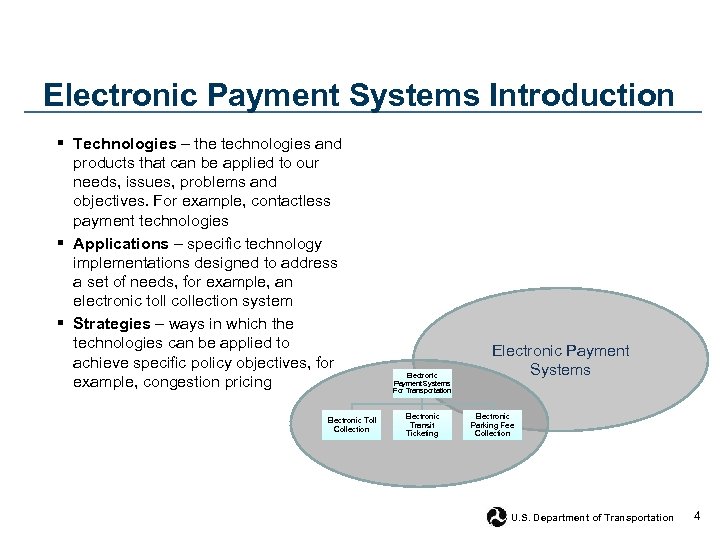 Electronic Payment Systems Introduction § Technologies – the technologies and products that can be applied to our needs, issues, problems and objectives. For example, contactless payment technologies § Applications – specific technology implementations designed to address a set of needs, for example, an electronic toll collection system § Strategies – ways in which the technologies can be applied to achieve specific policy objectives, for example, congestion pricing Electronic Toll Collection Electronic Payment Systems For Transportation Electronic Transit Ticketing Electronic Payment Systems Electronic Parking Fee Collection U. S. Department of Transportation 4
 SFPark San Francisco § The following link points to a video that provides an example of a smart car parking system being implemented in San Francisco § This shows how electronic payment systems can be applied to fee collection for parking within a wider congestion management context http: //sfpark. org/resources/sfpark-overview-video/ U. S. Department of Transportation 5
 Non-cash Transactions Worldwide § 260 billion on-cash transactions worldwide § Electronic payment techniques are growing in importance every year § The USA accounts for more than 40% of the total, with 104 billion transactions § Transportation electronic payment systems fit within this larger context and benefit from innovation and development from the wider market U. S. Department of Transportation 6
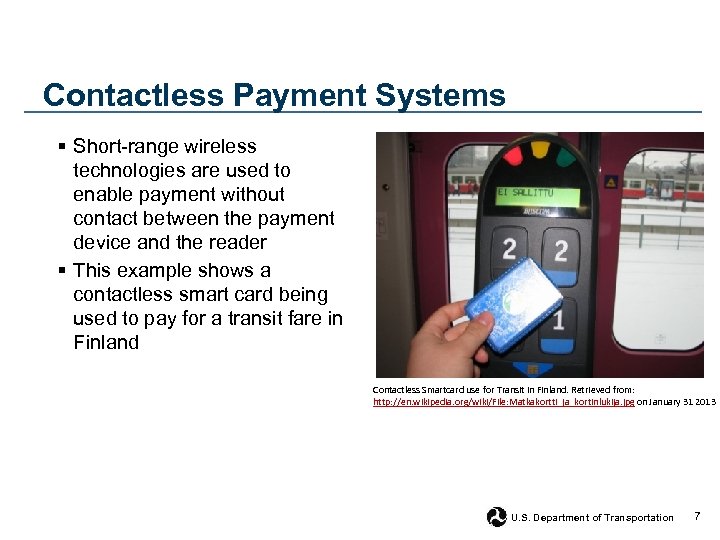 Contactless Payment Systems § Short-range wireless technologies are used to enable payment without contact between the payment device and the reader § This example shows a contactless smart card being used to pay for a transit fare in Finland Contactless Smartcard use for Transit in Finland. Retrieved from: http: //en. wikipedia. org/wiki/File: Matkakortti_ja_kortinlukija. jpg on January 31 2013 U. S. Department of Transportation 7
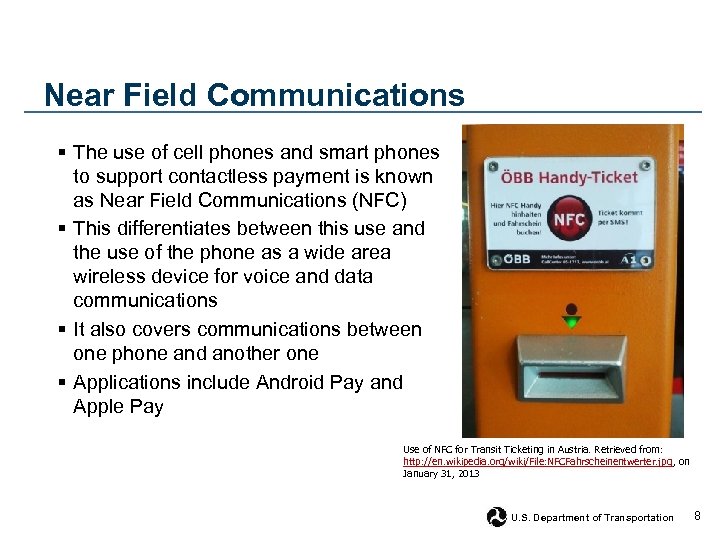 Near Field Communications § The use of cell phones and smart phones to support contactless payment is known as Near Field Communications (NFC) § This differentiates between this use and the use of the phone as a wide area wireless device for voice and data communications § It also covers communications between one phone and another one § Applications include Android Pay and Apple Pay Use of NFC for Transit Ticketing in Austria. Retrieved from: http: //en. wikipedia. org/wiki/File: NFCFahrscheinentwerter. jpg, on January 31, 2013 U. S. Department of Transportation 8
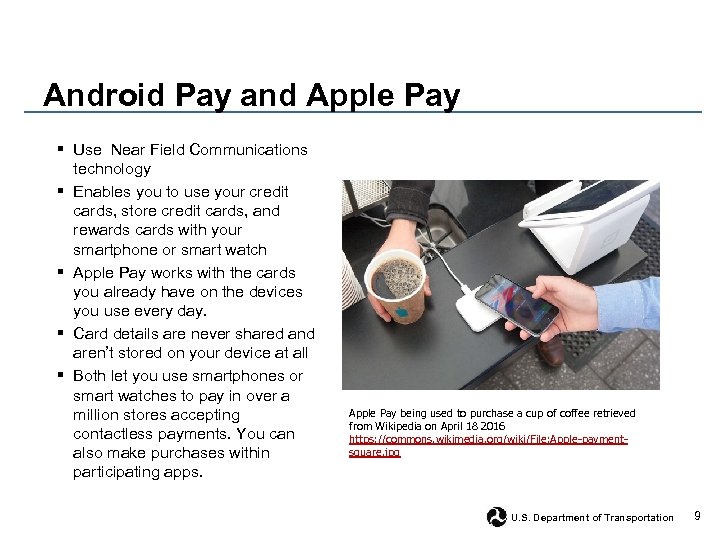 Android Pay and Apple Pay § Use Near Field Communications technology § Enables you to use your credit cards, store credit cards, and rewards cards with your smartphone or smart watch § Apple Pay works with the cards you already have on the devices you use every day. § Card details are never shared and aren’t stored on your device at all § Both let you use smartphones or smart watches to pay in over a million stores accepting contactless payments. You can also make purchases within participating apps. Apple Pay being used to purchase a cup of coffee retrieved from Wikipedia on April 18 2016 https: //commons. wikimedia. org/wiki/File: Apple-paymentsquare. jpg U. S. Department of Transportation 9
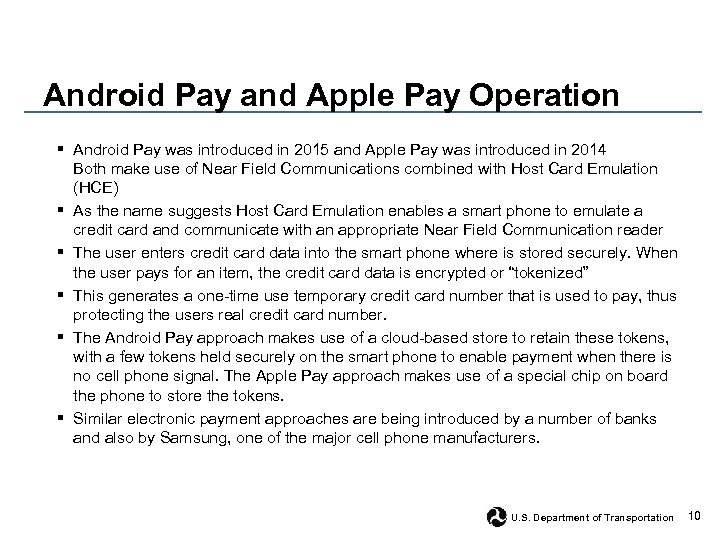 Android Pay and Apple Pay Operation § Android Pay was introduced in 2015 and Apple Pay was introduced in 2014 Both make use of Near Field Communications combined with Host Card Emulation (HCE) § As the name suggests Host Card Emulation enables a smart phone to emulate a credit card and communicate with an appropriate Near Field Communication reader § The user enters credit card data into the smart phone where is stored securely. When the user pays for an item, the credit card data is encrypted or “tokenized” § This generates a one-time use temporary credit card number that is used to pay, thus protecting the users real credit card number. § The Android Pay approach makes use of a cloud-based store to retain these tokens, with a few tokens held securely on the smart phone to enable payment when there is no cell phone signal. The Apple Pay approach makes use of a special chip on board the phone to store the tokens. § Similar electronic payment approaches are being introduced by a number of banks and also by Samsung, one of the major cell phone manufacturers. U. S. Department of Transportation 10
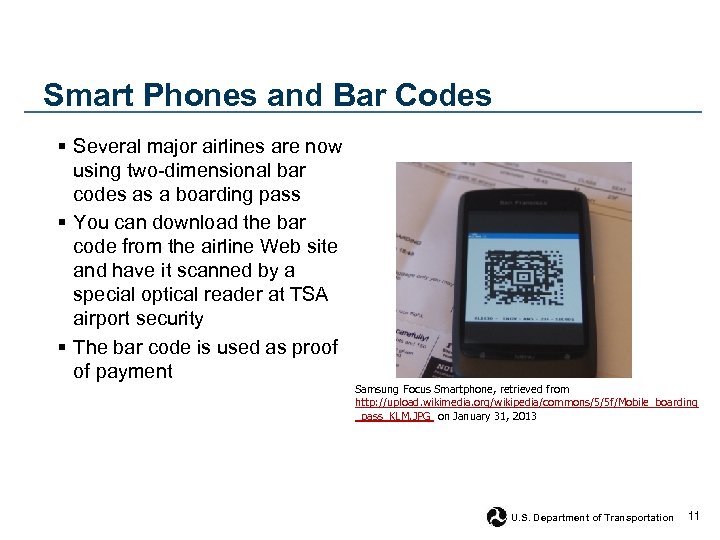 Smart Phones and Bar Codes § Several major airlines are now using two-dimensional bar codes as a boarding pass § You can download the bar code from the airline Web site and have it scanned by a special optical reader at TSA airport security § The bar code is used as proof of payment Samsung Focus Smartphone, retrieved from http: //upload. wikimedia. org/wikipedia/commons/5/5 f/Mobile_boarding _pass_KLM. JPG on January 31, 2013 U. S. Department of Transportation 11
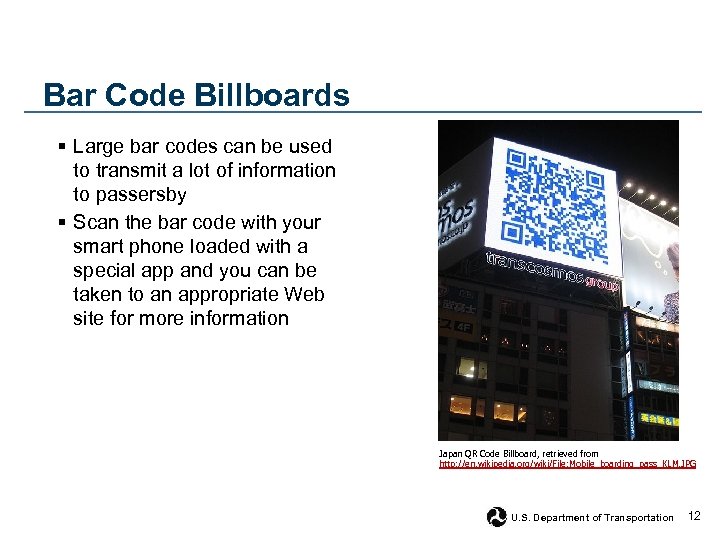 Bar Code Billboards § Large bar codes can be used to transmit a lot of information to passersby § Scan the bar code with your smart phone loaded with a special app and you can be taken to an appropriate Web site for more information Japan QR Code Billboard, retrieved from http: //en. wikipedia. org/wiki/File: Mobile_boarding_pass_KLM. JPG U. S. Department of Transportation 12
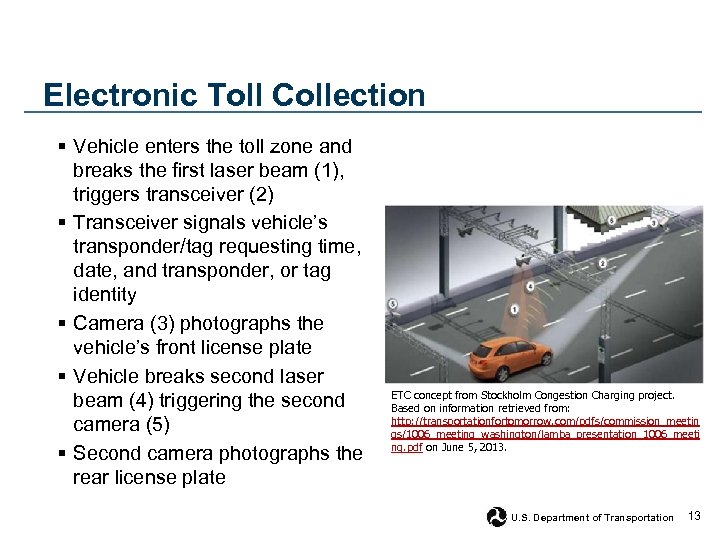 Electronic Toll Collection § Vehicle enters the toll zone and breaks the first laser beam (1), triggers transceiver (2) § Transceiver signals vehicle’s transponder/tag requesting time, date, and transponder, or tag identity § Camera (3) photographs the vehicle’s front license plate § Vehicle breaks second laser beam (4) triggering the second camera (5) § Second camera photographs the rear license plate ETC concept from Stockholm Congestion Charging project. Based on information retrieved from: http: //transportationfortomorrow. com/pdfs/commission_meetin gs/1006_meeting_washington/lamba_presentation_1006_meeti ng. pdf on June 5, 2013. U. S. Department of Transportation 13
 Audience Interaction § What is your opinion regarding open road tolling compared to all electronic toll collection? □ Should drivers be forced to use electronic means only, or should we always leave the opportunity to pay for cash at the roadside? □ Do the customer service benefits of accepting cash out weigh the cost of the cash collection? U. S. Department of Transportation 14
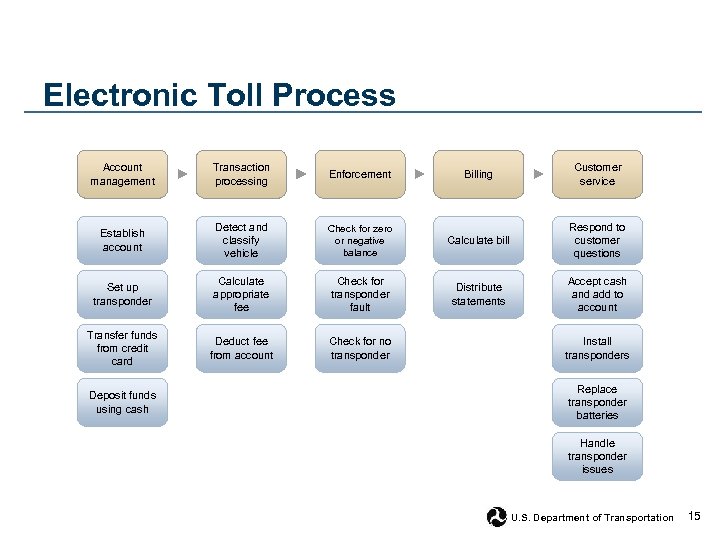 Electronic Toll Process Account management Transaction processing Enforcement Establish account Detect and classify vehicle Set up transponder Transfer funds from credit card Deposit funds using cash Billing Customer service Check for zero or negative balance Calculate bill Respond to customer questions Calculate appropriate fee Check for transponder fault Distribute statements Accept cash and add to account Deduct fee from account Check for no transponder Install transponders Replace transponder batteries Handle transponder issues U. S. Department of Transportation 15
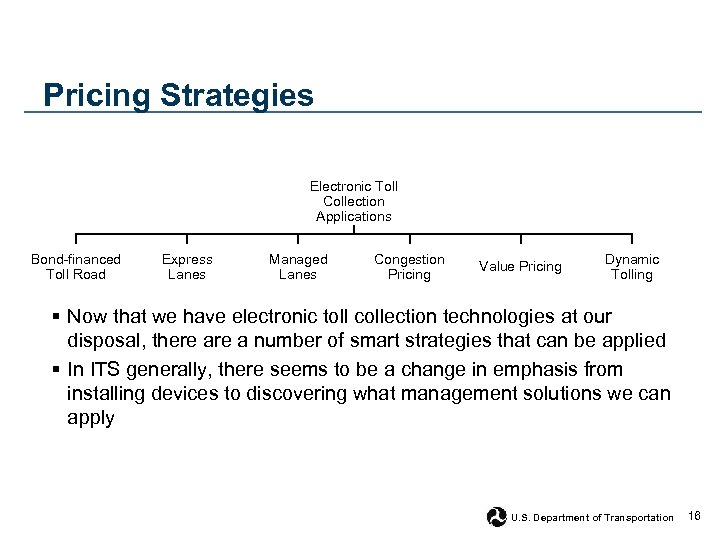 Pricing Strategies Electronic Toll Collection Applications Bond-financed Toll Road Express Lanes Managed Lanes Congestion Pricing Value Pricing Dynamic Tolling § Now that we have electronic toll collection technologies at our disposal, there a number of smart strategies that can be applied § In ITS generally, there seems to be a change in emphasis from installing devices to discovering what management solutions we can apply U. S. Department of Transportation 16
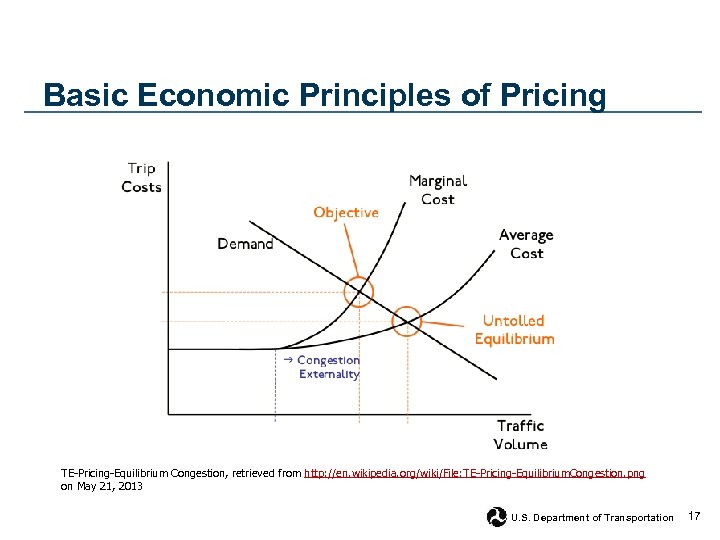 Basic Economic Principles of Pricing TE-Pricing-Equilibrium Congestion, retrieved from http: //en. wikipedia. org/wiki/File: TE-Pricing-Equilibrium. Congestion. png on May 21, 2013 U. S. Department of Transportation 17
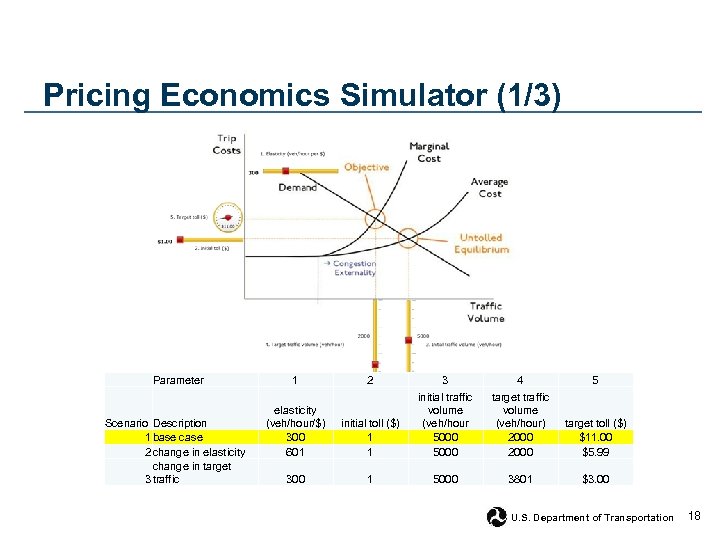 Pricing Economics Simulator (1/3) Parameter Scenario Description 1 base case 2 change in elasticity change in target 3 traffic 1 2 3 4 5 elasticity (veh/hour/$) 300 601 initial toll ($) 1 1 initial traffic volume (veh/hour 5000 target traffic volume (veh/hour) 2000 target toll ($) $11. 00 $5. 99 300 1 5000 3801 $3. 00 U. S. Department of Transportation 18
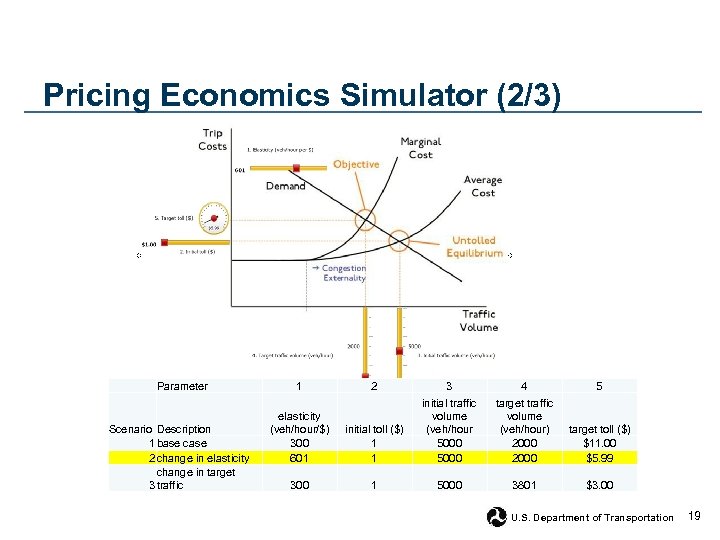 Pricing Economics Simulator (2/3) Parameter Scenario Description 1 base case 2 change in elasticity change in target 3 traffic 1 2 3 4 5 elasticity (veh/hour/$) 300 601 initial toll ($) 1 1 initial traffic volume (veh/hour 5000 target traffic volume (veh/hour) 2000 target toll ($) $11. 00 $5. 99 300 1 5000 3801 $3. 00 U. S. Department of Transportation 19
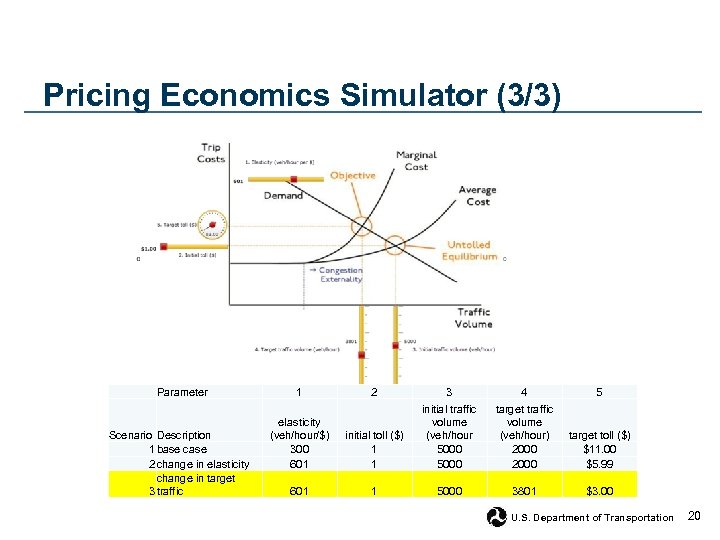 Pricing Economics Simulator (3/3) Parameter Scenario Description 1 base case 2 change in elasticity change in target 3 traffic 1 2 3 4 5 elasticity (veh/hour/$) 300 601 initial toll ($) 1 1 initial traffic volume (veh/hour 5000 target traffic volume (veh/hour) 2000 target toll ($) $11. 00 $5. 99 601 1 5000 3801 $3. 00 U. S. Department of Transportation 20
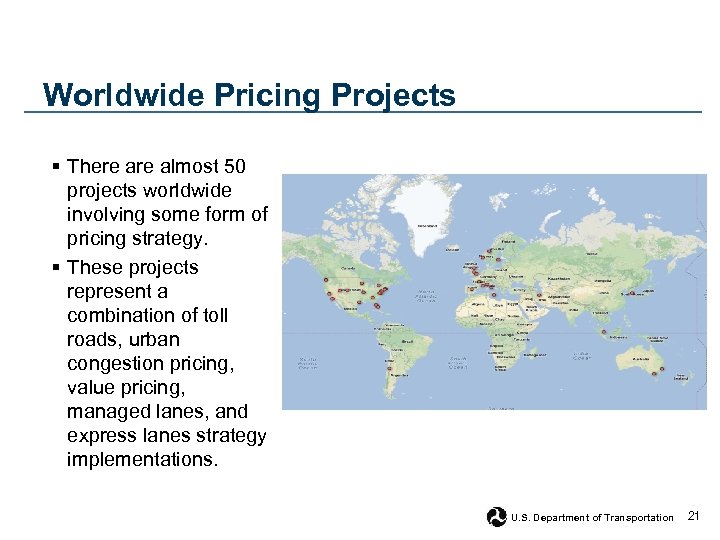 Worldwide Pricing Projects § There almost 50 projects worldwide involving some form of pricing strategy. § These projects represent a combination of toll roads, urban congestion pricing, value pricing, managed lanes, and express lanes strategy implementations. U. S. Department of Transportation 21
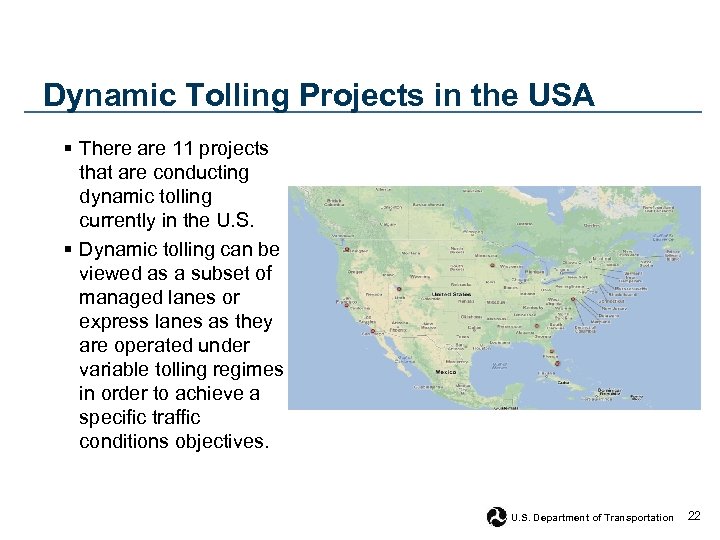 Dynamic Tolling Projects in the USA § There are 11 projects that are conducting dynamic tolling currently in the U. S. § Dynamic tolling can be viewed as a subset of managed lanes or express lanes as they are operated under variable tolling regimes in order to achieve a specific traffic conditions objectives. U. S. Department of Transportation 22
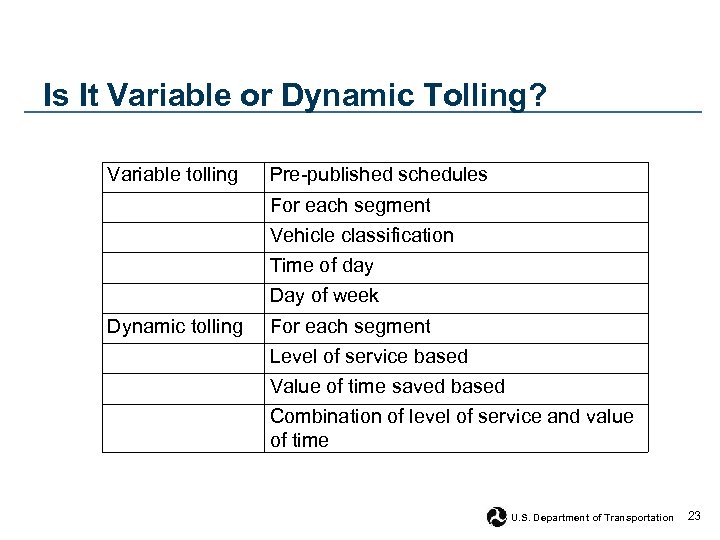 Is It Variable or Dynamic Tolling? Variable tolling Pre-published schedules For each segment Vehicle classification Time of day Day of week Dynamic tolling For each segment Level of service based Value of time saved based Combination of level of service and value of time U. S. Department of Transportation 23
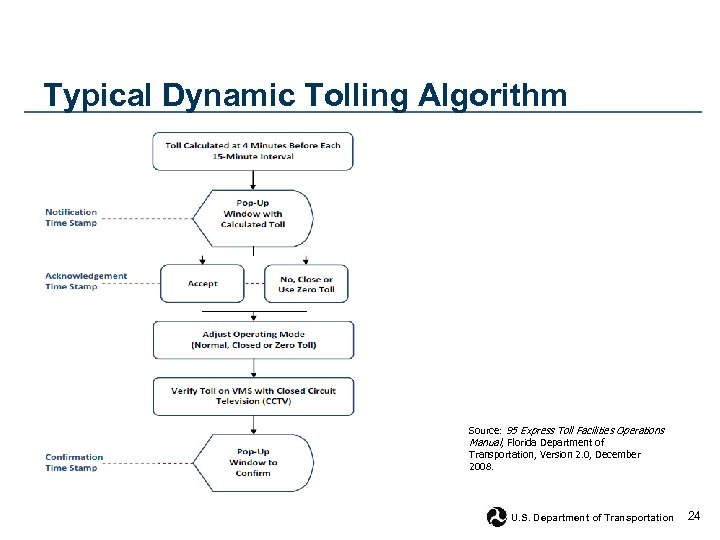 Typical Dynamic Tolling Algorithm Source: 95 Express Toll Facilities Operations Manual, Florida Department of Transportation, Version 2. 0, December 2008. U. S. Department of Transportation 24
 Audience Interaction § What is your opinion regarding urban congestion pricing? □ Would you be prepared to pay a mandatory fee for access to a downtown area in the U. S. ? □ Do you think that pricing is fair? U. S. Department of Transportation 25
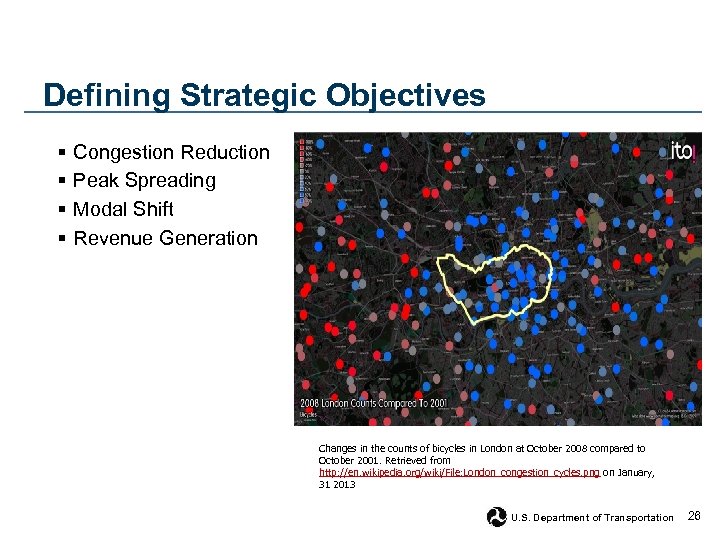 Defining Strategic Objectives § § Congestion Reduction Peak Spreading Modal Shift Revenue Generation Changes in the counts of bicycles in London at October 2008 compared to October 2001. Retrieved from http: //en. wikipedia. org/wiki/File: London_congestion_cycles. png on January, 31 2013 U. S. Department of Transportation 26
 Multimodal Electronic Payment Systems § Regional multimodal electronic payment system - all modes of transportation addressed by single payment system § While there may be one single payment system there may be different payment devices □ For example, vehicle-based payment can be achieved by transponder or tag while personal based payments such as ticketing for transit systems can be accomplished with a smartcard □ The same account can be used for both even if different payment devices are used § Regional multimodal approach offers more management solution possibilities □ For example, conditional discounts could be offered where users of the transit system on one particular day may be offered free parking downtown for another day when they decide to take their car U. S. Department of Transportation 27
 Challenges § Requirements definition § Proprietary technologies § Funding and financing § Future proofing § Privacy and anonymity § Fairness and equity § Fitting within the wider context § Harnessing regional partners § Finding the best business model U. S. Department of Transportation 28
 Electronic Payment, Transportation, ITS § Electronic toll collection and pricing considered as a subset of ITS § Many ITS applications complementary to electronic toll collection and pricing systems § Electronic toll collection and pricing set within a wider context of performance management § Electronic payment systems applications can be powerful collectors of data for performance management § Electronic payment systems applications fit within ITS and transportation management through delivery of more efficient data collection and demand management § The flexibility of electronic systems to adjust payment provides demand management possibilities U. S. Department of Transportation 29
 The Role of the Private Sector □ □ □ ▪ Providing technology products and services ▪ The private sector may have already invested considerable sums in technologies, products and services that can be incorporated into a public agency project Providing expertise and experience ▪ Many private sector companies have the ability to conduct business worldwide and may have gathered expertise and experience that is difficult to accumulate in a local context Providing financing ▪ It may also be possible for the private sector to provide financing under a suitable public private partnership relationship Defining a business model helps to define the private sector role in the implementation U. S. Department of Transportation 30
 Business Models § More than technology, business models and business processes are very important § There also new choices to acquire a service rather than technologies § The next few slides illustrate this with business process models from two transit agencies that acquired electronic ticketing capabilities recently □ Chicago Transit Authority (CTA), Chicago □ Dallas Area Rapid Transit (DART), Dallas U. S. Department of Transportation 31
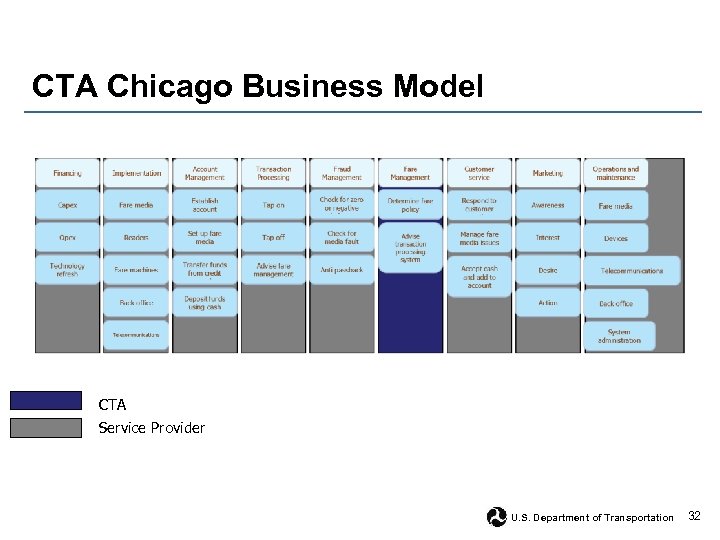 CTA Chicago Business Model CTA Service Provider U. S. Department of Transportation 32
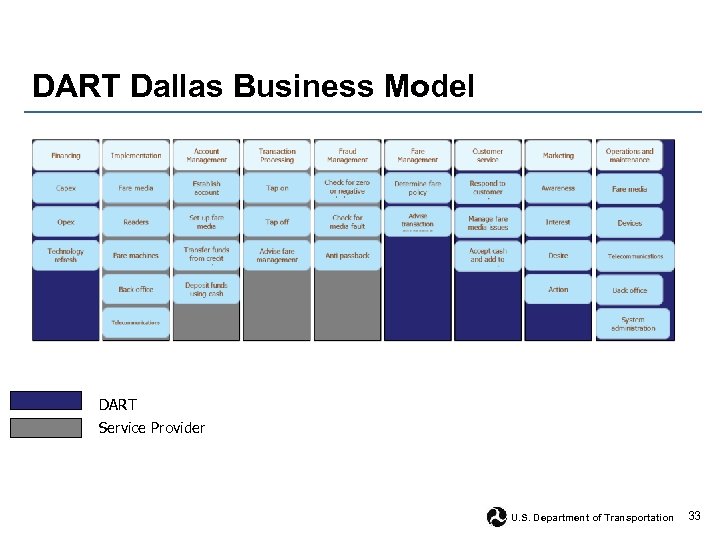 DART Dallas Business Model DART Service Provider U. S. Department of Transportation 33
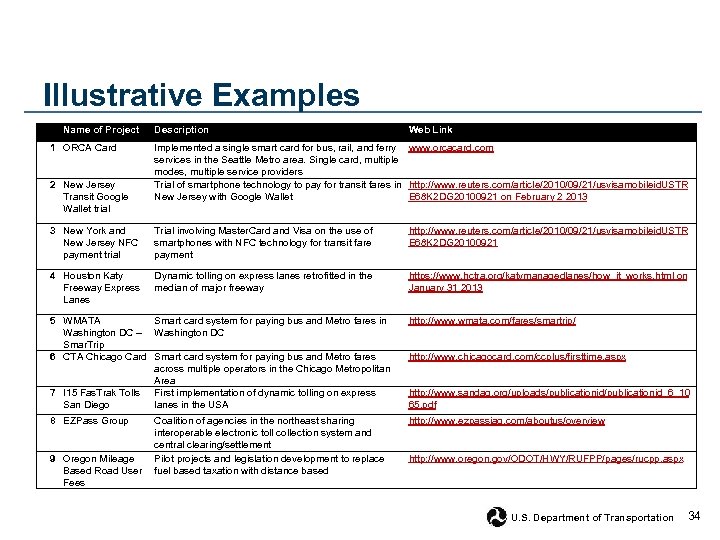 Illustrative Examples Name of Project 1 ORCA Card 2 New Jersey Transit Google Wallet trial Description Web Link Implemented a single smart card for bus, rail, and ferry www. orcacard. com services in the Seattle Metro area. Single card, multiple modes, multiple service providers Trial of smartphone technology to pay for transit fares in http: //www. reuters. com/article/2010/09/21/usvisamobileid. USTR New Jersey with Google Wallet E 68 K 2 DG 20100921 on February 2 2013 3 New York and New Jersey NFC payment trial Trial involving Master. Card and Visa on the use of smartphones with NFC technology for transit fare payment http: //www. reuters. com/article/2010/09/21/usvisamobileid. USTR E 68 K 2 DG 20100921 4 Houston Katy Freeway Express Lanes Dynamic tolling on express lanes retrofitted in the median of major freeway https: //www. hctra. org/katymanagedlanes/how_it_works. html on January 31 2013 5 WMATA Smart card system for paying bus and Metro fares in Washington DC – Washington DC Smar. Trip 6 CTA Chicago Card Smart card system for paying bus and Metro fares across multiple operators in the Chicago Metropolitan Area 7 I 15 Fas. Trak Tolls First implementation of dynamic tolling on express San Diego lanes in the USA http: //www. wmata. com/fares/smartrip/ 8 EZPass Group http: //www. ezpassiag. com/aboutus/overview Coalition of agencies in the northeast sharing interoperable electronic toll collection system and central clearing/settlement 9 Oregon Mileage Pilot projects and legislation development to replace Based Road User fuel based taxation with distance based Fees http: //www. chicagocard. com/ccplus/firsttime. aspx http: //www. sandag. org/uploads/publicationid_6_10 65. pdf http: //www. oregon. gov/ODOT/HWY/RUFPP/pages/rucpp. aspx U. S. Department of Transportation 34
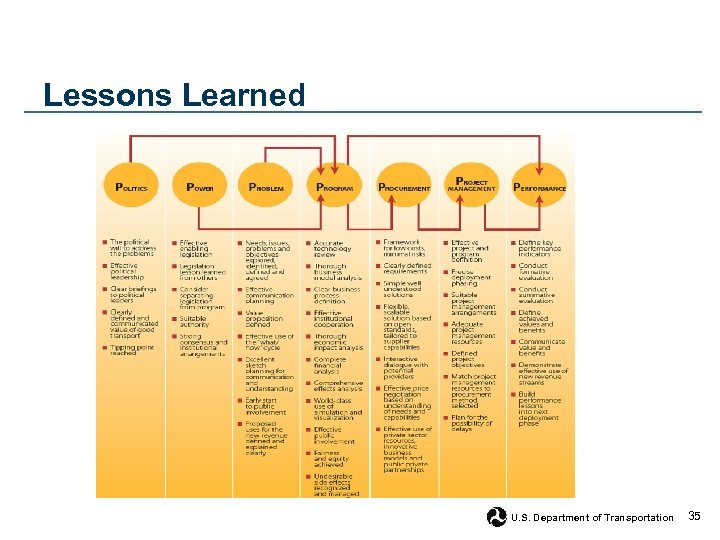 Lessons Learned U. S. Department of Transportation 35
 The Cost of Change Lesson § The lesson is simple – ambiguity costs money. § Ambiguity appears in system requirements due to lack of formal agreement on what the system is designed to do and lack of definition on specific requirements. § As a rule of thumb it will cost approximately $1, 000 to correct problems during the deployment stage. § While that same problem could have been dealt with during the requirements gathering stage for approximately $1. § That is why it’s worthwhile investing heavily in initial requirements analysis and objectives agreement. U. S. Department of Transportation 36
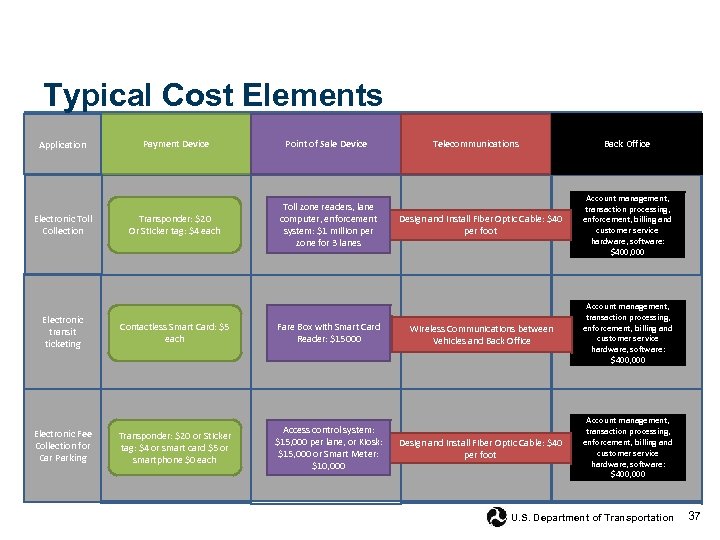 Typical Cost Elements Payment Device Application Electronic Toll Collection Electronic transit ticketing Electronic Fee Collection for Car Parking Point of Sale Device Toll zone readers, lane computer, enforcement system: $1 million per zone for 3 lanes Transponder: $20 Or Sticker tag: $4 each Transponder: $20 or Sticker tag: $4 or smart card $5 or smartphone $0 each Fare Box with Smart Card Reader: $15000 Access control system: $15, 000 per lane, or Kiosk: $15, 000 or Smart Meter: $10, 000 Back Office Design and Install Fiber Optic Cable: $40 per foot Account management, transaction processing, enforcement, billing and customer service hardware, software: $400, 000 Wireless Communications between Vehicles and Back Office Account management, transaction processing, enforcement, billing and customer service hardware, software: $400, 000 Design and Install Fiber Optic Cable: $40 per foot Account management, transaction processing, enforcement, billing and customer service hardware, software: $400, 000 Contactless Smart Card: $5 Telecommunications U. S. Department of Transportation 37
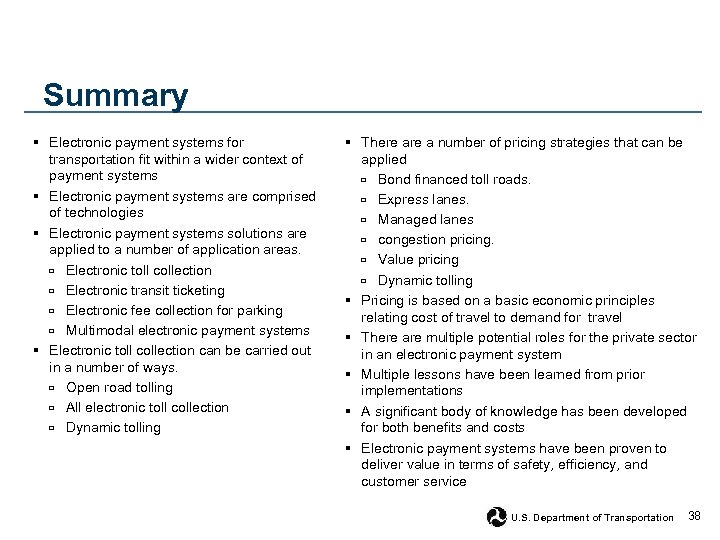 Summary § Electronic payment systems for transportation fit within a wider context of payment systems § Electronic payment systems are comprised of technologies § Electronic payment systems solutions are applied to a number of application areas. □ Electronic toll collection □ Electronic transit ticketing □ Electronic fee collection for parking □ Multimodal electronic payment systems § Electronic toll collection can be carried out in a number of ways. □ Open road tolling □ All electronic toll collection □ Dynamic tolling § There a number of pricing strategies that can be applied □ Bond financed toll roads. □ Express lanes. □ Managed lanes □ congestion pricing. □ Value pricing □ Dynamic tolling § Pricing is based on a basic economic principles relating cost of travel to demand for travel § There are multiple potential roles for the private sector in an electronic payment system § Multiple lessons have been learned from prior implementations § A significant body of knowledge has been developed for both benefits and costs § Electronic payment systems have been proven to deliver value in terms of safety, efficiency, and customer service U. S. Department of Transportation 38
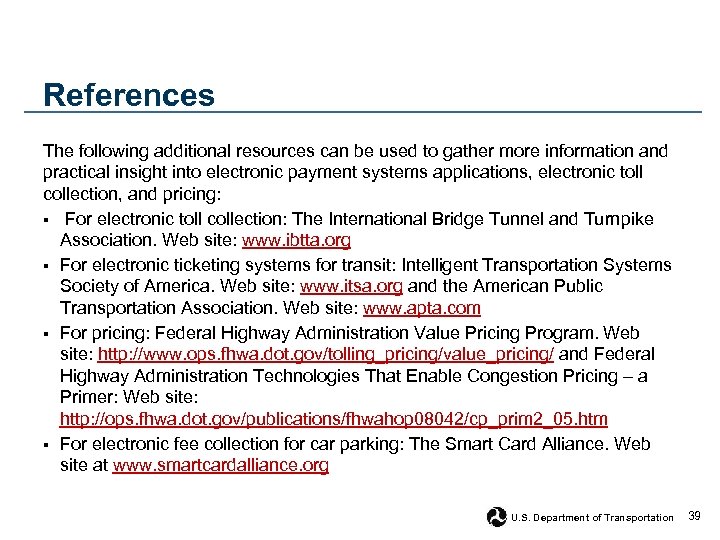 References The following additional resources can be used to gather more information and practical insight into electronic payment systems applications, electronic toll collection, and pricing: § For electronic toll collection: The International Bridge Tunnel and Turnpike Association. Web site: www. ibtta. org § For electronic ticketing systems for transit: Intelligent Transportation Systems Society of America. Web site: www. itsa. org and the American Public Transportation Association. Web site: www. apta. com § For pricing: Federal Highway Administration Value Pricing Program. Web site: http: //www. ops. fhwa. dot. gov/tolling_pricing/value_pricing/ and Federal Highway Administration Technologies That Enable Congestion Pricing – a Primer: Web site: http: //ops. fhwa. dot. gov/publications/fhwahop 08042/cp_prim 2_05. htm § For electronic fee collection for car parking: The Smart Card Alliance. Web site at www. smartcardalliance. org U. S. Department of Transportation 39
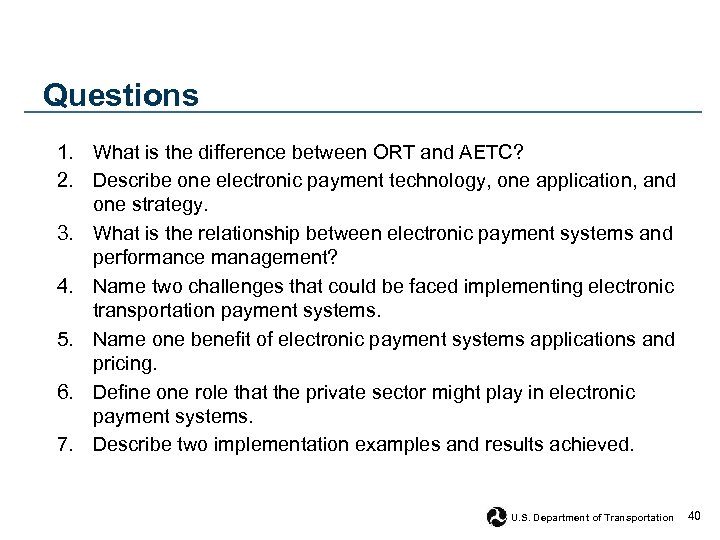 Questions 1. What is the difference between ORT and AETC? 2. Describe one electronic payment technology, one application, and one strategy. 3. What is the relationship between electronic payment systems and performance management? 4. Name two challenges that could be faced implementing electronic transportation payment systems. 5. Name one benefit of electronic payment systems applications and pricing. 6. Define one role that the private sector might play in electronic payment systems. 7. Describe two implementation examples and results achieved. U. S. Department of Transportation 40