 Скачать презентацию ITRS-2001 and Design Andrew B Kahng UC San
87dcd7731a0b144ad69163efd25426fd.ppt
- Количество слайдов: 44



ITRS-2001 and Design Andrew B. Kahng, UC San Diego CSE/ECE Depts. Chair, ITRS-2001 Design ITWG January 24, 2002 A. Kahng, 020124
Design ITWG Contributions to ITRS-2001 • New System Drivers Chapter – MPU – SOC (Low-Power, High-Performance, Mixed. Technology) – Mixed-Signal • Design Chapter • ORTC support – Frequency – Power – Density • New design cost and productivity models A. Kahng, 020124
Design Contributors • > 50 individuals (Japan, Europe, U. S. ) • Japan: Hitachi, Matsushita, Mitsubichi, NEC, Sony • ITWG: Y. Furui, T. Hiwatashi, T. Kadowaki, K. Uchiyama • SOC-LP roadmap • Europe: Infineon, Philips, STMicro • ITWG: R. Brederlow, W. Weber • Mixed-Signal roadmap • U. S. : Agere, Agilent, Cadence, HP, IBM, Intel, Lucent, Motorola, TI • ITWG: W. Joyner, A. Kahng • MPU, Power, Frequency, Density models A. Kahng, 020124
ITRS-2001 System Drivers Chapter A. Kahng, 020124
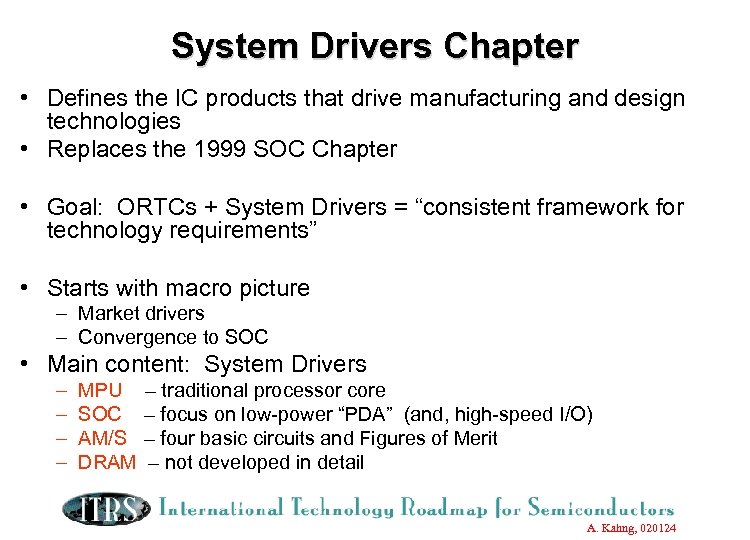
System Drivers Chapter • Defines the IC products that drive manufacturing and design technologies • Replaces the 1999 SOC Chapter • Goal: ORTCs + System Drivers = “consistent framework for technology requirements” • Starts with macro picture – Market drivers – Convergence to SOC • Main content: System Drivers – – MPU – traditional processor core SOC – focus on low-power “PDA” (and, high-speed I/O) AM/S – four basic circuits and Figures of Merit DRAM – not developed in detail A. Kahng, 020124
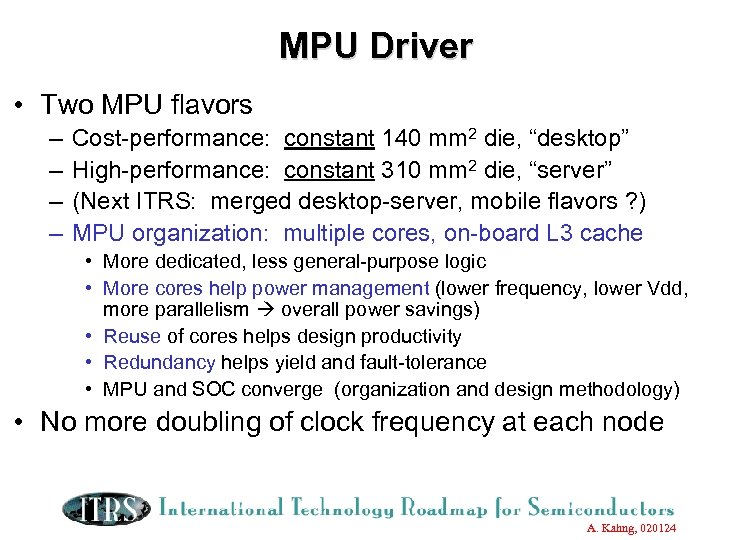
MPU Driver • Two MPU flavors – – Cost-performance: constant 140 mm 2 die, “desktop” High-performance: constant 310 mm 2 die, “server” (Next ITRS: merged desktop-server, mobile flavors ? ) MPU organization: multiple cores, on-board L 3 cache • More dedicated, less general-purpose logic • More cores help power management (lower frequency, lower Vdd, more parallelism overall power savings) • Reuse of cores helps design productivity • Redundancy helps yield and fault-tolerance • MPU and SOC converge (organization and design methodology) • No more doubling of clock frequency at each node A. Kahng, 020124
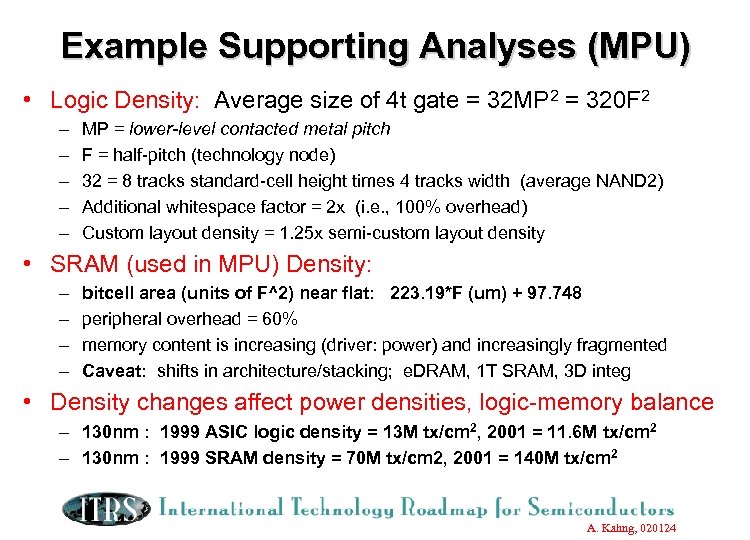
Example Supporting Analyses (MPU) • Logic Density: Average size of 4 t gate = 32 MP 2 = 320 F 2 – – – MP = lower-level contacted metal pitch F = half-pitch (technology node) 32 = 8 tracks standard-cell height times 4 tracks width (average NAND 2) Additional whitespace factor = 2 x (i. e. , 100% overhead) Custom layout density = 1. 25 x semi-custom layout density • SRAM (used in MPU) Density: – – bitcell area (units of F^2) near flat: 223. 19*F (um) + 97. 748 peripheral overhead = 60% memory content is increasing (driver: power) and increasingly fragmented Caveat: shifts in architecture/stacking; e. DRAM, 1 T SRAM, 3 D integ • Density changes affect power densities, logic-memory balance – 130 nm : 1999 ASIC logic density = 13 M tx/cm 2, 2001 = 11. 6 M tx/cm 2 – 130 nm : 1999 SRAM density = 70 M tx/cm 2, 2001 = 140 M tx/cm 2 A. Kahng, 020124
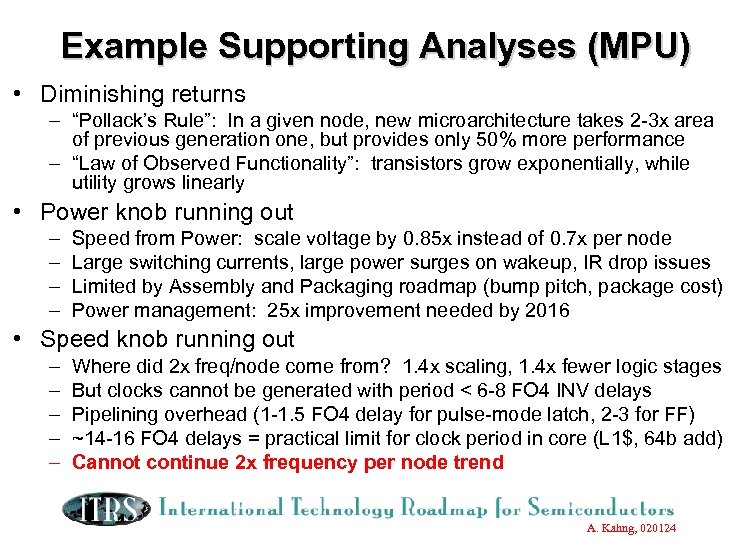
Example Supporting Analyses (MPU) • Diminishing returns – “Pollack’s Rule”: In a given node, new microarchitecture takes 2 -3 x area of previous generation one, but provides only 50% more performance – “Law of Observed Functionality”: transistors grow exponentially, while utility grows linearly • Power knob running out – – Speed from Power: scale voltage by 0. 85 x instead of 0. 7 x per node Large switching currents, large power surges on wakeup, IR drop issues Limited by Assembly and Packaging roadmap (bump pitch, package cost) Power management: 25 x improvement needed by 2016 • Speed knob running out – – – Where did 2 x freq/node come from? 1. 4 x scaling, 1. 4 x fewer logic stages But clocks cannot be generated with period < 6 -8 FO 4 INV delays Pipelining overhead (1 -1. 5 FO 4 delay for pulse-mode latch, 2 -3 for FF) ~14 -16 FO 4 delays = practical limit for clock period in core (L 1$, 64 b add) Cannot continue 2 x frequency per node trend A. Kahng, 020124
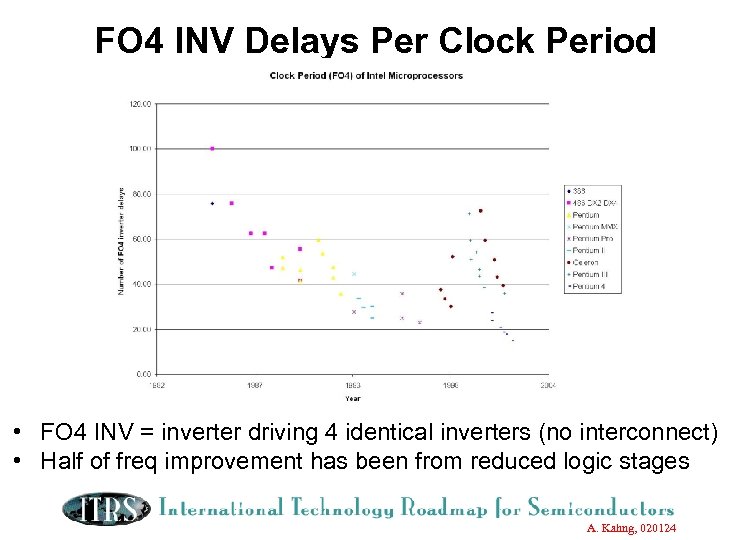
FO 4 INV Delays Per Clock Period • FO 4 INV = inverter driving 4 identical inverters (no interconnect) • Half of freq improvement has been from reduced logic stages A. Kahng, 020124
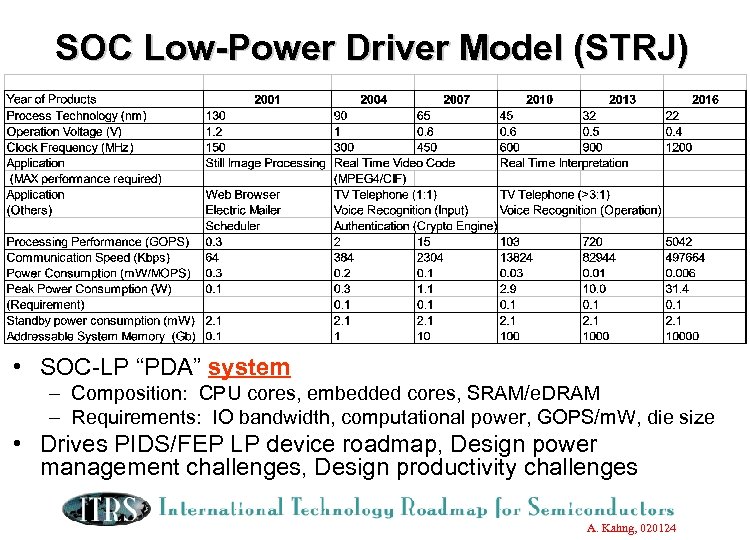
SOC Low-Power Driver Model (STRJ) • SOC-LP “PDA” system – Composition: CPU cores, embedded cores, SRAM/e. DRAM – Requirements: IO bandwidth, computational power, GOPS/m. W, die size • Drives PIDS/FEP LP device roadmap, Design power management challenges, Design productivity challenges A. Kahng, 020124
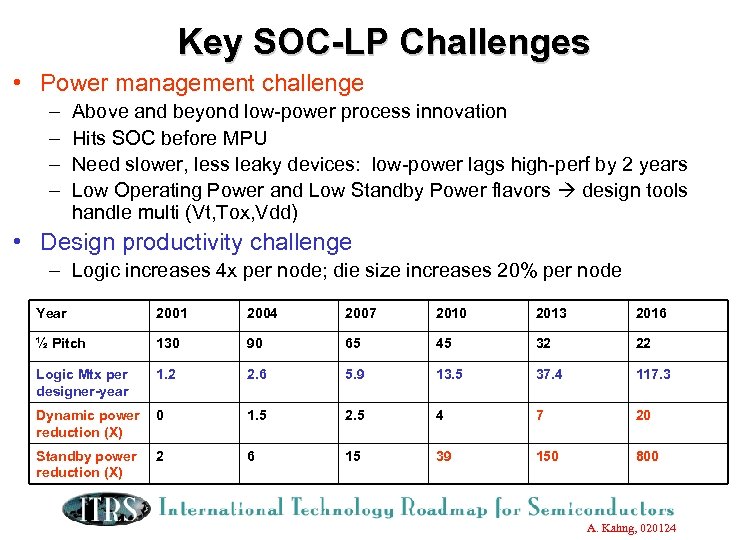
Key SOC-LP Challenges • Power management challenge – – Above and beyond low-power process innovation Hits SOC before MPU Need slower, less leaky devices: low-power lags high-perf by 2 years Low Operating Power and Low Standby Power flavors design tools handle multi (Vt, Tox, Vdd) • Design productivity challenge – Logic increases 4 x per node; die size increases 20% per node Year 2001 2004 2007 2010 2013 2016 ½ Pitch 130 90 65 45 32 22 Logic Mtx per designer-year 1. 2 2. 6 5. 9 13. 5 37. 4 117. 3 Dynamic power reduction (X) 0 1. 5 2. 5 4 7 20 Standby power reduction (X) 2 6 15 39 150 800 A. Kahng, 020124
Mixed-Signal Driver (Europe) • Today, the digital part of circuits is most critical for performance and is dominating chip area • But in many new IC-products the mixed-signal part becomes important for performance and cost • This shift requires definition of the “analog boundary conditions” in the design part of the ITRS • Goal: define criteria and needs for future analog/RF circuit performance, and compare to device parameters: • Choose critical, important analog/RF circuits • Identify circuit performance needs • and related device parameter needs A. Kahng, 020124
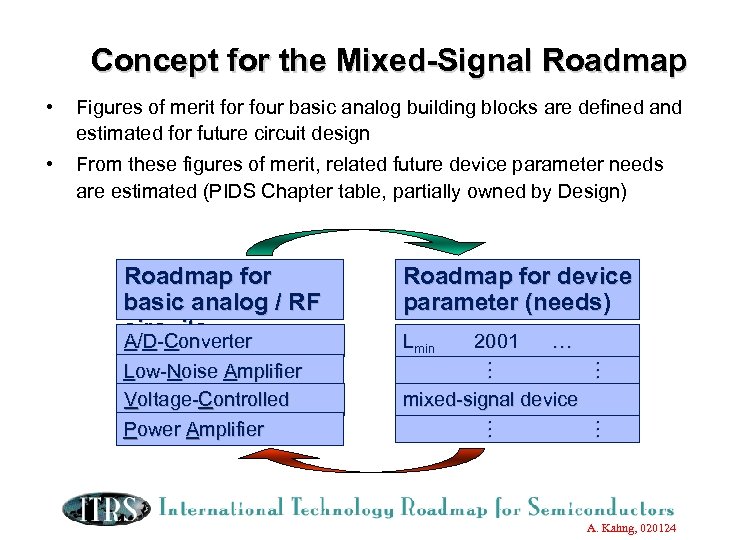
Concept for the Mixed-Signal Roadmap • Figures of merit for four basic analog building blocks are defined and estimated for future circuit design • From these figures of merit, related future device parameter needs are estimated (PIDS Chapter table, partially owned by Design) Roadmap for basic analog / RF circuits A/D-Converter 2001 … … … mixed-signal device parameter … … Lmin 2015 … … Low-Noise Amplifier Voltage-Controlled Oower Amplifier P scillator Roadmap for device parameter (needs) A. Kahng, 020124
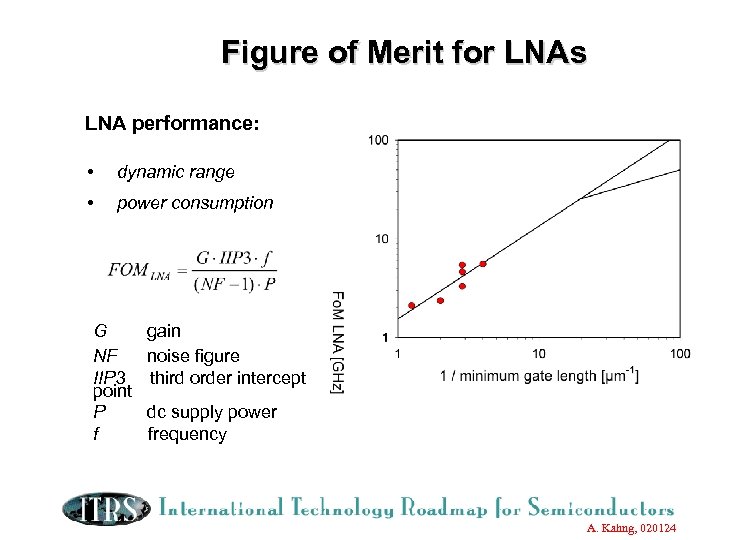
Figure of Merit for LNAs LNA performance: • dynamic range • power consumption G gain NF noise figure IIP 3 third order intercept point P dc supply power f frequency A. Kahng, 020124
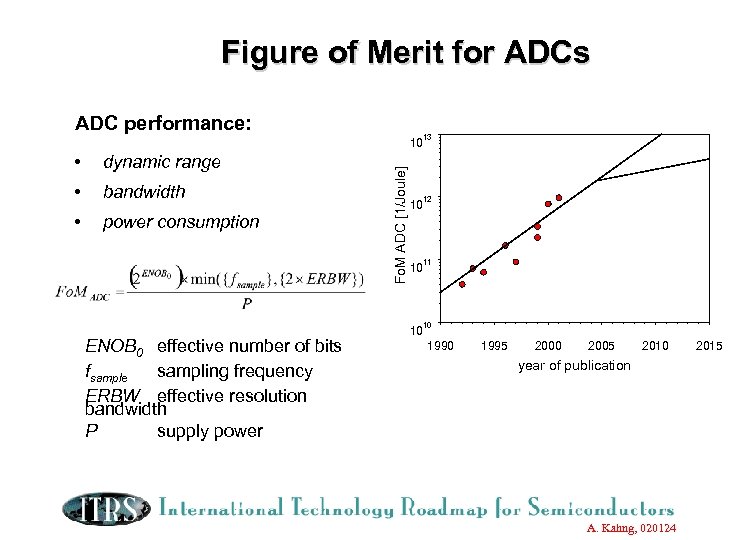
Figure of Merit for ADCs ADC performance: • dynamic range • bandwidth • power consumption ENOB 0 effective number of bits fsample sampling frequency ERBW effective resolution bandwidth P supply power Fo. M ADC [1/Joule] 10 13 10 12 10 11 10 10 1995 2000 2005 2010 year of publication A. Kahng, 020124 2015
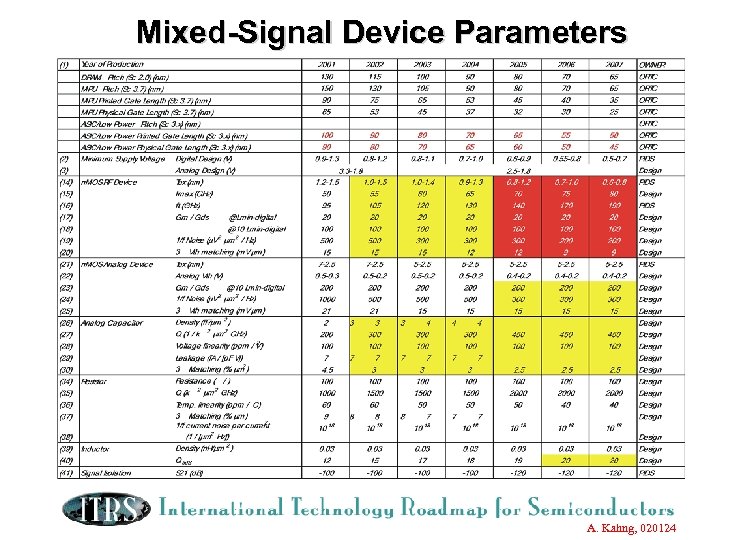
Mixed-Signal Device Parameters A. Kahng, 020124
ANALOGY #1 ? • ITRS is like a car • Before, two drivers (husband = MPU, wife = DRAM) • The drivers looked mostly in the rear-view mirror (destination = “Moore’s Law”) • Many passengers in the car (ASIC, SOC, Analog, Mobile, Low-Power, Networking/Wireless, …) wanted to go different places • This year: – Some passengers became drivers – All drivers explain more clearly where they are going A. Kahng, 020124
ITRS-2001 Design Chapter A. Kahng, 020124
Design Chapter Outline • Introduction – Scope of design technology – Complexities (silicon, system) A. Kahng, 020124
Silicon Complexity Challenges • Silicon Complexity = impact of process scaling, new materials, new device/interconnect architectures • Non-ideal scaling (leakage, power management, circuit/device innovation, current delivery) • Coupled high-frequency devices and interconnects (signal integrity analysis and management) • Manufacturing variability (library characterization, analog and digital circuit performance, error-tolerant design, layout reusability, static performance verification methodology/tools) • Scaling of global interconnect performance (communication, synchronization) • Decreased reliability (SEU, gate insulator tunneling and breakdown, joule heating and electromigration) • Complexity of manufacturing handoff (reticle enhancement and mask writing/inspection flow, manufacturing NRE cost) A. Kahng, 020124
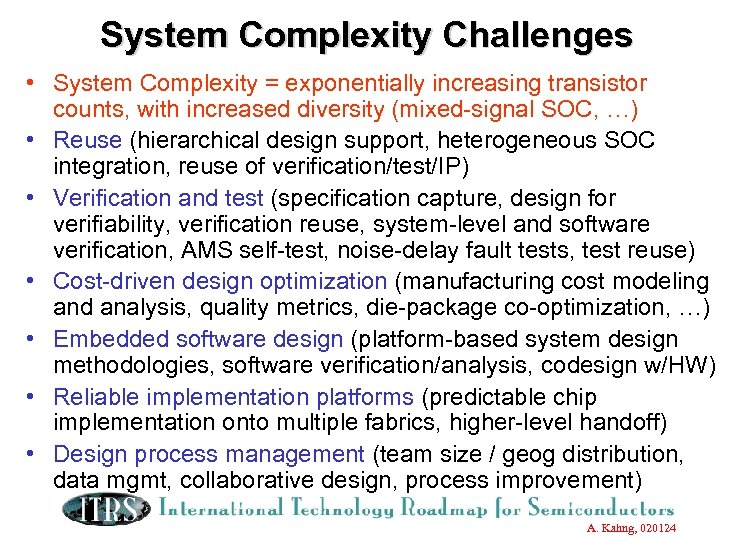
System Complexity Challenges • System Complexity = exponentially increasing transistor counts, with increased diversity (mixed-signal SOC, …) • Reuse (hierarchical design support, heterogeneous SOC integration, reuse of verification/test/IP) • Verification and test (specification capture, design for verifiability, verification reuse, system-level and software verification, AMS self-test, noise-delay fault tests, test reuse) • Cost-driven design optimization (manufacturing cost modeling and analysis, quality metrics, die-package co-optimization, …) • Embedded software design (platform-based system design methodologies, software verification/analysis, codesign w/HW) • Reliable implementation platforms (predictable chip implementation onto multiple fabrics, higher-level handoff) • Design process management (team size / geog distribution, data mgmt, collaborative design, process improvement) A. Kahng, 020124
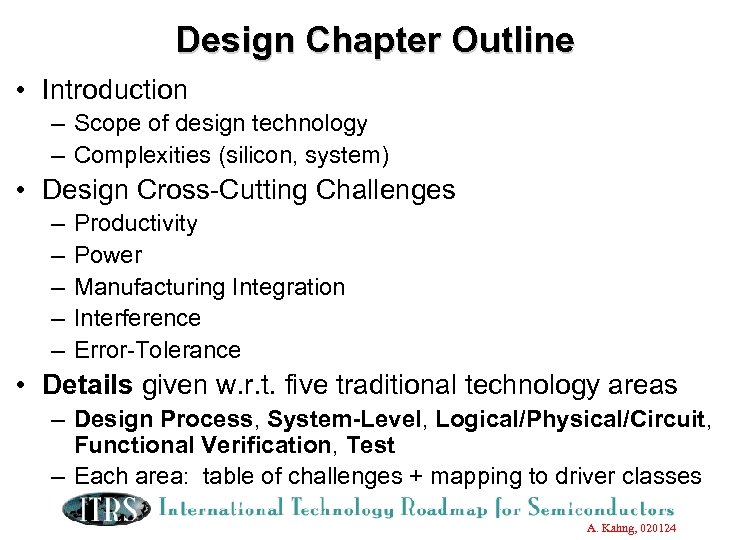
Design Chapter Outline • Introduction – Scope of design technology – Complexities (silicon, system) • Design Cross-Cutting Challenges – – – Productivity Power Manufacturing Integration Interference Error-Tolerance • Details given w. r. t. five traditional technology areas – Design Process, System-Level, Logical/Physical/Circuit, Functional Verification, Test – Each area: table of challenges + mapping to driver classes A. Kahng, 020124
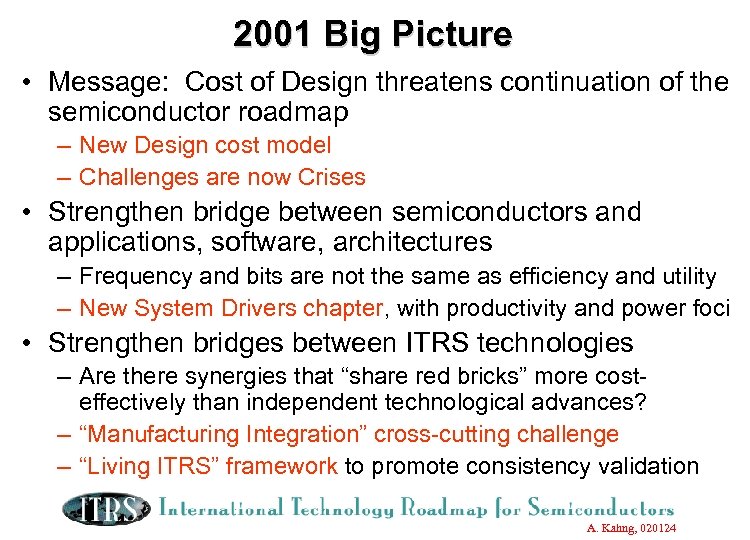
2001 Big Picture • Message: Cost of Design threatens continuation of the semiconductor roadmap – New Design cost model – Challenges are now Crises • Strengthen bridge between semiconductors and applications, software, architectures – Frequency and bits are not the same as efficiency and utility – New System Drivers chapter, with productivity and power foci • Strengthen bridges between ITRS technologies – Are there synergies that “share red bricks” more costeffectively than independent technological advances? – “Manufacturing Integration” cross-cutting challenge – “Living ITRS” framework to promote consistency validation A. Kahng, 020124
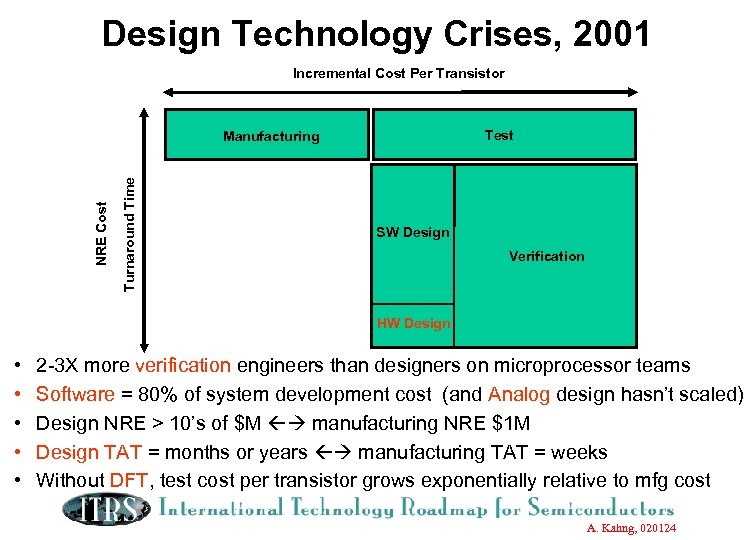
Design Technology Crises, 2001 Incremental Cost Per Transistor Test Turnaround Time NRE Cost Manufacturing SW Design Verification HW Design • • • 2 -3 X more verification engineers than designers on microprocessor teams Software = 80% of system development cost (and Analog design hasn’t scaled) Design NRE > 10’s of $M manufacturing NRE $1 M Design TAT = months or years manufacturing TAT = weeks Without DFT, test cost per transistor grows exponentially relative to mfg cost A. Kahng, 020124
Design Cost Model • Engineer cost per year increases 5% / year ($181, 568 in 1990) • EDA tool cost per year (per engineer) increases 3. 9% per year ($99, 301 in 1990) • Productivity due to 8 major Design Technology innovations (3. 5 of which are still unavailable) : RTL methodology; In-house P&R; Tall-thin engineer; Small-block reuse; Large-block reuse; IC implementation suite; Intelligent testbench; Electronic Systemlevel methodology • Matched up against SOC-LP PDA content: – SOC-LP PDA design cost = $15 M in 2001 – Would have been $342 M without EDA innovations and the resulting improvements in design productivity A. Kahng, 020124
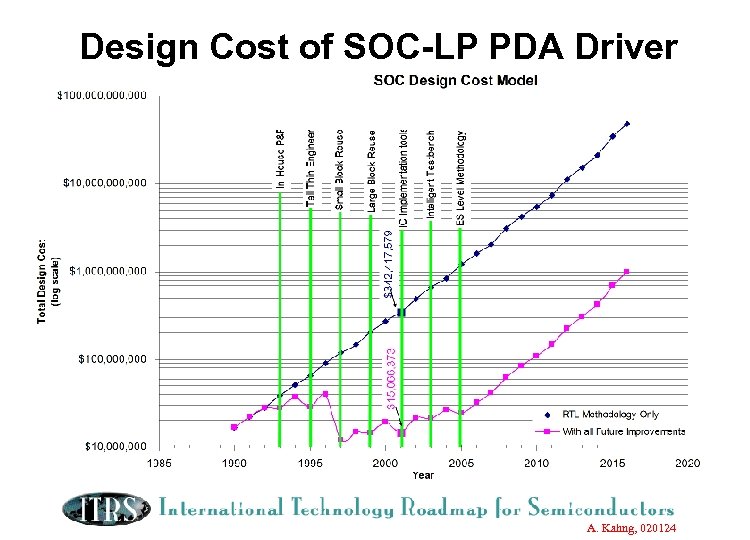
Design Cost of SOC-LP PDA Driver A. Kahng, 020124
Cross-Cutting Challenge: Productivity • Overall design productivity of normalized functions on chip must scale at 4 x per node for SOC Driver • Reuse (including migration) of design, verification and test effort must scale at > 4 x/node • Analog and mixed-signal synthesis, verification and test • Embedded software productivity A. Kahng, 020124
Cross-Cutting Challenge: Power • Reliability and performance analysis impacts • Accelerated lifetime testing (burn-in) paradigm fails • Large power management gaps (standby power for low-power SOC; dynamic power for MPU) • Power optimizations must simultaneously and fully exploit many degrees of freedom (multi-Vt, multi-Tox, multi-Vdd in core) while guiding architecture, OS and software A. Kahng, 020124
Cross-Cutting Challenge: Interference • • • Lower noise headroom especially in low-power devices Coupled interconnects Supply voltage IR drop and ground bounce Thermal impact on device off-currents and interconnect resistivities Mutual inductance Substrate coupling Single-event (alpha particle) upset Increased use of dynamic logic families Modeling, analysis and estimation at all levels of design A. Kahng, 020124
Cross-Cutting Challenge: Error-Tolerance • Relaxing 100% correctness requirement may reduce manufacturing, verification, test costs • Both transient and permanent failures of signals, logic values, devices, interconnects • Novel techniques: adaptive and self-correcting / self-repairing circuits, use of on-chip reconfigurability A. Kahng, 020124
Challenge: “Manufacturing Integration” • Goal: share red bricks with other ITRS technologies – Lithography CD variability requirement new Design techniques that can better handle variability ? – Mask data volume requirement new Design-Mfg interfaces and flows that pass functional requirements, verification knowledge to mask writing and inspection ? – ATE cost and speed red bricks new DFT, BIST/BOST techniques for high-speed I/O, signal integrity, analog/MS ? • Can technology development reflect ROI (value / cost) analysis: Who should solve a given red brick? – Q: what are respective values of “X initiative”, low-k, Cu ? A. Kahng, 020124
Example: Manufacturing Test • High-speed interfaces (networking, memory I/O) – Frequencies on same scale as overall tester timing accuracy • Heterogeneous SOC design – Test reuse – Integration of distinct test technologies within single device – Analog/mixed-signal test • Reliability screens failing – Burn-in screening not practical with lower Vdd, higher power budgets overkill impact on yield • Design Challenges: DFT, BIST – – Analog/mixed-signal Signal integrity and advanced fault models BIST for single-event upsets (in logic as well as memory) Reliability-related fault tolerance A. Kahng, 020124
Example: Lithography • 10% CD uniformity requirement causes red bricks • 10% < 1 atomic monolayer at end of ITRS • This year: Lithography, PIDS, FEP agreed to relax CD uniformity requirement (but we still see red bricks) • Design challenge: Design for variability – Novel circuit topologies – Circuit optimization (conflict between slack minimization and guardbanding of quadratically increasing delay sensitivity) – Centering and design for $/wafer • Design challenge: Design for when devices, interconnects no longer 100% guaranteed correct – Can this save $$$ in manufacturing, verification, test costs? A. Kahng, 020124
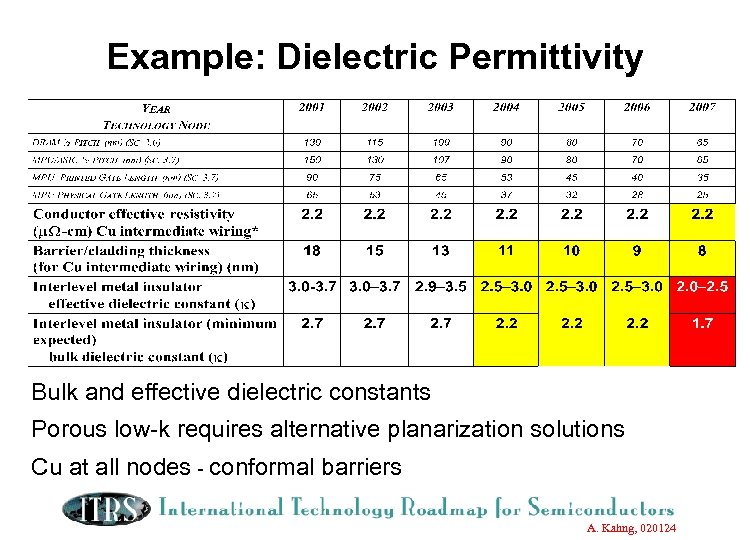
Example: Dielectric Permittivity Bulk and effective dielectric constants Porous low-k requires alternative planarization solutions Cu at all nodes - conformal barriers A. Kahng, 020124
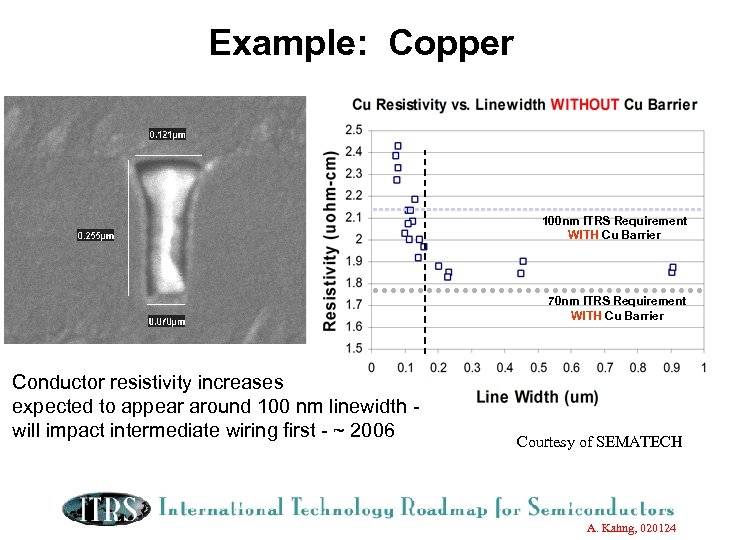
Example: Copper 100 nm ITRS Requirement WITH Cu Barrier 70 nm ITRS Requirement WITH Cu Barrier Conductor resistivity increases expected to appear around 100 nm linewidth will impact intermediate wiring first - ~ 2006 Courtesy of SEMATECH A. Kahng, 020124
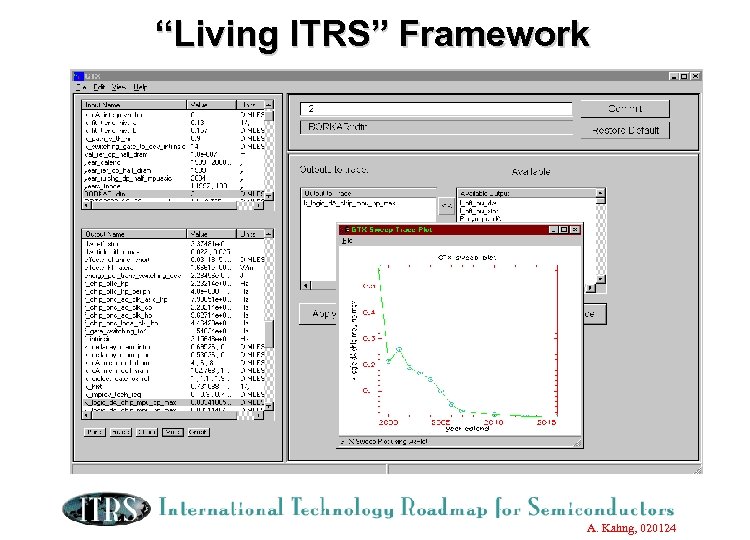
“Living ITRS” Framework A. Kahng, 020124
ANALOGY #2 ? • ITRS technologies are the parts of the ITRS car • Every one takes the “engine” point of view when it defines its requirements – Cf. Paolo’s “sum of their fears” metaphor • But, all parts must work together to make the car go smoothly • Need “global optimization” of requirements • (Design = Steering wheel and/or tires … ? ) A. Kahng, 020124
2001 Big Picture • Message: Cost of Design threatens continuation of the semiconductor roadmap – New Design cost model – Challenges are now Crises • Strengthen bridge between semiconductors and applications, software, architectures – Frequency and bits are not the same as efficiency and utility – New System Drivers chapter, with productivity and power foci • Strengthen bridges between ITRS technologies – Are there synergies that “share red bricks” more costeffectively than independent technological advances? – “Manufacturing Integration” cross-cutting challenge – “Living ITRS” framework to promote consistency validation A. Kahng, 020124

THANK YOU ! A. Kahng, 020124
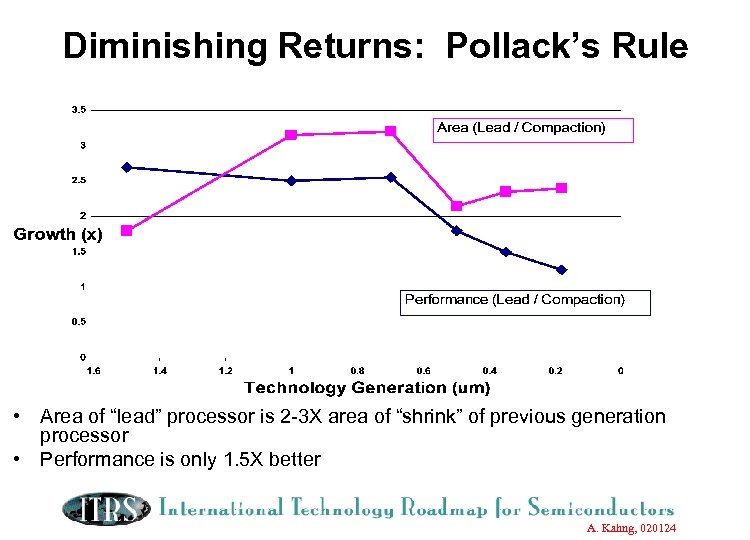
Diminishing Returns: Pollack’s Rule • Area of “lead” processor is 2 -3 X area of “shrink” of previous generation processor • Performance is only 1. 5 X better A. Kahng, 020124
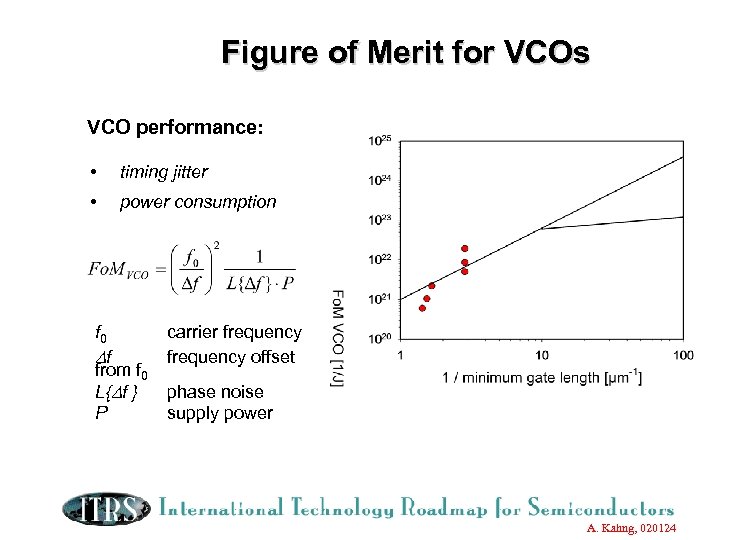
Figure of Merit for VCOs VCO performance: • timing jitter • power consumption f 0 Df from f 0 L{Df } P carrier frequency offset phase noise supply power A. Kahng, 020124
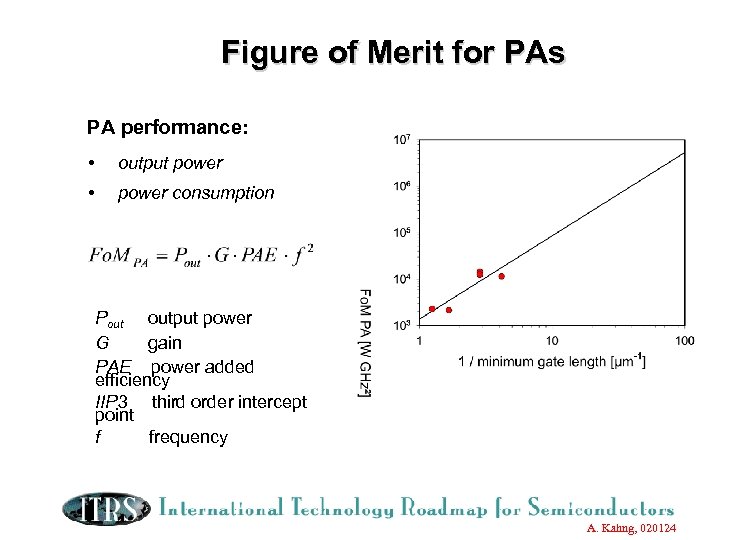
Figure of Merit for PAs PA performance: • output power • power consumption Pout output power G gain PAE power added efficiency IIP 3 third order intercept point f frequency A. Kahng, 020124
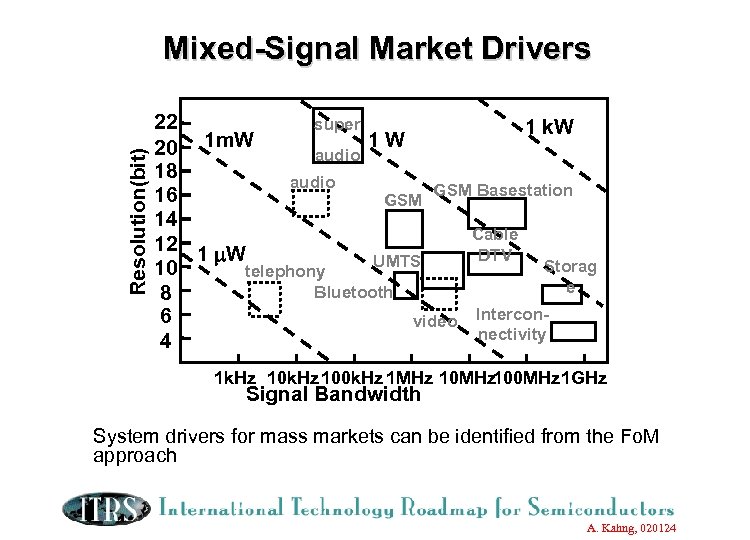
Resolution(bit) Mixed-Signal Market Drivers 22 super 1 k. W 1 m. W 1 W 20 audio 18 audio GSM Basestation 16 GSM 14 Cable 12 DTV 1 m. W UMTS Storag 10 telephony e Bluetooth 8 6 video Interconnectivity 4 1 k. Hz 100 k. Hz 1 MHz 100 MHz 1 GHz Signal Bandwidth System drivers for mass markets can be identified from the Fo. M approach A. Kahng, 020124
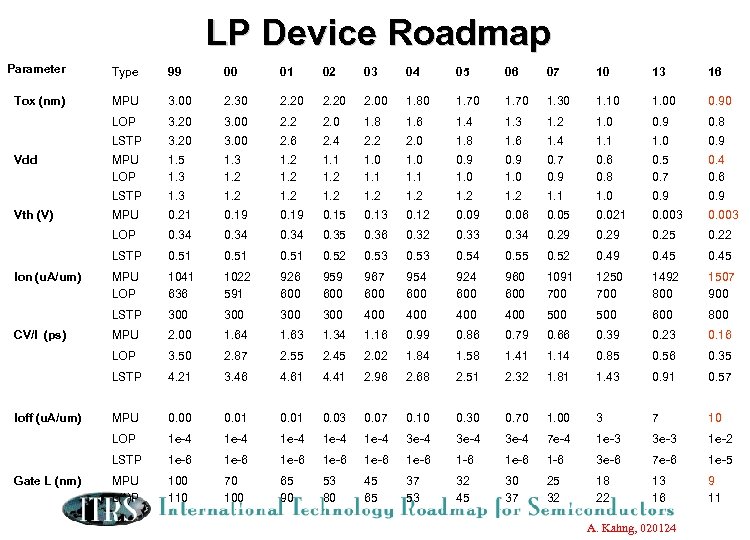
LP Device Roadmap Parameter Type 99 00 01 02 03 04 05 06 07 10 13 16 Tox (nm) MPU 3. 00 2. 30 2. 20 2. 00 1. 80 1. 70 1. 30 1. 10 1. 00 0. 90 LOP 3. 20 3. 00 2. 2 2. 0 1. 8 1. 6 1. 4 1. 3 1. 2 1. 0 0. 9 0. 8 LSTP 3. 20 3. 00 2. 6 2. 4 2. 2 2. 0 1. 8 1. 6 1. 4 1. 1 1. 0 0. 9 Vdd MPU LOP 1. 5 1. 3 1. 2 1. 1 1. 2 1. 0 1. 1 0. 9 1. 0 0. 7 0. 9 0. 6 0. 8 0. 5 0. 7 0. 4 0. 6 LSTP 1. 3 1. 2 1. 1 1. 0 0. 9 Vth (V) MPU 0. 21 0. 19 0. 15 0. 13 0. 12 0. 09 0. 06 0. 05 0. 021 0. 003 LOP 0. 34 0. 35 0. 36 0. 32 0. 33 0. 34 0. 29 0. 25 0. 22 LSTP 0. 51 0. 52 0. 53 0. 54 0. 55 0. 52 0. 49 0. 45 Ion (u. A/um) MPU LOP 1041 636 1022 591 926 600 959 600 967 600 954 600 924 600 960 600 1091 700 1250 700 1492 800 1507 900 LSTP 300 300 400 400 500 600 800 CV/I (ps) MPU 2. 00 1. 64 1. 63 1. 34 1. 16 0. 99 0. 86 0. 79 0. 66 0. 39 0. 23 0. 16 LOP 3. 50 2. 87 2. 55 2. 45 2. 02 1. 84 1. 58 1. 41 1. 14 0. 85 0. 56 0. 35 LSTP 4. 21 3. 46 4. 61 4. 41 2. 96 2. 68 2. 51 2. 32 1. 81 1. 43 0. 91 0. 57 Ioff (u. A/um) MPU 0. 00 0. 01 0. 03 0. 07 0. 10 0. 30 0. 70 1. 00 3 7 10 LOP 1 e-4 1 e-4 3 e-4 7 e-4 1 e-3 3 e-3 1 e-2 LSTP 1 e-6 1 e-6 1 -6 3 e-6 7 e-6 1 e-5 Gate L (nm) MPU L(*)P 100 110 70 100 65 90 53 80 45 65 37 53 32 45 30 37 25 32 18 22 13 16 9 11 A. Kahng, 020124
Скачать презентацию ITRS-2001 and Design Andrew B Kahng UC San
87dcd7731a0b144ad69163efd25426fd.ppt