 Скачать презентацию ITPA Expert Group Meeting April 2003 St Petersburg
8c948fa6f1c6929aaca8935ffe8df5c1.ppt
- Количество слайдов: 10



ITPA Expert Group Meeting, April 2003, St Petersburg, Russia ITPA PROFILE DATABASE: News and Planned Developments C M Roach, M Walters EURATOM/UKAEA Fusion Association, Culham Science Centre, Abingdon, Oxon, OX 14 3 DB, UK. CONTENTS • Recent Data Additions • Improvements to Online Documentation • Plans for Data Submission, and Access Permissions • Tool Developments • Integrating the ITB Profile Data • Inter-database Consistency • Conclusions This work was jointly funded by the UK Department of Trade and Industry and EURATOM
ITPA Expert Group Meeting, April 2003, St Petersburg, Russia Recent Data Submissions to the Profile Database Data submissions since the Cadarache ITPA meeting include: • JET ELMy H-modes: #52009, 52015, 52022, high density, influence of triangularity (P Stubberfield and R Budny) • Beam Parameters: for JET discharges #52015 and #52009 for beam calculation benchmarks. These are held as TRANSP namelist files (not MDSplus). • JET ITB: #53501, electron heated (V Parail, Y Baranov) • AUG: #10007, 11197, 12059, 12536, 13039, 13151 steady ELMy H-mode discharges with various power levels + Signs of interest in data submission from NSTX.
ITPA Expert Group Meeting, April 2003, St Petersburg, Russia Improved Online Documentation • More convenient documentation – (i) helps the process of database integration. – (ii) makes database more accessible • Current ITPA Profile Database Manual now web browsable: see http: //tokamakprofiledb. ukaea. org. uk/DOCS/PDBMAN/pdbman. html – based on Public Release 1998 Manual, updating key sections. • Tables of all ITPA Profile Database variables, with links to variable descriptions in the Online Manual. http: //tokamak-profiledb. ukaea. org. uk/DOCS/pdbvardoc. htm • Need to add more information on how data is stored in MDSplus trees • Documentation must evolve to remain current.
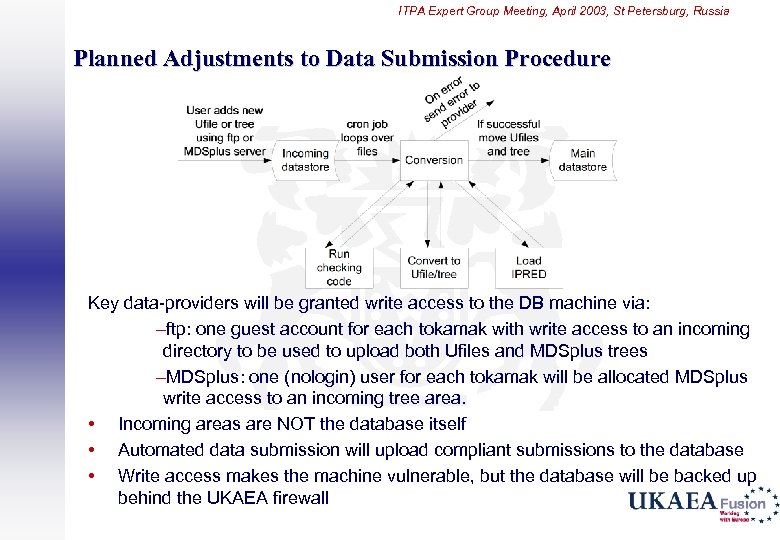
ITPA Expert Group Meeting, April 2003, St Petersburg, Russia Planned Adjustments to Data Submission Procedure Key data-providers will be granted write access to the DB machine via: –ftp: one guest account for each tokamak with write access to an incoming directory to be used to upload both Ufiles and MDSplus trees –MDSplus: one (nologin) user for each tokamak will be allocated MDSplus write access to an incoming tree area. • Incoming areas are NOT the database itself • Automated data submission will upload compliant submissions to the database • Write access makes the machine vulnerable, but the database will be backed up behind the UKAEA firewall
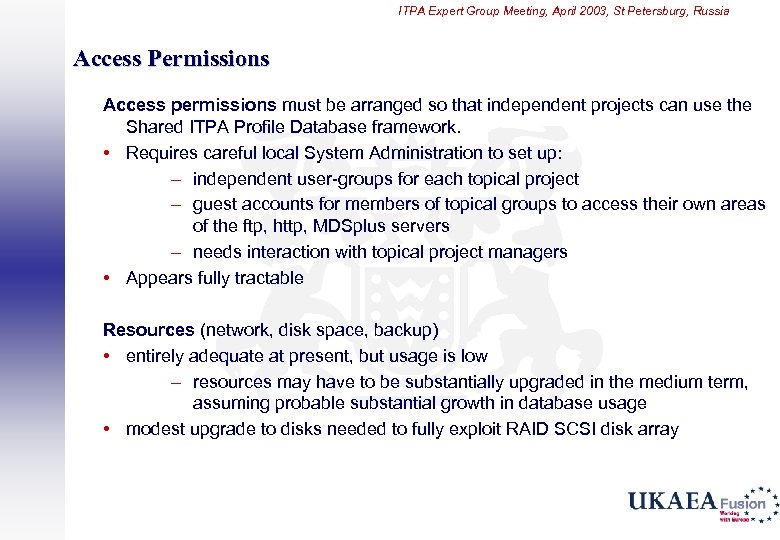
ITPA Expert Group Meeting, April 2003, St Petersburg, Russia Access Permissions Access permissions must be arranged so that independent projects can use the Shared ITPA Profile Database framework. • Requires careful local System Administration to set up: – independent user-groups for each topical project – guest accounts for members of topical groups to access their own areas of the ftp, http, MDSplus servers – needs interaction with topical project managers • Appears fully tractable Resources (network, disk space, backup) • entirely adequate at present, but usage is low – resources may have to be substantially upgraded in the medium term, assuming probable substantial growth in database usage • modest upgrade to disks needed to fully exploit RAID SCSI disk array
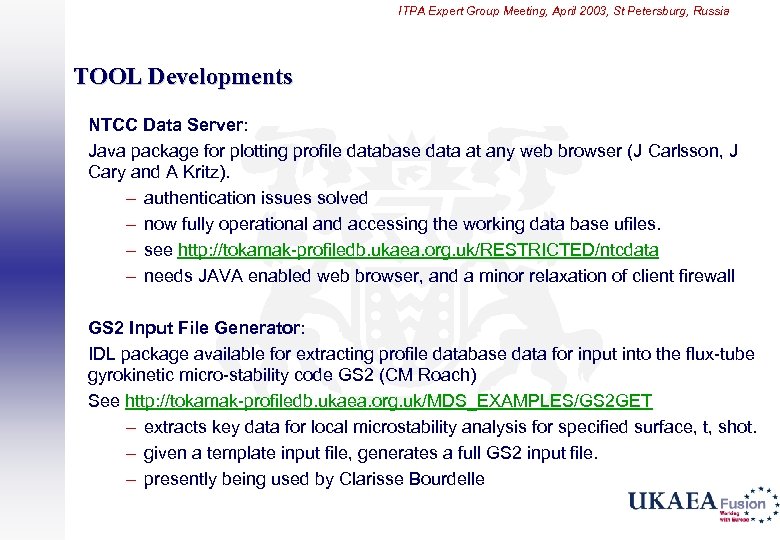
ITPA Expert Group Meeting, April 2003, St Petersburg, Russia TOOL Developments NTCC Data Server: Java package for plotting profile database data at any web browser (J Carlsson, J Cary and A Kritz). – authentication issues solved – now fully operational and accessing the working data base ufiles. – see http: //tokamak-profiledb. ukaea. org. uk/RESTRICTED/ntcdata – needs JAVA enabled web browser, and a minor relaxation of client firewall GS 2 Input File Generator: IDL package available for extracting profile database data for input into the flux-tube gyrokinetic micro-stability code GS 2 (CM Roach) See http: //tokamak-profiledb. ukaea. org. uk/MDS_EXAMPLES/GS 2 GET – extracts key data for local microstability analysis for specified surface, t, shot. – given a template input file, generates a full GS 2 input file. – presently being used by Clarisse Bourdelle
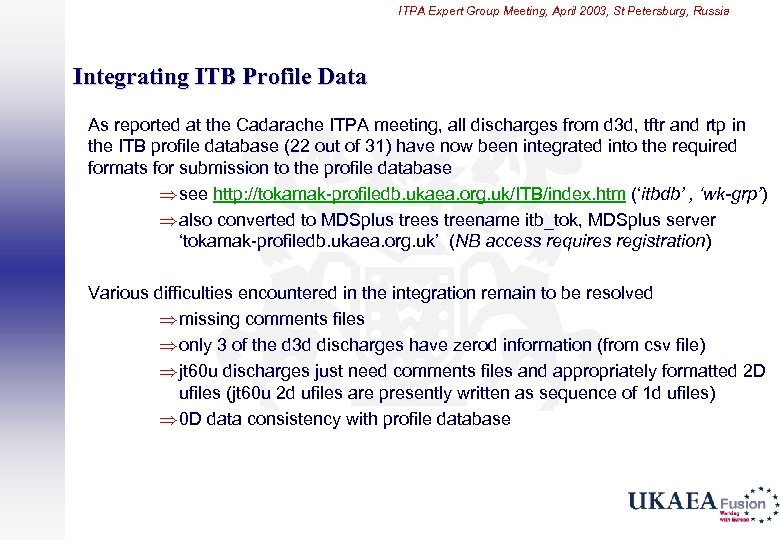
ITPA Expert Group Meeting, April 2003, St Petersburg, Russia Integrating ITB Profile Data As reported at the Cadarache ITPA meeting, all discharges from d 3 d, tftr and rtp in the ITB profile database (22 out of 31) have now been integrated into the required formats for submission to the profile database Þ see http: //tokamak-profiledb. ukaea. org. uk/ITB/index. htm (‘itbdb’ , ‘wk-grp’) Þ also converted to MDSplus treename itb_tok, MDSplus server ‘tokamak-profiledb. ukaea. org. uk’ (NB access requires registration) Various difficulties encountered in the integration remain to be resolved Þ missing comments files Þ only 3 of the d 3 d discharges have zerod information (from csv file) Þ jt 60 u discharges just need comments files and appropriately formatted 2 D ufiles (jt 60 u 2 d ufiles are presently written as sequence of 1 d ufiles) Þ 0 D data consistency with profile database
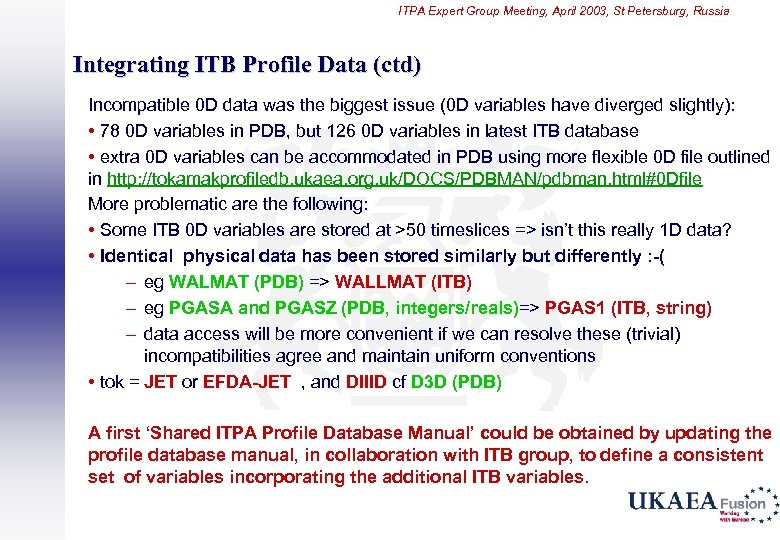
ITPA Expert Group Meeting, April 2003, St Petersburg, Russia Integrating ITB Profile Data (ctd) Incompatible 0 D data was the biggest issue (0 D variables have diverged slightly): • 78 0 D variables in PDB, but 126 0 D variables in latest ITB database • extra 0 D variables can be accommodated in PDB using more flexible 0 D file outlined in http: //tokamakprofiledb. ukaea. org. uk/DOCS/PDBMAN/pdbman. html#0 Dfile More problematic are the following: • Some ITB 0 D variables are stored at >50 timeslices => isn’t this really 1 D data? • Identical physical data has been stored similarly but differently : -( – eg WALMAT (PDB) => WALLMAT (ITB) – eg PGASA and PGASZ (PDB, integers/reals)=> PGAS 1 (ITB, string) – data access will be more convenient if we can resolve these (trivial) incompatibilities agree and maintain uniform conventions • tok = JET or EFDA-JET , and DIIID cf D 3 D (PDB) A first ‘Shared ITPA Profile Database Manual’ could be obtained by updating the profile database manual, in collaboration with ITB group, to define a consistent set of variables incorporating the additional ITB variables.
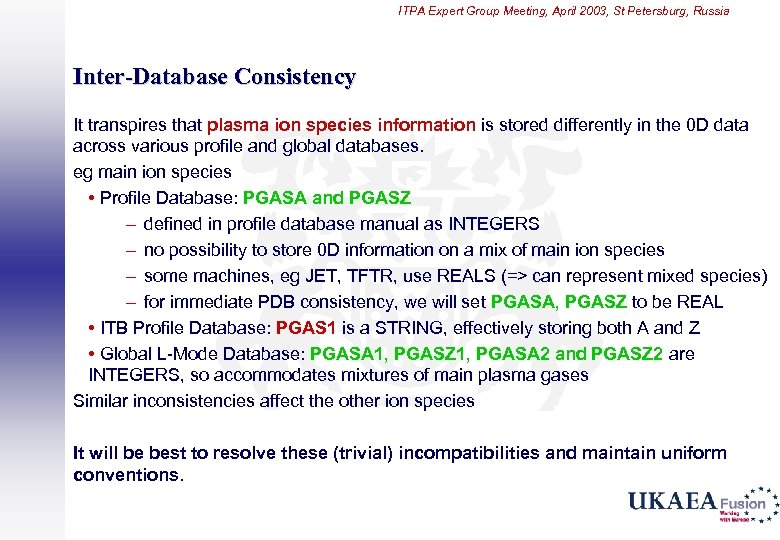
ITPA Expert Group Meeting, April 2003, St Petersburg, Russia Inter-Database Consistency It transpires that plasma ion species information is stored differently in the 0 D data across various profile and global databases. eg main ion species • Profile Database: PGASA and PGASZ – defined in profile database manual as INTEGERS – no possibility to store 0 D information on a mix of main ion species – some machines, eg JET, TFTR, use REALS (=> can represent mixed species) – for immediate PDB consistency, we will set PGASA, PGASZ to be REAL • ITB Profile Database: PGAS 1 is a STRING, effectively storing both A and Z • Global L-Mode Database: PGASA 1, PGASZ 1, PGASA 2 and PGASZ 2 are INTEGERS, so accommodates mixtures of main plasma gases Similar inconsistencies affect the other ion species It will be best to resolve these (trivial) incompatibilities and maintain uniform conventions.
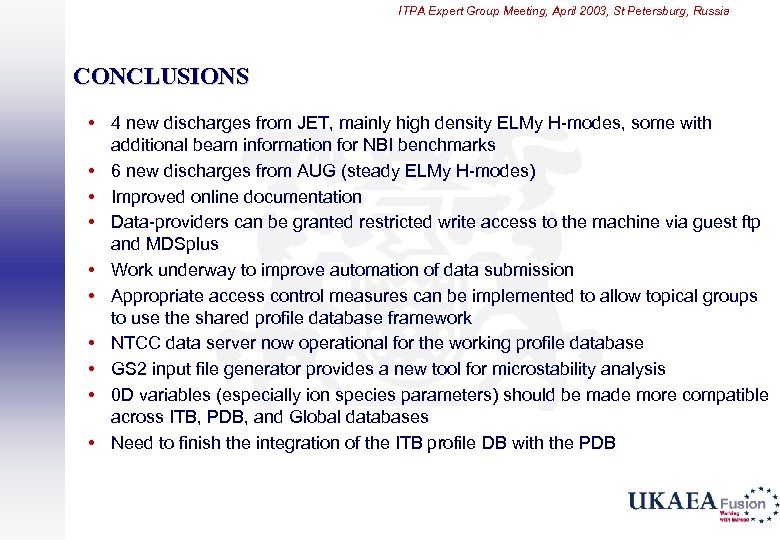
ITPA Expert Group Meeting, April 2003, St Petersburg, Russia CONCLUSIONS • 4 new discharges from JET, mainly high density ELMy H-modes, some with additional beam information for NBI benchmarks • 6 new discharges from AUG (steady ELMy H-modes) • Improved online documentation • Data-providers can be granted restricted write access to the machine via guest ftp and MDSplus • Work underway to improve automation of data submission • Appropriate access control measures can be implemented to allow topical groups to use the shared profile database framework • NTCC data server now operational for the working profile database • GS 2 input file generator provides a new tool for microstability analysis • 0 D variables (especially ion species parameters) should be made more compatible across ITB, PDB, and Global databases • Need to finish the integration of the ITB profile DB with the PDB
Скачать презентацию ITPA Expert Group Meeting April 2003 St Petersburg
8c948fa6f1c6929aaca8935ffe8df5c1.ppt