



 Items to Know • Test on L 1 -4, PSC 1 -4 and CW 1 -2 Next Tuesday • CW 2 will be available outside the physics office after 12 noon today • As of next week, Lecture groups will be split and there will now be a fourth lecture room 2 -407. Check your e-mail or Moodle for your new grouping.
 L 4 – NEWTON’S LAWS At the end of this lecture you should: • • • Understand: what is meant by a force Know: 4 (Classical) Forces, when and where they occur State: Newton’s Three Laws in words and as formulae Know: the differential form of Newton’s 2 nd law Use: Newton’s 2 nd and 3 rd Laws to perform calculations Understand: a free body diagram (FBD) and be able to draw such diagrams in a variety of situations • Have: legible and useable NOTES. May the Force be with you…
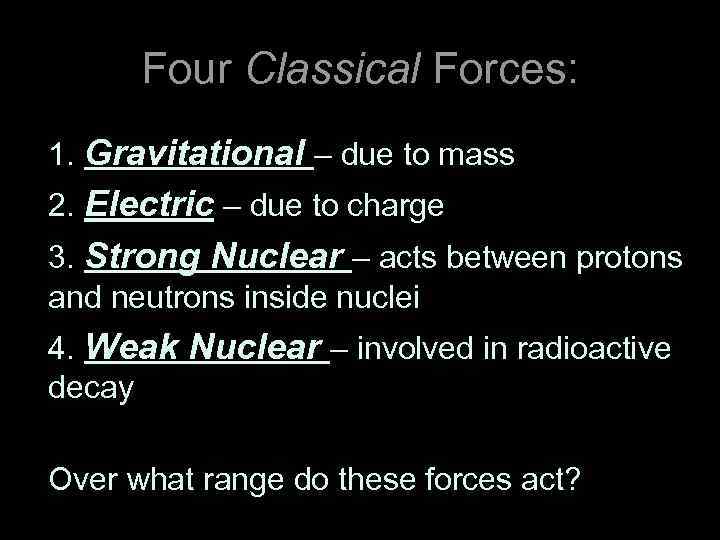 Four Classical Forces: 1. Gravitational – due to mass 2. Electric – due to charge 3. Strong Nuclear – acts between protons and neutrons inside nuclei 4. Weak Nuclear – involved in radioactive decay Over what range do these forces act?
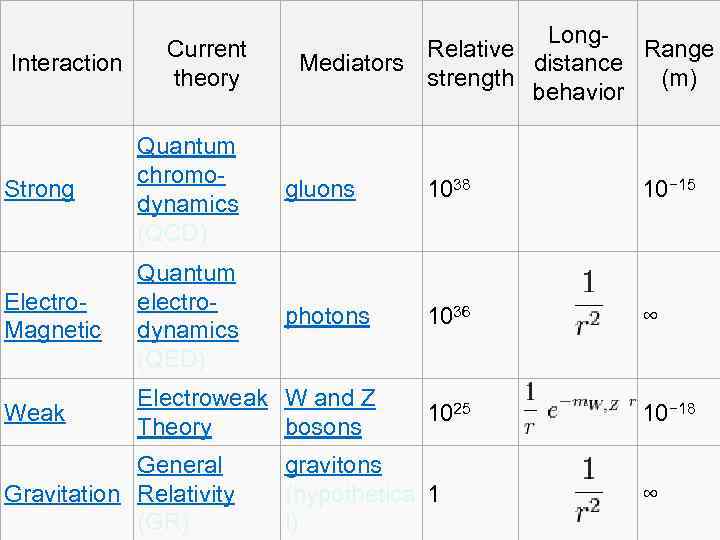 Interaction Current theory Long. Relative Range Mediators distance strength (m) behavior Strong Quantum chromodynamics (QCD) gluons 1038 10− 15 Electro. Magnetic Quantum electrodynamics (QED) photons 1036 ∞ Weak Electroweak W and Z Theory bosons 1025 10− 18 General Gravitation Relativity (GR) gravitons (hypothetica 1 l) ∞
 Big ideas • The BIG goal for some physicists is to unify these four forces. • The Grand Unified Theory (GUT) unifies all except for gravity. • ‘String theory’ can unify all four forces but needs ten dimensions! Also, it is untestable because the energies required are too great.
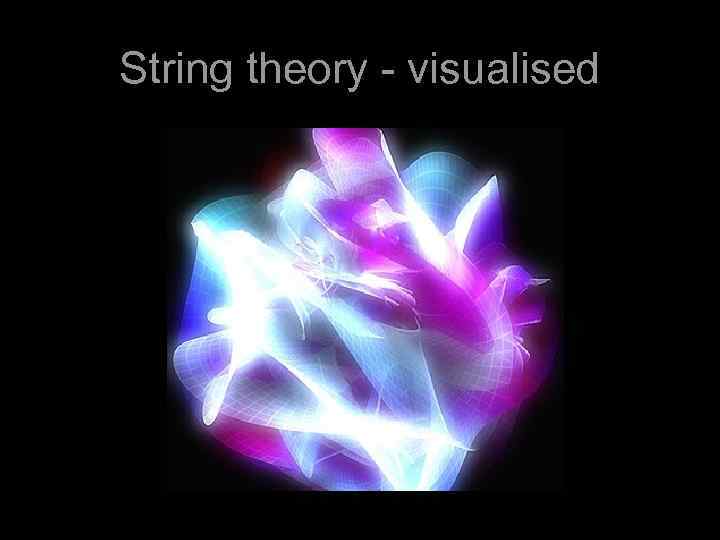 String theory - visualised
 Newtonian Force • Force is any influence that causes an object to undergo any of these: • a change in speed, • a change in direction, • or a change in shape. Force is a Vector, and has both magnitude and _____.
 Forces and Newton’s Laws Expressed Simply, a Force is a push or a pull! More precisely, a force is an interaction between two bodies. (In contrast, a field only involves one body)
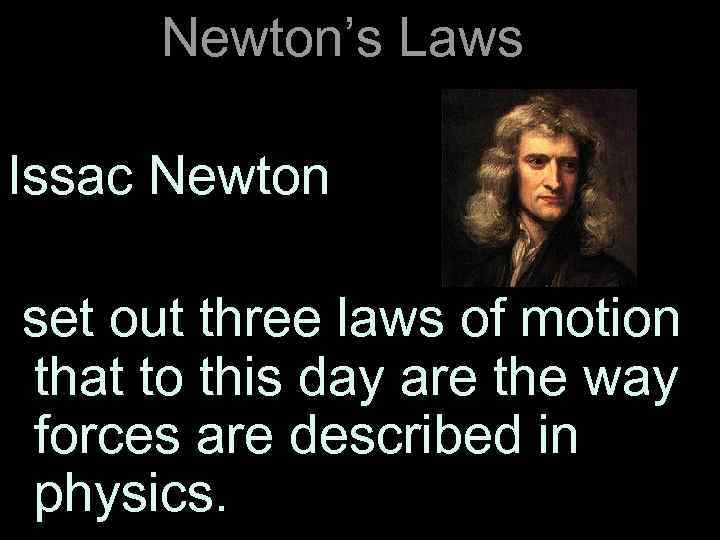 Newton’s Laws Issac Newton set out three laws of motion that to this day are the way forces are described in physics.
 st Law Newton’s 1 (Law of Inertia) An object remains ______, or if in motion moves with uniform velocity, unless acted on by a _____, _______force.
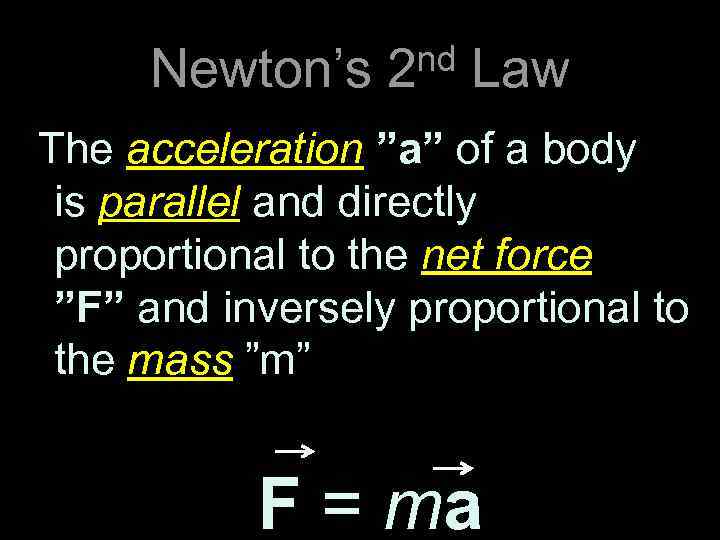 nd Law Newton’s 2 The acceleration ”a” of a body is parallel and directly proportional to the net force ”F” and inversely proportional to the mass ”m” F = ma
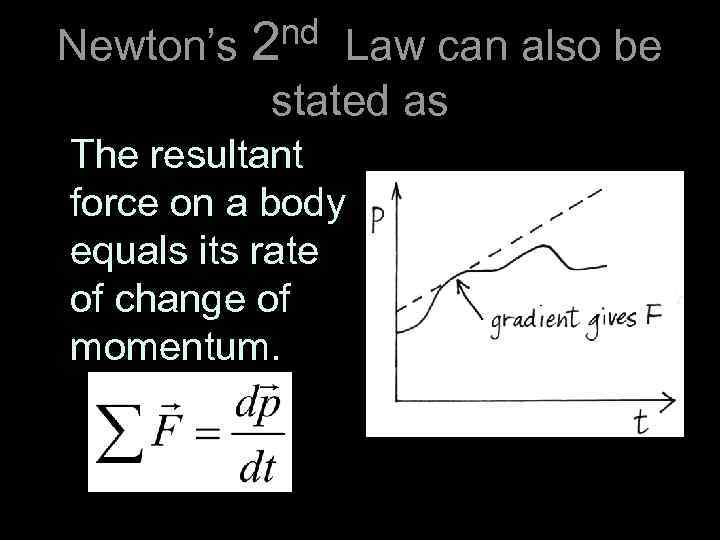 nd Law can also be Newton’s 2 stated as The resultant force on a body equals its rate of change of momentum.
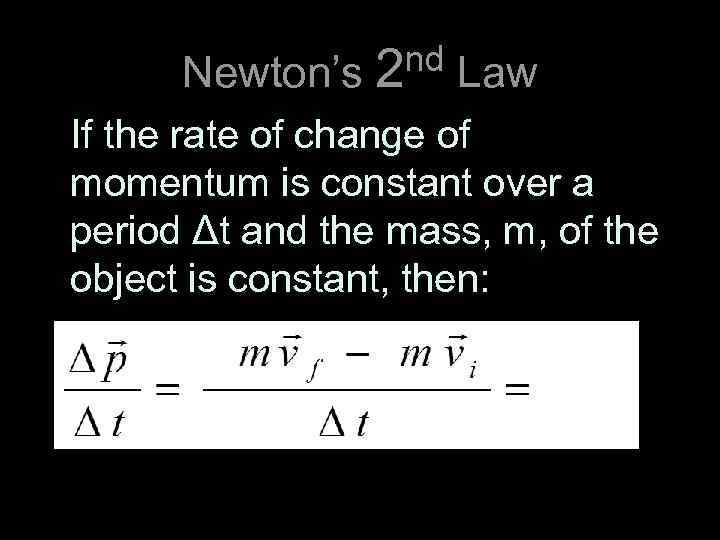 nd Law Newton’s 2 If the rate of change of momentum is constant over a period Δt and the mass, m, of the object is constant, then:
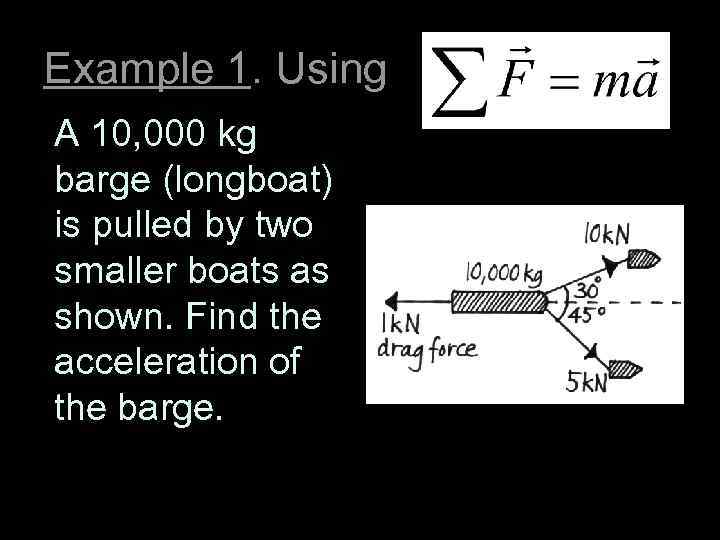 Example 1. Using A 10, 000 kg barge (longboat) is pulled by two smaller boats as shown. Find the acceleration of the barge.
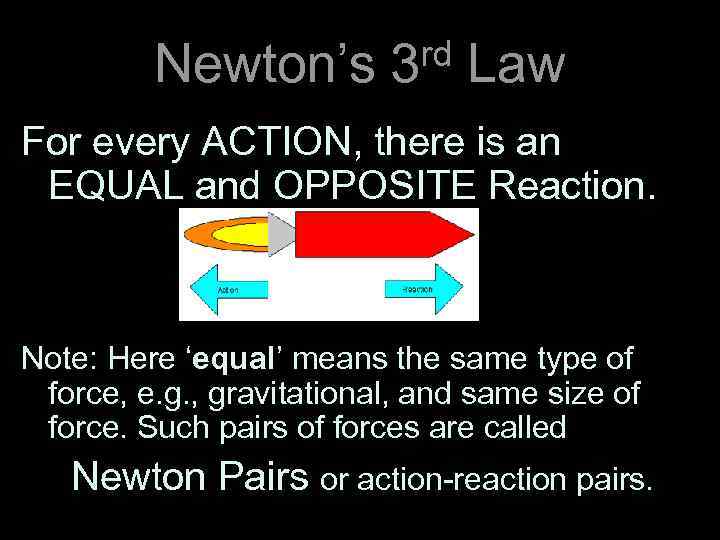 rd Law Newton’s 3 For every ACTION, there is an EQUAL and OPPOSITE Reaction. Note: Here ‘equal’ means the same type of force, e. g. , gravitational, and same size of force. Such pairs of forces are called Newton Pairs or action-reaction pairs.
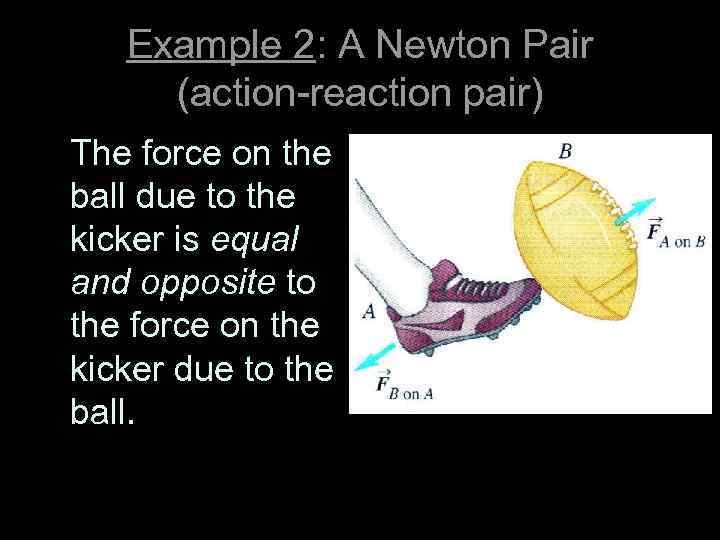 Example 2: A Newton Pair (action-reaction pair) The force on the ball due to the kicker is equal and opposite to the force on the kicker due to the ball.

 Free Body Diagram A free body diagram (FBD) shows the forces acting on one body. An object is pushed along a table top. a) Draw the FBD of the object as it moves with a constant velocity. b) Draw the FBD if the object accelerates.
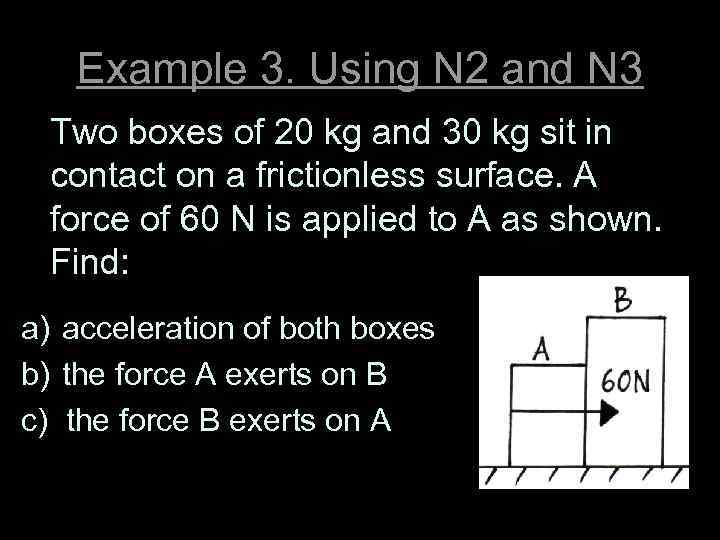 Example 3. Using N 2 and N 3 Two boxes of 20 kg and 30 kg sit in contact on a frictionless surface. A force of 60 N is applied to A as shown. Find: a) acceleration of both boxes b) the force A exerts on B c) the force B exerts on A
 Example 4. Using N 2 Two students are relaxing in their dorm room and are too lazy to get up and shut the door. One of them suggests throwing something at the door, but there are only two things close at hand: • A hard ball of mass “m” or • A soft sticky ball also with mass “m”. The hard ball will bounce off the door, and the sticky ball will stick to the door. Which collision will cause the door to shut the fastest? Why?
 CHECK LIST READING 3. 23 Adams and Allday: 3. 4, 3. 6, 3. 19, 3. 20, 3. 21, 3. 22, • At the end of this lecture you should • Understand what is meant by a force • Be able to name the 4 (classical) forces and understand which of these forces is acting in a variety of situations • Be able to state Newton’s Laws in words and as formulae if applicable • Understand the differential form of Newton’s second law and how it reduces to in the case of constant mass • Be able to perform calculations using Newton’s 2 nd and 3 rd Laws • Understand what is meant by a free body diagram and be able to draw such diagrams in a variety of situations