


 Скачать презентацию Item 20 Prefer class hierarchies to tagged classes
Item 20, 21, 22.pptx
- Количество слайдов: 14
 Item 20: Prefer class hierarchies to tagged classes
 Tagged class – • instances come in two or more flavors; • contain a tag field indicating the flavor of the instance
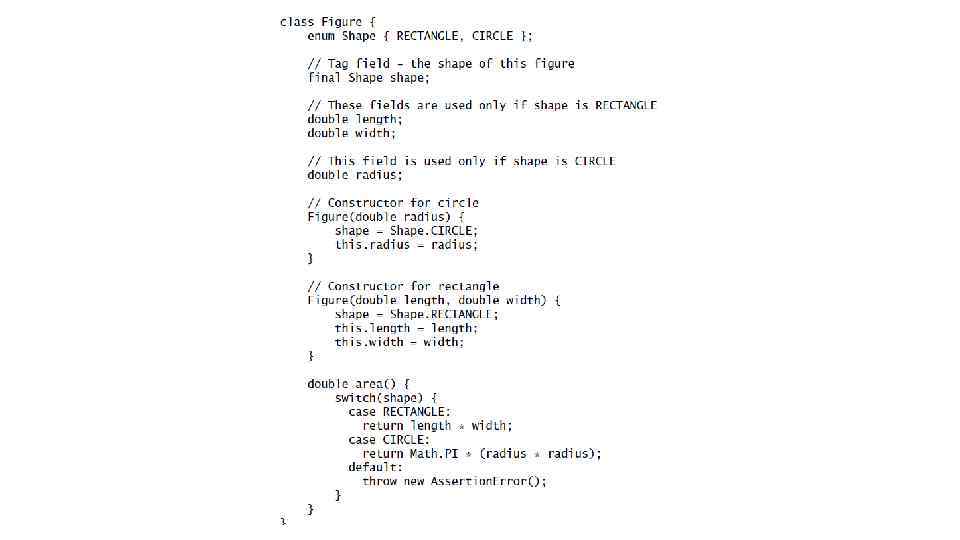
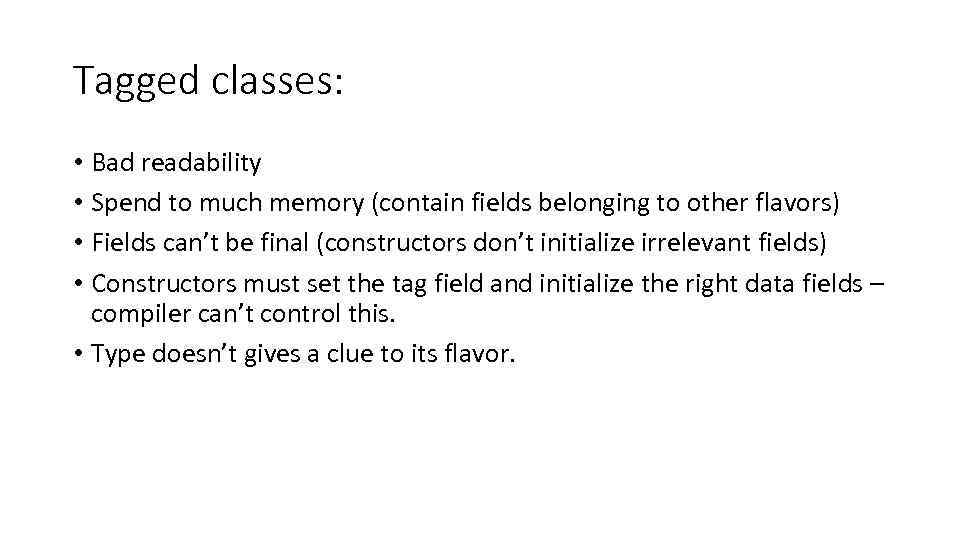 Tagged classes: • Bad readability • Spend to much memory (contain fields belonging to other flavors) • Fields can’t be final (constructors don’t initialize irrelevant fields) • Constructors must set the tag field and initialize the right data fields – compiler can’t control this. • Type doesn’t gives a clue to its flavor.
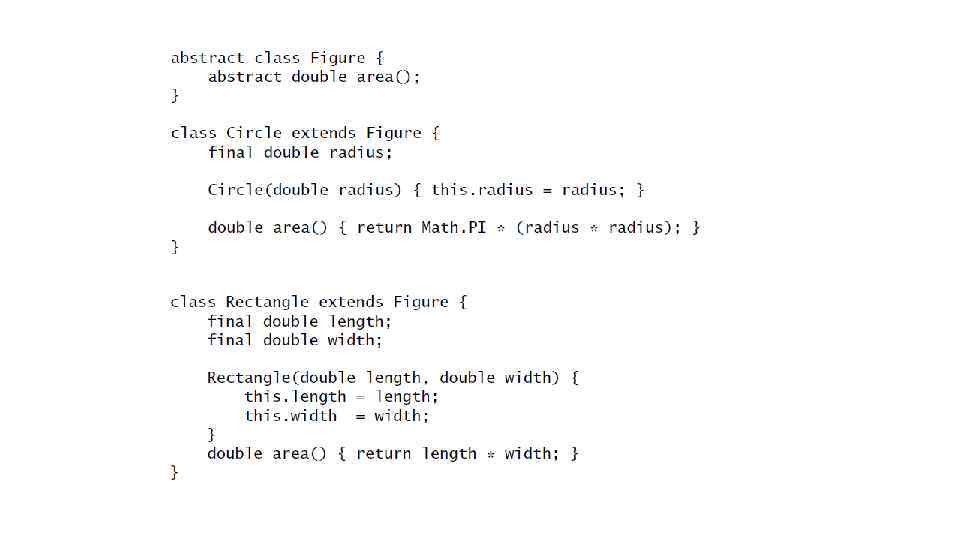
 A tagged class is just imitation of a class hierarchy Refactor tagged class into a hierarchy
 Item 21: Use function objects to represent strategies
 Function object is – An instance of a class that exports exactly one method performing operations on other objects, passed explicitly to the method Example: Comparator
 Concrete strategy • Comparator is concrete strategy for comparison • Typical concrete strategy classes are stateless: has no fields => all instances of the class are functionally equivalent => should be a singleton
 Concrete strategy classes are often declared as anonymous classes Note that using an anonymous class will create a new instance each time the call is executed • If concrete strategy used once – anonymous class • If concrete strategy is designed for repeated use: • Implementation – private static member class • Export – final public static field • Type – strategy interface
 Item 22: Favor static member classes over nonstatic
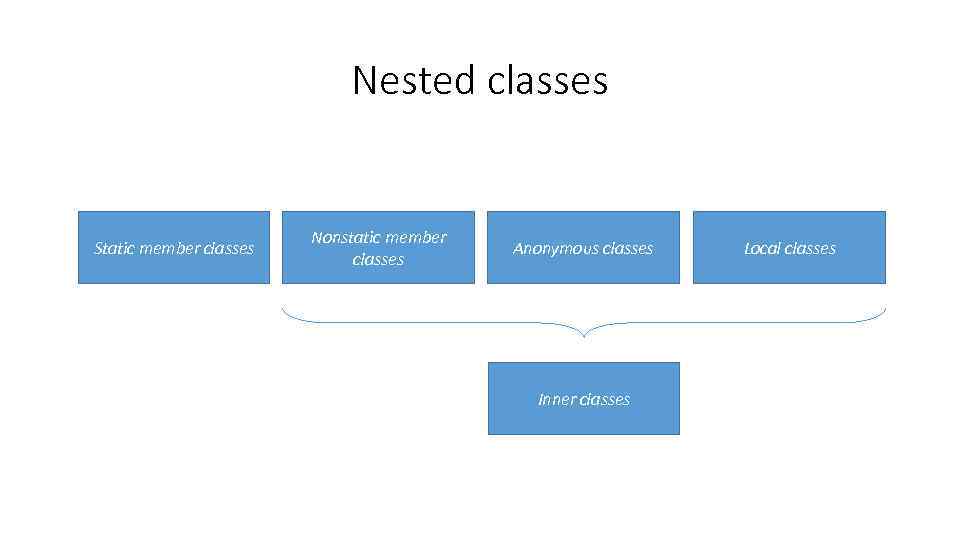 Nested classes Static member classes Nonstatic member classes Anonymous classes Inner classes Local classes
 If you declare a member class that does not require access to an enclosing instance – always put the static modifier in its declaration Nonstatic member class has reference to enclosing instance: • it costs time and resources; • it makes enclosing instance not available for garbage collection.
 Anonymous and local classes should be short – ten a fewer lines