


 Скачать презентацию ITEC 810 Workshop An Analysis of Platforms for
66261c4fd4dff22ed12445bf8b97d234.ppt
- Количество слайдов: 14
 ITEC 810 Workshop An Analysis of Platforms for Scholarly Publication 1 Yun Li 41017919 yun. li 1@students. mq. edu. au Supervisor: Robert Dale
 Agenda l l l 2 Purpose The General Publishing Process A Survey of Journal Publishing Process Automation in the Publishing Process Conclusion
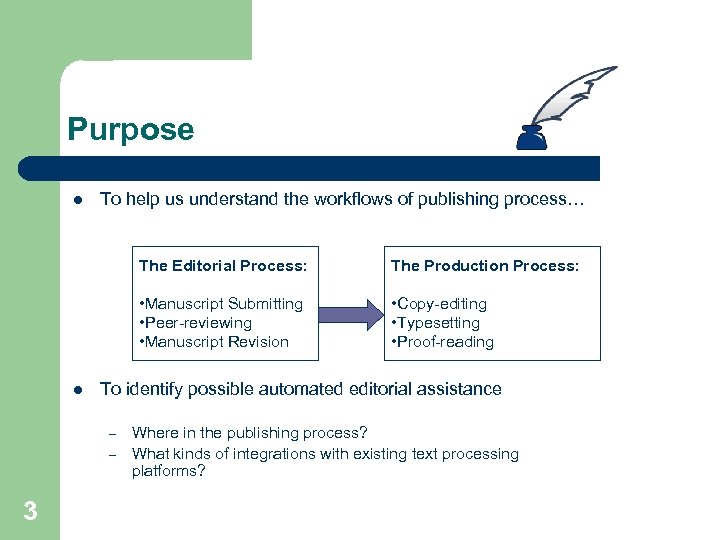 Purpose l To help us understand the workflows of publishing process… The Editorial Process: • Manuscript Submitting • Peer-reviewing • Manuscript Revision l • Copy-editing • Typesetting • Proof-reading To identify possible automated editorial assistance – – 3 The Production Process: Where in the publishing process? What kinds of integrations with existing text processing platforms?
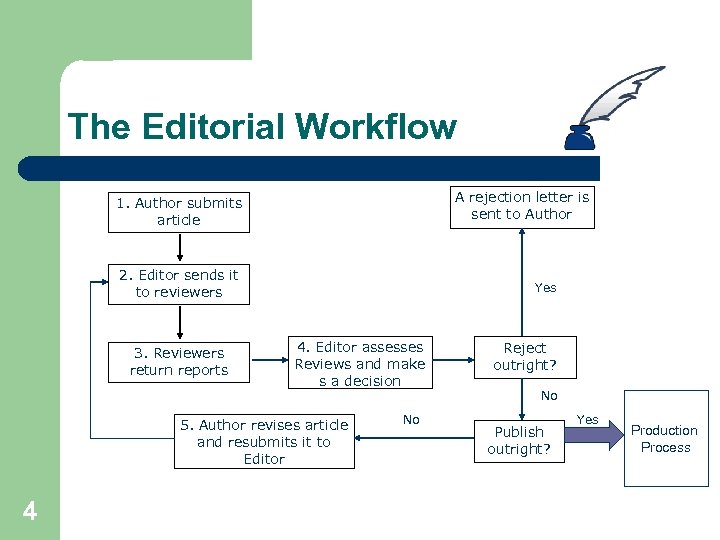 The Editorial Workflow A rejection letter is sent to Author 1. Author submits article 2. Editor sends it to reviewers 3. Reviewers return reports Yes 4. Editor assesses Reviews and make s a decision 5. Author revises article and resubmits it to Editor 4 No Reject outright? No Publish outright? Yes Production Process
 The Production Workflow? l When accepted article is passed into production process… – – – 5 What is the workflow of scholarly journal production process? What roles are involved in it? What text processing platforms do they use?
 Survey of Journal Publishing Process l l A 10 -question web survey distributed by e-mail 400 editors from 360 computer science journals – Editors are identified through information on the websites of 360 A+, A and B ranked journals in the CORE journal ranking list l 100 usable responses (25%) l Questions asked cover some general tasks in production process – – – 6 Copy-editing Typesetting Text processing platform
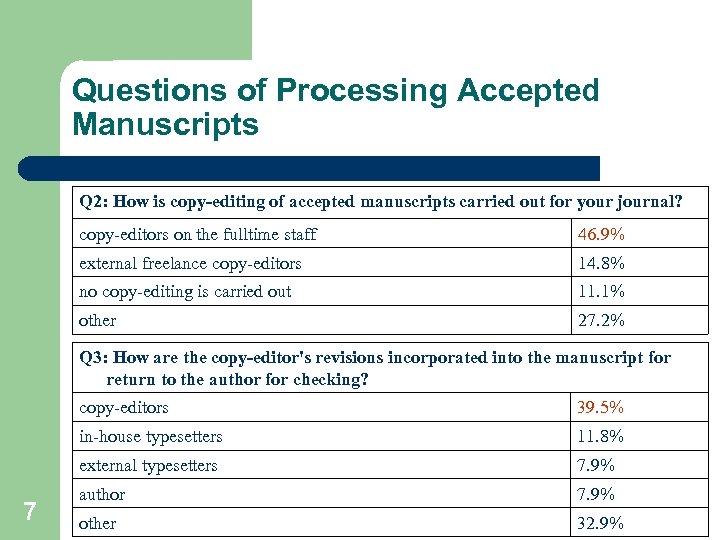 Questions of Processing Accepted Manuscripts Q 2: How is copy-editing of accepted manuscripts carried out for your journal? copy-editors on the fulltime staff 46. 9% external freelance copy-editors 14. 8% no copy-editing is carried out 11. 1% other 27. 2% Q 3: How are the copy-editor's revisions incorporated into the manuscript for return to the author for checking? copy-editors in-house typesetters 11. 8% external typesetters 7 39. 5% 7. 9% author 7. 9% other 32. 9%
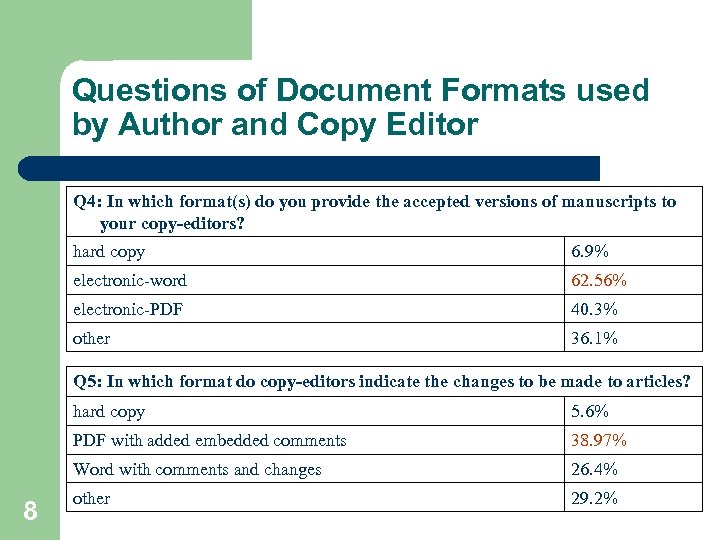 Questions of Document Formats used by Author and Copy Editor Q 4: In which format(s) do you provide the accepted versions of manuscripts to your copy-editors? hard copy 6. 9% electronic-word 62. 56% electronic-PDF 40. 3% other 36. 1% Q 5: In which format do copy-editors indicate the changes to be made to articles? hard copy PDF with added embedded comments 38. 97% Word with comments and changes 8 5. 6% 26. 4% other 29. 2%
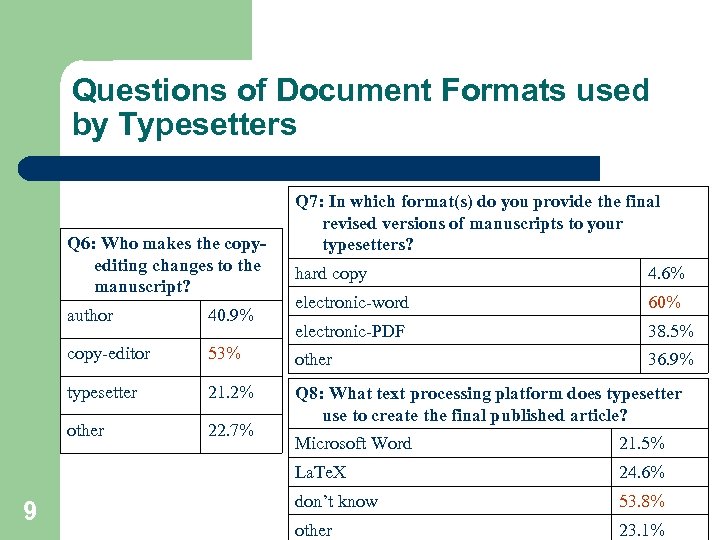 Questions of Document Formats used by Typesetters Q 6: Who makes the copyediting changes to the manuscript? Q 7: In which format(s) do you provide the final revised versions of manuscripts to your typesetters? hard copy 4. 6% electronic-word 60% electronic-PDF 38. 5% 36. 9% author 40. 9% copy-editor 53% other typesetter 21. 2% other 22. 7% Q 8: What text processing platform does typesetter use to create the final published article? 21. 5% La. Te. X 9 Microsoft Word 24. 6% don’t know 53. 8% other 23. 1%
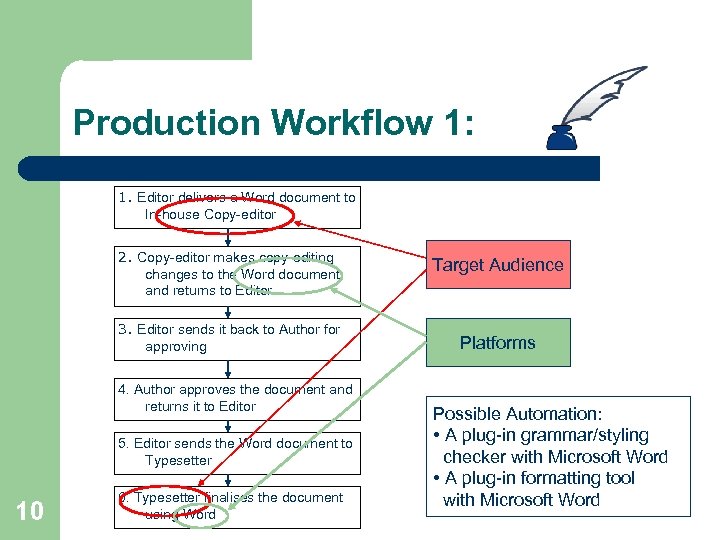 Production Workflow 1: 1. Editor delivers a Word document to In-house Copy-editor 2. Copy-editor makes copy-editing changes to the Word document, and returns to Editor 3. Editor sends it back to Author for approving 4. Author approves the document and returns it to Editor 5. Editor sends the Word document to Typesetter 10 6. Typesetter finalises the document using Word Target Audience Platforms Possible Automation: • A plug-in grammar/styling checker with Microsoft Word • A plug-in formatting tool with Microsoft Word
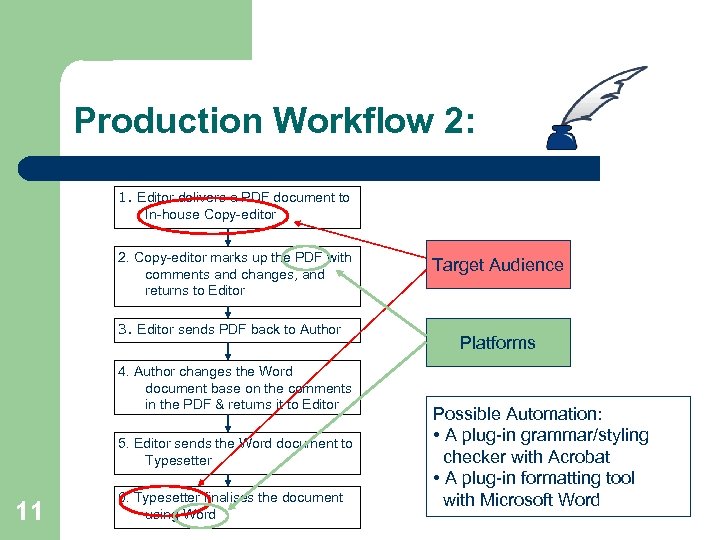 Production Workflow 2: 1. Editor delivers a PDF document to In-house Copy-editor 2. Copy-editor marks up the PDF with comments and changes, and returns to Editor 3. Editor sends PDF back to Author 4. Author changes the Word document base on the comments in the PDF & returns it to Editor 5. Editor sends the Word document to Typesetter 11 6. Typesetter finalises the document using Word Target Audience Platforms Possible Automation: • A plug-in grammar/styling checker with Acrobat • A plug-in formatting tool with Microsoft Word
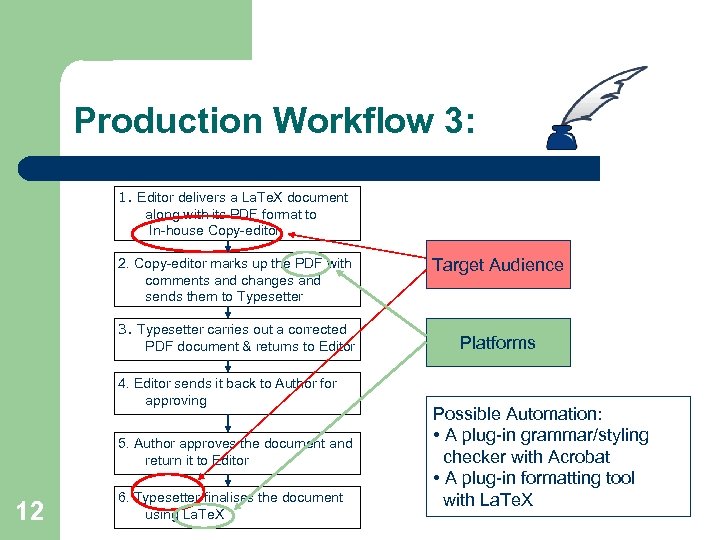 Production Workflow 3: 1. Editor delivers a La. Te. X document along with its PDF format to In-house Copy-editor 2. Copy-editor marks up the PDF with comments and changes and sends them to Typesetter 3. Typesetter carries out a corrected PDF document & returns to Editor 4. Editor sends it back to Author for approving 5. Author approves the document and return it to Editor 12 6. Typesetter finalises the document using La. Te. X Target Audience Platforms Possible Automation: • A plug-in grammar/styling checker with Acrobat • A plug-in formatting tool with La. Te. X
 Before we finish… l We discussed the general publishing process – – l l 13 Editorial process Production process We explained the workflows of these processes We also suggested some possible automation in the workflows
 Questions…? 14