


 Скачать презентацию ITEC 715 Computer Foundations for Instructional Multimedia Week
fa93ee804143480512b7381762842371.ppt
- Количество слайдов: 49
 ITEC 715 Computer Foundations for Instructional Multimedia Week 4
 Recall from Last Week Elements of Good Screen Design
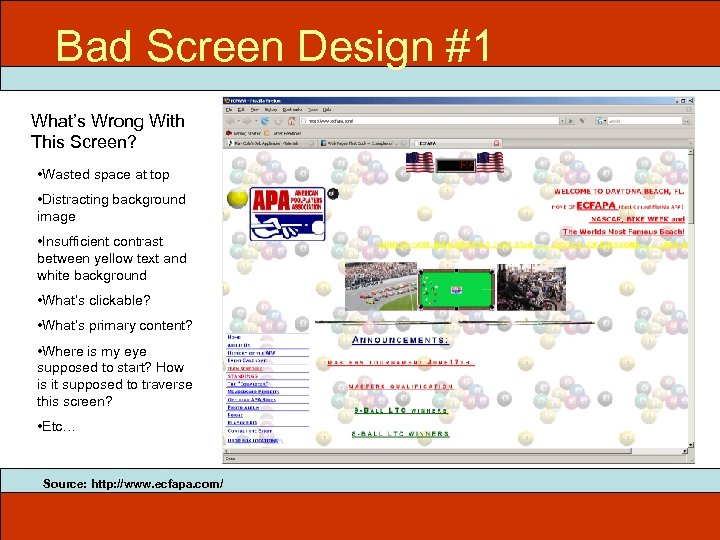 Bad Screen Design #1 What’s Wrong With This Screen? • Wasted space at top • Distracting background image • Insufficient contrast between yellow text and white background • What’s clickable? • What’s primary content? • Where is my eye supposed to start? How is it supposed to traverse this screen? • Etc… Source: http: //www. ecfapa. com/
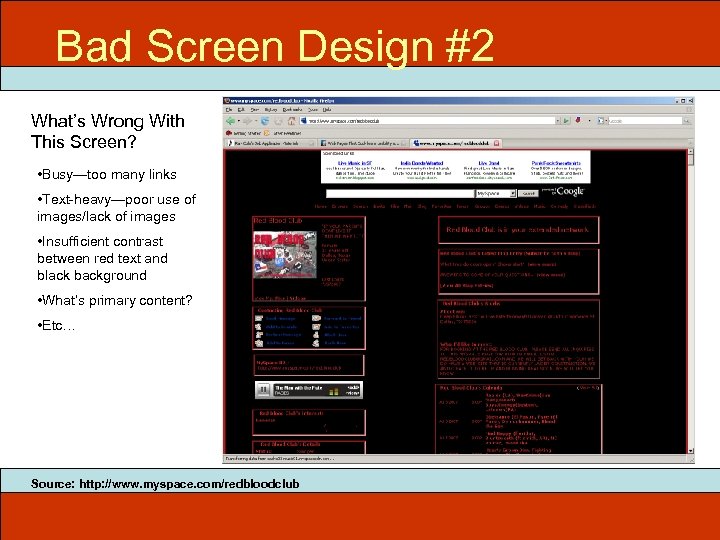 Bad Screen Design #2 What’s Wrong With This Screen? • Busy—too many links • Text-heavy—poor use of images/lack of images • Insufficient contrast between red text and black background • What’s primary content? • Etc… Source: http: //www. myspace. com/redbloodclub
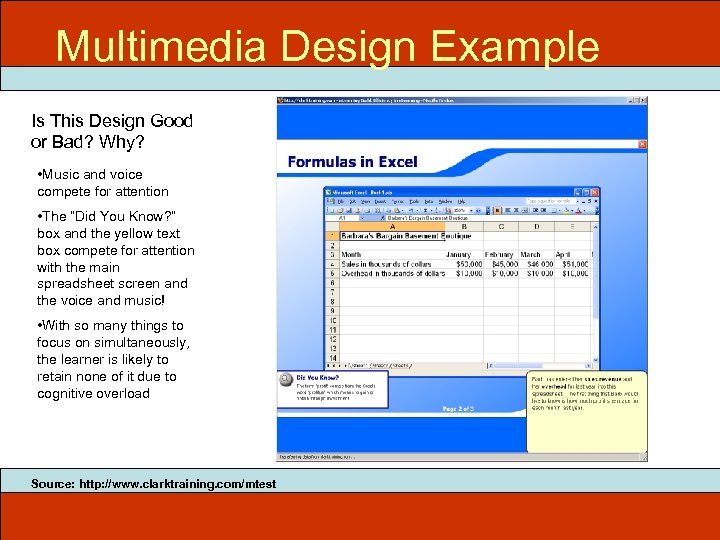 Multimedia Design Example Is This Design Good or Bad? Why? • Music and voice compete for attention • The “Did You Know? ” box and the yellow text box compete for attention with the main spreadsheet screen and the voice and music! • With so many things to focus on simultaneously, the learner is likely to retain none of it due to cognitive overload Source: http: //www. clarktraining. com/mtest
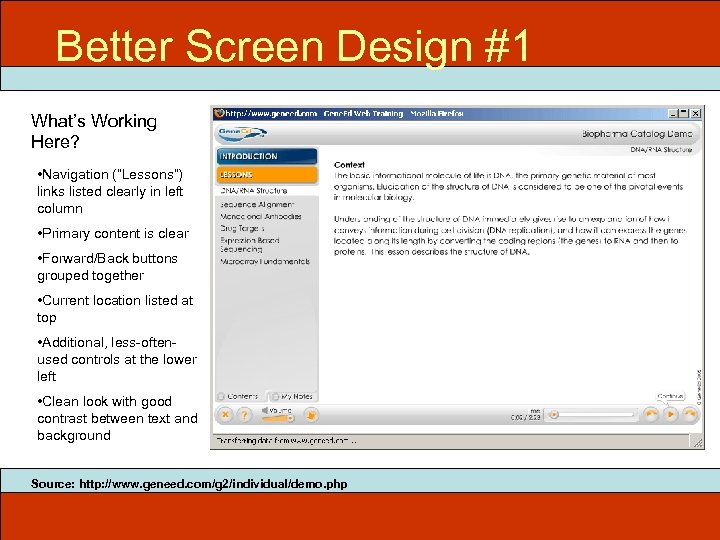 Better Screen Design #1 What’s Working Here? • Navigation (“Lessons”) links listed clearly in left column • Primary content is clear • Forward/Back buttons grouped together • Current location listed at top • Additional, less-oftenused controls at the lower left • Clean look with good contrast between text and background Source: http: //www. geneed. com/g 2/individual/demo. php
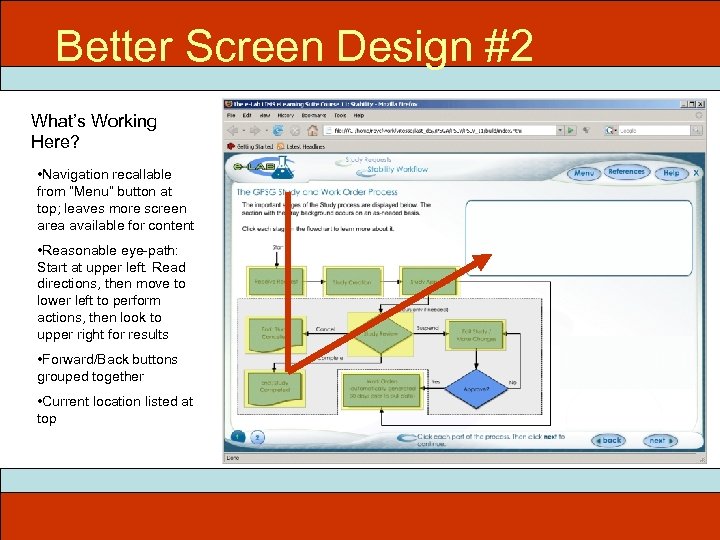 Better Screen Design #2 What’s Working Here? • Navigation recallable from “Menu” button at top; leaves more screen area available for content • Reasonable eye-path: Start at upper left. Read directions, then move to lower left to perform actions, then look to upper right for results • Forward/Back buttons grouped together • Current location listed at top
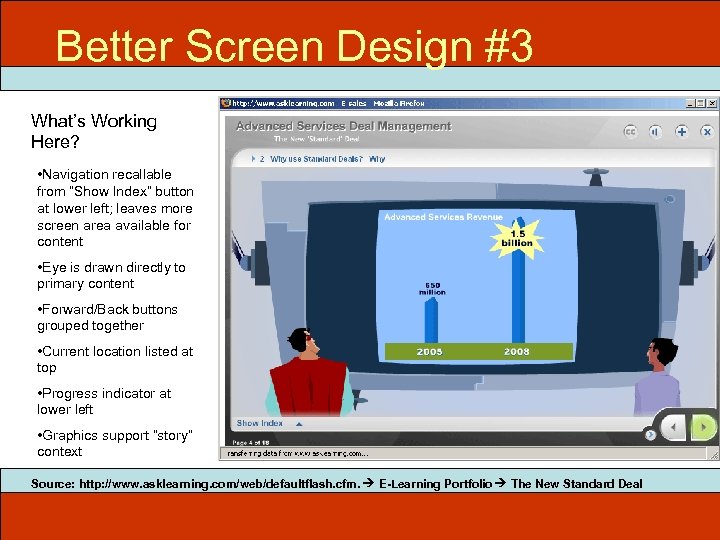 Better Screen Design #3 What’s Working Here? • Navigation recallable from “Show Index” button at lower left; leaves more screen area available for content • Eye is drawn directly to primary content • Forward/Back buttons grouped together • Current location listed at top • Progress indicator at lower left • Graphics support “story” context Source: http: //www. asklearning. com/web/defaultflash. cfm. E-Learning Portfolio The New Standard Deal
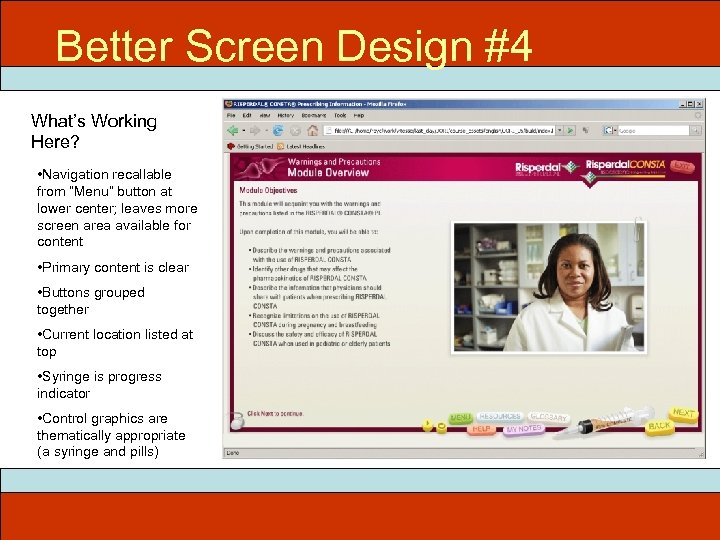 Better Screen Design #4 What’s Working Here? • Navigation recallable from “Menu” button at lower center; leaves more screen area available for content • Primary content is clear • Buttons grouped together • Current location listed at top • Syringe is progress indicator • Control graphics are thematically appropriate (a syringe and pills)
 Screen Design Principles Layout Principles • “CRAP”—Contrast, Repetition, Alignment, Proximity. See http: //www. thinkvitamin. com/features/design/how-crap-is-your-site-design • Colors—If you’re not sure what colors go with each other, hunt down some online visual art, screen capture it, then use Photoshop’s Eye-dropper tool to select some colors from the artist’s pallete. Or, visit a paint store and get some color combination cards. Navigation Principles • Learner should have a good idea of what will happen when clicking any button or link • Learner should be able to easily move around in the course—at least forward/back one page and to the start of any topic • If the learner receives feedback that he or she did something incorrectly, consider including a link to the portion of the course which explains how to do the task correctly • Place navigation controls in the same place on every screen; don’t let forward/back or other navigation buttons “jump” around from screen to screen
 Screen Design Resources ITEC 715 • Good Design list: http: //www. urlsinternetcafe. com/classroom/featuresgood. html • Bad Design list: http: //www. urlsinternetcafe. com/classroom/featuresbad. html • CRAP (Contrast, Repetition, Alignment, Proximity): http: //www. thinkvitamin. com/features/design/how-crap-is-your-site-design
 This Week Navigation Review (Break into groups and critique each other’s navigation mockups)
 Design Considerations for Designing, Using, and Choosing Effective Graphics
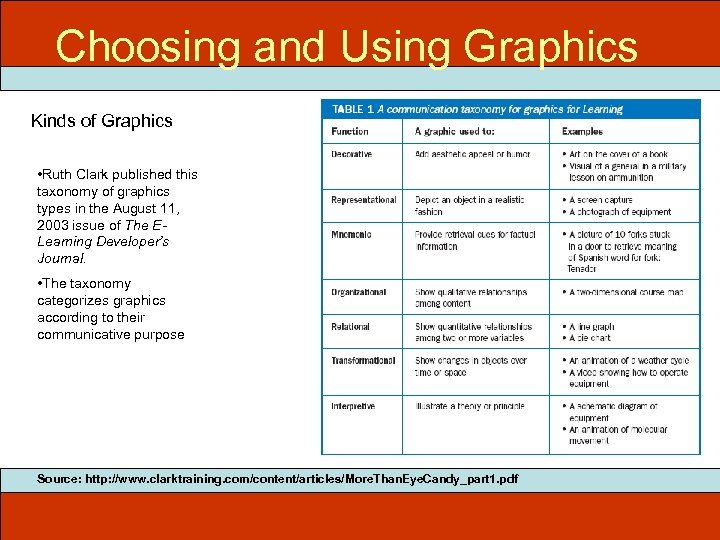 Choosing and Using Graphics Kinds of Graphics • Ruth Clark published this taxonomy of graphics types in the August 11, 2003 issue of The ELearning Developer’s Journal. • The taxonomy categorizes graphics according to their communicative purpose Source: http: //www. clarktraining. com/content/articles/More. Than. Eye. Candy_part 1. pdf
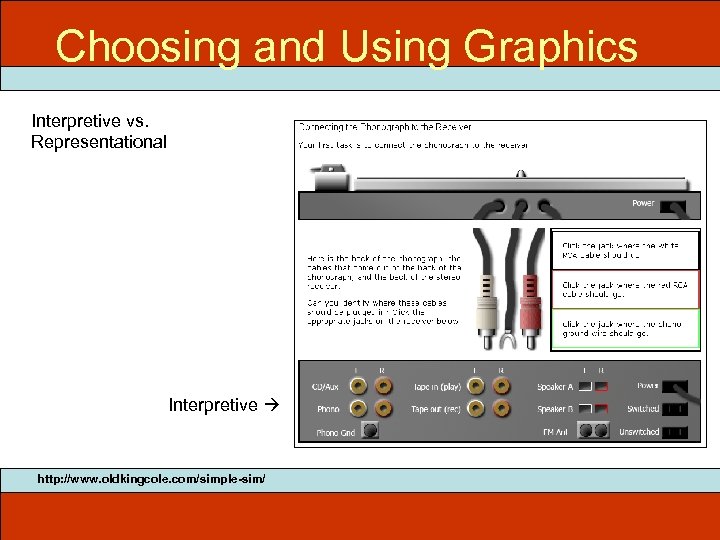 Choosing and Using Graphics Interpretive vs. Representational Interpretive http: //www. oldkingcole. com/simple-sim/
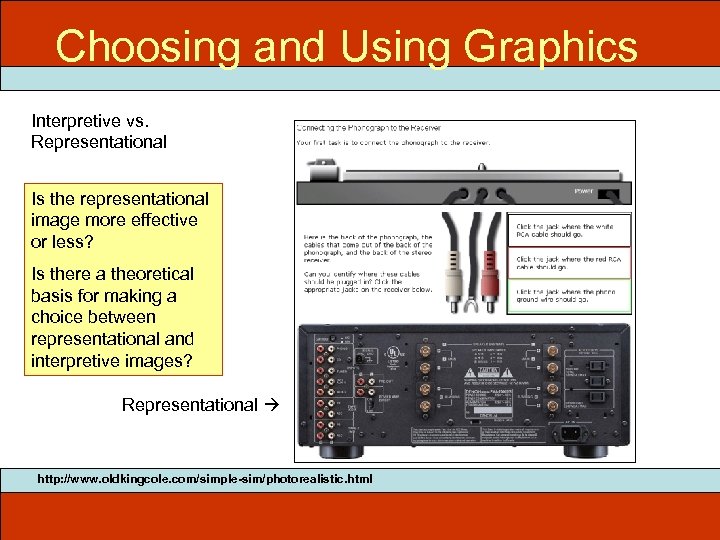 Choosing and Using Graphics Interpretive vs. Representational Is the representational image more effective or less? Is there a theoretical basis for making a choice between representational and interpretive images? Representational http: //www. oldkingcole. com/simple-sim/photorealistic. html
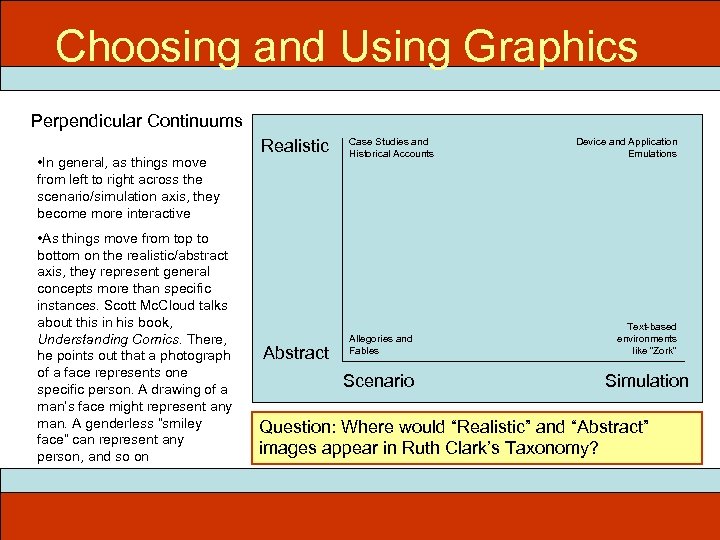 Choosing and Using Graphics Perpendicular Continuums • In general, as things move from left to right across the scenario/simulation axis, they become more interactive • As things move from top to bottom on the realistic/abstract axis, they represent general concepts more than specific instances. Scott Mc. Cloud talks about this in his book, Understanding Comics. There, he points out that a photograph of a face represents one specific person. A drawing of a man’s face might represent any man. A genderless “smiley face” can represent any person, and so on Realistic Case Studies and Historical Accounts Device and Application Emulations Text-based environments like “Zork” Scenario Abstract Allegories and Fables Simulation Question: Where would “Realistic” and “Abstract” images appear in Ruth Clark’s Taxonomy?
 A Divide and Conquer Approach to E-learning Design and Production
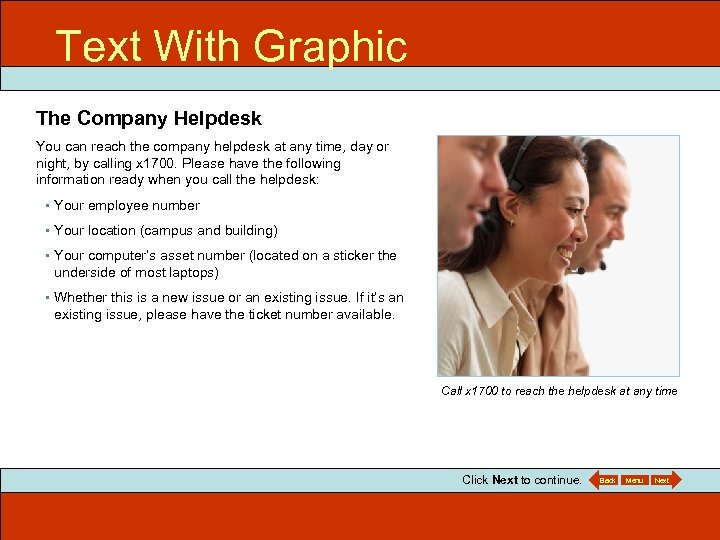 Text With Graphic ITEC 715 The Company Helpdesk You can reach the company helpdesk at any time, day or night, by calling x 1700. Please have the following information ready when you call the helpdesk: • Your employee number • Your location (campus and building) • Your computer’s asset number (located on a sticker the underside of most laptops) • Whether this is a new issue or an existing issue. If it’s an existing issue, please have the ticket number available. Call x 1700 to reach the helpdesk at any time Click Next to continue. Back Menu Next
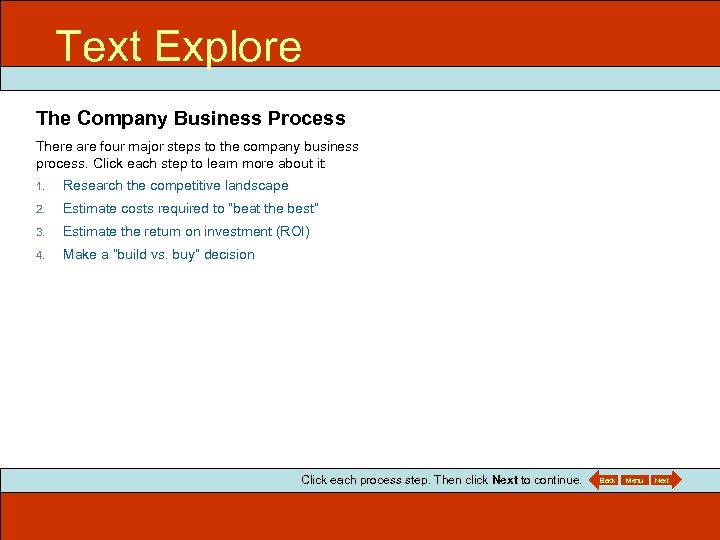 Text Explore ITEC 715 The Company Business Process There are four major steps to the company business process. Click each step to learn more about it: 1. Research the competitive landscape 2. Estimate costs required to “beat the best” 3. Estimate the return on investment (ROI) 4. Make a “build vs. buy” decision Click each process step. Then click Next to continue. Back Menu Next
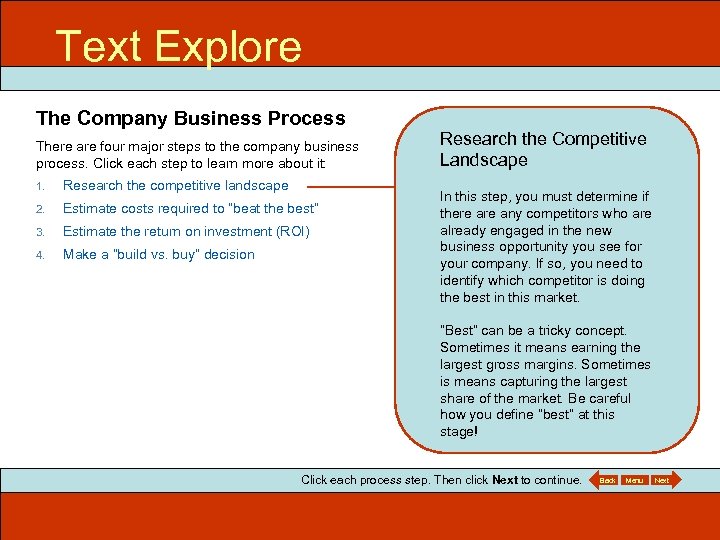 Text Explore ITEC 715 The Company Business Process There are four major steps to the company business process. Click each step to learn more about it: 1. Research the competitive landscape 2. Estimate costs required to “beat the best” 3. Estimate the return on investment (ROI) 4. Make a “build vs. buy” decision Research the Competitive Landscape In this step, you must determine if there any competitors who are already engaged in the new business opportunity you see for your company. If so, you need to identify which competitor is doing the best in this market. “Best” can be a tricky concept. Sometimes it means earning the largest gross margins. Sometimes is means capturing the largest share of the market. Be careful how you define “best” at this stage! Click each process step. Then click Next to continue. Back Menu Next
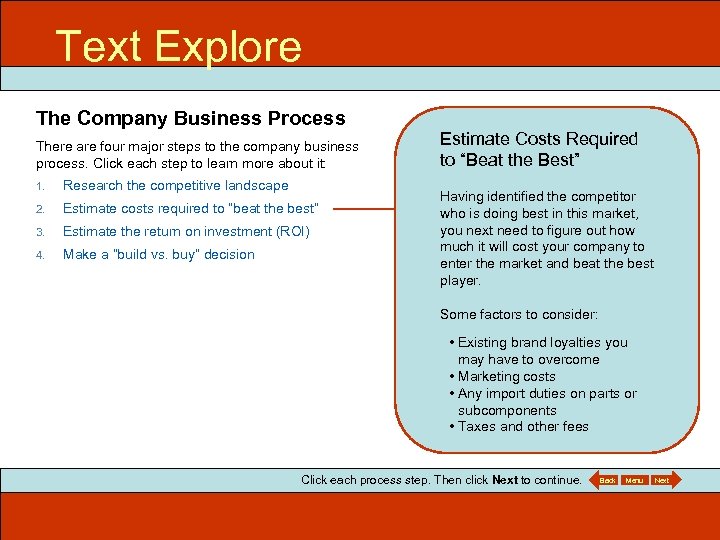 Text Explore ITEC 715 The Company Business Process There are four major steps to the company business process. Click each step to learn more about it: 1. Research the competitive landscape 2. Estimate costs required to “beat the best” 3. Estimate the return on investment (ROI) 4. Make a “build vs. buy” decision Estimate Costs Required to “Beat the Best” Having identified the competitor who is doing best in this market, you next need to figure out how much it will cost your company to enter the market and beat the best player. Some factors to consider: • Existing brand loyalties you may have to overcome • Marketing costs • Any import duties on parts or subcomponents • Taxes and other fees Click each process step. Then click Next to continue. Back Menu Next
 Text Explore ITEC 715 The Company Business Process There are four major steps to the company business process. Click each step to learn more about it: 1. Research the competitive landscape 2. Estimate costs required to “beat the best” 3. Estimate the return on investment (ROI) 4. Estimate the Return on Investment (ROI) Make a “build vs. buy” decision To compute the ROI,
 Text Explore ITEC 715 The Company Business Process There are four major steps to the company business process. Click each step to learn more about it: 1. Research the competitive landscape 2. Estimate costs required to “beat the best” 3. Estimate the return on investment (ROI) 4. Make a “build vs. buy” decision Make a “Build vs. Buy” Decision Factors to consider in making this decision include: • Blah • Yadda Click each process step. Then click Next to continue. Back Menu Next
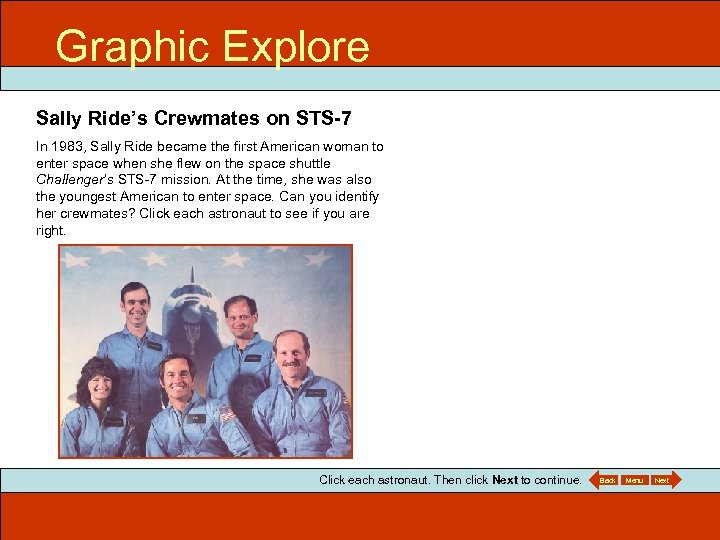 Graphic Explore 715 ITEC Sally Ride’s Crewmates on STS-7 In 1983, Sally Ride became the first American woman to enter space when she flew on the space shuttle Challenger’s STS-7 mission. At the time, she was also the youngest American to enter space. Can you identify her crewmates? Click each astronaut to see if you are right. Click each astronaut. Then click Next to continue. Back Menu Next
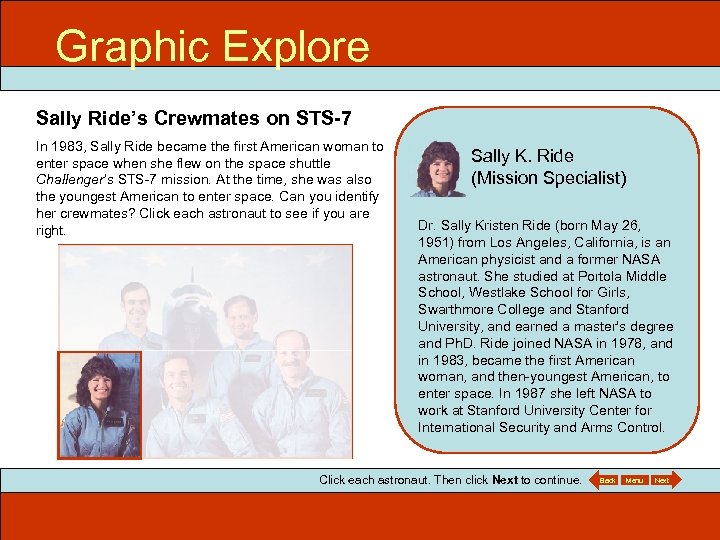 Graphic Explore 715 ITEC Sally Ride’s Crewmates on STS-7 In 1983, Sally Ride became the first American woman to enter space when she flew on the space shuttle Challenger’s STS-7 mission. At the time, she was also the youngest American to enter space. Can you identify her crewmates? Click each astronaut to see if you are right. Sally K. Ride (Mission Specialist) Dr. Sally Kristen Ride (born May 26, 1951) from Los Angeles, California, is an American physicist and a former NASA astronaut. She studied at Portola Middle School, Westlake School for Girls, Swarthmore College and Stanford University, and earned a master's degree and Ph. D. Ride joined NASA in 1978, and in 1983, became the first American woman, and then-youngest American, to enter space. In 1987 she left NASA to work at Stanford University Center for International Security and Arms Control. Click each astronaut. Then click Next to continue. Back Menu Next
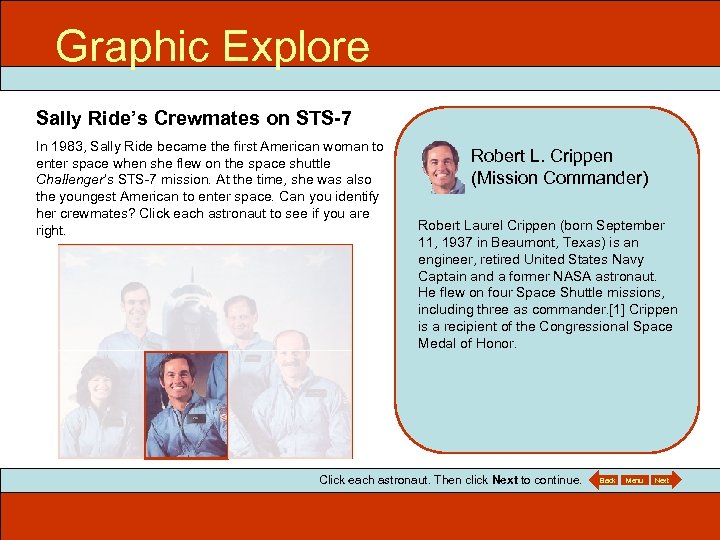 Graphic Explore 715 ITEC Sally Ride’s Crewmates on STS-7 In 1983, Sally Ride became the first American woman to enter space when she flew on the space shuttle Challenger’s STS-7 mission. At the time, she was also the youngest American to enter space. Can you identify her crewmates? Click each astronaut to see if you are right. Robert L. Crippen (Mission Commander) Robert Laurel Crippen (born September 11, 1937 in Beaumont, Texas) is an engineer, retired United States Navy Captain and a former NASA astronaut. He flew on four Space Shuttle missions, including three as commander. [1] Crippen is a recipient of the Congressional Space Medal of Honor. Click each astronaut. Then click Next to continue. Back Menu Next
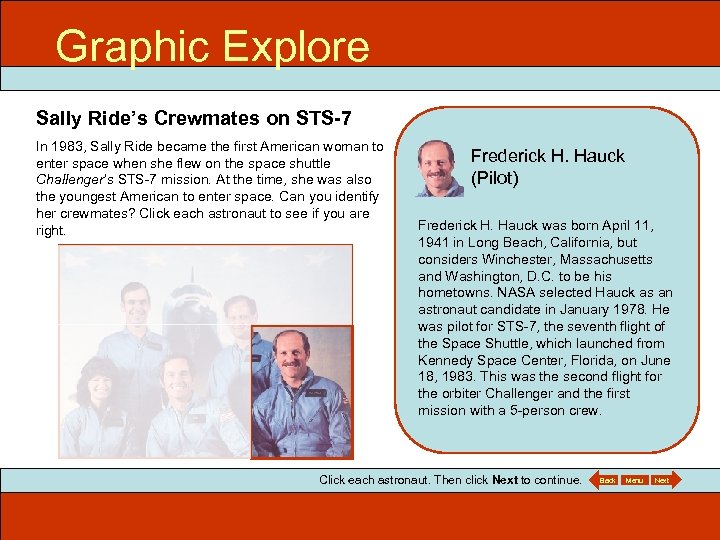 Graphic Explore 715 ITEC Sally Ride’s Crewmates on STS-7 In 1983, Sally Ride became the first American woman to enter space when she flew on the space shuttle Challenger’s STS-7 mission. At the time, she was also the youngest American to enter space. Can you identify her crewmates? Click each astronaut to see if you are right. Frederick H. Hauck (Pilot) Frederick H. Hauck was born April 11, 1941 in Long Beach, California, but considers Winchester, Massachusetts and Washington, D. C. to be his hometowns. NASA selected Hauck as an astronaut candidate in January 1978. He was pilot for STS-7, the seventh flight of the Space Shuttle, which launched from Kennedy Space Center, Florida, on June 18, 1983. This was the second flight for the orbiter Challenger and the first mission with a 5 -person crew. Click each astronaut. Then click Next to continue. Back Menu Next
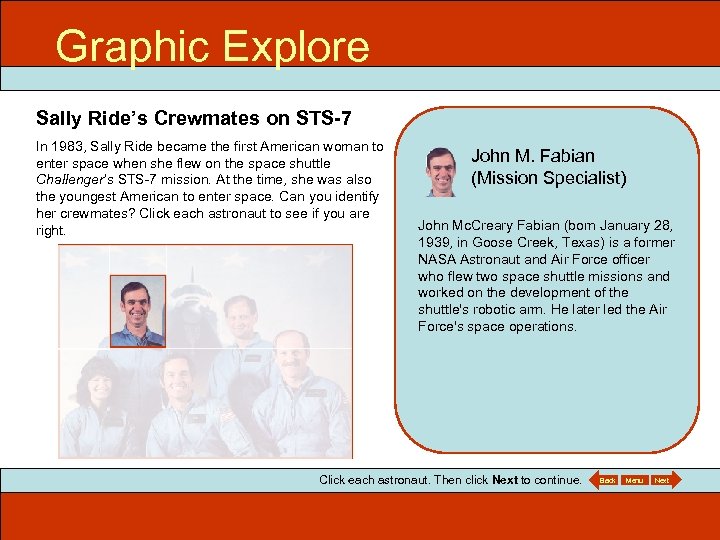 Graphic Explore 715 ITEC Sally Ride’s Crewmates on STS-7 In 1983, Sally Ride became the first American woman to enter space when she flew on the space shuttle Challenger’s STS-7 mission. At the time, she was also the youngest American to enter space. Can you identify her crewmates? Click each astronaut to see if you are right. John M. Fabian (Mission Specialist) John Mc. Creary Fabian (born January 28, 1939, in Goose Creek, Texas) is a former NASA Astronaut and Air Force officer who flew two space shuttle missions and worked on the development of the shuttle's robotic arm. He later led the Air Force's space operations. Click each astronaut. Then click Next to continue. Back Menu Next
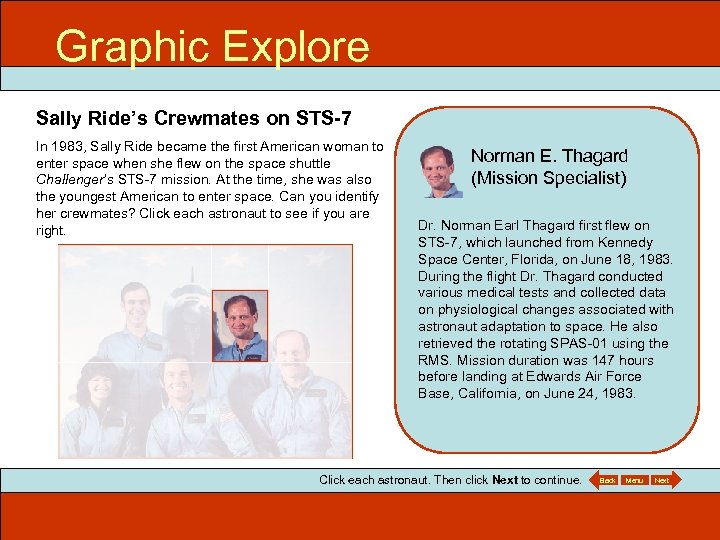 Graphic Explore 715 ITEC Sally Ride’s Crewmates on STS-7 In 1983, Sally Ride became the first American woman to enter space when she flew on the space shuttle Challenger’s STS-7 mission. At the time, she was also the youngest American to enter space. Can you identify her crewmates? Click each astronaut to see if you are right. Norman E. Thagard (Mission Specialist) Dr. Norman Earl Thagard first flew on STS-7, which launched from Kennedy Space Center, Florida, on June 18, 1983. During the flight Dr. Thagard conducted various medical tests and collected data on physiological changes associated with astronaut adaptation to space. He also retrieved the rotating SPAS-01 using the RMS. Mission duration was 147 hours before landing at Edwards Air Force Base, California, on June 24, 1983. Click each astronaut. Then click Next to continue. Back Menu Next
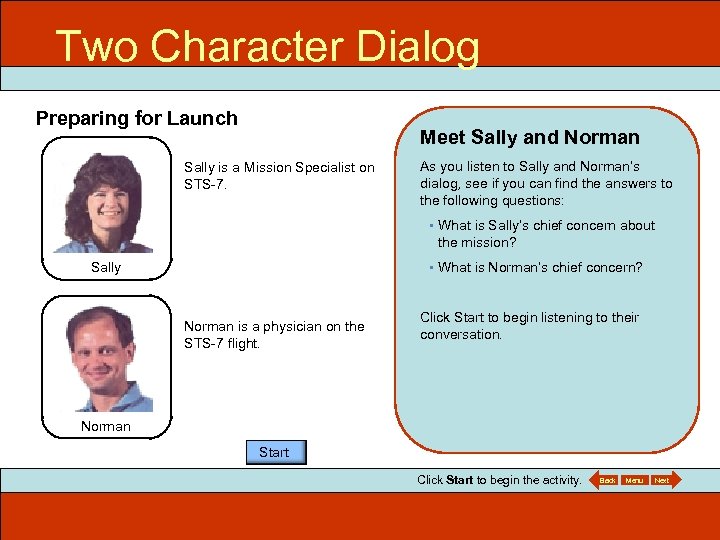 Two Character Dialog ITEC 715 Preparing for Launch Meet Sally and Norman Sally is a Mission Specialist on STS-7. As you listen to Sally and Norman’s dialog, see if you can find the answers to the following questions: • What is Sally’s chief concern about the mission? • What is Norman’s chief concern? Sally Norman is a physician on the STS-7 flight. Click Start to begin listening to their conversation. Norman Start Click Start to begin the activity. Back Menu Next
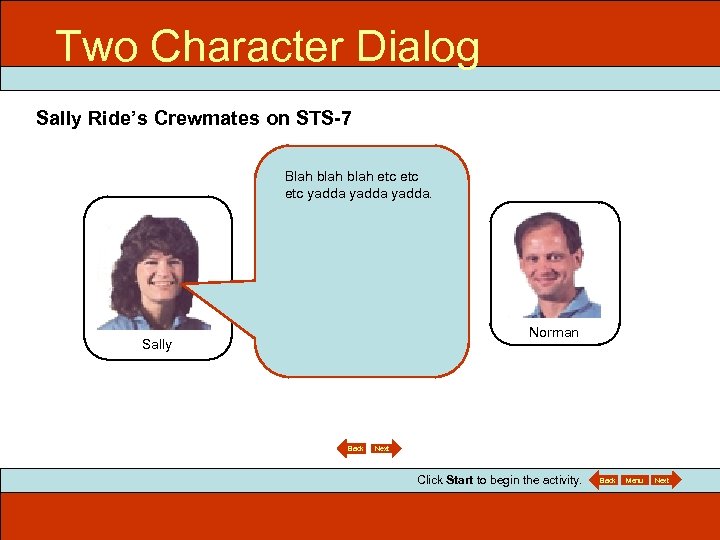 Two Character Dialog ITEC 715 Sally Ride’s Crewmates on STS-7 Blah blah etc etc yadda. Norman Sally Back Next Click Start to begin the activity. Back Menu Next
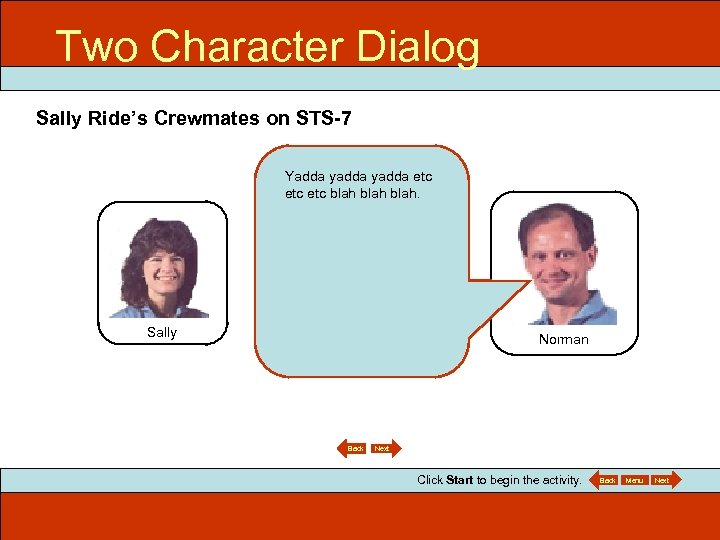 Two Character Dialog ITEC 715 Sally Ride’s Crewmates on STS-7 Yadda yadda etc etc blah. Sally Norman Back Next Click Start to begin the activity. Back Menu Next
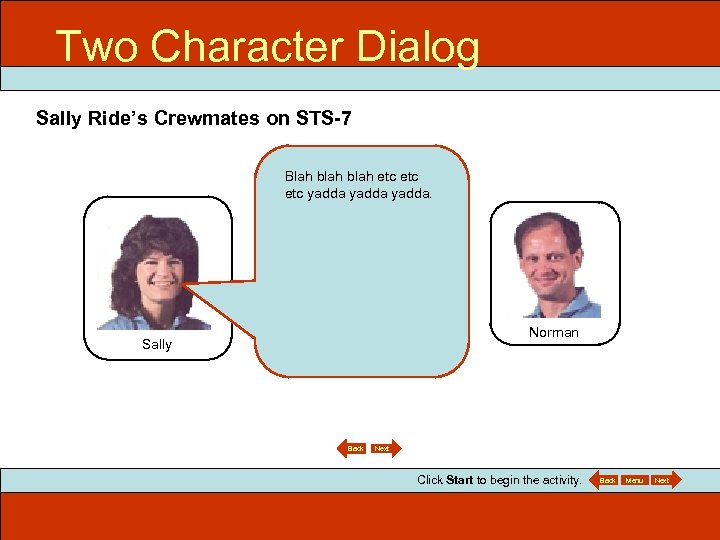 Two Character Dialog ITEC 715 Sally Ride’s Crewmates on STS-7 Blah blah etc etc yadda. Norman Sally Back Next Click Start to begin the activity. Back Menu Next
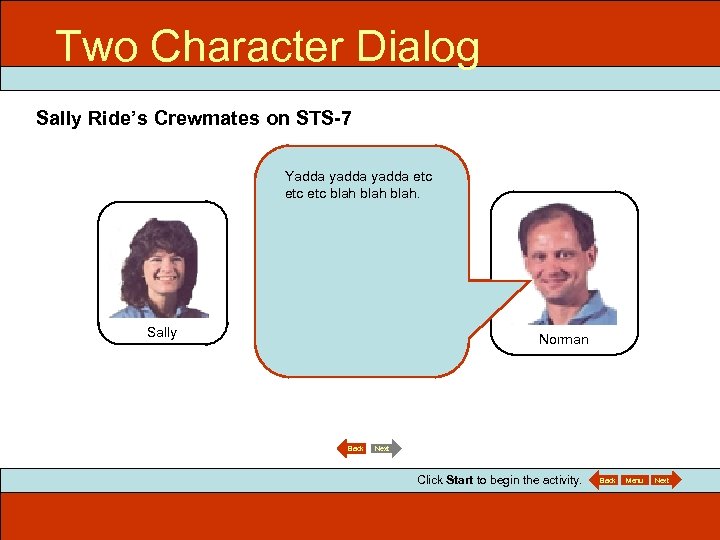 Two Character Dialog ITEC 715 Sally Ride’s Crewmates on STS-7 Yadda yadda etc etc blah. Sally Norman Back Next Click Start to begin the activity. Back Menu Next
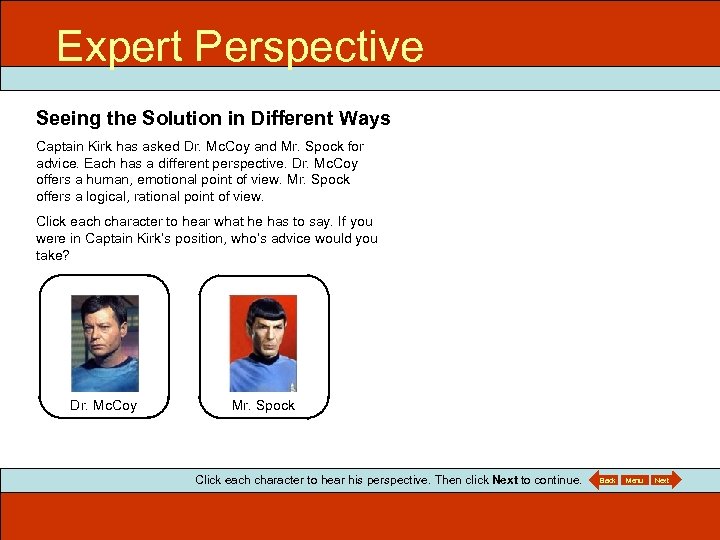 Expert Perspective ITEC 715 Seeing the Solution in Different Ways Captain Kirk has asked Dr. Mc. Coy and Mr. Spock for advice. Each has a different perspective. Dr. Mc. Coy offers a human, emotional point of view. Mr. Spock offers a logical, rational point of view. Click each character to hear what he has to say. If you were in Captain Kirk’s position, who’s advice would you take? Dr. Mc. Coy Mr. Spock Click each character to hear his perspective. Then click Next to continue. Back Menu Next
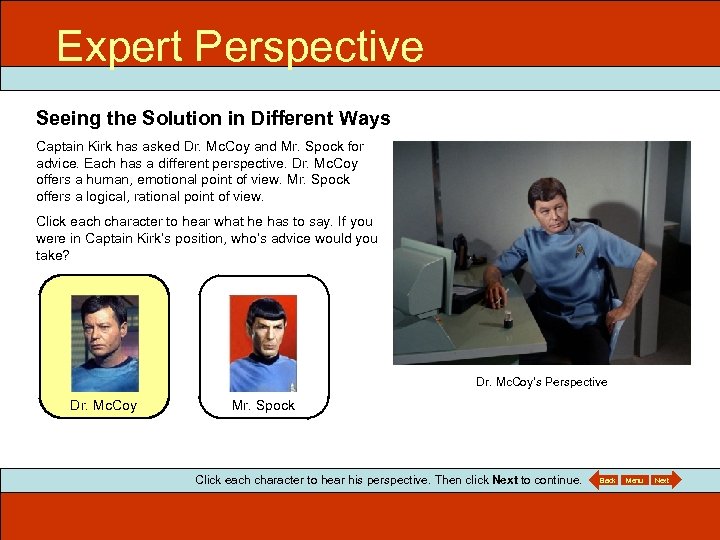 Expert Perspective ITEC 715 Seeing the Solution in Different Ways Captain Kirk has asked Dr. Mc. Coy and Mr. Spock for advice. Each has a different perspective. Dr. Mc. Coy offers a human, emotional point of view. Mr. Spock offers a logical, rational point of view. Click each character to hear what he has to say. If you were in Captain Kirk’s position, who’s advice would you take? Dr. Mc. Coy’s Perspective Dr. Mc. Coy Mr. Spock Click each character to hear his perspective. Then click Next to continue. Back Menu Next
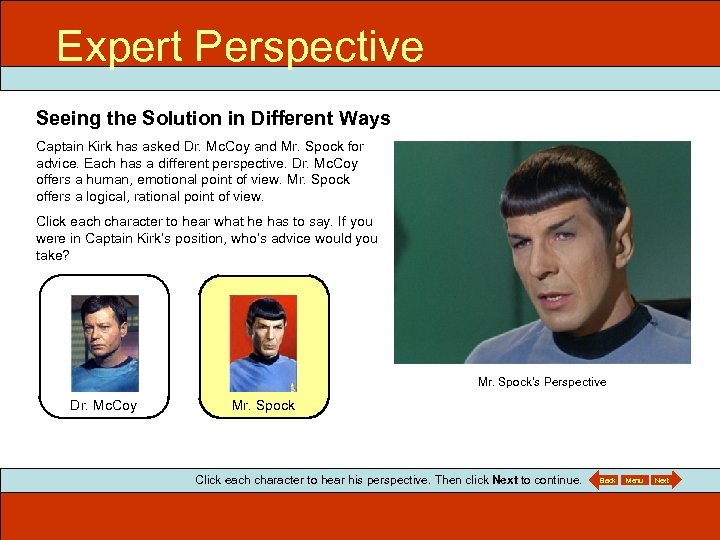 Expert Perspective ITEC 715 Seeing the Solution in Different Ways Captain Kirk has asked Dr. Mc. Coy and Mr. Spock for advice. Each has a different perspective. Dr. Mc. Coy offers a human, emotional point of view. Mr. Spock offers a logical, rational point of view. Click each character to hear what he has to say. If you were in Captain Kirk’s position, who’s advice would you take? Mr. Spock’s Perspective Dr. Mc. Coy Mr. Spock Click each character to hear his perspective. Then click Next to continue. Back Menu Next
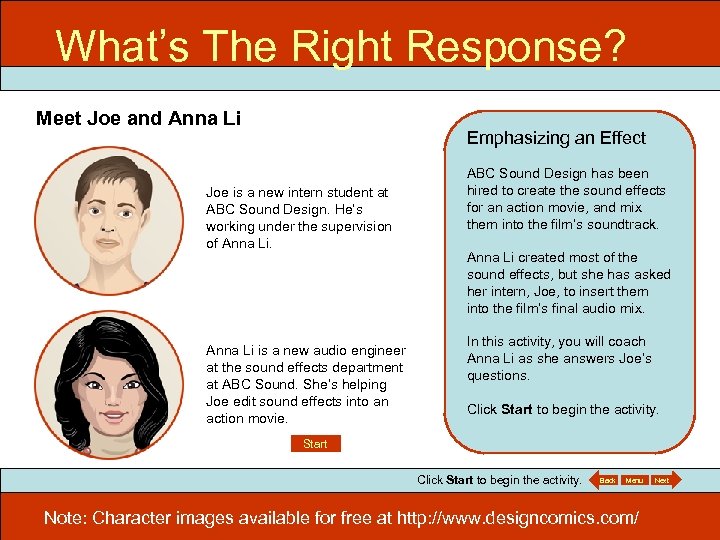 What’s The Right Response? ITEC 715 Meet Joe and Anna Li Emphasizing an Effect Joe is a new intern student at ABC Sound Design. He’s working under the supervision of Anna Li is a new audio engineer at the sound effects department at ABC Sound. She’s helping Joe edit sound effects into an action movie. ABC Sound Design has been hired to create the sound effects for an action movie, and mix them into the film’s soundtrack. Anna Li created most of the sound effects, but she has asked her intern, Joe, to insert them into the film’s final audio mix. In this activity, you will coach Anna Li as she answers Joe’s questions. Click Start to begin the activity. Start Click Start to begin the activity. Back Menu Note: Character images available for free at http: //www. designcomics. com/ Next
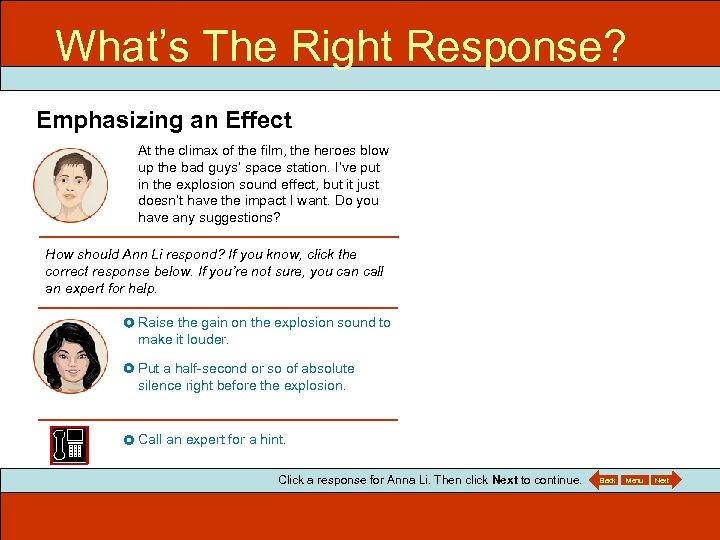 What’s The Right Response? ITEC 715 Emphasizing an Effect At the climax of the film, the heroes blow up the bad guys’ space station. I’ve put in the explosion sound effect, but it just doesn’t have the impact I want. Do you have any suggestions? How should Ann Li respond? If you know, click the correct response below. If you’re not sure, you can call an expert for help. Raise the gain on the explosion sound to make it louder. Put a half-second or so of absolute silence right before the explosion. Call an expert for a hint. Click a response for Anna Li. Then click Next to continue. Back Menu Next
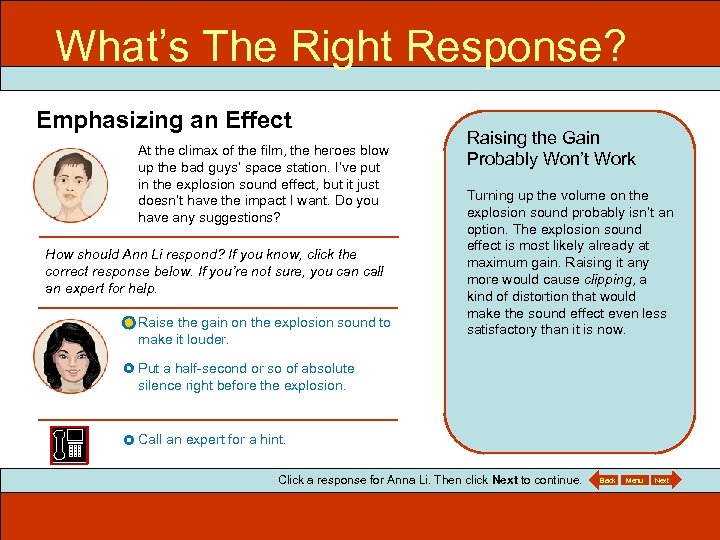 What’s The Right Response? ITEC 715 Emphasizing an Effect At the climax of the film, the heroes blow up the bad guys’ space station. I’ve put in the explosion sound effect, but it just doesn’t have the impact I want. Do you have any suggestions? How should Ann Li respond? If you know, click the correct response below. If you’re not sure, you can call an expert for help. Raise the gain on the explosion sound to make it louder. Raising the Gain Probably Won’t Work Turning up the volume on the explosion sound probably isn’t an option. The explosion sound effect is most likely already at maximum gain. Raising it any more would cause clipping, a kind of distortion that would make the sound effect even less satisfactory than it is now. Put a half-second or so of absolute silence right before the explosion. Call an expert for a hint. Click a response for Anna Li. Then click Next to continue. Back Menu Next
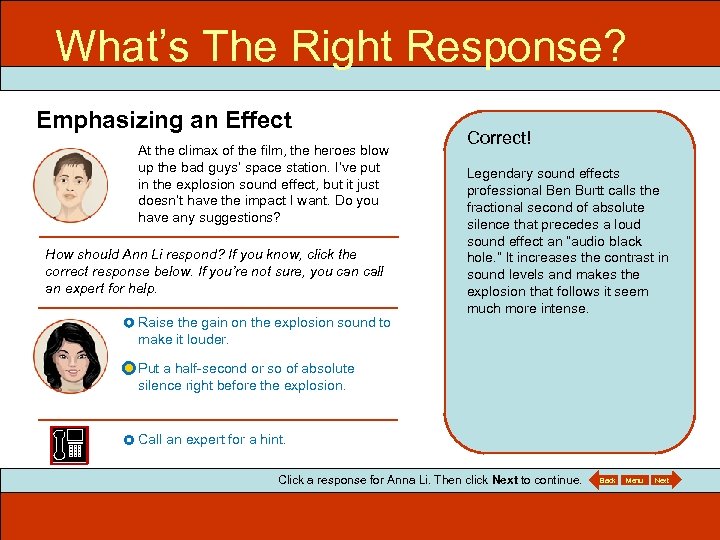 What’s The Right Response? ITEC 715 Emphasizing an Effect At the climax of the film, the heroes blow up the bad guys’ space station. I’ve put in the explosion sound effect, but it just doesn’t have the impact I want. Do you have any suggestions? How should Ann Li respond? If you know, click the correct response below. If you’re not sure, you can call an expert for help. Raise the gain on the explosion sound to make it louder. Correct! Legendary sound effects professional Ben Burtt calls the fractional second of absolute silence that precedes a loud sound effect an “audio black hole. ” It increases the contrast in sound levels and makes the explosion that follows it seem much more intense. Put a half-second or so of absolute silence right before the explosion. Call an expert for a hint. Click a response for Anna Li. Then click Next to continue. Back Menu Next
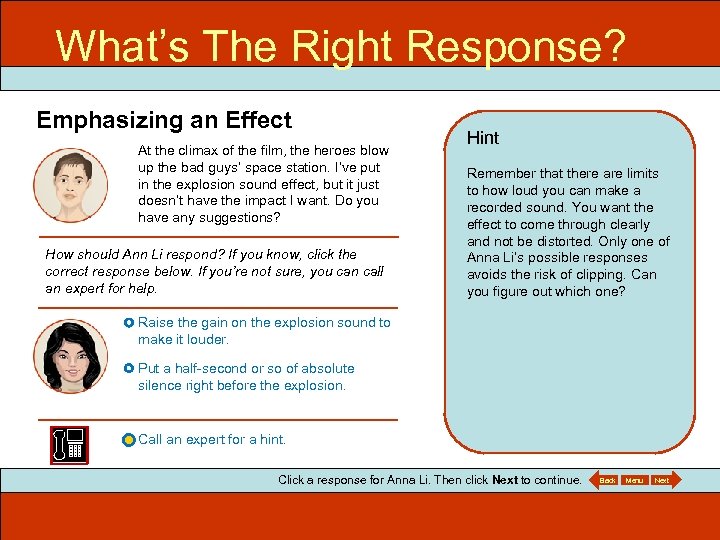 What’s The Right Response? ITEC 715 Emphasizing an Effect At the climax of the film, the heroes blow up the bad guys’ space station. I’ve put in the explosion sound effect, but it just doesn’t have the impact I want. Do you have any suggestions? How should Ann Li respond? If you know, click the correct response below. If you’re not sure, you can call an expert for help. Hint Remember that there are limits to how loud you can make a recorded sound. You want the effect to come through clearly and not be distorted. Only one of Anna Li’s possible responses avoids the risk of clipping. Can you figure out which one? Raise the gain on the explosion sound to make it louder. Put a half-second or so of absolute silence right before the explosion. Call an expert for a hint. Click a response for Anna Li. Then click Next to continue. Back Menu Next
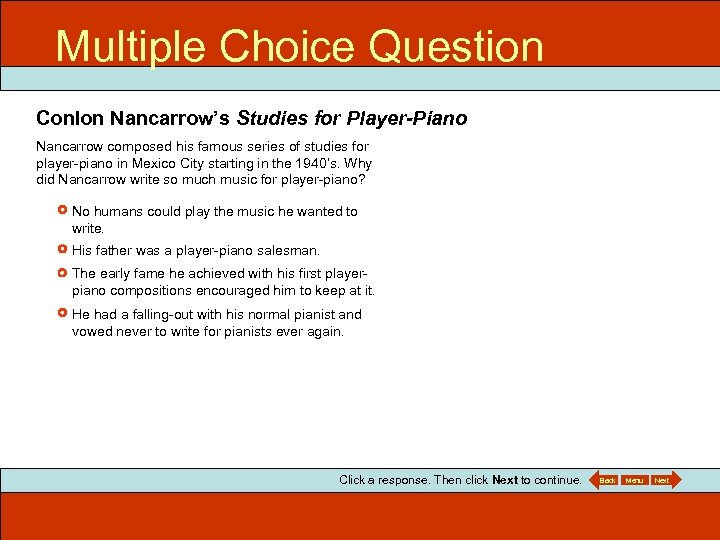 Multiple Choice Question ITEC 715 Conlon Nancarrow’s Studies for Player-Piano Nancarrow composed his famous series of studies for player-piano in Mexico City starting in the 1940’s. Why did Nancarrow write so much music for player-piano? No humans could play the music he wanted to write. His father was a player-piano salesman. The early fame he achieved with his first playerpiano compositions encouraged him to keep at it. He had a falling-out with his normal pianist and vowed never to write for pianists ever again. Click a response. Then click Next to continue. Back Menu Next
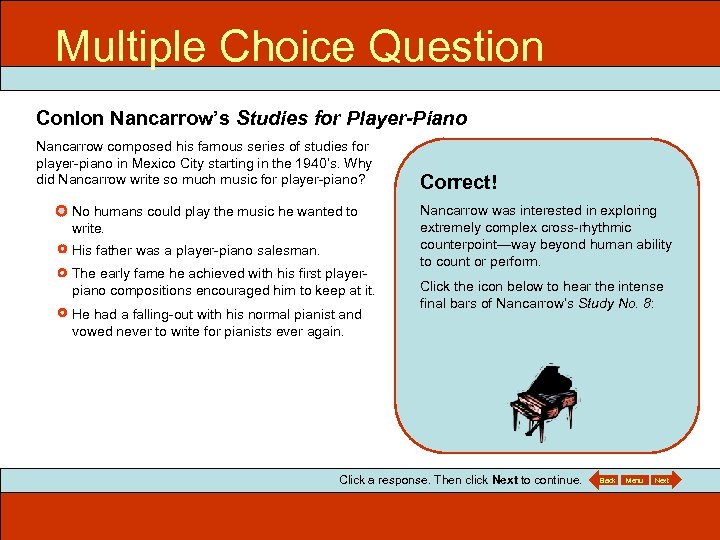 Multiple Choice Question ITEC 715 Conlon Nancarrow’s Studies for Player-Piano Nancarrow composed his famous series of studies for player-piano in Mexico City starting in the 1940’s. Why did Nancarrow write so much music for player-piano? No humans could play the music he wanted to write. His father was a player-piano salesman. The early fame he achieved with his first playerpiano compositions encouraged him to keep at it. He had a falling-out with his normal pianist and vowed never to write for pianists ever again. Correct! Nancarrow was interested in exploring extremely complex cross-rhythmic counterpoint—way beyond human ability to count or perform. Click the icon below to hear the intense final bars of Nancarrow’s Study No. 8: Click a response. Then click Next to continue. Back Menu Next
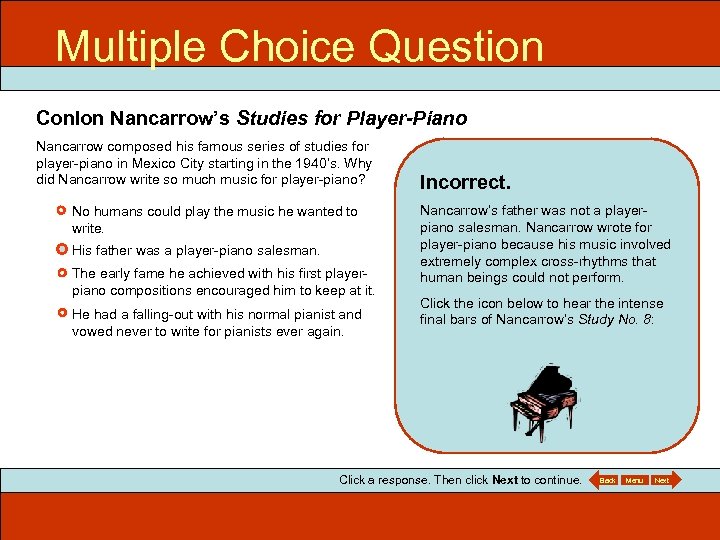 Multiple Choice Question ITEC 715 Conlon Nancarrow’s Studies for Player-Piano Nancarrow composed his famous series of studies for player-piano in Mexico City starting in the 1940’s. Why did Nancarrow write so much music for player-piano? No humans could play the music he wanted to write. His father was a player-piano salesman. The early fame he achieved with his first playerpiano compositions encouraged him to keep at it. He had a falling-out with his normal pianist and vowed never to write for pianists ever again. Incorrect. Nancarrow’s father was not a playerpiano salesman. Nancarrow wrote for player-piano because his music involved extremely complex cross-rhythms that human beings could not perform. Click the icon below to hear the intense final bars of Nancarrow’s Study No. 8: Click a response. Then click Next to continue. Back Menu Next
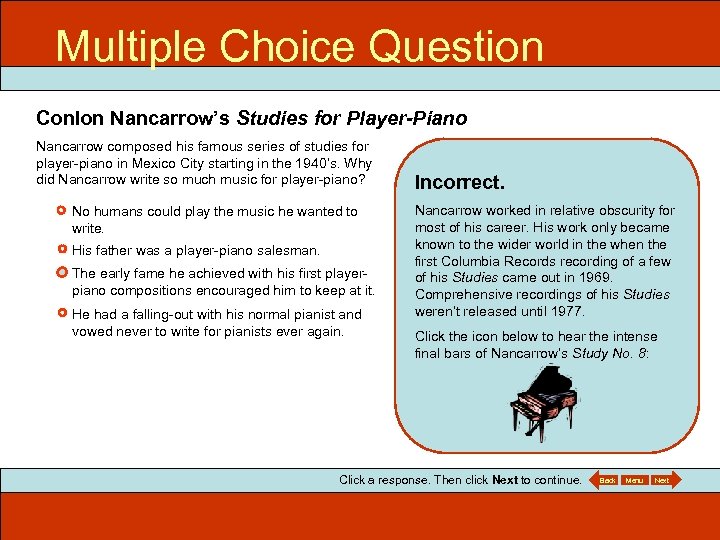 Multiple Choice Question ITEC 715 Conlon Nancarrow’s Studies for Player-Piano Nancarrow composed his famous series of studies for player-piano in Mexico City starting in the 1940’s. Why did Nancarrow write so much music for player-piano? No humans could play the music he wanted to write. His father was a player-piano salesman. The early fame he achieved with his first playerpiano compositions encouraged him to keep at it. He had a falling-out with his normal pianist and vowed never to write for pianists ever again. Incorrect. Nancarrow worked in relative obscurity for most of his career. His work only became known to the wider world in the when the first Columbia Records recording of a few of his Studies came out in 1969. Comprehensive recordings of his Studies weren’t released until 1977. Click the icon below to hear the intense final bars of Nancarrow’s Study No. 8: Click a response. Then click Next to continue. Back Menu Next
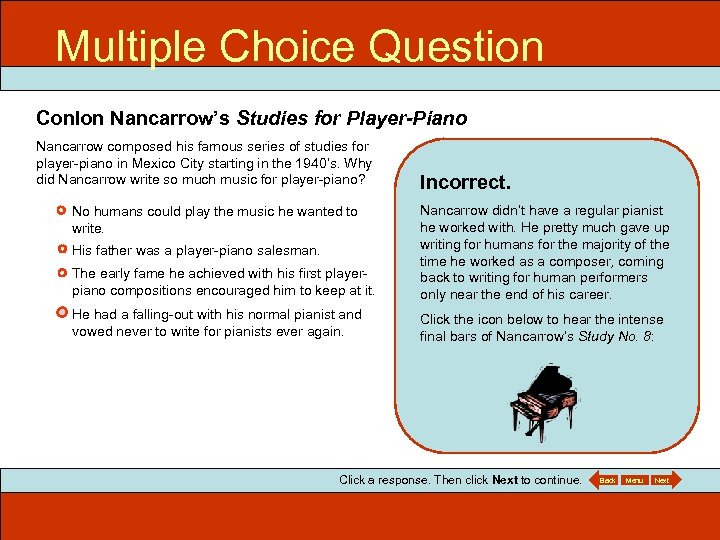 Multiple Choice Question ITEC 715 Conlon Nancarrow’s Studies for Player-Piano Nancarrow composed his famous series of studies for player-piano in Mexico City starting in the 1940’s. Why did Nancarrow write so much music for player-piano? Incorrect. The early fame he achieved with his first playerpiano compositions encouraged him to keep at it. Nancarrow didn’t have a regular pianist he worked with. He pretty much gave up writing for humans for the majority of the time he worked as a composer, coming back to writing for human performers only near the end of his career. He had a falling-out with his normal pianist and vowed never to write for pianists ever again. Click the icon below to hear the intense final bars of Nancarrow’s Study No. 8: No humans could play the music he wanted to write. His father was a player-piano salesman. Click a response. Then click Next to continue. Back Menu Next
 For Next Week 715 ITEC • In Power. Point, create a sample interaction deck containing an example of at least 6 different page-types you will use in the design of your final e-learning project. At this stage, you can use place-holder (generic) content, rather than final text and images. The purpose is to establish your page-types, so that you can use them as building blocks for your design. You must include at least one assessment/quiz page. • Download and read the ITEC 715 -Week 05. ppt slides and come to class ready to discuss • Next week: Design Documents!