


 Скачать презентацию ITEC 6120 System Requirements Management Luiz Marcio
6cdb2abec1c21ecf2d67f3e415259200.ppt
- Количество слайдов: 58
 ITEC 6120 System Requirements Management Luiz Marcio Cysneiros Fall 2016 1 http: //www. mathstat. yorku. ca/~cysneiro/courses. htm
 Textbook Requirements engineering : processes and techniques Gerald Kotonya and Ian Sommerville. Publication info: Chichester ; New York : J. Wiley & Sons, c 1998. ISBN: 0471972088 2 http: //www. mathstat. yorku. ca/~cysneiro/courses. htm
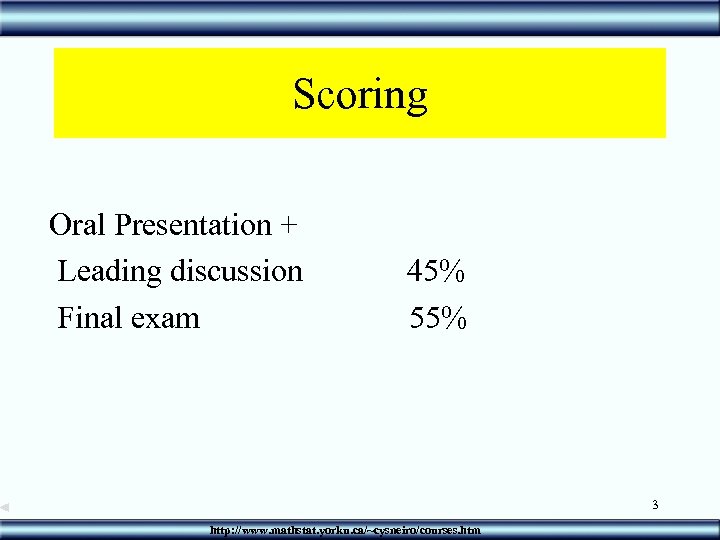 Scoring Oral Presentation + Leading discussion 45% Final exam 55% 3 http: //www. mathstat. yorku. ca/~cysneiro/courses. htm
 Directions email office cysneiro@yorku. ca TEL Building 3053 Office Hours – Tuesday: 2: 30 PM to 3: 30 PM Wednesday 5: 00 PM to 6: 30 PM 4 http: //www. mathstat. yorku. ca/~cysneiro/courses. htm
 5 http: //www. mathstat. yorku. ca/~cysneiro/courses. htm
 6 http: //www. mathstat. yorku. ca/~cysneiro/courses. htm
 7 http: //www. mathstat. yorku. ca/~cysneiro/courses. htm
 8 http: //www. mathstat. yorku. ca/~cysneiro/courses. htm
 Course Objectives • RE State-of-the-art for research and Practice • What does a RE do ? • Techniques • Methods • Process • Understanding RE • Research in RE • Existing Methods • Where it will lead us ? • Alternatives ? 9 http: //www. mathstat. yorku. ca/~cysneiro/courses. htm
 The Course at a Glance • • • Introduction Elicitation Modelling Analysis Management 10 http: //www. mathstat. yorku. ca/~cysneiro/courses. htm
 Nowadays World • Software-Intensive Systems • Software vs Systems ? – Software Alone is useless – Hardware Alone is useless – Both only exist when used to support any human activity – Software+Hardware+People+activities • Systems • Intensive use of software systems 11 http: //www. mathstat. yorku. ca/~cysneiro/courses. htm
 Nowadays World • Software systems present opportunities for change – It may be complex but should also be adaptable – Changes very quickly and some times very frequently – A New System may change human activities in many significant ways • • • Paperless Hospitals Virtual Doctors Virtual Surgeries Phone Chat facebook 12 http: //www. mathstat. yorku. ca/~cysneiro/courses. htm
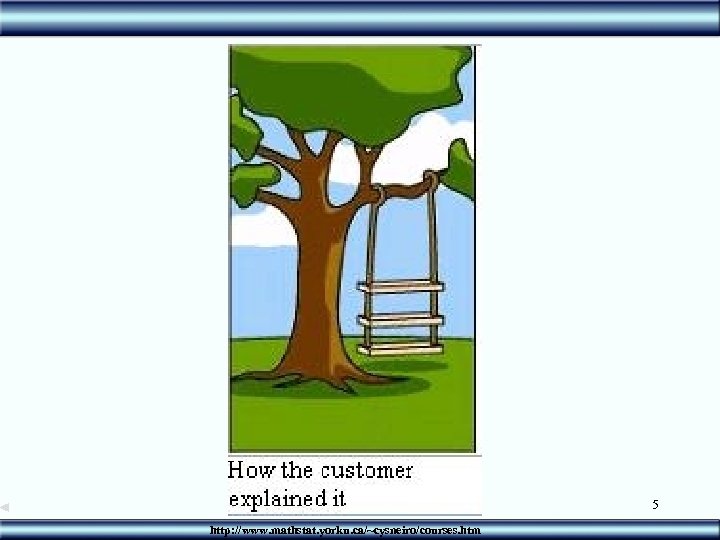
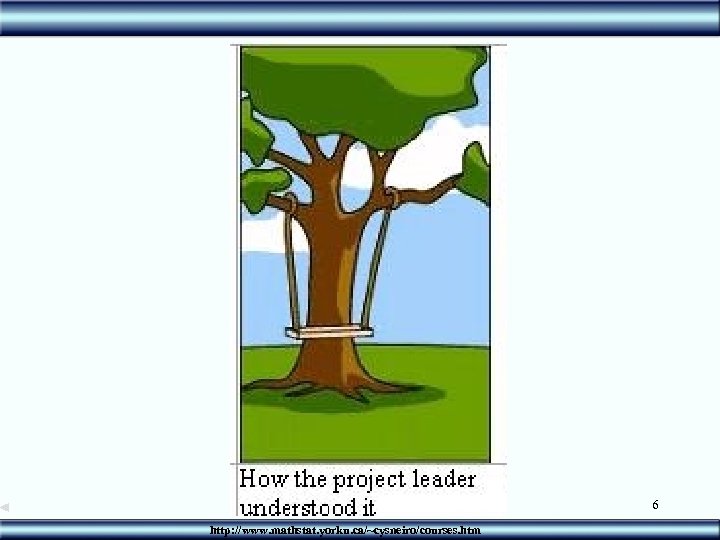
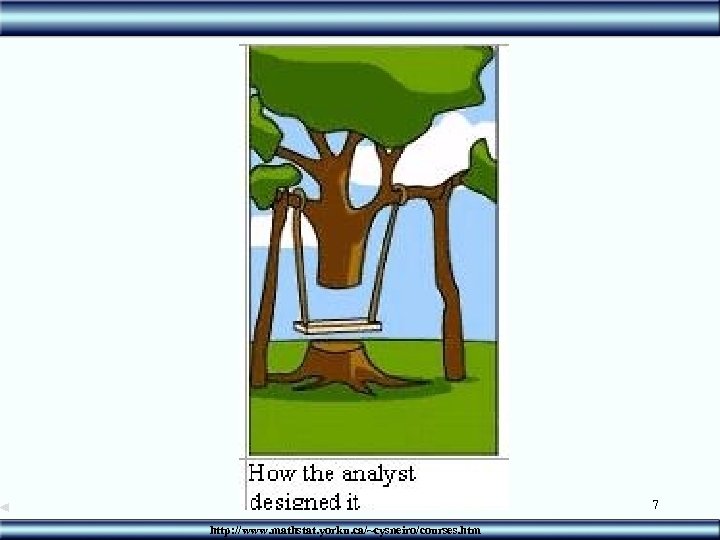
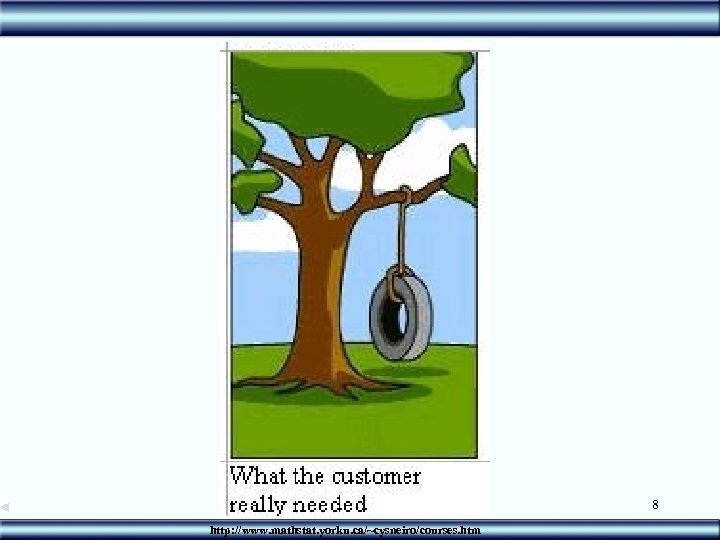
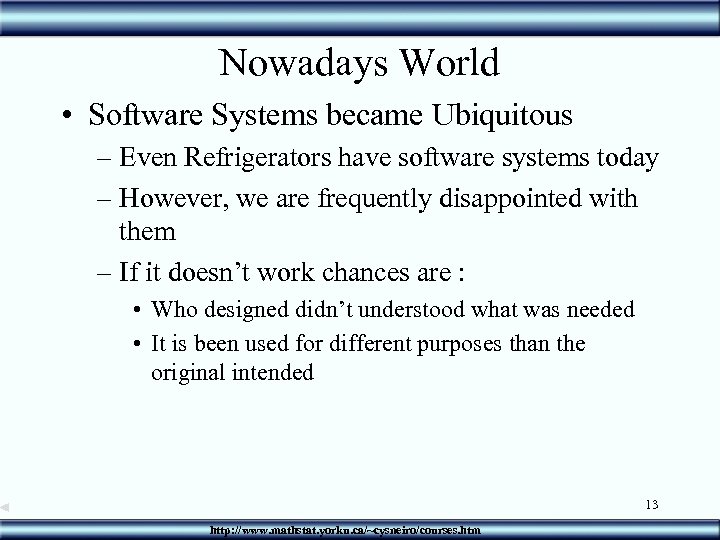 Nowadays World • Software Systems became Ubiquitous – Even Refrigerators have software systems today – However, we are frequently disappointed with them – If it doesn’t work chances are : • Who designed didn’t understood what was needed • It is been used for different purposes than the original intended 13 http: //www. mathstat. yorku. ca/~cysneiro/courses. htm
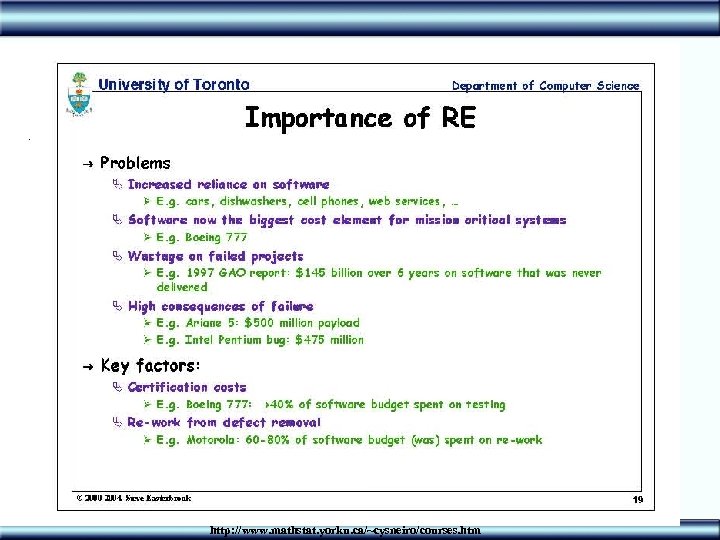 14 http: //www. mathstat. yorku. ca/~cysneiro/courses. htm
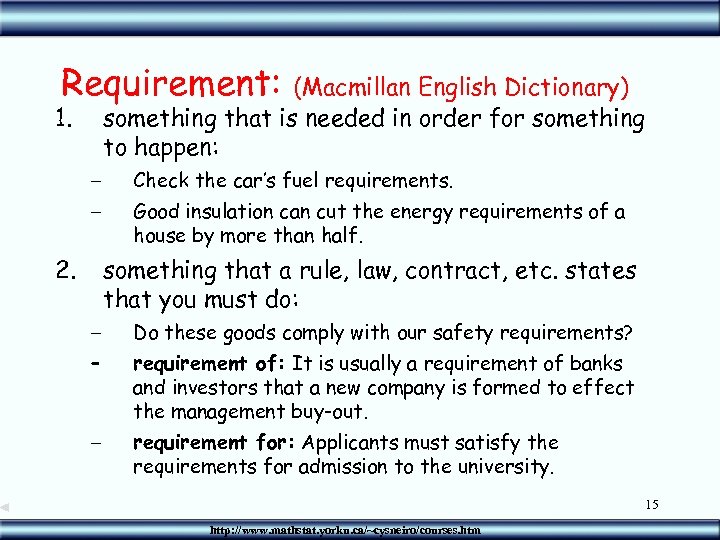 Requirement: (Macmillan English Dictionary) something that is needed in order for something to happen: 1. – Check the car’s fuel requirements. – Good insulation can cut the energy requirements of a house by more than half. 2. something that a rule, law, contract, etc. states that you must do: – Do these goods comply with our safety requirements? – requirement of: It is usually a requirement of banks and investors that a new company is formed to effect the management buy-out. – requirement for: Applicants must satisfy the requirements for admission to the university. 15 http: //www. mathstat. yorku. ca/~cysneiro/courses. htm
![System: (Macmillan English Dictionary) 1. [count] a set of connected things that work together](https://present5.com/presentation/6cdb2abec1c21ecf2d67f3e415259200/image-16.jpg "System: (Macmillan English Dictionary) 1. [count] a set of connected things that work together") System: (Macmillan English Dictionary) 1. [count] a set of connected things that work together for a particular purpose: – a central heating system – I decided to install a security system to prevent any break-ins. – the city’s inadequate public transportation system System: some part of a reality that can be observed to interact with its environment a set of interrelated components, or sub-systems, with a particular purpose. 1) there are 2 components at least, 2) each of which is related (directly or indirectly) to every other component and, 3) no sub set of which is unrelated to any other subset. Ackoff, Russell L. , (1971). Towards a System of Systems Concepts. Management science, 17(11), 661 -71. 16 http: //www. mathstat. yorku. ca/~cysneiro/courses. htm
System: (Macmillan English Dictionary) 1. [count] a set of connected things that work together for a particular purpose: – a central heating system – I decided to install a security system to prevent any break-ins. – the city’s inadequate public transportation system System: some part of a reality that can be observed to interact with its environment a set of interrelated components, or sub-systems, with a particular purpose. 1) there are 2 components at least, 2) each of which is related (directly or indirectly) to every other component and, 3) no sub set of which is unrelated to any other subset. Ackoff, Russell L. , (1971). Towards a System of Systems Concepts. Management science, 17(11), 661 -71. 16 http: //www. mathstat. yorku. ca/~cysneiro/courses. htm
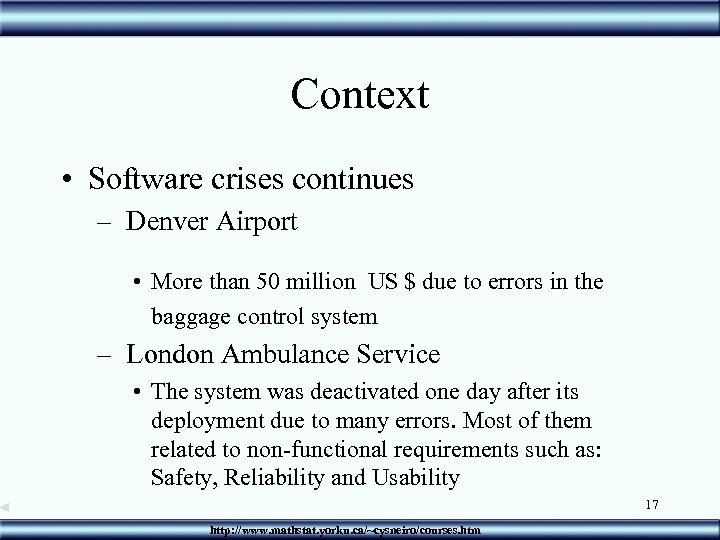 Context • Software crises continues – Denver Airport • More than 50 million US $ due to errors in the baggage control system – London Ambulance Service • The system was deactivated one day after its deployment due to many errors. Most of them related to non-functional requirements such as: Safety, Reliability and Usability 17 http: //www. mathstat. yorku. ca/~cysneiro/courses. htm
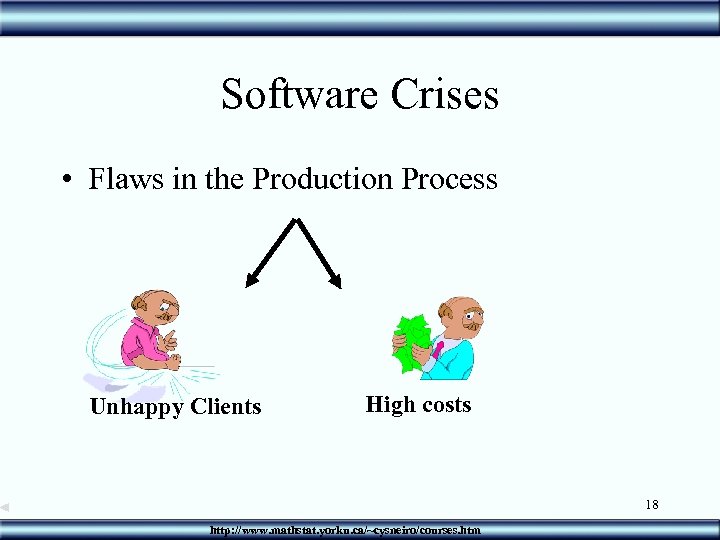 Software Crises • Flaws in the Production Process Unhappy Clients High costs 18 http: //www. mathstat. yorku. ca/~cysneiro/courses. htm
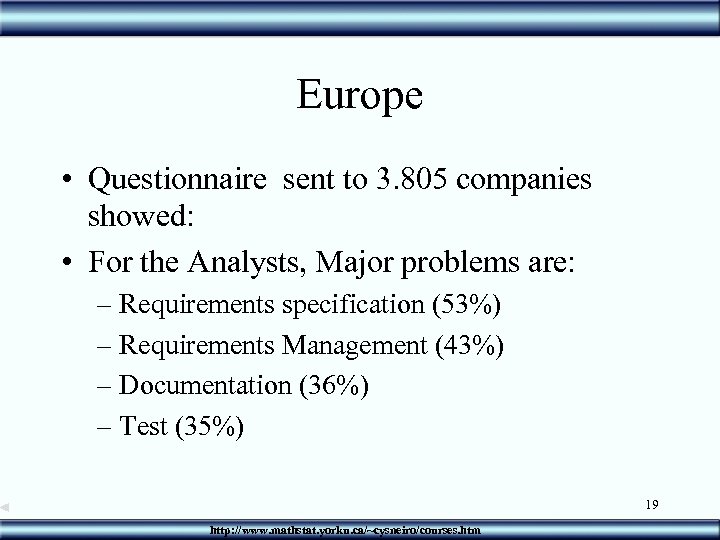 Europe • Questionnaire sent to 3. 805 companies showed: • For the Analysts, Major problems are: – Requirements specification (53%) – Requirements Management (43%) – Documentation (36%) – Test (35%) 19 http: //www. mathstat. yorku. ca/~cysneiro/courses. htm
 USA • Requirements Management (Also know as Requirements Engineering – RE) is seen as one of the most important problems to be overcome in order for companies to achieve level 2 in the SEI’s (Software Engineering Institute – Carnegie Mellon) CMM (Capability Maturity Model) • SEI has recently released a package aiming to transfer technology in RE to facilitate companies’ certification 20 http: //www. mathstat. yorku. ca/~cysneiro/courses. htm
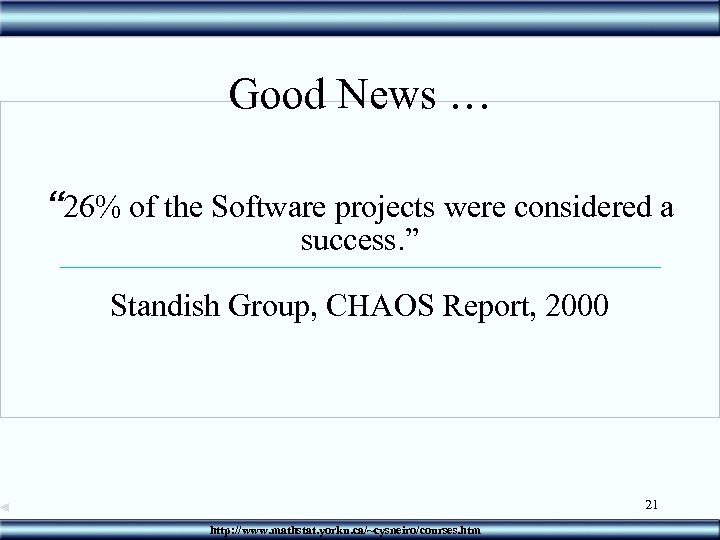 Good News … “ 26% of the Software projects were considered a success. ” Standish Group, CHAOS Report, 2000 21 http: //www. mathstat. yorku. ca/~cysneiro/courses. htm
 Bad News… Meaning that 74% have FAILED! Standish Group, CHAOS Report, 2000 22 http: //www. mathstat. yorku. ca/~cysneiro/courses. htm
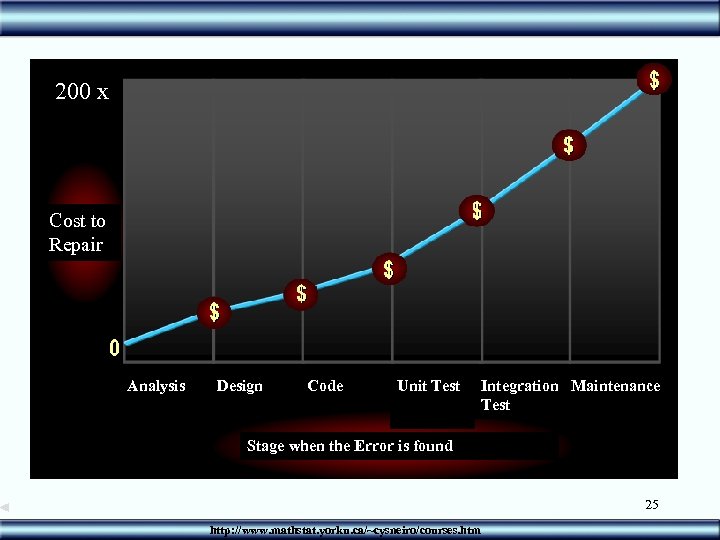
 Tom De Marco “ 56% of the errors in a software can be traced back to the requirements phase” • The later an error is detected the more expensive is to fix it. • Many errors are done during Requirements elicitation and analysis 23 http: //www. mathstat. yorku. ca/~cysneiro/courses. htm
 • Many errors in requirements can (and should) be detected early in the software development life cycle. • Typical errors include: Use of incorrect facts, omission, inconsistency and ambiguity. • Errors in requirements specification are one of the major concerns for software industry. 24 http: //www. mathstat. yorku. ca/~cysneiro/courses. htm
 200 x Cost to Repair Analysis Design Code Unit Test Integration Maintenance Test Stage when the Error is found 25 http: //www. mathstat. yorku. ca/~cysneiro/courses. htm
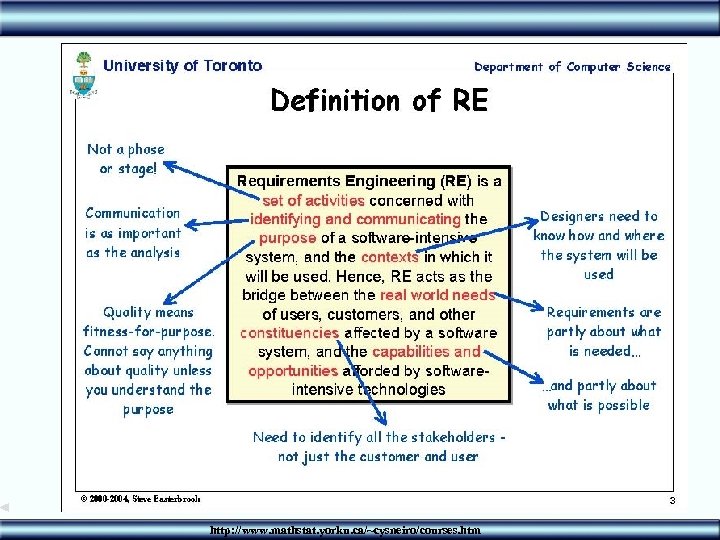
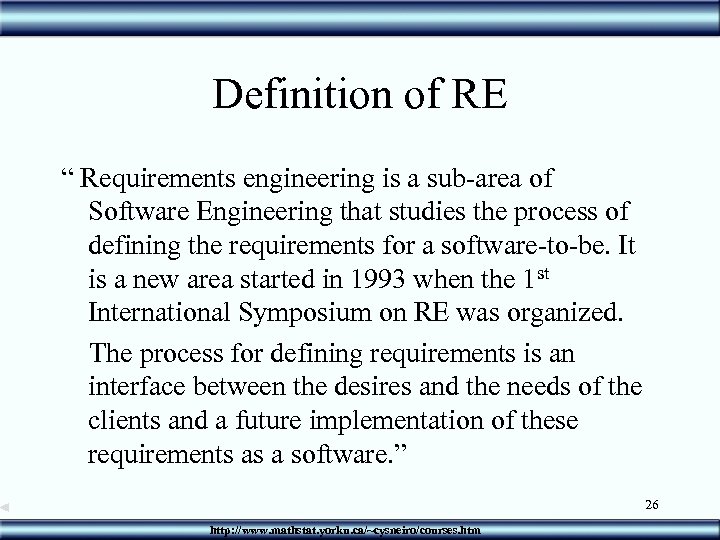 Definition of RE “ Requirements engineering is a sub-area of Software Engineering that studies the process of defining the requirements for a software-to-be. It is a new area started in 1993 when the 1 st International Symposium on RE was organized. The process for defining requirements is an interface between the desires and the needs of the clients and a future implementation of these requirements as a software. ” 26 http: //www. mathstat. yorku. ca/~cysneiro/courses. htm
 27 http: //www. mathstat. yorku. ca/~cysneiro/courses. htm
 Goals • Understand the needs and support the client’s desires. • Provide the Requirements Engineer with methods, techniques and tools to help on the process of understanding and registering what a software must do. 28 http: //www. mathstat. yorku. ca/~cysneiro/courses. htm
 Fred Brook’s • Brook adds: “The most difficult part of building a software system is to decide, precisely, what must be built. No other part of the work can undermine so badly the resulting software if not done correctly. No other part is so difficult to fix later. ” 29 http: //www. mathstat. yorku. ca/~cysneiro/courses. htm
 Factors influencing requirements • Personality and status of stakeholders • The personal goals of individuals within an organization • The degree of political influence of stakeholders within an organization 30 http: //www. mathstat. yorku. ca/~cysneiro/courses. htm
 RE process problems • • • Lack of stakeholder involvement Business needs not considered Lack of requirements management Lack of defined responsibilities Stakeholder communication problems Over-long schedules and poor quality requirements documents • Many confuse it with Design • Pressure from the Market – “It has to be ready next week” • Clients keep adding and changing things 31 http: //www. mathstat. yorku. ca/~cysneiro/courses. htm
 Process improvement • Process improvement is concerned with modifying processes in order to meet some improvement objectives • Improvement objectives – Quality improvement – Schedule reduction – Resource reduction 32 http: //www. mathstat. yorku. ca/~cysneiro/courses. htm
 Planning process improvement • What are the problems with current processes? • What are the improvement goals? • How can process improvement be introduced to achieve these goals? • How should process improvements be controlled and managed? 33 http: //www. mathstat. yorku. ca/~cysneiro/courses. htm
 Process maturity • Process maturity can be thought of as the extent that an organization has defined its processes, actively controls these processes and provides systematic human and computer-based support for them. • The SEI’s Capability Maturity Model is a framework for assessing software process maturity in development organizations 34 http: //www. mathstat. yorku. ca/~cysneiro/courses. htm
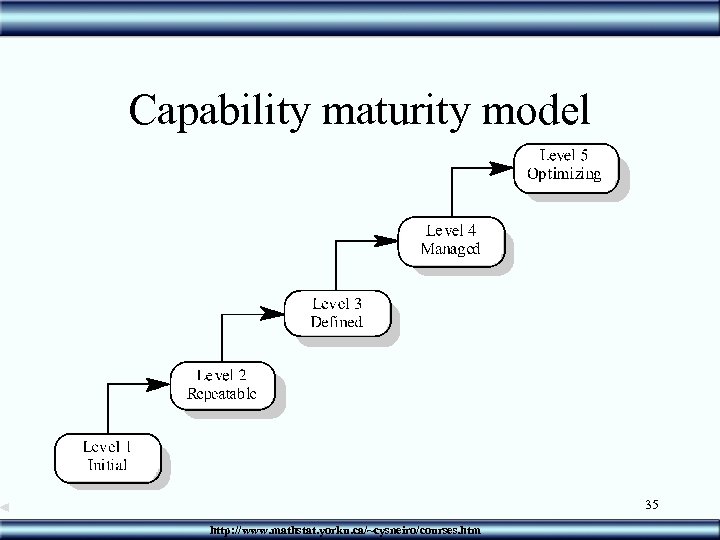 Capability maturity model 35 http: //www. mathstat. yorku. ca/~cysneiro/courses. htm
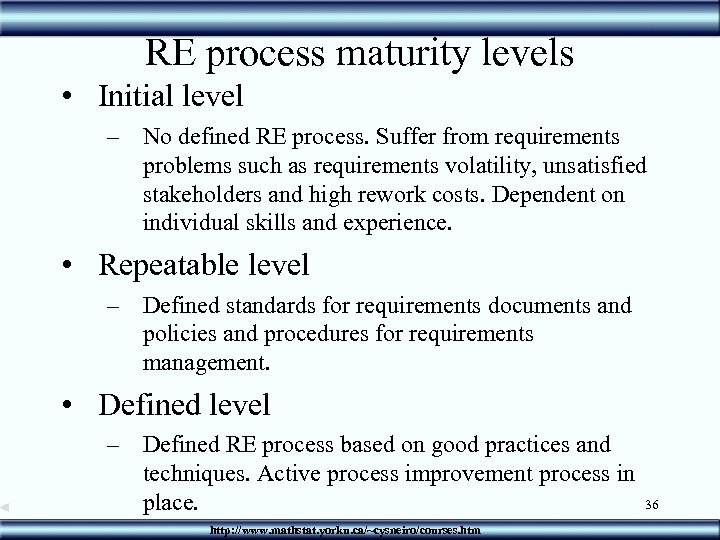 RE process maturity levels • Initial level – No defined RE process. Suffer from requirements problems such as requirements volatility, unsatisfied stakeholders and high rework costs. Dependent on individual skills and experience. • Repeatable level – Defined standards for requirements documents and policies and procedures for requirements management. • Defined level – Defined RE process based on good practices and techniques. Active process improvement process in 36 place. http: //www. mathstat. yorku. ca/~cysneiro/courses. htm
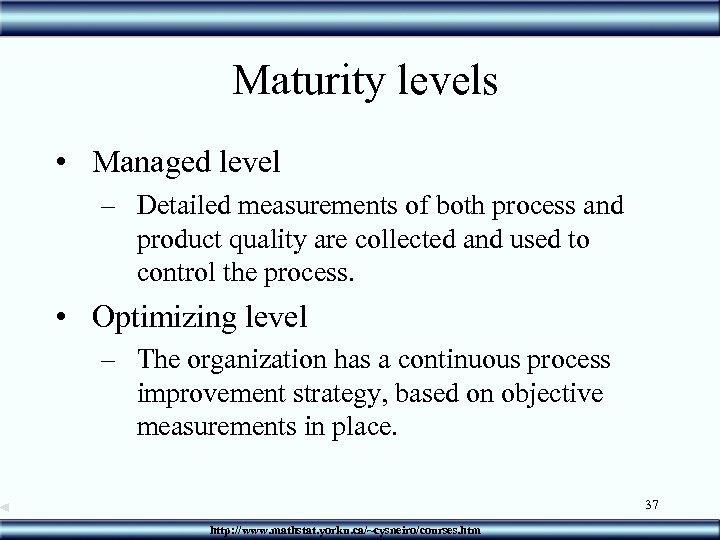 Maturity levels • Managed level – Detailed measurements of both process and product quality are collected and used to control the process. • Optimizing level – The organization has a continuous process improvement strategy, based on objective measurements in place. 37 http: //www. mathstat. yorku. ca/~cysneiro/courses. htm
 Good practice for RE process improvement • RE processes can be improved by the systematic introduction of good requirements engineering practice • Each improvement cycle identifies good practice guidelines and works to introduce them in an organization 38 http: //www. mathstat. yorku. ca/~cysneiro/courses. htm
 Most Common Scenario • • Structured Analisys Structured Project Essential Analysis Entity-Relationship Model Objects CASE Automatic Genaration of Applications 39 http: //www. mathstat. yorku. ca/~cysneiro/courses. htm
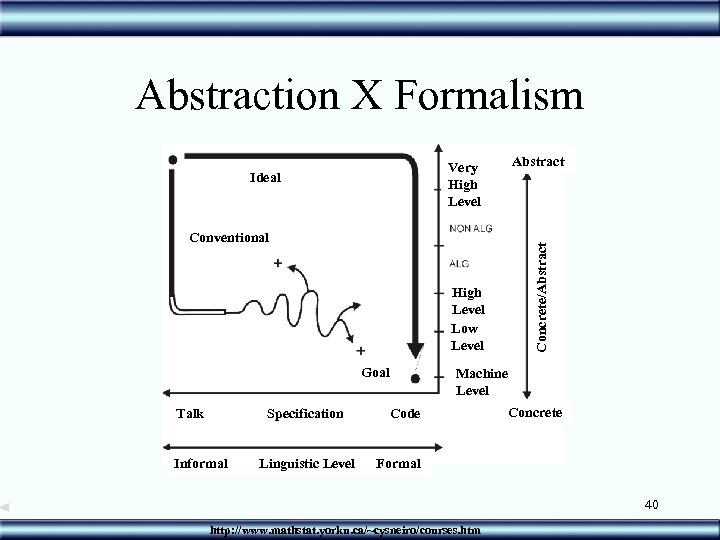 Abstraction X Formalism Abstract Very High Level Ideal Concrete/Abstract Conventional High Level Low Level Goal Talk Specification Informal Linguistic Level Machine Level Code Concrete Formal 40 http: //www. mathstat. yorku. ca/~cysneiro/courses. htm
 Why Requirements Engineering? Von Neumann: “There is no sense in being precise when you don’t even know what you are talking about” 41 http: //www. mathstat. yorku. ca/~cysneiro/courses. htm
 The Context of RE • • Information System Engineering Systems Organizations Producing Software Models 42 http: //www. mathstat. yorku. ca/~cysneiro/courses. htm
 Context • The Blank Page Fallacy • The Completeness Fallacy • Social Aspects Involved 43 http: //www. mathstat. yorku. ca/~cysneiro/courses. htm
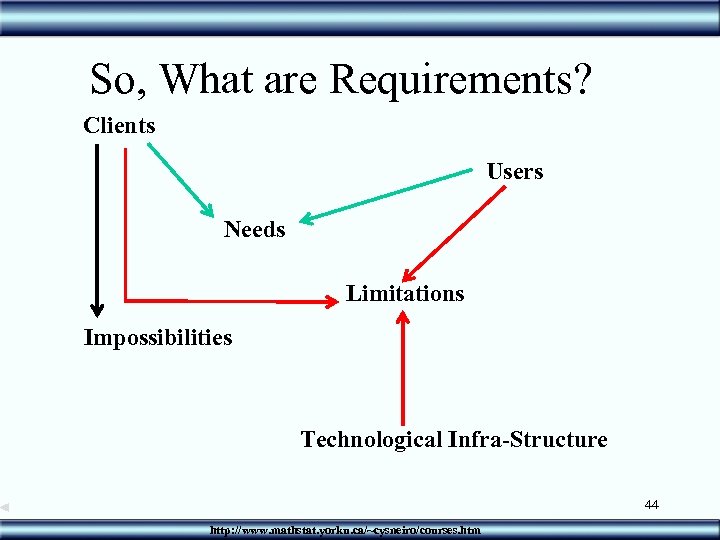 So, What are Requirements? Clients Users Needs Limitations Impossibilities Technological Infra-Structure 44 http: //www. mathstat. yorku. ca/~cysneiro/courses. htm
 Definition • Software Requirements – Sentences that express clients’ needs and establish the desired quality 45 http: //www. mathstat. yorku. ca/~cysneiro/courses. htm
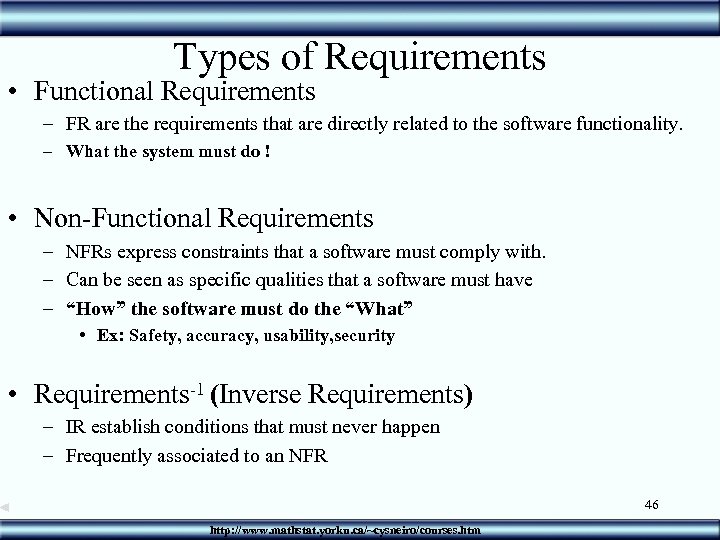 Types of Requirements • Functional Requirements – FR are the requirements that are directly related to the software functionality. – What the system must do ! • Non-Functional Requirements – NFRs express constraints that a software must comply with. – Can be seen as specific qualities that a software must have – “How” the software must do the “What” • Ex: Safety, accuracy, usability, security • Requirements-1 (Inverse Requirements) – IR establish conditions that must never happen – Frequently associated to an NFR 46 http: //www. mathstat. yorku. ca/~cysneiro/courses. htm
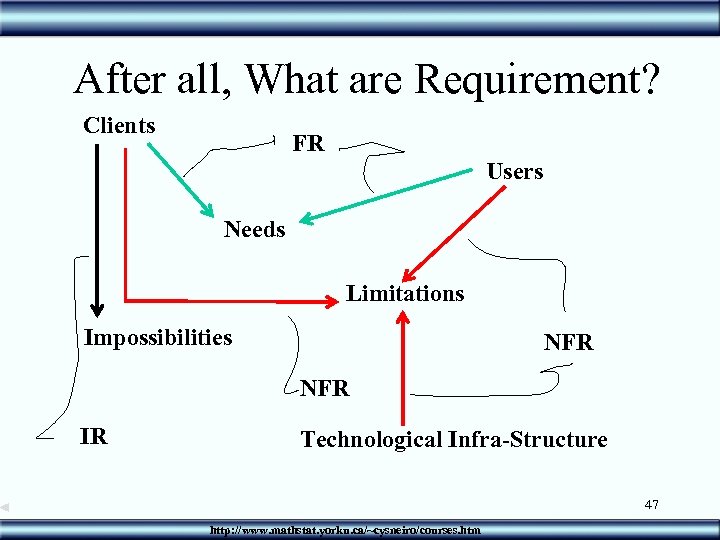 After all, What are Requirement? Clients FR Users Needs Limitations Impossibilities NFR IR Technological Infra-Structure 47 http: //www. mathstat. yorku. ca/~cysneiro/courses. htm
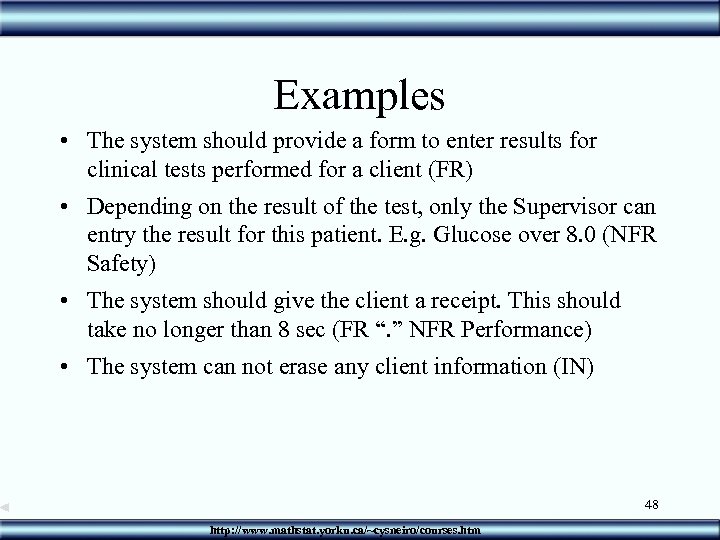 Examples • The system should provide a form to enter results for clinical tests performed for a client (FR) • Depending on the result of the test, only the Supervisor can entry the result for this patient. E. g. Glucose over 8. 0 (NFR Safety) • The system should give the client a receipt. This should take no longer than 8 sec (FR “. ” NFR Performance) • The system can not erase any client information (IN) 48 http: //www. mathstat. yorku. ca/~cysneiro/courses. htm
 Definitions • Universe of Discourse – Is the context in which the software should be developed and operated. Uof. D includes all sources of information and all people related to the software. These people are also known as the actors of this universe. Uof. D is a reality circumstantiated by the set of goals defined by those who demand the software 49 http: //www. mathstat. yorku. ca/~cysneiro/courses. htm
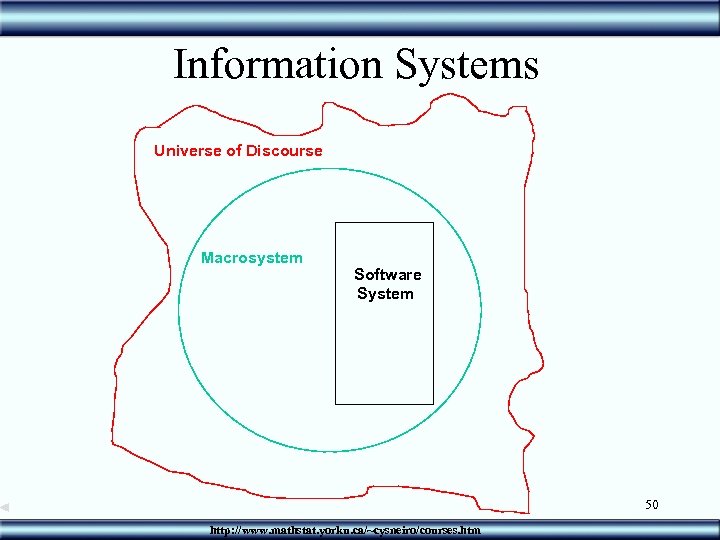 Information Systems Universe of Discourse Macrosystem Software System 50 http: //www. mathstat. yorku. ca/~cysneiro/courses. htm
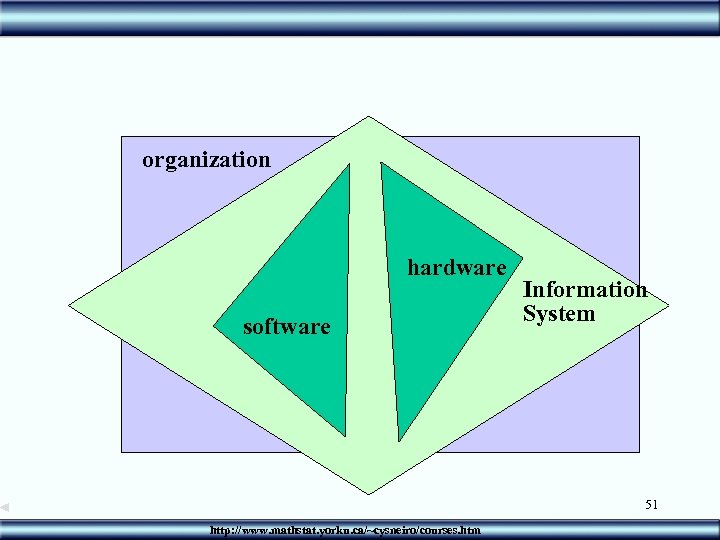 organization hardware software Information System 51 http: //www. mathstat. yorku. ca/~cysneiro/courses. htm
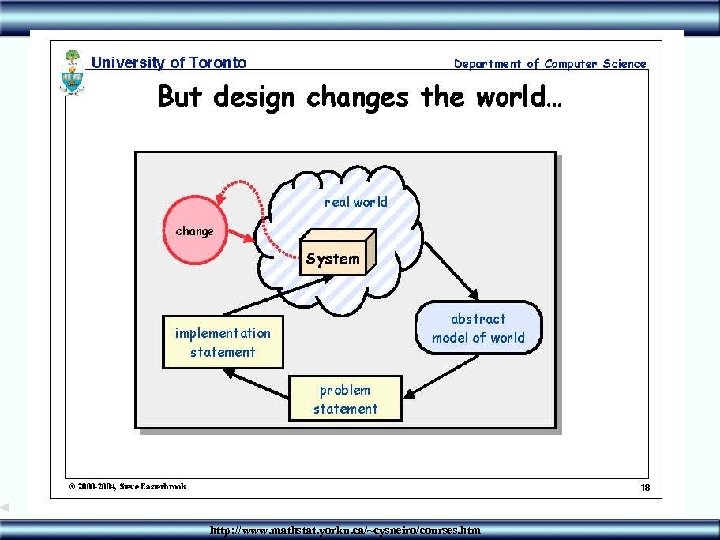 52 http: //www. mathstat. yorku. ca/~cysneiro/courses. htm
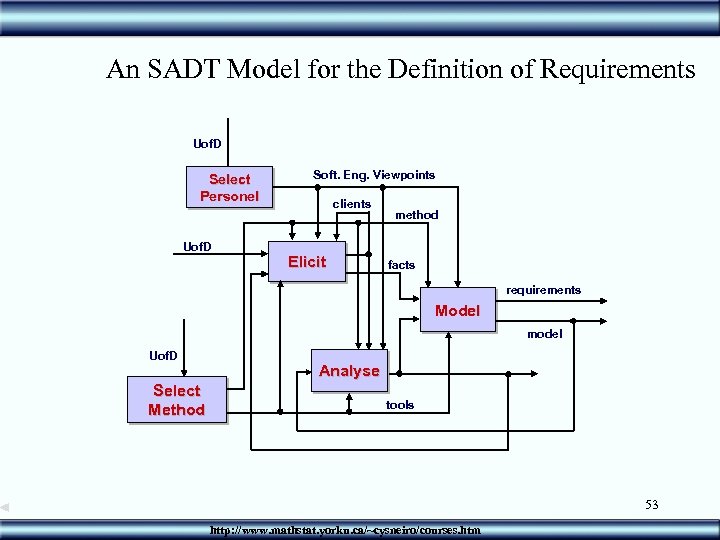 An SADT Model for the Definition of Requirements Uof. D Select Personel Uof. D Soft. Eng. Viewpoints clients Elicit method facts requirements Model model Uof. D Select Method Analyse tools 53 http: //www. mathstat. yorku. ca/~cysneiro/courses. htm
 The “Requirements Lifecycle” • Not Waterfall • Not Spiral • Not Iterative 54 http: //www. mathstat. yorku. ca/~cysneiro/courses. htm
 55 http: //www. mathstat. yorku. ca/~cysneiro/courses. htm
 Books • Requirements Engineering: Processes and Techniques by Ian Sommerville, Gerald Kotonya (September 1998) John Wiley & Son Ltd; ISBN: 0471972088 Amazon. com Sales Rank: 188, 502 • System Requirements Engineering by Pericles Loucopoulos, Vassilios Karakostas (June 1995) Mc. Graw Hill Text; ISBN: 0077078438 Amazon. com Sales Rank: 1, 067, 908 • Software Requirements & Specifications : A Lexicon of Practice, Principles and Prejudices by Michael Jackson (July 1995) Addison-Wesley Pub Co; ISBN: 0201877120 Amazon. com Sales Rank: 38, 607 56 http: //www. mathstat. yorku. ca/~cysneiro/courses. htm
 More Books • Exploring Requirements : Quality Before Design by Donald C. Gause and Gerald M. Weinberg (September 1989) Dorset House; ISBN: 0932633137 Amazon. com Sales Rank: 13, 641 • Mastering the Requirements Process by Suzanne Robertson, James Robertson (May 4, 2000) Addison-Wesley Pub Co; ISBN: 0201360462 ; Dimensions (in inches): 0. 93 x 9. 50 x 7. 66 Amazon. com Sales Rank: 7, 392 • Managing Software Requirements: A Unified Approach (The Addison. Wesley Object Technology Series)by Dean Leffingwell, Don Widrig (November 1999), Addison-Wesley Pub Co; ISBN: 0201615932 Dimensions (in Inches): 1. 13 x 9. 46 x 7. 76 Amazon. com Sales Rank: 14, 447 57 http: //www. mathstat. yorku. ca/~cysneiro/courses. htm
 Reading for next Class • Requirements Engineering - a roadmap - Nuseibeh, Easterbrook – First Presentation • • [Goguen 94] - Goguen, J. A. and Linde, C. - Techiques for Requirements Elicitation, In Proceedings of the First IEEE International Symposium on Requirements Engineering, San Diego, Ca, IEEE Computer Society Press - 1994, pp 152 -164. • [Goguen 94 a] - Goguen, Joseph - Requirements Engineering as the reconciliation of social and technical issues - in Requirements Engineering: Social and Technical Issues edited by Joseph Goguen and Marina Jirotka - Academic Press 1994. • Download from course page 58 http: //www. mathstat. yorku. ca/~cysneiro/courses. htm