


 Скачать презентацию ITEC 3010 Systems Analysis and Design I Instructor
b15fc5664f7deddf591e9bc5f8c79c2a.ppt
- Количество слайдов: 50
 ITEC 3010: Systems Analysis and Design I Instructor: Dr. Luiz Marcio Cysneiros Class site: http: //www. yorku. ca/cysneiro/courses. htm Office: TEL Building 3053 Email: cysneiro@yorku. ca http: //www. yorku. ca/cysneiro/courses. htm 1
 General Info. • Text: “Systems Analysis and Design in a Changing World” by John Satzinger, Robert Jackson and Stephen Burd 3 rd / 4 th / 5 th edition – Current available 6 th edition. Not the best one to use – Best Editions to use : 5 th and 3 rd • Office Hours: Tuesday: 2: 00 PM to 3: 30 PM and Wednesday 5: 00 PM to 6: 30 PM Phone: 416 -736 -2100, ext. 33886 Email: cysneiro@yorku. ca http: //www. yorku. ca/cysneiro/courses. htm 2
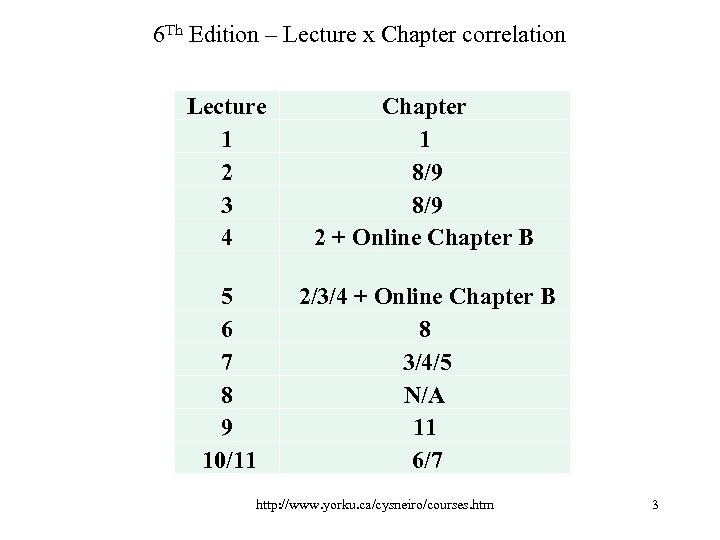 6 Th Edition – Lecture x Chapter correlation Lecture 1 2 3 4 Chapter 1 8/9 2 + Online Chapter B 5 6 7 8 9 10/11 2/3/4 + Online Chapter B 8 3/4/5 N/A 11 6/7 http: //www. yorku. ca/cysneiro/courses. htm 3
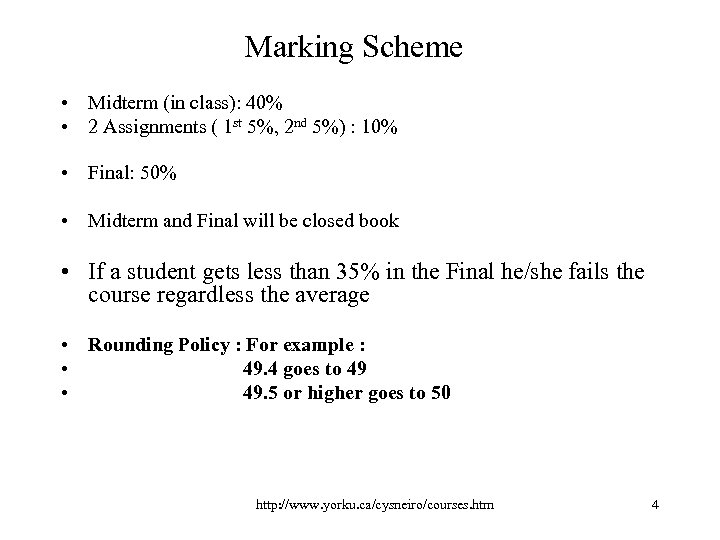 Marking Scheme • Midterm (in class): 40% • 2 Assignments ( 1 st 5%, 2 nd 5%) : 10% • Final: 50% • Midterm and Final will be closed book • If a student gets less than 35% in the Final he/she fails the course regardless the average • Rounding Policy : For example : • 49. 4 goes to 49 • 49. 5 or higher goes to 50 http: //www. yorku. ca/cysneiro/courses. htm 4
 http: //www. yorku. ca/cysneiro/courses. htm 5
 http: //www. yorku. ca/cysneiro/courses. htm 6
 7
7
 8
8
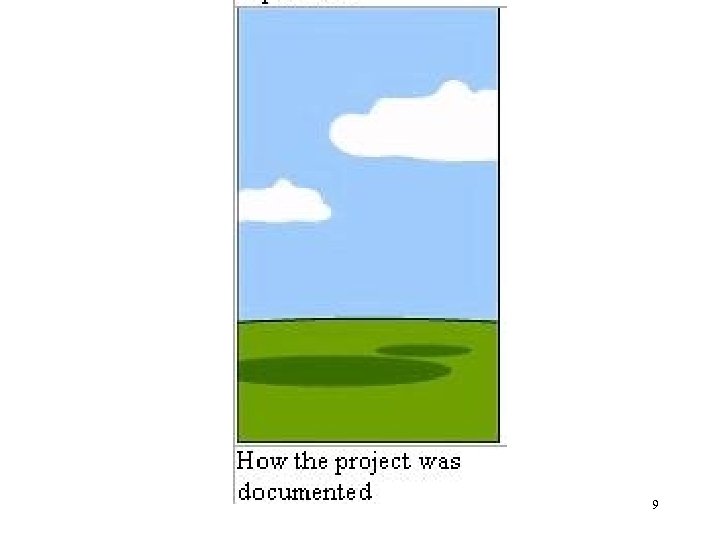 9
9
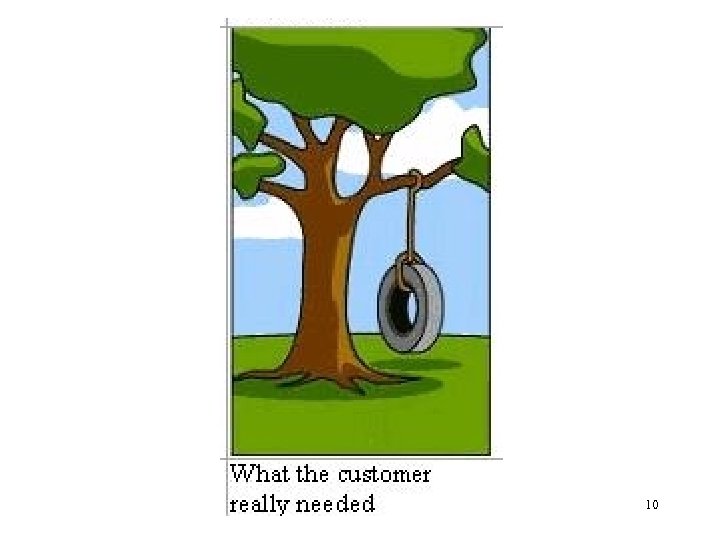 10
10
 Course Objectives • To provide you with new ways of looking at information in the world in order to solve business problems • To introduce you to concepts and methods of System Analysis and design (SAD) • To describe the systems development life cycle (SDLC) • To teach you effective methods for gathering essential information during system analysis • To teach you effective methods for designing systems to solve problems effectively using technology http: //www. yorku. ca/cysneiro/courses. htm 11
 Denys Lasdun – “Our job is to give the client, on time and on cost, not what he wants, but what he never dreamed he wanted; and when he gets it, he recognizes it as something he wanted all the time” http: //www. yorku. ca/cysneiro/courses. htm 12
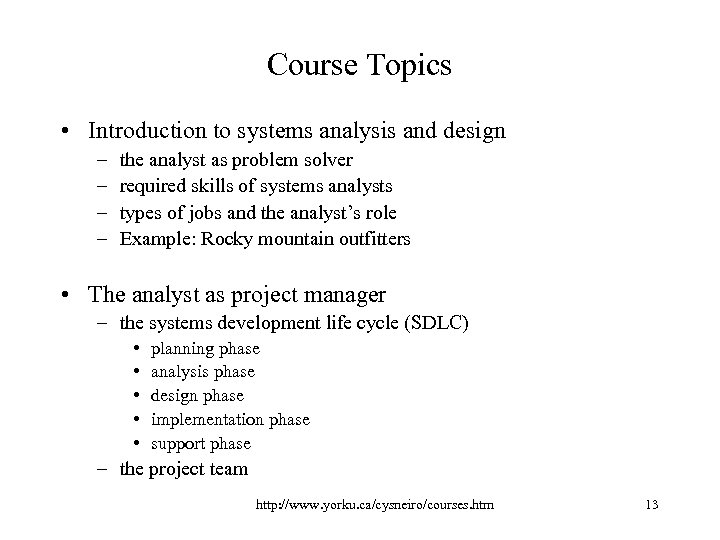 Course Topics • Introduction to systems analysis and design – – the analyst as problem solver required skills of systems analysts types of jobs and the analyst’s role Example: Rocky mountain outfitters • The analyst as project manager – the systems development life cycle (SDLC) • • • planning phase analysis phase design phase implementation phase support phase – the project team http: //www. yorku. ca/cysneiro/courses. htm 13
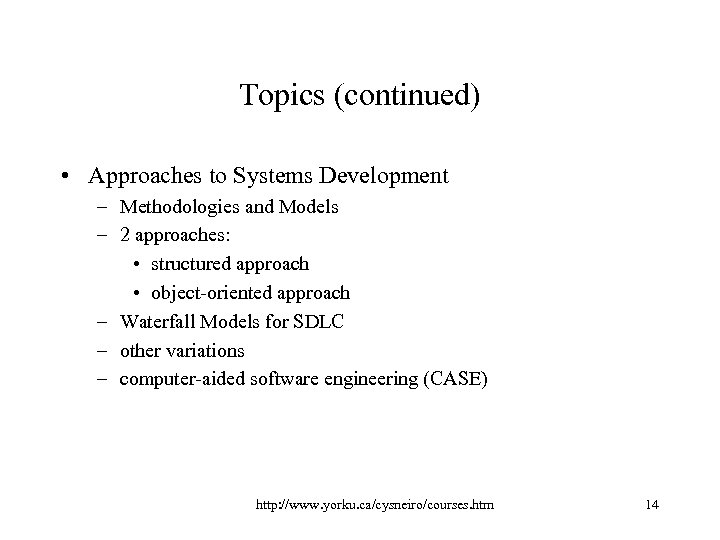 Topics (continued) • Approaches to Systems Development – Methodologies and Models – 2 approaches: • structured approach • object-oriented approach – Waterfall Models for SDLC – other variations – computer-aided software engineering (CASE) http: //www. yorku. ca/cysneiro/courses. htm 14
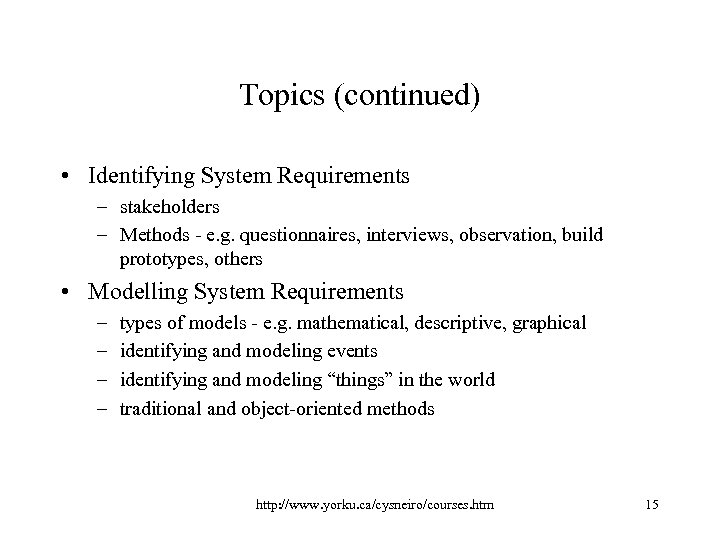 Topics (continued) • Identifying System Requirements – stakeholders – Methods - e. g. questionnaires, interviews, observation, build prototypes, others • Modelling System Requirements – – types of models - e. g. mathematical, descriptive, graphical identifying and modeling events identifying and modeling “things” in the world traditional and object-oriented methods http: //www. yorku. ca/cysneiro/courses. htm 15
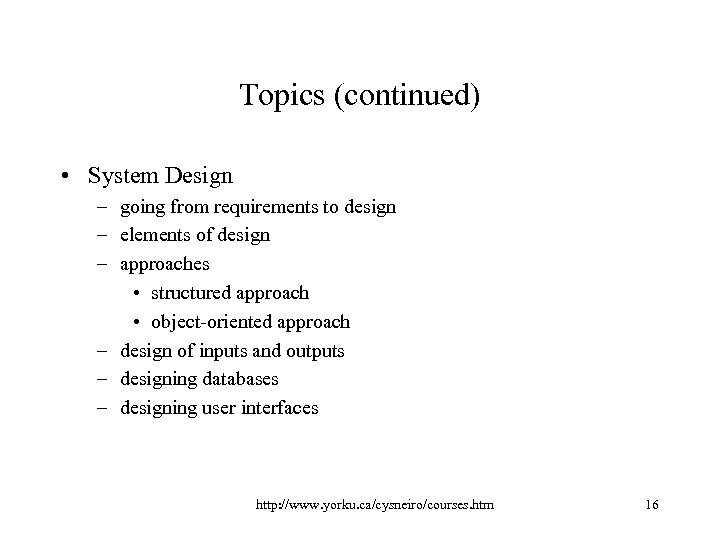 Topics (continued) • System Design – going from requirements to design – elements of design – approaches • structured approach • object-oriented approach – design of inputs and outputs – designing databases – designing user interfaces http: //www. yorku. ca/cysneiro/courses. htm 16
 The World of the Modern System Analyst • System Analysis: the process of understanding and specifying in detail what the information system should do • System Design: the process of specifying in detail how the many component parts of the information system should be implemented • System Analyst: A professional who used analysis and design techniques to solve business problems (involving information technology) • A theme of the course: developing effective information systems is much more than just writing computer programs (involves cognitive skills in understanding problems and knowing where computer technology best “fits in”) http: //www. yorku. ca/cysneiro/courses. htm 17
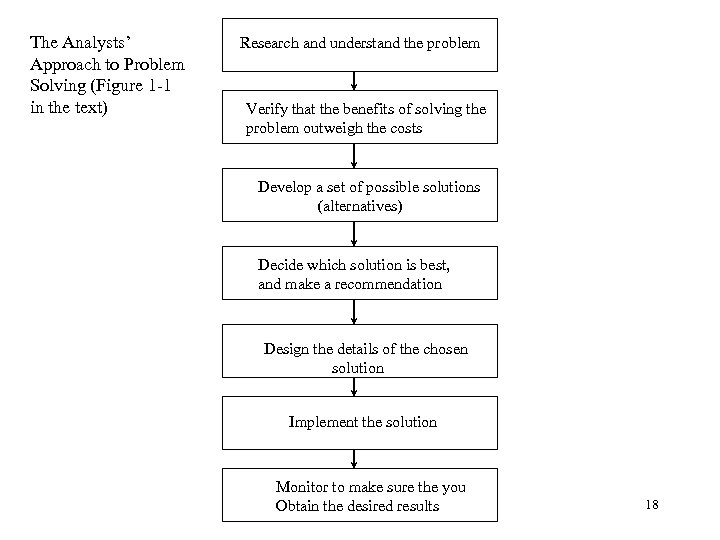 The Analysts’ Approach to Problem Solving (Figure 1 -1 in the text) Research and understand the problem Verify that the benefits of solving the problem outweigh the costs Develop a set of possible solutions (alternatives) Decide which solution is best, and make a recommendation Design the details of the chosen solution Implement the solution Monitor to make sure the you Obtain the desired results 18
 Thinking in terms of “Systems” • What is a system? A system is a collection of interrelated components (subsystems) that function together to achieve some outcome (e. g. biological system, computer system, social system) An information system is a collection of interrelated components that collect, process, store and provide as output the information needed to complete business tasks (e. g. payroll system) 19
 Characteristics of Systems • Systems are made up of interrelated subsystems (e. g. a nuclear reactor is composed of boilers, reactor components etc. ) • Functional decomposition – dividing a system into components based on subsystems (which are in turn further divided into subsystems) • System boundary – the separation between a system and its environment (where inputs and outputs cross) • Automation boundary – separation between the automated part of system and the manual part http: //www. yorku. ca/cysneiro/courses. htm 20
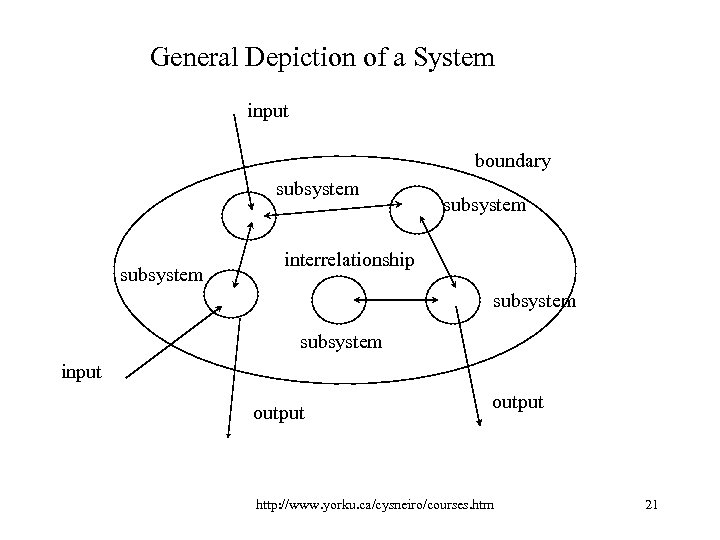 General Depiction of a System input boundary subsystem interrelationship subsystem input output http: //www. yorku. ca/cysneiro/courses. htm 21
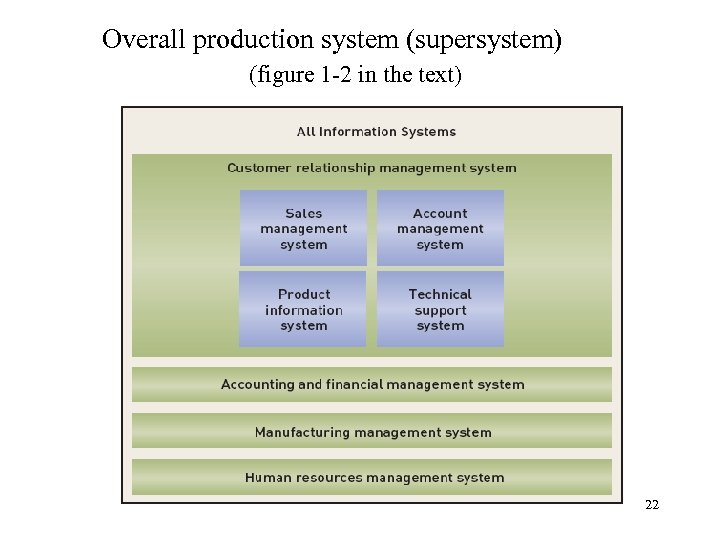 Overall production system (supersystem) (figure 1 -2 in the text) 22
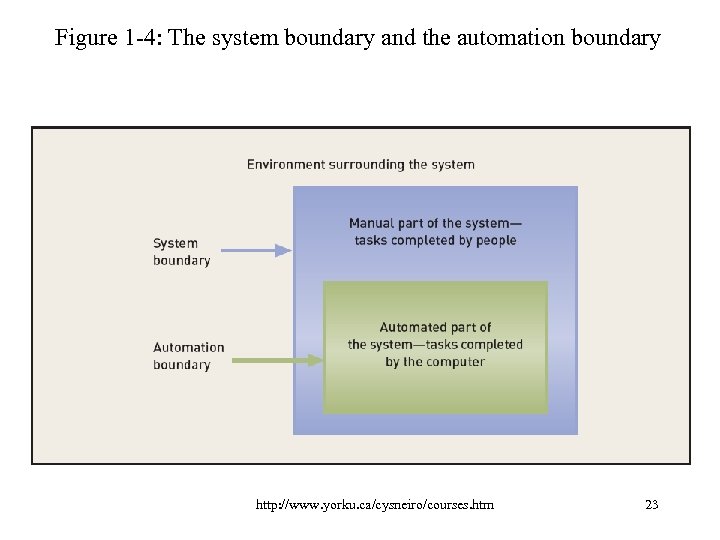 Figure 1 -4: The system boundary and the automation boundary http: //www. yorku. ca/cysneiro/courses. htm 23
 “Systems” Thinking • • Being able to identify something as a system Involves being able to identify subsystems Identifying system characteristics and functions Identifying where the boundaries are (or should be) • Identifying inputs and outputs to systems • Identifying relationships among subsystems http: //www. yorku. ca/cysneiro/courses. htm 24
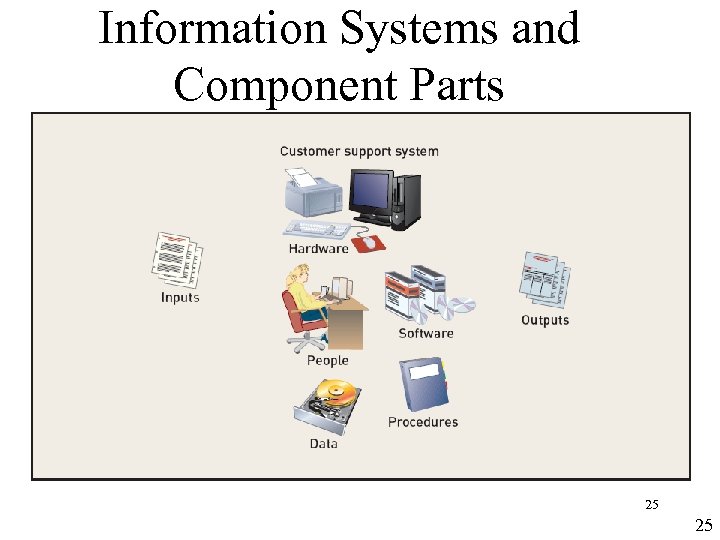 Information Systems and Component Parts 25 25
 Types of Information Systems • Transaction processing systems (TPS) – Capture and record information about the transactions that affect the organization (e. g. the sale of an item, a withdrawal from an ATM etc. ) • Management Information Systems (MIS) – Take information captured by the transaction processing system and produce reports management needs for planning and controlling business http: //www. yorku. ca/cysneiro/courses. htm 26
 • Executive Information Systems (EIS) – Provide information for executives to use in strategic planning (could be from organizational database, or outside sources like stock market reports) • Decision Support Systems (DSS) – Support human decision making and allows users to explore the potential impact of available options or decisions (e. g. can ask “what if”) – Closely related to “expert systems” or “knowledgebased” systems 27
 Required Skills of the Systems Analyst • Technical Knowledge and Skills • • • Computers and how they work in general Programming languages Devices that interact with computers Communications networks Database and database management systems Operating systems and utilities Tools: software products used to help develop analysis and design specifications and completed system components • e. g. Microsoft Access, Integrated development environments, computer-supported system engineering (CASE) tools http: //www. yorku. ca/cysneiro/courses. htm 28
 • Business Knowledge and Skills • What activities and processes do organizations perform? • How are organizations structured? • How are organizations managed? • What type of work (activity) is done in the organization? (e. g. hospital, bank etc. ) • Who are the “actors” doing the activities About the organization (e. g. company) the system analyst needs to know: • • What the specific organization does What makes it successful What its strategies and plans are What its tradition (“culture”) and values are http: //www. yorku. ca/cysneiro/courses. htm 29
 • People Knowledge and Skills • Single most important interpersonal skill: • To communicate clearly and effectively with others! • Since analysts work on teams with others (e. g. team members, clients etc. ) must understand about people: • • • How people think How people learn How people react to change How people communicate How people work (“activities” and “actors”) • Other areas: • Skill in interviewing, listening and observing • Good written and oral presentation • Being able to work in a team http: //www. yorku. ca/cysneiro/courses. htm 30
 Typical Job Titles • • • Programmer/analyst Business systems analyst System liaison End-user analyst Business consultant System support analyst System designer Software engineer System architect http: //www. yorku. ca/cysneiro/courses. htm 31
 Typical Job Ad: Systems Analyst – Distribution Center We are the world’s leading manufacturer of women’s apparel products. Our organization in the Far East has openings for a Systems Analyst Requirements: • Bachelor’s degree in Computer Science, Business Administration or closely related field with 5 (+) years of working experience • In-depth understanding of Distribution and Manufacturing concepts (Allocation, Replenishment, Floor Control, Production Scheduling) • Working knowledge of project management and all phases of the software development life cycle • Experience with CASE tools, PC and Bar Code equipment • Working knowledge of AS/400 and/or UNIX environment with the languages C++, Java and/or COBOL are desirable http: //www. yorku. ca/cysneiro/courses. htm 32
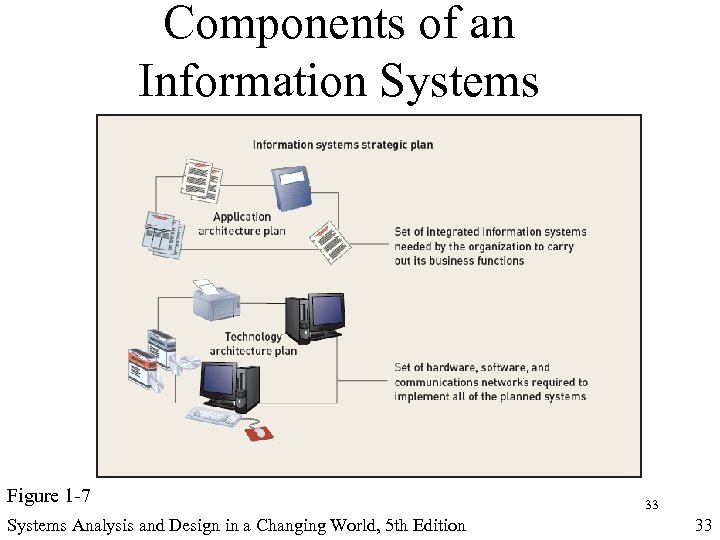 Components of an Information Systems Strategic Plan Figure 1 -7 Systems Analysis and Design in a Changing World, 5 th Edition 33 33
 Rocky Mountain Outfitters (RMO) and Its Strategic Information Systems Plan • RMO sports clothing manufacturer and distributor about to begin customer support system project • Need to understand the nature of the business, approach to strategic planning, and objectives for customer support system • RMO system development project used to demonstrate analysis and design concepts 34 34
 Introduction to Rocky Mountain Outfitters (RMO) Business • Began in Park City, Utah supplying winter sports clothes to local ski shops • Expanded into direct mail-order sales with small catalog—as catalog interest increased, opened retail store in Park City • Became large, regional sports clothing distributor by early 2000 s in Rocky Mountain and Western states • Currently $180 million in annual sales and 600 employees and two retail stores • Mail-order revenue is $90 million; phone-order 35 revenue is $50 million 35
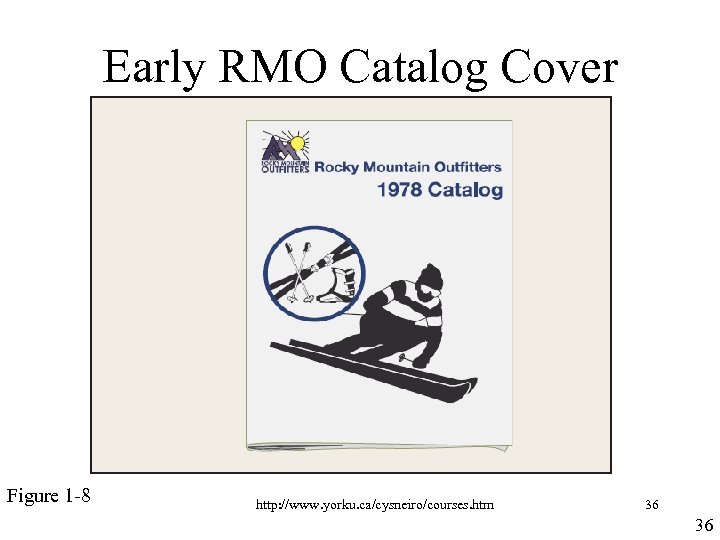 Early RMO Catalog Cover (Fall 1978) Figure 1 -8 http: //www. yorku. ca/cysneiro/courses. htm 36 36
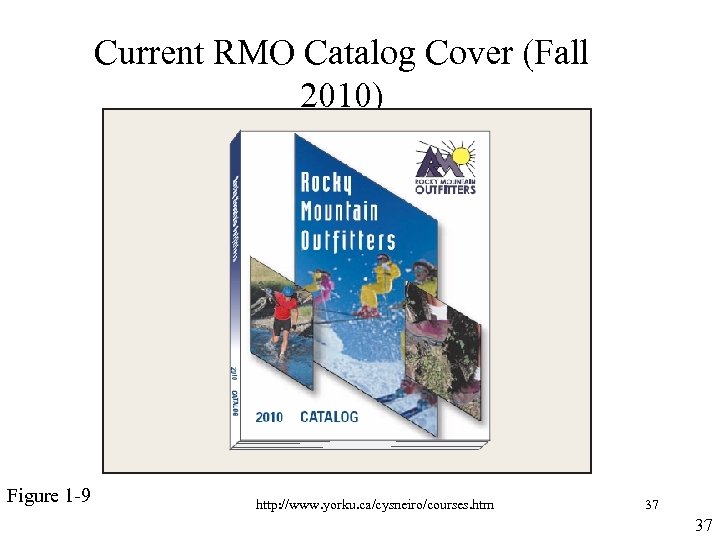 Current RMO Catalog Cover (Fall 2010) Figure 1 -9 http: //www. yorku. ca/cysneiro/courses. htm 37 37
 RMO Strategic Issues • Innovative clothing distributor; featured products on Web site ahead of competitors • Original Web site now underperforming – Slow, poor coordination with in-house, poor supply chain management, poor technical support • Market analysis showed alarming trends – Sales growth too slow, age of customers increasing, Web sales small percentage of total http: //www. yorku. ca/cysneiro/courses. htm 38 38
 RMO Strategic Issues (continued) • Enhanced Web site functions – Add specific product information, weekly specials, and all product offerings • Detailed IS strategic plan – Supply chain management – Customer relationship management http: //www. yorku. ca/cysneiro/courses. htm 39 39
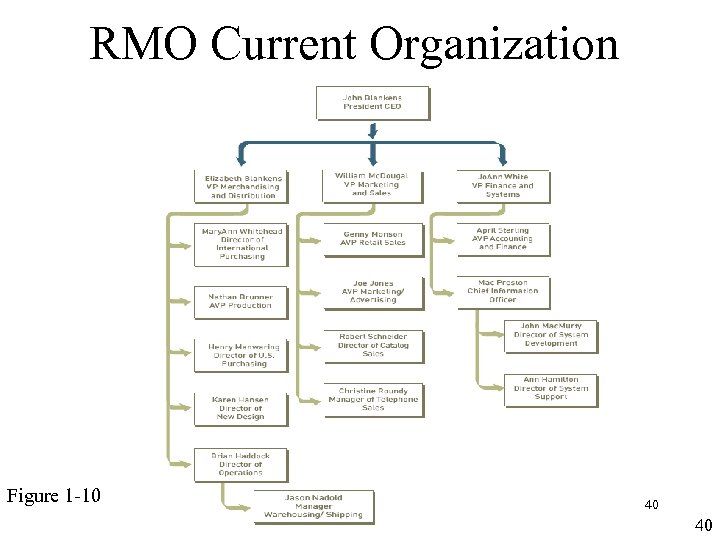 RMO Current Organization Figure 1 -10 40 40
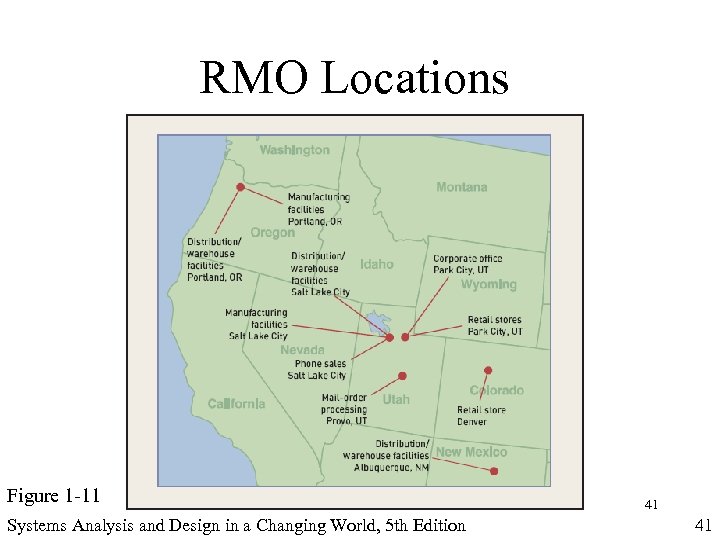 RMO Locations Figure 1 -11 Systems Analysis and Design in a Changing World, 5 th Edition 41 41
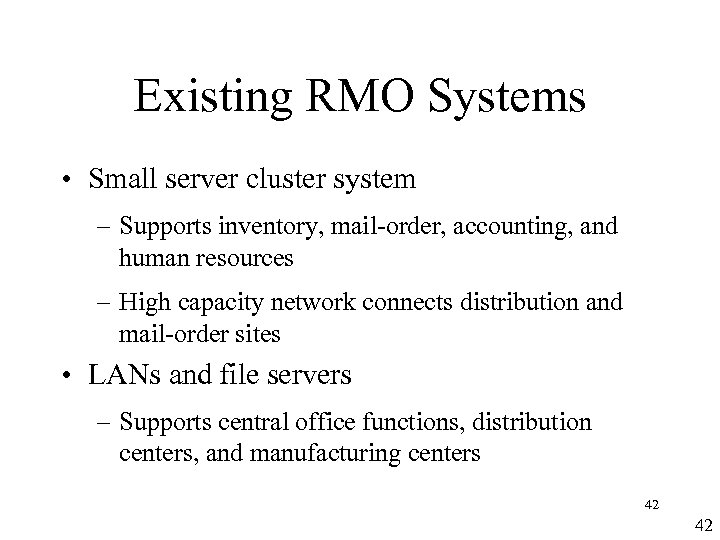 Existing RMO Systems • Small server cluster system – Supports inventory, mail-order, accounting, and human resources – High capacity network connects distribution and mail-order sites • LANs and file servers – Supports central office functions, distribution centers, and manufacturing centers 42 42
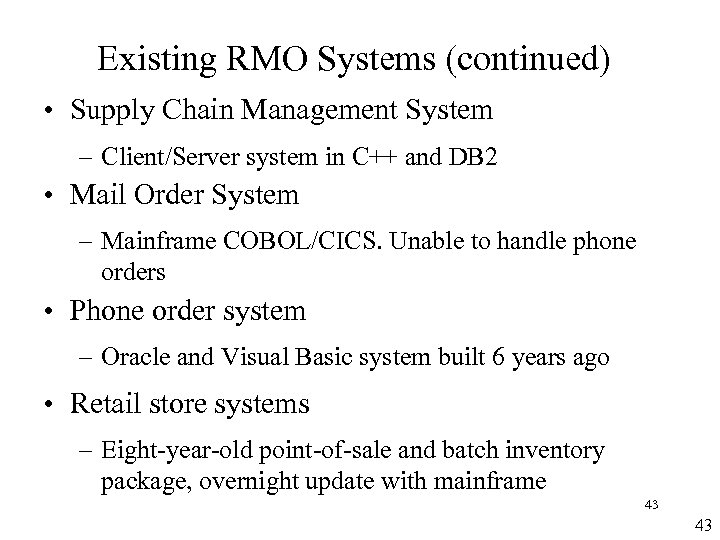 Existing RMO Systems (continued) • Supply Chain Management System – Client/Server system in C++ and DB 2 • Mail Order System – Mainframe COBOL/CICS. Unable to handle phone orders • Phone order system – Oracle and Visual Basic system built 6 years ago • Retail store systems – Eight-year-old point-of-sale and batch inventory package, overnight update with mainframe 43 43
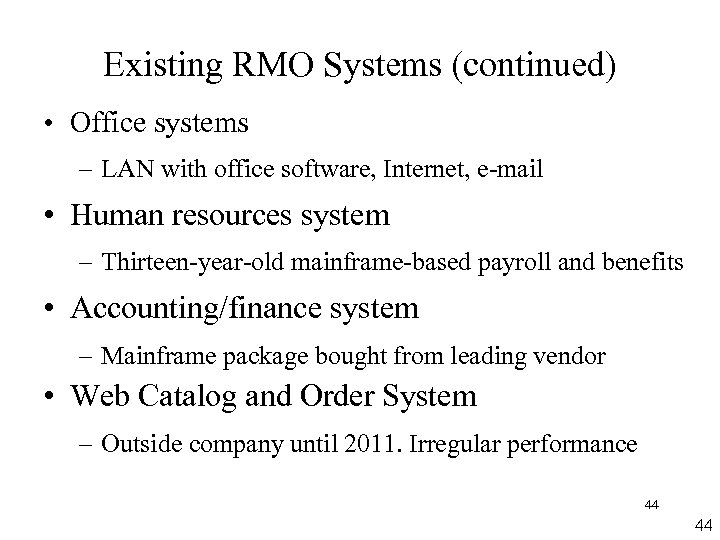 Existing RMO Systems (continued) • Office systems – LAN with office software, Internet, e-mail • Human resources system – Thirteen-year-old mainframe-based payroll and benefits • Accounting/finance system – Mainframe package bought from leading vendor • Web Catalog and Order System – Outside company until 2011. Irregular performance 44 44
 The Information Systems Strategic Plan • Supports RMO strategic objectives – Build more direct customer relationships – Expand marketing beyond Western states • Plan calls for a series of information system development and integration projects over several years • Project launch: New customer support system to integrate phone orders, mail orders, and direct customer orders via Internet 45 45
 RMO Technology Architecture Plan • Distribute business applications – Across multiple locations and systems – Reserve data center for Web server, database, and telecommunications • Strategic business processes via Internet – Supply chain management (SCM) – Direct customer ordering via dynamic Web site – Customer relationship management (CRM) • Web-based intranet for business functions http: //www. yorku. ca/cysneiro/courses. htm 46 46
 RMO Application Architecture Plan • Supply chain management (SCM) – Product development, product acquisition, manufacturing, inventory management • Customer support system (CSS) – Integrate order-processing and fulfillment system with SCM – Support customer orders (mail, phone, Web) • Strategic information management system – Extract and analyze SCM and CSS information for strategic and operational decision making and control http: //www. yorku. ca/cysneiro/courses. htm 47 47
 RMO Application Architecture Plan (continued) • Retail store system (RSS) – Replace existing retail store system with system integrated with CSS • Accounting/finance system – Purchase intranet application to maximize employee access to financial data for planning and control • Human resources (HR) system – Purchase intranet application to maximize employee access to human resources forms, procedures, and benefits information 48 48
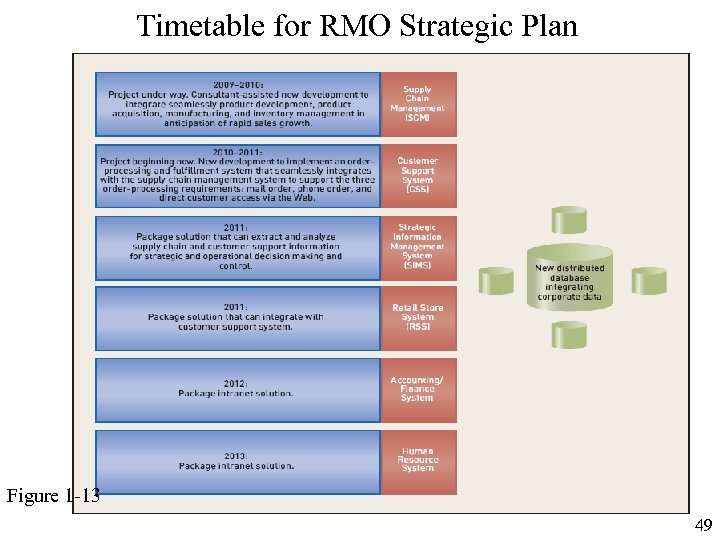 Timetable for RMO Strategic Plan Figure 1 -13 49 49
 System Development • Project: a planned undertaking that has a beginning and an end, and which produces a predetermined result or product • Information System development project: planned undertaking that produces a system • Basic activities in development of any new system: – Analysis – to understand information needs – Design – define the system architecture (based on needs) – Implementation – the actual construction of the system http: //www. yorku. ca/cysneiro/courses. htm 50