 Скачать презентацию Italy i ɪtəli Italian Italia iˈtaːlja officially the Italian
Italy.pptx
- Количество слайдов: 20



![Italy i/ɪtəli/ (Italian: Italia [iˈtaːlja]), officially the Italian Republic (Italian: Repubblica italiana), is a](https://present5.com/presentation/63753022_44171475/image-1.jpg "Italy i/ɪtəli/ (Italian: Italia [iˈtaːlja]), officially the Italian Republic (Italian: Repubblica italiana), is a")
Italy i/ɪtəli/ (Italian: Italia [iˈtaːlja]), officially the Italian Republic (Italian: Repubblica italiana), is a unitary parliamentary republic in South. Central Europe. To the north it borders France, Switzerland, Austria and Slo venia along the Alps. To the south it consists of the entirety of the Italia Peninsula, Sicily, Sardinia–the two largest islands in the Mediterranean Sea–and many other smaller islands. The independent states of San Marino and the Vatican City are enclaves within Italy, whilst Campione d'Italia is an Italian exclave in Switzerland. The territory of Italy covers some 301, 338 km 2 (116, 347 sq mi) and is influenced by a temperate seasonal climate. With 60. 6 million inhabitants, it is the fifth most populous country in Europe, and the 23 rd most populous in the world. Flag Emblem
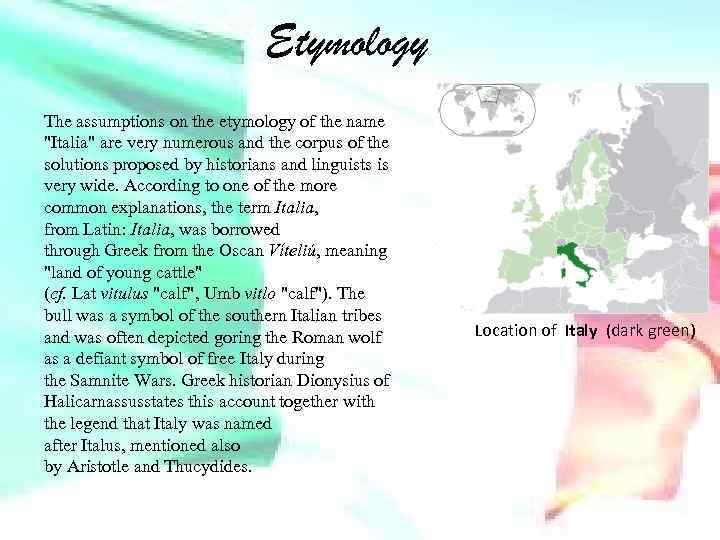
Etymology The assumptions on the etymology of the name "Italia" are very numerous and the corpus of the solutions proposed by historians and linguists is very wide. According to one of the more common explanations, the term Italia, from Latin: Italia, was borrowed through Greek from the Oscan Víteliú, meaning "land of young cattle" (cf. Lat vitulus "calf", Umb vitlo "calf"). The bull was a symbol of the southern Italian tribes and was often depicted goring the Roman wolf as a defiant symbol of free Italy during the Samnite Wars. Greek historian Dionysius of Halicarnassusstates this account together with the legend that Italy was named after Italus, mentioned also by Aristotle and Thucydides. Location of Italy (dark green)
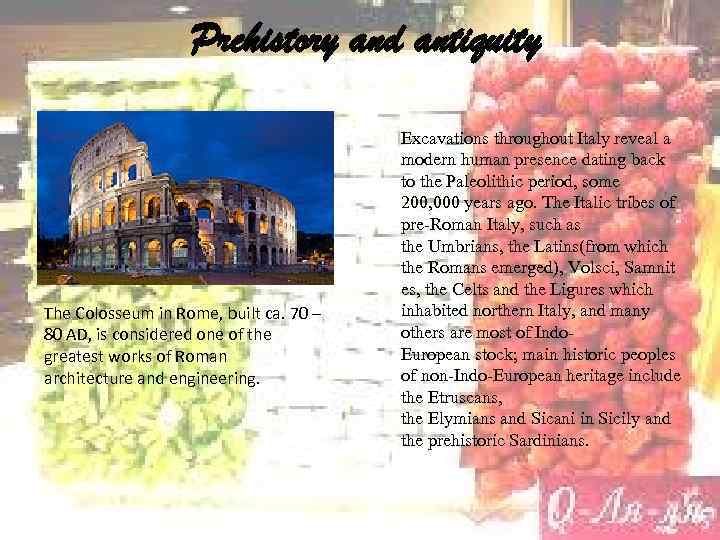
Prehistory and antiquity The Colosseum in Rome, built ca. 70 – 80 AD, is considered one of the greatest works of Roman architecture and engineering. Excavations throughout Italy reveal a modern human presence dating back to the Paleolithic period, some 200, 000 years ago. The Italic tribes of pre-Roman Italy, such as the Umbrians, the Latins(from which the Romans emerged), Volsci, Samnit es, the Celts and the Ligures which inhabited northern Italy, and many others are most of Indo. European stock; main historic peoples of non-Indo-European heritage include the Etruscans, the Elymians and Sicani in Sicily and the prehistoric Sardinians.
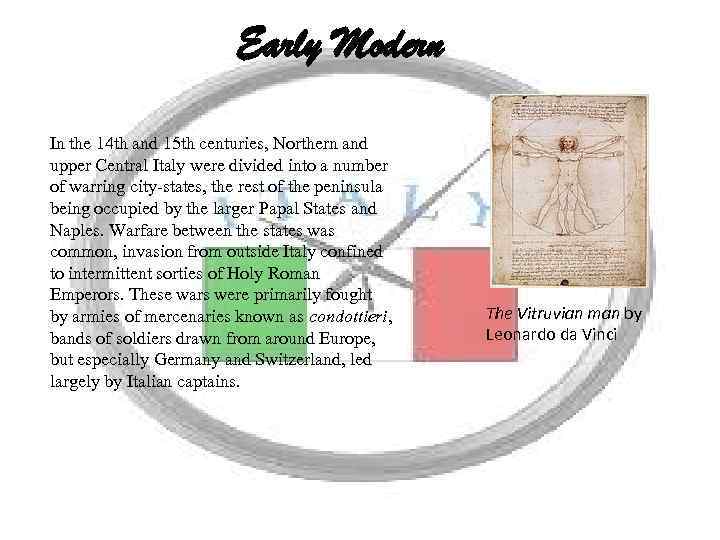
Early Modern In the 14 th and 15 th centuries, Northern and upper Central Italy were divided into a number of warring city-states, the rest of the peninsula being occupied by the larger Papal States and Naples. Warfare between the states was common, invasion from outside Italy confined to intermittent sorties of Holy Roman Emperors. These wars were primarily fought by armies of mercenaries known as condottieri, bands of soldiers drawn from around Europe, but especially Germany and Switzerland, led largely by Italian captains. The Vitruvian man by Leonardo da Vinci
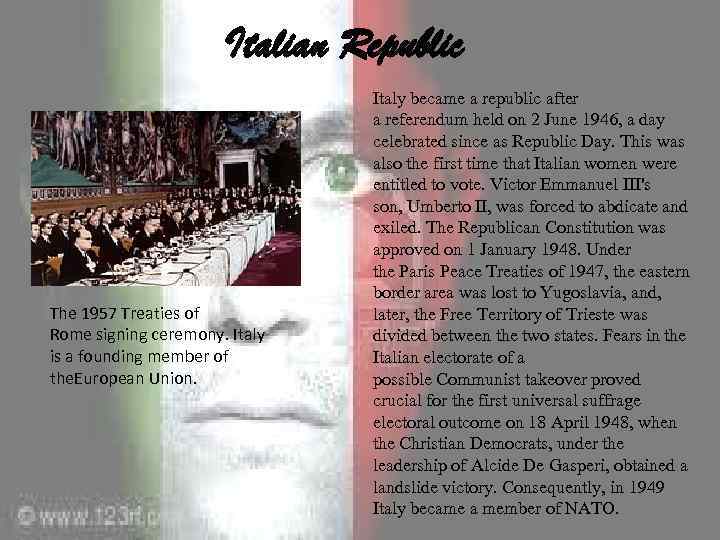
Italian Republic The 1957 Treaties of Rome signing ceremony. Italy is a founding member of the. European Union. Italy became a republic after a referendum held on 2 June 1946, a day celebrated since as Republic Day. This was also the first time that Italian women were entitled to vote. Victor Emmanuel III's son, Umberto II, was forced to abdicate and exiled. The Republican Constitution was approved on 1 January 1948. Under the Paris Peace Treaties of 1947, the eastern border area was lost to Yugoslavia, and, later, the Free Territory of Trieste was divided between the two states. Fears in the Italian electorate of a possible Communist takeover proved crucial for the first universal suffrage electoral outcome on 18 April 1948, when the Christian Democrats, under the leadership of Alcide De Gasperi, obtained a landslide victory. Consequently, in 1949 Italy became a member of NATO.
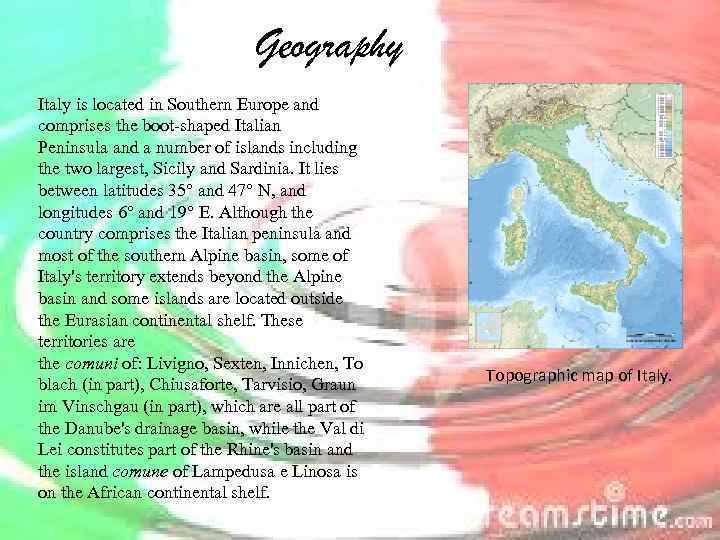
Geography Italy is located in Southern Europe and comprises the boot-shaped Italian Peninsula and a number of islands including the two largest, Sicily and Sardinia. It lies between latitudes 35° and 47° N, and longitudes 6° and 19° E. Although the country comprises the Italian peninsula and most of the southern Alpine basin, some of Italy's territory extends beyond the Alpine basin and some islands are located outside the Eurasian continental shelf. These territories are the comuni of: Livigno, Sexten, Innichen, To blach (in part), Chiusaforte, Tarvisio, Graun im Vinschgau (in part), which are all part of the Danube's drainage basin, while the Val di Lei constitutes part of the Rhine's basin and the island comune of Lampedusa e Linosa is on the African continental shelf. Topographic map of Italy.
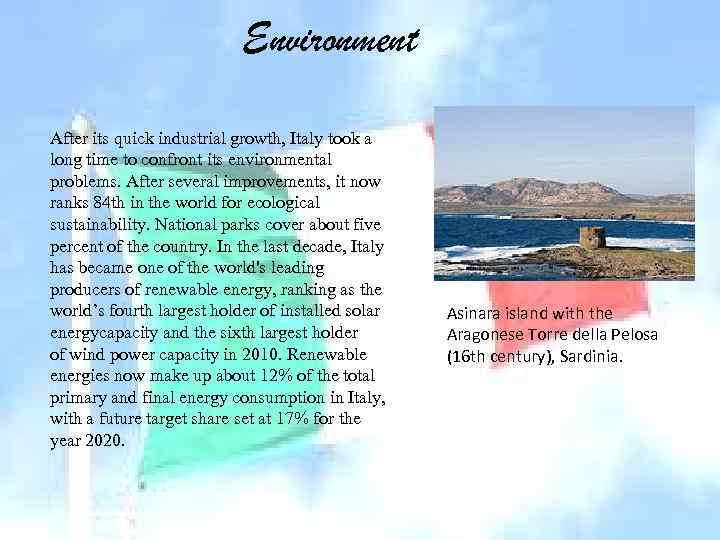
Environment After its quick industrial growth, Italy took a long time to confront its environmental problems. After several improvements, it now ranks 84 th in the world for ecological sustainability. National parks cover about five percent of the country. In the last decade, Italy has became one of the world's leading producers of renewable energy, ranking as the world’s fourth largest holder of installed solar energycapacity and the sixth largest holder of wind power capacity in 2010. Renewable energies now make up about 12% of the total primary and final energy consumption in Italy, with a future target share set at 17% for the year 2020. Asinara island with the Aragonese Torre della Pelosa (16 th century), Sardinia.
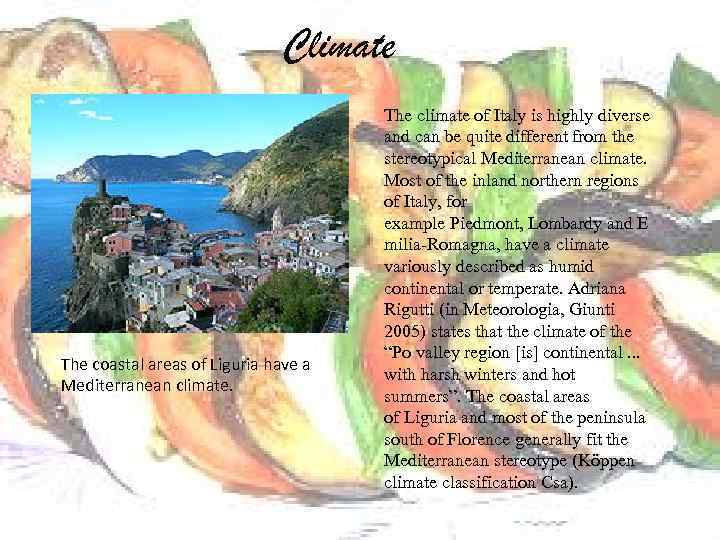
Climate The coastal areas of Liguria have a Mediterranean climate. The climate of Italy is highly diverse and can be quite different from the stereotypical Mediterranean climate. Most of the inland northern regions of Italy, for example Piedmont, Lombardy and E milia-Romagna, have a climate variously described as humid continental or temperate. Adriana Rigutti (in Meteorologia, Giunti 2005) states that the climate of the “Po valley region [is] continental. . . with harsh winters and hot summers”. The coastal areas of Liguria and most of the peninsula south of Florence generally fit the Mediterranean stereotype (Köppen climate classification Csa).
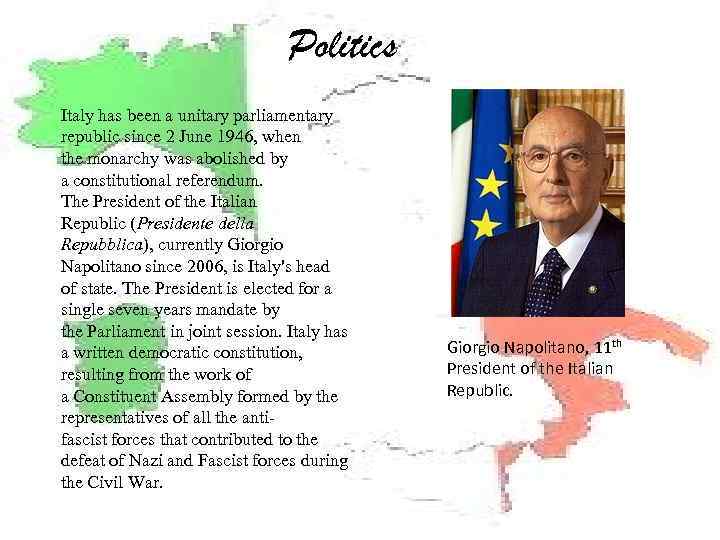
Politics Italy has been a unitary parliamentary republic since 2 June 1946, when the monarchy was abolished by a constitutional referendum. The President of the Italian Republic (Presidente della Repubblica), currently Giorgio Napolitano since 2006, is Italy's head of state. The President is elected for a single seven years mandate by the Parliament in joint session. Italy has a written democratic constitution, resulting from the work of a Constituent Assembly formed by the representatives of all the antifascist forces that contributed to the defeat of Nazi and Fascist forces during the Civil War. Giorgio Napolitano, 11 th President of the Italian Republic.
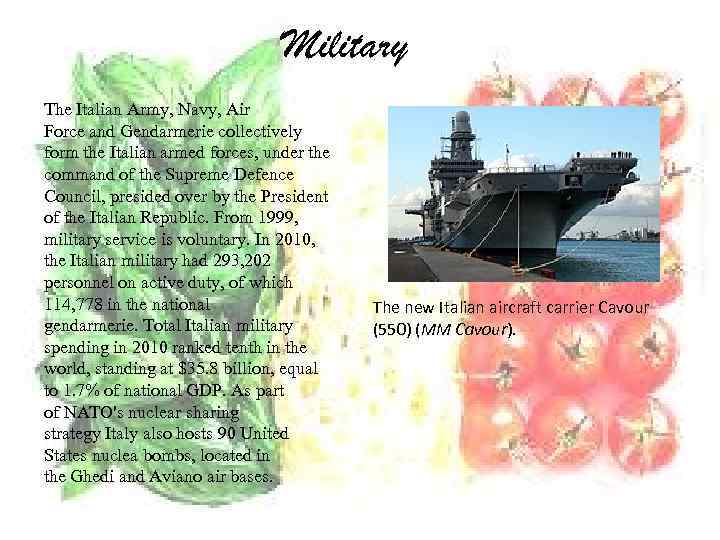
Military The Italian Army, Navy, Air Force and Gendarmerie collectively form the Italian armed forces, under the command of the Supreme Defence Council, presided over by the President of the Italian Republic. From 1999, military service is voluntary. In 2010, the Italian military had 293, 202 personnel on active duty, of which 114, 778 in the national gendarmerie. Total Italian military spending in 2010 ranked tenth in the world, standing at $35. 8 billion, equal to 1. 7% of national GDP. As part of NATO's nuclear sharing strategy Italy also hosts 90 United States nuclea bombs, located in the Ghedi and Aviano air bases. The new Italian aircraft carrier Cavour (550) (MM Cavour).
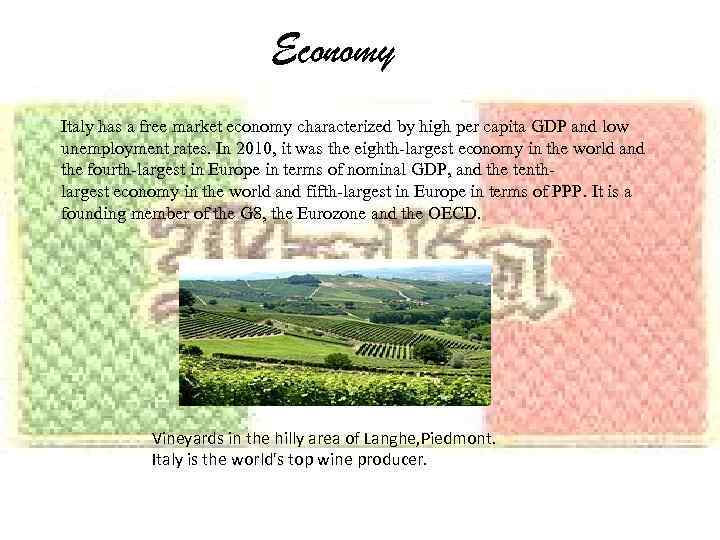
Economy Italy has a free market economy characterized by high per capita GDP and low unemployment rates. In 2010, it was the eighth-largest economy in the world and the fourth-largest in Europe in terms of nominal GDP, and the tenthlargest economy in the world and fifth-largest in Europe in terms of PPP. It is a founding member of the G 8, the Eurozone and the OECD. Vineyards in the hilly area of Langhe, Piedmont. Italy is the world's top wine producer.
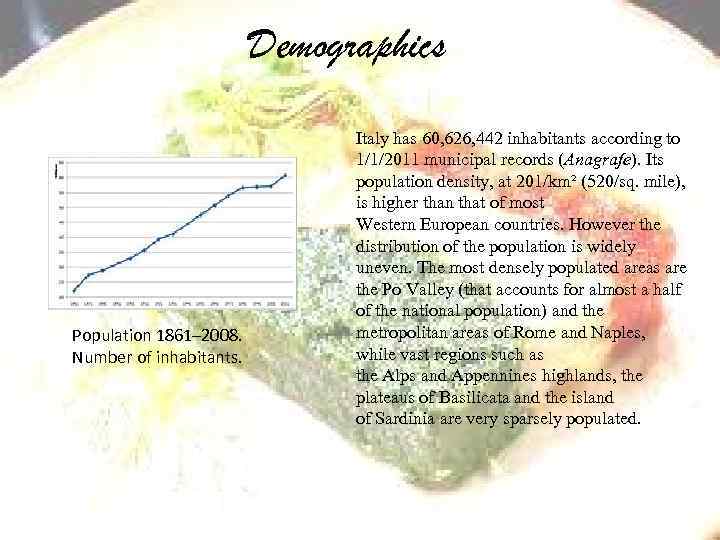
Demographics Population 1861– 2008. Number of inhabitants. Italy has 60, 626, 442 inhabitants according to 1/1/2011 municipal records (Anagrafe). Its population density, at 201/km² (520/sq. mile), is higher than that of most Western European countries. However the distribution of the population is widely uneven. The most densely populated areas are the Po Valley (that accounts for almost a half of the national population) and the metropolitan areas of Rome and Naples, while vast regions such as the Alps and Appennines highlands, the plateaus of Basilicata and the island of Sardinia are very sparsely populated.
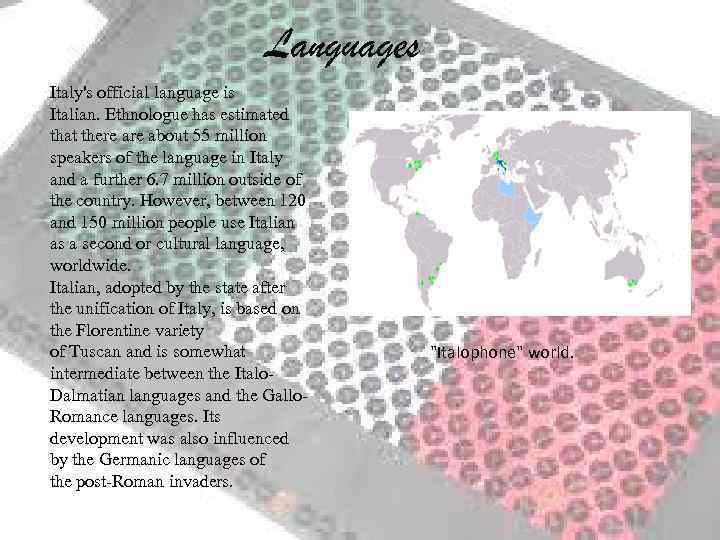
Languages Italy's official language is Italian. Ethnologue has estimated that there about 55 million speakers of the language in Italy and a further 6. 7 million outside of the country. However, between 120 and 150 million people use Italian as a second or cultural language, worldwide. Italian, adopted by the state after the unification of Italy, is based on the Florentine variety of Tuscan and is somewhat intermediate between the Italo. Dalmatian languages and the Gallo. Romance languages. Its development was also influenced by the Germanic languages of the post-Roman invaders. "Italophone" world.
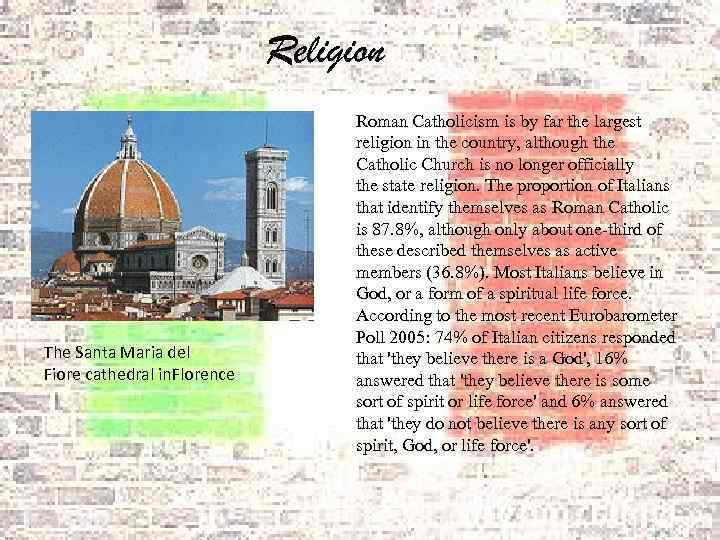
Religion The Santa Maria del Fiore cathedral in. Florence Roman Catholicism is by far the largest religion in the country, although the Catholic Church is no longer officially the state religion. The proportion of Italians that identify themselves as Roman Catholic is 87. 8%, although only about one-third of these described themselves as active members (36. 8%). Most Italians believe in God, or a form of a spiritual life force. According to the most recent Eurobarometer Poll 2005: 74% of Italian citizens responded that 'they believe there is a God', 16% answered that 'they believe there is some sort of spirit or life force' and 6% answered that 'they do not believe there is any sort of spirit, God, or life force'.
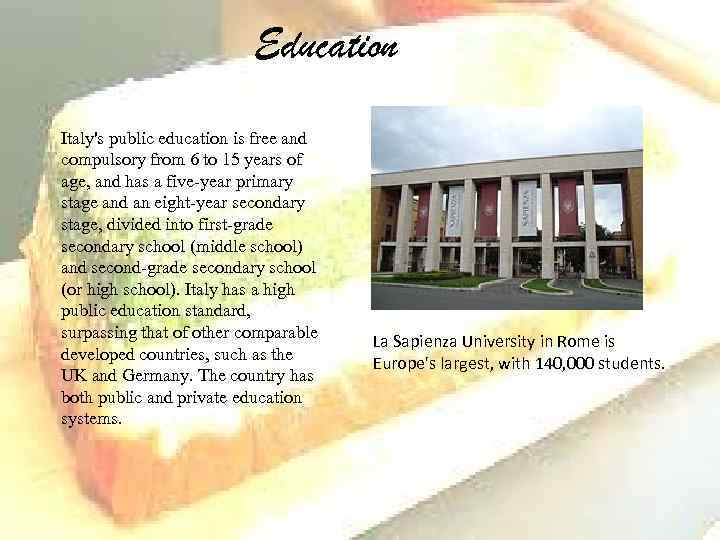
Education Italy's public education is free and compulsory from 6 to 15 years of age, and has a five-year primary stage and an eight-year secondary stage, divided into first-grade secondary school (middle school) and second-grade secondary school (or high school). Italy has a high public education standard, surpassing that of other comparable developed countries, such as the UK and Germany. The country has both public and private education systems. La Sapienza University in Rome is Europe's largest, with 140, 000 students.
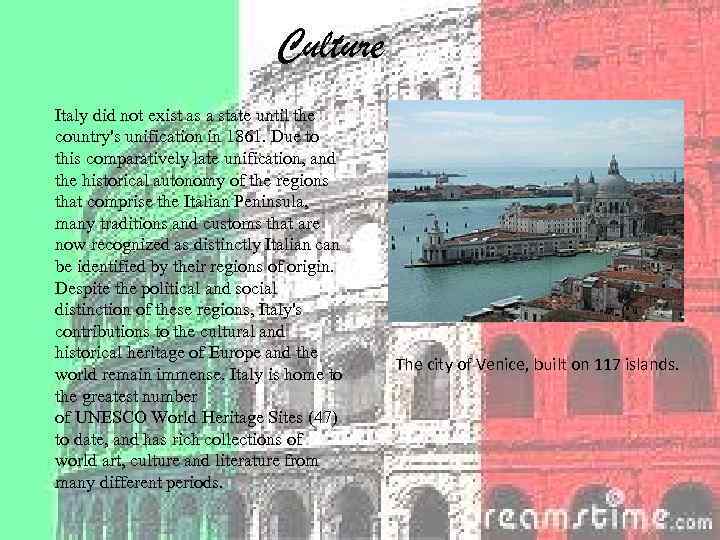
Culture Italy did not exist as a state until the country's unification in 1861. Due to this comparatively late unification, and the historical autonomy of the regions that comprise the Italian Peninsula, many traditions and customs that are now recognized as distinctly Italian can be identified by their regions of origin. Despite the political and social distinction of these regions, Italy's contributions to the cultural and historical heritage of Europe and the world remain immense. Italy is home to the greatest number of UNESCO World Heritage Sites (47) to date, and has rich collections of world art, culture and literature from many different periods. The city of Venice, built on 117 islands.
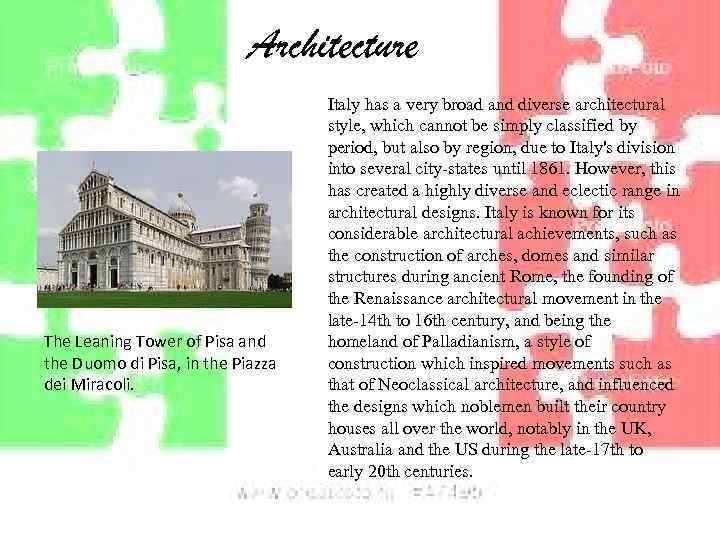
Architecture The Leaning Tower of Pisa and the Duomo di Pisa, in the Piazza dei Miracoli. Italy has a very broad and diverse architectural style, which cannot be simply classified by period, but also by region, due to Italy's division into several city-states until 1861. However, this has created a highly diverse and eclectic range in architectural designs. Italy is known for its considerable architectural achievements, such as the construction of arches, domes and similar structures during ancient Rome, the founding of the Renaissance architectural movement in the late-14 th to 16 th century, and being the homeland of Palladianism, a style of construction which inspired movements such as that of Neoclassical architecture, and influenced the designs which noblemen built their country houses all over the world, notably in the UK, Australia and the US during the late-17 th to early 20 th centuries.
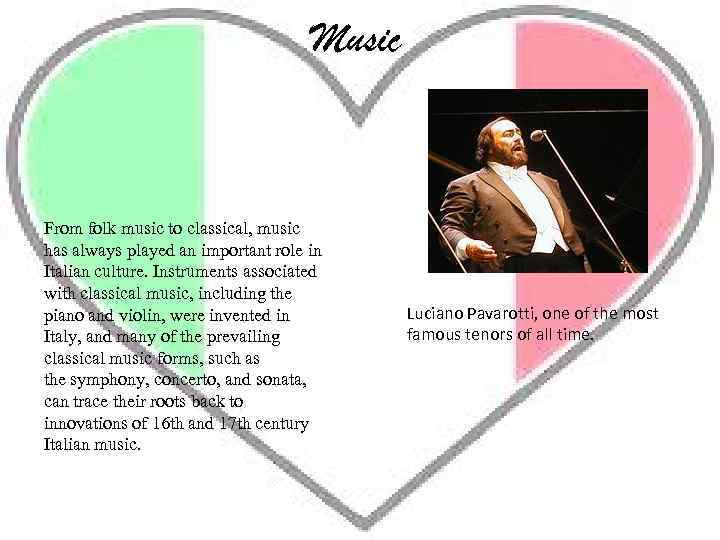
Music From folk music to classical, music has always played an important role in Italian culture. Instruments associated with classical music, including the piano and violin, were invented in Italy, and many of the prevailing classical music forms, such as the symphony, concerto, and sonata, can trace their roots back to innovations of 16 th and 17 th century Italian music. Luciano Pavarotti, one of the most famous tenors of all time.
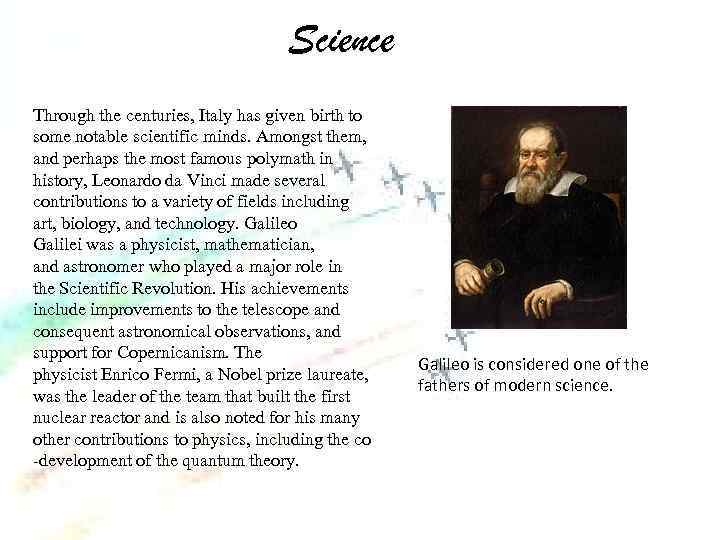
Science Through the centuries, Italy has given birth to some notable scientific minds. Amongst them, and perhaps the most famous polymath in history, Leonardo da Vinci made several contributions to a variety of fields including art, biology, and technology. Galileo Galilei was a physicist, mathematician, and astronomer who played a major role in the Scientific Revolution. His achievements include improvements to the telescope and consequent astronomical observations, and support for Copernicanism. The physicist Enrico Fermi, a Nobel prize laureate, was the leader of the team that built the first nuclear reactor and is also noted for his many other contributions to physics, including the co -development of the quantum theory. Galileo is considered one of the fathers of modern science.
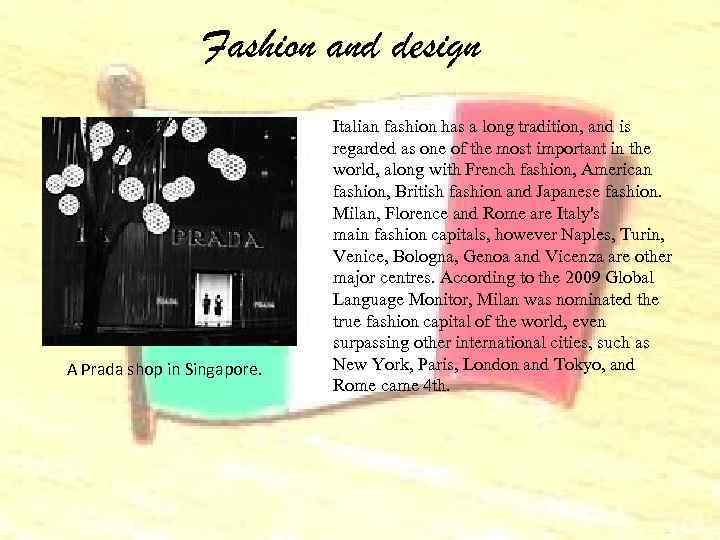
Fashion and design A Prada shop in Singapore. Italian fashion has a long tradition, and is regarded as one of the most important in the world, along with French fashion, American fashion, British fashion and Japanese fashion. Milan, Florence and Rome are Italy's main fashion capitals, however Naples, Turin, Venice, Bologna, Genoa and Vicenza are other major centres. According to the 2009 Global Language Monitor, Milan was nominated the true fashion capital of the world, even surpassing other international cities, such as New York, Paris, London and Tokyo, and Rome came 4 th.
Скачать презентацию Italy i ɪtəli Italian Italia iˈtaːlja officially the Italian
Italy.pptx