



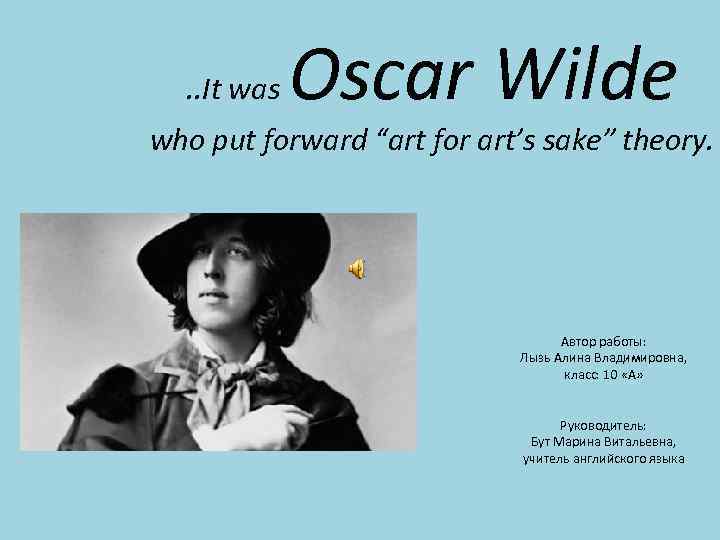
 . . It was Oscar Wilde who put forward “art for art’s sake” theory. Автор работы: Лызь Алина Владимировна, класс: 10 «А» Руководитель: Бут Марина Витальевна, учитель английского языка
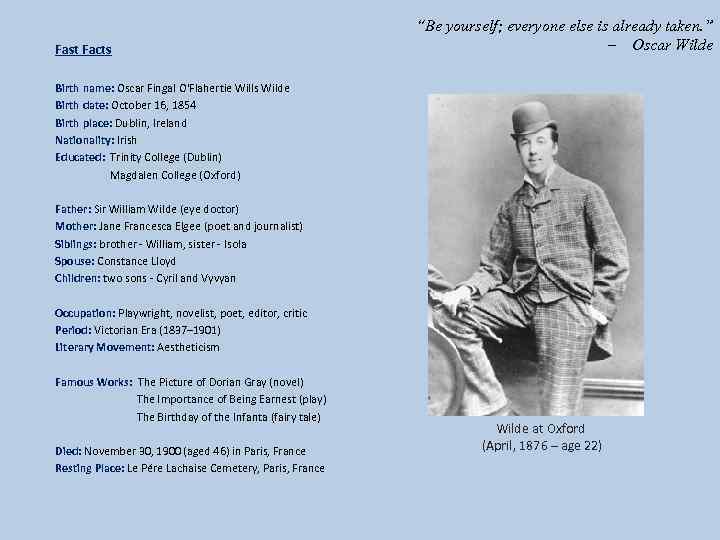 Fast Facts “Be yourself; everyone else is already taken. ” – Oscar Wilde Birth name: Oscar Fingal O'Flahertie Wills Wilde Birth date: October 16, 1854 Birth place: Dublin, Ireland Nationality: Irish Educated: Trinity College (Dublin) Magdalen College (Oxford) Father: Sir William Wilde (eye doctor) Mother: Jane Francesca Elgee (poet and journalist) Siblings: brother - William, sister - Isola Spouse: Constance Lloyd Children: two sons - Cyril and Vyvyan Occupation: Playwright, novelist, poet, editor, critic Period: Victorian Era (1837– 1901) Literary Movement: Aestheticism Famous Works: The Picture of Dorian Gray (novel) The Importance of Being Earnest (play) The Birthday of the Infanta (fairy tale) Died: November 30, 1900 (aged 46) in Paris, France Resting Place: Le Pére Lachaise Cemetery, Paris, France Wilde at Oxford (April, 1876 – age 22)
 “I put all my genius into my life; I put only my talent into my work. ” – Oscar Wilde Chronology of Wilde's Life 1854 Born in Dublin 1864 - 1871 Attends Portora Royal School, Enniskillen 1871 - 1874 Attends Trinity College, Dublin 1874 -1879 Attends Magdalen College, Oxford 1878 Wins Newdigate Prize for Ravenna (poem) 1881 Publishes his first collection of poetry – Poems 1882 Lectures in the United States and Canada. Writes his first play - Vera, or the Nihilists (was not successful). 1883 Lectures in Britain and Ireland. Writes his second unsuccessful play, The Duchess of Padua.
 “Anybody can make history. Only a great man can write it. ” – Oscar Wilde 1884 Marries Constance Lloyd 1885 His son, Cyril, is born 1886 His son, Vyvyan, is born 1887 -1889 Edits Woman's World magazine 1888 Publishes The Happy Prince and Other Tales 1889 - 1890 Publishes several essays 1891 Publishes two collections of short stories - Lord Arthur Savile's Crime and other stories , and A House of Pomegranates. Publishes The Picture of Dorian Gray, his first and only novel. Begins his friendship with Lord Alfred Douglas - Bosie. 1892 Writes two plays: Lady Windermere's Fan (great success) and Salome.
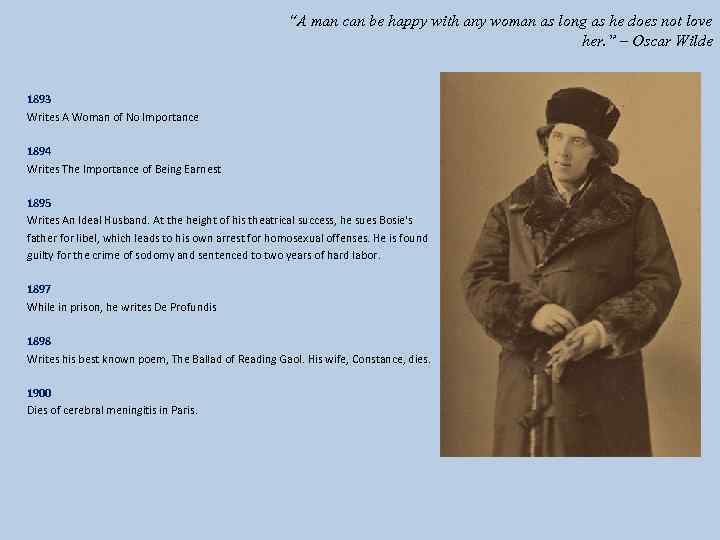 “A man can be happy with any woman as long as he does not love her. ” – Oscar Wilde 1893 Writes A Woman of No Importance 1894 Writes The Importance of Being Earnest 1895 Writes An ldeal Husband. At the height of his theatrical success, he sues Bosie's father for libel, which leads to his own arrest for homosexual offenses. He is found guilty for the crime of sodomy and sentenced to two years of hard labor. 1897 While in prison, he writes De Profundis 1898 Writes his best known poem, The Ballad of Reading Gaol. His wife, Constance, dies. 1900 Dies of cerebral meningitis in Paris.
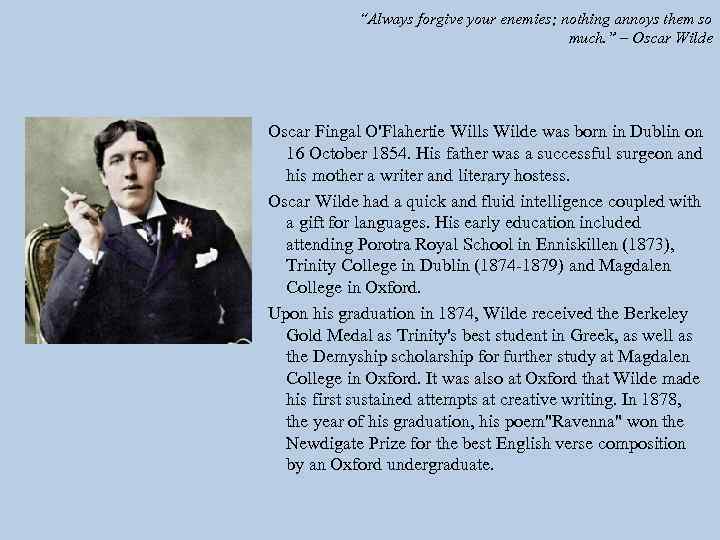 “Always forgive your enemies; nothing annoys them so much. ” – Oscar Wilde Oscar Fingal O'Flahertie Wills Wilde was born in Dublin on 16 October 1854. His father was a successful surgeon and his mother a writer and literary hostess. Oscar Wilde had a quick and fluid intelligence coupled with a gift for languages. His early education included attending Porotra Royal School in Enniskillen (1873), Trinity College in Dublin (1874 -1879) and Magdalen College in Oxford. Upon his graduation in 1874, Wilde received the Berkeley Gold Medal as Trinity's best student in Greek, as well as the Demyship scholarship for further study at Magdalen College in Oxford. It was also at Oxford that Wilde made his first sustained attempts at creative writing. In 1878, the year of his graduation, his poem"Ravenna" won the Newdigate Prize for the best English verse composition by an Oxford undergraduate.
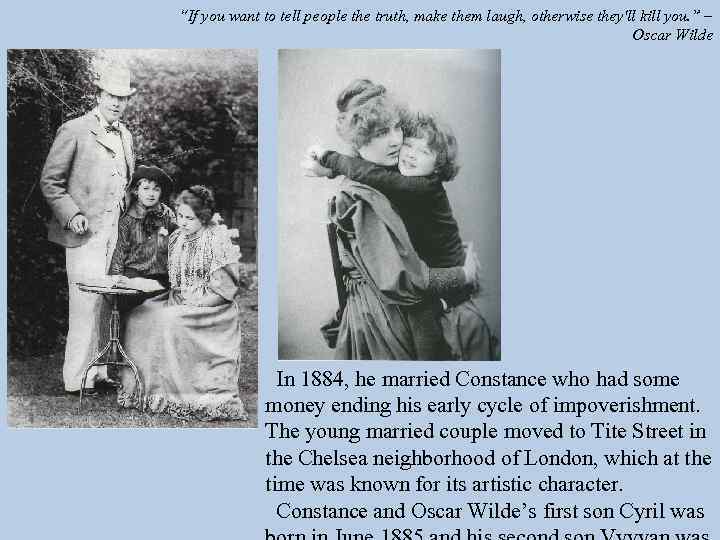 “If you want to tell people the truth, make them laugh, otherwise they'll kill you. ” – Oscar Wilde In 1884, he married Constance who had some money ending his early cycle of impoverishment. The young married couple moved to Tite Street in the Chelsea neighborhood of London, which at the time was known for its artistic character. Constance and Oscar Wilde’s first son Cyril was
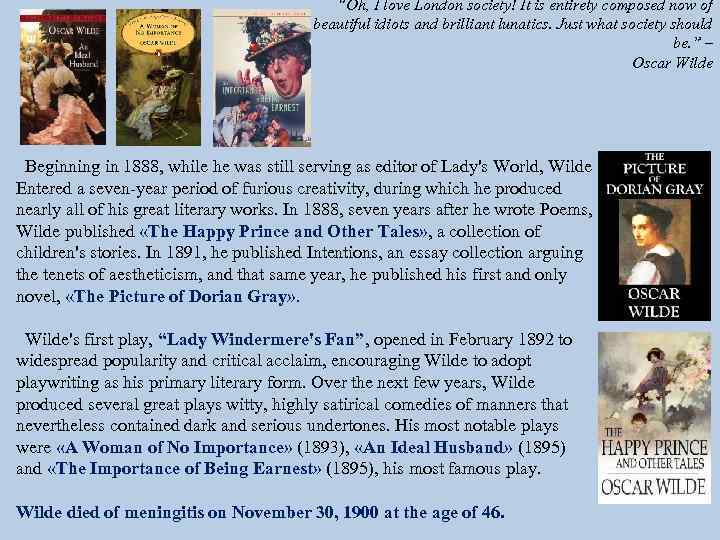 “Oh, I love London society! It is entirely composed now of beautiful idiots and brilliant lunatics. Just what society should be. ” – Oscar Wilde Beginning in 1888, while he was still serving as editor of Lady's World, Wilde Entered a seven-year period of furious creativity, during which he produced nearly all of his great literary works. In 1888, seven years after he wrote Poems, Wilde published «The Happy Prince and Other Tales» , a collection of children's stories. In 1891, he published Intentions, an essay collection arguing the tenets of aestheticism, and that same year, he published his first and only novel, «The Picture of Dorian Gray» . Wilde's first play, “Lady Windermere's Fan”, opened in February 1892 to widespread popularity and critical acclaim, encouraging Wilde to adopt playwriting as his primary literary form. Over the next few years, Wilde produced several great plays witty, highly satirical comedies of manners that nevertheless contained dark and serious undertones. His most notable plays were «A Woman of No Importance» (1893), «An Ideal Husband» (1895) and «The Importance of Being Earnest» (1895), his most famous play. Wilde died of meningitis on November 30, 1900 at the age of 46.
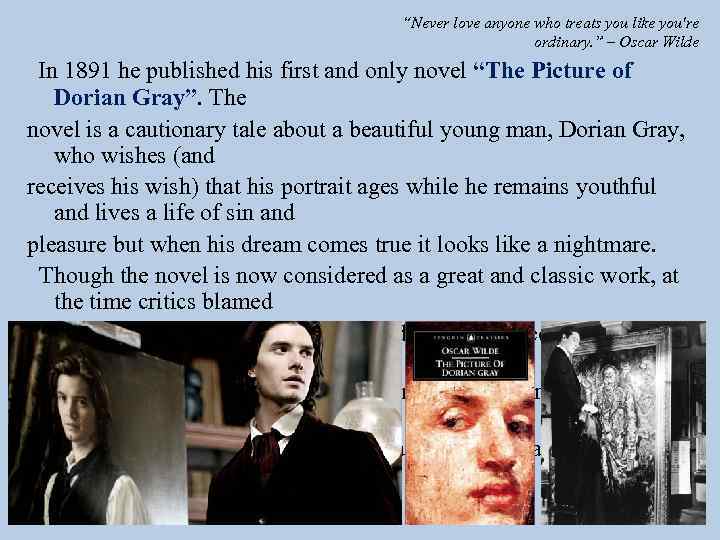 “Never love anyone who treats you like you're ordinary. ” – Oscar Wilde In 1891 he published his first and only novel “The Picture of Dorian Gray”. The novel is a cautionary tale about a beautiful young man, Dorian Gray, who wishes (and receives his wish) that his portrait ages while he remains youthful and lives a life of sin and pleasure but when his dream comes true it looks like a nightmare. Though the novel is now considered as a great and classic work, at the time critics blamed the book on lack of morality. Wilde ardently protected himself in a preface to the novel in which he wrote, "an ethical sympathy in an artist is an unpardonable mannerism of style“ and "vice and virtue are to the artist materials for an art. "
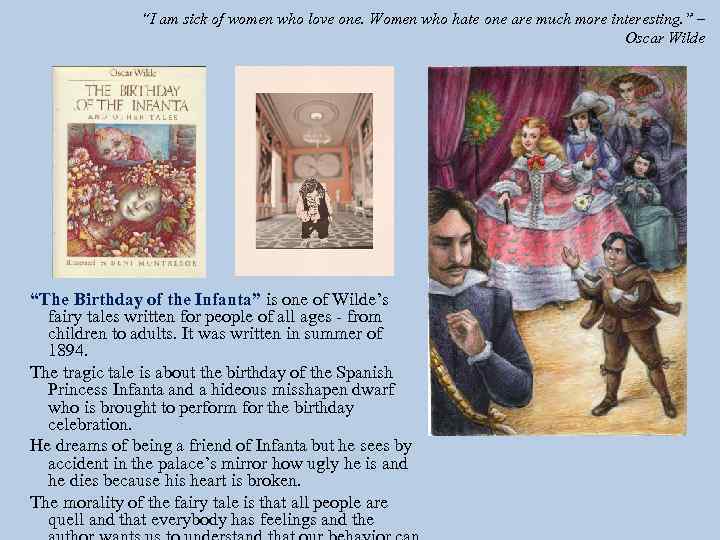 “I am sick of women who love one. Women who hate one are much more interesting. ” – Oscar Wilde “The Birthday of the Infanta” is one of Wilde’s fairy tales written for people of all ages - from children to adults. It was written in summer of 1894. The tragic tale is about the birthday of the Spanish Princess Infanta and a hideous misshapen dwarf who is brought to perform for the birthday celebration. He dreams of being a friend of Infanta but he sees by accident in the palace’s mirror how ugly he is and he dies because his heart is broken. The morality of the fairy tale is that all people are quell and that everybody has feelings and the
 “Women are meant to be loved, not to be understood. ” – Oscar Wilde INTERESTING FACTS o Wilde's last words were reputedly: “This wallpaper is terrible - one of us will have to go!” o “Salome” was banned in Britain: the play was refused a license on the grounds that it depicted biblical characters on stage. o Despite Wilde’s preference for men and the social scandal caused by his trial and imprisonment, Wilde and his wife never divorced. However Constance did change her and her sons’ last name to Holland. o Along with his sparkling prose, Wilde is also known for his flamboyant fashion sense. He often, for example, wore green carnations in his jacket lapel.
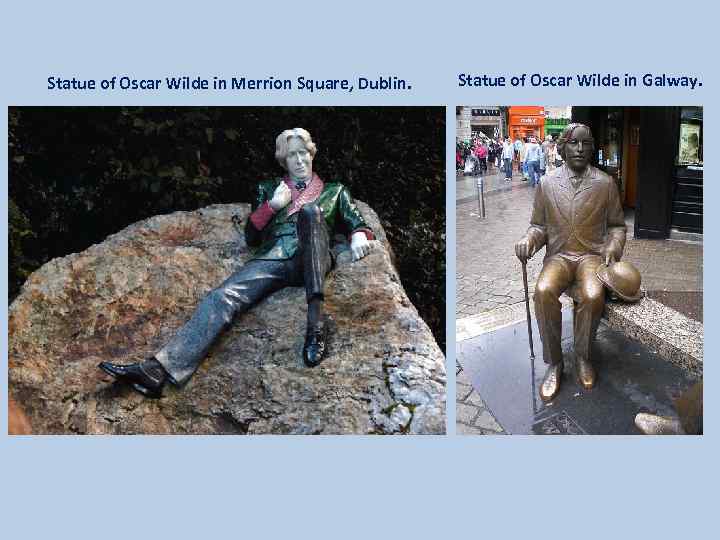 Statue of Oscar Wilde in Merrion Square, Dublin. Statue of Oscar Wilde in Galway.