


 Скачать презентацию It s You My syndicate wants to try out
59872c25d5698baf46f0cf14aa689cde.ppt
- Количество слайдов: 10
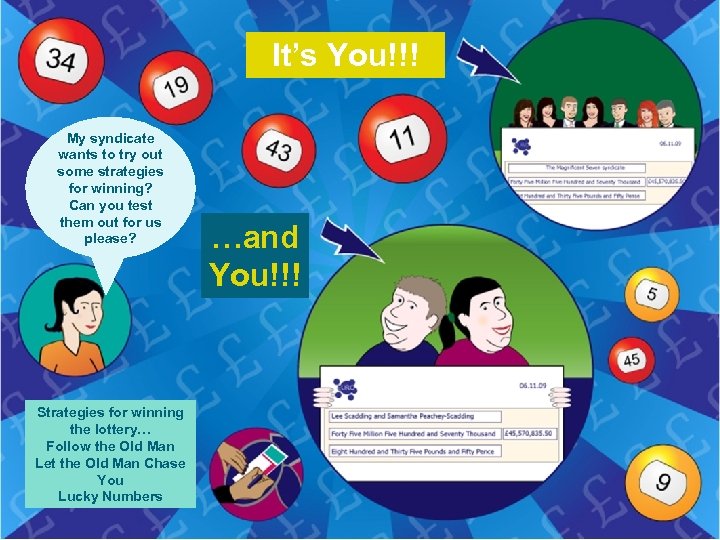 It’s You!!! My syndicate wants to try out some strategies for winning? Can you test them out for us please? Strategies for winning the lottery… Follow the Old Man Let the Old Man Chase You Lucky Numbers …and You!!!
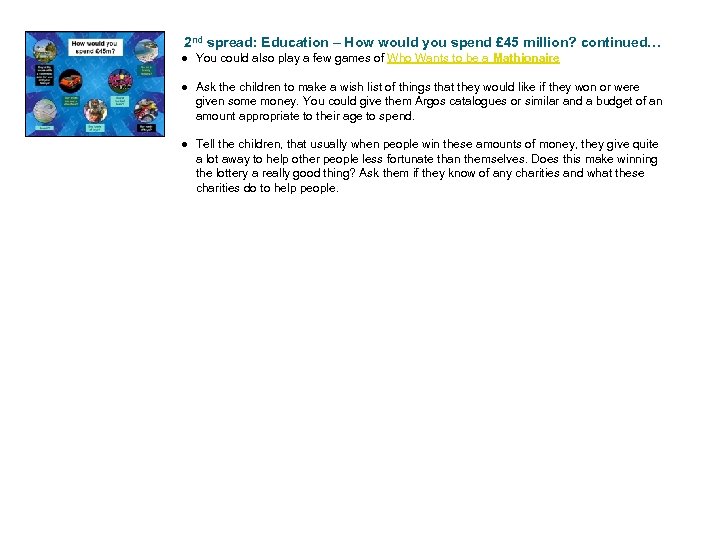
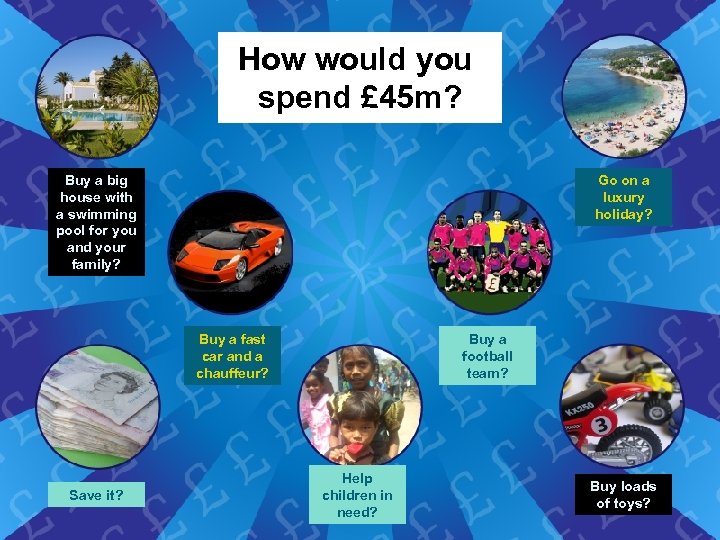 How would you spend £ 45 m? Buy a big house with a swimming pool for you and your family? Go on a luxury holiday? Buy a fast car and a chauffeur? Save it? Buy a football team? Help children in need? Buy loads of toys?
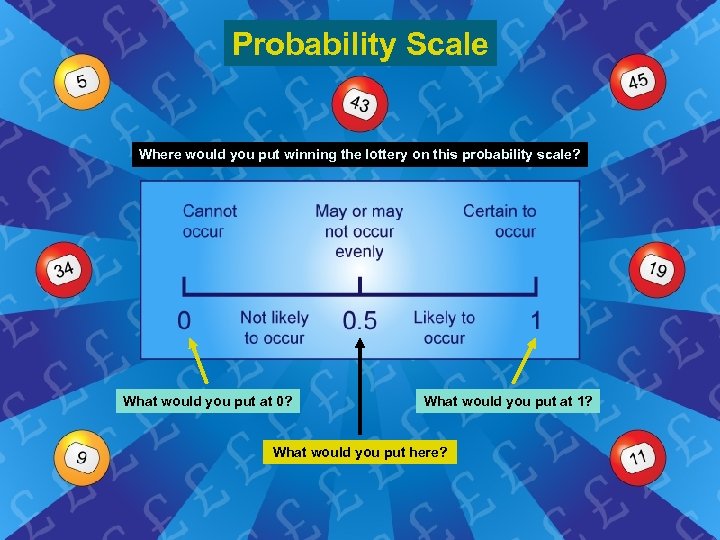 Probability Scale Where would you put winning the lottery on this probability scale? What would you put at 0? What would you put at 1? What would you put here?
 Up 2 d 8 maths Teacher’s guide On November 8 th 2009, the largest ever amount of money was won in the Euromillions lottery, a total of £ 91 million. There were two winning tickets. One had been bought by a syndicate of seven IT workers from Liverpool who thought they were being made redundant when the phone rang that morning. They had much better news though when they were told that they had won forty-five million pounds on the lottery. The other ticket was won by a married couple from Wales. They were £ 68 overdrawn at the bank when they bought two lucky dip tickets at their local supermarket. … continued on the next slide
 Now they are planning a dream car and a holiday in Barbados! According to The Sunday Times Rich List, they will find themselves with wealth at the level of celebrities such as DJ Chris Evans, chef Jamie Oliver and film star Sir Michael Caine. The spreads provide a great opportunity to explore such mathematical concepts as data handling including probability , problem solving involving money and calculating. Before working on these spreads it might be a good idea to familiarise yourself with their stories: uk. reuters. com The Scotsman www. itnsource. com/shotlist/ITN/2009/11/10/T 10110928/
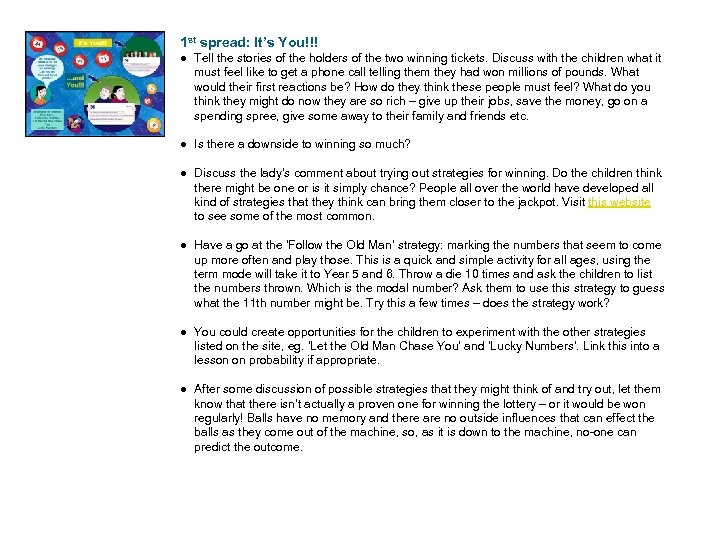 1 st spread: It’s You!!! ● Tell the stories of the holders of the two winning tickets. Discuss with the children what it must feel like to get a phone call telling them they had won millions of pounds. What would their first reactions be? How do they think these people must feel? What do you think they might do now they are so rich – give up their jobs, save the money, go on a spending spree, give some away to their family and friends etc. ● Is there a downside to winning so much? ● Discuss the lady’s comment about trying out strategies for winning. Do the children think there might be one or is it simply chance? People all over the world have developed all kind of strategies that they think can bring them closer to the jackpot. Visit this website to see some of the most common. ● Have a go at the ‘Follow the Old Man’ strategy: marking the numbers that seem to come up more often and play those. This is a quick and simple activity for all ages, using the term mode will take it to Year 5 and 6. Throw a die 10 times and ask the children to list the numbers thrown. Which is the modal number? Ask them to use this strategy to guess what the 11 th number might be. Try this a few times – does the strategy work? ● You could create opportunities for the children to experiment with the other strategies listed on the site, eg. ‘Let the Old Man Chase You’ and ‘Lucky Numbers’. Link this into a lesson on probability if appropriate. ● After some discussion of possible strategies that they might think of and try out, let them know that there isn’t actually a proven one for winning the lottery – or it would be won regularly! Balls have no memory and there are no outside influences that can effect the balls as they come out of the machine, so, as it is down to the machine, no-one can predict the outcome.
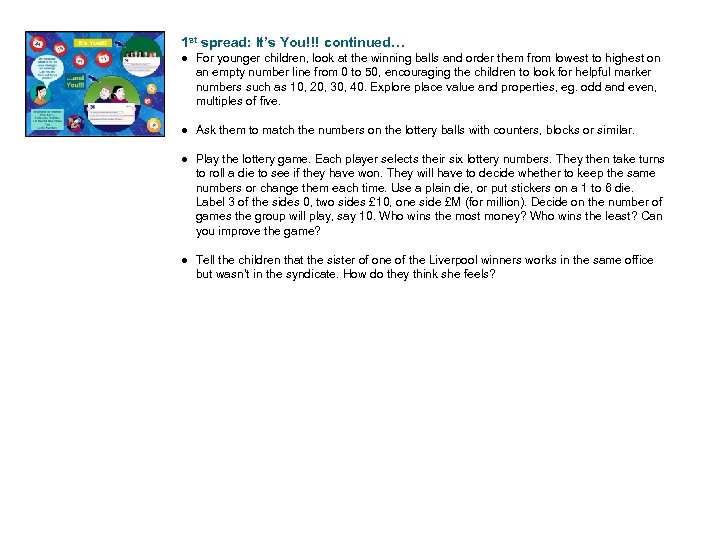 1 st spread: It’s You!!! continued… ● For younger children, look at the winning balls and order them from lowest to highest on an empty number line from 0 to 50, encouraging the children to look for helpful marker numbers such as 10, 20, 30, 40. Explore place value and properties, eg. odd and even, multiples of five. ● Ask them to match the numbers on the lottery balls with counters, blocks or similar. ● Play the lottery game. Each player selects their six lottery numbers. They then take turns to roll a die to see if they have won. They will have to decide whether to keep the same numbers or change them each time. Use a plain die, or put stickers on a 1 to 6 die. Label 3 of the sides 0, two sides £ 10, one side £M (for million). Decide on the number of games the group will play, say 10. Who wins the most money? Who wins the least? Can you improve the game? ● Tell the children that the sister of one of the Liverpool winners works in the same office but wasn’t in the syndicate. How do they think she feels?
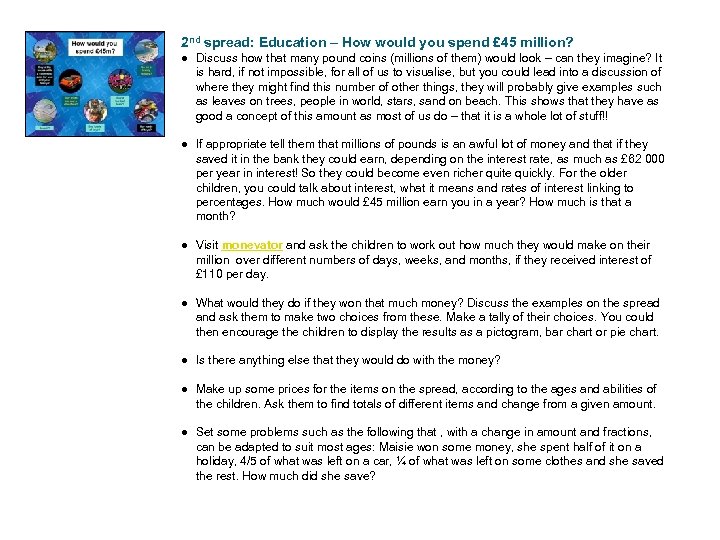 2 nd spread: Education – How would you spend £ 45 million? ● Discuss how that many pound coins (millions of them) would look – can they imagine? It is hard, if not impossible, for all of us to visualise, but you could lead into a discussion of where they might find this number of other things, they will probably give examples such as leaves on trees, people in world, stars, sand on beach. This shows that they have as good a concept of this amount as most of us do – that it is a whole lot of stuff!! ● If appropriate tell them that millions of pounds is an awful lot of money and that if they saved it in the bank they could earn, depending on the interest rate, as much as £ 62 000 per year in interest! So they could become even richer quite quickly. For the older children, you could talk about interest, what it means and rates of interest linking to percentages. How much would £ 45 million earn you in a year? How much is that a month? ● Visit monevator and ask the children to work out how much they would make on their million over different numbers of days, weeks, and months, if they received interest of £ 110 per day. ● What would they do if they won that much money? Discuss the examples on the spread and ask them to make two choices from these. Make a tally of their choices. You could then encourage the children to display the results as a pictogram, bar chart or pie chart. ● Is there anything else that they would do with the money? ● Make up some prices for the items on the spread, according to the ages and abilities of the children. Ask them to find totals of different items and change from a given amount. ● Set some problems such as the following that , with a change in amount and fractions, can be adapted to suit most ages: Maisie won some money, she spent half of it on a holiday, 4/5 of what was left on a car, ¼ of what was left on some clothes and she saved the rest. How much did she save?
 2 nd spread: Education – How would you spend £ 45 million? continued… ● You could also play a few games of Who Wants to be a Mathionaire ● Ask the children to make a wish list of things that they would like if they won or were given some money. You could give them Argos catalogues or similar and a budget of an amount appropriate to their age to spend. ● Tell the children, that usually when people win these amounts of money, they give quite a lot away to help other people less fortunate than themselves. Does this make winning the lottery a really good thing? Ask them if they know of any charities and what these charities do to help people.
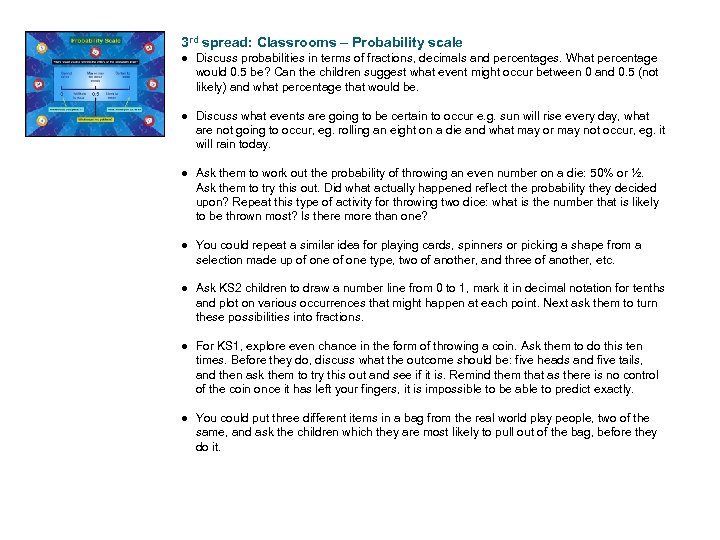 3 rd spread: Classrooms – Probability scale ● Discuss probabilities in terms of fractions, decimals and percentages. What percentage would 0. 5 be? Can the children suggest what event might occur between 0 and 0. 5 (not likely) and what percentage that would be. ● Discuss what events are going to be certain to occur e. g. sun will rise every day, what are not going to occur, eg. rolling an eight on a die and what may or may not occur, eg. it will rain today. ● Ask them to work out the probability of throwing an even number on a die: 50% or ½. Ask them to try this out. Did what actually happened reflect the probability they decided upon? Repeat this type of activity for throwing two dice: what is the number that is likely to be thrown most? Is there more than one? ● You could repeat a similar idea for playing cards, spinners or picking a shape from a selection made up of one type, two of another, and three of another, etc. ● Ask KS 2 children to draw a number line from 0 to 1, mark it in decimal notation for tenths and plot on various occurrences that might happen at each point. Next ask them to turn these possibilities into fractions. ● For KS 1, explore even chance in the form of throwing a coin. Ask them to do this ten times. Before they do, discuss what the outcome should be: five heads and five tails, and then ask them to try this out and see if it is. Remind them that as there is no control of the coin once it has left your fingers, it is impossible to be able to predict exactly. ● You could put three different items in a bag from the real world play people, two of the same, and ask the children which they are most likely to pull out of the bag, before they do it.