 Скачать презентацию It s Recycling Naturally By Shakhuov Talgat What
composting Shakhuov Talgat.pptx [Автосохраненны..
- Количество слайдов: 27



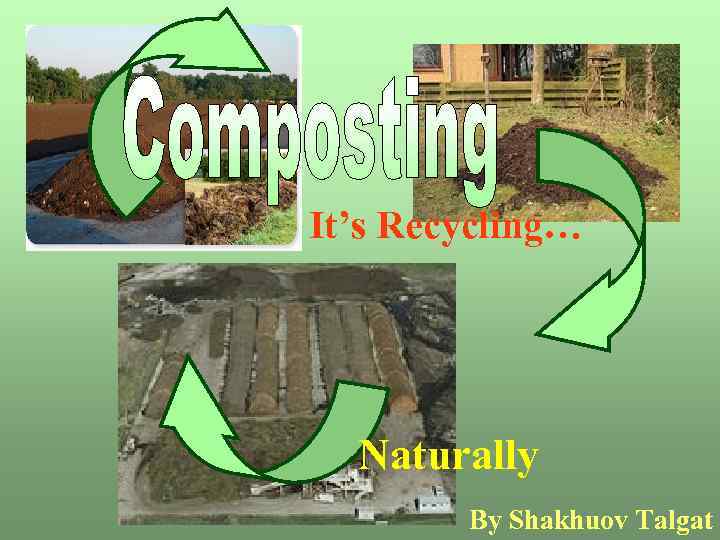
It’s Recycling… Naturally By Shakhuov Talgat
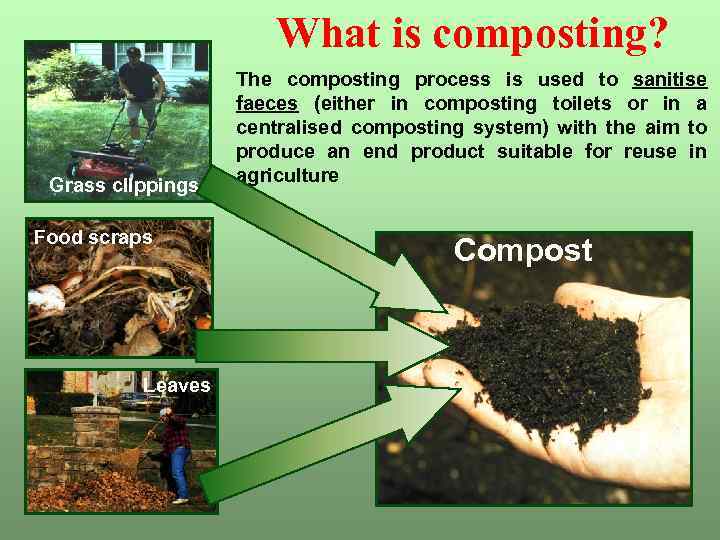
What is composting? Grass clippings Food scraps Leaves The composting process is used to sanitise faeces (either in composting toilets or in a centralised composting system) with the aim to produce an end product suitable for reuse in agriculture Compost
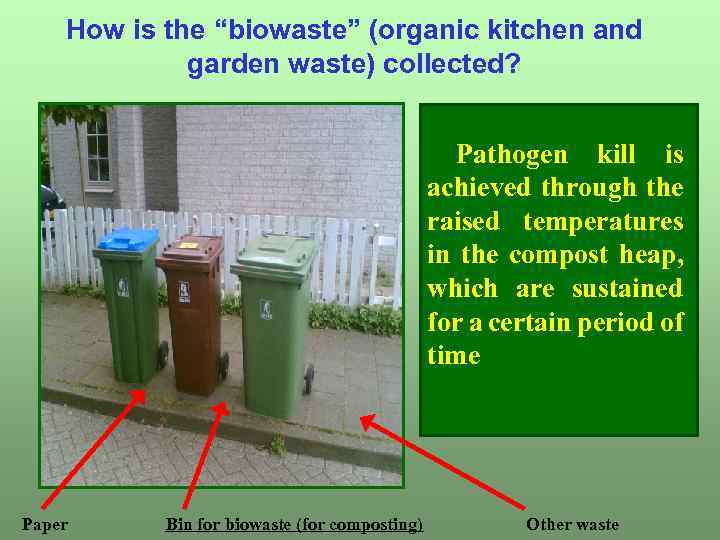
How is the “biowaste” (organic kitchen and garden waste) collected? Pathogen kill is achieved through the raised temperatures in the compost heap, which are sustained for a certain period of time Paper Bin for biowaste (for composting) Other waste
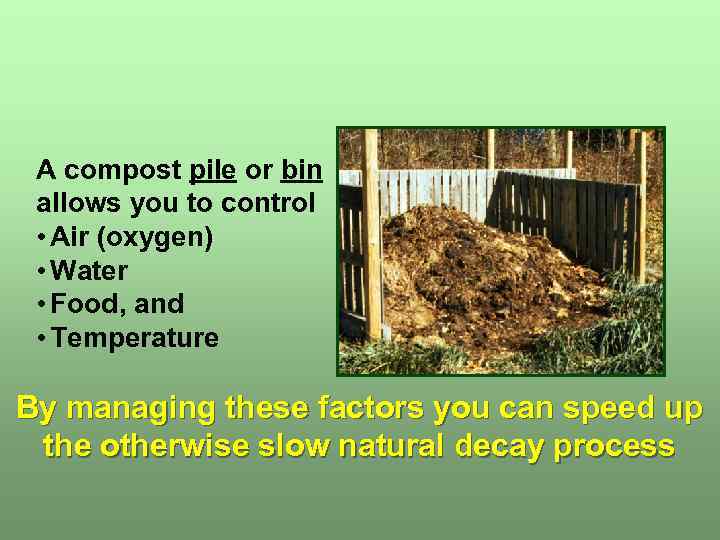
A compost pile or bin allows you to control • Air (oxygen) • Water • Food, and • Temperature By managing these factors you can speed up the otherwise slow natural decay process
What is “compost” and “composting”? § Compost is the aerobically decomposed remnants of organic materials (those with plant and animal origins). Compost is used in gardening and agriculture as a soil amendment, and commercially by the landscaping and container nursery industries. § Composting is the process of producing compost through aerobic decomposition of biodegradable organic matter.
Reminder of terms (1): “Indicator organisms” – Microorganisms which are easy to quantify and which exhibit same or greater survival characteristics in the environment as the target pathogen organism for which they are a surrogate – Examples: helminth eggs, total coliforms, faecal coliforms, E. coli, Enterococci, MS 2 coliphage
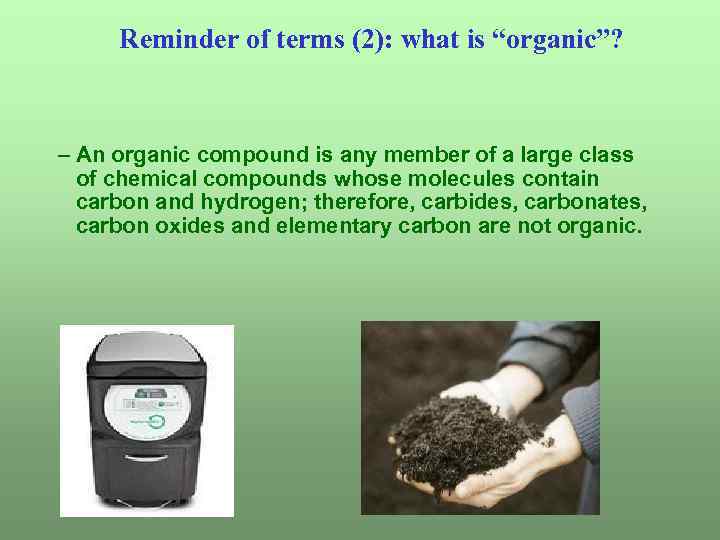
Reminder of terms (2): what is “organic”? – An organic compound is any member of a large class of chemical compounds whose molecules contain carbon and hydrogen; therefore, carbides, carbonates, carbon oxides and elementary carbon are not organic.
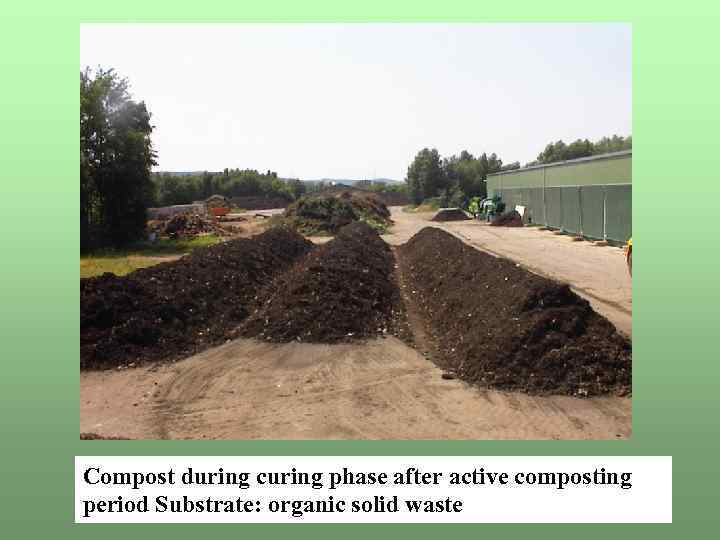
Compost during curing phase after active composting period Substrate: organic solid waste
Composting fundamentals overview § Organic material undergoes biological degradation to a stable end product (the compost) § During the decomposition process, the compost heap heats itself up to temperatures in the pasteurisation range of 50 to 70°C (=self-heating) and enteric pathogenic organisms are destroyed -Note no external heating needs to be applied! - Sometimes an insulation is used (in composting toilets) § When composting is used to treat faecal matter, the recommended indicator organism to measure extent of pathogen kill is helminth eggs
Composting process microbiology Interrelationships between microbial populations are not fully understood § Three stages of activity and associated temperatures: – Stage 1: Initial mesophilic stage (40°C) – self-heating – Stage 2: Thermophilic range 40 -70°C – self-heating – Stage 3: Cooling period (stabilisation of p. H, completion of humic acid formation)
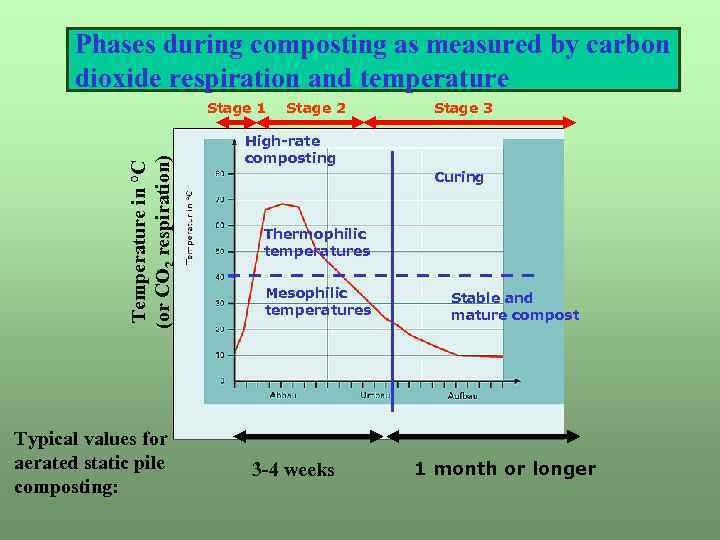
Phases during composting as measured by carbon dioxide respiration and temperature Temperature in °C (or CO 2 respiration) Stage 1 Typical values for aerated static pile composting: Stage 2 Stage 3 High-rate composting Curing Thermophilic temperatures Mesophilic temperatures 3 -4 weeks Stable and mature compost 1 month or longer
Amendments and bulking agents • Amendment – = Organic material added to the feed substrate to reduce the bulk weight, reduce moisture content and increase the air voids for proper aeration – Can be used to increase the quantity of degradable organics in the mixture – Examples are sawdust, straw, recycled compost, rice hulls • Bulking agent – = Organic or inorganic material that is used to provide structural support and increase the porosity of the mixture for effective aeration – Wood chips are commonly used (can be recovered and reused)
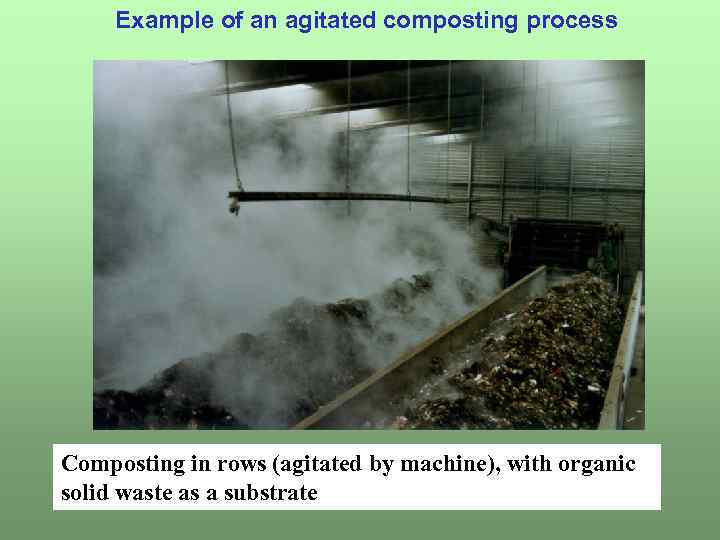
Example of an agitated composting process Composting in rows (agitated by machine), with organic solid waste as a substrate
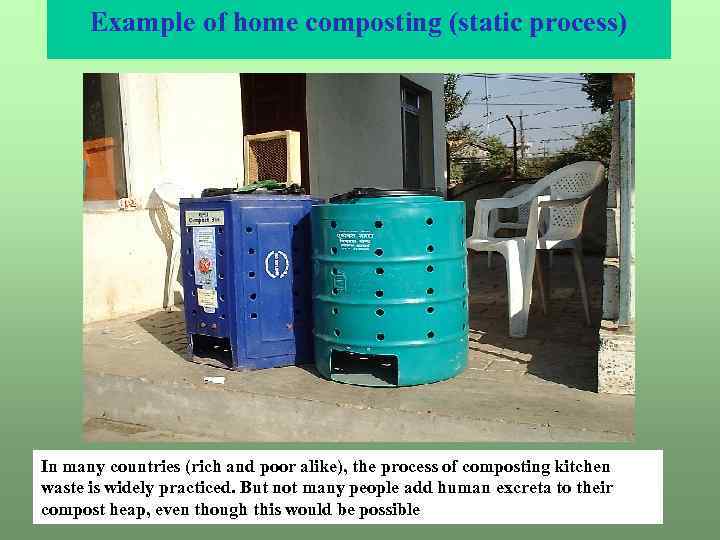
Example of home composting (static process) In many countries (rich and poor alike), the process of composting kitchen waste is widely practiced. But not many people add human excreta to their compost heap, even though this would be possible
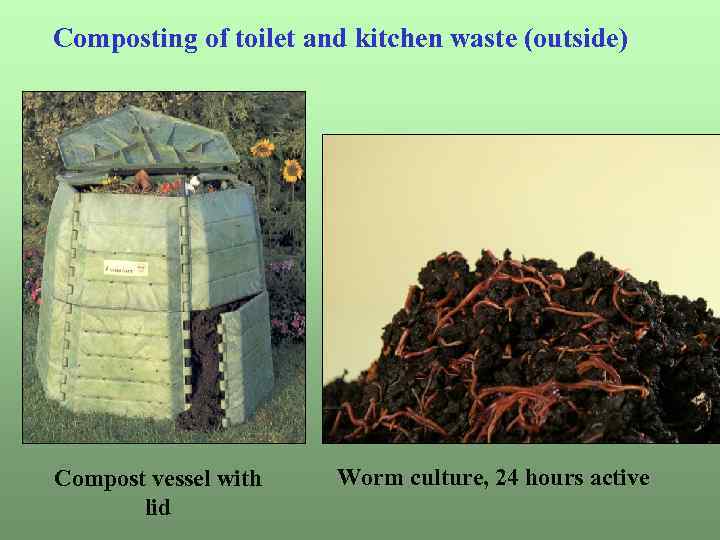
Composting of toilet and kitchen waste (outside) Compost vessel with lid Worm culture, 24 hours active
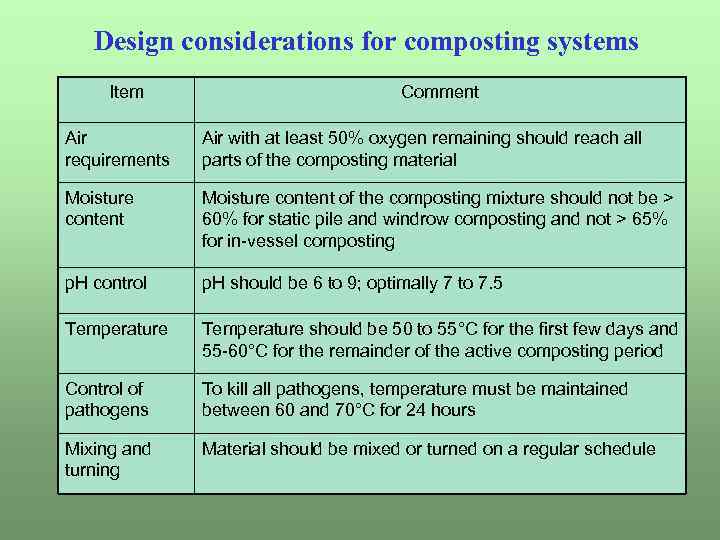
Design considerations for composting systems Item Comment Air requirements Air with at least 50% oxygen remaining should reach all parts of the composting material Moisture content of the composting mixture should not be > 60% for static pile and windrow composting and not > 65% for in-vessel composting p. H control p. H should be 6 to 9; optimally 7 to 7. 5 Temperature should be 50 to 55°C for the first few days and 55 -60°C for the remainder of the active composting period Control of pathogens To kill all pathogens, temperature must be maintained between 60 and 70°C for 24 hours Mixing and turning Material should be mixed or turned on a regular schedule
Possible reasons for process failure (related to the table on the previous slide) • Not enough aeration – mix more (turn over more) – use of bulking agent • Too much moisture – reduce water content of input material – use urine diversion if composting toilet is used • Not enough moisture – add water (rainwater harvesting or recirculate leachate or add urine)
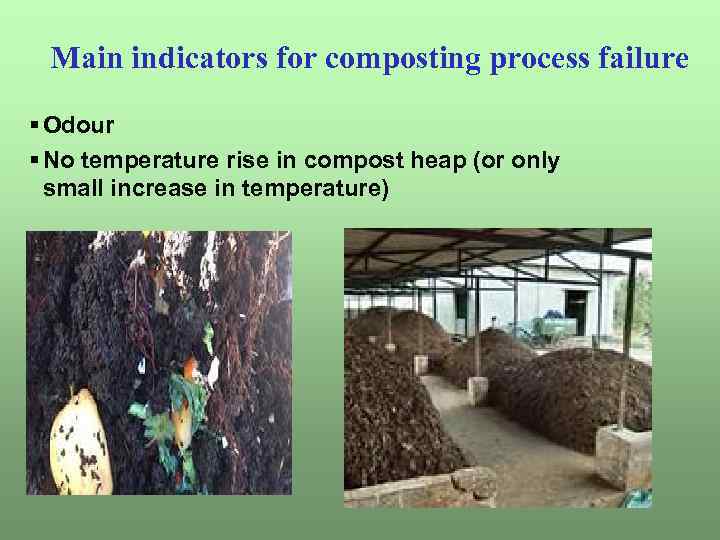
Main indicators for composting process failure § Odour § No temperature rise in compost heap (or only small increase in temperature)
Possible compost prices • € 7 per ton for compost made from organic solid waste in Germany – sometimes the compost also has to be given away for free • € 22 per ton for compost made from faecal sludge and organic solid waste in Accra, Ghana – predicted value • € 28 per ton for compost made from organic solid waste - example from Bangladesh
Operating costs for semi-centralised composting processes § It depends on the composting technology used and the scale of the process § In developing countries it may cost only € 15 per ton of input material § in Germany the costs are around € 60 per ton (in comparison: anaerobic digestion: ~ € 120 per ton)
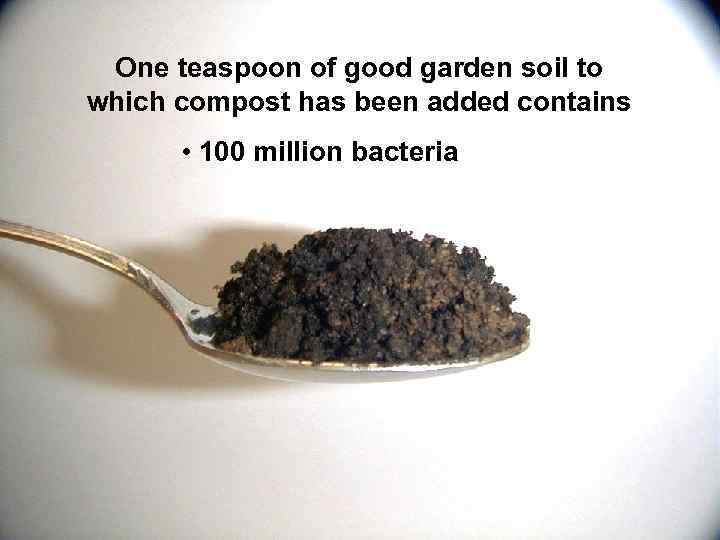
One teaspoon of good garden soil to which compost has been added contains • 100 million bacteria
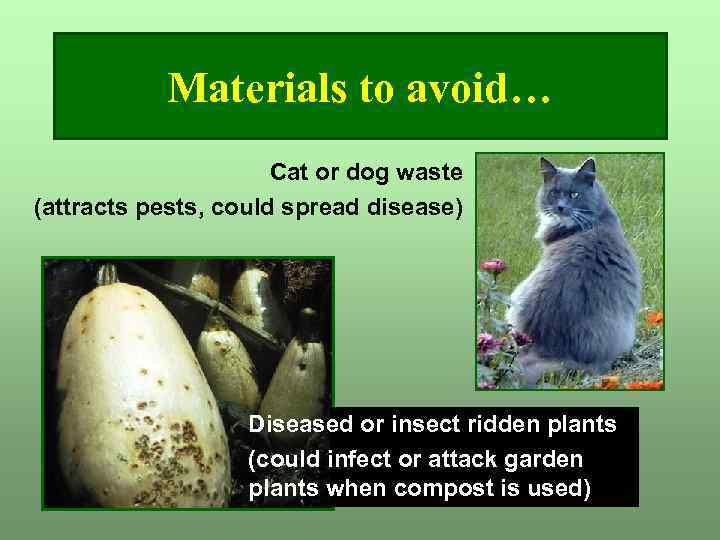
Materials to avoid… Cat or dog waste (attracts pests, could spread disease) Diseased or insect ridden plants (could infect or attack garden plants when compost is used)
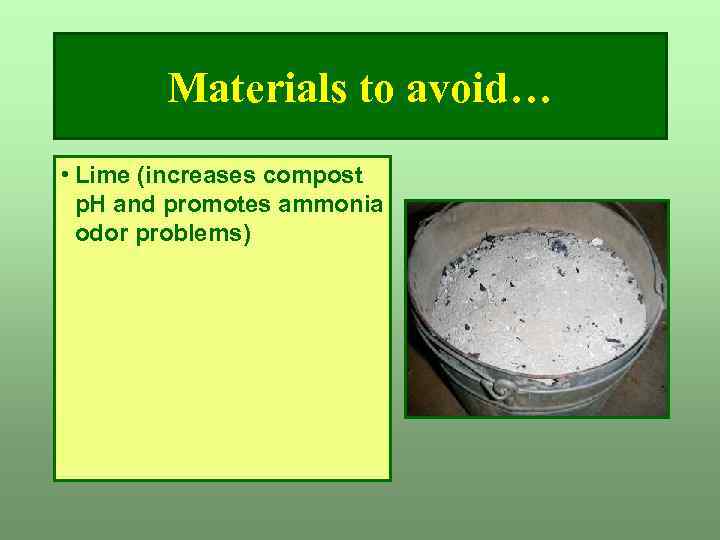
Materials to avoid… • Lime (increases compost p. H and promotes ammonia odor problems)
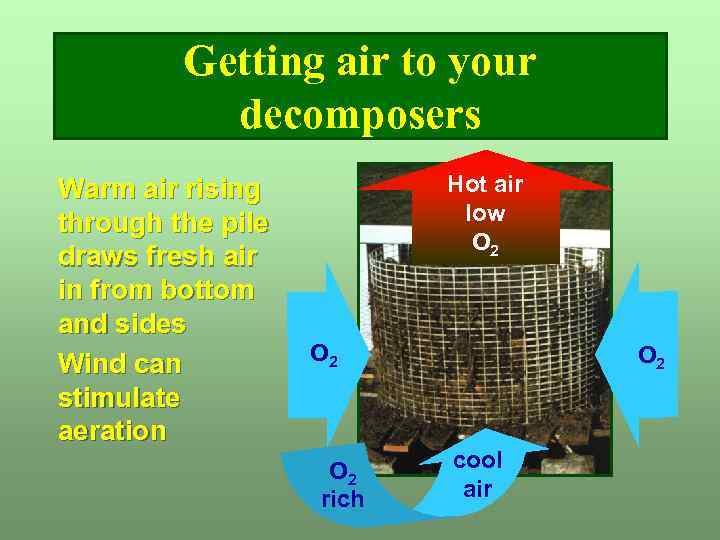
Getting air to your decomposers Warm air rising through the pile draws fresh air in from bottom and sides Wind can stimulate aeration Hot air low O 2 O 2 rich O 2 cool air
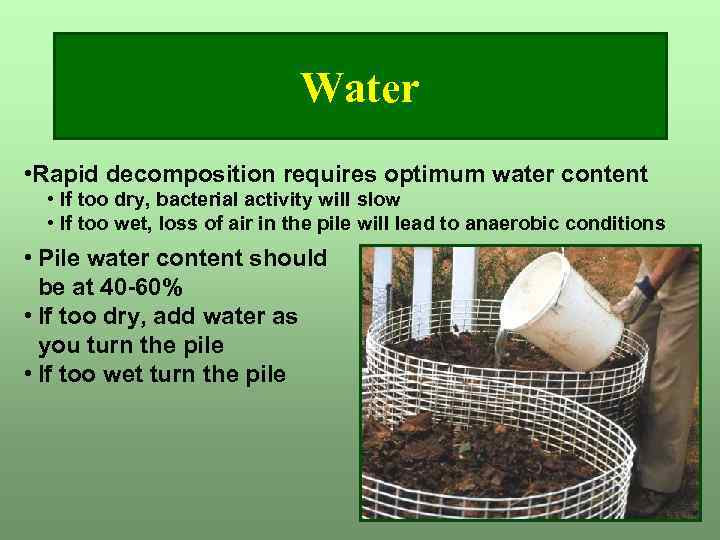
Water • Rapid decomposition requires optimum water content • If too dry, bacterial activity will slow • If too wet, loss of air in the pile will lead to anaerobic conditions • Pile water content should be at 40 -60% • If too dry, add water as you turn the pile • If too wet turn the pile
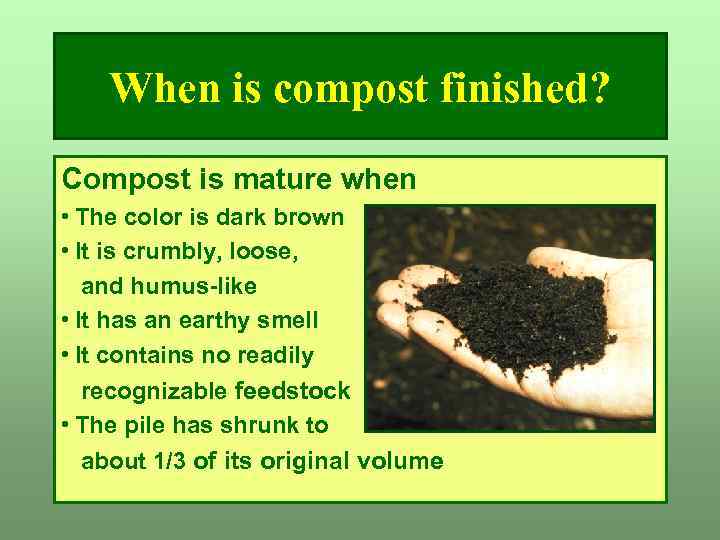
When is compost finished? Compost is mature when • The color is dark brown • It is crumbly, loose, and humus-like • It has an earthy smell • It contains no readily recognizable feedstock • The pile has shrunk to about 1/3 of its original volume

Thank you for listening
Скачать презентацию It s Recycling Naturally By Shakhuov Talgat What
composting Shakhuov Talgat.pptx [Автосохраненны..