 Скачать презентацию IT Pressures Felt by Most Businesses Today
381d5bf80b05dfa583a066b1257d54b1.ppt
- Количество слайдов: 19



IT Pressures Felt by Most Businesses Today § How do we respond more quickly to business requirements? § Flexibility § Interoperability § How do we get more for our IT dollar? § Reduce IT operating costs § Minimize capital investment § Deliver more “new” capabilities for less § How do we manage complexity in IT? § Maintain skills for multiple technologies § Enforce standards and compliance
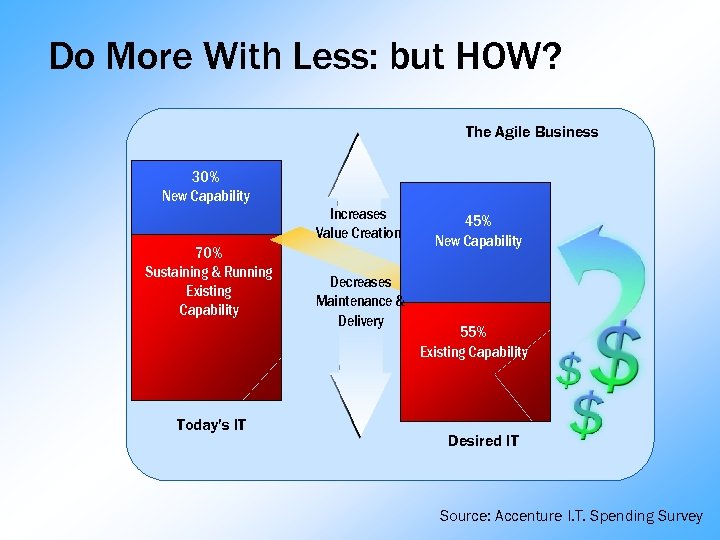
Do More With Less: but HOW? The Agile Business 30% New Capability 70% Sustaining & Running Existing Capability Today’s IT Increases Value Creation Decreases Maintenance & Delivery 45% New Capability 55% Existing Capability Desired IT Source: Accenture I. T. Spending Survey
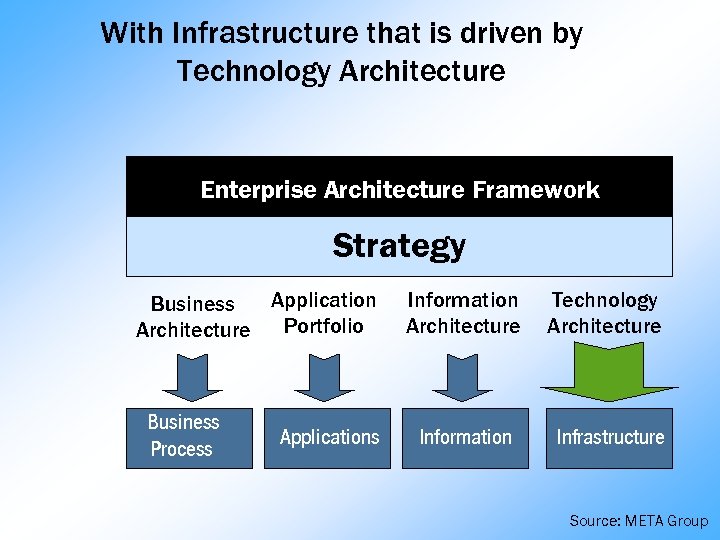
With Infrastructure that is driven by Technology Architecture Enterprise Architecture Framework Strategy Application Business Portfolio Architecture Business Process Applications Information Architecture Technology Architecture Information Infrastructure Source: META Group
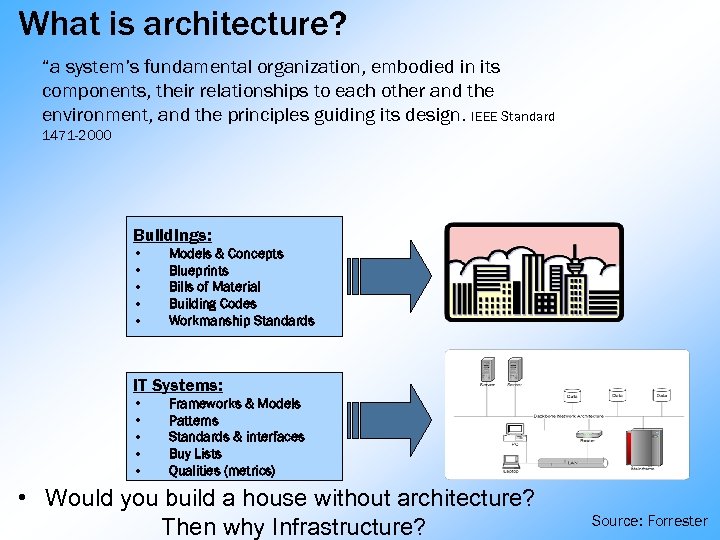
What is architecture? “a system’s fundamental organization, embodied in its components, their relationships to each other and the environment, and the principles guiding its design. IEEE Standard 1471 -2000 Buildings: • • • Models & Concepts Blueprints Bills of Material Building Codes Workmanship Standards IT Systems: • • • Frameworks & Models Patterns Standards & interfaces Buy Lists Qualities (metrics) • Would you build a house without architecture? Then why Infrastructure? Source: Forrester
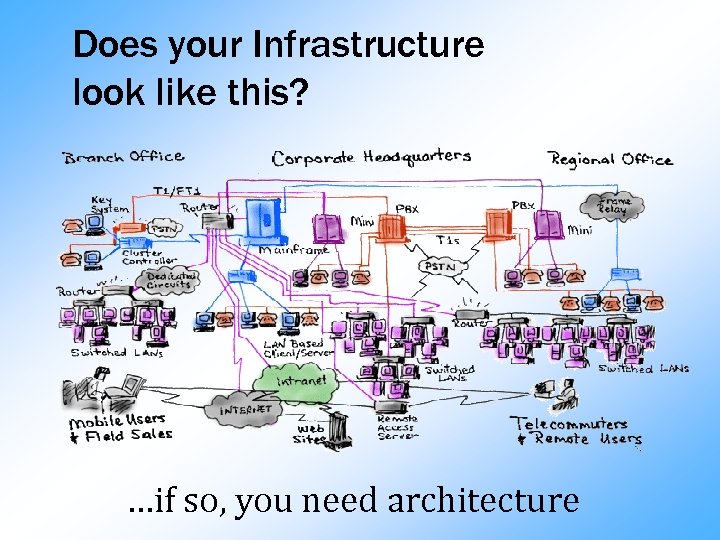
Does your Infrastructure look like this? …if so, you need architecture
How does Technology Architecture help? Tool for Risk Management • Architecture is based on requirements • Architecture helps you to make decisions • Translates IT decisions into business consequences Tool for Project Management • Classic” project management focuses on time and money - Functionality pays the price • Architecture guards the functionality • “Design authority” • Architecture gives insight into the consequences of decisions as they impact on the requirements Planning Tool • Provides early insight into all relevant items • Helps to analyze the consequences of decisions • Develops standards and guidelines
Architecture Matters “If the Federal Government continues to do what we have done (i. e. build non-architected solutions), we will continue to get what we have (i. e. a noninteroperable, expensive, and ever challenging tangle of data, applications, and technology)” - Federal CIO Council Source: Federal Enterprise Architecture Framework V 1. 1
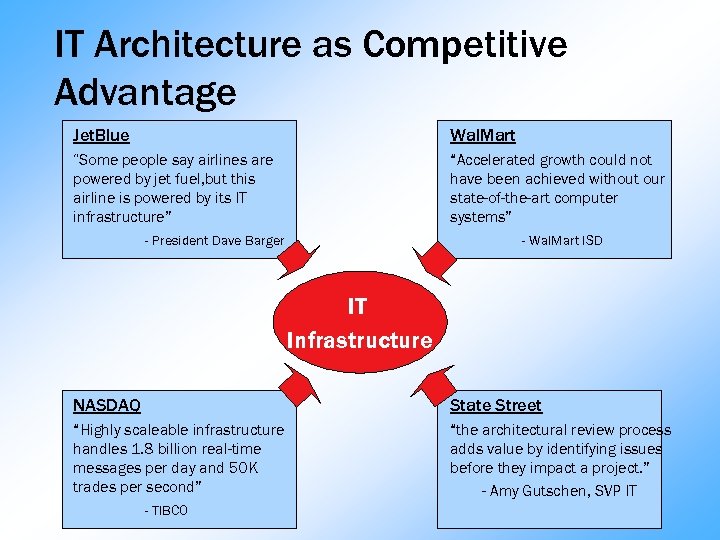
IT Architecture as Competitive Advantage Jet. Blue Wal. Mart “Some people say airlines are powered by jet fuel, but this airline is powered by its IT infrastructure” “Accelerated growth could not have been achieved without our state-of-the-art computer systems” - President Dave Barger - Wal. Mart ISD IT Infrastructure NASDAQ State Street “Highly scaleable infrastructure handles 1. 8 billion real-time messages per day and 50 K trades per second” “the architectural review process adds value by identifying issues before they impact a project. ” - Amy Gutschen, SVP IT - TIBCO
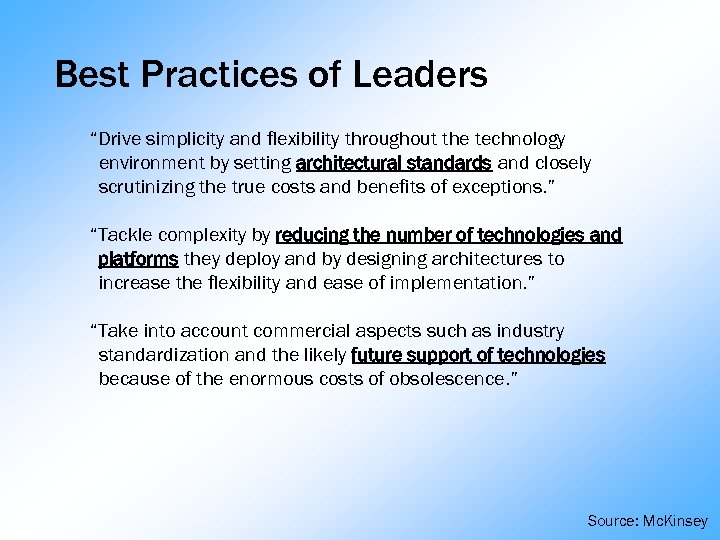
Best Practices of Leaders “Drive simplicity and flexibility throughout the technology environment by setting architectural standards and closely scrutinizing the true costs and benefits of exceptions. ” “Tackle complexity by reducing the number of technologies and platforms they deploy and by designing architectures to increase the flexibility and ease of implementation. ” “Take into account commercial aspects such as industry standardization and the likely future support of technologies because of the enormous costs of obsolescence. ” Source: Mc. Kinsey
The MIT Study: Leaders have ‘High Capability’ IT Infrastructure § Analyzed 180 electronically based business initiatives in 89 top performing enterprises Common thread among leaders: “IT Architecture & Standards”
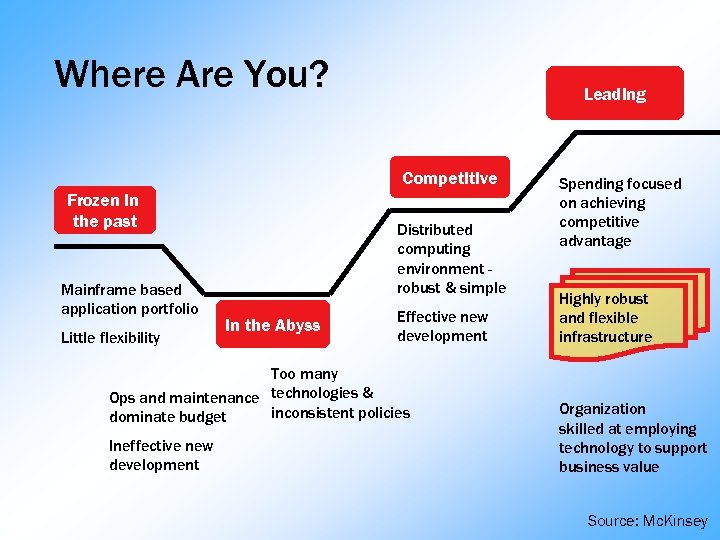
Where Are You? Leading Competitive Frozen in the past Mainframe based application portfolio Little flexibility Distributed computing environment robust & simple In the Abyss Effective new development Too many Ops and maintenance technologies & inconsistent policies dominate budget Ineffective new development Spending focused on achieving competitive advantage Highly robust and flexible infrastructure Organization skilled at employing technology to support business value Source: Mc. Kinsey
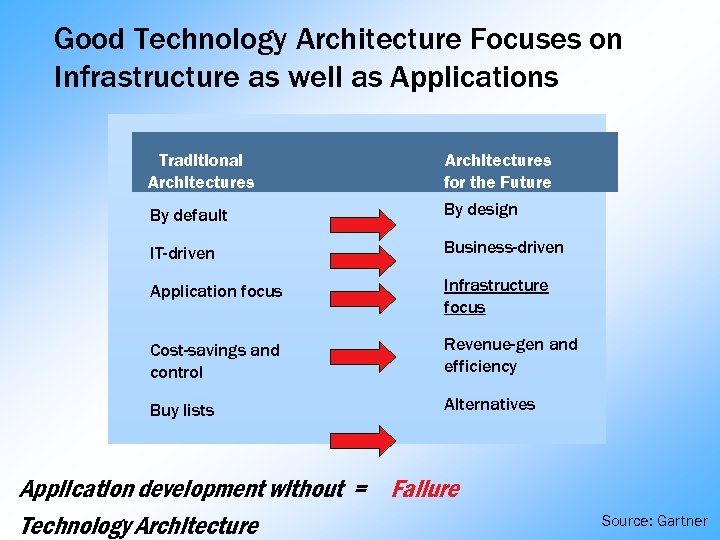
Good Technology Architecture Focuses on Infrastructure as well as Applications Traditional Architectures for the Future By default By design IT-driven Business-driven Application focus Infrastructure focus Cost-savings and control Revenue-gen and efficiency Buy lists Alternatives Application development without = Failure Technology Architecture Source: Gartner
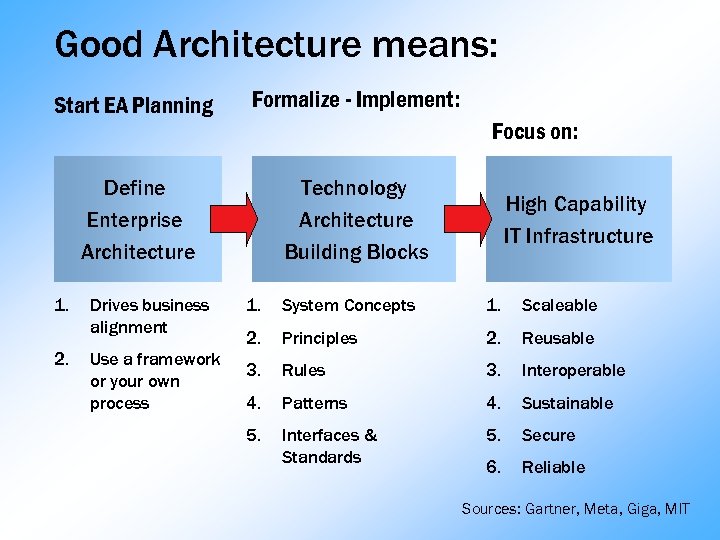
Good Architecture means: Start EA Planning Formalize - Implement: Define Enterprise Architecture Technology Architecture Building Blocks 1. 2. Drives business alignment Use a framework or your own process Focus on: High Capability IT Infrastructure 1. System Concepts 1. Scaleable 2. Principles 2. Reusable 3. Rules 3. Interoperable 4. Patterns 4. Sustainable 5. Interfaces & Standards 5. Secure 6. Reliable Sources: Gartner, Meta, Giga, MIT
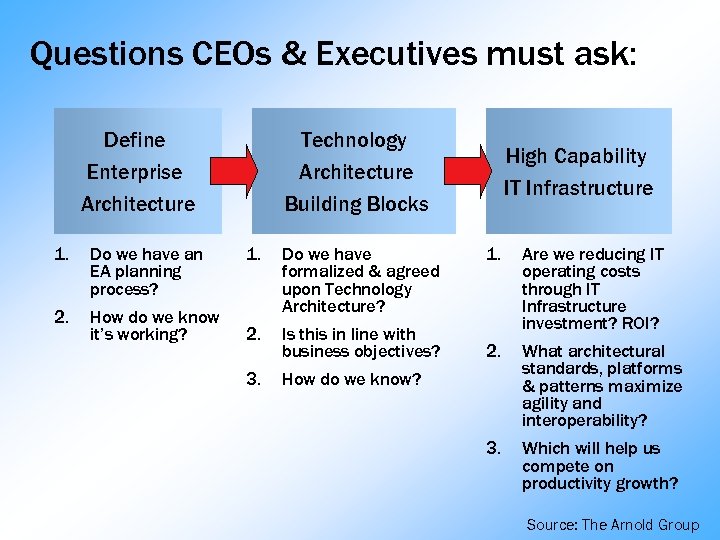
Questions CEOs & Executives must ask: Define Enterprise Architecture 1. Do we have an EA planning process? 2. How do we know it’s working? Technology Architecture Building Blocks 1. Do we have formalized & agreed upon Technology Architecture? 2. Is this in line with business objectives? 3. High Capability IT Infrastructure 1. Are we reducing IT operating costs through IT Infrastructure investment? ROI? 2. What architectural standards, platforms & patterns maximize agility and interoperability? How do we know? 3. Which will help us compete on productivity growth? Source: The Arnold Group
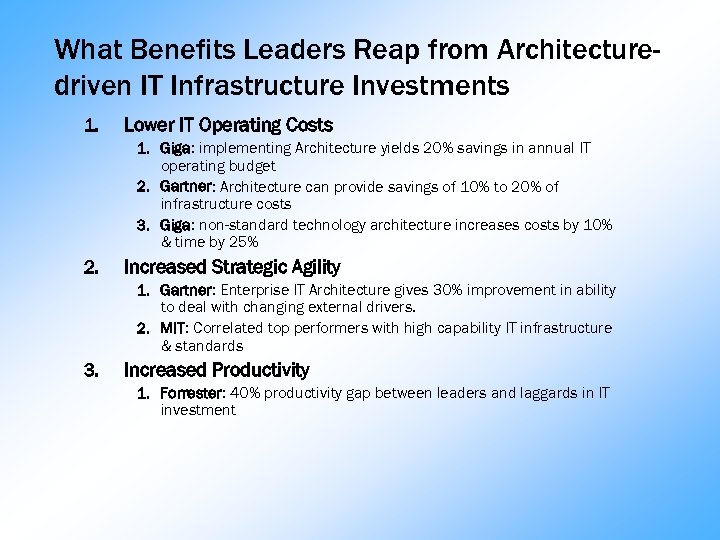
What Benefits Leaders Reap from Architecturedriven IT Infrastructure Investments 1. Lower IT Operating Costs 1. Giga: implementing Architecture yields 20% savings in annual IT operating budget 2. Gartner: Architecture can provide savings of 10% to 20% of infrastructure costs 3. Giga: non-standard technology architecture increases costs by 10% & time by 25% 2. Increased Strategic Agility 1. Gartner: Enterprise IT Architecture gives 30% improvement in ability to deal with changing external drivers. 2. MIT: Correlated top performers with high capability IT infrastructure & standards 3. Increased Productivity 1. Forrester: 40% productivity gap between leaders and laggards in IT investment
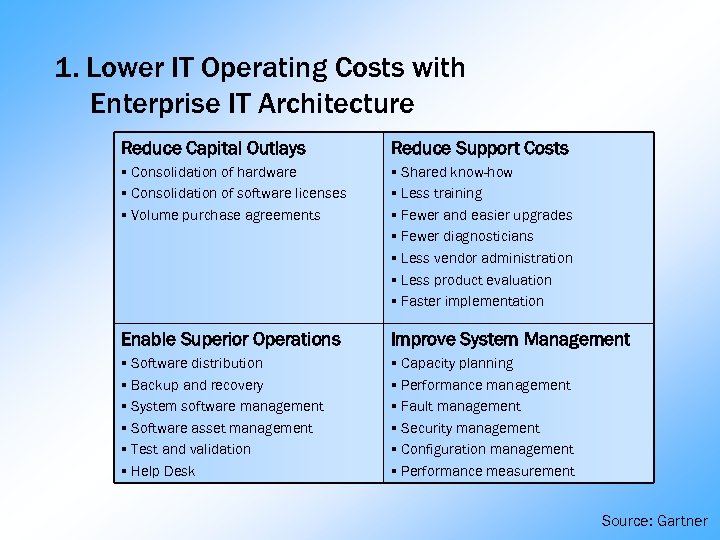
1. Lower IT Operating Costs with Enterprise IT Architecture Reduce Capital Outlays Reduce Support Costs § Consolidation of hardware § Shared know-how § Consolidation of software licenses § Less training § Volume purchase agreements § Fewer and easier upgrades § Fewer diagnosticians § Less vendor administration § Less product evaluation § Faster implementation Enable Superior Operations Improve System Management § Software distribution § Capacity planning § Backup and recovery § Performance management § System software management § Fault management § Software asset management § Security management § Test and validation § Configuration management § Help Desk § Performance measurement Source: Gartner
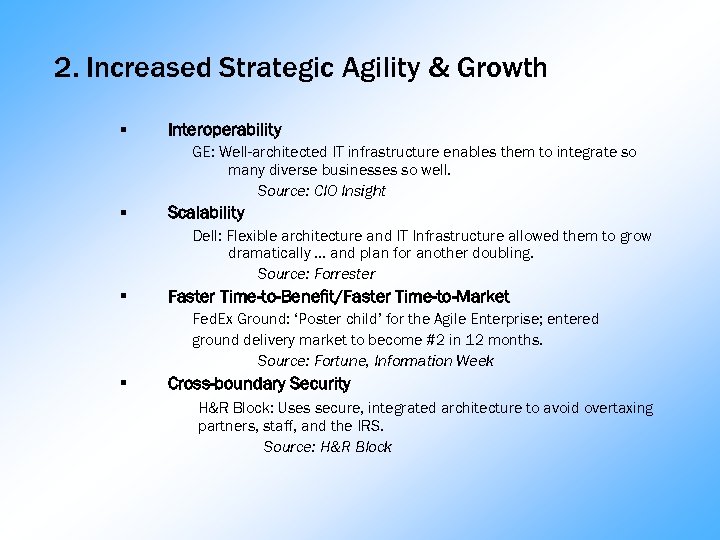
2. Increased Strategic Agility & Growth § Interoperability GE: Well-architected IT infrastructure enables them to integrate so many diverse businesses so well. Source: CIO Insight § Scalability Dell: Flexible architecture and IT Infrastructure allowed them to grow dramatically … and plan for another doubling. Source: Forrester § Faster Time-to-Benefit/Faster Time-to-Market Fed. Ex Ground: ‘Poster child’ for the Agile Enterprise; entered ground delivery market to become #2 in 12 months. Source: Fortune, Information Week § Cross-boundary Security H&R Block: Uses secure, integrated architecture to avoid overtaxing partners, staff, and the IRS. Source: H&R Block
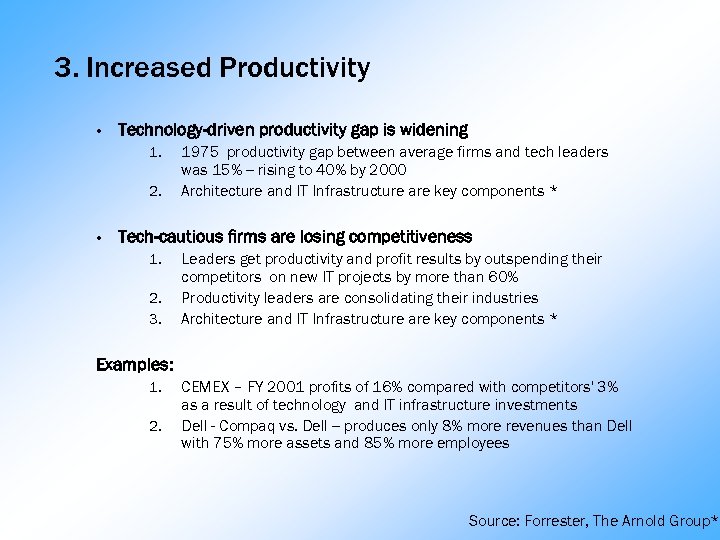
3. Increased Productivity • Technology-driven productivity gap is widening 1. 1975 productivity gap between average firms and tech leaders was 15% -- rising to 40% by 2000 2. Architecture and IT Infrastructure are key components * • Tech-cautious firms are losing competitiveness 1. Leaders get productivity and profit results by outspending their competitors on new IT projects by more than 60% 2. Productivity leaders are consolidating their industries 3. Architecture and IT Infrastructure are key components * Examples: 1. 2. CEMEX – FY 2001 profits of 16% compared with competitors' 3% as a result of technology and IT infrastructure investments Dell - Compaq vs. Dell -- produces only 8% more revenues than Dell with 75% more assets and 85% more employees Source: Forrester, The Arnold Group*
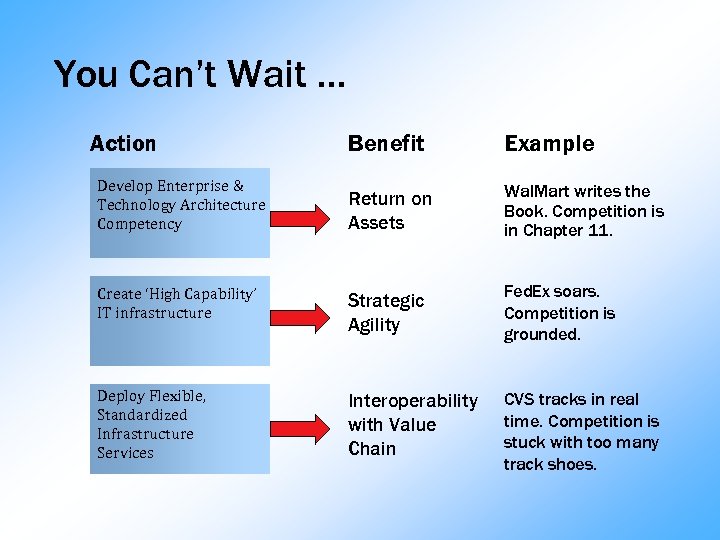
You Can’t Wait … Action Benefit Example Return on Assets Wal. Mart writes the Book. Competition is in Chapter 11. Create ‘High Capability’ IT infrastructure Strategic Agility Fed. Ex soars. Competition is grounded. Deploy Flexible, Standardized Infrastructure Services Interoperability with Value Chain CVS tracks in real time. Competition is stuck with too many track shoes. Develop Enterprise & Technology Architecture Competency
Скачать презентацию IT Pressures Felt by Most Businesses Today
381d5bf80b05dfa583a066b1257d54b1.ppt