


 Скачать презентацию IT Outsourcing o Until 1990 the major drivers
126123433a7a2b6c6a745170eae48906.ppt
- Количество слайдов: 24
 IT Outsourcing o Until 1990, the major drivers for outsourcing were: n Cost-effective access to specialized or occasionally needed computing power or systems development skills n n Avoidance of building in-house IT skills and skill sets, primarily an issue for small and very low-technology organizations Access to special functional capabilities. Outsourcing during this period was important but, in retrospect, largely peripheral to the main IT activities that took place in mid-sized and large organizations.
 IT Outsourcing n o Recent IT Outsourcing Agreements o Billions of $ Two factors have affected the growth of IT outsourcing n Recognition of strategic alliances n Changes in the technological environment
 IT Outsourcing o Acceptance of Strategic Alliances n Finding a strong organization partner to complement an area of weakness gives an organization an island of stability in a turbulent environment. o o n n It is difficult to fight on all simultaneously on all fronts Alliances allow a company to simplify its management agenda safely. Alliance allow a firm to leverage a key part of the value chain by bringing in a strong partner that complements its skills. Both firms should legitimately be benefiting
 IT Outsourcing o IT Changing Environment n n n Today, firms are not focusing IT only on internal processing systems: but, in a network fashion, integrating internal system with those of customers, suppliers, - to be more efficient in globally market place. This integration places extraordinary pressures on firms trying to keep the old system services running while developing the interconnections and services demanded by the new environment. On the one hand, firm are looking for low-cost maintenance of the old systems to ensure they operate reliably, while, on the other hand, gaining access to new skills to permit their transformation to new model.
 IT Outsourcing o o Contracting ? n “Contracting is the purchasing of goods or services when the buyer owns the process. ” Bendor-Samuel n If the buyer owns a process but purchases time, products or services to facilitate that process, then the buyer is in a contractual relationship. Outsourcing? n “Outsourcing takes place when an organization transfer the ownership of a business process to a supplier” Bendor-Samuel n. The key is the concept of transfer of control or transfer of ownership. n This is why IT outsourcing is very challenging and often a painful process.
 IT Outsourcing o What drives Outsourcing n Concern for cost and quality o o n Breakdown in IT performance o n To free internal resources for other purposes Simplified GM Agenda o o n Access to capabilities not otherwise available Intense Supplier pressure o n Can we get our existing services for a reduced price at acceptable quality standard? (cost reduction) Can we get new systems developed faster? Concentrating on core competence? Improved company focus Financial factors (make capital available) o o E. g. General Dynamics received $200 m for transferring its hardware/software to EDS. Cash infusion
 IT Outsourcing o What drives Outsourcing n n n To reduce cycle time o Some kind of process improvement (BPR/TQM) Corporate culture o Turn fixed cost into variable cost Eliminating Internal Irritant o Engage an outside agent in the change process.
 IT Outsourcing o Disadvantages of IT Outsourcing n Can Increase Costs n Locks Company to a Provider o Switching Costs in outsourcing vs. contracting n n n n n Terminating charges Resume responsibility for process itself Rebuild infrastructure Recapture the process expertise Removes Knowledge of Processes from the Company Time and materials, and other capital investments Decreases Ability to Use Information Technology Strategically Losing control over process Risk involved in establishing IT process group from scratch
 IT Outsourcing o Why Outsourcing Alliances are so Difficult n Length of relationship o o n Long term contracts (8 -10 years. ) in fast moving technical and business environment. A deal that make sense in the beginning might make less sense three years after and requires adjustments to functions Resulting into negotiation and misunderstanding Outsourcing is relatively easy but in-sourcing again is very difficult o Initial process ownership investment, ? , etc
 IT Outsourcing o Difficulties with IT Outsourcing n n Measuring results o In the first year the outputs closely resemble those anticipated in the contract. In subsequent year, however, the contract payment stream becomes less and less tied to the initial set of planned outputs as the world changes Supplier power o The longer the outsourcing-relationship continued, the more the power shifts to the supplier, why?
 IT Outsourcing o The Nature of IT Outsourcing Relationship n Alliance n Partnership n Relationship (strategic) n Marriage n Integration o o “The term outsourcing is inappropriate. This is really more of an integration of two separate businesses” “We wanted to take the best parts of each culture and put them together. The same goes for structure, strategy and people. ” Jagdish Dalal Head of Xerox’s Global outsourcing in 1994. o “Integration could only be achived if they developed a high degree of cooperation” Mike Reed Xerox outsourcing team
 IT Outsourcing o When to Outsource IT and What could be Outsourced?
 IT Outsourcing o When do the benefit of outsourcing outweigh the risks? n n n Development portfolio A firm’s position in the market Current IT organization Make, Buy, Outsource Partnership Strategies Resource dependence theory
 IT Outsourcing o Development Portfolio n n n The higher the percentage of the systems development portfolio in maintenance or high-structured projects, the more the portfolio is a candidate for outsourcing Outsourcers with access to high-quality, cheap labor pools (e. g. in Russia, India or Ireland) and good project management skills can consistently outperform, on both cost and quality, a local unit that is caught in a “high-cost” geographic area and lacks the contacts, skills and confidence to manage extended relationship The growth of global fiber-optic networks has made all conventional thinking on where work should be done obsolete o n Research have pointed out that more than 150, 000 programmers are working in India on software development for US and European countries Large, low-structured projects pose very difficult coordination problems for outsourcing.
 IT Outsourcing o A Firm’s Position in the market n The further a company is from the network era in its internal use of IT, the more useful outsourcing can be to close the gap n n Firms still in the DP era and early micro era do not have the IT leadership, staff skills, or architecture to move ahead The outsourcer, by contrast, cannot just keep its old systems running, but must drive forward with contemporary practices and technology.
 IT Outsourcing o Current IT Organization n The more IT development and operations are already segregated, in the organization and in accounting, the easier it is to negotiate an enduring outsourcing contract. n n A stand-alone differentiated IT unit has already developed the integrating organizational and control mechanisms that are the foundation for an outsourcing contract. Separate functions and their ways of integrating with the rest of the organization already exist.
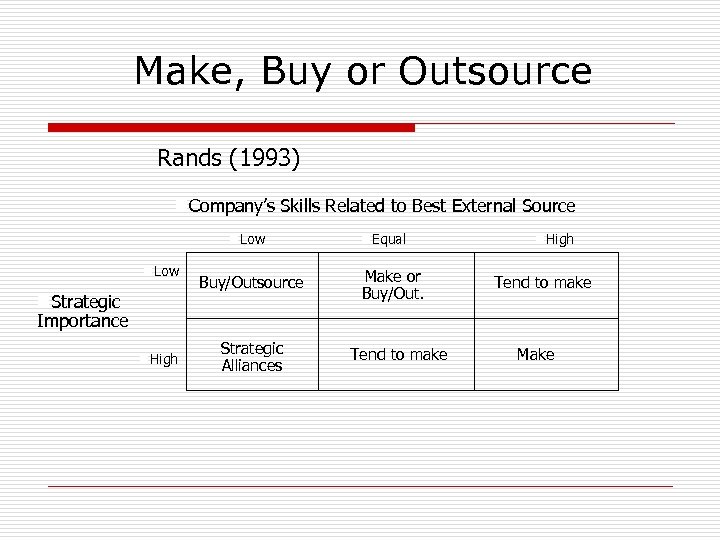 Make, Buy or Outsource Rands (1993) n. Company’s Skills Related to Best External Source n. Low n. Strategic Importance n. High Buy/Outsource Strategic Alliances n. Equal Make or Buy/Out. Tend to make n. High Tend to make Make
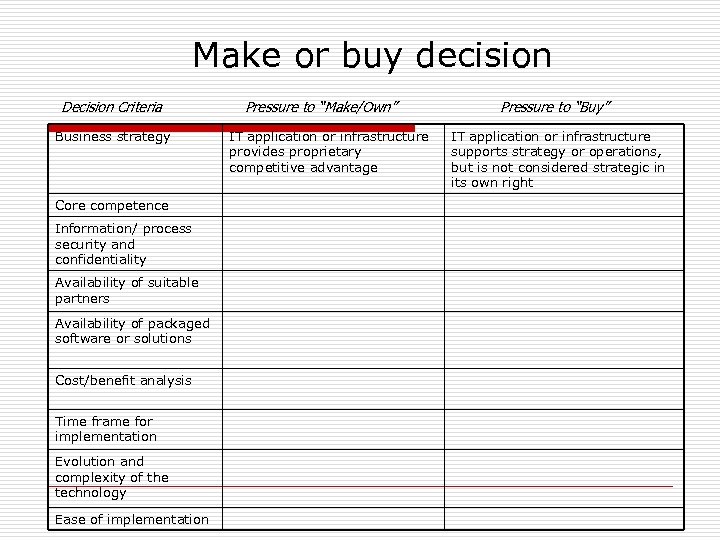 Make or buy decision Decision Criteria Business strategy Core competence Information/ process security and confidentiality Availability of suitable partners Availability of packaged software or solutions Cost/benefit analysis Time frame for implementation Evolution and complexity of the technology Ease of implementation Pressure to “Make/Own” IT application or infrastructure provides proprietary competitive advantage Pressure to “Buy” IT application or infrastructure supports strategy or operations, but is not considered strategic in its own right
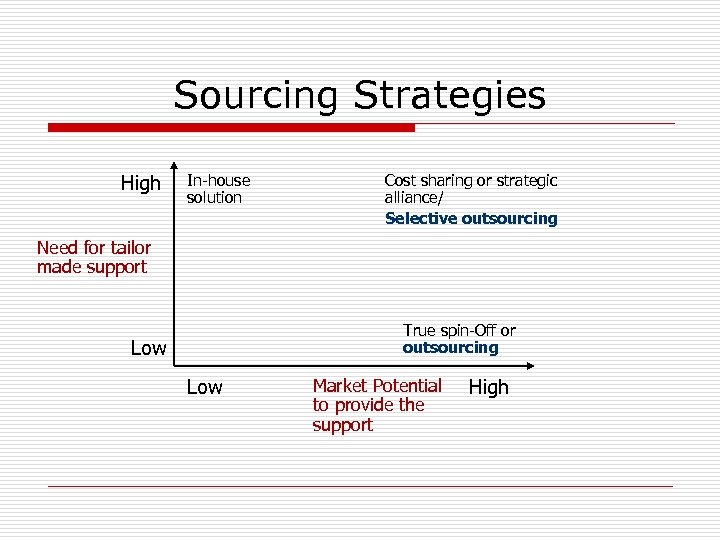 Sourcing Strategies High In-house solution Cost sharing or strategic alliance/ Selective outsourcing Need for tailor made support True spin-Off or outsourcing Low Market Potential to provide the support High
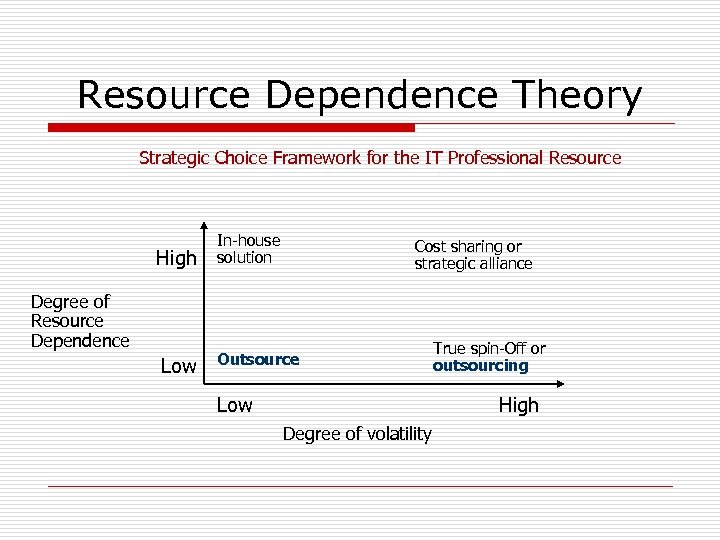 Resource Dependence Theory Strategic Choice Framework for the IT Professional Resource High Degree of Resource Dependence Low In-house solution Cost sharing or strategic alliance Outsource Low True spin-Off or outsourcing High Degree of volatility
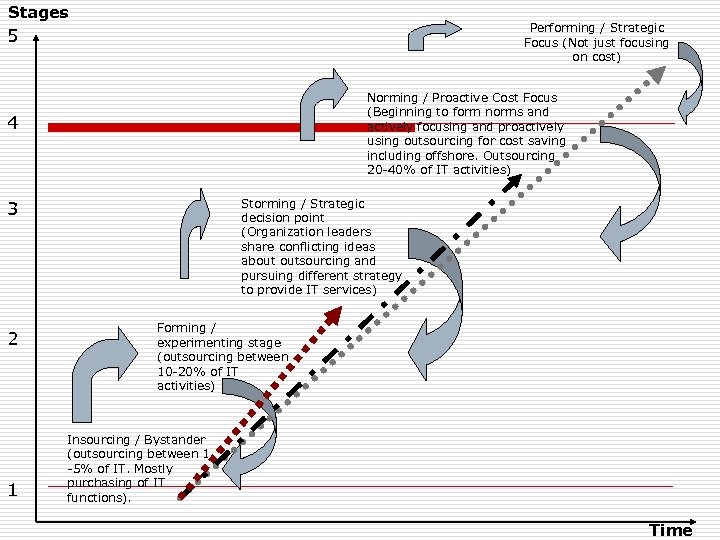 Stages Performing / Strategic Focus (Not just focusing on cost) 5 Norming / Proactive Cost Focus (Beginning to form norms and actively focusing and proactively using outsourcing for cost saving including offshore. Outsourcing 20 -40% of IT activities) 4 Storming / Strategic decision point (Organization leaders share conflicting ideas about outsourcing and pursuing different strategy to provide IT services) 3 2 1 Forming / experimenting stage (outsourcing between 10 -20% of IT activities) Insourcing / Bystander (outsourcing between 1 -5% of IT. Mostly purchasing of IT functions). Time
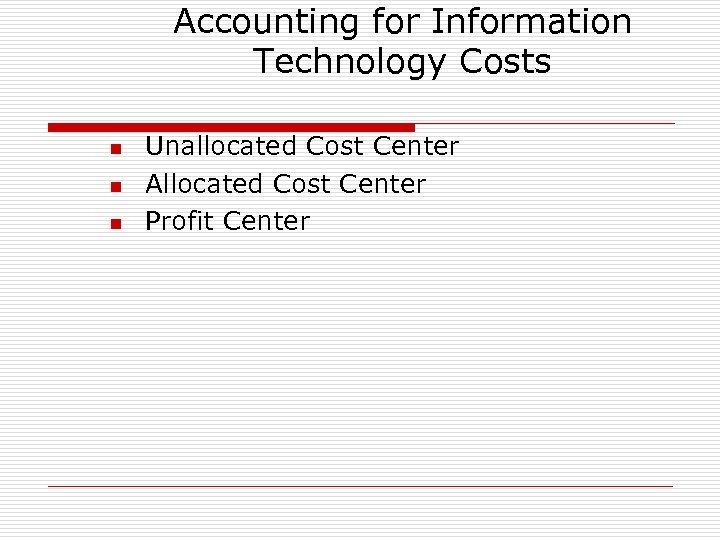 Accounting for Information Technology Costs n n n Unallocated Cost Center Allocated Cost Center Profit Center
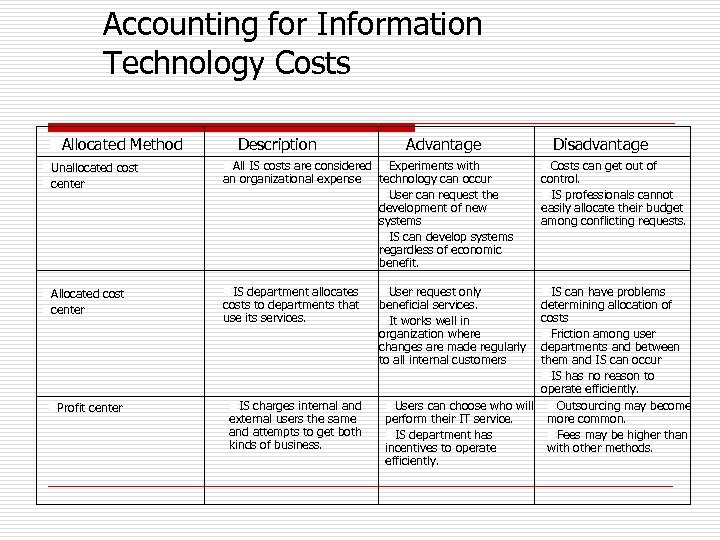 Accounting for Information Technology Costs n. Allocated Method Description Advantage n. Unallocated cost ncenter n. All IS costs are considered n. Experiments with an organizational expense technology can occur n. User can request the development of new systems n. IS can develop systems regardless of economic benefit. n. Allocated cost ncenter n. IS department allocates costs to departments that use its services. n. Profit center n. IS charges internal and external users the same and attempts to get both kinds of business. n. User request only beneficial services. n. It works well in organization where changes are made regularly to all internal customers Disadvantage n. Costs can get out of control. n. IS professionals cannot easily allocate their budget among conflicting requests. n. IS can have problems determining allocation of costs n. Friction among user departments and between them and IS can occur n. IS has no reason to operate efficiently. n. Users can choose who will n. Outsourcing may become perform their IT service. more common. n. IS department has n. Fees may be higher than incentives to operate with other methods. efficiently.
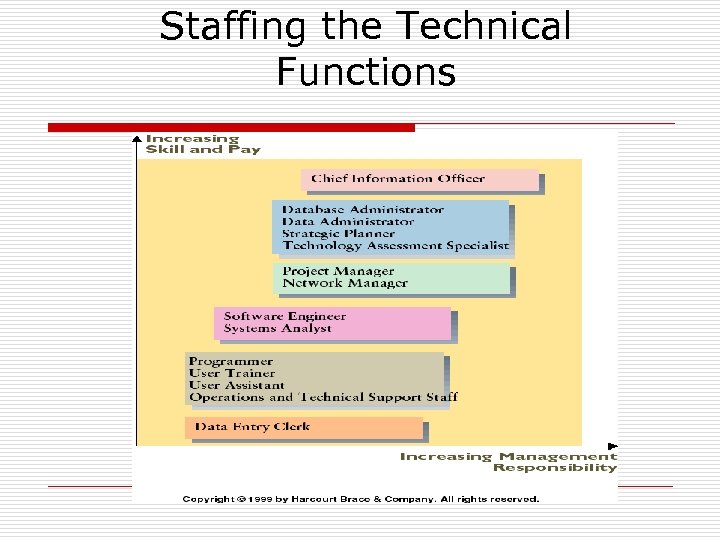 Staffing the Technical Functions