 Скачать презентацию IT Outsourcing and Bangladesh IT Policy Presentation by
877adc173659e9ca0d8e3373558029a5.ppt
- Количество слайдов: 31



IT Outsourcing and Bangladesh IT Policy Presentation by Sayeed Rahman Founder of BANGLA IT Bangladesh Information Technology (IT) Group Dec 20, 2004 http: //www. banglait. org
" MAKING BANGLADESH A NEW SILICON DELTA “ Recognition of Bangladesh as an emerging Silicon Delta is the vision of all of us. We believe we can all bring our aspirations to fruition by pulling together, as one. With that vision held aloft, our primary objective for Bangladesh Information Technology (IT) group mail list would be to exchange ideas, share articles, present the current trends, and introduce futuristic vision directly related to the real development of the IT sector in Bangladesh. The idea is to create awareness among budding Bangladeshi entrepreneurs and IT architects. This IT forum, dedicated to the Non Resident Bangladeshi(NRB) and RB IT professionals and students, will make a difference in the years to come. IT professionals and students from all over the world are cordially invited to join this group to get an overview of the cutting edge, state-of-the–art technology and future job trends. Vision To provide technical leadership in meeting the needs of Bangladeshi Citizens by addressing ICT opportunities through the effective use of technology
Mission We strive to bring this Mission to fruition by aspiring to be an organization that is: A catalyst for emerging technologies Provide information and guidance to Bangladeshi companies to achieve certifications such as CMM/PCMM/CMMI Provide a single source of information on IT services and industry in Bangladesh Transforming the Internet into a powerful environment for Bangladesh Education Recognized as a center of expertise for Information and Communication Technology Help Bangladeshi companies access the expertise of the non-resident Bangladeshi (NRB) community in the ICT industries around the world Use Open Source Software for the development of Bangladesh Share information, experiences and resources to realize the potential of Information and Communication Technologies to improve lives, reduce poverty and empower people http: //groups. yahoo. com/group/bangla_ict/ Subscribe: bangla_ict-subscribe@yahoogroups. com
The need for ICT in Bangladesh n n ICT plays an indispensable role in promoting openness, accessibility, accountability, connectivity, democracy and decentralization- all the “soft” qualities so essential for effective social, economic, and political development. Bangladesh needs the capacity to network with people, ideas and initiatives. This is as critical and fundamental to nation building as water, agriculture, health and housing, and without it, Bangladesh’s democracy could founder.
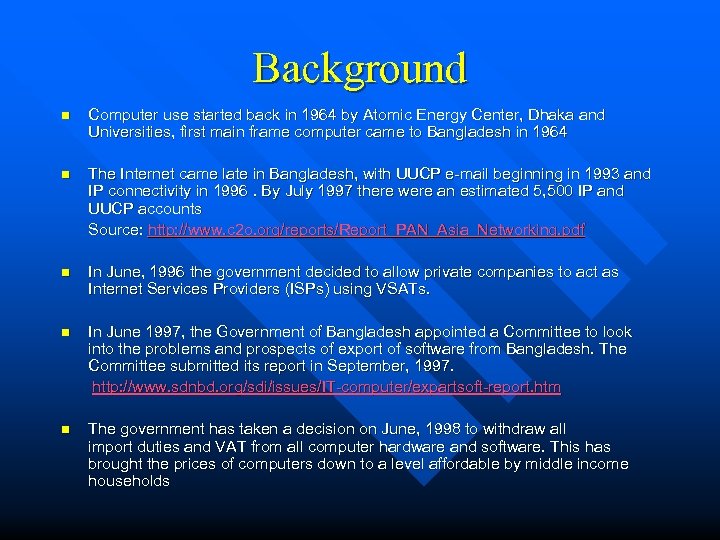
Background n Computer use started back in 1964 by Atomic Energy Center, Dhaka and Universities, first main frame computer came to Bangladesh in 1964 n The Internet came late in Bangladesh, with UUCP e-mail beginning in 1993 and IP connectivity in 1996. By July 1997 there were an estimated 5, 500 IP and UUCP accounts Source: http: //www. c 2 o. org/reports/Report_PAN_Asia_Networking. pdf n In June, 1996 the government decided to allow private companies to act as Internet Services Providers (ISPs) using VSATs. In June 1997, the Government of Bangladesh appointed a Committee to look into the problems and prospects of export of software from Bangladesh. The Committee submitted its report in September, 1997. http: //www. sdnbd. org/sdi/issues/IT-computer/expartsoft-report. htm n n The government has taken a decision on June, 1998 to withdraw all import duties and VAT from all computer hardware and software. This has brought the prices of computers down to a level affordable by middle income households
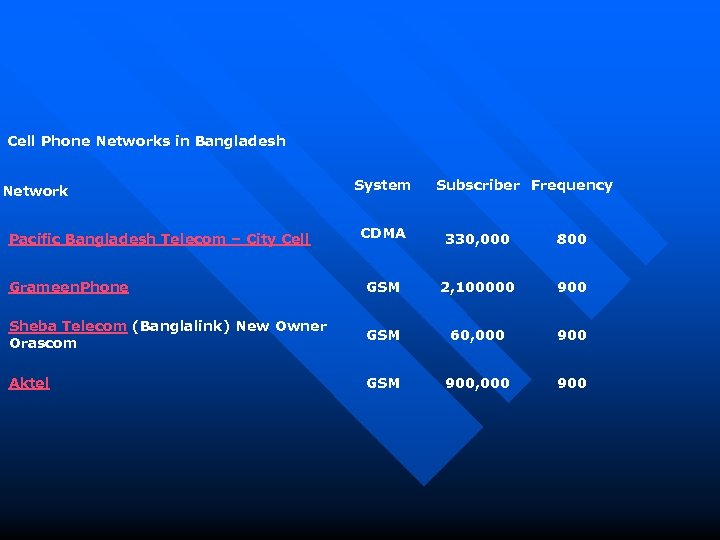
Cell Phone Networks in Bangladesh Network System Subscriber Frequency CDMA 330, 000 800 Grameen. Phone GSM 2, 100000 900 Sheba Telecom (Banglalink) New Owner Orascom GSM 60, 000 900 Aktel GSM 900, 000 900 Pacific Bangladesh Telecom – City Cell
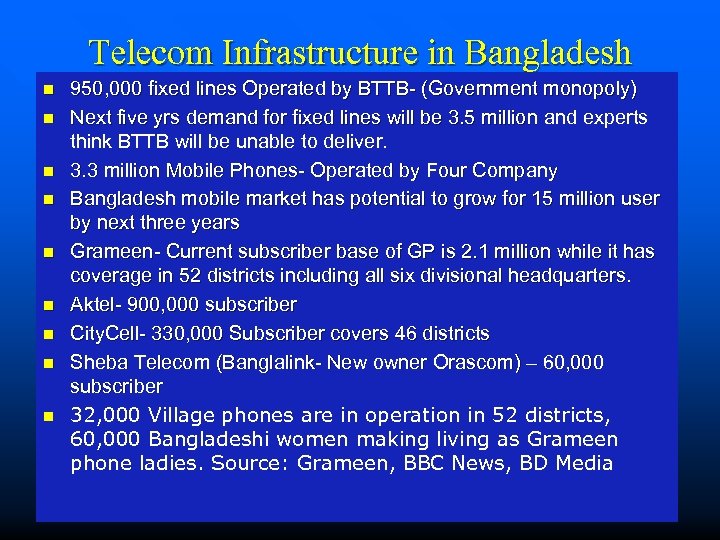
Telecom Infrastructure in Bangladesh n n n n n 950, 000 fixed lines Operated by BTTB- (Government monopoly) Next five yrs demand for fixed lines will be 3. 5 million and experts Next five yrs demand for fixed lines will be 3. 5 million think BTTB will be unable to deliver. 3. 3 million Mobile Phones- Operated by Four Company Bangladesh mobile market has potential to grow for 15 million user by next three years Grameen- Current subscriber base of GP is 2. 1 million while it has coverage in 52 districts including all six divisional headquarters. Aktel- 900, 000 subscriber City. Cell- 330, 000 Subscriber covers 46 districts Sheba Telecom (Banglalink- New owner Orascom) – 60, 000 subscriber 32, 000 Village phones are in operation in 52 districts, 60, 000 Bangladeshi women making living as Grameen phone ladies. Source: Grameen, BBC News, BD Media
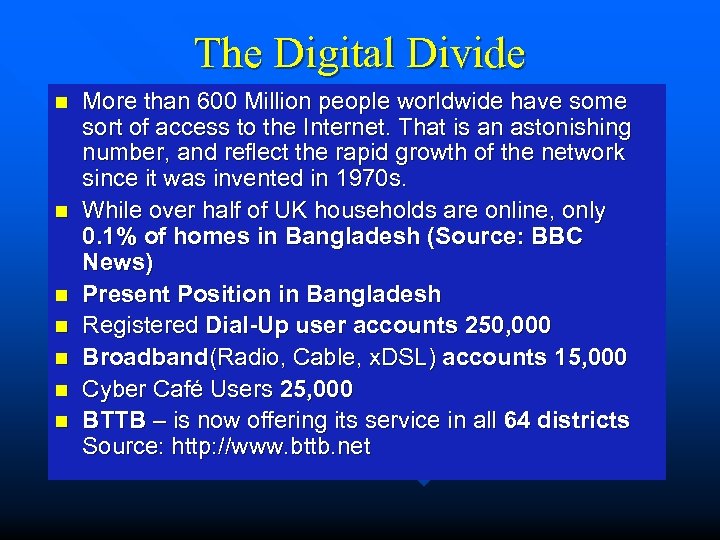
The Digital Divide n n n n More than 600 Million people worldwide have some sort of access to the Internet. That is an astonishing number, and reflect the rapid growth of the network since it was invented in 1970 s. While over half of UK households are online, only 0. 1% of homes in Bangladesh (Source: BBC News) Present Position in Bangladesh Registered Dial-Up user accounts 250, 000 Broadband(Radio, Cable, x. DSL) accounts 15, 000 Cyber Café Users 25, 000 BTTB – is now offering its service in all 64 districts Source: http: //www. bttb. net
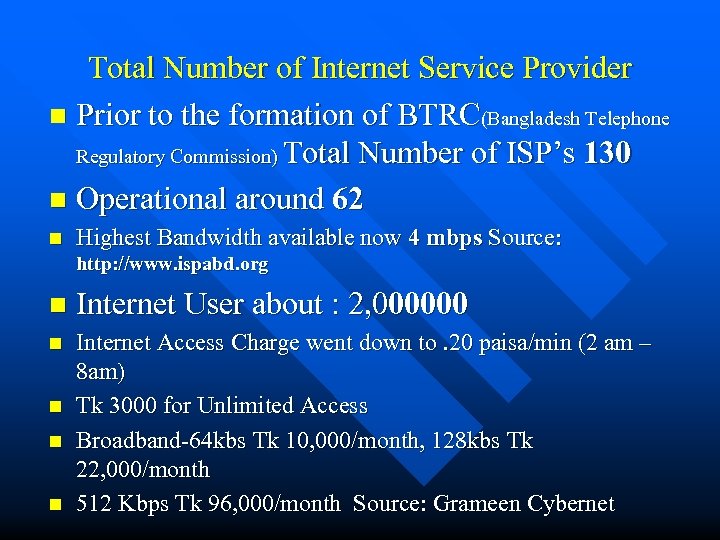
Total Number of Internet Service Provider n Prior to the formation of BTRC(Bangladesh Telephone Regulatory Commission) Total Number of ISP’s 130 n Operational around 62 n Highest Bandwidth available now 4 mbps Source: http: //www. ispabd. org n Internet User about : 2, 000000 n Internet Access Charge went down to. 20 paisa/min (2 am – 8 am) Tk 3000 for Unlimited Access Broadband-64 kbs Tk 10, 000/month, 128 kbs Tk 22, 000/month 512 Kbps Tk 96, 000/month Source: Grameen Cybernet n n n
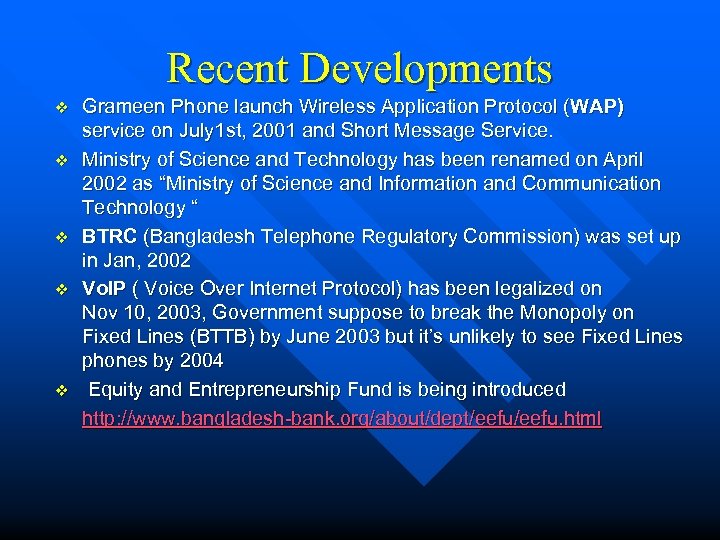
Recent Developments v v v Grameen Phone launch Wireless Application Protocol (WAP) service on July 1 st, 2001 and Short Message Service. Ministry of Science and Technology has been renamed on April 2002 as “Ministry of Science and Information and Communication Technology “ BTRC (Bangladesh Telephone Regulatory Commission) was set up in Jan, 2002 Vo. IP ( Voice Over Internet Protocol) has been legalized on Nov 10, 2003, Government suppose to break the Monopoly on Fixed Lines (BTTB) by June 2003 but it’s unlikely to see Fixed Lines phones by 2004 Equity and Entrepreneurship Fund is being introduced http: //www. bangladesh-bank. org/about/dept/eefu. html
Global Information Superhighway v Submarine Cable connection to Global Information Superhighway(SEA-ME-WE-4) will be ready for service in 2005. It will be built using DWDM (Dense Wavelength Division Multiplex) technology with 1. 28 terabits per second speed

Bangladesh’s Strengths v v v A substantial number of educated unemployed youth force, with ability to read and write English About 2500 Bangladeshi NRB(Non Resident Bangladeshi) IT professionals employed in North America Total number of ICT related graduate every year now Bangladesh producing about 5000 from 21 Public and 51 Private Universities A large number of Bangladeshi students are studying overseas in Computer related subjects, specially in India Bangladesh offers a very attractive cost-effective wage level for Programmers about half of India Visit http: //www. banglait. org for more info
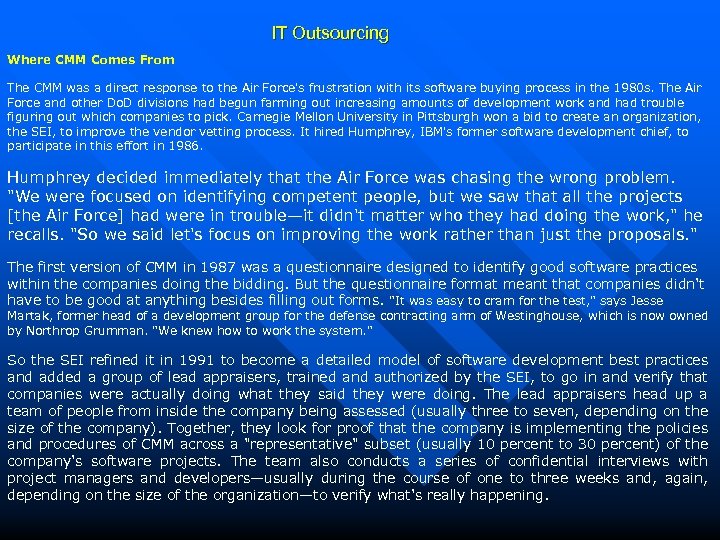
IT Outsourcing Where CMM Comes From The CMM was a direct response to the Air Force's frustration with its software buying process in the 1980 s. The Air Force and other Do. D divisions had begun farming out increasing amounts of development work and had trouble figuring out which companies to pick. Carnegie Mellon University in Pittsburgh won a bid to create an organization, the SEI, to improve the vendor vetting process. It hired Humphrey, IBM's former software development chief, to participate in this effort in 1986. Humphrey decided immediately that the Air Force was chasing the wrong problem. "We were focused on identifying competent people, but we saw that all the projects [the Air Force] had were in trouble—it didn't matter who they had doing the work, " he recalls. "So we said let's focus on improving the work rather than just the proposals. " The first version of CMM in 1987 was a questionnaire designed to identify good software practices within the companies doing the bidding. But the questionnaire format meant that companies didn't have to be good at anything besides filling out forms. "It was easy to cram for the test, " says Jesse Martak, former head of a development group for the defense contracting arm of Westinghouse, which is now owned by Northrop Grumman. "We knew how to work the system. " So the SEI refined it in 1991 to become a detailed model of software development best practices and added a group of lead appraisers, trained and authorized by the SEI, to go in and verify that companies were actually doing what they said they were doing. The lead appraisers head up a team of people from inside the company being assessed (usually three to seven, depending on the size of the company). Together, they look for proof that the company is implementing the policies and procedures of CMM across a "representative" subset (usually 10 percent to 30 percent) of the company's software projects. The team also conducts a series of confidential interviews with project managers and developers—usually during the course of one to three weeks and, again, depending on the size of the organization—to verify what's really happening.
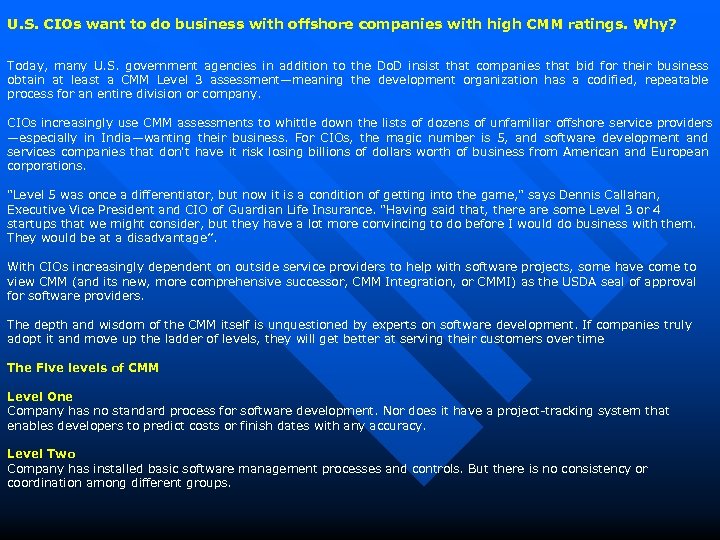
U. S. CIOs want to do business with offshore companies with high CMM ratings. Why? Today, many U. S. government agencies in addition to the Do. D insist that companies that bid for their business obtain at least a CMM Level 3 assessment—meaning the development organization has a codified, repeatable process for an entire division or company. CIOs increasingly use CMM assessments to whittle down the lists of dozens of unfamiliar offshore service providers —especially in India—wanting their business. For CIOs, the magic number is 5, and software development and services companies that don't have it risk losing billions of dollars worth of business from American and European corporations. "Level 5 was once a differentiator, but now it is a condition of getting into the game, " says Dennis Callahan, Executive Vice President and CIO of Guardian Life Insurance. "Having said that, there are some Level 3 or 4 startups that we might consider, but they have a lot more convincing to do before I would do business with them. They would be at a disadvantage’’. With CIOs increasingly dependent on outside service providers to help with software projects, some have come to view CMM (and its new, more comprehensive successor, CMM Integration, or CMMI) as the USDA seal of approval for software providers. The depth and wisdom of the CMM itself is unquestioned by experts on software development. If companies truly adopt it and move up the ladder of levels, they will get better at serving their customers over time The Five levels of CMM Level One Company has no standard process for software development. Nor does it have a project-tracking system that enables developers to predict costs or finish dates with any accuracy. Level Two Company has installed basic software management processes and controls. But there is no consistency or coordination among different groups.
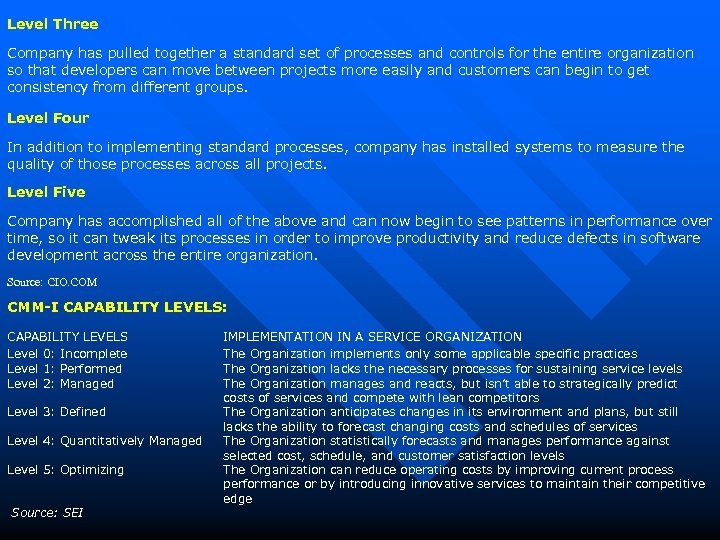
Level Three Company has pulled together a standard set of processes and controls for the entire organization so that developers can move between projects more easily and customers can begin to get consistency from different groups. Level Four In addition to implementing standard processes, company has installed systems to measure the quality of those processes across all projects. Level Five Company has accomplished all of the above and can now begin to see patterns in performance over time, so it can tweak its processes in order to improve productivity and reduce defects in software development across the entire organization. Source: CIO. COM CMM-I CAPABILITY LEVELS: CAPABILITY LEVELS Level 0: Incomplete Level 1: Performed Level 2: Managed Level 3: Defined Level 4: Quantitatively Managed Level 5: Optimizing Source: SEI IMPLEMENTATION IN A SERVICE ORGANIZATION The Organization implements only some applicable specific practices The Organization lacks the necessary processes for sustaining service levels The Organization manages and reacts, but isn’t able to strategically predict costs of services and compete with lean competitors The Organization anticipates changes in its environment and plans, but still lacks the ability to forecast changing costs and schedules of services The Organization statistically forecasts and manages performance against selected cost, schedule, and customer satisfaction levels The Organization can reduce operating costs by improving current process performance or by introducing innovative services to maintain their competitive edge
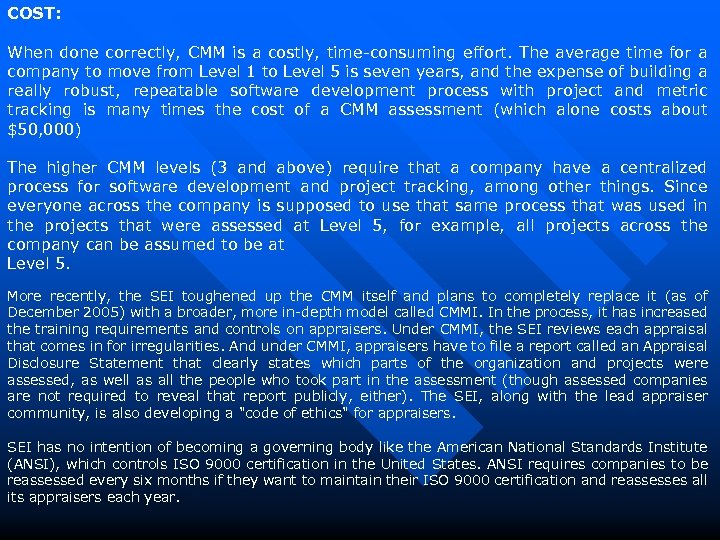
COST: When done correctly, CMM is a costly, time-consuming effort. The average time for a company to move from Level 1 to Level 5 is seven years, and the expense of building a really robust, repeatable software development process with project and metric tracking is many times the cost of a CMM assessment (which alone costs about $50, 000) The higher CMM levels (3 and above) require that a company have a centralized process for software development and project tracking, among other things. Since everyone across the company is supposed to use that same process that was used in the projects that were assessed at Level 5, for example, all projects across the company can be assumed to be at Level 5. More recently, the SEI toughened up the CMM itself and plans to completely replace it (as of December 2005) with a broader, more in-depth model called CMMI. In the process, it has increased the training requirements and controls on appraisers. Under CMMI, the SEI reviews each appraisal that comes in for irregularities. And under CMMI, appraisers have to file a report called an Appraisal Disclosure Statement that clearly states which parts of the organization and projects were assessed, as well as all the people who took part in the assessment (though assessed companies are not required to reveal that report publicly, either). The SEI, along with the lead appraiser community, is also developing a "code of ethics" for appraisers. SEI has no intention of becoming a governing body like the American National Standards Institute (ANSI), which controls ISO 9000 certification in the United States. ANSI requires companies to be reassessed every six months if they want to maintain their ISO 9000 certification and reassesses all its appraisers each year.
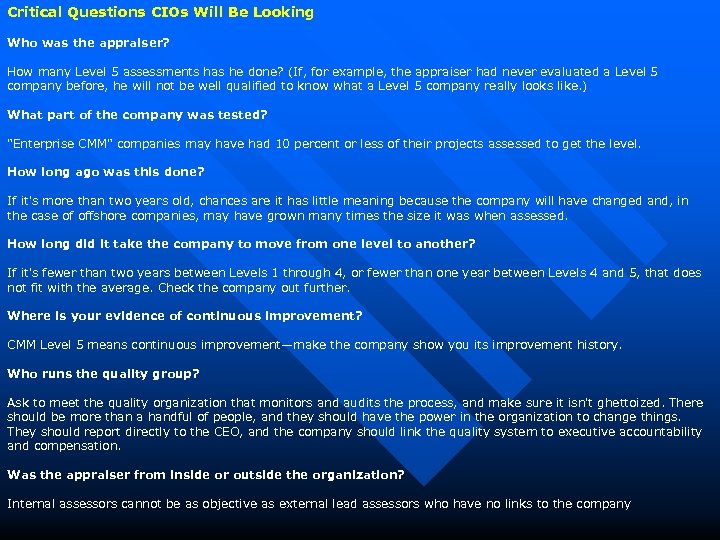
Critical Questions CIOs Will Be Looking Who was the appraiser? How many Level 5 assessments has he done? (If, for example, the appraiser had never evaluated a Level 5 company before, he will not be well qualified to know what a Level 5 company really looks like. ) What part of the company was tested? "Enterprise CMM" companies may have had 10 percent or less of their projects assessed to get the level. How long ago was this done? If it's more than two years old, chances are it has little meaning because the company will have changed and, in the case of offshore companies, may have grown many times the size it was when assessed. How long did it take the company to move from one level to another? If it's fewer than two years between Levels 1 through 4, or fewer than one year between Levels 4 and 5, that does not fit with the average. Check the company out further. Where is your evidence of continuous improvement? CMM Level 5 means continuous improvement—make the company show you its improvement history. Who runs the quality group? Ask to meet the quality organization that monitors and audits the process, and make sure it isn't ghettoized. There should be more than a handful of people, and they should have the power in the organization to change things. They should report directly to the CEO, and the company should link the quality system to executive accountability and compensation. Was the appraiser from inside or outside the organization? Internal assessors cannot be as objective as external lead assessors who have no links to the company
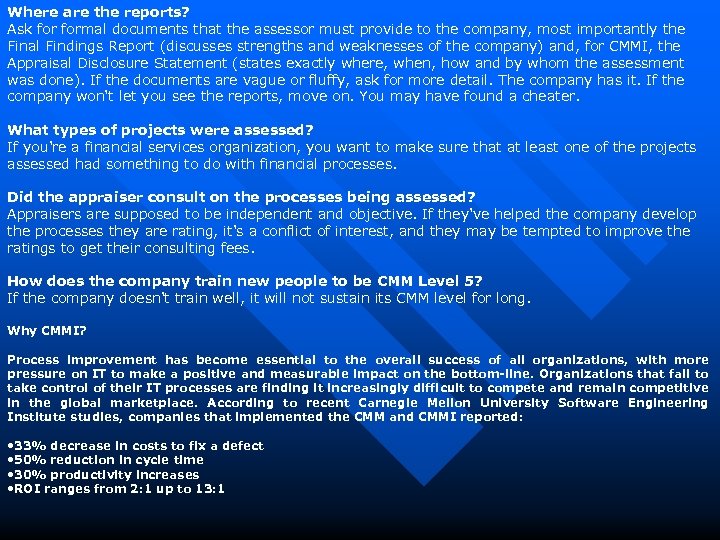
Where are the reports? Ask formal documents that the assessor must provide to the company, most importantly the Final Findings Report (discusses strengths and weaknesses of the company) and, for CMMI, the Appraisal Disclosure Statement (states exactly where, when, how and by whom the assessment was done). If the documents are vague or fluffy, ask for more detail. The company has it. If the company won't let you see the reports, move on. You may have found a cheater. What types of projects were assessed? If you're a financial services organization, you want to make sure that at least one of the projects assessed had something to do with financial processes. Did the appraiser consult on the processes being assessed? Appraisers are supposed to be independent and objective. If they've helped the company develop the processes they are rating, it's a conflict of interest, and they may be tempted to improve the ratings to get their consulting fees. How does the company train new people to be CMM Level 5? If the company doesn't train well, it will not sustain its CMM level for long. Why CMMI? Process improvement has become essential to the overall success of all organizations, with more pressure on IT to make a positive and measurable impact on the bottom-line. Organizations that fail to take control of their IT processes are finding it increasingly difficult to compete and remain competitive in the global marketplace. According to recent Carnegie Mellon University Software Engineering Institute studies, companies that implemented the CMM and CMMI reported: • 33% decrease in costs to fix a defect • 50% reduction in cycle time • 30% productivity increases • ROI ranges from 2: 1 up to 13: 1
Comments: It doesn't matter how good a company's programming skills are. Until business folks and IT folks are taught how to collaborate effectively with each other, business will continue to be frustrated by its inability to get satisfactory results from IT related projects. Advertising from TCS Quality Initiative- 15 SEI CMM Level 5 Centers (12, 000 consultants) and over 1600 Certified Quality Analysts (CQA), State-of-the-art R & D and IT Training Facilities News February 2000 http: //www. tcs. com/0_media_room/releases/200002 feb/200002_cqa_top. htm TCSer tops the Certified Quality Analyst (CQA) examination - Third time in a row Mr. Raju Dutta from TCS Calcutta has scored the highest marks in the CQA exam conducted worldwide in Oct'99. To date there approximately 2000 active CQA's all over the world of which 678 are from TCS, the highest number of CQA's in any organisation world-wide
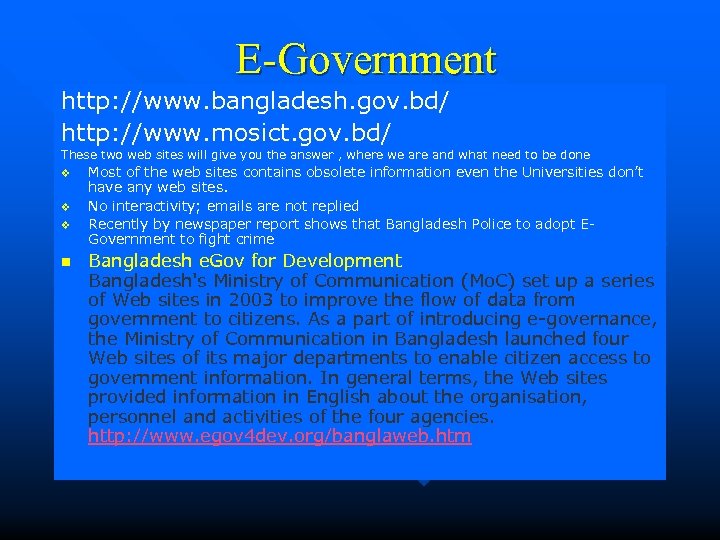
E-Government http: //www. bangladesh. gov. bd/ http: //www. mosict. gov. bd/ These two web sites will give you the answer , where we are and what need to be done v v v n Most of the web sites contains obsolete information even the Universities don’t have any web sites. No interactivity; emails are not replied Recently by newspaper report shows that Bangladesh Police to adopt EGovernment to fight crime Bangladesh e. Gov for Development Bangladesh's Ministry of Communication (Mo. C) set up a series of Web sites in 2003 to improve the flow of data from government to citizens. As a part of introducing e-governance, the Ministry of Communication in Bangladesh launched four Web sites of its major departments to enable citizen access to government information. In general terms, the Web sites provided information in English about the organisation, personnel and activities of the four agencies. http: //www. egov 4 dev. org/banglaweb. htm
We can evaluate the project cost, which have been created as part of a much larger US$7 million, four-year reform project of the Ministry of Communication, 80% of which is donor-funded. As it says: The benefits to citizens are unknown, but one should not underestimate the gains delivered by publication of even basic information in a medium of growing accessibility; information that was often hard to access before. Impact: Costs and Benefits The Web sites have been created as part of a much larger US$7 million, four-year reform project of the Ministry of Communication, 80% of which is donor-funded. Capital costs for the Web infrastructure were bundled into the larger project; maintenance costs for the Web site (ten staff plus Internet connection costs, excluding depreciation costs for IT) are around US$60, 000 per annum. The larger project began in 1999; Web-related developments began in earnest in 2002, leading to launch in mid-2003.

E- Commerce v CSE (Chittagong Stock Exchange) offers Online Trading of Stocks v Few Private Banks are offering online Banking v http: //www. bdauctions. com/home. htm Market place combining B 2 B, B 2 C & C 2 C resource groups to buy and sale all sorts of new and used products v http: //www. homeviewbangladesh. com Offers variety of consumer items Visit http: //www. banglait. org
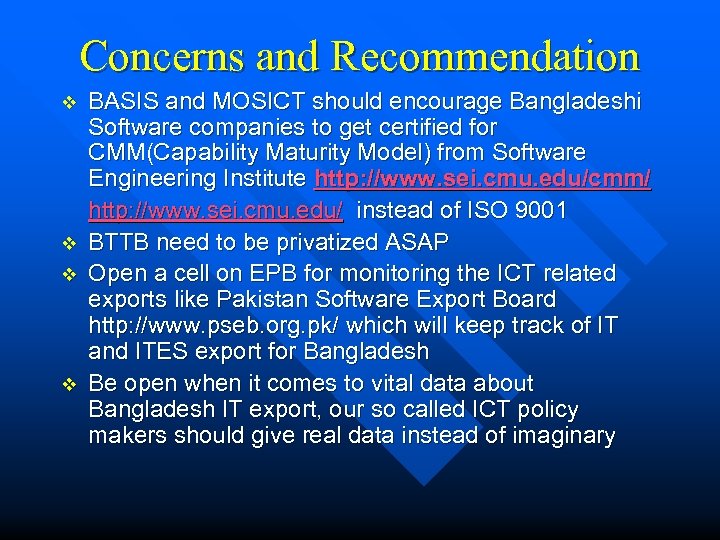
Concerns and Recommendation BASIS and MOSICT should encourage Bangladeshi Software companies to get certified for CMM(Capability Maturity Model) from Software Engineering Institute http: //www. sei. cmu. edu/cmm/ http: //www. sei. cmu. edu/ instead of ISO 9001 v BTTB need to be privatized ASAP v Open a cell on EPB for monitoring the ICT related exports like Pakistan Software Export Board http: //www. pseb. org. pk/ which will keep track of IT and ITES export for Bangladesh v Be open when it comes to vital data about Bangladesh IT export, our so called ICT policy makers should give real data instead of imaginary v
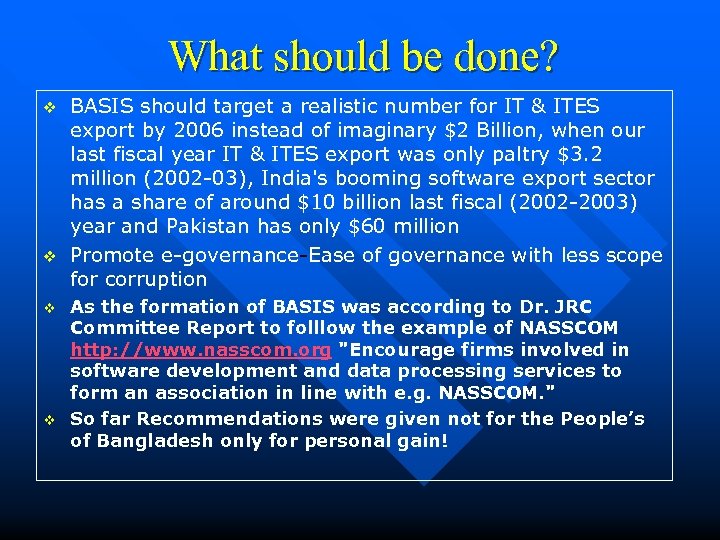
What should be done? v v BASIS should target a realistic number for IT & ITES export by 2006 instead of imaginary $2 Billion, when our last fiscal year IT & ITES export was only paltry $3. 2 million (2002 -03), India's booming software export sector has a share of around $10 billion last fiscal (2002 -2003) year and Pakistan has only $60 million Promote e-governance-Ease of governance with less scope for corruption As the formation of BASIS was according to Dr. JRC Committee Report to folllow the example of NASSCOM http: //www. nasscom. org "Encourage firms involved in software development and data processing services to form an association in line with e. g. NASSCOM. " So far Recommendations were given not for the People’s of Bangladesh only for personal gain!
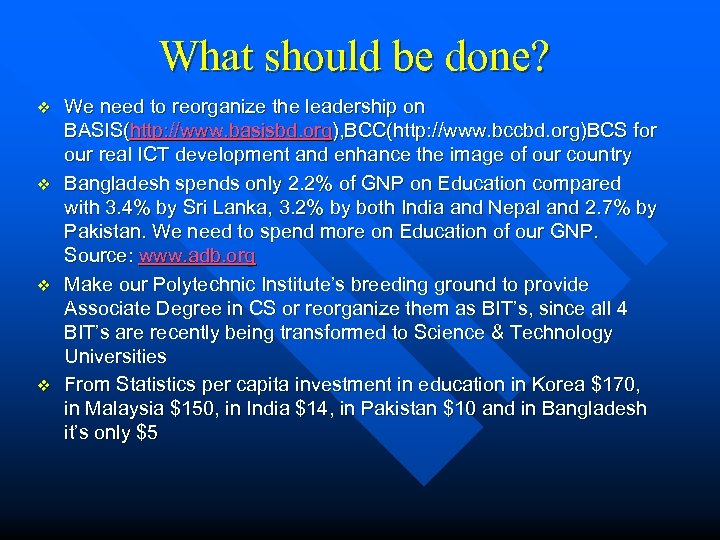
What should be done? v v We need to reorganize the leadership on BASIS(http: //www. basisbd. org), BCC(http: //www. bccbd. org)BCS for our real ICT development and enhance the image of our country Bangladesh spends only 2. 2% of GNP on Education compared with 3. 4% by Sri Lanka, 3. 2% by both India and Nepal and 2. 7% by Pakistan. We need to spend more on Education of our GNP. Source: www. adb. org Make our Polytechnic Institute’s breeding ground to provide Associate Degree in CS or reorganize them as BIT’s, since all 4 BIT’s are recently being transformed to Science & Technology Universities From Statistics per capita investment in education in Korea $170, in Malaysia $150, in India $14, in Pakistan $10 and in Bangladesh it’s only $5
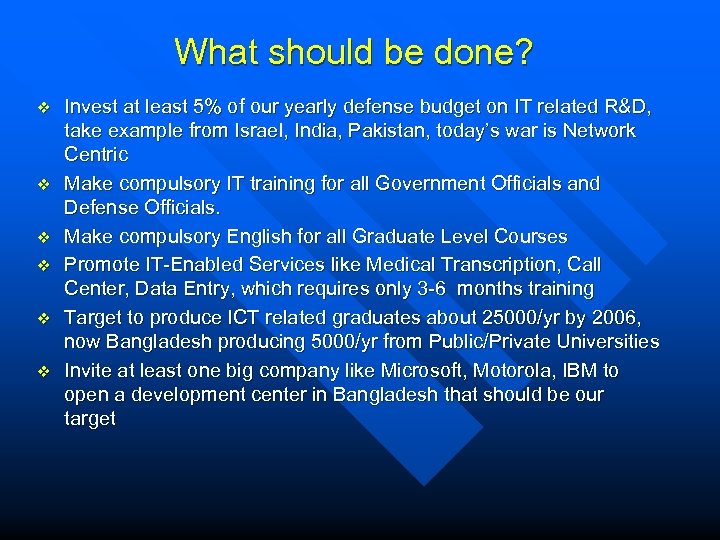
What should be done? v v v Invest at least 5% of our yearly defense budget on IT related R&D, take example from Israel, India, Pakistan, today’s war is Network Centric Make compulsory IT training for all Government Officials and Defense Officials. Make compulsory English for all Graduate Level Courses Promote IT-Enabled Services like Medical Transcription, Call Center, Data Entry, which requires only 3 -6 months training Target to produce ICT related graduates about 25000/yr by 2006, now Bangladesh producing 5000/yr from Public/Private Universities Invite at least one big company like Microsoft, Motorola, IBM to open a development center in Bangladesh that should be our target
What should be done? v v v v All Government Organization (Ministries/Offices) with whom Citizen need to interact must have websites All Private/Public Universities must have websites and their Final Year CS students could developed these web sites as their projects Teachers should be updated with latest technology rather than sticking with their old lectures Emphasis should be given to open source technology with highest priority We shouldn’t focus on giving away 10, 000 - 25, 000 computer’s to schools rather we should make 25, 000 computer literate teacher for schools & colleges The government also dreams of changing the country through IT, although not farsighted enough to make investment in IT Education Compare to other Engineering & Science education IT education requires low investment which is good for poor countries like ours
Success Stories in Bangladesh ICT n At present 32, 000 village phones are in 52 districts, 60, 000 Bangladeshi women making a living as Grameen phone ladies, as they are known. Thus emerged Bangladesh's 'telephone ladies, ' who gained social importancenot to mention income-from selling wireless service to fellow villagers. The women, who power their phones with solar panels, now make $500 per month, about the same amount as earned by the typical CEO of a Bangladeshi bank a far cry from the annual average income of US$380. As of November, 2004, Grameen has over 2. 1 million subscriber and phone ladies, who are 3% of the subscriber, uses 15% of the airtime of the company n In the early 1990 s, when Iqbal Quadir founder of Grameen Phone was looking for investors to back his idea for a mobile-phone network in Bangladesh, he said he was turned down by an executive at a cell-phone company in New York who told him, "We're not the Red Cross. “ At the end of 2001, Quadir showed how Third World ventures can be profitable - and provide a useful service - when Grameen. Phone Ltd. , the cell-phone company he founded in Bangladesh, made $27 million in pretax profit. It turned that profit after just five years far sooner than many First World start-ups.
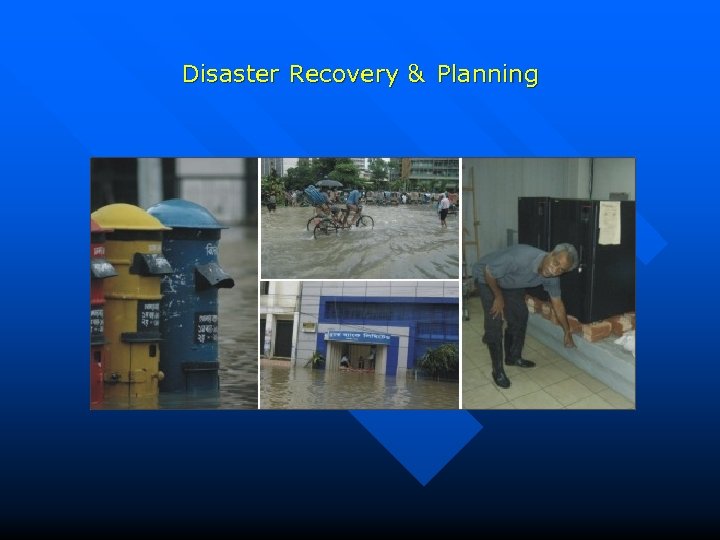
Disaster Recovery & Planning
Bangladesh ICT Policy http: //www. sdnbd. org/sdi/issues/IT-computer/itpolicy-bd-2002. htm 3. 4. 1. 6 An annual target of 3 (three) billion US dollars from earnings of export of software, data entry and IT-enabled services shall be planned up to year 2006. The target shall be revised periodically to match the growth of the market. Information Technology Policy 2001 -2005 - (Draft) BASIS Domestic IT Industry will have an Export Target of US $ 2 (Two) Billions by June 2005

http: //www. outsourcebangladesh. com
Скачать презентацию IT Outsourcing and Bangladesh IT Policy Presentation by
877adc173659e9ca0d8e3373558029a5.ppt