


 Скачать презентацию It is the last lesson of modern science
4b956632ae30cb1a995d94a629f4b190.ppt
- Количество слайдов: 23
 “It is the last lesson of modern science, that the highest simplicity of structure is produced, not by few elements, but by the highest complexity. ” Ralph Waldo Emerson, “Goethe; or, the Writer” Modeling & Simulation “Life was simple before In Enterprise World War II. After that, we had systems. ” Architectures RADM Grace Hopper Stephen J. Swenson October 22, 2003
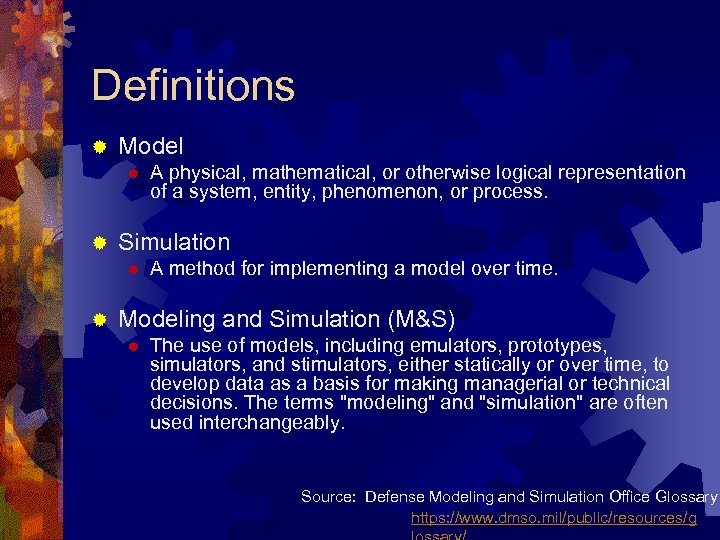 Definitions ® Model ® ® Simulation ® ® A physical, mathematical, or otherwise logical representation of a system, entity, phenomenon, or process. A method for implementing a model over time. Modeling and Simulation (M&S) ® The use of models, including emulators, prototypes, simulators, and stimulators, either statically or over time, to develop data as a basis for making managerial or technical decisions. The terms "modeling" and "simulation" are often used interchangeably. Source: Defense Modeling and Simulation Office Glossary https: //www. dmso. mil/public/resources/g
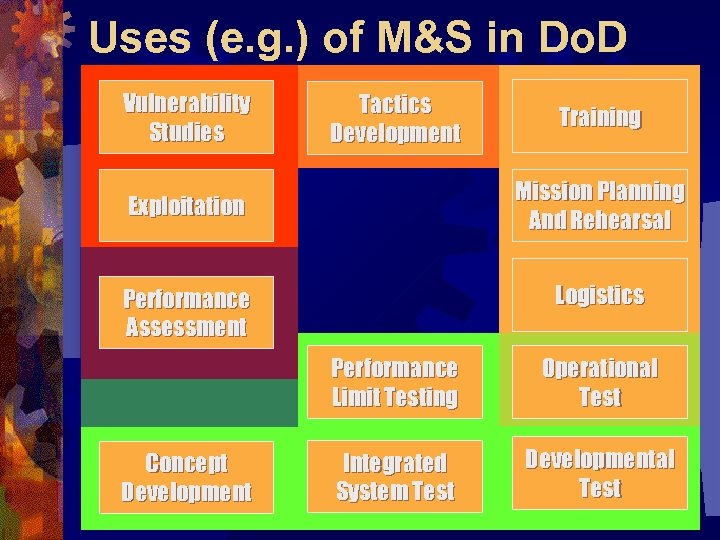 Uses (e. g. ) of M&S in Do. D Vulnerability Studies Tactics Development Training Mission Planning And Rehearsal Exploitation Logistics Performance Assessment Performance Limit Testing Concept Development Operational Test Integrated System Test Developmental Test
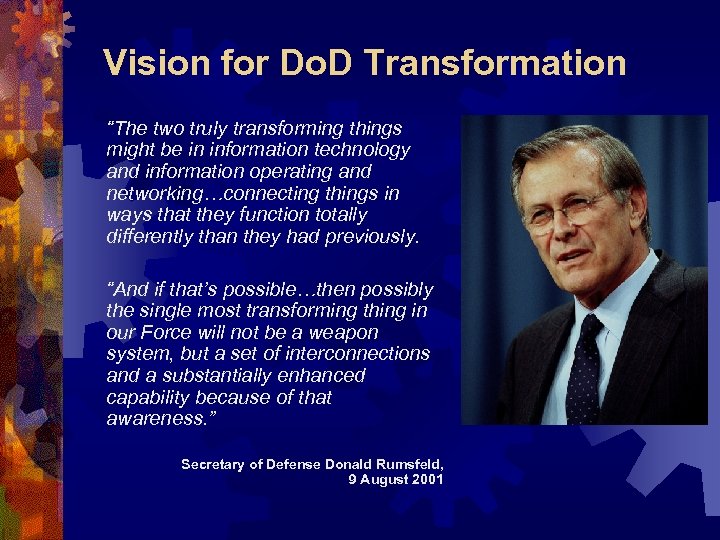 Vision for Do. D Transformation “The two truly transforming things might be in information technology and information operating and networking…connecting things in ways that they function totally differently than they had previously. “And if that’s possible…then possibly the single most transforming thing in our Force will not be a weapon system, but a set of interconnections and a substantially enhanced capability because of that awareness. ” Secretary of Defense Donald Rumsfeld, 9 August 2001
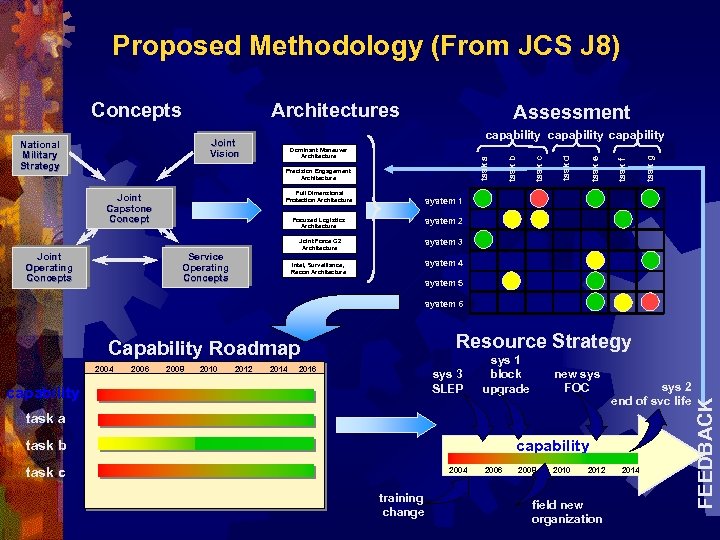 Proposed Methodology (From JCS J 8) Architectures Full Dimensional Protection Architecture Joint Capstone Concept task g task f task e system 1 Focused Logistics Architecture system 2 Joint Force C 2 Architecture Service Operating Concepts Joint Operating Concepts task d Precision Engagement DM Architecture task c Dominant Maneuver Architecture task b capability Joint Vision National Military Strategy Assessment task a Concepts system 3 system 4 Intel, Surveillance, Recon Architecture system 5 system 6 2004 2006 2008 2010 2012 2014 2016 sys 3 SLEP capability sys 1 block upgrade new sys FOC sys 2 end of svc life task a capability task b task c 2004 training change 2006 2008 2010 2012 field new organization 2014 FEEDBACK Resource Strategy Capability Roadmap
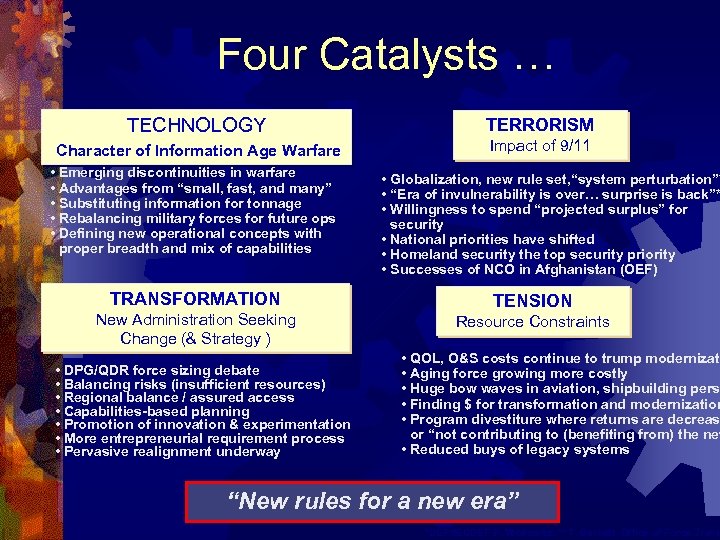 Four Catalysts … TECHNOLOGY TERRORISM Character of Information Age Warfare Impact of 9/11 • Emerging discontinuities in warfare • Advantages from “small, fast, and many” • Substituting information for tonnage • Rebalancing military forces for future ops • Defining new operational concepts with proper breadth and mix of capabilities TRANSFORMATION New Administration Seeking Change (& Strategy ) • DPG/QDR force sizing debate • Balancing risks (insufficient resources) • Regional balance / assured access • Capabilities-based planning • Promotion of innovation & experimentation • More entrepreneurial requirement process • Pervasive realignment underway • Globalization, new rule set, “system perturbation”* • “Era of invulnerability is over… surprise is back”* • Willingness to spend “projected surplus” for security • National priorities have shifted • Homeland security the top security priority • Successes of NCO in Afghanistan (OEF) TENSION Resource Constraints • QOL, O&S costs continue to trump modernizati • Aging force growing more costly • Huge bow waves in aviation, shipbuilding persi • Finding $ for transformation and modernization • Program divestiture where returns are decreas or “not contributing to (benefiting from) the net • Reduced buys of legacy systems “New rules for a new era” *DEPSECDEF P. Wolfowitz; ** T. Barnett, Office of Force Trans
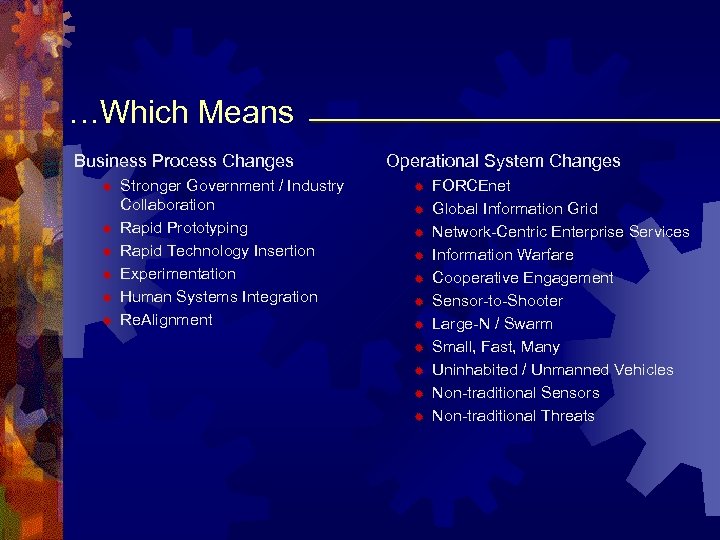 …Which Means Business Process Changes ® ® ® Stronger Government / Industry Collaboration Rapid Prototyping Rapid Technology Insertion Experimentation Human Systems Integration Re. Alignment Operational System Changes ® ® ® FORCEnet Global Information Grid Network-Centric Enterprise Services Information Warfare Cooperative Engagement Sensor-to-Shooter Large-N / Swarm Small, Fast, Many Uninhabited / Unmanned Vehicles Non-traditional Sensors Non-traditional Threats
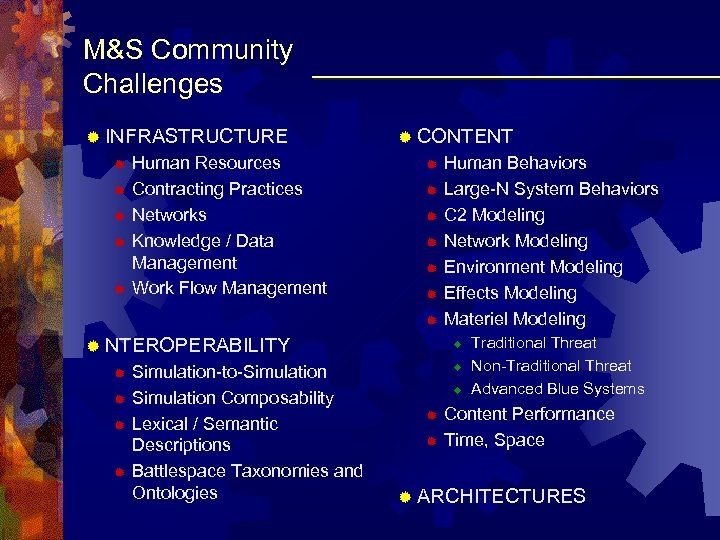 M&S Community Challenges ® INFRASTRUCTURE ® ® ® Human Resources Contracting Practices Networks Knowledge / Data Management Work Flow Management ® CONTENT ® ® ® ® NTEROPERABILITY ® ® Simulation-to-Simulation Composability Lexical / Semantic Descriptions Battlespace Taxonomies and Ontologies Human Behaviors Large-N System Behaviors C 2 Modeling Network Modeling Environment Modeling Effects Modeling Materiel Modeling ® ® ® Traditional Threat Non-Traditional Threat Advanced Blue Systems Content Performance Time, Space ® ARCHITECTURES
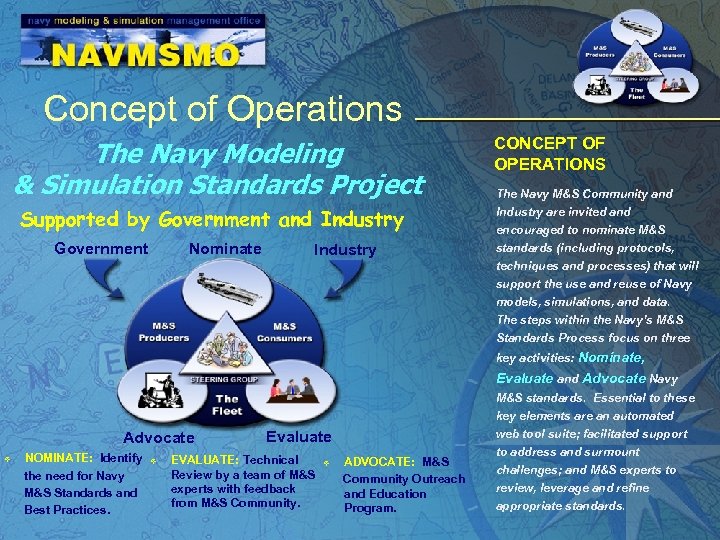 Concept of Operations The Navy Modeling & Simulation Standards Project Supported by Government and Industry Government Nominate Industry CONCEPT OF OPERATIONS The Navy M&S Community and Industry are invited and encouraged to nominate M&S standards (including protocols, techniques and processes) that will support the use and reuse of Navy models, simulations, and data. The steps within the Navy’s M&S Standards Process focus on three key activities: Nominate, Evaluate and Advocate Navy Advocate v NOMINATE: Identify the need for Navy M&S Standards and Best Practices. v Evaluate EVALUATE: Technical Review by a team of M&S experts with feedback from M&S Community. v ADVOCATE: M&S Community Outreach and Education Program. M&S standards. Essential to these key elements are an automated web tool suite; facilitated support to address and surmount challenges; and M&S experts to review, leverage and refine appropriate standards.
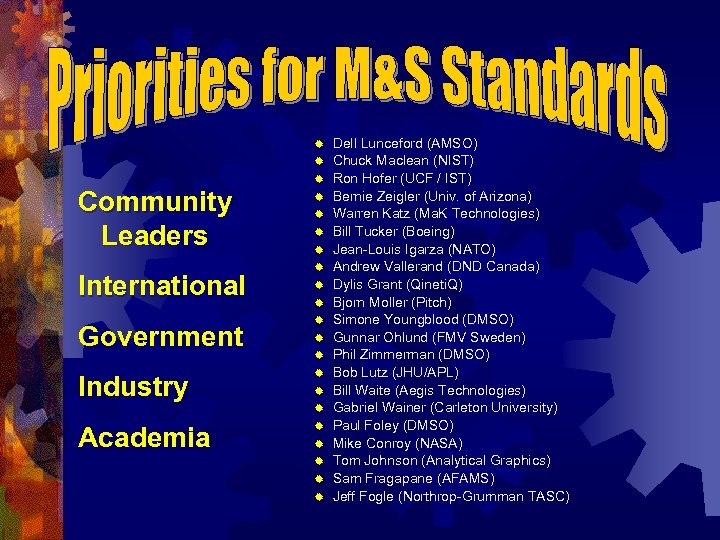 ® Dell Lunceford (AMSO) ® Chuck Maclean (NIST) ® Ron Hofer (UCF / IST) Community Leaders International Government Industry Academia ® Bernie Zeigler (Univ. of Arizona) ® Warren Katz (Ma. K Technologies) ® Bill Tucker (Boeing) ® Jean-Louis Igarza (NATO) ® Andrew Vallerand (DND Canada) ® Dylis Grant (Qineti. Q) ® Bjorn Moller (Pitch) ® Simone Youngblood (DMSO) ® Gunnar Ohlund (FMV Sweden) ® Phil Zimmerman (DMSO) ® Bob Lutz (JHU/APL) ® Bill Waite (Aegis Technologies) ® Gabriel Wainer (Carleton University) ® Paul Foley (DMSO) ® Mike Conroy (NASA) ® Tom Johnson (Analytical Graphics) ® Sam Fragapane (AFAMS) ® Jeff Fogle (Northrop-Grumman TASC)
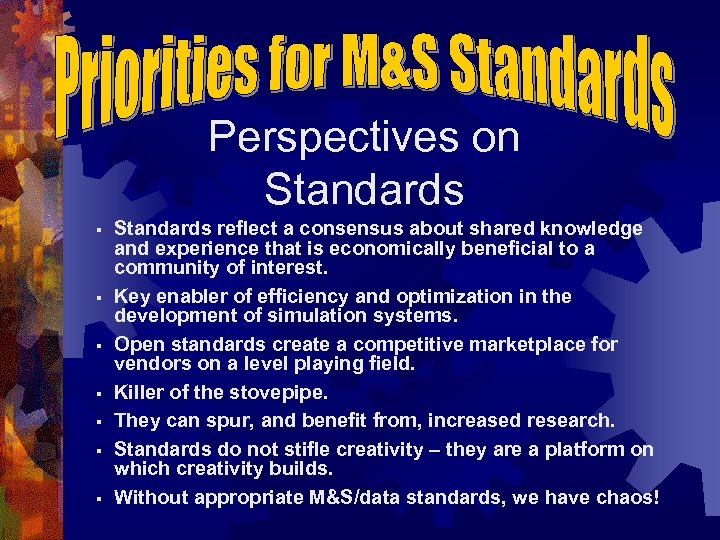 Perspectives on Standards § § § § Standards reflect a consensus about shared knowledge and experience that is economically beneficial to a community of interest. Key enabler of efficiency and optimization in the development of simulation systems. Open standards create a competitive marketplace for vendors on a level playing field. Killer of the stovepipe. They can spur, and benefit from, increased research. Standards do not stifle creativity – they are a platform on which creativity builds. Without appropriate M&S/data standards, we have chaos!
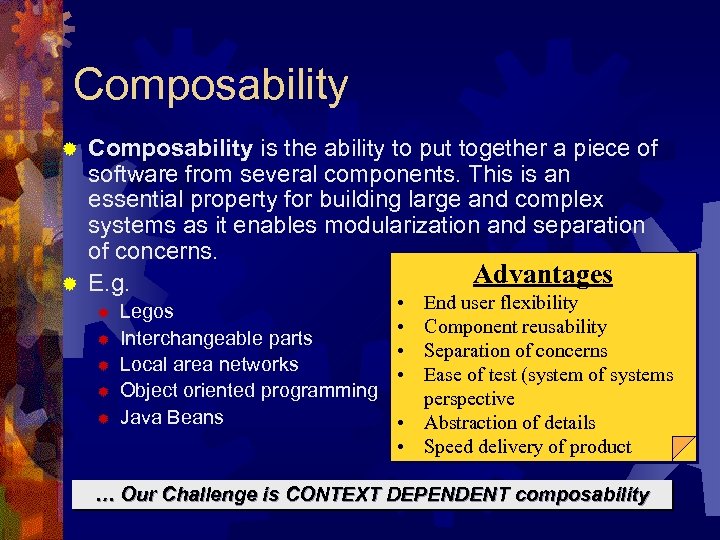 Composability is the ability to put together a piece of software from several components. This is an essential property for building large and complex systems as it enables modularization and separation of concerns. Advantages ® E. g. ® ® ® Legos Interchangeable parts Local area networks Object oriented programming Java Beans • • End user flexibility Component reusability Separation of concerns Ease of test (system of systems perspective • Abstraction of details • Speed delivery of product … Our Challenge is CONTEXT DEPENDENT composability
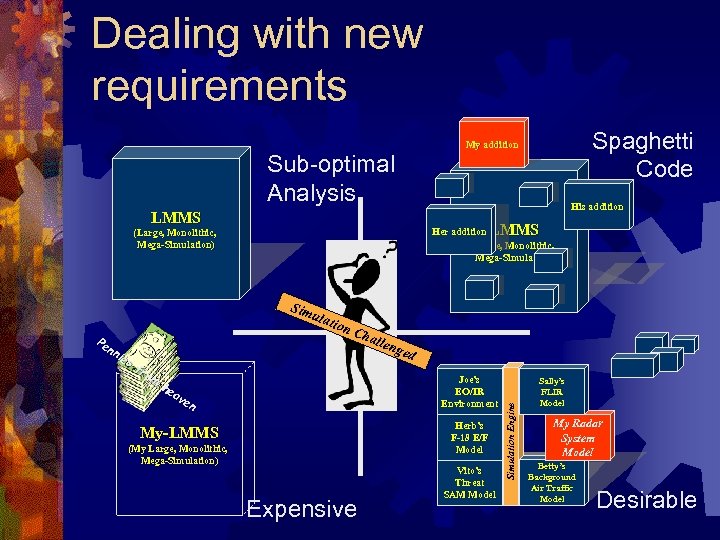 Dealing with new requirements Sub-optimal Analysis His addition LMMS Her addition (Large, Monolithic, Mega-Simulation) latio fr om n. C hall eng e d he av en Joe’s EO/IR Environment My-LMMS Herb’s F-18 E/F Model (My Large, Monolithic, Mega-Simulation) Expensive Vito’s Threat SAM Model Simulation Engine Sim u Pe nn ies Spaghetti Code My addition Sally’s FLIR Model My Radar System Model Betty’s Background Air Traffic Model Desirable
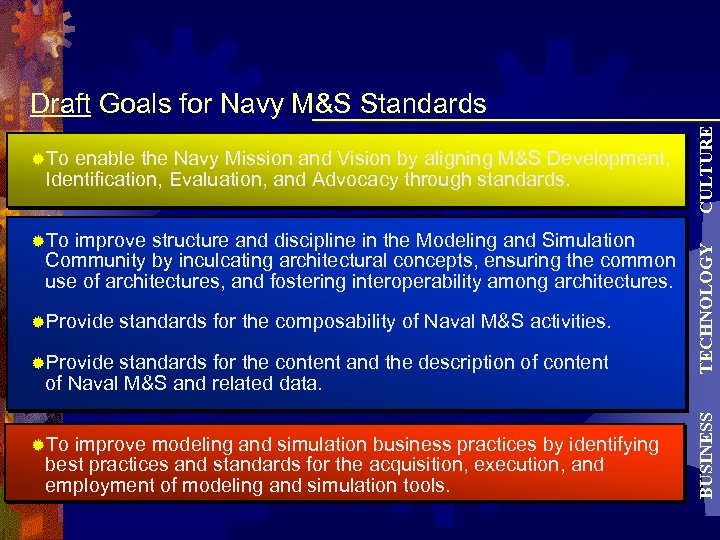 ®To improve structure and discipline in the Modeling and Simulation Community by inculcating architectural concepts, ensuring the common use of architectures, and fostering interoperability among architectures. ®Provide standards for the composability of Naval M&S activities. ®Provide standards for the content and the description of content of Naval M&S and related data. ®To improve modeling and simulation business practices by identifying best practices and standards for the acquisition, execution, and employment of modeling and simulation tools. TECHNOLOGY Identification, Evaluation, and Advocacy through standards. BUSINESS ®To enable the Navy Mission and Vision by aligning M&S Development, CULTURE Draft Goals for Navy M&S Standards
 T*E*A*M*S Torpedo Enterprise Advanced(ing) Modeling and Simulation Initiative
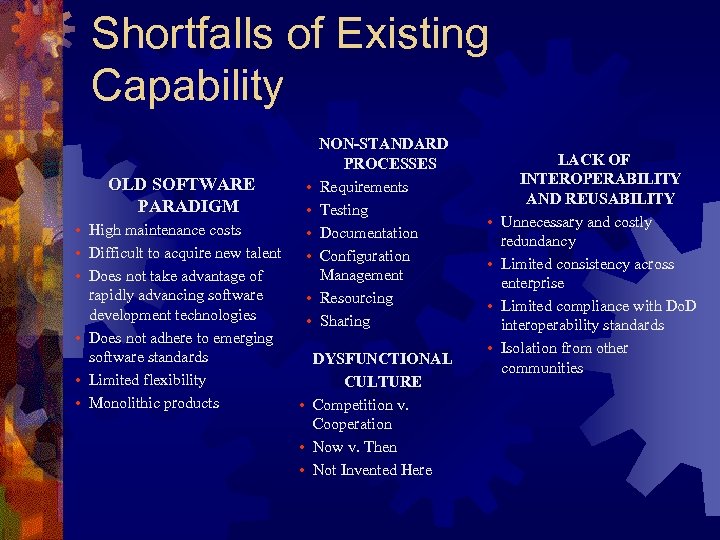 Shortfalls of Existing Capability OLD SOFTWARE PARADIGM • High maintenance costs • Difficult to acquire new talent • Does not take advantage of rapidly advancing software development technologies • Does not adhere to emerging software standards • Limited flexibility • Monolithic products • • • NON-STANDARD PROCESSES Requirements Testing Documentation Configuration Management Resourcing Sharing DYSFUNCTIONAL CULTURE • Competition v. Cooperation • Now v. Then • Not Invented Here • • LACK OF INTEROPERABILITY AND REUSABILITY Unnecessary and costly redundancy Limited consistency across enterprise Limited compliance with Do. D interoperability standards Isolation from other communities
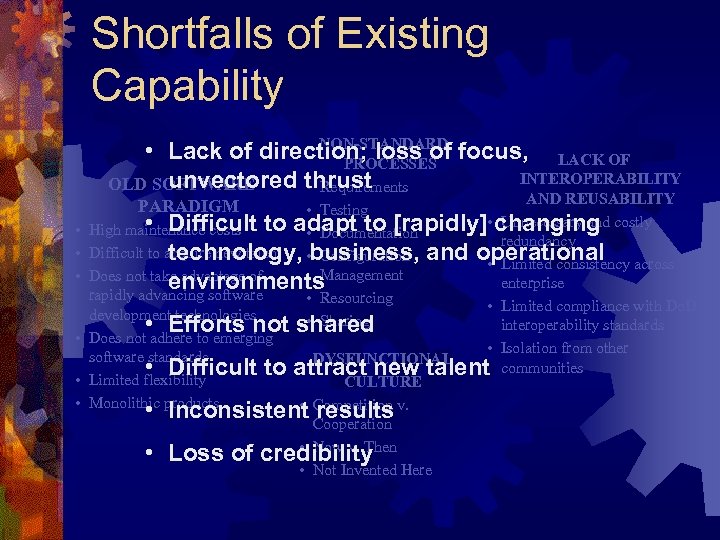 Shortfalls of Existing Capability NON-STANDARD • Lack of direction; loss of focus, LACK OF PROCESSES INTEROPERABILITY unvectored thrust OLD SOFTWARE • Requirements AND REUSABILITY • Testing • Unnecessary and costly • Difficult High maintenance costs to adapt to [rapidly] changing • Documentation redundancy Difficult to acquire new talent technology, • business, and operational across Configuration • Limited consistency Management Does not take advantage of enterprise environments rapidly advancing software • Resourcing • Limited compliance with Do. D development technologies interoperability standards • adhere to emerging shared Efforts not • Sharing Does not • Isolation from other software standards DYSFUNCTIONAL • Difficult to attract new talent communities Limited flexibility CULTURE Monolithic products • • Inconsistent Competition v. results Cooperation • Now v. Then • Loss of credibility • Not Invented Here PARADIGM • • •
 End States Analysts identify required components, assemble components into a requirement-specific simulation tool, document the tool’s configuration, and begin a study within 48 hours of initial tasking. ® A fully integrated team of [weapon enterprise] model developers, testers, users, and sponsors define M&S strategic goals, standards, and processes ® Component models developed for one program are “plug compatible” with models developed for other programs (I. e. pay once) ® ® ® Corollary: Modeling content built for one phase of weapon development is usable in all subsequent phases of weapon development Corollary: Technology, acquisition, operational, etc decisions are based on consistent model results Confidence in undersea weapon models is high because each component model is developed according to a standard specification (I. e. interface and structure), tested according to a standard process, and integrated into requirement-specific simulation tools according to standard practices. ® Content developers are free to focus on content and to innovate “on top of standards” unfettered by peripheral (I. e. non-content) concerns. ® A Modeling and Simulation Resource Repository (MSRR) compliant “card catalog” (meta-data) of undersea weapon models, environments, and threats is available to the entire weapons enterprise. ® Modeling and simulation is matter-of-fact. Focus is on putting better ordnance in the hands of the warfighter -- cheaper and faster.
 To Achieve the End States: ® Technology ® ® ® Standards / Formalisms ® ® Modeling content (quality, fidelity, critical mass) Simulation framework(s) Repository (card catalog model) – web, MSRR compliant Human-machine interface(s) Interoperability standards: common vocabulary (lexicon), grammar (syntax), world view (taxonomies, ontology), understanding (semantics) Process standards: common model development, VV&A and integration processes Documentation standards: common templates and documentation requirements Evolved Culture ® ® Enterprise-wide cooperation is the rule; competition is the (sometimes advantageous) exception Individual technical contributions are encouraged and efficiently managed
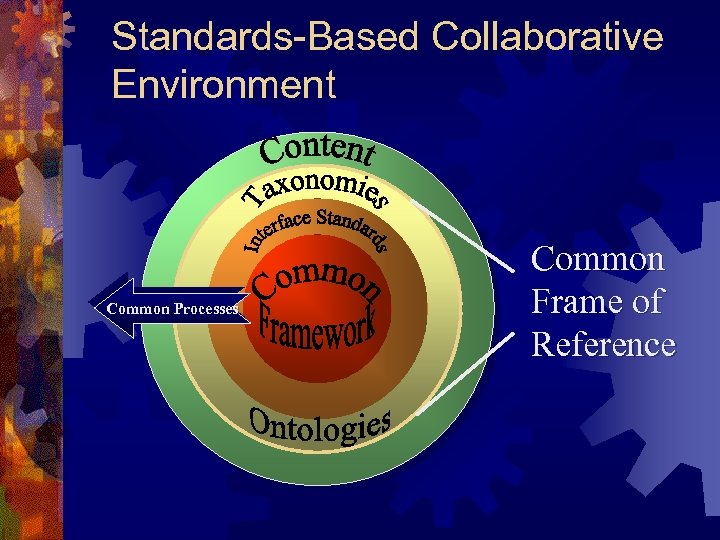 Standards-Based Collaborative Environment Common Processes Common Frame of Reference
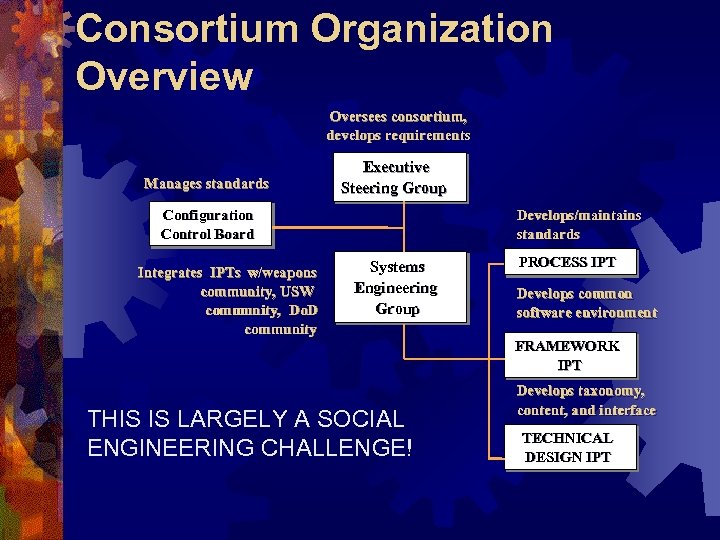 Consortium Organization Overview Oversees consortium, develops requirements Manages standards Executive Steering Group Configuration Control Board Integrates IPTs w/weapons community, USW community, Do. D community Develops/maintains standards Systems Engineering Group THIS IS LARGELY A SOCIAL ENGINEERING CHALLENGE! PROCESS IPT Develops common software environment FRAMEWORK IPT Develops taxonomy, content, and interface TECHNICAL DESIGN IPT
 “The woods are lovely, dark and deep. But I have promises to keep, And miles to go before I sleep. ” From Stopping By Woods on a Snowy Evening by Robert Frost
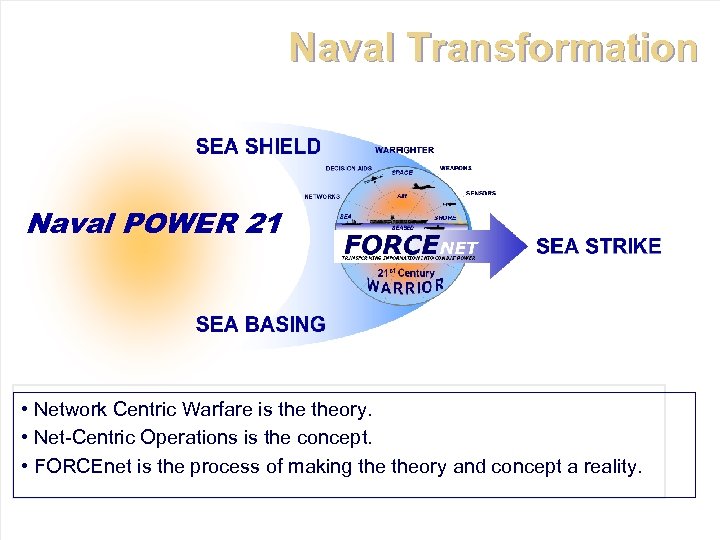 Naval Transformation Naval POWER 21 • Network Centric Warfare is theory. • Net-Centric Operations is the concept. • FORCEnet is the process of making theory and concept a reality.