


 Скачать презентацию IT Industry Trends Directions Presented to FEI
504ca5fa373327a2efeabd9cc133c285.ppt
- Количество слайдов: 28
 IT Industry Trends & Directions Presented to FEI Regina Chapter March 9, 2005 Brian Fergusson IBM Global Services
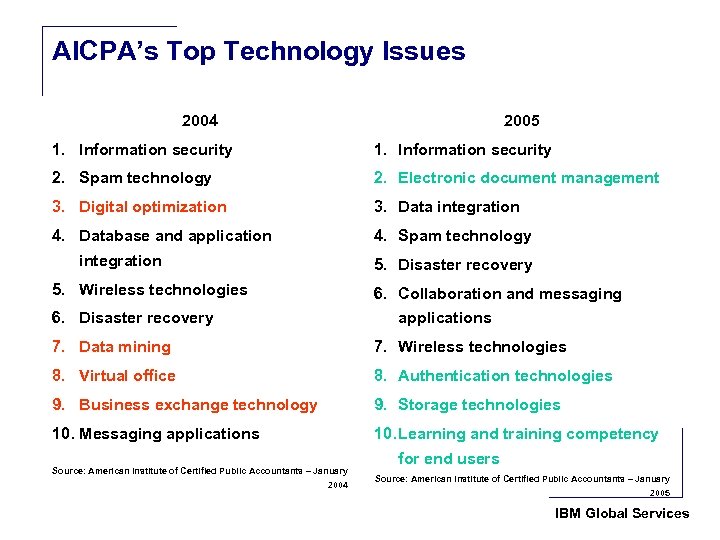 AICPA’s Top Technology Issues 2004 2005 1. Information security 2. Spam technology 2. Electronic document management 3. Digital optimization 3. Data integration 4. Database and application 4. Spam technology integration 5. Disaster recovery 5. Wireless technologies 6. Collaboration and messaging 6. Disaster recovery applications 7. Data mining 7. Wireless technologies 8. Virtual office 8. Authentication technologies 9. Business exchange technology 9. Storage technologies 10. Messaging applications 10. Learning and training competency Source: American Institute of Certified Public Accountants – January 2004 for end users Source: American Institute of Certified Public Accountants – January 2005 IBM Global Services
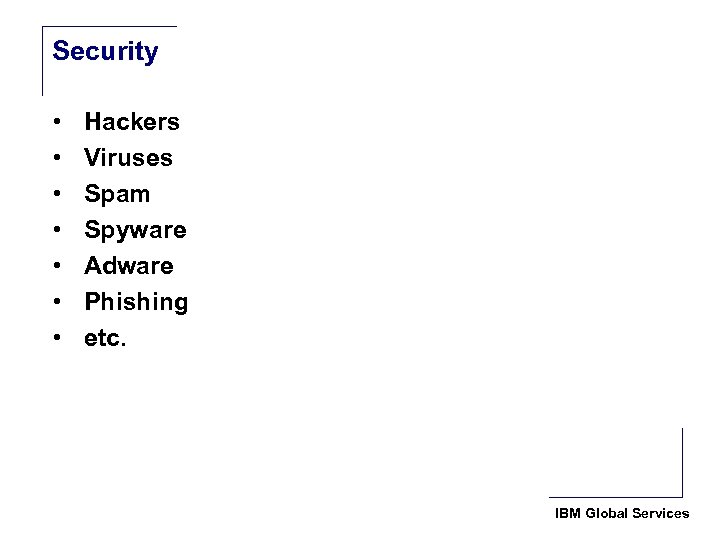 Security • • Hackers Viruses Spam Spyware Adware Phishing etc. IBM Global Services
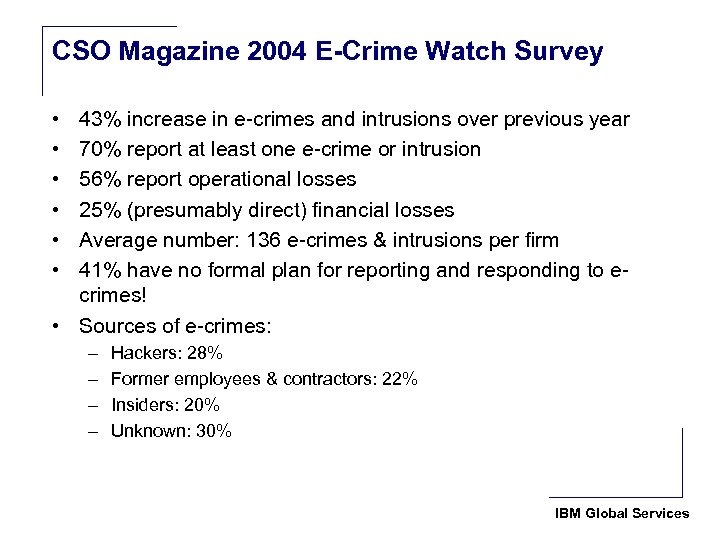 CSO Magazine 2004 E-Crime Watch Survey • • • 43% increase in e-crimes and intrusions over previous year 70% report at least one e-crime or intrusion 56% report operational losses 25% (presumably direct) financial losses Average number: 136 e-crimes & intrusions per firm 41% have no formal plan for reporting and responding to ecrimes! • Sources of e-crimes: – – Hackers: 28% Former employees & contractors: 22% Insiders: 20% Unknown: 30% IBM Global Services
 Viral Infection Rates • According to Computer Economics, 99 percent of companies surveyed have some kind of antivirus protection installed. • 76 percent admit having been infected by a virus in the last year and over 50 percent reported having suffered a massive virus attack. • Why? ? – Workstations and servers are covered, but not all companies have protection for Internet and mail gateway servers. – Antivirus settings often inadequate to face latest Internet-borne threats, such as resident protection disabled in desktops, outdated versions of the antivirus, slack signature file update policy and no proper gateway content filtering policy. – Groups of users to which antivirus policy is not applied, either because they are remote users, groups of administrators or simply because there is no policy. Source: Panda Software - 2004 IBM Global Services
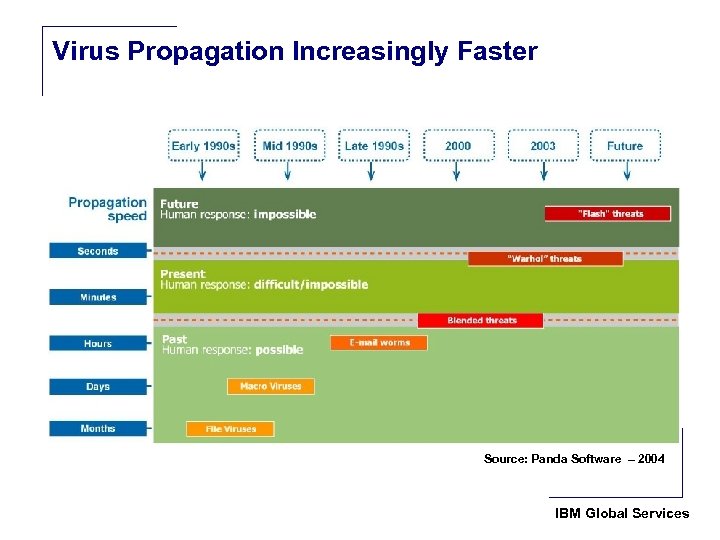 Virus Propagation Increasingly Faster Source: Panda Software – 2004 IBM Global Services
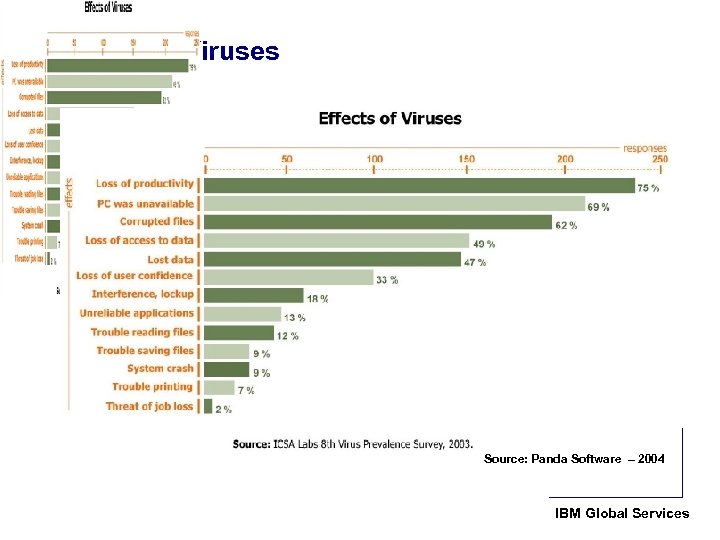 Effects of Viruses Source: Panda Software – 2004 IBM Global Services
 Virus Attacks • According to Yankee Group, 80% of companies were hit by a virus or worm during 2003. • According to the latest ICSA survey (ICSA Virus Prevalence Survey) 28% of large organizations with more than 500 PCs have been affected by some kind of computer virus attack, resulting in significant damage and financial costs. • The result of sector studies show that computer virus attacks cost companies worldwide US$13 billion dollars in 2001. This figure grew to US$30 billion dollars in 2002, and in 2003, the IT consultancy M 12 G put this cost to companies and home users at US$73 billion dollars. Source: Panda Software – 2004 • Average unprotected PC running Windows will be infected and/or hacked within 12 minutes of being connected to Internet Source: Computeractive – January 2005 IBM Global Services
 More Virus Attacks • 4, 496 new viruses and worms identified in 1 H 2004 by Symantec – more than 4 x comparable period previous year • Aug. 20, 2003 - CSX Railroad – 2% of company PCs infected – enough to bring network to standstill – Forced to delay several trains as a result • ROI on stopping viruses: >2, 000% Source: Baseline Magazine – February 2005 IBM Global Services
 Spyware • Spy. Audit report conducted by ISP Earthlink and Webroot Software performed 2. 07 million scans in the first six months of 2004, finding 332, 809 system monitors and 366, 961 Trojan horses. • Survey of 600 North American businesses by IDC, spyware was ranked as the fourth greatest threat – ahead of spam, hackers and cyberterrorism. The only areas viewed as bigger threats than spyware were viruses, Internet worms and damage through employee errors. Source: Sophos Pk. - 2005 IBM Global Services
 Spam • Nucleus Research conducted in-depth interviews with employees at 82 Fortune 500 companies, identified the following: – The average employee receives nearly 7500 spam messages per year, up from 3500 in 2003. – Average lost productivity per year, per employee, is 3. 1%, up from 1. 4% in 2003. Source: Sophos Pk. – 2005 • ROI on stopping spam: >74% Source: Baseline Magazine – February 2005 IBM Global Services
 Phishing • “International electronic crime of choice” • Fake e-mail messages that ask recipients to enter personal information (e. g. bank account numbers, PINs, credit card numbers, etc. ) • Typical attack duration less than one week • Many fake Web sites online for 2 or 3 days • Most activity in first 24 hours • Anti-Phishing Working Group: – January 2003: 176 unique attacks – December 2004: > 1, 700 unique attacks Source: e. Week – March 2005 IBM Global Services
 Languages / Programming (2004) • • J 2 EE, Unix and Windows will dominate XML emerging as language of choice and foreseeable future Companies demanding open platform development Platform technologies being transformed to embrace Service Oriented Architecture (SOA) • SOA will become architectural model for all J 2 EE application server providers • Common SOA framework components will become standardized – driving a more robust third-party component marketplace Source: Darwin Magazine – December 2003 IBM Global Services
 Gartner – All Roads Lead to SOA • Most companies will adopt SOA frameworks by 2007 • Other key elements – – – – Virtualization IP network convergence Outsourcing Wireless broadband Policy-based automation RFID Mobile device advances • Massive vendor consolidation inevitable – at least 1/2 will be acquired or go out of business Source: ZDNet – October 2004 IBM Global Services
 Service Oriented Architecture • More flexible, adaptive business processes • Multi-tiered, component-based environment that improves processes • Build applications in radically less time (e. g. 90% less) • IT can adapt as quickly as business changes processes Source: intelligent enterprise – February 2005 • Build and integrate IT infrastructure and applications at lower cost and greater certainty of successful deployment Source: ZDNet – August 2004 • Industry standard framework that is interchangeable, adaptive and flexible, but most importantly is closely linked to the business • Abstracts process from underlying application and systems Source: ZDNet – January 2005 IBM Global Services
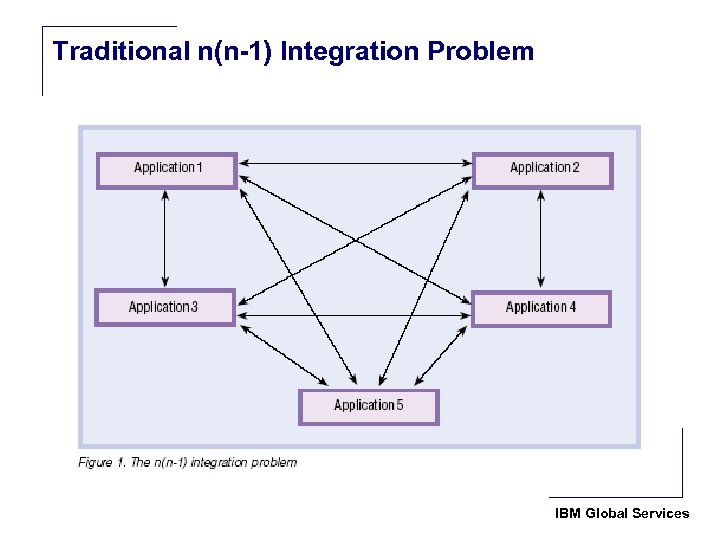 Traditional n(n-1) Integration Problem IBM Global Services
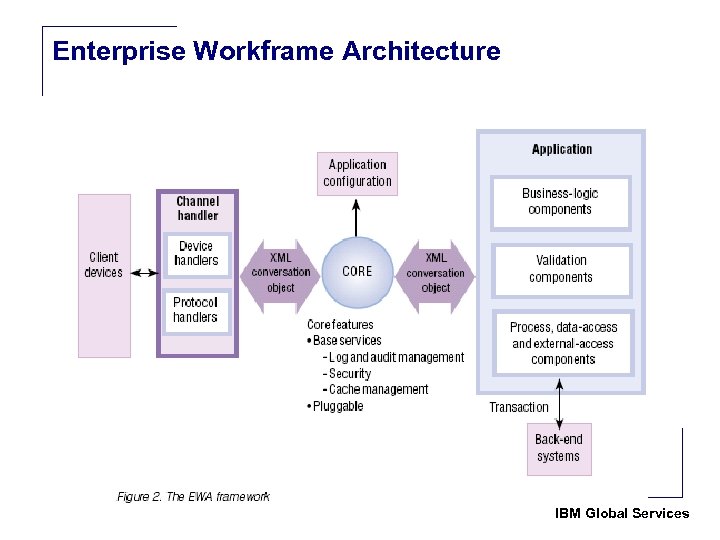 Enterprise Workframe Architecture IBM Global Services
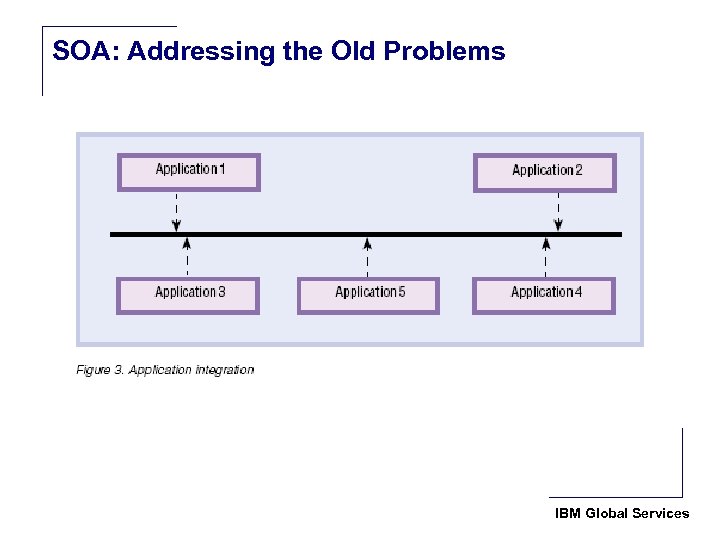 SOA: Addressing the Old Problems IBM Global Services
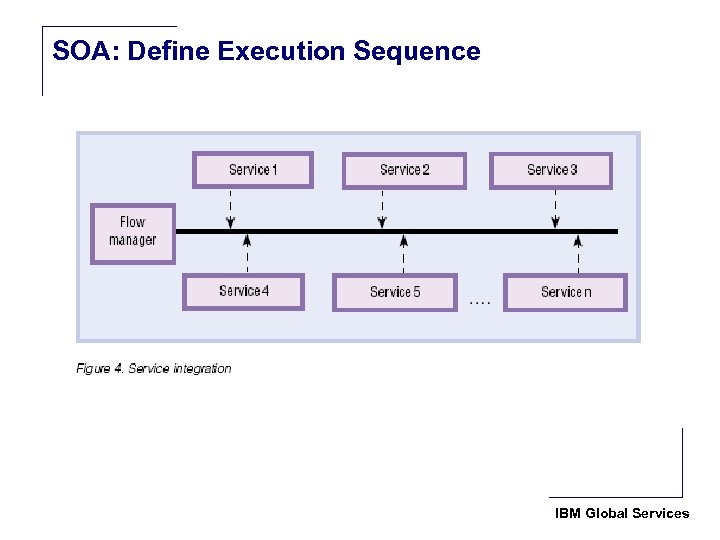 SOA: Define Execution Sequence IBM Global Services
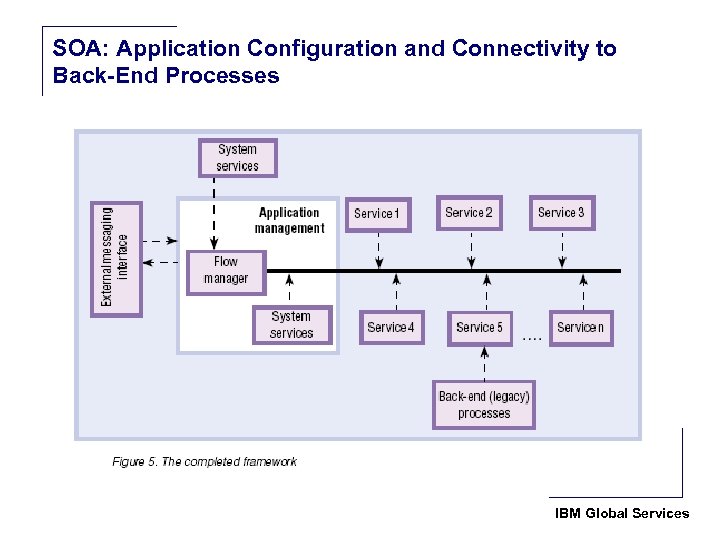 SOA: Application Configuration and Connectivity to Back-End Processes IBM Global Services
 Virtualization (2004) • Multiple virtual machines on hardware • Improve utilization • Moving from mainframe environments to UNIX and Intel platforms • Legacy systems expected to be overtaken by Intel in 3 -5 years • Linux as an application server will do to Windows what Windows did to UNIX – market growing 60% YOY • Key element in data centre provisioning, service delivery and cost-effective consolidation • By 2005, >20% of high-end Intel market will be exploiting virtualization for production applications Source: META Group – February 2004 IBM Global Services
 Virtualization • Companies failing to leverage virtualization will pay more – up to 40% more to acquire by 2008 – 20% more in administration Source: ZDNet – October 2004 • Gartner predicts 40% of PCs shipped in 2008 will include virtualization technology Source: Baseline – February 2005 IBM Global Services
 IP Telephony (2004) • Moving toward mainstream use, but not until 2006 • Applications include IP-based conferencing, call centers and integrated collaboration suites including videoconferencing • Cost savings an important element • Most organizations waiting for replacement cycles for current digital and analog phone systems Source: Gartner – April 2004 • 1/3 of ZDNet survey respondents indicated their organizations have “paved the way” for Vo. IP Source: ZDNet Survey – April 2004 IBM Global Services
 IP Network Convergence • META Group finds users considering IP telephony 90% of the time • IPT market growth accelerated in 2004, with IP phone shipments numbering in the millions • By 2010 – 40% of companies completely converged voice and data onto single network – >95% will have started convergence – 80% will have integrated communications (voice, instant messaging, e-mail • Vo. IP will cannibalize local and long distance revenue • Risk of single point of failure – Shadow legacy networks likely to remain unless resolved Source: ZDNet – October 2004 IBM Global Services
 Wireless Local Area Networks (2004) • Security concerns alleviated by Wi-Fi Protected Access (WPA) protocol • Seen as viable alternative to wired connectivity Source: Gartner – April 2004 • Wi-FI hotspots expected to increase 70% in 2004 • Increase in Wi-Fi enabled devices and Wi-Fi hotspots as well as growth in subscribers will re-ignite interest in Internet advertising • Growth in technologies for targeted one-on-one marketing • Investments in wired infrastructure will slow corporate adoption Source: Darwin Magazine – December 2003 IBM Global Services
 Wireless and Broadband • 65% of enterprises to install some form of wireless application by 2007 • META expects mainstream deployments based on major platforms (Java, . Net and SAP) Source: ZDNet – September 2004 • Technologies standard components around 2006 or 2007 • Wi. Max (IEEE 802. 16) with wireless range of 50 Km should “gain traction” around 2007 Source: ZDNet – October 2004 IBM Global Services
 IT Trends & Directions - 2005 Questions? Comments? IBM Global Services
 IBM Global Services